Research Project Milestones: Complete Guide
By Dr. Zubair Khalid, DVM, MS, PhD ·

Research project milestones are fixed checkpoints that mark the completion of a major phase of work, each tied to a dated deliverable and a measurable completion criterion. They turn a long, uncertain research effort into a sequence of verifiable stages that funders, supervisors, and team members can track, and nearly every large research program in the published literature describes its progress this way.
This guide explains what research project milestones are, how they differ from tasks and deliverables, how they work in practice across real research programs, and how to build them into a research project plan you can actually manage.
What Are Research Project Milestones?
A milestone is a point in time, not a stretch of work. It answers one question at one moment: did a defined piece of the project reach its completion criterion by the planned date? A task is the work itself, such as recruiting participants or calibrating an instrument. A deliverable is the tangible output, such as a validated dataset or a submitted manuscript. The milestone is the dated checkpoint at which you confirm that the deliverable meets its acceptance criteria.
The concept applies at every scale. A single doctoral thesis has milestones such as candidacy examination, comprehensive review approval, and final defense. A multinational collaboration reports milestones across years of activity. The International Network for Cross-Linguistic Research on Brain Health (Include), for example, summarized the key milestones achieved during its first four years, spanning cross-linguistic empirical studies, harmonized data-governance frameworks, and global dissemination efforts [1].
Three properties separate a true milestone from a vague intention:
- A fixed date or date range. "By month 18 of the award" or "by the end of Q2."
- A defined deliverable. Something concrete that exists when the milestone is reached, such as a completed protocol, an enrolled cohort, or a validated index.
- An acceptance criterion. A standard the deliverable must meet. In the Reuma-EPA project, which developed and validated entrustable professional activities for rheumatology training in Brazil, consensus during the national validation phase was defined as at least 80 percent of responses rated 4 or 5 on a five-point Likert scale. That numeric threshold is exactly what made each validation milestone checkable [2].
When people search for "what is research project milestones" or want research project milestones explained, the honest answer is that the term covers both a planning device and a reporting device. In planning, milestones structure the timeline before work begins. In reporting, they become the evidence of progress that funders and institutions review.
Why Milestones Matter in Research Project Management
Research differs from most other project environments because the outcome is uncertain by design. You cannot promise a discovery, but you can promise a sequence of verifiable steps. Milestones are how research project management handles that uncertainty. They create accountability for process when accountability for results is impossible to guarantee.
The published literature shows several distinct functions that milestones perform.
They make progress visible and auditable. The National Tuberculosis Indicators Project (NTIP) in the United States is a secure, web-based monitoring system that uses routinely collected surveillance data on individual tuberculosis cases to measure program performance and track progress toward national objectives, with data reported yearly and updated frequently [3]. The same principle applies to a single lab project. A tracking system built on milestone dates lets a principal investigator see at a glance which phases are on schedule.
They anchor ongoing engagement. A study of clinical nurses in a tertiary teaching hospital in eastern China tested whether sustained, multicomponent, project-embedded support changed research literacy and engagement. The intervention combined structured research activities, an ongoing research clinic, project tracking, and individualized support. In adjusted analysis, all four core outcomes, including functional, interactive, and critical research literacy and research translation capability, improved. The project tracking component was part of a structure that kept participants moving through defined research activities rather than drifting after a one-off training [4]. Milestones served as the skeleton of that support.
They let projects demonstrate cumulative achievement. Large programs publish their milestones as a record of what was accomplished and when. The Australian MRI Linear Accelerator program, a major effort to build and test a unique MRI linac prototype for cancer treatment, summarized its development and achievements explicitly as an example of a successful large-scale research project. The program obtained over 27 million dollars from competitive sources, published over 120 papers, and supported 25 PhD completions [5]. Those are milestone-level outcomes, and reporting them as such made the program's value legible to funders and reviewers.
They create measurable policy and funding inflection points. A longitudinal study of Canadian Institutes of Health Research funding for women-focused cardiovascular research used policy implementation milestones, mandatory application-level requirements in 2010 and grant criteria assessed by reviewers in 2018, as interruption points in a segmented regression analysis covering fiscal years 2000 to 2024 across 17,168 grant records [6]. In that analysis, the milestones themselves were the analytical landmarks around which change was measured.
The Core Milestone Framework for a Research Project
Most research projects, from a semester lab rotation to a multi-institution consortium, pass through the same sequence of phases. The framework below adapts that sequence into eight standard milestones. Adjust the count to your project, but keep the properties of date, deliverable, and acceptance criterion intact.
Milestone 1. Concept and Feasibility Approved
The project idea has been examined against existing literature, available resources, and the skills of the team. The deliverable is a short concept document stating the question, the rationale, and the feasibility assessment. The acceptance criterion is approval from a supervisor, department, or internal review panel.
Feasibility review at this stage prevents the most expensive category of research failure, starting a project the team cannot finish. In a qualitative study of a 12-month research internship program for health and care practitioners in north west England, one recurring theme was clarifying expectations, and interns described discovering purpose from initial uncertainty before negotiating commitment and researcher identity [7]. Early clarity about scope is what makes later milestones achievable.
Milestone 2. Proposal and Funding Secured
The full proposal, with budget, timeline, and milestone schedule, has been submitted and accepted. For students this may mean a thesis proposal defense. For established researchers it means a grant award. The acceptance criterion is a signed or issued award document, not the submission itself. Writing the milestone schedule into the proposal matters because reviewers evaluate whether the plan is realistic, and the schedule becomes the reference against which later progress reports are judged.
Milestone 3. Protocol Finalized and Approvals Obtained
The detailed protocol, including sampling plan, methods, statistical analysis plan, and data management procedures, is complete. For human or animal research, this milestone includes ethics or institutional review board approval. The deliverable is the approved protocol document with its approval number. No milestone in this framework should be considered reached until every regulatory precondition is documented, because protocol amendments after launch consume time that the rest of the schedule does not have.
Milestone 4. Setup Complete and Recruitment Open
Equipment is installed and validated, databases and case report forms are built, staff are trained, and recruitment has begun. The acceptance criterion differs by study type. For a clinical cohort it may be a fixed enrollment target reached by a target date. For a bench project it may be a validated assay producing acceptable control values across several runs.
Milestone 5. Data Collection Target Reached
The planned volume of data has been collected within quality tolerances. Quality criteria deserve their own acceptance standards. In the CLARION study, a non-interventional cohort safety study of cladribine tablets that combined data from multiple sclerosis registries, 28 harmonized data quality indicators were defined with the participating sources and used to assess consistency, accuracy, completeness, and study representativeness under the European Medicines Agency Data Quality Framework, drawing on data from 5,069 patients across eight registries and 14 countries [8]. The lesson generalizes. Define your data quality indicators before collection starts, and make meeting them an explicit part of the milestone rather than a cleanup task afterward.
Milestone 6. Analysis Complete
The primary analysis has been run per the pre-specified plan, results tables are locked, and interpretation has been reviewed by the team. The acceptance criterion is a frozen analysis dataset and a results document that a colleague could reproduce.
Milestone 7. Dissemination Achieved
The manuscript is submitted, the thesis is deposited, the dataset is deposited, or the report is delivered to the funder. Dissemination deserves milestone status because unfinished projects so often stall here. The Australian MRI linac program's record of over 120 published papers [5] reflects dissemination treated as a series of deliberate, tracked outputs rather than an afterthought.
Milestone 8. Closeout and Evaluation
The project formally ends. The deliverable is a closeout report comparing planned versus actual milestones, documenting lessons learned, archiving data, and completing financial reconciliation. Evaluation-focused programs institutionalize this step. The Lancet Countdown, an international multidisciplinary collaboration tracking progress on health and climate change, is structured to report annually on a series of indicators across five thematic working groups, making recurring evaluation itself a milestone-driven activity [9].
Summary Table
| Milestone | Deliverable | Acceptance criterion (example) | Typical failure mode |
|---|---|---|---|
| 1. Concept approved | Concept document | Supervisor or panel sign-off | Scope grows before it is written down |
| 2. Funding secured | Signed award or approved proposal | Award issued, not merely submitted | Budget omits analysis and dissemination costs |
| 3. Protocol approved | Approved protocol with approval number | Regulatory approval documented | Amendments requested after launch |
| 4. Setup and recruitment open | Validated systems, first participants enrolled | Enrollment or assay validation targets met | Training gaps discovered mid-enrollment |
| 5. Data collection target | Complete dataset | Quality indicators within tolerance | Missing data found only at analysis |
| 6. Analysis complete | Frozen dataset and results document | Independent colleague can reproduce it | Unplanned exploratory analyses delay lock |
| 7. Dissemination | Submitted manuscript or deposited outputs | Submission or deposit confirmed | Writing waits for "free time" that never comes |
| 8. Closeout | Closeout and lessons-learned report | Funder and archive requirements met | Records scattered when the team disperses |
Research Project Milestones Examples From Real Programs
Abstract frameworks become concrete when you see how real research programs defined and used their milestones. The following examples, research project milestones examples drawn directly from the published record, show the range of scales and structures.
A Hardware and Clinical Research Program
The Australian MRI linac program aimed to build and test a unique configuration combining a 1 T magnetic field with a 6 MV accelerator, with the beam delivered in line with the magnetic field and the patient placed across the field in the split between the two magnet halves. The program spanned six Australian universities and international collaborators, organized its work into broad research domains of personalized disease targeting, medical device innovation, and biodiscovery, and ran specific projects including artificial intelligence image enhancement, radiation dosimetry in high magnetic fields, MRI characterization of cancer heterogeneity, and animal and human studies [5]. The published report presents the program's development and achievements as a sequence of milestones, from early concept through prototype construction to clinical and preclinical studies, which is precisely how a hardware-heavy research program must be managed. Each subsystem, the magnet, the accelerator, the beam delivery configuration, represented a checkpoint that had to be verified before the next phase could begin.
A Network Built Around Reported Milestones
The Include network was created to address the English-centric bias in speech and language measures used in brain health research. Its organizational report reviews the network's origins, mission, and structure, then summarizes key milestones achieved during its first four years, including cross-linguistic empirical studies, harmonized data-governance frameworks, and global dissemination efforts, before outlining flagship projects and remaining challenges such as language underrepresentation, tool harmonization, and regulatory heterogeneity [1]. Note the structure of that reporting. Milestones were grouped by function, empirical work, governance, and dissemination, rather than listed chronologically, which made the report useful both as accountability and as a map for new collaborators.
An Implementation Project With Named Milestones
The Veterans Health Administration implemented Care Coordination and Integrated Case Management, a standardized clinical practice framework assigning high-needs veterans a lead coordinator. A multi-methods project assessed implementation at six rural facilities participating in an Office of Rural Health Enterprise-Wide Initiative from October 2024 through September 2025. Implementation proceeded through five named milestones: Leadership Awareness, Facility Readiness, Preparing to Implement, Systems and Clinical Integration, and Establishment of a Governance Structure. All six sites achieved clinical integration, one site will not continue due to staffing constraints, and over 80 percent of veterans identified for care coordination needs were engaged [10]. This is one of the clearest published illustrations of milestones as a management sequence. Each named stage had to be completed before the next could proceed, and the evaluation structure, combining quantitative data with qualitative interviews, focus groups, and observations, was built directly on that sequence.
A Five-Phase Validation Project
The Reuma-EPA project, conducted by the Education Committee of the Brazilian Society of Rheumatology, used a five-phase methodological approach: identification of core professional activities, drafting of preliminary EPAs, internal expert review, internal consistency analysis, and national validation through a two-round Delphi process. Eleven EPAs were developed and validated covering the full spectrum of rheumatology practice [2]. The five phases map one-to-one onto milestones, and each had a checkable standard, culminating in the 80 percent consensus threshold. The design shows how to define acceptance criteria for milestone types that feel inherently qualitative, such as expert agreement.
A Quality Improvement Project Using Iterative Cycles
A quality improvement project in a newly established paediatric cardiac operating room used a stepwise Plan-Do-Study-Act methodology for each key performance indicator, including baseline data, interventions, and outcome analysis. Root cause analysis with Fishbone and 5 Whys identified gaps. Weekly performance was tracked on a spreadsheet with messaging updates, while control charts and feedback sessions ensured progress. First case on-time start compliance improved from 50 percent to 91 percent, mean turnover time decreased from 34 to 27 minutes, and the case cancellation rate dropped from 30 percent to 7 percent [11]. The Plan-Do-Study-Act cycle is itself a miniature milestone system. Each rotation through plan, do, study, and act closes with a studied result, and the control charts made every checkpoint objectively verifiable.
Disciplinary Development Milestones
Milestones also operate at the scale of an entire field. A review of clinical pharmacology in China sorted domestic disciplinary milestones across three phases of development after 1979, tracked investigational new drug applications rising from 446 in 2012 to 3,516 in 2025, and noted that the National Natural Science Foundation set up an independent clinical pharmacology discipline classification in 2015 [12]. Similarly, a narrative review of point-of-care ultrasound training in critical care traced key milestones in training development, from informal apprenticeship and short workshops through longitudinal programs, society guidelines, and recent innovations including simulation and artificial intelligence-assisted training [13]. In both cases, milestones function as the periodization of a field, the agreed dates at which something changed state.
How Research Evolution Is Mapped Milestone by Milestone
Bibliometric studies reconstruct milestones from the publication record. A bibliometric and visualization analysis of intracorporeal urinary diversion during robot-assisted radical cystectomy mapped the knowledge landscape using 250 records from the Web of Science Core Collection, showing annual publications rising from 2 in 2010 to 34 in 2025 with a peak of 36 in 2021, and characterized publication patterns, collaborative structure, and temporal changes in keyword-based research themes [14]. When a new technique is described as "an important technical milestone in the transition" toward a fully minimally invasive pathway, as that study describes intracorporeal urinary diversion, the word milestone carries the same meaning it carries in project management, a recognizable state change in an ongoing sequence.
Building Your Research Project Plan Template
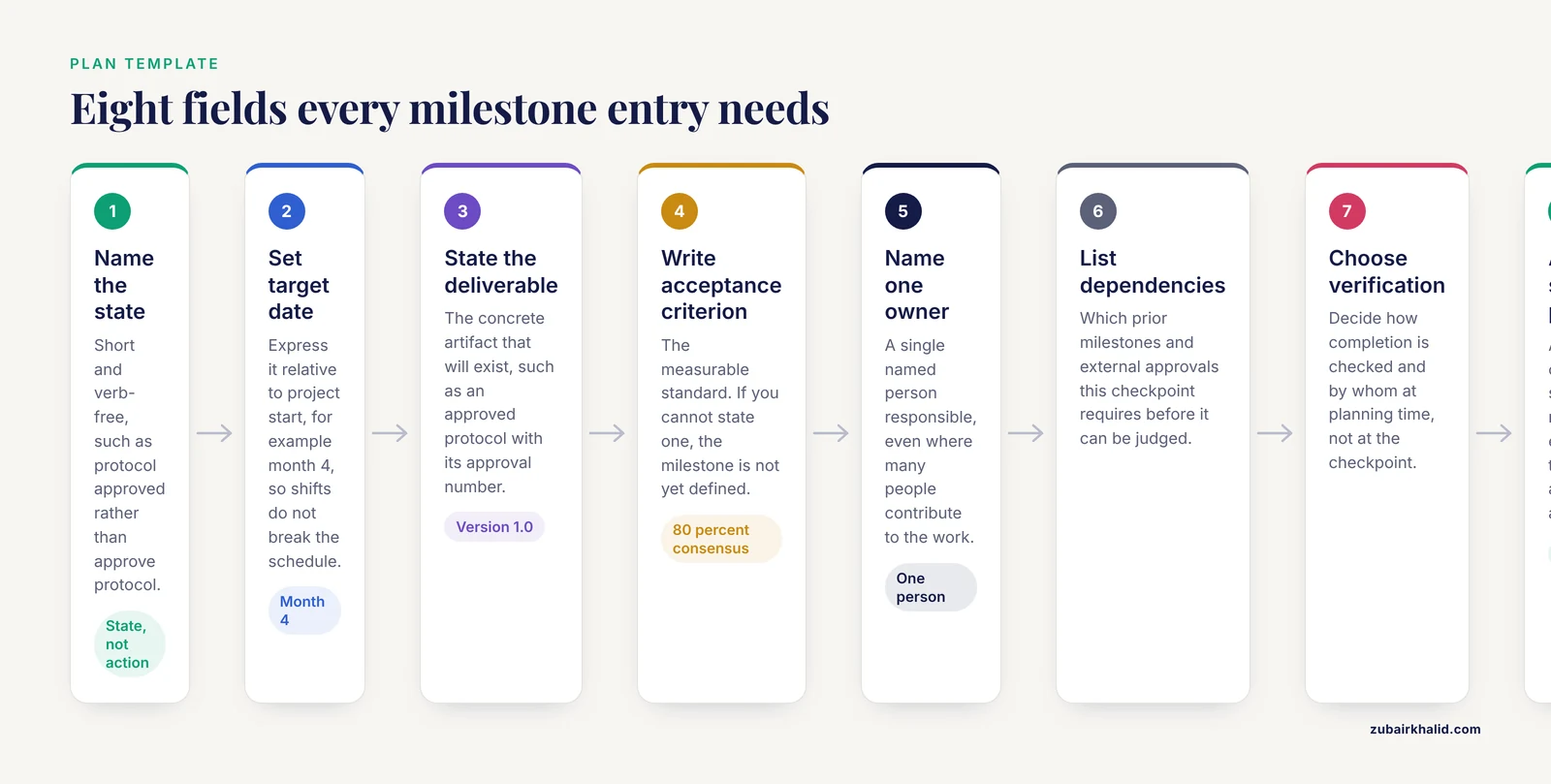
A research project plan template is most useful when it forces you to state each milestone with the same three fields, date, deliverable, and acceptance criterion. Below is a reusable structure you can copy into any planning document. Fill it in with a numbered list, one block per milestone.
1. Milestone name. Short and verb-free, since the milestone is a state, not an action. "Protocol approved," not "Approve protocol."
2. Target date. Express it relative to project start, for example month 4, so the schedule survives shifts in the absolute start date.
3. Deliverable. The artifact that will exist. Be concrete. "Approved protocol, version 1.0, with IRB approval number" beats "protocol done."
4. Acceptance criterion. The measurable standard. If you cannot state one, the milestone is not yet defined. The Reuma-EPA project's 80 percent consensus rule [2] and the CLARION study's 28 defined data quality indicators [8] are both models of this discipline.
5. Owner. One named person responsible, even in a team where many people contribute.
6. Dependencies. Which prior milestones and external approvals this one requires.
7. Verification method. How completion will be checked and by whom. The VHA implementation project paired its five milestones with quantitative and qualitative evaluation methods [10]. Decide your verification method at planning time, not at the checkpoint.
8. Slippage plan. What happens if the date passes without the criterion met. A one-line contingency, such as an alternate supplier, a reduced enrollment target, or a scope reduction agreed in advance, turns a crisis into a decision.
Two practical extensions strengthen any template. First, add a monitoring rhythm. Set a recurring interval, weekly for a small project or monthly for a large one, at which every active milestone is reviewed. The operating room quality improvement project tracked weekly performance on a spreadsheet with messaging updates and feedback sessions, and leadership maintained accountability [11]. Second, for longitudinal studies, add interim reporting milestones. The Performance Monitoring for Action Ethiopia cohort enrolled pregnant women at baseline and collected data again at six weeks postpartum, generating follow-up analyses of intimate partner violence during the index pregnancy and its correlates from the merged baseline and postpartum data [15]. Interim contact points are milestones because missing them destroys the analysis plan that depends on the follow-up.
Tracking and Monitoring Milestones in Practice
Tracking is where research project management either succeeds or quietly decays. Three principles recur in the programs that do it well.
Use a single, shared tracking system. NTIP demonstrates the value of a centralized, web-based monitoring system fed by routinely collected data, updated frequently, and used to prioritize improvement efforts [3]. Your version can be a shared spreadsheet, a laboratory information management system, or a project management tool. The requirement is that one system holds the current status of every milestone, visible to everyone with a stake.
Tie indicators to milestones. The Lancet Countdown is organized into five thematic working groups that provide indicators for a global overview of health and climate change, with annual reporting [9]. The design lesson is that indicators should map onto milestone domains, so that when a checkpoint arrives, the numbers that decide it are already being collected routinely rather than assembled retroactively.
Embed support around the tracking. Tracking alone does not move projects. The nurse research study paired project tracking with an ongoing research clinic and individualized support, and objective project progression was described alongside the outcome measures [4]. A milestone review that only records failure is a demoralizing meeting. A milestone review connected to concrete help, methodological consultation, protected time, or mentoring, changes the trajectory of the next phase.
Evaluate structure and process, not just outcomes. The VHA rural implementation project used structure and process evaluation alongside outcome measures, analyzing transcripts with rapid matrix content analysis supported by human review [10]. Milestone tracking that captures only "done or not done" misses the information that lets you fix a struggling phase. Record how the work proceeded, not only whether it finished.
Common Mistakes and Limitations
Confusing tasks with milestones. "Collect samples" is a task. "Cohort enrollment target of 200 participants reached with complete baseline records by month 10" is a milestone. Teams that plan in tasks lose the ability to report progress in language funders understand.
Writing milestones without acceptance criteria. A milestone with no measurable completion standard becomes a matter of opinion at the checkpoint. Every example program cited above paired milestones with explicit standards, from consensus percentages [2] to control chart targets [11].
Scheduling milestones as if nothing slips. Buffers exist for a reason. Plans that place every milestone end-to-end with no slack convert any single delay into cascading failure across the schedule.
Treating approvals as informal. Ethics approval, data use agreements, and material transfer agreements are gates. Starting work that depends on a pending approval is the most common way a well-planned timeline collapses in its first quarter.
Letting dissemination float. Analysis completes, energy drops, the manuscript drifts. Give submission a date and an acceptance criterion, as the MRI linac program's publication record implies [5].
Tracking without acting. A tracker updated quarterly and never discussed is decoration. The effective tracking systems in the literature update frequently and feed directly into prioritized improvement efforts [3].
Ignoring the human side. Research capacity builds through identity and support, not schedules alone. The internship study found that participants moved from initial uncertainty through negotiating commitment and researcher identity to establishing a sense of research legitimacy, with support structures and clarifying expectations among the operative subthemes [7]. A milestone plan that ignores who does the work and what support they have is incomplete.
One general limitation applies to this entire guide. Published project reports describe what worked and, less often, what did not, so any template built from the literature inherits that reporting bias. Adapt the framework to your own constraints, and expect to revise your milestone schedule after the first real slippage reveals where your estimates were optimistic.
Frequently Asked Questions
What is research project milestones?
Research project milestones are dated checkpoints that mark the completion of a major project phase, each defined by a deliverable and a measurable acceptance criterion. They exist so that progress on an inherently uncertain endeavor can be verified at fixed points rather than judged only at the end.
What are some research project milestones examples?
Common examples include concept approval, proposal and funding secured, protocol approved by an ethics committee, recruitment target reached, data collection complete within quality standards, analysis locked, manuscript submitted, and project closeout. Real programs provide larger-scale examples, such as the five implementation milestones used across six rural VHA facilities [10] and the five-phase validation sequence of the Reuma-EPA project [2].
What is the difference between a milestone, a task, and a deliverable?
A task is work performed over time, a deliverable is the artifact that work produces, and a milestone is the dated checkpoint at which you verify the deliverable meets its criterion. A milestone is a moment, the other two are things and activities.
How many milestones should a research project have?
Enough to cover every phase where failure would be expensive, and no more. Small projects work well with five to eight milestones across the full arc from concept to closeout. Very large programs may track dozens, organized by work stream, as the MRI linac program did across its research domains [5].
How do milestones fit into research project management?
Milestones are the skeleton of research project management. Around them you schedule tasks, allocate budget, assign owners, and run monitoring. Effective systems, like the web-based National Tuberculosis Indicators Project, update tracking frequently and use the results to prioritize improvement efforts [3].
What should a research project plan template include?
Include, for each milestone, a name, a target date relative to project start, a concrete deliverable, a measurable acceptance criterion, a named owner, dependencies, a verification method, and a slippage plan. Add a defined review rhythm and, for cohort studies, interim follow-up milestones.
What happens if a milestone is missed?
A missed milestone triggers the slippage plan you wrote in advance, followed by an assessment of whether the delay shifts dependent milestones and whether scope, resources, or the timeline itself must change. Missed milestones are information about the plan, and programs that treat them that way, as NTIP did by using indicator data to formulate plans for improvement [3], recover faster than programs that treat them as blame events.
How do I write milestones in a grant proposal?
Write each milestone with its target month, deliverable, and acceptance criterion, and make sure the sequence is one a reviewer would judge feasible. Reviewers assess whether the timeline is realistic, and once the award is issued, that milestone schedule becomes the standard against which your progress reports are measured, much as policy milestones served as fixed reference points in the Canadian funding analysis [6].
Sources
- The include network: Advancing cross-linguistic equity in brain health research.
- Development and validation of entrustable professional activities (EPAs) for rheumatology training in Brazil: the Reuma-EPA project.
- Monitoring tuberculosis programs - National Tuberculosis Indicator Project, United States, 2002-2008.
- Research Literacy and Research Engagement Following Project-Embedded Support Among Clinical Nurses: An Exploratory Nonrandomised Controlled Study.
- A Review of the Australian MRI Linac Program: From Pie in the Sky to Research Milestone.
- Women-Focused and Sex/Gender-Related Cardiovascular Research Funding under Canada's Sex- and Gender-Based Analysis Policy from 2000 to 2024.
- Building Research Capacity in Health and Care Practitioners: Qualitative Insights From an Internship Program.
- Harmonized Data Quality Indicators Maintain Data Quality in Long-Term Safety Studies Using Multiple Sclerosis Registries/Data Sources: Experience from the CLARION Study.
- The Lancet Countdown: tracking progress on health and climate change.
- Five Milestones to Addressing Rural Veteran Care Coordination, Care Management, and Case Management Needs: An Integrated Case Management Practice Framework.
- A Plan-Do-Study-Act Cycle to Enhance Operational Efficiency in a Newly Established Paediatric Cardiac Operating Room.
- Clinical Pharmacology in China: Seven Decades of Progress in Discipline Development and Education.
- Narrative Review on History of Point-of-Care Ultrasound Training in Critical Care.
- Intracorporeal urinary diversion during robot-assisted radical cystectomy: a bibliometric and visualization analysis of research evolution, evidence landscape, learning curves, and clinical outcomes.
- Partner conflict during their index pregnancy and its correlates among a cohort of six weeks postpartum women in Ethiopia.