How to Run a Research Project Kickoff Meeting: Sample Agenda
By Dr. Zubair Khalid, DVM, MS, PhD ·
By the end of this guide you will be able to draft a research project kickoff meeting agenda, run the meeting from open to close, and leave with three concrete outputs: agreed roles, a shared timeline, and a written action log. You will also have a research project plan template you can fill in the same afternoon.
Before you start, have these on hand:
- The funded proposal or project brief, including aims and the budget period
- A list of every team member and external partner, with roles
- A shared calendar link for the meeting
- A blank document for minutes and an action log
- The research project plan template near the end of this article
A kickoff meeting is the single working session where a research team converts a funded proposal into a shared working plan. In research this session matters more than in most industries, because research teams routinely mix people who have never worked together, from bench scientists to clinicians to community partners, and the evidence from multi-stakeholder projects shows that early, transparent communication is one of the strongest predictors of later collaboration quality [1]. Projects that skip this step tend to rediscover the same problems months in, when the timeline is already slipping.
Why Research Kickoffs Fail Without an Agenda
Research projects carry specific risks that a generic business kickoff agenda does not address. Multidisciplinary and co-produced projects face epistemological, relational, and institutional challenges that experienced project leaders now plan for explicitly, using inclusive communication practices, deliberately chosen levels of co-production, and realistic timelines that expect delays [2]. Wet laboratory work adds another layer, because protocols, assay optimization, and regulatory approvals routinely extend timelines beyond what newcomers expect [3].
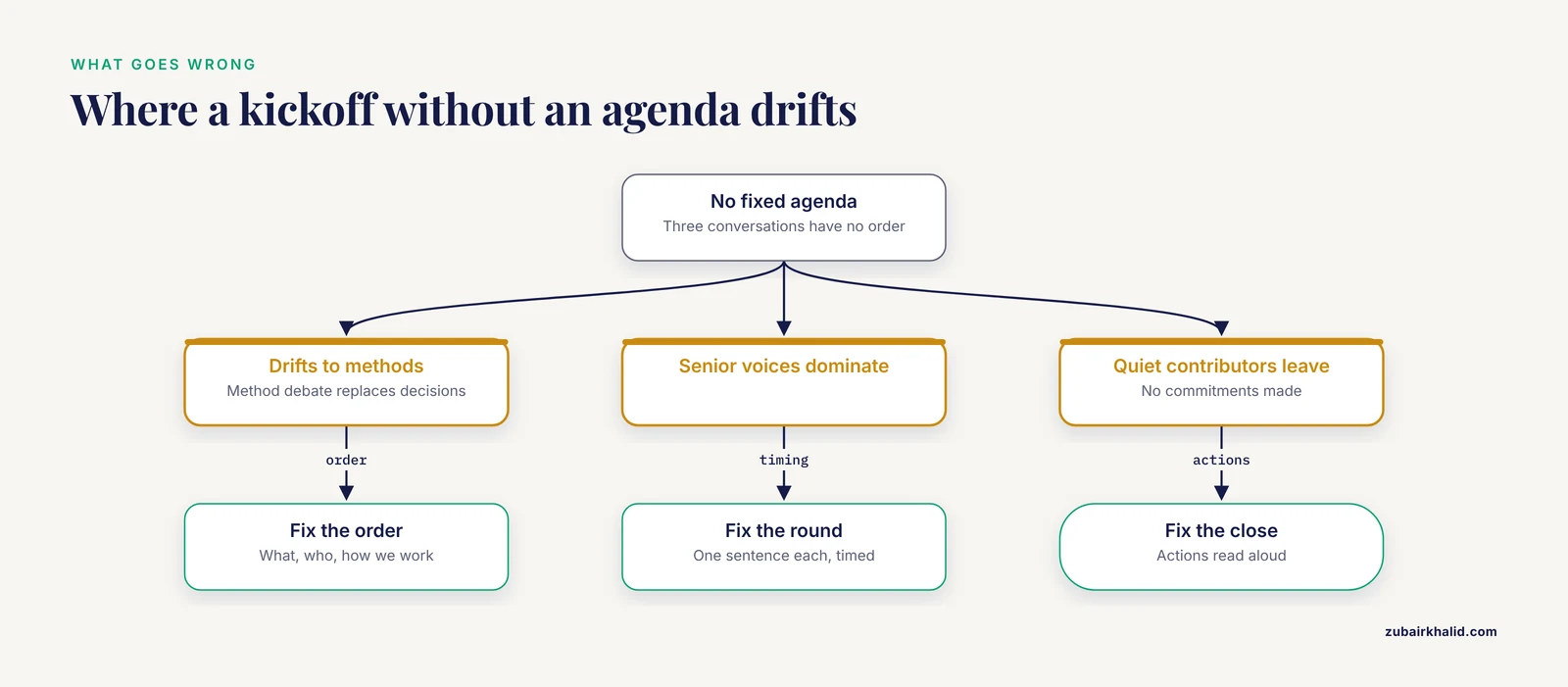
An agenda fixes this by forcing three conversations to happen in a fixed order: what the project is, who does what, and how we will work together. Without that order, kickoff meetings drift into method debates, senior voices dominate, and quieter contributors leave without commitments.
Before the Meeting: Five Preparation Steps
1. Define the decisions the meeting must produce
A kickoff meeting is not a briefing. It should end with decisions. Write down the three to five decisions you need, for example:
- Confirmed roles and a single point of contact per work package
- An agreed timeline with named milestones
- A communication rhythm (meeting cadence, channel, owner)
- Working agreements for how the team handles disagreements and absences
If a proposed agenda item does not feed one of these decisions, cut it or move it to a later meeting.
2. Map your stakeholders and their motivations
List every person and organization with a stake in the project, and write one sentence per stakeholder about what they want from the project. This is a core research project management skill, and it changes how you run the meeting. In community-based health promotion work, for example, mass media partners engaged most readily when the project offered them corporate social responsibility value and access to a large audience, so those motivations belonged in the kickoff conversation rather than in an email afterwards [4]. In cross-sector projects such as school meal programs, coordinated stakeholder capacity building during planning was identified as a condition for successful implementation, which means the kickoff is where you schedule that capacity building, not just mention it [5].
3. Decide the depth of participation before invitations go out
Not every project needs full co-production, and not every project can afford consultation-only engagement. Research on co-produced convergence research recommends selecting the style and depth of co-production intentionally, tailored to the communities involved, and equalizing power dynamics from the start [2]. Decide now, and put the decision on the agenda so everyone hears the same answer. If patients, citizens, or practitioners will act as co-researchers rather than subjects, the kickoff must give them real tasks and real influence, because accessible research tasks and visible use of contributions are what make participation meaningful in practice [1].
4. Draft the agenda and test it with two people
Send a draft agenda to one senior collaborator and one junior collaborator or partner before finalizing. This catches scope mismatches early. Large convenings use exactly this technique: the agenda for a multi-country HPV immunization symposium was developed through stakeholder interviews and prior advisory input, and participant polls then prioritized candidate themes for working groups [6]. You can run a miniature version with a two-person email review.
5. Handle logistics and accessibility in the invitation
Send the invitation at least two weeks ahead with the agenda, the pre-reads, and a line asking about any accommodations or scheduling constraints. Research teams that include peer researchers with lived experience emphasize respectful, open communication about needs, planned flexibility, and institutional support for accommodations, and these work best when arranged before the first meeting rather than improvised during it [7]. If students, older adults, or community members will join, remember that anticipated barriers include training needs and technical language, so plan plain-language materials and a short orientation slot [8].
The Sample Agenda: Time Allocation Table
This is a research project kickoff meeting agenda format that fits a 90-minute meeting with 5 to 12 participants. For larger or multi-institution projects, double items 3 and 4.
| # | Agenda item | Time | Led by | Output |
|---|---|---|---|---|
| 1 | Welcome, introductions, and motivations | 10 min | Project lead | Everyone knows who is present and why |
| 2 | Project purpose, scope, and success criteria | 10 min | Project lead | Agreed one-paragraph project definition |
| 3 | Roles, decision rights, and working agreements | 15 min | Project lead | Draft engagement or team charter |
| 4 | Workplan, milestones, and timeline reality check | 20 min | Work package leads | Milestone list with owners and dates |
| 5 | Communication plan and tools | 10 min | Coordinator | Meeting cadence, channel, and response norms |
| 6 | Involvement, training, and support needs | 10 min | Coordinator or PPI lead | Support needs list with owners |
| 7 | Risks, assumptions, and open questions | 10 min | All | Ranked top 3 risks with mitigations |
| 8 | Actions, owners, deadlines, and close | 5 min | Coordinator | Written action log read aloud |
A quick time budget check before you finalize:
Total meeting time:        90 min
Item 1 (intros):           10 min
Item 2 (purpose):          10 min
Item 3 (roles/charter):    15 min
Item 4 (timeline):         20 min
Item 5 (communication):    10 min
Item 6 (support needs):    10 min
Item 7 (risks):            10 min
Item 8 (actions/close):     5 min
---------------------------------
Sum: 10+10+15+20+10+10+10+5 = 90 min  ✓
If the sum exceeds your meeting length, cut item 7 to 5 minutes and move the risk register to the second team meeting. Never cut item 8. A kickoff without written actions is a presentation, not a kickoff.
The Copy-Paste Agenda Template
Use this research project kickoff meeting agenda template directly. Replace everything in brackets.
# Kickoff Meeting: [Project Title]
Date: [YYYY-MM-DD]   Time: [HH:MM to HH:MM, time zone]
Location/Link: [room or video call URL]
Chair: [name]   Notetaker: [name]

Pre-reads (sent on [date]):
1. [Funded proposal or project brief, page range]
2. [Draft milestone list]
3. [Draft engagement charter, if applicable]

Agenda
1. Welcome and introductions (10 min)
   - Each person: name, role, and one sentence on what you
     want this project to achieve
2. Project purpose, scope, and success criteria (10 min)
   - Read the agreed aims aloud
   - Confirm what is in scope and what is out of scope
3. Roles, decision rights, and working agreements (15 min)
   - Confirm work package leads and decision escalation path
   - Draft working agreements: meeting attendance, authorship,
     data sharing, absence cover
4. Workplan and timeline (20 min)
   - Walk through milestones and dependencies
   - Reality check: which milestones have external
     dependencies (approvals, recruitment, reagents, partners)?
5. Communication plan (10 min)
   - Meeting cadence, primary channel, response-time norm
   - Who talks to funders, partners, and media, and when
6. Involvement, training, and support needs (10 min)
   - Confirm training or orientation offers for new
     contributors
   - Confirm accommodations and flexibility arrangements
7. Risks and open questions (10 min)
   - Round-robin: each person names one risk
   - Rank and assign owners for the top 3
8. Actions and close (5 min)
   - Notetaker reads each action, owner, and deadline aloud
   - Confirm date of next meeting
Running the Meeting: Item-by-Item Walkthrough
1. Welcome and introductions
Do not let introductions become name and job title only. Ask each person for one sentence on what they want the project to achieve. This surfaces hidden motivations in the first ten minutes instead of in month six. With community or citizen contributors, this framing also matters for retention, because participants in health research consistently describe motivation in terms of social contribution, learning, and personal wellbeing, and they respond to being treated as contributors rather than as a subject pool [8].
Common failure: the round takes 25 minutes because eight people over-share. Fix: state the one-sentence rule up front and have the notetaker time the round.
2. Project purpose, scope, and success criteria
Read the funded aims aloud, then state explicitly what is out of scope. This is the item that prevents scope creep. Finish with success criteria phrased as verifiable statements, for example "a validated dataset from 200 participants by month 18" rather than "strong data."
Common failure: two work package leads hold incompatible assumptions about scope. The phrase you will hear is "I thought the deliverable was a protocol, not a full trial." Fix: stop the walkthrough, write both interpretations on a shared screen, and force a decision or a named owner to decide within three days.
3. Roles, decision rights, and working agreements
Confirm who leads each work package, who decides when collaborators disagree, and who speaks externally. Then draft working agreements. Evidence from participatory oncology and palliative care projects shows that teams sustain collaboration better when they agree on processes rather than leaving them implicit, and that an explicit engagement framework, including a mission statement and engagement charter, can be co-developed in the first meetings and then used as a reference throughout the project [9]. Keep the charter to one page.
Common failure: decision rights stay vague, and months later someone says "Nobody told me I could not contact the funder directly." Fix: write an explicit list of who communicates with funders, press, and partner organizations, and circulate it with the minutes.
4. Workplan and timeline reality check
Walk through milestones, then apply the reality check. This is where research differs most from generic project kickoff advice. Wet laboratory timelines are routinely longer than newcomers expect because of complex protocols, tissue handling, assay optimization, and regulatory approvals, and experienced teams stress realistic planning and mutual respect between clinical or administrative staff and the technical specialists who run the experiments [3]. Co-produced projects should go further and deliberately build in slack, because project leaders who have run convergent, co-production work recommend embracing an expanded timeline and planning for delays rather than treating them as failures [2].
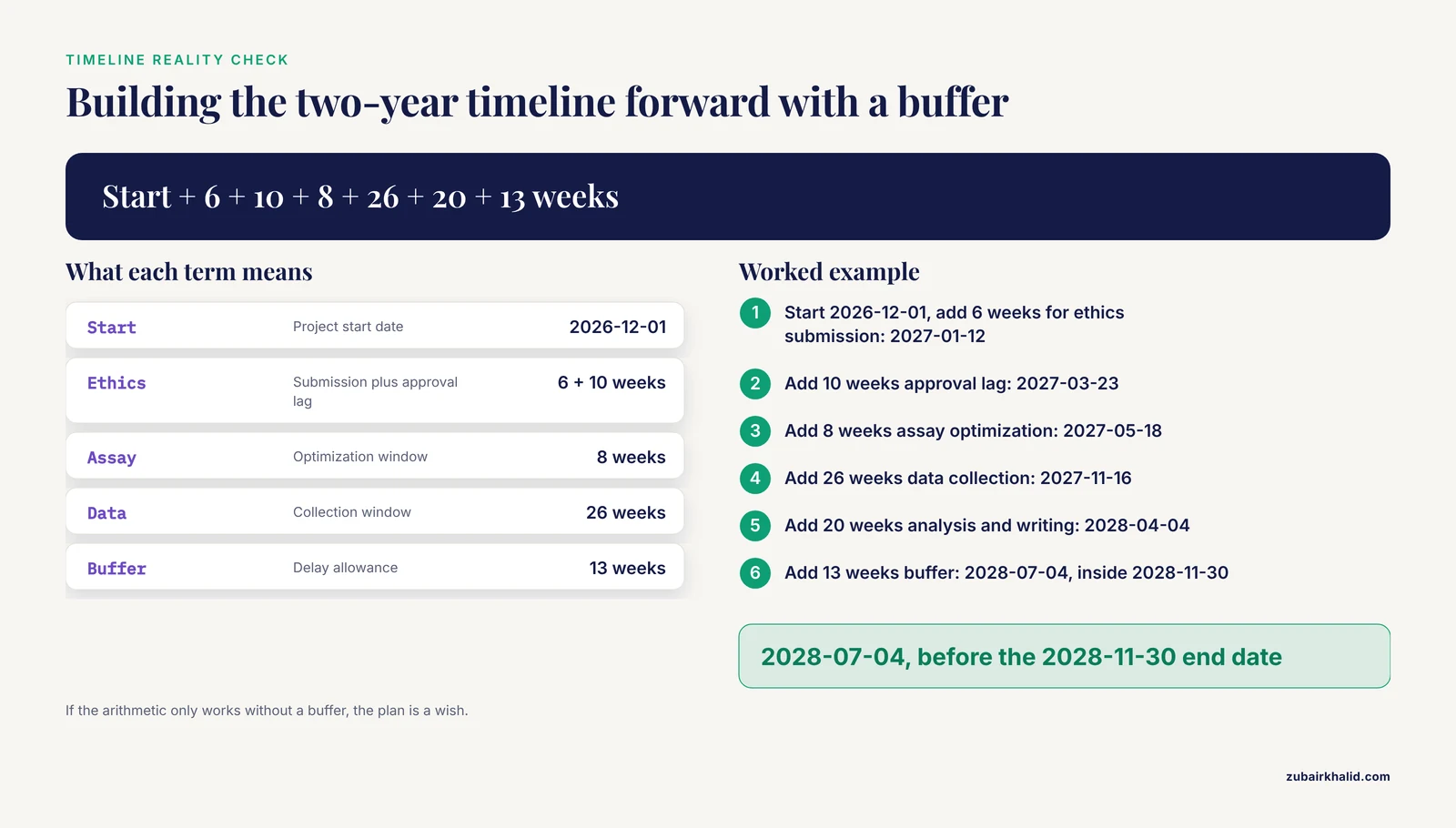
A worked timeline calculation for a hypothetical two-year project with a wet lab component:
Project start:                 2026-12-01
Ethics/regulatory submission:  start + 6 weeks  = 2027-01-12
Assume approval lag:           + 10 weeks        = 2027-03-23
Assay optimization window:     + 8 weeks         = 2027-05-18
Data collection window:        + 26 weeks        = 2027-11-16
Analysis and writing:          + 20 weeks        = 2028-04-04
Buffer for delays (1 quarter): + 13 weeks        = 2028-07-04
Funder end date (example):                       2028-11-30  ✓ fits
The buffer is the point. If the arithmetic only works without a buffer, the plan is not a plan, it is a wish.
Common failure: milestones are set by the funder's end date and then reversed-engineered backward without consulting the people who must execute each step. Fix: build the timeline forward from task durations, ask the bench scientists, technicians, or field partners to confirm each duration, and only then compare against the funder's date.
5. Communication plan and tools
Agree on one primary channel, one meeting cadence, and a response-time norm, for example "email threads answered within two working days." Projects that integrate new digital tools into routine practice have used structured, iterative co-design workshops with front-line staff to build and adapt workflows, which shows the value of scheduling feedback loops from day one rather than after launch [10]. If your project has a website, press plan, or community newsletter, name the single person authorized to approve external communications.
6. Involvement, training, and support needs
If the project includes co-researchers, peer researchers, students, or community partners, this item is where you make the participation real. Three practices have direct evidence behind them:
- Offer concrete, accessible research tasks early, because early involvement and accessible tasks support meaningful participation [1]
- Offer training and ongoing support, since citizens considering research involvement name the need for training, ongoing support, and jargon-free communication as key conditions for taking part [8]
- Discuss accommodations, absence cover, and workload openly, including for peer researchers whose lived experience overlaps with the study topic, where trauma-informed training and mindful planning reduce harm and attrition [7]
7. Risks, assumptions, and open questions
Run a fast round-robin where every person, including the most junior, names one risk. Junior members and external partners see risks that leads do not. Rank the top three, assign an owner and a mitigation to each, and record them in the plan.
8. Actions, owners, deadlines, and close
The notetaker reads every action aloud with its owner and deadline. Ambiguity dies when spoken aloud. Confirm the next meeting date before anyone leaves.
Checking the Result: Did the Kickoff Work?
Within 48 hours you should have sent:
- Minutes with decisions, not a transcript
- An action log with owner and date for every line
- The one-page charter or working agreements, if drafted
- The updated milestone list
- Calendar invitations for the agreed meeting cadence
You can check quality with four questions. Can any team member state the project's success criteria from memory? Does every milestone have a named owner? Does every person at the meeting appear in the action log at least once across the project plan? Did the meeting end on time? If the answer to any of these is no, schedule a 30-minute follow-up within a week rather than waiting for the next monthly meeting.
Research Project Plan Template
The kickoff produces the inputs, and this template turns them into the standing project document used in your research project management from week one onward.
# Project Plan: [Project Title]

## 1. Summary
One paragraph: aim, design, funder, period.

## 2. Team and roles
| Name | Role | Work package | Decision rights | Contact |

## 3. Milestones
| ID | Milestone | Owner | Target date | Dependency |

## 4. Timeline assumptions
List each duration assumption and who confirmed it, plus
the total buffer included.

## 5. Communication plan
Cadence, channel, response norm, external communications owner.

## 6. Engagement and involvement plan
Co-production depth, engagement charter reference, training
offers, accommodations process.

## 7. Risks
| Rank | Risk | Owner | Mitigation |

## 8. Action log (running)
| Date | Action | Owner | Due | Status |

## 9. Change log
| Date | Change | Approved by |
Worked Example: A Filled Agenda in Practice
Consider a hypothetical 18-month university-community study on neighborhood air quality and childhood asthma, involving two academic labs, a county health department, and a parent advisory group. The filled agenda would look like this:
# Kickoff Meeting: Air-Quality and Asthma Pilot Study
Date: 2026-12-03   Time: 13:00 to 14:30 ET
Location/Link: Engineering Hall 2-214 + video link
Chair: Dr. R. Alvarez   Notetaker: J. Okafor

1. Welcome and introductions (10 min)
   8 attendees: 3 lab staff, 1 county epidemiologist,
   1 school nurse, 2 parent advisors, 1 data manager
2. Purpose and scope (10 min)
   In scope: monitor PM2.5 at 12 sites for 12 months,
   link to de-identified clinic asthma visit counts.
   Out of scope: individual-level health data.
3. Roles and working agreements (15 min)
   Sensor deployment: lab A. Data linkage: county.
   Parent advisors co-author the plain-language report.
   Decisions on site selection: joint, county has veto.
4. Timeline (20 min)
   Site permissions: by 2027-01-15. Sensor calibration:
   by 2027-02-15. First quarterly report: 2027-04-01.
   Buffer: 8 weeks before funder end date.
5. Communication (10 min)
   Biweekly 30-min call. Shared drive for data.
   Only Dr. Alvarez speaks to press.
6. Involvement and support (10 min)
   One-hour sensor orientation for parent advisors in
   January. Meeting materials in plain language.
7. Risks (10 min)
   Top risk: school district permission delays.
   Owner: county epidemiologist. Mitigation: start
   paperwork next week.
8. Actions and close (5 min)
   6 actions read aloud, next meeting 2026-12-17.
Notice what this example does that a bare agenda does not: it assigns decision rights, names a veto, commits co-authorship for community partners, and includes a buffer. Those four details separate kickoffs that work from kickoffs that feel productive and change nothing.
Adapting the Agenda for Participatory and Multi-Partner Projects
If your project involves sustained collaboration with patients, community members, practitioners, or multiple institutions, make three adjustments to the standard agenda format.
First, extend the meeting or run a second session. Co-produced projects report relational and institutional challenges that take time to work through, and experienced leaders recommend investing in shared understanding and trust at the start rather than compressing it [2]. Living lab and co-design projects handle this by structuring the work into thematic sprints with repeated workshops across sites, which keeps participation iterative instead of front-loading everything into one session [10].
Second, build prioritization into the agenda itself. Rather than presenting a fixed plan, present candidate options and let the group rank them. An electronic poll that asked symposium participants to prioritize twelve candidate implementation themes, followed by round-table working groups and written action plans, is a proven structure you can scale down to a single kickoff with a simple poll and one breakout [6].
Third, formalize the engagement structure. A PPI resource group in a French cancer prevention department co-developed its mission statement, engagement charter, and annual action plan during its first two meetings, then used a patient facilitator to provide independent feedback on how the involvement was actually working [9]. Your kickoff can produce a first draft of the same three documents.
Common Mistakes and Limitations
- Inviting stakeholders to attend but not to decide. Attendance without decision rights breeds cynicism. If community partners or technical staff are in the room, at least one decision on the agenda should be genuinely theirs to shape.
- Reverse-engineering the timeline from the funder's end date. Build durations forward with input from the people executing each task, then check against the deadline. Laboratory work in particular runs longer than expected because of approvals and assay optimization [3].
- Treating the kickoff as the end of engagement planning. Meaningful participation depends on continued transparent communication and visible use of contributions after the meeting, not on a single session [1].
- Assuming everyone wants the same thing. Partner organizations join projects for reasons of their own, such as visibility, service obligations, or corporate social responsibility, and unstated motivations become conflicts later [4].
- Skipping accommodations and support planning. Arranging access needs, absence cover, and workload expectations before work begins prevents the attrition that otherwise follows.
- Cutting the action log when time runs short. If nothing else survives the meeting, the written actions must. Reclaim time from the risk discussion instead.
- Scheduling the kickoff before regulatory or access paperwork has started. The kickoff should launch paperwork, not follow it, because approval lags are among the least controllable parts of a research timeline [3].
- One honest limitation of any single meeting: a kickoff cannot resolve deep disagreements about research design or epistemology, and teams in convergent, multi-discipline work should expect those discussions to continue across several sessions [2]. Plan a second working session within the first month for method-heavy projects.
Frequently Asked Questions
How long should a research project kickoff meeting last?
Ninety minutes works for most projects of five to twelve people. Large multi-institution or co-produced projects often need a half-day or two sessions, because building shared understanding across disciplines takes deliberate time [2].
Who should be invited to a research project kickoff meeting?
Everyone who will do the work, approve decisions, or supply a critical dependency, including technical staff, community or patient partners, and data or regulatory contacts. People who will execute milestones should help set the durations for those milestones.
What is the difference between a kickoff meeting and a regular lab meeting?
A kickoff establishes the project's scope, roles, timeline, and working agreements once, while a lab meeting runs recurring progress review. The kickoff produces decisions and documents, the recurring meetings produce updates and problem-solving.
How do I write a research project kickoff meeting agenda?
List the three to five decisions the meeting must produce, assign a time and owner to each agenda item that feeds those decisions, cut anything that does not, and test the draft with one senior and one junior participant before sending it [6].
Should community partners or patient representatives attend the kickoff?
Yes, if they will contribute to the work rather than only be studied, and they should hold real decision rights and see their contributions used. Early involvement with accessible tasks is what makes their participation meaningful rather than symbolic [1].
What documents should I send before the kickoff meeting?
Send the funded proposal or brief, a draft milestone list, and a draft engagement charter if you have one, at least two weeks ahead. Plain-language versions help participants who are new to research terminology [8].
How do I run a kickoff when the team spans multiple time zones?
Keep the live meeting to decisions only, record the walkthrough items, and collect risk and comment rounds asynchronously before the call. Include response-time norms in the communication plan so async members are not disadvantaged.
What should happen immediately after the kickoff meeting?
Send minutes, the action log, and calendar invitations within 48 hours, and file the completed research project plan template. Then schedule the first progress meeting before the momentum fades.
Sources
- Enabling meaningful participation and involvement in oncology and palliative care research: insights from two participatory research projects.
- Navigating the practice of co-produced convergence research: Lessons from projects funded by NSF's Coastlines and People (CoPe) program.
- Bridging laboratory and clinical practice: timelines and challenges in wet lab research.
- Strengthening the engagement of mass media stakeholders in community-based health promotion interventions - the Danish Project SoL.
- Managing Food Allergies and Intolerances in the Tasmanian School Lunch Project, Australia.
- Meeting report of the fifth symposium organized by the coalition to strengthen the HPV immunization community (CHIC): Nairobi, Kenya - advancing sustainable HPV vaccination programs in Africa.
- Creating disability-inclusive research cultures: Opportunities, challenges, and recommendations for best practices in supporting peer researchers.
- What do older adults think about involvement in health research through a citizen science lens? A situated qualitative study.
- Patient and public involvement in a cancer prevention research department: lessons learned from the DIADEME group.
- Using a Living Lab to Refine an Electronic Prescribing Workflow: Insights From the eRIKA Project.