Research Project Handoff Process: A Step-by-Step Guide
By Dr. Zubair Khalid, DVM, MS, PhD ·
A research project handoff is the structured transfer of a project, along with its data, materials, context, and open decisions, from one person or team to another. The most common cause of a failed handoff is the absence of a standardized structure. When the outgoing and incoming parties rely on memory, scattered files, and hallway conversations instead of a written checklist and a defined format, critical context disappears between the two people, and the incoming researcher spends weeks reconstructing what the outgoing researcher already knew.
The first thing to check is simple. Ask both parties whether a written handoff document exists and whether both of them have agreed on what it must contain. If the answer is no, you have found the problem before diagnosing anything else. Decades of handoff research in clinical settings, where a missed transfer of information can harm a patient, converge on the same conclusion. Structured formats with a fixed set of fields outperform informal verbal transfers, and teams that adopt them report better satisfaction, fewer omissions, and more reliable continuity [1], [2].
This guide translates that evidence into a practical process for scientific collaboration, whether you are handing a project to a new graduate student, transferring a study to a collaborating site, or leaving a position and passing your portfolio to a successor.
What Counts as a Research Project Handoff
Handoffs appear at several points in the life of a research project:
- A departing student, postdoc, or staff scientist transfers a project to their replacement.
- A principal investigator hands a study to a new site coordinator or data manager.
- A core facility delivers data or samples to a downstream analysis team.
- A lead lab transfers responsibility for a multisite study to another institution.
- A wet lab hands an assay or cell line to a lab that will continue the work.
Each of these is a continuity problem of the same shape. Information, materials, authority, and accountability must all move together. Handoff science developed largely in healthcare, where nurses, anesthesiologists, and intensive care teams transfer patients between shifts and units under time pressure. A major quality improvement project in a cardiothoracic intensive care unit showed that a handoff process built around a staff position map and a written handoff tool reduced perceived patient turnover times and improved the readiness of providers at the point of care [3]. The same design logic applies when the thing being transferred is a dataset, a mouse colony, or an unfinished manuscript.
Why Research Project Handoffs Fail
Understanding the research project handoff process causes in order of frequency lets you fix the likely problem first. The mechanisms below run from the most common to the rarest.
1. No Standardized Format
An unstructured handoff depends on the outgoing person's memory and narrative skill. Working memory is limited, and important details that feel obvious to the person leaving are invisible to the person arriving. The fix, proven across many clinical settings, is a structured format with fixed fields. In a national project across 17 Israeli general hospitals, implementing the ISBAR format (Introduction, Situation, Background, Assessment, Recommendations) for patient transfers between intensive care units and hospital wards produced a statistically significant increase in satisfaction scores on four measured variables, and participants who perceived less missing information were far more satisfied with the flow of information between units [1]. A pediatric surgery center that replaced its inconsistent report process with an evidence-based standardized bedside report cut average handoff times by 30 percent and cut the time from patient admission to the completed handoff by 28 percent [4].
The mechanism is the same in research. A fixed template forces the outgoing researcher to answer questions they would otherwise skip, such as which experiment failed last, which reagent lot is nearly used up, and which collaborator expects an update.
2. Interruptions and Distractions During the Transfer
Even a well-prepared handoff fails when it is constantly interrupted. An integrative review of 17 studies on nurse-to-nurse handoffs found that interruptions and distractions degrade both the quality and the efficiency of the transfer, and identified the two most common sources as people, such as patients and family members, and environmental factors, such as equipment alarms [5]. In a research building, the equivalents are Slack notifications, bench neighbors asking questions, seminars, and open-plan noise. A handoff conversation conducted over three interrupted days carries less information than one conducted in a booked room over one protected hour.
3. Fragmented Tools and Incompatible Systems
Research information lives in many places at once. A quality improvement project on hospital transfers identified four significant root causes of delayed decisions, and two of them were informational: no standard on the specific information required for the handoff, and incompatible electronic record systems between the sending and receiving facilities [6]. Research teams face the same two problems. One lab stores analysis code on a personal laptop, the receiving lab uses an institutional cluster. One site tracks samples in a spreadsheet, the other uses a laboratory information system. When the systems cannot talk to each other, the handoff document becomes the only bridge, and it is usually incomplete.
The solution direction is documented in clinical informatics. An electronic health record-connected rounding and handoff application called Carelign was implemented on 152 of 169 inpatient services across three hospitals and reached roughly 3,275 unique weekly users generating about 26,981 weekly access sessions, with usage remaining steady for four years after implementation [7]. The lesson for research teams is that handoff tools work best when they pull live information from the systems people already use, rather than asking for a separate manual write-up that drifts out of date.
4. Governance and Ethics Do Not Travel With the Data
A subtle but serious failure mode is a handoff that transfers the data but not the authority to use it. In data science health research, researchers have described ethical governance continuity dissolution, the progressive loss of domain-specific governance authority across a data lineage, such that no coherent set of actors can authorize, monitor, or remediate the current use of data relative to the people and communities it came from [8]. In practical terms, a dataset can arrive in a new lab with no one clearly responsible for its consent terms, its use restrictions, or its retention schedule. The handoff process must explicitly transfer stewardship, not just files.
5. Metadata Gaps
Data without metadata is a common handoff casualty, especially in multi-omics and imaging work. The MetaServe project, an open-source governance and delivery layer for pre-publication research assets, addresses exactly this gap by combining file-type recognition, partial automatic metadata extraction, manually supplied project and biological annotations, and indexed faceted retrieval, with role-based controls, explicit file-level sharing, and operational traceability [9]. A handoff that delivers raw sequencing files but not the sample annotation sheet, the processing parameters, or the protocol version forces the incoming researcher to reverse-engineer months of decisions.
6. Multisite Complexity
When a handoff crosses institutions, the failure surface expands. An experience report from a multisite pediatric research network identifies the major logistical areas that complicate multisite projects: project management, regulatory approvals, data use agreements, training, communication, and financial management [10]. A single-site handoff that runs smoothly can fail at the multisite stage because a data use agreement lapsed, a site lead was never formally onboarded, or no one owned the communication plan.
7. Human and Cultural Resistance
The rarest but most stubborn cause is cultural. An action research study of bedside handover implementation in neurological rehabilitation found that the biggest challenges were privacy concerns and difficult patient interactions, and that sustainable change required understanding which underlying factors actually motivate staff to change their handover practices [11]. In a research lab, the parallel is a senior member who resists documenting their work because documentation feels like surveillance, or a team whose informal knowledge-sharing culture treats checklists as bureaucracy. Participatory approaches, where the people doing the handoff help design it, produce more durable change than mandates from above [11].
Step-by-Step Research Project Handoff Process
This sequence assumes a typical academic or industry research setting. Adjust the depth to the size of the project.
Step 1. Perform a Needs Assessment
Before writing anything, establish what the incoming person or team actually needs and what constraints apply. Implementation science offers a tested scaffold here. Implementation mapping, a technique that connects an innovation to its anticipated barriers and then links those barriers to specific strategies, proceeds through five steps: performing a needs assessment, creating a matrix of change, identifying mechanisms and strategies for change, creating implementation materials, and measuring implementation outcomes. Applied to an anesthesia handoff tool, this method produced high acceptability, appropriateness, and feasibility ratings among frontline clinicians [12]. For a project handoff, the needs assessment answers three questions. What does the receiver need to continue the work safely? What barriers exist, such as missing access, expired agreements, or unfamiliar methods? Who must approve each transfer?
Step 2. Inventory Everything That Must Move
Build a complete list across at least six categories:
- Data. Raw and processed files, file formats, storage locations, and version history.
- Metadata. Sample annotations, protocol versions, instrument settings, batch information, and analysis parameters.
- Materials. Cell lines, plasmids, antibodies, animal colonies, reagent lots, and their associated material transfer agreements.
- Code and workflows. Scripts, notebooks, container images, environment specifications, and compute credentials.
- Commitments. Grant deadlines, collaborator expectations, regulatory reporting dates, and manuscripts in progress.
- Governance. Consents, data use agreements, approvals, and the named person responsible for each [8], [10].
Step 3. Draft the Handoff Document With a Fixed Template
Use a structured template with the same fields every time, because standardization is the single intervention with the strongest evidence behind it [4], [1], [2]. A workable template contains:
- Project summary and current status
- What has been completed and verified
- What is in progress and its exact state
- Known problems and failed approaches, which prevent the successor from repeating dead ends
- Immediate next steps with owners and deadlines
- Locations of every data, code, and materials asset
- Open questions and pending decisions
- Names and roles of collaborators, core facilities, and regulators
- Governance items with their expiration dates
Step 4. Conduct a Structured, Protected Handoff Meeting
Book a room, silence notifications, and hold the meeting without interruption, because distractions measurably degrade handoff quality [5]. Follow the template in order rather than conversing freely, so the structure carries the conversation when a topic is uncomfortable or forgotten. A quality improvement project in a neonatal intensive care unit defined a safe handoff as meeting three criteria: all team members present, a structured format in use, and an environment conducive to the handoff [2]. Those three criteria translate directly to research. Everyone with decision authority attends, the template drives the discussion, and the meeting is protected from interruption.
Step 5. Transfer Access and Verify It Works
The outgoing person should transfer credentials, permissions, and system access during the handoff period, not after. Test each one. The incoming researcher should log into the storage system, run one analysis script, open the sample database, and confirm write permissions. Role-based controls and explicit file-level sharing, as implemented in institutional research data platforms, allow this transfer to be audited rather than assumed [9].
Safety note. When the project involves human data, biological materials, or regulated agents, the handoff must include a privacy and biosafety review before any transfer occurs. Confirm that consents and data use agreements cover the incoming person's intended use, and route any physical material transfer through your institution's material transfer agreement process. Never move human subject data or restricted materials on personal accounts or unapproved storage.
Step 6. Provide a Supervised Practice Period
A one-way verbal handoff rarely sticks. The strongest clinical evidence supports supervised practice. The neonatal intensive care project that reduced postoperative handoff-related care failures from 75 percent to 6 percent used standardization, scripted ideal communication, and simulation to establish behavioral norms [2]. In research, the equivalent is having the incoming researcher run the next experiment or analysis while the outgoing researcher observes, then reversing roles for a second run. Two or three supervised cycles usually expose gaps that no document reveals, such as an undocumented incubation step or an unwritten agreement with a collaborator.
Step 7. Audit, Get Feedback, and Re-Audit
Close the loop with measurement. An evidence implementation project on communication among nurses followed an audit, feedback, and re-audit structure, observing 250 handovers and using targeted training where compliance was low. Communication training moved one criterion from 0 percent compliance to 78 percent, and teamwork and conflict management training moved another from 21 percent to 50 percent [13]. For a project handoff, a simple re-audit two to four weeks later asks the incoming researcher to locate five named assets, explain the current status of three experiments, and name two open deadlines. Gaps found in the re-audit tell you what the original handoff missed.
Troubleshooting Table
| Symptom | Likely cause | How to confirm | Fix |
|---|---|---|---|
| Incoming researcher asks repeated basic questions weeks later | No structured template, so context lived only in the outgoing person's head | Check whether a written handoff document exists and covers all six inventory categories | Redo the handoff with a fixed template and hold a follow-up session [4], [1] |
| Handoff meeting keeps getting cut short or rescheduled | Interruptions and competing priorities | Review calendars and message logs for the planned handoff window | Book a protected room, silence notifications, hold one uninterrupted session [5] |
| Incoming person can find files but cannot run the analysis | Fragmented or incompatible systems, missing environment specifications | Attempt to reproduce one result using only what was handed over | Document the compute environment, transfer credentials, and verify by running a test analysis [6], [7] |
| Data arrived but its permitted uses are unclear | Governance did not travel with the data | Check whether consents, data use agreements, and a named steward transferred with the dataset | Assign stewardship explicitly and record agreement terms in the handoff document [8] |
| Successor cannot interpret the dataset contents | Missing metadata and annotations | Compare the delivered files against the original sample list | Reconstruct metadata from the outgoing researcher, then adopt a metadata-aware system going forward [9] |
| Cross-site work stalls after the transfer | Multisite logistics were never transferred, such as agreements, training, or communication plans | Review whether data use agreements, site contacts, and financial arrangements transferred [10] | Build a multisite checklist covering regulatory approvals, training, communication, and financial management [10] |
| Team members resist the new handoff process | Cultural resistance and unaddressed motivations | Interview the team about what they fear losing or gaining | Use a participatory approach, let the team shape the process, and connect it to their own priorities [11] |
| The new handoff process is ignored within a month | No measurement or reinforcement | Compare process use before and after implementation | Run audit, feedback, and re-audit cycles with targeted training on weak criteria [13] |
How to Fix a Broken Handoff Process
If your team's existing research project handoff process is failing, apply these solutions in order of expected impact.
Standardize First
Introduce a single, mandatory template before adding anything else. The evidence is consistent that standardization alone produces measurable gains, including the 30 percent reduction in handoff time seen in the pediatric surgery center and the significant satisfaction gains from the national ISBAR implementation [4], [1]. Resist the temptation to buy software before you have agreed on what information must transfer.
Diagnose Root Causes Formally
When failures persist, use a structured root cause method. In the hospital transfer project, a fishbone diagram displayed 23 root causes of transfer delays, which a nominal voting technique then narrowed to four significant causes, and a solution selection matrix evaluated fixes for each [6]. A research team can run the same exercise in one afternoon. List every reason a recent handoff went badly, vote on the few that matter most, and design fixes for those specifically rather than rebuilding everything at once.
Connect Tools to the Systems People Already Use
Research collaboration tools reduce handoff friction when they integrate with existing work rather than adding a parallel silo. The Carelign project succeeded because it gathered and integrated data from the institution's existing information systems into a responsive web application accessible from any device, which drove near-immediate adoption [7]. For research teams, candidate research collaboration tools include shared electronic laboratory notebooks, version-controlled repositories, institutional data platforms with metadata-aware retrieval, and project trackers connected to the calendars and storage people already use [9]. Choose tools that pull information automatically, because manually maintained parallel records decay quickly.
Use Implementation Mapping for the Rollout
Adopting a new handoff process is itself a change project. The five-step implementation mapping approach, from needs assessment through measuring implementation outcomes, produced high acceptability, appropriateness, and feasibility when applied to a new anesthesia handoff tool, and its logical barrier-to-strategy connections made it easy to adjust the plan as new challenges arose [12]. Map your anticipated barriers to named strategies before rollout, and expect to revise.
Measure Before and After
Pick two or three metrics before you change anything. Useful candidates are the time from transfer start to full productive work, the number of clarifying questions the incoming person asks in the first month, the percentage of handoffs meeting your template criteria, and a short satisfaction survey for both parties. The pediatric and cardiothoracic projects both demonstrated that pre and post measurement makes improvement visible and defensible [3], [4].
Train Deliberately Where Compliance Is Low
Audit results tell you where training will pay off. In the long-term care communication project, targeted educational sessions and focus groups produced large compliance gains on exactly the criteria that training addressed [13]. If your re-audit shows the handoff template is used but the governance section is always blank, run a short session on data governance rather than retraining everyone on everything.
Engage End Users on Both Sides of the Interface
A handoff crosses a boundary, so both sides must accept the process. The stroke care project improved prehospital and handover processes by gathering structured feedback from professionals on both sides of the interface through interviews and surveys, identifying educational and training barriers that shaped the final design [14]. When you design a handoff between a lab and a core facility, or between two institutions, interview people on both sides before finalizing the format.
A Short Diagnostic Sequence
When a handoff has already gone wrong, work through these checks in order:
- Ask whether a written handoff document exists. If not, build one now with the outgoing person while their knowledge is still accessible.
- Attempt to reproduce one recent result using only the transferred materials. The exact point of failure identifies the missing piece.
- Check governance. Confirm that agreements, consents, and stewardship transferred with the data.
- Review the meeting record. Determine whether the handoff conversation was structured and protected from interruption.
- Survey both parties. Divergent perceptions between the sender and receiver usually reveal the true failure point.
- Check the systems. Confirm the incoming person's access, credentials, and tool permissions were actually transferred and tested.
Common Mistakes and Limitations
- Treating the handoff as an event instead of a process. A single meeting cannot transfer a project. The supervised practice period and the follow-up re-audit carry more weight than the meeting itself.
- Assuming the document is enough. A document without a live conversation and verified access transfer leaves the receiver alone with questions the document cannot answer.
- Skipping governance because it feels administrative. The most damaging failures are ones where data moves legally and technically but without any accountable steward. Assign the steward by name during the handoff, not after [8].
- Building the process without the people who will use it. Mandated processes that ignore staff motivations and privacy concerns do not survive contact with real workloads. Participatory design produces more durable change [11].
- Adding tools before fixing structure. Software cannot compensate for a missing template. Standardize the content first, then choose research collaboration tools that automate it.
- Measuring nothing. Without a baseline and a re-audit, you cannot tell whether your changes helped, and weak criteria never get the targeted training they need [13].
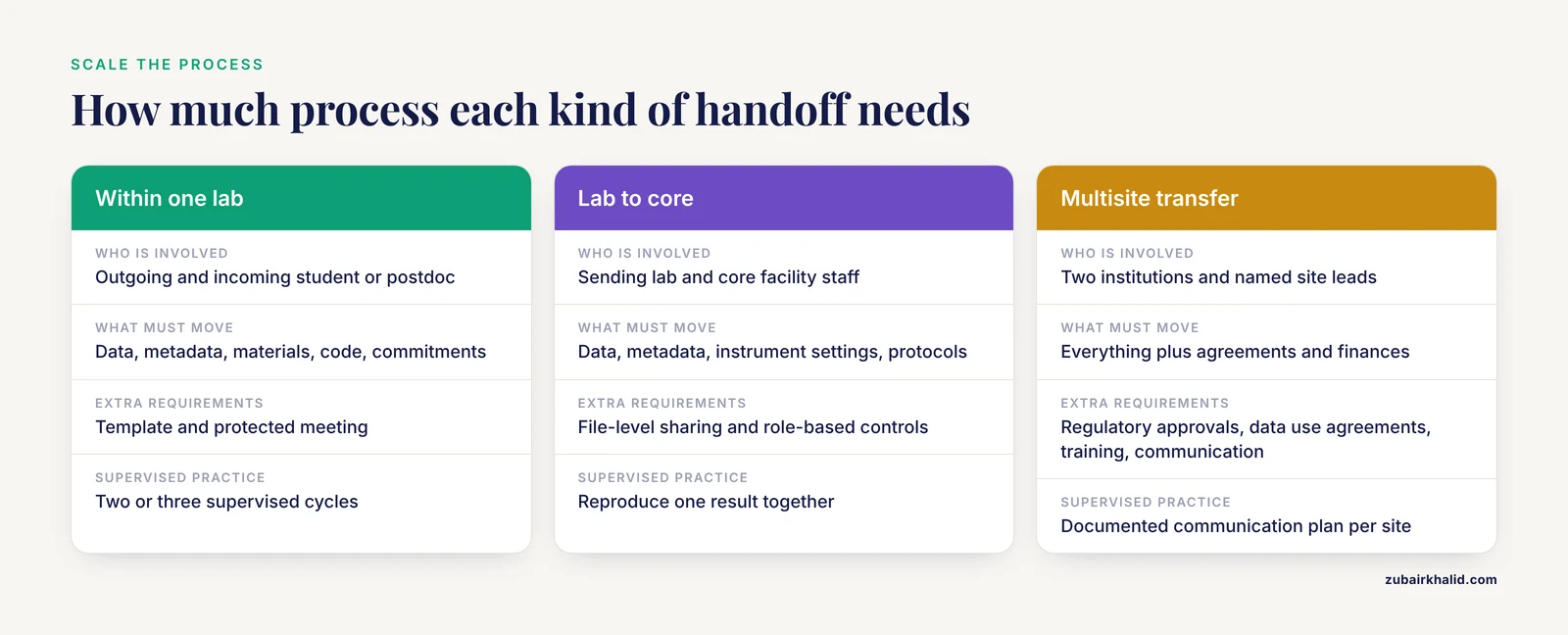
- Expecting one format to fit every handoff. A student-to-student handoff inside one lab differs from a multisite institutional transfer, which carries additional requirements around regulatory approvals, data use agreements, training, and financial management [10]. Scale the process to the transfer.
Prevention Practices
Durable prevention is mostly a matter of small habits sustained over time.
- Keep the handoff template stored where the whole team can reach it, and treat it as a living document that improves with each use.
- Update the project inventory continuously rather than reconstructing it during the departure notice period. A monthly fifteen-minute inventory review prevents most metadata gaps.
- Make access reviews routine. Quarterly checks of who has permissions to which storage, repositories, and instruments mean the handoff transfers working access instead of expired accounts.
- Pair structured documentation with a culture that values it. Recognize thorough handoffs in lab meetings, and let team members refine the template, because participatory ownership sustains the practice [11].
- Rehearse. Run a brief handoff simulation once a year, especially before a known departure, so that the structured format is practiced rather than improvised [2].
- For multisite work, maintain the checklist of logistical areas, including agreements, training, communication, and finances, from the day the study launches rather than the day a site lead departs [10].
- Audit on a schedule. A light re-audit after every handoff, following the audit, feedback, and re-audit pattern, keeps the process honest and shows new team members that the standard is real [13].
Frequently Asked Questions
What is a research project handoff process?
It is the structured transfer of a research project, including its data, materials, code, governance, commitments, and open decisions, from one person or team to another, using a defined format and verification steps rather than informal conversation alone.
What are the most common causes of handoff failure?
The most common cause is the absence of a standardized format, followed by interruptions during the transfer, fragmented or incompatible tools, missing governance, and gaps in metadata. Root cause analysis in related settings has shown that a small number of named causes usually explain most failures [6].
How long should a project handoff take?
There is no fixed duration, but plan for a protected handoff meeting, a supervised practice period of one to two weeks, and a re-audit two to four weeks later. Standardized formats reduce the time required, with one clinical implementation reporting a 30 percent reduction in handoff time after standardization [4].
What should a handoff document contain?
At minimum, it should cover project status, completed and in-progress work, known problems and failed approaches, next steps with owners, locations of all data, code, and materials, open questions, collaborator contacts, and governance items such as agreements and named stewards.
Which research collaboration tools help most with handoffs?
Tools connected to the systems your team already uses work best, such as shared electronic lab notebooks, version-controlled code repositories, and metadata-aware data platforms. Integration drove rapid, sustained adoption of one clinical handoff application across 152 hospital services [7], and metadata-aware design protects research assets during transfer [9].
How do you hand off a multisite research study?
Plan around the major logistical areas: project management, regulatory approvals, data use agreements, training, communication, and financial management. Each site needs a named lead, current agreements, and a documented communication plan before any transfer of responsibility [10].
How do you know whether a handoff succeeded?
Verify it directly. The incoming person should locate named assets, reproduce one result, explain current project status, and confirm their own access. A re-audit after a few weeks, following an audit and feedback structure, reveals remaining gaps while they are still cheap to fix [13].
Who is responsible when a handoff fails?
Responsibility is shared. The outgoing researcher must document accurately, the incoming researcher must verify rather than assume, and the institution or principal investigator must ensure governance and stewardship transfer with the work. Assigning a named steward during the handoff prevents accountability from dissolving afterward [8].
Sources
- Improving Patient Safety in General Hospitals Using Structured Handoffs: Outcomes From a National Project.
- A quality improvement project improving post-operative transitions of care in a level IV NICU.
- An Operating Room to Intensive Care Unit Handoff That Is More Than a Handshake: A Quality Improvement Project.
- The Quest for Excellence: A Quality Improvement Project on the Effects of a Standardized PACU/Phase II Bedside Report in a High Turnover Pediatric Ambulatory Surgery Center.
- Nurse-to-nurse handoff with distractors and interruptions: An integrative review.
- Improving the Hospital Transfer Process for Acute Type A Aortic Dissections.
- A Mobile, Electronic Health Record-Connected Application for Managing Team Workflows in Inpatient Care.
- Dissolution of Continuity of Ethical Governance in Data Science Health Research: Diagnostic and Response Framework for Lifecycle Oversight.
- MetaServe: a lightweight, metadata-aware governance and delivery layer for pre-publication research omics data.
- Getting Started With Multi-site Research: Lessons From the Eliminating Monitor Overuse (EMO) Study.
- [[Implementing bedside handover in neurological rehabilitation: An Action Research Approach in Practice Development].](https://pubmed.ncbi.nlm.nih.gov/37800613/)
- Implementation Mapping to Guide Adoption of a Semi-Structured Intraoperative Anesthesia Handoff Tool.
- General principles of communication among nurses in a long-term care unit: a best practice implementation project.
- Improving the interface for information transfer in acute stroke care: a mixed-methods process evaluation of the emergency use case within the CAEHR project.