5 Common Mistakes When Reviewing Research Notes and How to Fix Them
By Dr. Zubair Khalid, DVM, MS, PhD ·

The most common research note review mistake is reviewing your notes against memory instead of against the source. You read a summary you wrote three weeks ago, it sounds plausible, and you move on. The problem is that memory smooths over gaps. A note that says "sample size was adequate" tells you nothing when you later need the actual number, and a note that quietly misstates a finding can survive months of review if nobody ever opens the original paper to check.
The first thing to check is simple. Open the source document next to your note and ask one question: does every claim in my note trace back to a specific line, table, or figure in the original? If you cannot point to where a statement came from, that statement is the place to start.
This article walks through the five mistakes that account for most failed note reviews, ordered from the most common to the rarest. For each one, you get the underlying mechanism, a way to confirm you have the problem, and a concrete fix. A troubleshooting table near the end condenses everything into a format you can use during an actual review session.
Why Research Note Review Mistakes Happen
Note review fails for predictable reasons, not random ones. Three mechanisms show up again and again.
Fluency illusion. When you reread your own writing, the text feels familiar, and your brain mistakes that familiarity for accuracy. Fluency is a poor proxy for correctness. This is why a note can feel "obviously right" and still be wrong in a way you only catch when you compare it line by line against the source.
Documentation drift. Notes written at different times, in different formats, with different levels of detail resist review. A review of intervention adaptation studies found that reporting was fragmented and inconsistent across frameworks, which limited researchers' ability to understand how findings evolved across contexts [1]. The same fragmentation happens inside a personal note collection when each note follows its own format.
Unverified delegation. Handing review work to a summary, a colleague, or a software tool without checking the output. This is not laziness, it is a workflow design problem, and it has become more common as automated note-taking tools spread. Research on ambient AI scribes in healthcare found that these systems can produce omissions and errors that require editorial work by the person responsible for the final note [2].
The consequences of a superficial review are not trivial. In clinical settings, providers who performed quick pattern-matching instead of in-depth analysis misidentified serious diseases, and the authors of one review stressed that in-depth analysis rather than a superficial diagnosis should precede any conclusion [3]. Research notes feed the same kind of downstream decisions, so a weak review process propagates weak conclusions.
Mistake 1: Reviewing Notes Against Memory Instead of the Source
The mechanism
When you review a note, your working memory reconstructs what you remember reading. Reconstruction is not playback. It fills gaps with expectations, merges details from different sources, and drops qualifiers like "in male mice only" because qualifiers are exactly the kind of detail memory handles poorly. A review pass done from memory therefore tends to confirm the note rather than test it.
How to confirm you have this problem
Pick three notes at random from a completed project. For each claim in those notes, mark whether you can identify the exact location in the source that supports it (a page number, a table, a figure panel). If fewer than half the claims have a traceable location, you have been reviewing from memory.
How to fix it
Make the source the reference point, not the note. During review, open the paper, dataset, or lab notebook beside the note and work claim by claim:
- Read one claim in the note.
- Find the exact sentence, table cell, or figure that supports it.
- If you find it, add the locator (page, section, table number) to the note.
- If you cannot find it, either delete the claim or tag the note as unverified and resolve it in the same session.
The locator habit is what turns a summary into a verifiable record. It also makes future reviews faster, because the next pass starts from a specific location instead of a search.
Mistake 2: Reviewing Without a Standard Template or Checklist
The mechanism
When every note is reviewed in a different way, errors hide in the gaps between formats. One note records the sample size, another omits it, a third records it in a comment nobody reopens. This is documentation drift, and it is well documented at the field level. A study of cognitive frailty in acute coronary syndrome patients found prevalence estimates ranging from 8% to 55% across studies, with the differences attributed to heterogeneity in assessment tools and diagnostic criteria [4]. When measurement criteria vary, results stop being comparable, and the same principle applies to notes. If your review criteria vary from session to session, your notes stop being comparable to each other.
Inconsistency also appears when people agree on principles but not on execution. An international review of postnatal collapse prevention guidelines found agreement on key risk factors, but practical recommendations differed considerably across countries, including observation frequency and the use of standardized monitoring tools [5]. Agreement on "what matters" does not guarantee agreement on "what to record."
How to confirm you have this problem
Pull up five notes from different weeks. Check whether each contains the same core fields: full citation, the specific claim, the supporting locator, your own evaluation, and the date of review. If the fields differ across notes, your review process is inconsistent.
How to fix it
Write a review checklist once and apply it identically every time. A useful minimal checklist for a literature note has five items:
- Full citation with a persistent identifier (DOI or PubMed ID)
- The exact claim you are recording, in quotation marks or tightly paraphrased
- The locator in the source (page, section, table, figure)
- Your evaluation: is this method sound, is the claim supported, does it conflict with other notes
- Review date and reviewer initials if anyone else may read the note
Keep the checklist short. A scoping review of clinical practice guideline implementation in older adult mental health found that guideline length and providers' perception of relevance were among the main barriers to use [6]. A fifteen-item checklist that takes an hour will be abandoned within a month. Five items that take five minutes will survive.
Also define your thresholds before you review, not during. A review of pH-responsive food freshness indicators emphasized that a comprehensive evaluation framework linking a measured signal to a color-change threshold is crucial for accurate interpretation [7]. The parallel for note review is direct: decide in advance what counts as "strong evidence," "weak evidence," or "contradicted," so that two reviews of the same note reach the same verdict.
Mistake 3: Trusting Summaries and Automated Output Without Verification
The mechanism
Delegating review to a summarizing tool transfers the error rate of that tool into your notes, and most people never measure that rate. Automated note-taking tools are now common in professional settings, and their limitations are measurable. In a study of large language models extracting structured features from clinical and anatomic pathology reports, error rates were near 5% for simple extraction cases and about 10% for more complex ones, and prompt engineering did not drastically improve performance [8]. Concordance between model output and expert labels was high but not perfect. A 5% error rate sounds small until you multiply it by hundreds of notes.
Sociotechnical research on ambient scribes reached a similar conclusion from a different direction. These systems do more than automate note-taking. They actively shape the workflow around the notes, and their errors require editorial work by the human who owns the final document [2]. In other words, the tool changes how you work, and someone still has to check the output.
How to confirm you have this problem
Trace the origin of your notes. For each note, ask: did I write this from the primary source, or from an abstract, a review article, a lecture slide, or an AI summary? Count how many notes come from secondary or generated text. If a large fraction do, and you have not verified them against the primary source, your review process has an unmeasured error layer.
How to fix it
Treat any generated or secondhand summary as a draft that carries no evidentiary weight until verified. Build one step into your workflow: every claim that will appear in a manuscript, thesis, or report gets checked against the primary source, in the same session where you first notice it. For automated output, spot-check a fixed sample (for example, every tenth note) against the source and record the error rate you find. If the rate is higher than you can tolerate, change the tool or the workflow rather than tightening your tolerance. The fix is structural, not motivational.
Mistake 4: Letting the Literature Notes System Decay
The mechanism
Individual notes can be accurate and still fail you if the system connecting them decays. Orphan notes (notes with no link to a project, question, or other note) are the classic symptom. A literature notes system is supposed to let you synthesize across sources, but synthesis only happens when notes are reviewed in relation to each other, not one at a time. When the linking and consolidation steps get skipped, you accumulate a pile of accurate notes that cannot answer any question larger than the one that prompted each note.
Large-scale evidence synthesis shows what a functioning system looks like. A systematic review of food swap interventions in grocery settings screened 11 included studies using duplicate screening in a dedicated tool, extracted data on a defined set of outcomes, and synthesized the findings narratively [9]. The individual notes mattered less than the structure that connected them: defined questions, defined outcomes, and a synthesis step.
How to confirm you have this problem
Ask three questions of your note collection:
- Can I find every note related to my current project in under five minutes?
- Do at least some of my notes link to each other, with the reason for the link written down?
- Is there any document where notes from multiple sources are combined into one argument?
Two or more "no" answers indicate a decaying system.
How to fix it
Adopt three maintenance habits, each taking minutes rather than hours:
- Link on creation. When you file a new note, add at least one link to an existing note and one line on why the connection matters.
- Consolidate weekly. Once a week, pick one question and write a short synthesis paragraph that cites only your own notes, by their identifiers. Notes that never appear in a synthesis are candidates for deletion or archiving.
- Archive ruthlessly. Move stale, superseded, or orphaned notes to an archive folder. A smaller, accurate, well-linked collection beats a larger, unsorted one.
The payoff compounds. When your literature notes system is healthy, the review step for a manuscript becomes a reading task rather than an archaeology project.
Mistake 5: Reviewing Once, at the End, in One Long Session
The mechanism
The rarest but most expensive mistake is treating review as a single event before a deadline. Two failure modes stack here. First, errors made early in the project get copied into downstream work, so each later step inherits and multiplies them. Second, long uninterrupted review sessions degrade attention. Vigilance decrements over prolonged task performance are a robust finding in cognitive psychology, and review is a vigilance task: you are scanning for low-frequency defects.
The cost of unstructured, high-stakes routine work is visible in adjacent domains. A systematic review of medication administration errors by caregivers of children with chronic illness found that directly observed error prevalence ranged from 30% to 80% across studies, with dosing errors the most frequent category [10]. Routine tasks performed repeatedly, without structured checks, accumulate errors at rates that surprise the people doing them. Multi-hour solo review sessions are routine work of exactly that kind.
Adopting a new structured tool has its own cost, and that cost is front-loaded. In reconstructive microsurgery, reviews of robot-assisted platforms consistently reported prolonged procedure times and a learning and adaptation period as leading challenges, even for platforms that improved precision over time [11]. Expect your first structured review sessions to feel slower than your old unstructured ones. The slowdown is temporary and it is not a sign the method failed.
How to confirm you have this problem
Look at your calendar. If review sessions for a project are rare, long, and clustered before deadlines, you have the pattern. A second sign: bugs or errors found late in a project that, in hindsight, were visible in notes written months earlier.
How to fix it
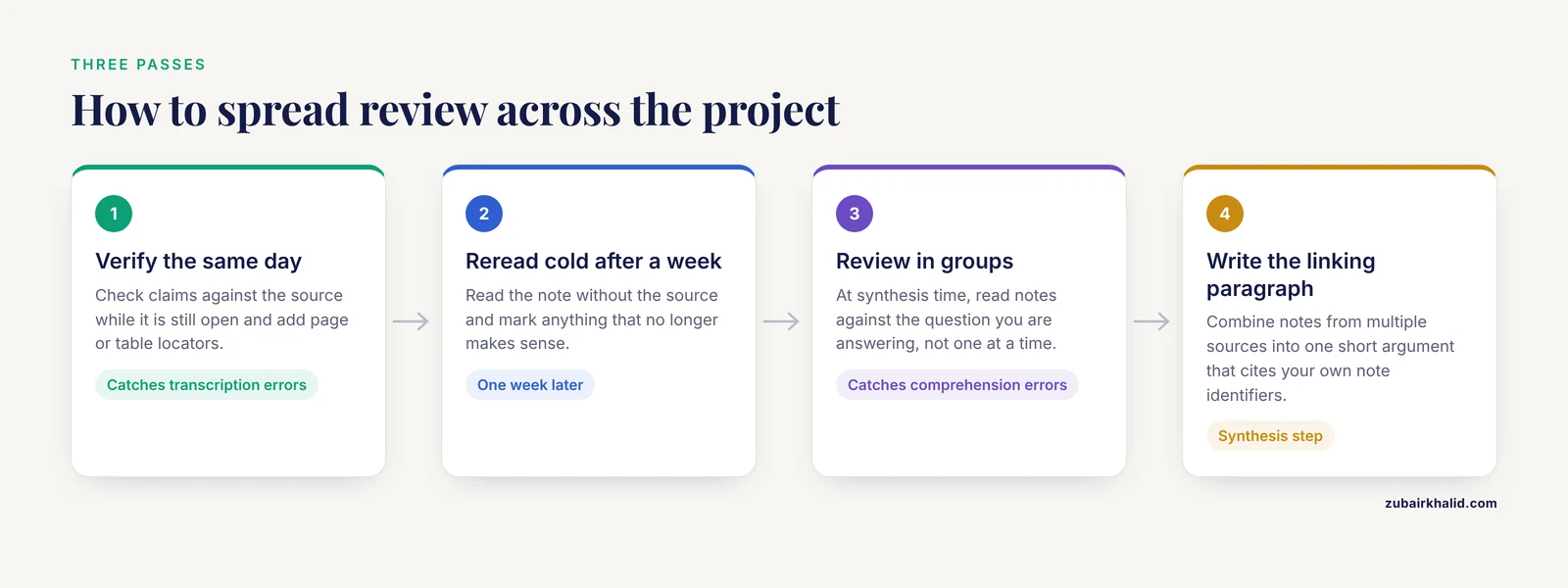
Replace the single mega-review with short, spaced, layered passes:
- Pass 1, same day. Verify claims and add locators while the source is still open.
- Pass 2, one week later. Reread the note cold and mark anything that no longer makes sense without the source open. Confusion marks a note that is too thin or too compressed.
- Pass 3, at synthesis time. Review notes in groups, against the question you are trying to answer, and write the linking paragraph.
Spaced passes catch different error types. The same-day pass catches transcription errors. The one-week pass catches comprehension errors, because a note you cannot re-understand a week later was never fully understood.
Troubleshooting Table
| Symptom | Likely cause | How to confirm | Fix |
|---|---|---|---|
| Note sounds right but you cannot defend the numbers | Reviewing from memory instead of the source | Fewer than half of claims have a locator | Work claim by claim with the source open, add page or table locators |
| Notes from different months use different formats | No standard review template | Core fields differ across five random notes | Adopt a five-item checklist and apply it identically every time |
| Notes built from abstracts or AI summaries contain subtle errors | Delegated review was never verified | Most notes trace to secondary or generated text | Verify every claim destined for a manuscript against the primary source, spot-check automated output |
| Accurate notes that cannot answer project-level questions | Literature notes system decay, missing links and synthesis | Cannot retrieve project notes in five minutes, no synthesis documents | Link on creation, consolidate weekly, archive orphans |
| Errors discovered late that were visible in early notes | Single end-of-project review session | Review events cluster before deadlines | Same-day, one-week, and synthesis-time passes instead of one mega-review |
| Two reviewers reach different verdicts on the same note | Evaluation thresholds undefined before review | Verdicts differ without a rule to arbitrate | Define strong, weak, and contradicted criteria before the session |
| New structured workflow abandoned after two weeks | Checklist or tool too heavy | Sessions take far longer than the old method | Cut the checklist to five items, keep the tool minimal |
A Diagnostic Sequence for Your Next Review
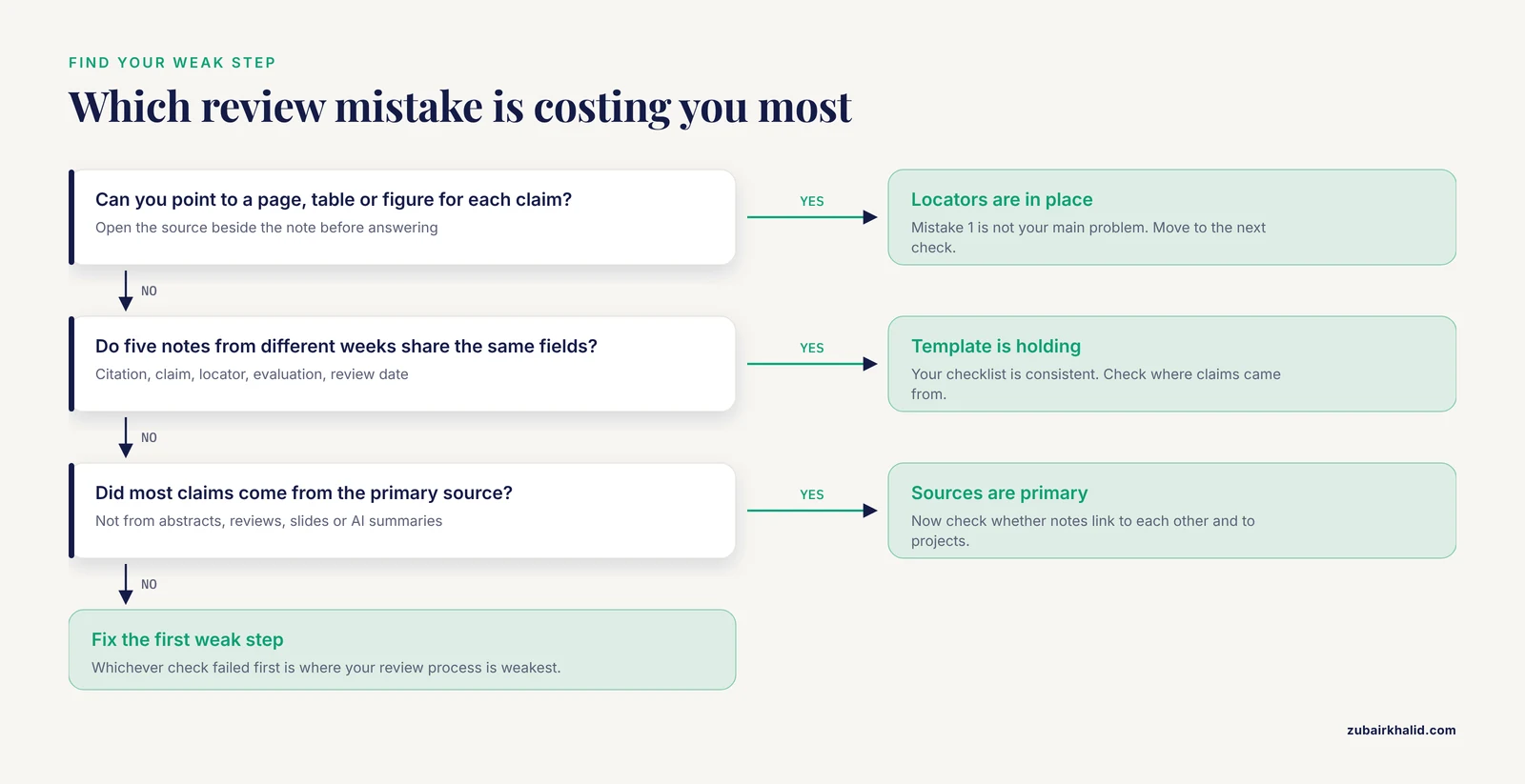
Run this sequence the next time you sit down to review notes. It takes about fifteen minutes and it localizes which of the five mistakes is costing you the most.
- Open the source, not just the note. If the source is unavailable, tag the note unverified and move on. This single habit eliminates Mistake 1.
- Check the fields. Does the note have a citation, a claim, a locator, an evaluation, and a date? Missing fields indicate Mistake 2.
- Trace one claim to its origin. Ask whether the claim came from the primary source or from a summary. Generated or secondhand claims get verified now (Mistake 3).
- Follow the links. Open one link from the note. If the note has no links, add one before you close the session (Mistake 4).
- Check the calendar. When was this note last touched, and when will it next be reviewed? If the answer is "never again until the deadline," schedule the one-week pass now (Mistake 5).
Whichever step produced the most friction is where your review process is weakest. Fix that one thing before adding anything else.
Prevention: Building a Review Habit That Lasts
Fixes fail when they add friction. These practices are designed to survive contact with a real workload.
Separate research note taking from review. Capture quickly and imperfectly. Review deliberately, on a schedule. Trying to do both at once produces neither, and it is the reason many people abandon note systems entirely.
Review in pairs when the stakes justify it. Independent review by a second person catches errors that self-review structurally cannot, because self-review shares the same memory that produced the note. Structured collaborative learning has documented benefits for confidence and shared understanding in interdisciplinary training contexts [12], and the same dynamic applies to two people reviewing the same set of notes against the same checklist.
Budget for the learning curve. If you introduce a template, a reference manager, or a screening tool, expect the first several sessions to run slower than your old workflow. Sustained use of complex new tools reliably involves an adaptation period before the efficiency gains arrive [11].
Record your review, not just your conclusions. A one-line note on what you checked and what you changed turns every review into an audit trail. The value of structured reporting is a recurring finding across research domains [1], and your own notes deserve the same discipline you expect from published work.
Keep verbatim and interpretive notes visibly distinct. Use quotation marks or a highlight for anything copied directly, and reserve your own interpretation for clearly marked fields. Most plagiarism and misattribution problems in student work trace to verbatim text that lost its marking somewhere between capture and review.
Handle restricted material with restraint. If your notes contain patient data, unpublished results, or material covered by a data use agreement, store them only in systems approved by your institution, de-identify where possible, and never copy restricted content into general-purpose note apps or AI tools without explicit authorization. When your work involves confidential human data, your institution's data security office is the authority on what is permitted.
Common Mistakes and Limitations
A few practical points that deserve their own section, because they trip up even careful reviewers.
- Re-reading is not reviewing. Rereading produces familiarity without verification. Every fix in this article involves opening an external reference, because only comparison against the source tests accuracy.
- Perfection at the note level does not guarantee synthesis quality. A systematic review of symptom network studies in complex posttraumatic stress disorder noted considerable heterogeneity across 22 articles even under formal PRISMA-guided methods [13]. Your individual notes can be flawless and your synthesis can still go wrong if you combine studies that measured different things. Review synthesis decisions, not just source notes.
- High agreement is not proof of correctness. The pathology extraction study found extremely high concordance between model outputs and experts, yet still reported measurable error rates [8]. Agreement between two imperfect reviewers (human or machine) can be systematically wrong in the same direction.
- Individual projects differ. A five-item checklist suits literature-based thesis work. A wet-lab project may need fields for reagent lot numbers and instrument calibration. Adapt the structure to the evidence type, and accept that individual research situations need judgment that no template can supply.
- Tools do not enforce habits. Software can remind you, but a review process you skip is identical to having no process. Choose the smallest structure you will actually maintain.
Frequently Asked Questions
What is the most common research note review mistake?
Reviewing notes against memory rather than against the source. Memory reconstructs rather than replays, so gaps and errors feel correct during review. The fix is to open the source beside the note and verify each claim against a specific page, table, or figure.
How often should I review my research notes?
Use three passes: verify against the source the same day you take the note, reread cold one week later, and review in groups at synthesis time. Spaced short passes catch different error types than a single long session and prevent late-stage error cascades.
What is a literature notes system?
A literature notes system is an organized collection of notes on published sources, where each note records a claim, its locator in the source, and links to related notes. Its purpose is synthesis across sources, so the linking and consolidation steps matter as much as the individual notes.
Can AI tools review my research notes for me?
They can assist, but their output needs verification. Studies of large language models extracting structured data from clinical reports found error rates near 5% for simple cases and about 10% for complex ones, with prompt engineering providing little improvement. Treat generated summaries as unverified drafts and spot-check a fixed sample against the primary source.
How do I fix a note I already suspect is wrong?
Open the primary source, verify or delete each claim, add locators for claims you confirm, and mark the note with a review date. If the source is unavailable, tag the note unverified and exclude it from any synthesis until you can check it.
What should a research note review checklist include?
Five items: a full citation with a persistent identifier, the exact claim, a locator in the source, your evaluation of the evidence, and the review date. Keep it to five items, because longer checklists get abandoned within weeks of adoption.
Why do two reviews of the same note reach different verdicts?
Usually because evaluation criteria were not defined before the session. Decide in advance what counts as strong, weak, or contradicted evidence, the same way standardized assessment frameworks are needed to make measurements comparable across studies.
Is re-reading my notes the same as reviewing them?
No. Re-reading builds familiarity, which your brain mistakes for accuracy. Reviewing means comparing each claim against the original source, checking that fields are complete, and confirming links between notes. Only the second process tests correctness.
Sources
- Study protocol for the development of reporting guidelines for intervention adaptation studies: Transparent Reporting of Adaptations, Context and Effects (TRACE) - a multimethod approach using literature review, Delphi, crowdsourcing, webinar and usability testing.
- Beyond productivity: a NASSS-informed review of implementation risks and research priorities for ambient AI scribes in healthcare.
- The Neglect and Fast Spread of Some Arboviruses: A Note for Healthcare Providers in Nigeria.
- Cognitive frailty in patients with acute coronary syndromes: A scoping review.
- Preventing sudden unexpected postnatal collapse: a narrative review.
- Implementation strategies used in clinical practice guidelines in older adults' mental health and neurocognitive conditions: a scoping review.
- Research Progress of pH-Responsive Indicator Films for Real-Time Food Quality Monitoring.
- Evaluation of Large-Language Models for Structured Feature Extraction of Anatomic and Clinical Pathology Reports.
- A Systematic Review of Food Swap Interventions Used in Grocery Store Settings.
- Medication Administration Errors by Caregivers of Children with Chronic Illness in Home Settings: A Systematic Review.
- Challenges of Robot-Assisted Surgery in Reconstructive Microsurgery: A Scoping Review.
- Interdisciplinary Educational Initiatives for Health and Care Undergraduate Students-A Scoping Review.
- Networks of complex posttraumatic stress disorder: A systematic review.