Research Note Organization Mistakes: Causes and Fixes
By Dr. Zubair Khalid, DVM, MS, PhD ·

The most common research note organization mistake is scattered capture with no single home for information. Notes pile up in three notebooks, two apps, email to yourself, margin scribbles, and a folder called "misc." Six months later you cannot answer one simple question: where did I write that down?
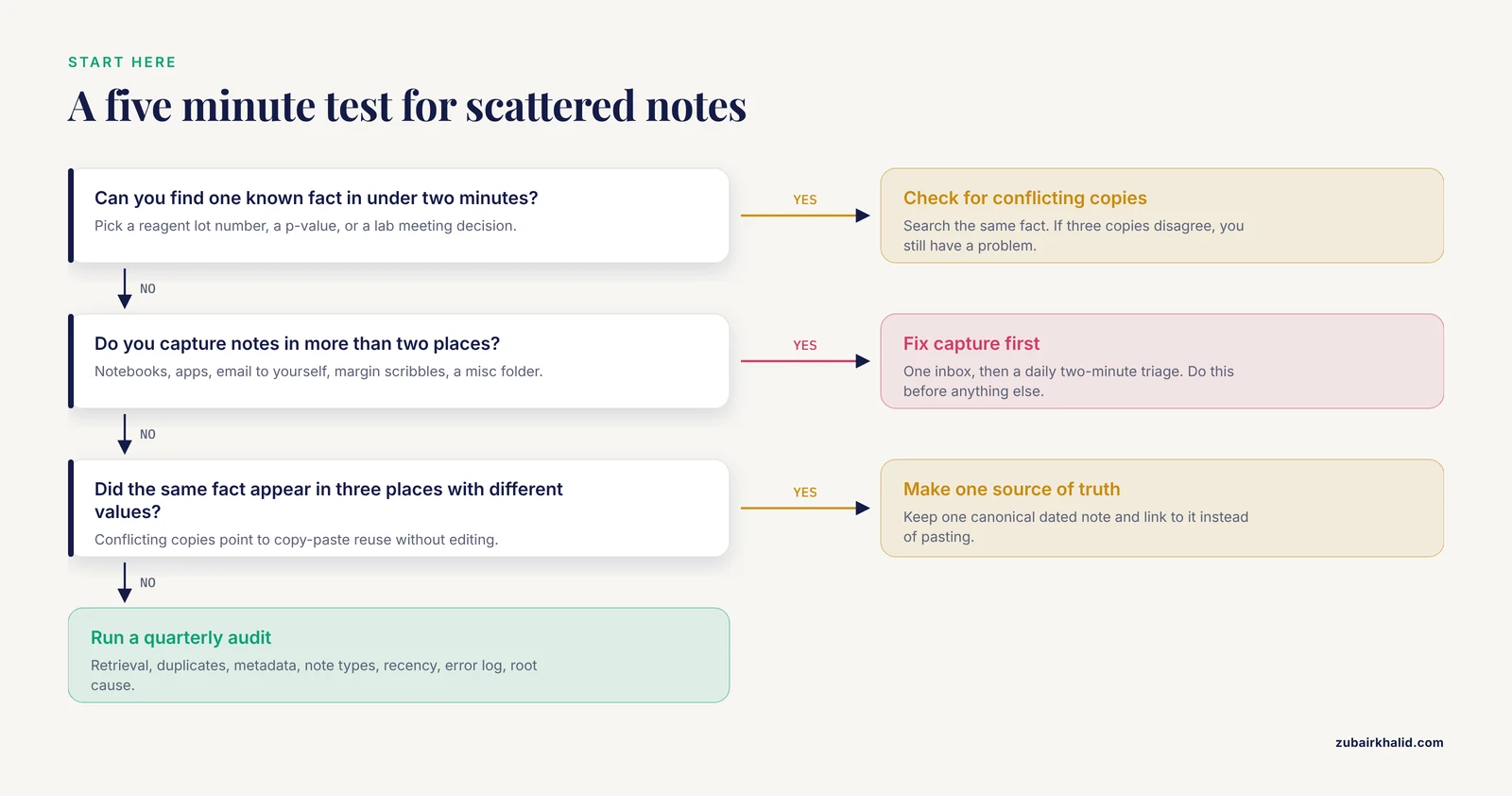
The first thing to check takes five minutes. Pick one fact you know you recorded, such as a reagent lot number, a p-value from a paper you read, or a decision from a lab meeting. Try to find it in under two minutes using only your notes. If you fail, or if you find the same fact written in three places with three different values, you have an organization problem, not a memory problem.
This article walks through the major research note organization mistakes in order of how often they cause trouble, explains why each one happens, gives you a diagnostic sequence, and ends with prevention practices you can keep running after the initial cleanup. The same failure patterns show up in professional documentation audits. In one multi-center study of clinical visit notes, 27 percent of patient and family reports identified a potential inaccuracy, and the most common problems were mundane: an inaccurate description of symptoms (21 percent), outdated past medical history (21 percent), medication details (18 percent), and important information that was simply missing (15 percent) [1]. Research notes fail the same way, through small, boring, preventable gaps.
Why Small Note Mistakes Matter
A wrong concentration written in a lab notebook does not stay wrong quietly. It propagates into a failed experiment that looks like a biological result, a methods section that misleads readers, or a dataset that cannot be reproduced. A paper responding to an error study in psychiatry research put it plainly in its title: "to err is human," but small mistakes matter [2]. In well-run clinical settings, most reported note inaccuracies actually led to a correction, with 55 to 67 percent of patient-reported problems resulting in a change to the record or to care at two of three centers studied [1]. That is the encouraging part. When you look for note errors, you find them, and most of them are fixable.
The cost of not looking is higher. A team that never audits its notes discovers the damage only when a manuscript, a collaborator, or an automated pipeline trips over them.
Troubleshooting Table: Symptoms, Causes, Confirmation, Fixes
| Symptom | Likely cause | How to confirm | Fix |
|---|---|---|---|
| You remember writing something but cannot find it | Notes scattered across many locations | List every place you capture notes. More than two means trouble | One inbox, daily two-minute triage (see Cause 1) |
| The same protocol or summary appears in several notes with different values | Copy-paste reuse without editing | Search a key term. Count duplicates and compare values | Single source of truth, link instead of copy (see Cause 2) |
| A note says "the new batch worked" with no date, source, or lot number | Missing metadata and provenance | Sample five random notes. Check each for date, source, and conditions | Standard header on every note (see Cause 3) |
| Ideas, literature summaries, and raw data live in one tangled note | Note types not separated | Ask: can I list all my paper summaries in one place? | Build a literature notes system (see Cause 4) |
| Search returns nothing useful, or an automated tool cannot parse your notes | Unstructured prose with no consistent fields | Try to extract sample IDs or concentrations programmatically | Template with labeled fields (see Cause 5) |
| Two versions of a method exist and you cannot tell which is current | No versioning or date discipline | Check whether old versions are marked superseded | Date-stamp and mark status (see Cause 6) |
| Errors cluster late in long sessions | Attention decay during repetitive work | Compare error rates in early versus late entries | Shorter sessions, checklists for late steps (see Cause 7) |
| Team members write in incompatible formats and nobody flags errors | No shared convention and no error-reporting path | Ask each member to describe the format. Answers will differ | Team convention plus easy reporting (see Cause 8) |
| Your system is beautiful but you stopped using it | Over-engineered system | Count days since last entry | Simplify to the minimum viable format (see Cause 9) |
Causes of Research Note Organization Mistakes, From Most to Least Common
Cause 1: Scattered Capture
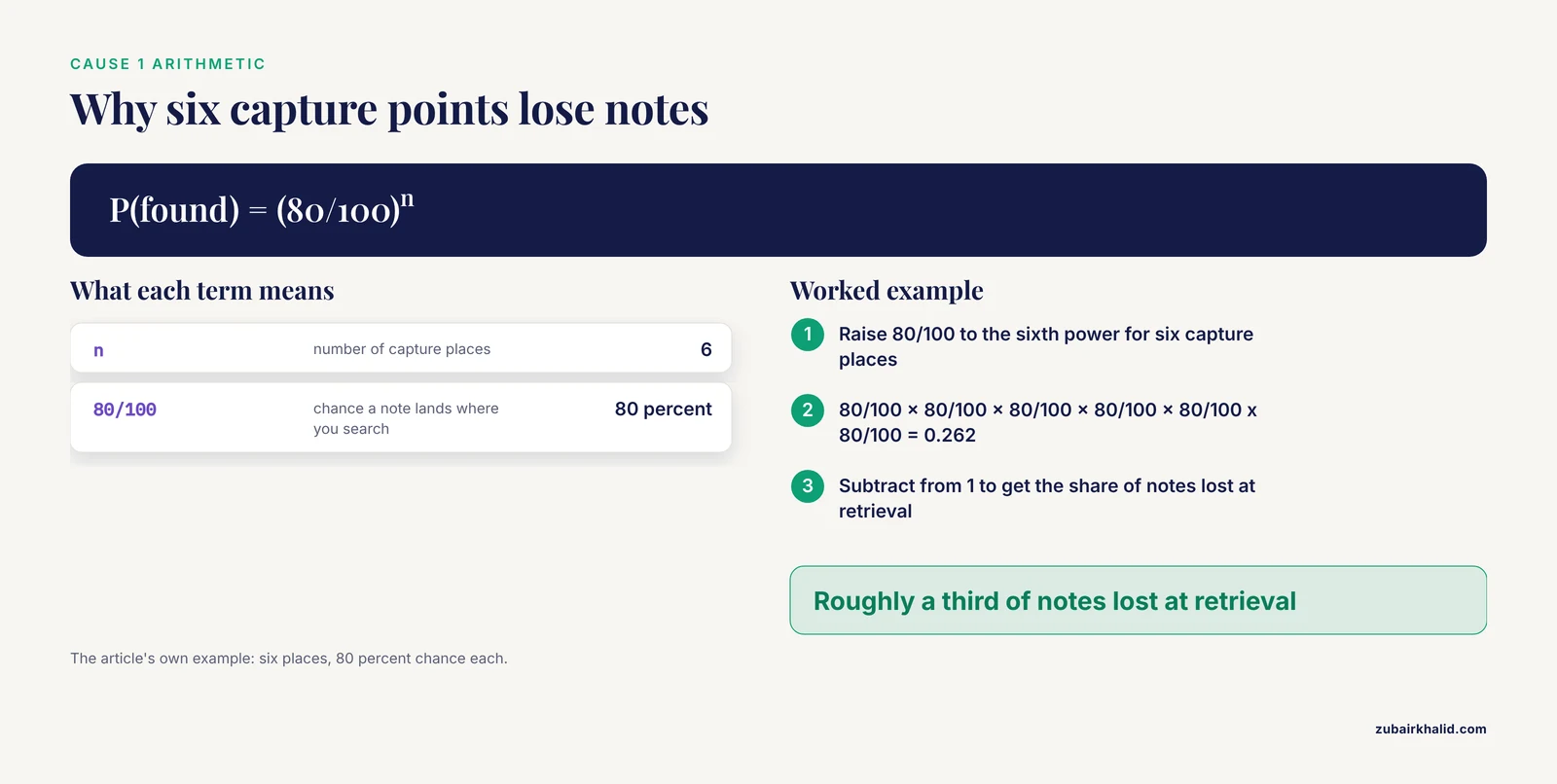
Mechanism. Ideas and observations arrive at unpredictable moments, at the bench, in a seminar, on a walk. Each capture point feels reasonable in the moment. The problem is arithmetic: if you record in six places and each entry has an 80 percent chance of ending up in the place you later search, you lose roughly a third of your notes at retrieval time.
Fix. Give every note exactly one destination, a single inbox. That inbox can be one notebook section, one app, or one folder. The rule is capture anywhere, land everywhere in one place. Then triage the inbox daily or at minimum twice a week, moving each note to its permanent home in your literature notes system, experiment log, or project file. Capture speed stays high because you never stop to decide where something "really" belongs in the moment.
Cause 2: Copy-Paste Duplication
Mechanism. Copy-paste feels efficient, so the same protocol paragraph, background summary, or template block gets pasted into new notes repeatedly. Then conditions change, the pasted block does not, and you have two documents that disagree. In a survey of 253 physicians writing electronic notes, 90 percent used the copy-paste function and 70 percent used it almost always or most of the time for daily progress notes. Notably, 71 percent acknowledged that inconsistencies and outdated information were more common in notes containing pasted text, yet 80 percent still wanted to keep using the function [3]. The gap between knowing a habit is risky and changing it is the mechanism at work.
Fix. Establish a single source of truth for anything reused, such as one canonical protocol note with a version number and date. Everywhere else, link to it instead of copying it. If your system does not support links, write the note title and date of the canonical version. When you must copy, add a line stating the source note and its date, so future you knows which copy to distrust.
Cause 3: Missing Metadata and Provenance
Mechanism. In the flow of work, the context feels unforgettable. It is not. A note that reads "sample B responded strongly" is unusable in six months without the date, the sample's identity, the assay conditions, and who ran it. Audits of clinical documentation keep finding the same gap, information that is missing entirely rather than wrong. In an obstetrics and gynecology quality project where 6,594 patients read their visit notes, 27 percent of the 232 submitted reports identified inaccuracies, and missing or incorrect background items such as family history (21 percent) and social history (11 percent) featured prominently alongside symptoms (29 percent) [4]. Missing context, not wrong content, is a huge share of real-world note failure.
Fix. Put a standard header at the top of every note. For a lab note: date, experiment or project ID, operator, and instrument or reagent details including lot numbers. For a literature note: full citation, page numbers, and the date you read it. For a meeting note: date, attendees, and decisions with owners. Writing the header first, before any content, is the single highest-value habit in research note taking.
Cause 4: Mixing Note Types
Mechanism. A single running document that holds paper summaries, raw observations, ideas, and to-do items feels natural. It fails because these four note types have different lifespans and different uses. A literature summary needs to be findable by topic for years. A raw observation is immutable source data. An idea may become a project or may die. A task list is disposable. When they share a page, none of them can be filed, searched, or discarded cleanly.
Fix. Separate note types and connect them with links. A workable literature notes system has three parts. First, a literature note for each paper you read, one note per source, containing the citation, a two to four sentence summary in your own words, and the specific points relevant to your work with page numbers. Second, your own permanent notes, one idea per note, written in complete sentences, linked to the literature notes they came from. Third, an index or map that groups notes by project or topic. This structure, a close relative of the Zettelkasten method described in standard writing and scholarship guides, is what turns reading into retrievable knowledge.
Cause 5: Unstructured Notes That Resist Retrieval
Mechanism. Prose is excellent for human reasoning and terrible for lookup. If concentrations, sample IDs, and outcomes are buried in paragraphs, you cannot filter, sort, or compute over them. Automation makes this concrete. When researchers tested large language models on extracting structured data from unstructured German clinical notes, medication extraction reached an F1 score of 0.78, or 0.95 for drug names alone, but diagnosis extraction managed only 0.12, because the task itself was too ill-defined for unstructured text [5]. The lesson generalizes: whatever is not labeled and separated in your notes will be unreliable to retrieve, whether the retriever is a script, a colleague, or you.
Fix. Use labeled fields for anything you will later need as a value. Write "concentration: 50 µM" rather than "we used a fairly dilute solution." For repetitive procedures, a structured form beats a paragraph. A pleural clinic quality improvement project replaced variable free-text assessment with a structured proforma incorporating a validated score, and the design goal was exactly this consistency of captured fields [6]. You do not need software for this. A printed or digital template with fixed fields does the job.
Cause 6: Stale Versions and No Date Discipline
Mechanism. Documents evolve. Protocol version three differs from version five in a step that matters. Without dates and status markers, the wrong version gets used, and the resulting failure looks mysterious because both documents appear authoritative. This is the "outdated information" problem that copy-paste users themselves report at high rates [3].
Fix. Every note carries a date. Every reusable document carries a version marker and a status line: current, superseded by X, or draft. When a protocol changes, do not edit the old note into place. Add the new version, mark the old one superseded, and link them in both directions. The history becomes evidence instead of a liability.
Cause 7: Attention Decay in Long Sessions
Mechanism. Accuracy drops during repetitive, sequential work. In a simulation study of emergency teams performing electrical cardioversion, correct performance declined significantly across consecutive shocks. Synchronization mode was switched on correctly in 94.4 percent of first shocks in 2015 but only 72.22 percent by the third shock, with a similar drop from 100 to 81.48 percent across consecutive shocks in 2019 [7]. Long note-taking sessions behave the same way. The last three samples you annotate at the end of a four-hour bench session are the most likely to be the ones with errors.
Fix. Plan high-risk annotation work for the start of a session. Build a short checklist for the final steps of any repetitive recording task. If a session must run long, insert a two-minute verification break every 30 minutes in which you re-read the last few entries against the source.
Cause 8: Team-Level Failures, Format Drift and Silenced Error Reports
Mechanism. Individual habits decay gracefully. Team habits decay chaotically, because each member improvises a format and nobody wants to point out a colleague's mistake. The reporting barrier is real and measurable. In a survey of over 8,600 patients who read their medical notes, 93 percent agreed that reporting mistakes improves safety, and 17 percent perceived at least one mistake, yet the most common barrier to speaking up, cited by 61 percent of those who stayed silent, was simply not knowing how to report a mistake, with fear of being seen as a troublemaker also cited [8]. A lab has the same structure. People see errors. They do not report them because there is no easy path and no psychological safety.
Fix. Two interventions. First, publish a one-page team note convention: where notes live, the header format, naming rules, and where data files are referenced. Keep it to one page. Second, create a trivially easy error-reporting path, a shared log or a standing agenda item, and thank the first few reporters publicly. Implementation research on structured monitoring supports the loop. A hospital pharmacy team defined eight agreed incident types, recorded them electronically, and re-evaluated poor performers, after which the share of suppliers rated good rose from 70 percent in 2023 to 90 percent in 2024, with missing delivery notes and missing packages consistently the most frequent incidents [9]. Define your incident categories, log them, act on the top ones.
Cause 9: Over-Engineered Systems (The Rarest but Most Ironic Cause)
Mechanism. Some researchers respond to disorganization by building an elaborate system, nested hierarchies, custom tags, mandatory fields for everything. The system is complete and unusable, so entry frequency collapses and the old scatter resumes underneath it. The failure is not lack of structure. It is structure that costs more per note than the value it returns.
Fix. Reduce to the minimum that solves your actual retrieval failures. If your five-minute findability test from the start of this article now passes, stop adding structure. Field notes from a multi-site community health implementation project showed that flexible, tailored processes with clear ownership outperformed rigid ones, and that staff field notes and meeting minutes, kept simple and consistent, were sufficient data sources for evaluating what worked [10].
A Diagnostic Sequence You Can Follow
Run this once per quarter. It takes about an hour.
- Retrieval test. Pick three facts you know you recorded. Find each in under two minutes. Record which notes failed.
- Duplicate scan. Search for your most reused content, usually a protocol name or a project keyword. Count copies and check whether their values agree.
- Metadata audit. Pull five random notes. Check each for date, source, and context. Tally what is missing.
- Type separation check. Ask whether you can list all literature notes in one view and all experiment notes in another. If not, note types are mixed.
- Recency check. Find the date of your most recent note. Gaps of more than two weeks during active projects signal that capture has broken down.
- Error log check. If you keep a mistake log, review it for repeats. If you do not, that absence is itself a finding.
- Root cause pass. For the top recurring error, apply a simple root cause analysis. The DMAIC sequence used in a medication error study, define, measure, analyze, improve, control, paired with Pareto ranking of error types, found that prescribing-phase problems caused 42.8 percent of errors versus 24.8 percent in the administration phase, meaning the true fix belonged upstream of where the error surfaced [11]. Ask the same question of your notes: where did the error originate, not where did it annoy you?
How to Fix Research Note Organization Mistakes: A Practical Rebuild
You do not need to reorganize everything at once. Rebuild in this order.
Step 1, choose one home per note type. One inbox for capture. One location for experiment notes. One location for literature notes. One location for project admin. Fewer than five locations total.
Step 2, adopt a naming convention. Something like 2026-11-11_pcr-optimization_v3 beats "final final notes." Dates first means automatic chronological sorting across every tool.
Step 3, build one template and use it everywhere. For a lab experiment note:
- Date and operator
- Project and experiment ID
- Goal in one sentence
- Materials, with concentrations, lot numbers, and source
- Procedure, linking to the canonical protocol version
- Raw observations, dated and separate from interpretation
- Interpretation and next steps
For a literature note:
- Full citation and date read
- One-paragraph summary in your own words
- Key points with page numbers
- How it connects to your project, and links to related notes
Step 4, separate observation from interpretation. Within each note, keep what you saw and what you think in visibly different sections. Raw observations are never edited later. Interpretations get revised freely. This distinction preserves the evidentiary value of the note.
Step 5, run a weekly 15-minute review. Empty the inbox, link new notes to at least one existing note, and flag anything that needs a follow-up. This single habit prevents most re-accumulation of the mess you just cleaned.
Step 6, log note errors when you find them. A three-column log, date found, what was wrong, probable cause, costs almost nothing and converts your mistakes into a fixable list. Make it easy for labmates to add entries, and never treat a logged error as an accusation.
Safety note. When a note records hazardous materials, capture the safety-critical fields at the time of use: chemical or biological agent identity, concentration, hazard class, and the location of the corresponding safety data sheet or institutional protocol. Never defer hazard details to memory or reconstruct them at the end of the day. An unrecorded hazard is a hazard that your future self, or a colleague cleaning the bench, will meet without warning. Follow your institution's chemical hygiene and biosafety requirements for record retention.
Prevention Practices That Keep Notes Organized
- Header first, always. Write the metadata before any content. A note without a header does not count as written.
- Link, do not paste. Reused information lives in exactly one note. Everything else points to it.
- One idea, one note. Atomic notes are easier to file, link, and retrieve than sprawling ones.
- Date every entry and version every reusable document. Mark superseded material explicitly.
- Use fixed fields for values you will analyze. Numbers, IDs, and conditions get labels, not prose.
- Verify the last entries of long sessions. Attention decays with repetition, so audit the end of the batch first.
- Keep the reporting path easy. The single biggest reporting barrier in a large note-error survey was not apathy, it was not knowing how to report [8]. Remove that barrier on day one.
- Review weekly, audit quarterly. Small regular passes beat annual heroic reorganizations.
- Prefer boring tools you actually open. The best system is the one with today's date in its most recent entry.
Common Mistakes and Limitations
- Buying software to solve a habit problem. A new app imports your old scatter within a month. Fix capture and review habits before changing tools.
- Fixing the place where the error hurts instead of where it originates. Error analysis in healthcare quality work repeatedly shows the damaging phase is not the phase to fix, as when prescribing errors outweighed administration errors by 1.7-fold in a hospital medication study [11]. Trace upstream.
- Assuming error rates from clinical settings transfer directly. The percentages quoted in this article come from clinical documentation studies, where stakes, workflows, and reporters differ from bench or field research. Use them as evidence that these failure modes are real and common, not as predictions for your own error rate.
- Over-structuring. Every mandatory field you add raises the cost of writing a note. Keep only fields you have actually retrieved later.
- Treating cleanup as one-time. Organization decays without a review cadence. The weekly pass is the maintenance schedule, not an optional extra.
- Backing up without testing restores. A backup you have never restored is a hypothesis, not a backup. Test a restore twice a year.
- Individual cases need expert judgment. For institution-specific requirements on data retention, lab records, or hazardous material documentation, consult your institution's research integrity office or safety officer.
Frequently Asked Questions
What is the most common research note organization mistake?
Scattered capture, meaning notes spread across many locations with no single home. The fastest check is a two-minute retrieval test on a fact you know you wrote down. If you cannot find it, or you find conflicting copies, fix capture first.
How do I fix research note organization mistakes in years of old notes?
Do not reorganize everything. Move notes into the new structure only when you actually touch them, and add a header with date and source as you go. Within a few months, the notes you use most will be organized and the rest can wait.
What is a literature notes system?
A literature notes system keeps one note per paper, containing the citation, a short summary in your own words, and key points with page numbers, all linked to your own idea notes and grouped by topic or project. It makes reading cumulative instead of evaporating.
Should I use paper or digital notebooks?
Use whichever you will actually open consistently, because consistency matters more than the medium. Many researchers capture on paper at the bench and transcribe to a digital system weekly, which combines fast capture with searchable storage.
How often should I review and reorganize my notes?
Fifteen minutes weekly for triage and linking, plus a one-hour audit each quarter. Weekly passes prevent re-accumulation, and quarterly audits catch slow drifts such as format inconsistency or stale protocol versions.
How do I stop copy-paste from cluttering my notes?
Keep one canonical, dated, version-numbered note for each reused item and link to it everywhere else. If you must paste, record the source note and its date, so stale copies are identifiable at a glance.
How do I get a whole lab to follow one note format?
Write a one-page convention covering locations, headers, and naming, and pair it with a blame-free, low-effort error log. Most people stay silent about note errors simply because no easy reporting path exists, so make the path obvious and thank early reporters.
How detailed should a research note be?
Detailed enough that a competent colleague could reproduce the observation or trace the claim without asking you a question. That usually means date, conditions, exact values with units, and a clear split between what you observed and what you concluded.
Sources
- A patient and family reporting system for perceived ambulatory note mistakes: experience at 3 U.S. healthcare centers.
- 'To err is human' - but small mistakes matter! A further note on Bitan et al. (2020).
- Physicians' attitudes towards copy and pasting in electronic note writing.
- An Opportunity to Engage Obstetrics and Gynecology Patients Through Shared Visit Notes.
- Clinical Code Mapping with LLM Tool Use: A Pilot for Automated Data Extraction of Medication and Diagnosis Information from Unstructured Clinical Notes.
- Standardising Pleural Management in Suspected Malignant Pleural Effusion Using a Structured Pre-Test Probability and RED Score-Guided Proforma: A Single-Centre Before-and-After Quality Improvement Project.
- What Mistakes Can Be Made When Performing the Electrical Cardioversion Procedure?-Analysis of Emergency Medical Team Performance during the Championships in Emergency Medicine.
- Speaking up about patient-perceived serious visit note errors: Patient and family experiences and recommendations.
- Implementation of an internal evaluation and monitoring system for pharmaceutical product suppliers: FARMAVIGO-PROV project.
- What works in real-world implementation? Practice-based insights from the ENJOY IMP-ACT project promoting physical activity among older adults.
- Using total quality management approach to improve patient safety by preventing medication error incidences(*).