Meeting Minutes for Research Teams: A Template
By Dr. Zubair Khalid, DVM, MS, PhD ·
By the end of this article you will be able to write clean, defensible minutes for a lab meeting, project team call, steering committee, or advisory group. You will have a free research meeting minutes template you can copy into any document editor, a filled-in example based on a realistic project call, and a step-by-step walkthrough of the workflow from agenda to archived record. You need nothing installed. A text editor, a shared drive or version-controlled repository, and a calendar invite are enough. If your team uses one of the common research collaboration tools for shared documents, the same template works there.
Why Minutes Matter in Research Teams
Meeting minutes in research serve three functions that ordinary business minutes do not.
First, they are a scientific record. Decisions about study design, sample handling, and analysis plans need a timestamped, attributable paper trail. Regulatory and ethics committees already treat minutes this way. An analysis of four years of Indian Subject Expert Committee minutes reviewed 551 meetings and 4,563 agenda items and used those records to evaluate regulatory decision-making trends, which is only possible because the minutes were complete and consistently structured [1]. A study of a Liberian institutional review board coded 124 documented ethical concerns directly from its 2018 to 2019 meeting minutes, showing that well-kept minutes can be analyzed as data in their own right [2].
Second, minutes support governance and audit. A cross-sectional study of all ten active health research ethics committees in mainland Tanzania assessed governance, documentation systems, and institutional support, and found that administrative record-keeping is a core component of ethical oversight capacity, not an afterthought [3]. Your lab's minutes play the same role at smaller scale. When a funder, auditor, or collaborator asks how a decision was reached, the minutes answer the question.
Third, minutes keep collaborations accountable. An environmental scan of practices for meaningful health research partnerships identified communication and meetings as one of seven core domains, with formal communication plans and structured meeting practices reported repeatedly in the literature [4]. A qualitative study of pediatric palliative care integration across four Canadian cancer centers found that structured collaboration, including joint meetings and shared care planning, supported effective teamwork, while unclear roles among team members created risks of fragmented work [5]. Minutes are where roles and action items get written down.
Finally, minutes preserve institutional memory for groups that include members outside the core team. Patient and public involvement (PPI) groups, which bring patients and citizens into research governance, rely on documented meetings to show how engagement shaped the work. The DIADEME group at a French cancer center co-developed its engagement framework during its first two meetings and tracked contributions across nine monthly meetings, producing tangible outcomes such as revisions to a colorectal cancer prevention study [6]. A consumer research advisory group for aged care research used its meeting minutes, alongside a project logbook, as the primary data source for evaluating how the group was established and functioned [7]. If minutes had not been kept, that evidence would not exist.
What to Capture and What to Leave Out
Good minutes for research teams record decisions, actions, and rationale. They do not transcribe discussion.
Capture:
- Attendance, including apologies and guests, because authorship and contribution disputes often trace back to who was in the room.
- Every decision, worded as a motion or a resolution with the outcome (approved, approved with modifications, deferred, rejected).
- Every action item with one named owner and a due date. "The team will clean the data" is not an action item. "J. Okafor will deliver the cleaned dataset to the shared drive by March 14" is.
- Short rationale statements, especially for methodological choices. Two sentences on why the team chose a nested design will save weeks of re-litigation in six months.
- Items deferred and the reason for deferral, since review committees track modification requests separately from approvals [1].
Leave out:
- Verbatim debate. Summarize positions in one line each if the disagreement matters.
- Preliminary, unverified data. If someone presents numbers that are not yet quality-checked, label them as preliminary in the minutes or leave them out.
- Anything that would breach confidentiality of grant reviews, personnel matters, or identifiable participant information.
The Research Meeting Minutes Template
Copy this template into your document editor or shared note. It works for weekly lab meetings, monthly project calls, and quarterly steering committees. The bracketed items are placeholders.
# [Team or Committee Name] Meeting Minutes

**Meeting number:** [e.g., 2026-04]
**Date and time:** [YYYY-MM-DD, HH:MM to HH:MM, time zone]
**Location / platform:** [Room name or video call link]
**Chair:** [Name]
**Minutes taker:** [Name]

## 1. Attendance
Present: [Names and roles]
Apologies: [Names]
Guests: [Names, reason for attending]

## 2. Minutes of the previous meeting
Approved without changes / Approved with changes listed below / Deferred
[Changes, if any]

## 3. Matters arising
| Item | Action from last meeting | Owner | Status |
|------|--------------------------|-------|--------|
| [Item] | [What was agreed] | [Name] | Done / In progress / Blocked |

## 4. Agenda items and decisions
### 4.1 [Item title]
Presenter: [Name]
Discussion summary: [2-4 sentences]
**Decision:** [Approved / Rejected / Deferred, with the exact wording agreed]
Rationale: [1-2 sentences]

### 4.2 [Next item]
[Same structure]

## 5. Action items arising from this meeting
| # | Action | Owner | Due date |
|---|--------|-------|----------|
| 1 | [Specific deliverable] | [Name] | [YYYY-MM-DD] |

## 6. Any other business
[Items noted, with any decisions or deferrals]

## 7. Date of next meeting
[YYYY-MM-DD, HH:MM, time zone]
Items for the next agenda: [List]

---
Draft minutes prepared by [Name] on [Date].
Reviewed and approved by [Chair] on [Date].
Version: [v1.0 draft, v1.1 approved]
Notes on Each Field
| Field | Purpose | Common failure mode |
|---|---|---|
| Meeting number | Creates a sortable, citable identifier | Skipping it, so nobody can cite "the March decision" unambiguously |
| Attendance | Establishes who contributed to decisions | Listing names without roles, which hides whether a required reviewer was present |
| Previous minutes | Closes the loop and creates an audit trail | Never formally approving old minutes, so nothing is ever final |
| Matters arising | Tracks open actions | Vague statuses like "ongoing" with no due date |
| Decisions | The core scientific and governance record | Recording "discussed X" without recording what was decided |
| Rationale | Preserves methodological reasoning | Omitting it, forcing the team to reconstruct arguments later |
| Action items | Drives execution | Multiple owners, which means no owner |
| Version line | Distinguishes draft from approved | Circulating edits without version numbers, causing conflicting copies |
The decision wording matters most. Committees that document outcomes as approved, requiring modifications, or rejected can later analyze their own patterns, as the Indian regulatory study did across 3,557 evaluable agenda items [1]. Use the same three-outcome vocabulary in your own team's minutes and you inherit that analytical clarity.
Worked Example
Here is the template filled in for a realistic project call in a university research group studying a biomarker panel. Names and details are illustrative.
# Barrett Lab Project Team Meeting Minutes

**Meeting number:** 2026-07
**Date and time:** 2026-03-11, 14:00 to 15:00, US Eastern
**Location / platform:** Zoom, recurring link in calendar invite
**Chair:** Dr. R. Barrett
**Minutes taker:** S. Patel

## 1. Attendance
Present: R. Barrett (PI), S. Patel (postdoc), J. Okafor (PhD student),
M. Lindqvist ([research technician](/blog/guides/research-technician)), T. Nguyen (biostatistician)
Apologies: None
Guests: None

## 2. Minutes of the previous meeting
Approved without changes.

## 3. Matters arising
| Item | Action from last meeting | Owner | Status |
|------|--------------------------|-------|--------|
| Pilot assay | Run 24 pilot samples on the new plate lot | M. Lindqvist | Done |
| Power calc | Revise sample size for 0.4 SD effect | T. Nguyen | Blocked, awaiting pilot CVs |

## 4. Agenda items and decisions
### 4.1 Pilot assay results
Presenter: M. Lindqvist
Discussion summary: Inter-plate CV was 9.2 percent, below the
pre-specified 15 percent threshold. One lot showed edge effects in
wells H1 to H12. Team discussed whether to randomize plate positions.
**Decision:** Approved proceeding to the full cohort with the new lot,
with plate positions randomized.
Rationale: CV met the pre-specified acceptance criterion. Randomization
removes the edge-effect confound at negligible cost.

### 4.2 Sample size revision
Presenter: T. Nguyen
**Decision:** Deferred to the April meeting, pending recalculated power
using the pilot variance estimates.
Rationale: The revised effect size estimate changes recruitment targets
and needs PI sign-off against the budget.

## 5. Action items arising from this meeting
| # | Action | Owner | Due date |
|---|--------|-------|----------|
| 1 | Write plate randomization scheme into the lab SOP | S. Patel | 2026-03-18 |
| 2 | Deliver recalculated power table with 90 and 95 percent scenarios | T. Nguyen | 2026-03-25 |
| 3 | Order randomized plate maps for cohort batch 1 | M. Lindqvist | 2026-04-01 |

## 6. Any other business
J. Okafor noted the shared freezer log has gaps from February.
**Decision:** Approved adding a weekly freezer-log check to the
technician checklist, starting March 16. Owner: M. Lindqvist.

## 7. Date of next meeting
2026-04-08, 14:00, US Eastern
Items for the next agenda: Revised power calculation, cohort batch 1
timeline, conference abstract deadline.

---
Draft minutes prepared by S. Patel on 2026-03-12.
Reviewed and approved by R. Barrett on 2026-03-14.
Version: v1.1 approved
This single page now answers the questions that come up in every lab: why the plate positions are randomized, who owes the power table and when, and what the freezer protocol change was.
Step-by-Step Walkthrough
Follow this numbered workflow for every meeting. Steps 1 through 3 happen before the meeting, steps 4 through 7 during and after.
Step 1. Create the agenda from the last meeting's action items. Open the previous minutes, copy the action item table into a new document, and convert each open action into an agenda slot. This single habit eliminates the most common meeting failure, which is actions that silently die between meetings.
Step 2. Send the agenda with the invite, at least 48 hours ahead. Attach the draft agenda and any documents that need decisions. In the invite body, name the decision required for each item, for example "Item 3 requires a go/no-go decision on cohort batch 1." Members who cannot attend can then submit written comments, which you record in the minutes under the relevant item.
Step 3. Pre-fill the template. Before the meeting starts, fill in the header, the expected attendance list, and the agenda item titles from the template above. Save the file with a clear name and version.
File naming convention:
2026-07_barrett-lab_minutes_v1.0_draft_2026-03-11.mdThe pattern is meeting number, team name, document type, version, status, date. Sorting by filename then produces chronological order, and the version plus status fields prevent the classic conflict of two documents both claiming to be final.
Step 4. Take decisions-first notes during the meeting. For each agenda item, write down the decision and the rationale as soon as they emerge, then backfill a two-sentence discussion summary. If a discussion ends without a decision, write "Deferred" and the reason. This mirrors how review committees classify outcomes, and it makes the minutes analyzable later [1].
Step 5. Read the action items aloud at the end. Before closing, the chair reads each new action item, its owner, and its due date. Owners confirm on the record. This takes ninety seconds and prevents the majority of follow-up disputes.
Step 6. Distribute draft minutes within 24 hours. Send the draft to attendees with a reply-by date, typically three business days. Mark the document clearly as a draft in both the filename and the version line. Comments should be submitted as tracked changes or inline comments, not as free-form email replies.
Step 7. Finalize, approve, and archive. Incorporate comments, change the version line to approved, have the chair sign off with the approval date, and file the final document in the team's permanent folder. Keep both the draft and the final if your governance context requires it. Ethics committees are assessed partly on their documentation systems, including how records are stored and retrieved [3], and the same standard serves research teams well.
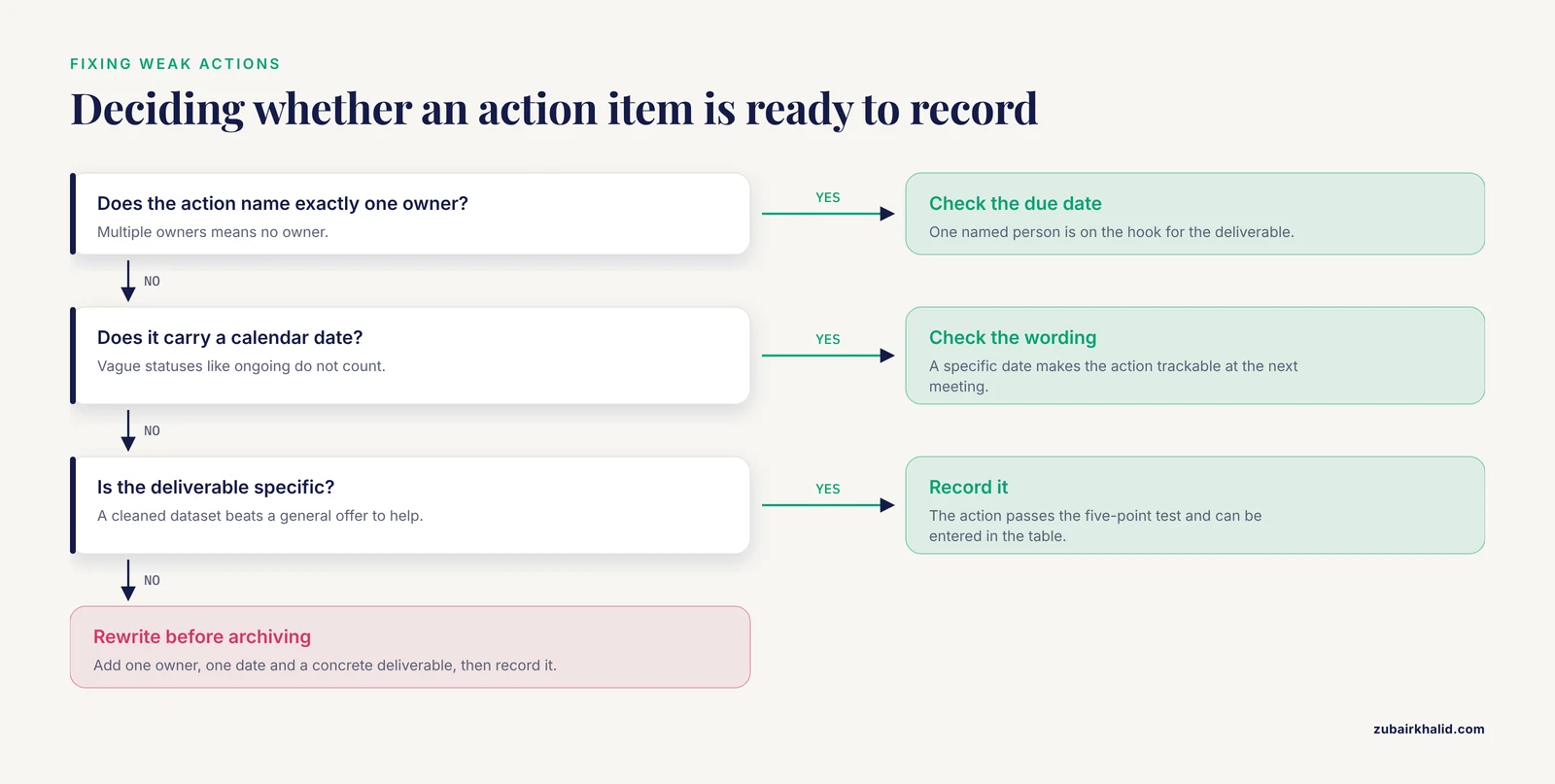
Verification check. A complete set of minutes passes this five-point test:
- Every action item from the previous meeting has a terminal status of done, superseded, or carried forward.
- Every agenda item ends in exactly one of the three outcomes: approved, rejected, or deferred.
- Every new action has exactly one named owner and a calendar date.
- A reader who missed the meeting can reconstruct what was decided and why without asking anyone.
- The version line says approved and names the approver.
If any point fails, fix it before archiving. If a reader who missed the meeting still has questions, those questions tell you which rationale statements were too thin.
Choosing Tools for Minutes and Scientific Collaboration
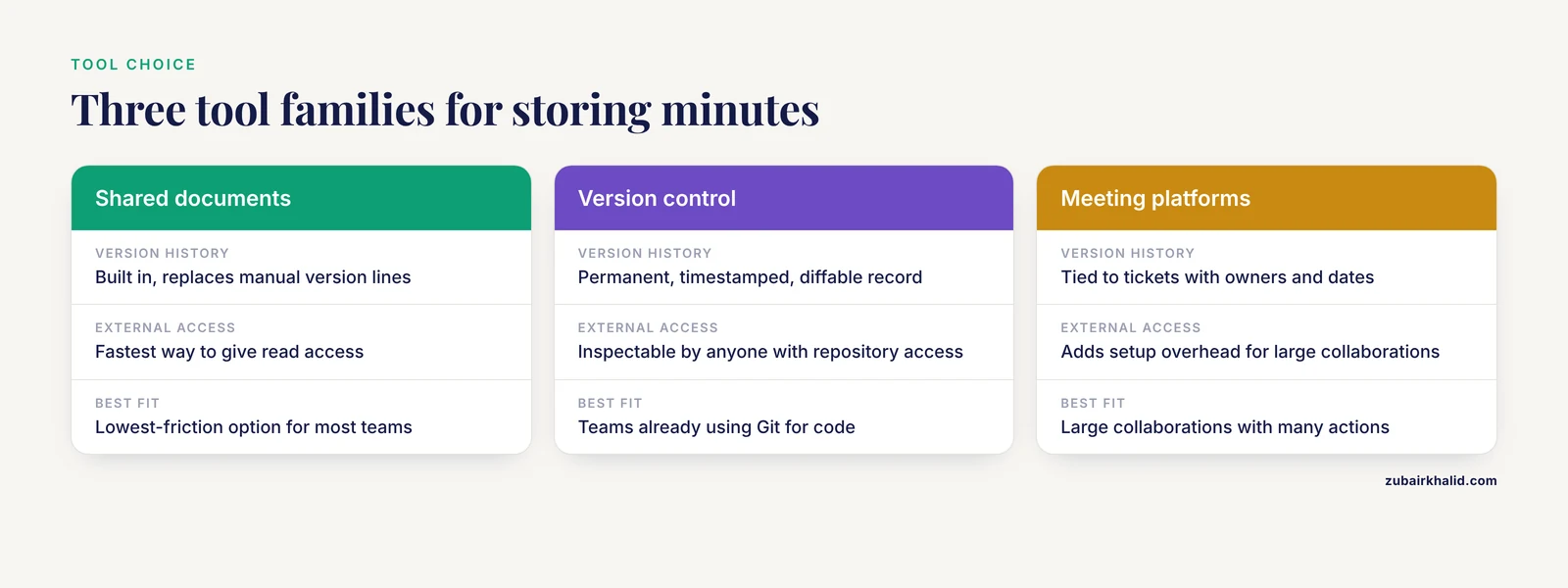
The template above is tool-agnostic. Three tool families cover almost every research team's needs, and the choice matters less than the discipline of using one system consistently.
Shared documents. A cloud document with comment threads and version history is the lowest-friction option. Version history substitutes for manual version lines, though keeping the explicit version field still helps when documents get exported or printed. For teams working across institutions, shared documents are usually the fastest way to give external collaborators read access.
Version-controlled repositories. If your team already uses Git for code or manuscripts, store minutes as plain-text or Markdown files in the project repository. This gives you a permanent, timestamped, diffable record. The environmental scan of partnership practices found that teams increasingly document governance, roles, and reporting in shared, inspectable places [4], and a repository is the most inspectable place available. Commit the minutes after each approval with a message like "Approve minutes 2026-07".
Structured meeting platforms. Dedicated meeting tools and project trackers tie action items to tickets with due dates and owners. This is powerful for large collaborations but adds setup overhead. A reasonable progression is to start with shared documents and migrate action items into a tracker only when the action list outgrows a table.
Two integration rules make any tool choice work. First, every action item must live in exactly one system of record. If the minutes list it, the tracker references the minutes, not the other way around. Second, the archive location must be named in the minutes themselves, so a future reader can find the full series.
For multi-site collaborations, minutes also carry a communication function. The Canadian pediatric palliative care study found that unclear roles and responsibilities among team members created fragmentation risk, while structured joint meetings with shared planning supported consistent messaging [5]. Writing roles and decisions into a circulated record is the cheapest available fix for that failure mode.
Adapting the Template for Committees and Advisory Groups
The same template extends to governance bodies, with small modifications.
Ethics and review committees. Add a field recording which documents each item was reviewed against, for example protocol version and date. Record outcomes using the approved, modifications required, or rejected vocabulary, and capture the specific modifications requested. Minutes from real review bodies show this level of detail is what makes the record useful for later analysis of decision patterns and consistency [1][2].
Patient and public involvement groups. Add a field for accessibility arrangements and a field for how each member contributed. PPI research highlights supportive environments, clear orientation, and remuneration as conditions for meaningful involvement [7], and co-design work with children and young people in Uganda used structured workshops with documented outputs and facilitator notes to build engagement principles [8]. Documenting arrangements and contributions in the minutes signals that participation is valued, and it creates the evidence base that funders of engagement increasingly ask for [6].
Committees where transparency matters to participants. If your committee makes decisions that affect people outside the team, consider how minutes could later support transparency. Interviews with patients and clinicians about transplant selection meetings found that limited transparency of deliberations contributed to patient mistrust, and participants saw potential in making processes more understandable [9]. You do not need to publish minutes to benefit from this. Writing decisions in plain language, rather than internal shorthand, costs nothing now and preserves the option later.
Common Mistakes and Limitations
Transcribing instead of summarizing. Minutes that read like a transcript are slow to write, slow to read, and often miss the actual decision. Write decisions first, discussion second.
Actions without owners or dates. "The team will review the draft" fails the five-point test. Every action gets one name and one date.
Draft minutes that never get approved. An unapproved draft has no standing. Build the approval step into the next meeting's agenda, as the template does in section 2, so nothing lingers in draft.
Recording unverified data as fact. Label preliminary numbers as preliminary, or omit them. Minutes circulate further than their authors expect.
Editing after approval without a version change. If a correction is needed after sign-off, issue a new version with a change note rather than silently editing the approved file. Silent edits destroy the audit trail.
Skipping minutes for short meetings. Fifteen-minute calls make decisions too. A five-minute decision log beats a full template when the meeting is small, but some record must exist.
Assuming minutes alone create accountability. Minutes record commitments. They do not enforce them. Pair the action table with a standing agenda item that reviews open actions, which is how the loop closes in practice.
On limitations. This article provides a template and workflow, not a compliance standard. Institutions, funders, and regulatory bodies may impose their own documentation requirements for specific committee types, and those requirements take precedence where they apply. Individual situations with legal, regulatory, or ethical complexity should be checked against your institution's research office or relevant committee before relying on a generic template.
One further limitation deserves honesty. Minutes are a selective record, and the selection itself shapes what future readers believe happened. The Liberian IRB study explicitly interpreted its findings as a profile of what was documented rather than a measure of the committee's underlying ethical priorities, because minutes capture objections and requested changes, not every consideration [2]. Write your minutes knowing they may be read as a complete account, and record material dissent, not just majority outcomes.
Frequently Asked Questions
What should meeting minutes for a research team include?
Include the meeting identifier, date, attendance, approval of previous minutes, status of open actions, one decision or deferral per agenda item with brief rationale, new action items with owners and due dates, and the next meeting date. That structure is the core of the template in this article.
Is there a free research meeting minutes template I can copy?
Yes. The template in the section above is free to copy into any editor, with a filled-in example showing how it looks in practice. It needs no special software.
How detailed should the discussion summary be?
Two to four sentences per item is enough. Capture the positions that mattered and the reasoning behind the decision, not the conversation itself.
Who should take the minutes?
Anyone reliable who is not chairing the meeting. Rotating the role shares the load and improves the record, because different takers notice different gaps.
How soon after the meeting should minutes be circulated?
Within 24 hours for the draft, with comments due within three business days. Approval should happen by the start of the next meeting.
Should minutes record who said what?
Attribute decisions and formal positions, for example "T. Nguyen recommended deferring the power calculation." Do not attribute informal remarks, and record dissent only at the level of positions, not personality.
How do I handle confidential items in shared minutes?
Record that the item was discussed and the decision reached, and hold the detail in a restricted annex. The main minutes should note that a restricted annex exists and where it is stored.
Can meeting minutes be used as research data?
Yes, with consent and appropriate governance. Studies of advisory groups and ethics committees have analyzed minutes directly to evaluate how groups function and how decisions are made [2][7]. Plan for this at the start if evaluation is likely, since consent and documentation standards are easier to satisfy prospectively.
Sources
- Analyzing Subject Expert Committee meeting of minutes as a strategic metric for evaluating India's clinical research trajectory.
- When Scientific Validity Overshadows Justice: An Analysis of a Liberian Institutional Review Board's Minutes (2018-2019) Using the Emanuel et al. Framework.
- How strong is the administrative backbone of ethical governance? A descriptive cross-sectional study of health research ethics committees in Tanzania.
- Identifying practices for meaningful health research partnerships: series of rapid environmental scans.
- Communication Barriers and Facilitators to Specialist Pediatric Palliative Care Involvement in Pediatric Oncology Settings Across Canada.
- Patient and public involvement in a cancer prevention research department: lessons learned from the DIADEME group.
- How can we meaningfully involve older adults in aged care research? Insights from establishing a consumer research advisory group.
- Co-designing engagement principles for involving children and young people in palliative care research in low- and middle-income settings.
- Patient Participation in Organ Transplant Selection Meetings: A Qualitative Study.