How to Write an Effective Meeting Agenda for Research Teams
By Dr. Zubair Khalid, DVM, MS, PhD ·

By the end of this article you will be able to write a research meeting agenda that names every decision to be made, assigns an owner and a time limit to each item, and produces a written record your team can act on. You need nothing more than a plain text editor, a shared document your whole team can open, and a calendar invitation. Everything here works for weekly lab meetings, project check-ins, data safety reviews, steering committee calls, and multi-day consensus workshops.
The template format below is a single reusable file. You fill in six fields per item, send it at least a day ahead, and close the meeting by confirming what was decided. The rest of this article explains why each field exists, shows a filled-in example, and pulls concrete scheduling tactics from published research consensus meetings that had to get agendas right because their entire output depended on it.
Why the Agenda Is the Meeting
In research teams, the agenda does more work than in most workplaces because the output of a research meeting is usually a decision about direction, priority, or interpretation, not a task handed down from a manager. When an international consortium wants to agree on what to study next, the agenda is the instrument that makes that agreement possible.
You can see this in how large research groups actually run agenda-setting meetings. The International Foot and Ankle Osteoarthritis Consortium generated a list of 24 candidate agenda items through interactive discussion at a world congress, then asked 31 of the 45 attending delegates to score every item on a 0 to 100 rating scale and kept only the items with a mean score of 70 or above [1]. That structure, generate then discuss then score then cut, only works if the agenda states in advance that scoring will happen and how. A vague agenda item labeled "research priorities" would have produced talk, not a ranked list.
The same pattern appears across fields. A 2-day transplant meeting in Chicago organized its breakout sessions around the five World Health Organization dimensions of medication adherence, so each session had a defined scope before anyone sat down [2]. A pediatric emergency care consensus conference used a modified Delphi survey before the in-person meeting to narrow topic priorities, then gave a group of 40 organizers and participants a single 90-minute breakout session to finalize five collaborative research priorities [3]. An Utstein-style consensus meeting on extended reality in healthcare simulation sent a Delphi-informed pre-meeting survey to 24 international experts, structured the day around breakout and plenary sessions, and refined five initial domains into three overarching themes [4]. In every case, the agenda predetermined the format of each segment, and the format predetermined the output.
The lesson for a weekly lab meeting is the same at smaller scale. If you want a decision, the agenda has to say a decision is due, name the decider, and reserve time for it.
The Anatomy of a Good Research Meeting Agenda Template
A usable research meeting agenda template has a short header and a repeated item block. The header answers logistics questions so nobody asks them live. The item block forces the writer to specify, for each topic, what kind of item it is and what should exist when the meeting ends.
Use this item format for every line:
| Field | What it contains | Why it matters |
|---|---|---|
| Item | One-line topic title | Keeps discussion from drifting into adjacent topics |
| Type | Decide, Update, Discuss, Assign | Sets the expected outcome before anyone speaks |
| Owner | The one person who presents | Prevents the whole team improvising context |
| Time | Minutes allotted, including buffer | Makes the total fit the meeting length |
| Pre-read | Document to read beforehand, with link | Moves context out of meeting time |
| Output | The artifact due at the end of the item | Turns talk into a record |
The "Type" field is the one most agendas omit and most need. An Update means information flows one way and questions are for clarity only. A Discuss means the group explores an open question but no decision is due. A Decide means the meeting ends with a choice recorded in the minutes. An Assign means a task leaves the room with a named owner and a date. Meetings overrun when a team treats every item as Discuss, because Discuss has no natural stopping point. Decide and Assign do.
A Free Research Meeting Agenda Template You Can Copy
Here is the complete template in Markdown. Save it once in your shared repository and copy it for each meeting. This doubles as a free research meeting agenda template file for any lab using Git, Notion, Google Docs, or a plain shared drive.
# [Project or Lab] Meeting Agenda

**Date:** YYYY-MM-DD
**Time:** HH:MM to HH:MM (time zone)
**Location / call link:** [link]
**Chair:** [name]
**Minutes taker:** [name]
**Attendance confirmed:** [names]

## Standing items
| # | Item | Type | Owner | Min | Pre-read | Output |
|---|------|------|-------|-----|----------|--------|
| 1 | Action item review | Decide | [name] | 5 | Last minutes | Confirmed or reassigned |
| 2 | Risks and blockers | Update | All, 1 min each | 10 | None | Blocker list in minutes |

## This meeting's items
| # | Item | Type | Owner | Min | Pre-read | Output |
|---|------|------|-------|-----|----------|--------|
| 3 | [Topic] | [Type] | [name] | [n] | [link] | [artifact] |
| 4 | [Topic] | [Type] | [name] | [n] | [link] | [artifact] |

## Decisions log
| Decision | Date | Owner | Rationale |
|----------|------|-------|-----------|

## Parking lot
- [topics raised but deferred, with the meeting they go to]

## Next meeting
**Date:** YYYY-MM-DD
**Proposed items:** [list]
Three details in this format deserve explanation. The standing item for action item review comes first, not last, because reviewing commitments at the start makes people arrive accountable. The parking lot exists so the chair can deflect off-topic contributions without dismissing them, which preserves goodwill and protects the clock. The decisions log is a running table across meetings, not a per-meeting section, so that a new lab member can read one document and know what the team has already settled.
Worked Example: A Filled-In Agenda
Here is the same template format filled in for a realistic weekly project meeting of a five-person academic research team studying an applied problem.
# Bacterial Growth Curve Project - Weekly Meeting Agenda

**Date:** 2026-11-16
**Time:** 10:00 to 11:00 (Eastern)
**Location:** Zoom link in calendar invite
**Chair:** R. Osei
**Minutes taker:** D. Vance
**Attendance confirmed:** RO, DV, MK, PL, SC

## Standing items
| # | Item | Type | Owner | Min | Pre-read | Output |
|---|------|------|-------|-----|----------|--------|
| 1 | Action item review | Decide | RO | 5 | Minutes of 11-09 | Each action confirmed or reassigned |
| 2 | Risks and blockers | Update | All | 10 | None | Blocker list with owners |

## This meeting's items
| # | Item | Type | Owner | Min | Pre-read | Output |
|---|------|------|-------|-----|----------|--------|
| 3 | Plate reader calibration drift | Decide | MK | 15 | Calibration log CSV | Choice of recalibration schedule, recorded in minutes |
| 4 | Manuscript figure 3 revision | Discuss | DV | 15 | Draft figure v4 | List of changes DV will make by 11-20 |
| 5 | Conference abstract deadline | Assign | PL | 10 | Draft abstract | Owner and internal deadline confirmed |

## Parking lot
- New incubator quote (to facilities meeting 11-18)

## Next meeting
**Date:** 2026-11-23
**Proposed items:** Figure 3 revision review, statistics plan for replicate analysis
The expected output of this meeting, if the agenda worked, is three written records: an updated decisions log with one new row for the calibration decision, an action list with named owners and dates, and a parking lot with one deferred item. Anything else is unfinished business that carries to the next agenda.
Step-by-Step: Building and Filling the Template
Work through these seven steps for each meeting. The first time takes about 20 minutes. Once the standing items are fixed, recurring meetings take about 10 minutes to prepare.
Step 1. Save the template file once. Create a folder in your shared drive or repository called meetings. Inside it, save the blank template as _template.md. Copy it for every new meeting so the format stays stable across the project.
Step 2. Set the header. Fill in date, time with time zone, location, chair, and minutes taker. Rotate the minutes taker if the team is small, because shared note-taking keeps one person from always documenting while others talk.
Step 3. Collect items from the team. Ask for agenda items in writing, in a channel or shared doc, 48 hours ahead. Set a cutoff and hold it. This mirrors what consensus meetings do with pre-meeting surveys. The XR simulation consensus meeting collected topics through a structured pre-meeting survey before anyone met, which let the organizers arrange the day around themes rather than improvise [4]. The social work supervision consensus project used a modified Delphi survey as its first phase for the same reason, to surface and narrow topics before discussion [5].
Step 4. Assign a type, owner, time, and output to every item. This is the step people skip and then regret. Rule of thumb for a 60-minute meeting with five people: no more than one Decide item per 15 minutes of meeting time, because genuine decisions with discussion need the full block. If you have three decisions, extend the meeting or move one to the next agenda rather than compressing all three.
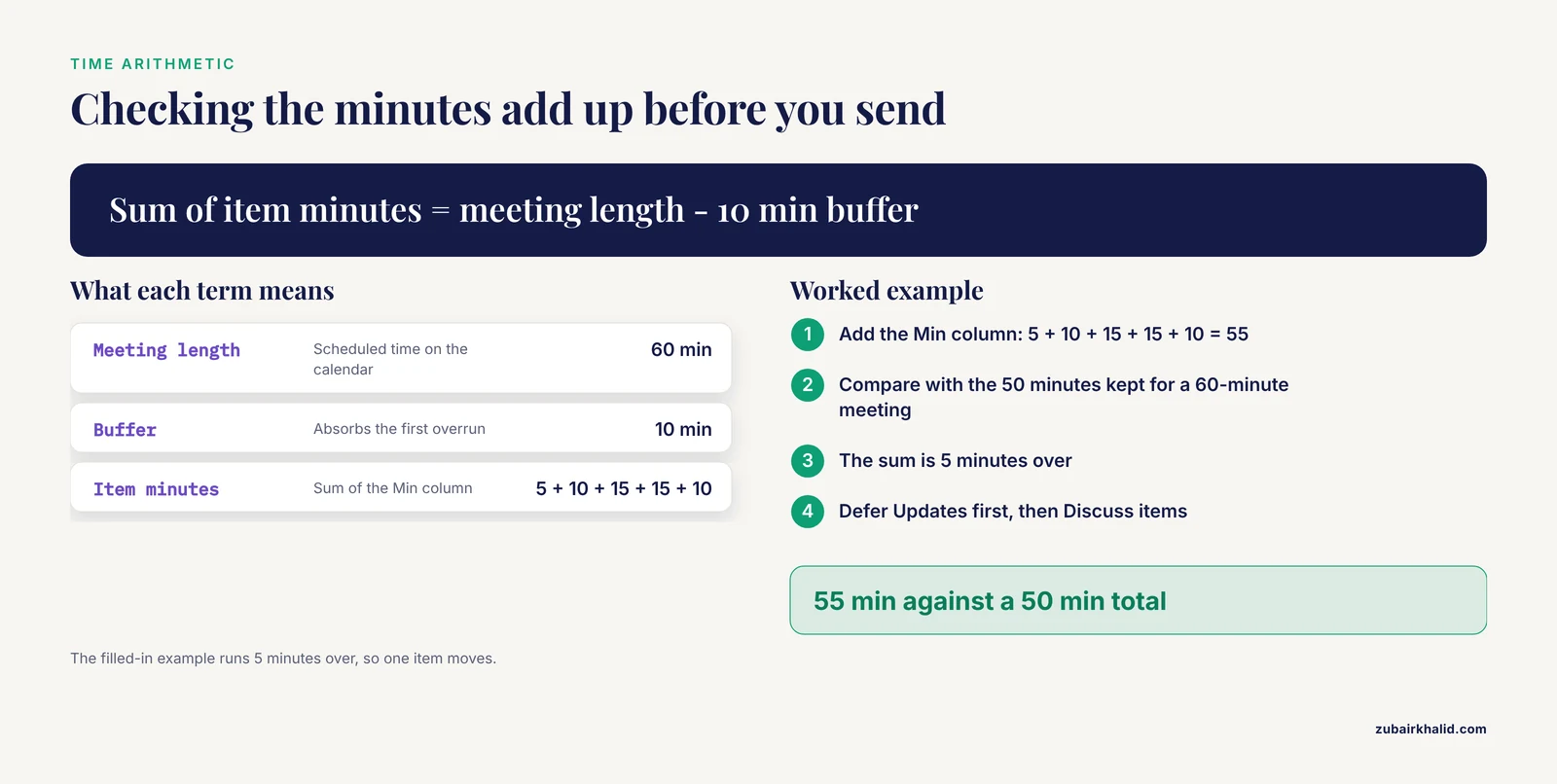
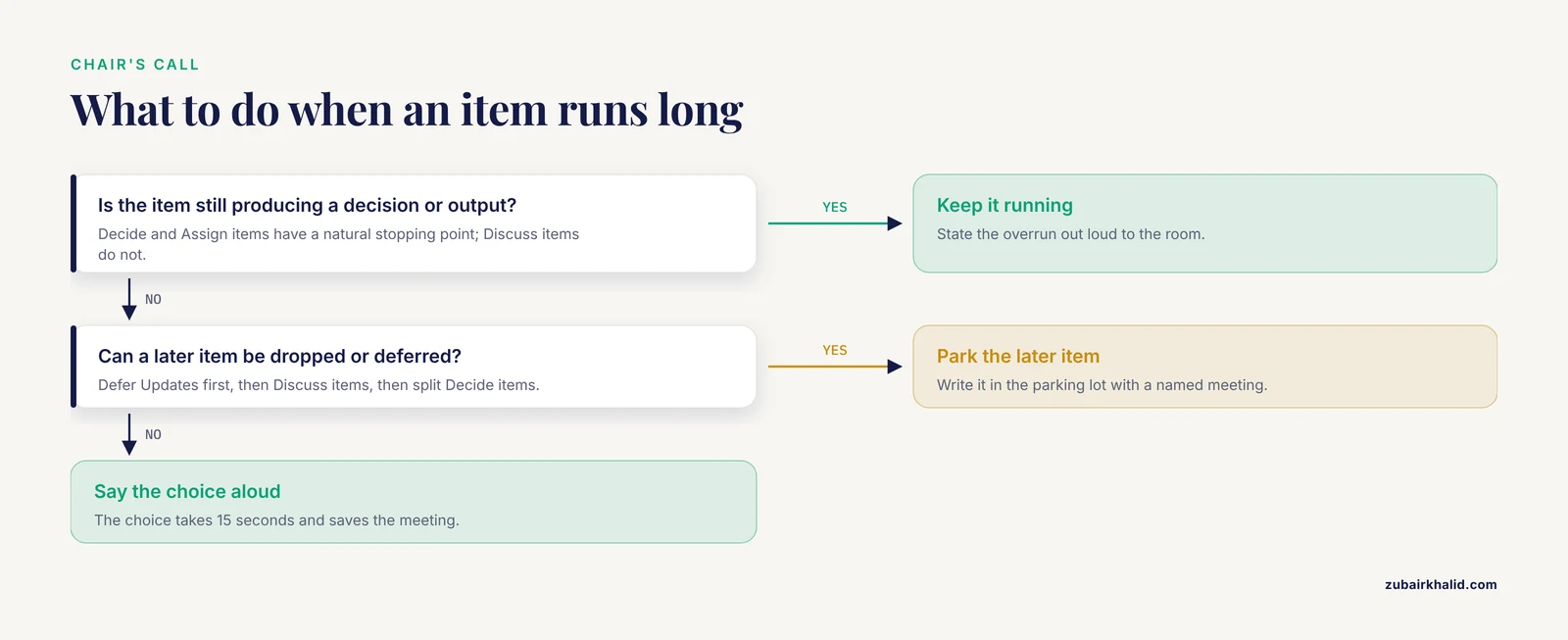
Step 5. Check the time arithmetic. Sum the minutes column and compare it to the meeting length. Keep the sum at 50 minutes for a 60-minute meeting. The missing 10 minutes is not slack, it is the buffer that absorbs the first overrun without cascading. If the sum exceeds your budget, cut or defer items by type in this order of preference: defer Updates first, then Discuss items, then split Decide items across meetings only if the decision is genuinely independent.
Step 6. Send the agenda with pre-reads attached. Send it at least 24 hours ahead and state in the message that pre-reads are expected. For meetings where a real ranking or decision is due, a pre-meeting input round measurably changes the quality of the live discussion, which is why the pediatric emergency care consensus group ran its priority survey before the meeting rather than during it [3].
Step 7. Close the loop after the meeting. The minutes taker sends notes within one working day. Update the decisions log and the action list in the shared file. Then carry unresolved items into the next agenda explicitly, as proposed items, so nothing silently disappears.
Techniques Worth Borrowing from Consensus Meetings
Research groups that run agenda-setting workshops have already stress-tested most agenda design problems. Four of their tactics transfer directly to ordinary team meetings.
Use breakout structure for large or contentious topics. The transplant adherence consensus meeting in Chicago did not try to resolve a multidimensional problem in one plenary discussion. It created breakout sessions mapped to the five WHO dimensions of adherence, then reassembled to integrate results [2]. The transplant exercise consensus meeting in Toronto took the same shape, with a multidisciplinary group of clinicians, researchers, administrators, and patient representatives working through structured discussion over 2 days [6]. For your lab, the equivalent is splitting a heated methodological dispute into two 20-minute structured discussions with a defined question each, rather than one open-ended argument.
Score options rather than debating them in sequence. The osteoarthritis consortium's approach, rating each candidate item on a 0 to 100 scale and applying a cutoff at a mean of 70, converted a discussion that could have lasted days into a ranked shortlist [1]. Any team choosing between experiment designs, analysis approaches, or candidate aims can use a simple version. Have everyone score options privately first, reveal scores together, then discuss only the spread. Private scoring before group discussion reduces anchoring on the first opinion spoken.
Put the right people in the room, not the most people. The NIH Fogarty International Center workshop on childhood obesity prevention in Latin America deliberately convened researchers, policymakers, program implementers, and public health advocates together, because each group held information the others lacked [7]. For a research team, the analogous move is inviting the data manager to the agenda item about data collection, not expecting secondhand reports afterward. The aphasia research consensus work distributed its drafted objectives to more than 180 network members for review and approval, a reminder that the people affected by decisions should see them in writing [8].
Timebox ruthlessly and make the box visible. A 90-minute breakout session at the pediatric emergency consensus conference produced five consensus priorities because the scope was fixed in advance [3]. Put the minutes on the agenda where everyone can see them. When an item runs over, the chair states the overrun and offers the room a choice, extend this item and drop a later one, or park it. That choice takes 15 seconds and saves the meeting.
Documenting the Meeting: Minutes That Match the Agenda
The agenda and the minutes should share a structure, item for item, so anyone can check what happened against what was planned. This matters more in research than in most settings because meeting records sometimes become data. Regulators analyze committee minutes to study decision patterns. One analysis of Subject Expert Committee meeting minutes at India's drug regulator examined four years of records covering 4,563 agenda items, of which about 78 percent were evaluable, to characterize decision-making trends across 551 meetings [9]. That kind of retrospective analysis is only possible when minutes record the agenda item, the outcome, and the rationale, which is exactly what the decisions log in the template captures.
For participatory research teams, where patients, caregivers, or community members serve as co-researchers, the meeting record has an additional function. A qualitative evaluation of two participatory oncology and palliative care projects found that meaningful participation depended on early involvement, transparent communication, visible use of people's contributions, and accessible research tasks [10]. In agenda terms, that means sending the agenda early enough for non-academic co-researchers to read it, writing items in plain language, and recording in the minutes when a contribution changed a decision. If a patient co-researcher's suggestion alters the study design, the decisions log should say so.
Connecting the Agenda to Your Research Project Plan
An agenda is a tactical document. It works best when it sits on top of a strategic one. In research project management terms, the agenda answers "what must we decide this week" while the research project plan answers "what must be true by month six." The two connect through a simple rule: every Decide or Assign item on any agenda should trace to a milestone, deliverable, or risk in the project plan, and every milestone in the plan should at some point appear as an agenda item as its deadline approaches.
You do not need elaborate software to maintain this. A research project plan template can be a single Markdown table with columns for milestone, owner, target date, status, and the meeting where it will be discussed. When you write each weekly agenda, scan the plan for anything due within four weeks and pull it forward as an agenda item. When a meeting changes a decision, write the change back into the plan the same day. Teams that skip the write-back accumulate a plan that describes a project they are no longer running.
For a long project, add one standing agenda item per month called "plan review," typed as Update, five minutes, where the project lead reads out milestones passed and slipped. That is usually enough to keep the plan honest without turning every meeting into a status meeting.
Common Mistakes and Limitations
Sending the agenda at the meeting itself. An agenda distributed at the start is a table of contents, not an agenda. Its purpose is to let people prepare. If your team consistently arrives without reading it, shorten the pre-reads before you shorten the agenda.
Letting one item consume the meeting. The most common failure is an unplanned deep discussion in the first 15 minutes that pushes every later item off the agenda. The fix is the chair's extend-or-park choice, stated out loud, every time an item runs long.
Writing items as nouns instead of outcomes. "Budget" is not an agenda item. "Decide whether to reallocate $2,000 from sequencing to analysis support" is. If you cannot write the item as a question or a decision, you do not yet know what the meeting should do with it.
Overloading updates. Status updates that could be read asynchronously do not deserve synchronous time. Convert routine updates to written pre-reads and keep the live slot for Decides and genuinely interactive Discuss items.
No minutes taker. If nobody is assigned, the decisions log stays empty and the same decision gets relitigated in three weeks. Assign the role in the header every single time, even for short meetings.
A limitation to keep in view. The published consensus meetings cited here ran for days with professional facilitation and small expert groups. Their methods transfer to lab meetings in scaled-down form, but a weekly one-hour meeting will not produce what a 2-day facilitated workshop produces, and individual team circumstances vary. Adapt the techniques to your team size and meeting cadence rather than copying any single meeting's format wholesale.
Frequently Asked Questions
How far in advance should I send a research meeting agenda?
Send it at least 24 hours before the meeting, and 48 hours when any item requires reading a document or forming a position. Consensus meetings that depend on structured input almost always collect it before people arrive, not during the session.
What is the difference between a Decide item and a Discuss item?
A Decide item must end with a recorded choice made by a named person or the group. A Discuss item is exploratory and ends with a summary of positions or a list of options, with the decision deferred to a later agenda. Labeling items correctly is what stops meetings from running over.
How long should each agenda item be?
Budget 5 minutes for an Update, 10 to 15 minutes for a Discuss item in a small group, and at least 15 minutes for a genuine Decide item that involves options and tradeoffs. Then sum the minutes and confirm the total fits the meeting length with a 10-minute buffer.
Can I use this research meeting agenda template for a conference or multi-day workshop?
The item format transfers, but a multi-day event needs session blocks, breakout assignments, and a facilitation plan that a weekly template does not carry. Published consensus workshops typically pair a pre-meeting survey with alternating breakout and plenary sessions, and you should plan the same two-layer structure if your goal is a ranked output.
How do I handle people who derail the agenda?
Use the parking lot. Write the off-topic contribution there, in front of the group, and name the meeting where it will be discussed. This acknowledges the point without surrendering the clock, and it gives chronic derailers a legitimate route for their concerns.
What belongs in the minutes versus the agenda?
The agenda is the plan and the minutes are the record. Minutes should list each agenda item, the outcome or decision, the owner of any resulting action, and any rationale worth preserving. If a decision is likely to matter later, for example a change to study design, record the reason for it, because future readers of the minutes will ask.
How many items should a one-hour research meeting have?
Three to five items, with at most one or two of them Decide items. Five people for 60 minutes supports roughly 50 minutes of scheduled content. If you routinely have eight items, the problem is meeting frequency or item quality, not agenda length.
Is a written agenda really necessary for a small lab of two or three people?
Yes, because the agenda's main value is not ordering the conversation, it is forcing item owners, decision types, and outputs to be explicit before the meeting. Small teams skip it and then quietly lose decisions and commitments. A five-line agenda in a shared file costs two minutes and prevents that.
Sources
- International Foot and Ankle Osteoarthritis Consortium review and research agenda for diagnosis, epidemiology, burden, outcome assessment and treatment
- Meeting report: Consensus recommendations for a research agenda to address immunosuppressant nonadherence in organ transplantation
- Pediatric Emergency Care Research Networks: A Research Agenda
- Setting a research agenda for the use of extended reality in healthcare simulation: an Utstein style meeting.
- Towards an International Consensus on a Research Agenda for Social Work Supervision: Report on the First Survey of a Delphi Study
- Meeting Report: Consensus Recommendations for a Research Agenda in Exercise in Solid Organ Transplantation
- Preventing Childhood Obesity in Latin America: An Agenda for Regional Research and Strategic Partnerships
- An aphasia research agenda - a consensus statement from the collaboration of aphasia trialists
- Analyzing Subject Expert Committee meeting of minutes as a strategic metric for evaluating India's clinical research trajectory.
- Enabling meaningful participation and involvement in oncology and palliative care research: insights from two participatory research projects.