How to Build a Strong Research Integrity Culture
By Dr. Zubair Khalid, DVM, MS, PhD ·

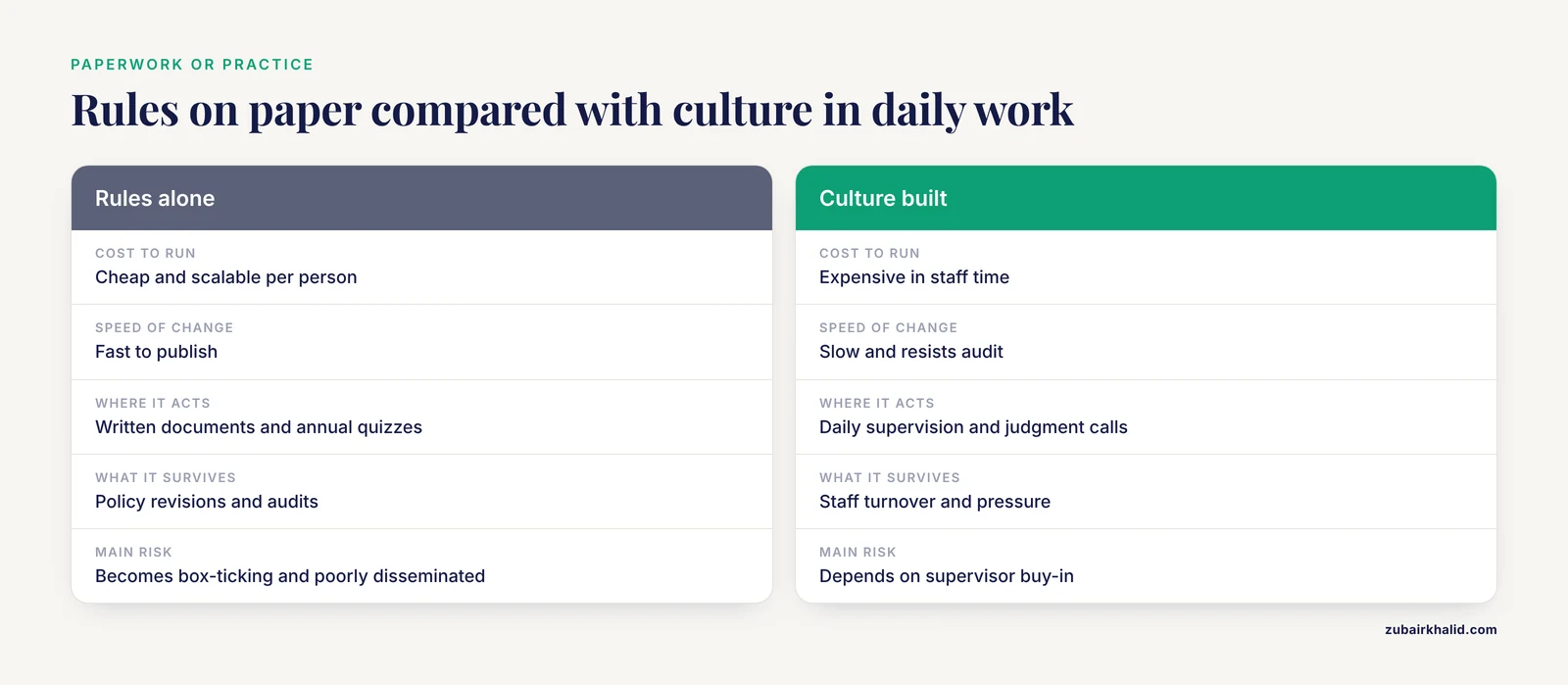
The difference between a rules-driven institution and a culture-driven institution is simple: rules tell researchers what they cannot do, while a research integrity culture makes honest, careful, transparent work the default behavior even when nobody is watching. A rule of thumb for choosing where to invest: if your institution mainly writes policies and runs a yearly online compliance quiz, it has paperwork, not culture. Culture is built through supervision, incentives, training that people actually engage with, and honest handling of failure.
This article explains what a research integrity culture is, compares the main options institutions and research groups use to build one, weighs the pros and cons of each, and works through concrete scenarios for principal investigators, administrators, and trainees.
What a research integrity culture actually means
Research integrity refers to the honesty, rigor, and accountability of the research process itself, including how data are generated, analyzed, reported, and credited. Research ethics is the broader field covering the moral responsibilities of research, including the treatment of human and animal subjects. Responsible conduct of research (RCR) is the practical, teachable set of skills that connects the two, covering topics such as data management, authorship, plagiarism, conflicts of interest, and mentorship.
These three ideas overlap but are not identical. Macleod describes how research integrity, research culture, and open research interact as connected layers of the same system, where reforms in one layer (for example, sharing data openly) reinforce or undermine the others depending on how they are implemented [1].
The case for culture over rules alone comes from repeated observation that misconduct keeps happening in institutions with formal policies on the books. Ellis argued in The Lancet Oncology that the erosion of research integrity calls for culture change rather than only more regulation, because individual misconduct cases are symptoms of a system that rewards shortcut behavior [2]. A multi-actor study of the Flemish biomedical landscape reached a similar conclusion from a different direction. Researchers, funders, editors, and technicians described problems tied less to individual character and more to the climates in which researchers operate, and noted that the very elements defined as success, such as publication counts and grant income, can accentuate those problems by disrupting research culture [3].
That framing matters for how you spend your effort. Policy documents are necessary but cheap. Culture is expensive because it lives in daily practices, in how a supervisor responds to an unexpected result, and in what gets a person promoted.
Research integrity culture options: a side-by-side comparison
Institutions and research groups typically combine several of the options below. De Peuter and Conix grouped institutional action into three broad categories: policies, procedures, and processes, dealing with breaches of research integrity, and education and training [4]. The table adds two further options that the literature treats as distinct levers, open research practices and culture measurement.
| Option | What it looks like in practice | Main strengths | Main limits | Best fit |
|---|---|---|---|---|
| Policies, codes, and procedures | Written codes of conduct, data management plans, authorship criteria, reporting channels | Low cost, scalable, sets legal and moral baseline | Weak alone, often poorly disseminated, can become box-ticking | Every institution, as the floor |
| Breach handling systems | Independent investigations, confidential reporting routes, consistent sanctions | Builds trust when fair, deters repeat behavior | High stakes, slow, can punish whistleblowers if badly run | Institutions with real enforcement power |
| Formal RCR training | Required courses on ethics, data management, authorship | Reaches everyone, standardizes vocabulary | Lecture formats produce shallow learning, decays quickly | Doctoral programs, onboarding |
| Role-play and role-model programs | Rotatory role-play scenarios, visible senior champions | Builds judgment, engages learners, adaptable by discipline | Needs trained facilitators, takes staff time | Teaching-heavy settings, early career groups |
| Supervision and mentoring reform | Training supervisors, clarifying expectations, feedback loops | Shapes daily behavior where integrity actually happens | Slow, depends on supervisor buy-in, hard to audit | Labs, departments, graduate schools |
| Open research practices | Preregistration, data and code sharing, registered reports | Makes errors detectable, deters selective reporting | Adds workload, discipline-specific feasibility varies | Fields with digital data and reproducible workflows |
| Culture measurement | Institution-wide surveys, feedback to leadership, published results | Locates specific problems, tracks change over time | Only as good as the response rate and follow-through | Universities and large institutes |
No single option is the best research integrity culture on its own. The evidence supports layering them, and the details of each option explain why.
The options explained on their own terms
Policies, procedures, and processes
Codes of conduct, authorship policies, data management requirements, and conflict-of-interest rules define the baseline of responsible conduct of research. Their strength is scalability. A single policy reaches every researcher without per-person cost.
Their weakness is the gap between paper and practice. In a qualitative study of Japanese researchers and administrators, participants observed that research integrity regulations were not widely disseminated, and proposed more concrete educational materials to close that gap [5]. A parallel analysis from China found that despite a series of government regulations and institutional measures, plagiarism and falsification incidents continue to occur, and argued that the deep-seated causes lie in the culture of science rather than in the absence of rules [6]. Policies set expectations. They do not automatically create the daily judgment calls that integrity demands.
For policies to work, they need three features: they must be discoverable in the moment a decision arises, they must be short enough that researchers actually read them, and they must be enforced consistently when violated.
Dealing with breaches of research integrity
How an institution responds to a misconduct allegation is a culture signal more powerful than any policy statement. De Peuter and Conix treat breach handling as one of three core pillars of institutional action, alongside policies and education [4]. Effective systems share three traits. Investigations are run by people independent of the lab under scrutiny. Reporting channels are confidential and protect whistleblowers from retaliation. Sanctions are proportionate and applied consistently regardless of the seniority or productivity of the person involved.
When breach handling is perceived as arbitrary or protective of senior faculty, the organizational lesson researchers absorb is that honesty is risky. That lesson undoes years of training.
Formal responsible conduct of research training
Most doctoral programs now require some RCR instruction. The question is not whether to train but how. Löfström and colleagues analyzed the training materials of four European Union funded projects and found that the most effective programs share a constructivist or socio-constructivist understanding of learning, meaning learners build their own judgment through active engagement rather than passively absorbing rules. The trainings implemented activating and engaging learning activities and emphasized higher-order learning objectives, such as evaluating and applying norms, rather than merely recalling them [7].
A practical takeaway from that analysis is to audit your own training against learning objectives. If the objective of your session is that participants can name the definitions of fabrication, falsification, and plagiarism, you are teaching recall. If the objective is that participants can judge a difficult authorship dispute and justify their decision, you are teaching judgment. The second objective maps far better onto the situations researchers actually face.
Role-play and role-model programs
The Path2Integrity project developed rotatory role-play scenarios and visible role-models for secondary school students, undergraduates, graduates, and early career researchers. Its handbook contains vivid stories involving research integrity dilemmas, and the rotation of roles within a scenario increases students' ability to form judgments about accepting or rejecting norms in research. A train-the-trainer program shows educators how to adapt the material to their own discipline and organization [8].
Role-play works because it forces a person to argue a position they may not hold, such as defending a questionable authorship addition from the perspective of the person adding it. That experience builds the evaluative skill that lectures cannot. The approach also scales down well. A single lab meeting of 45 minutes can run one scenario with no external facilitator if the PI has completed a train-the-trainer session.
There is one caution. Culture perception is shaped by signaling, and researchers can be judged by the company their field keeps. A study of psychedelic researchers across three studies with 952 participants found that self-admitted substance use lowered perceived researcher integrity, while association with stereotyped elements of psychedelic culture lowered perceived research quality, particularly among audience members without personal experience with the substances [9]. The practical lesson for integrity culture building is that community events, conference culture, and public signaling all feed into how much the wider public trusts a research community, which is part of what integrity culture exists to protect.
Supervision and mentoring reform
Daily supervision is where research integrity culture is transmitted, or eroded, more than anywhere else. The largest direct evidence on this comes from a university-wide survey at KU Leuven in Belgium. Researchers of KU Leuven were invited to complete a questionnaire assessing attitudes toward research integrity and the local research culture, with a specific emphasis on the supervision of junior researchers. Of 7,353 invitations, 1,866 responses were collected, a 25.3 percent response rate, of which 1,723 responses were analyzed [10].
The headline finding is a supervision perception gap. Supervisors evaluated their supervision of junior researchers almost unanimously as positive, but fewer supervisees evaluated it the same way [10]. Both groups work in the same labs under the same policies, yet they experience the culture differently. The survey also identified data management as an area of concern, both in reviewing raw data and in data storage, and found that fewer female professors felt safe to speak up than male professors even as more female professors emphasized open communication and supported their supervisees' development [10].
Two features made this survey useful rather than decorative. First, it asked about specific daily practices, such as how often raw data are reviewed, rather than asking abstract questions about whether integrity matters. Second, the results were fed back to the university board and to faculties and departments, and served as input to update research policy [10]. Measurement without follow-through produces cynicism. Measurement with follow-through produces change.
Open research practices
Open research practices, including preregistering hypotheses, sharing data and code, and publishing through formats that accept the protocol before results are known, change the incentive structure of research itself. Because open practices make the full research trail inspectable, questionable practices such as selective outcome reporting become detectable, which shifts the risk calculus away from cutting corners. Macleod's analysis of how open research, research culture, and research integrity interact frames openness as a structural support for integrity rather than a separate agenda [1].
The limits are practical. Some fields work with data that cannot be shared for legal or ethical reasons, and shared data still require curation. Open practices therefore complement, rather than replace, the human elements of culture such as supervision and training.
Recognition and incentive reform
Success in science is defined in practice by indicators, and indicators shape behavior. In the multi-actor study cited earlier, respondents described success as a multi-factorial, context-dependent, and mutable construct, shaped by an interaction between personal characteristics, institutional conditions, and the assessment systems researchers face [11]. The companion paper documented tension between what actors say promotes integrity and what their assessment systems reward [3].
An institution serious about integrity culture reviews its promotion and grant criteria and asks a direct question: does our definition of success reward careful, honest, reproducible work, or does it reward volume? If the answer is volume, every training course you run is swimming against the current.
Pros and cons: how to choose your mix
The real choice is rarely between options but between emphases, and the trade-offs differ by institution size, discipline, and career stage.
Policies are cheap and fast but produce shallow change. Training is scalable but decays unless reinforced. Role-play produces durable judgment but is resource-intensive to facilitate well. Supervision reform reaches the daily behaviors that policies cannot, but moves slowly and resists audit. Open practices change incentives structurally but add workload and do not fit every discipline equally. Measurement locates real problems but only pays off when leadership acts on the results. Breach handling is high impact but operates after harm has occurred.
A reasonable default sequence for a university starting from a low base is the following five steps.
- Publish or refresh a short, readable code of conduct with clear authorship and data management expectations.
- Replace the passive compliance module with an interactive format, using case discussion or role-play rather than slides, and connect it to learning objectives that target judgment rather than recall [7].
- Train supervisors explicitly, because the supervision perception gap will not close by itself [10].
- Establish or publicize a confidential reporting channel and commit publicly to how reports are handled.
- Run a baseline culture survey, share the aggregate results openly with the community, and announce at least one concrete policy change that resulted [10].
For a single laboratory, steps 2 through 4 are the practical core, delivered through lab meetings and a written onboarding document for new members.
Worked scenarios
Scenario 1: A new principal investigator building a lab of six. Dr. Chen has just started an assistant professorship with two PhD students, two master's students, and a technician. Her highest-leverage moves cost almost nothing. She writes a one-page lab charter covering raw data storage, notebook conventions, authorship criteria, and the expectation that negative results are reported at lab meeting. She runs one 45-minute role-play scenario at a lab meeting each semester, adapted from published role-play handbooks [8]. She reviews raw data with each trainee monthly, directly addressing the data management weakness found in the large university survey [10]. When her first student gets a result that contradicts the grant application's preliminary data, the charter she wrote in week one determines whether that conversation is easy or impossible.
Scenario 2: A research office at a mid-size university. The office has budget for one major initiative per year. The literature suggests the order that yields the most return is supervisor training first, because supervision shapes more daily decisions than any other single lever. The office trains 80 principal investigators over a year using a dialogical case-based format, then runs an institution-wide survey modeled on instrument designs like the KU Leuven questionnaire, reports results back to faculties, and uses the findings to update policy [10]. In year two, it adds a role-play program for doctoral cohorts [8].
Scenario 3: A graduate student who suspects a problem. A student notices a figure in her lab's manuscript that does not match the underlying data. In a strong culture, three supports are already in place: a written data management policy she can check to confirm the discrepancy, a named person outside the lab, such as an ombudsperson or integrity officer, she can consult confidentially, and a departmental norm that raising concerns is treated as a service rather than a betrayal [4]. A student entering a new lab should locate all three supports during the first week, before any problem arises.
Common mix-ups
Mistaking compliance for culture. A completed training module is not evidence of an integrity culture. Students themselves draw this distinction. In a cross-cultural qualitative study of students in Germany and Bulgaria, participants across both countries agreed categorically on the significance of research integrity, but the study revealed intercultural differences in how students understood integrity, in the value-action gap between what they endorsed and what they did, and in their preferences for enforcement approaches and training [12]. The value-action gap is the core insight here. People can sincerely value integrity and still act otherwise under pressure, which is why culture and practice design matter more than stated values.
Treating misconduct and questionable research practices as the same problem. Fabrication, falsification, and plagiarism are the serious, sanctionable end of the spectrum. Questionable research practices, such as selective reporting, vague authorship, or sloppy data storage, are far more common and erode trust gradually. Culture building is mostly about the second category, because the first category is usually visible only after the second has been tolerated for years.
Treating authorship as an administrative detail. Authorship carries real responsibility, and repeated authorship misconduct occurs both intentionally, such as buying or gifting authorship, and through suboptimal training about what being an author obligates a person to do. From a publisher perspective, addressing gaps in understanding ethical authorship practices requires training co-developed and deployed across stakeholders, including institutions, funders, publishers, and researchers [13]. If your institution's integrity program has no authorship component, it is missing one of the most frequent failure points, a gap made sharper by the arrival of generative AI tools in the writing process without appropriate guardrails [13].
Assuming integrity problems are caused by bad individuals. The multi-actor study found that different actors attribute problems either to personalities and attitudes or to the climates in which researchers operate, and that the climates explanation is the one that points toward fixable systems [3]. Individual accountability and system redesign are both needed, but institutions habitually overinvest in the first and underinvest in the second.
Common Mistakes and Limitations
- Running a survey and burying the results. The KU Leuven survey worked because its findings fed into policy updates and detailed reports to faculties and departments [10]. A survey whose results disappear into an administrator's drawer actively damages trust.
- Training once, at onboarding, forever. Integrity judgment is a skill that needs practice with realistic dilemmas, not a fact set absorbed once. Taxonomies of learning can help trainers state whether a session aims at recall, application, or evaluation, and communicate that aim to learners [7].
- Assuming one policy fits all disciplines and cultures. Understanding and practice of research integrity vary across cultures, even between two European countries in the same study, so imported training materials need adaptation rather than direct translation [12]. Within a single country, the Japanese study identified boundary ambiguity around what research integrity even covers, with participants calling for a new definition, alongside barriers rooted in the laboratory environment, job security for junior researchers, and pressures faced by principal investigators [5]. These are structural problems that a generic training module cannot touch.
- Expecting policy alone to change behavior. Both the Chinese and Japanese analyses document persistent integrity problems despite substantial regulation, pointing to culture as the operative variable [5][6].
- Overestimating what individual intentions can resist. Even the perceived integrity of researchers is shaped by contextual signals outside their control, such as the stereotyped associations of their field's public culture [9]. This is a limitation of integrity perception as a metric, and a reason institutions should judge conduct against defined standards rather than vibes.
- Ignoring who feels safe to speak. The finding that fewer female professors felt safe to speak up than male professors, at the same institution with the same policies, shows that psychological safety is not evenly distributed and must be measured and addressed deliberately [10].
- Forgetting that individual cases need case-level handling. Frameworks and surveys guide system design. A specific suspected breach requires your institution's named procedures and, where applicable, its research integrity officer, not a general checklist.
Frequently Asked Questions
What is the difference between research integrity and research ethics?
Research ethics covers the moral responsibilities of research broadly, including the treatment of human participants and animals. Research integrity focuses on the honesty and rigor of the research process itself, including data handling, analysis, reporting, and authorship. Responsible conduct of research is the practical skill set where the two meet.
What does responsible conduct of research training typically involve?
It covers topics such as data management, authorship, plagiarism, conflicts of interest, collaboration, and mentorship. The most effective programs use active, case-based, or role-play formats aimed at building judgment, rather than passive formats aimed at recall of rules.
Can a strong research integrity culture exist without formal policies?
No. Policies are the floor that defines expectations and enables enforcement, and breach handling systems are a core pillar of institutional integrity work [4]. But policies without supervision, training, and aligned incentives produce documents, not culture.
How do open science practices support research integrity?
Open practices such as preregistration, data sharing, and transparent reporting make the full research trail inspectable, which makes selective reporting and post-hoc rationalization easier to detect. They change the structure of incentives rather than relying only on individual virtue.
What should I do if I suspect misconduct in my lab?
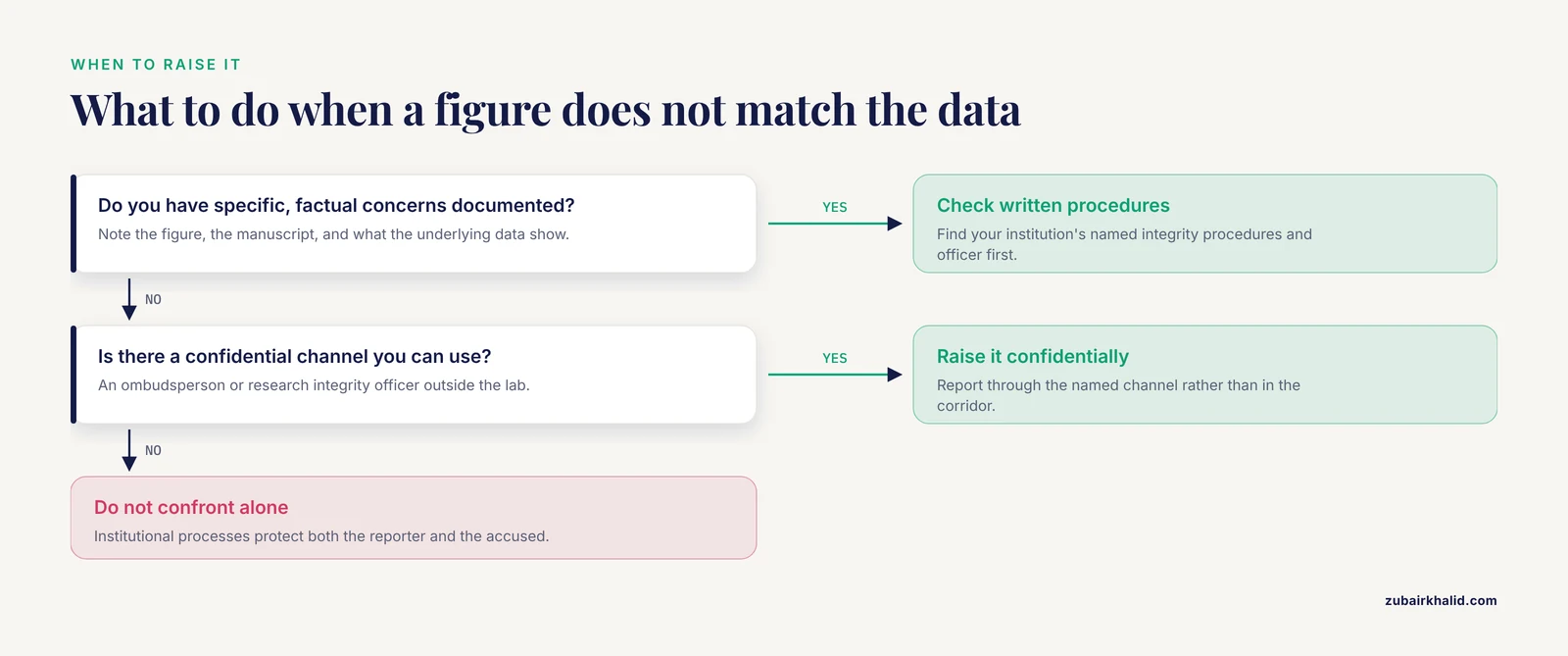
Check your institution's written procedures first, document your specific concerns factually, and raise them through a confidential channel such as an ombudsperson or research integrity officer [4]. Avoid confronting a colleague alone in the first instance, because institutional processes exist to protect both the reporter and the accused.
How can a single research group improve integrity culture without institutional support?
A lab can adopt a written charter covering data practices and authorship, run short role-play scenarios at lab meetings [8], review raw data together regularly, and normalize reporting negative results. These local practices are portable and often outpace institutional policy.
Sources
- Open Research, Research Culture and Research Integrity
- The erosion of research integrity: the need for culture change.
- Rethinking success, integrity, and culture in research (part 2) - a multi-actor qualitative study on problems of science
- Fostering a Research Integrity Culture: Actionable Advice for Institutions
- Research Culture and Integrity in Japan: A Qualitative Study.
- Causes and countermeasures of research-integrity problems in the new era: From the perspective of the culture of science
- Fostering Research Integrity through Training: The training materials of four EU-funded projects through the lens of pedagogical underpinnings and three taxonomies of learning.
- Rotatory role-playing and role-models to enhance the research integrity culture
- How psychedelic researchers’ self-admitted substance use and their association with psychedelic culture affect people’s perceptions of their scientific integrity and the quality of their research
- Mismatch in perceptions of the quality of supervision and research data management as an area of concern: Results from a university-wide survey of the research integrity culture at a Belgian university
- Rethinking success, integrity, and culture in research (part 1) - a multi-actor qualitative study on success in science
- Students’ mindsets on research integrity-a cross-cultural comparison
- Understanding authorship is at the core of research integrity culture