Research Ethics Training Program: Step-by-Step Guide
By Dr. Zubair Khalid, DVM, MS, PhD ·

By the end of this guide, you will be able to design, deploy, and evaluate a research ethics training program for a lab, department, or whole institution. You will write measurable learning objectives, choose a delivery format, build case-based modules on authorship, conflicts of interest, data management, and reporting, pilot the program, roll it out, and measure whether it changed behavior.
Before you start, have these on hand:
- Your institution's existing policies on misconduct, data retention, and human or animal subjects
- Any mandated training requirements from your funder or graduate school
- A list of your learner groups (undergraduate students, graduate students, postdocs, faculty, research staff, administrators)
- A spreadsheet or simple text file for tracking learning objectives and completion
- Access to a learning platform or, at minimum, a shared drive and a sign-in sheet
What a Research Ethics Training Program Covers
Research ethics is the set of principles that govern how research is planned, performed, reported, and reviewed. Responsible conduct of research (RCR), often shortened in US funding contexts to responsible and ethical conduct of research (RECR), is the practical application of those principles to everyday work. A training program translates both into teachable skills: how to keep an auditable lab notebook, how to decide authorship, how to disclose a financial interest, how to report results without exaggeration, and how to use new tools such as generative AI honestly.
A recurring finding across institutions is that formal training exists but coverage is uneven. A survey of faculty, students, and research staff at research-intensive and primarily undergraduate institutions found that while many institutions offer formal education in research ethics and grant writing, major gaps persist in mentoring, grant implementation, and project management, and students reported limited awareness of foundations such as data lifecycle management [1]. A well-built program closes those gaps deliberately rather than assuming a single compliance course covers everything.
Who Needs Training and When
Plan for every role that touches a research project. That includes trainees who collect data, staff who manage it, and principal investigators who supervise it. Nursing faculty interviewed about academic integrity reported limited training and inconsistent administrative support, which shows that even experienced educators often lack structured preparation for teaching and enforcing integrity themselves [2]. Build a train-the-trainer layer so faculty and supervisors can reinforce the material in daily work, not just in a classroom.
Typical trigger points for training:
- First enrollment or hire (onboarding)
- Before a protocol involving human participants, animals, or regulated materials
- Before first authorship on a manuscript
- At grant submission, when funder requirements apply
- Periodic renewal, commonly annual or every few years depending on policy
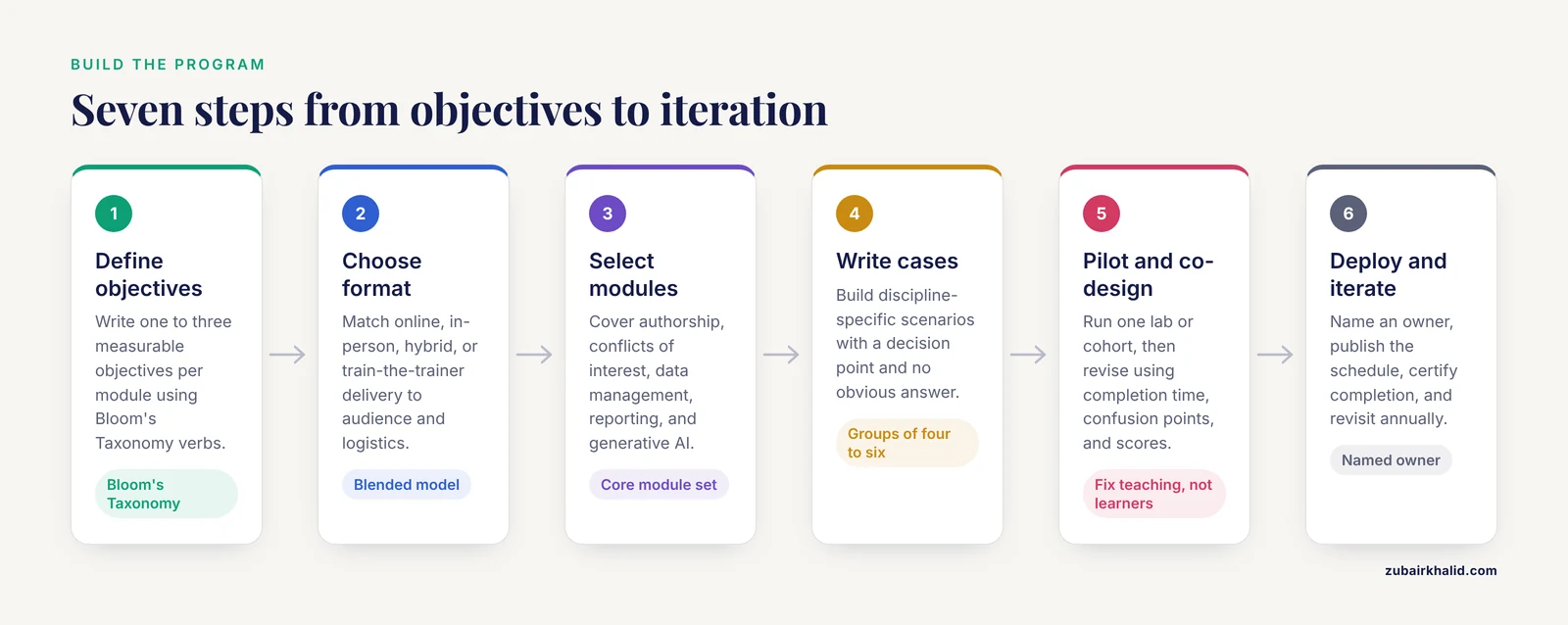
Step-by-Step: Building Your Program
Step 1: Define Learning Objectives with a Taxonomy
Start with objectives, not content. Analysis of training materials from four European research integrity projects found that the strongest programs used constructivist or socio-constructivist designs, ran activating and engaging activities, and aimed at higher-order learning objectives, and that structured use of learning taxonomies helped trainers communicate goals and learners calibrate expectations [3].
Use the revised Bloom's Taxonomy, which orders cognitive work from remembering and understanding through applying and analyzing to evaluating and creating. Write one to three objectives per module, each starting with a measurable verb.
Create a plain-text objectives file so you can version it and share it:
module: authorship_and_credit
audience: first-year PhD students
duration_minutes: 90
objectives:
  - verb: define
    level: remember
    text: "Define authorship, contributorship, and gift authorship."
  - verb: apply
    level: apply
    text: "Apply a contribution matrix to a four-author case study."
  - verb: evaluate
    level: evaluate
    text: "Evaluate a disputed authorship scenario and justify a resolution."
assessment: case discussion plus a 5-item quiz
Expected output when you share this file with your curriculum committee: reviewers can see at a glance what learners will be able to do, at what cognitive level, and how you will check it. If an objective cannot be observed or assessed, rewrite it. "Understand integrity" is not assessable. "Evaluate a disputed authorship scenario and justify a resolution" is.
Step 2: Choose a Delivery Format
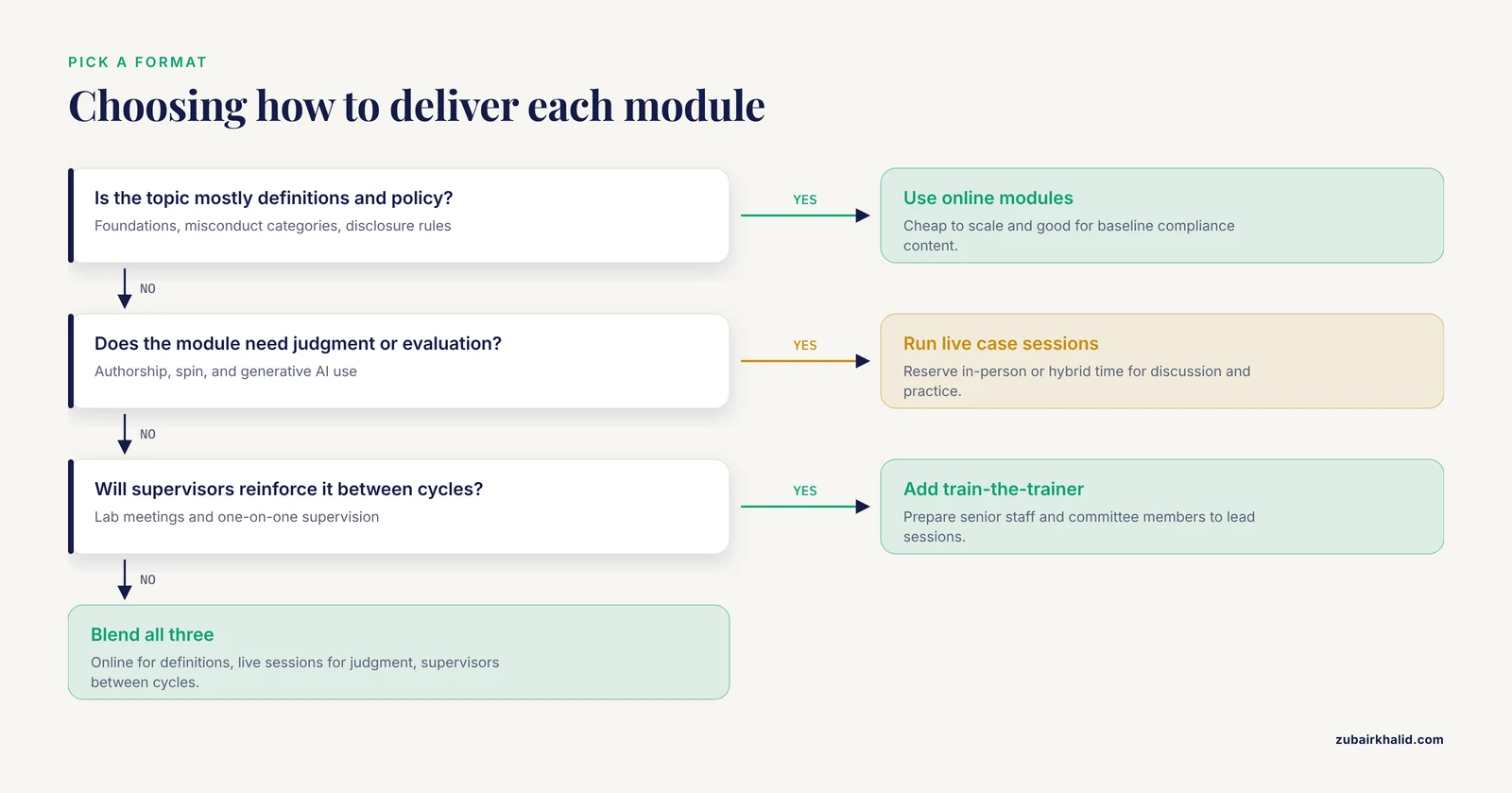
Match format to audience and logistics. The Kenya Medical Research Institute combined five delivery strategies for institution-wide reach: a train-the-trainer program for committee members, integration of research integrity symposia into national conferences, geographically clustered center-specific sessions, hybrid in-person and virtual delivery, and digital dissemination through bulletins, social media, and the institutional website. That mix reached more than 1,200 of over 4,000 staff across 15 research centers [4].
Practical options:
- Online modules. Best for baseline compliance content. Cheap to scale, weak on discussion.
- In-person workshops. Best for case discussion and skill practice.
- Hybrid sessions. Record the lecture portion, reserve live time for cases.
- Train-the-trainer. Prepare senior staff and committee members to lead sessions in their own units.
- Embedded mentoring. Fold ethics conversations into lab meetings and one-on-one supervision, because survey evidence shows mentoring is a common gap in RECR training [1].
A blended model works for most institutions. Use online modules for definitions and policies, live sessions for judgment-heavy topics, and supervisor-led reinforcement between cycles.
Step 3: Select Core Modules
The table below summarizes a standard module set, the Bloom's level to target, and a suitable assessment for each.
| Module | Target level | Format | Assessment |
|---|---|---|---|
| Foundations of research ethics and misconduct | Understand | Online module | 10-item quiz |
| Data management and the data lifecycle | Apply | Workshop plus template | Data plan review |
| Authorship and contributorship | Evaluate | Case discussion | Contribution matrix exercise |
| Conflicts of interest and disclosure | Apply | Short lecture plus scenarios | Disclosure form exercise |
| Responsible reporting and avoiding spin | Evaluate | Manuscript-abstract workshop | Rewrite an overstated abstract |
| Human participants and animal subjects | Apply | Protocol walkthrough | Protocol checklist |
| Generative AI use in research and writing | Evaluate | Guideline discussion plus cases | AI-use statement drafting |
| Mentoring and lab culture | Analyze | Supervisor session | Mentoring compact draft |
A few notes on the modules that trainees most often get wrong.
Authorship. Authorship is the primary currency of academic credit, yet guidance across journals and institutions is highly variable. A working group convened across the publishing and research community proposed anchoring authorship in three principles: transparency, credit, and accountability, with early and inclusive authorship discussions as the practical mechanism [5]. Teach the five recognized forms of free riding, meaning authorship without substantive contribution: coercive, reciprocal, gratitude, purchased, and entitlement authorship, and have trainees classify examples [6]. A worked contribution matrix makes the idea concrete:
name,designed_experiments,collected_data,analyzed_data,wrote_draft,approved_final,qualifies_as_author
A. Rivera,yes,yes,yes,yes,yes,yes
J. Okafor,no,yes,yes,partial,yes,discuss
M. Silva,no,no,no,yes,yes,discuss
T. Nguyen,no,yes,no,no,no,no,no
Ask learners to justify each row. The discussion, not the table, is the lesson.
Conflicts of interest. A conflict of interest (COI) is any financial, personal, professional, or social relationship that could bias research judgments. In surgical fields, evidence shows inaccurate disclosures remain common, with up to 81 percent of authors failing to report conflicts correctly, and hidden biases appearing through social media and mentorship ties [7]. Have trainees complete a real disclosure form during the session rather than reading about disclosure.
Responsible reporting. Spin is the misleading presentation or interpretation of results so that findings appear more favorable or significant than they are. It misleads readers, clinicians, and policymakers, and it can be addressed through training researchers, reviewers, and editors in transparent reporting [8]. Give trainees a real abstract that overstates a finding and ask them to rewrite the conclusion sentence so it matches the data. Compare versions as a group.
Generative AI. Students report real ambiguity about where legitimate AI help ends and academic misconduct begins. A qualitative study of nursing students found tension between efficiency and authentic learning, manifesting as cognitive offloading and academic integrity ambiguities, alongside calls for clearer curricular guidance [9]. Journal-side responses are also evolving, with proposals to mandate AI transparency through reporting frameworks such as CONSORT-AI and global cooperation through initiatives like DORA and COPE [10]. Have every trainee draft an AI-use statement for their next manuscript or thesis chapter, naming the tool, the task, and how they verified the output.
Step 4: Write Cases and Activities
Case-based discussion is the pedagogical core. Build cases from your own discipline. A case should include a realistic scenario, a decision point, and no obvious answer. For example:
A postdoc discovers that a co-author excluded a data subset that weakens the headline claim. The manuscript is under review. The principal investigator says the exclusion is a legitimate analytic choice. What does the postdoc do, in what order, and what documentation matters?
Run cases in groups of four to six with a facilitator who holds a written debrief key. Close each case by connecting it to one policy and one reporting pathway at your institution, because knowledge of reporting pathways improves measurably when targeted training covers them [11].
Step 5: Pilot with a Small Group and Co-Design
Run a pilot with one lab or one course cohort before scaling. Co-design the materials with the people who will use them. A co-designed Australian vocational training program for peer health navigators built its curriculum through a multi-stage process integrating a systematic review, stakeholder interviews, focus groups, co-design workshops with communities, and curriculum development with subject matter experts, producing 12 units aligned to both educational requirements and identified capabilities [12]. You do not need that scale, but you should copy the sequence: review existing evidence, interview stakeholders, run a workshop with learners, then revise.
During the pilot, collect three data points: time to completion, confusion points, and quiz or case performance. If more than a quarter of the pilot group misses the same assessment item, fix the teaching, not the learners.
Step 6: Deploy Institution-Wide
Scale through structure, not enthusiasm. Research culture is shaped by institutional supports, and a case study of a research performing organization found that after deploying accessible training and supports on good research practices, knowledge of authorship, data management, and open access resources improved significantly, and open-ended comments shifted from emphasizing obstacles toward training and constructive practices [11]. Leadership involvement matters here, because organizational integrity initiatives succeed when leaders model and resource them [13].
A rollout checklist:
- Secure a named owner, such as a research integrity officer or a faculty committee
- Publish the schedule a full term in advance
- Pair every online module with a live discussion within two weeks
- Certify completion and record it in the institutional system
- Publicize through multiple channels, including seminars, newsletters, and internal social channels, following the multi-channel model used at KEMRI [4]
Step 7: Assess, Certify, and Iterate
Assess at three levels:
- Reaction. Short post-session survey on clarity and relevance.
- Learning. Quiz scores and case performance against your written objectives.
- Behavior. Follow-up indicators such as disclosure form quality, data management plan completeness, and authorship discussion timing.
No single factor guarantees integrity across an institution. A fuzzy-set comparative analysis of 109 university faculty identified four distinct causal pathways, combining individual attributes and organizational conditions, that were each sufficient to promote integrity, which means programs should be tailored to local configurations rather than copied wholesale [14]. Qualitative work in Japan likewise identified barriers rooted in laboratory environment, job security for junior researchers, and pressure on principal investigators, alongside proposals for better dissemination of regulations and education [15]. Revisit your program annually. Drop what does not change behavior.
Worked Example: Mapping One Module End to End
Here is a complete mapping for the reporting and spin module so you can see the whole chain in one place.
module: responsible_reporting
audience: graduate students and postdocs
duration_minutes: 60
objectives:
  - verb: identify
    level: analyze
    text: "Identify spin in a published abstract, naming the sentence and the distortion."
  - verb: rewrite
    level: create
    text: "Rewrite an overstated conclusion so it matches the reported data."
case: "A trial reports a non-significant primary outcome. The abstract states the treatment 'showed benefit' based on a secondary subgroup."
activity: groups rewrite the abstract conclusion in 10 minutes, then compare versions
assessment: instructor rubric scores accuracy, hedging, and completeness
policy_link: institutional guideline on accurate reporting, journal reporting checklist
expected_outcome: learner produces a conclusion that states the primary result honestly and labels subgroup findings as exploratory
Expected output from a competent learner: a rewritten conclusion that reports the primary outcome as not meeting significance, describes the subgroup result as hypothesis-generating, and omits causal language the data cannot support.
Common Mistakes and Limitations
- Teaching definitions instead of judgment. Learners can pass a quiz on definitions and still mishandle a real conflict. Reserve live time for cases at the evaluate and create levels [3].
- One course for every audience. A first-year undergraduate, a new principal investigator, and a grants administrator need different cases and different depth. Segment at least by trainee status and supervision responsibility.
- Treating training as a compliance checkbox. Institutions that deploy targeted training see measurable gains in domain-specific knowledge, which suggests compliance-only designs leave value on the table [11].
- Ignoring mentoring. Formal coursework cannot substitute for supervised practice. Build supervisor sessions into the program because mentoring is a documented gap even at well-resourced institutions [1].
- Skipping the trainer layer. Faculty who must teach integrity often report they were never trained for it themselves [2]. Run a train-the-trainer session before rollout.
- Leaving AI out. Trainees are already using generative tools and experiencing genuine ambiguity about acceptable use. Address it explicitly with a written AI-use statement exercise rather than hoping a plagiarism policy covers it.
- Assuming culture follows curriculum. Pressures from the publish-or-perish environment, precarious early-career positions, and laboratory hierarchies undermine training unless leaders address them alongside the curriculum [15]. State this limitation openly when you present the program to leadership.
- Copying another institution's program without adaptation. Different faculty populations reach integrity through different combinations of supports, so adapt the design to your own organizational conditions [14].
- Confusing academic integrity training with research ethics training. They overlap but differ. Classroom misconduct and research misconduct have different policies, different evidence bases, and different remedies [16]. Keep the module boundaries clear even where the underlying values are shared.
Individual ethical dilemmas often require consultation with your institutional ethics office, integrity officer, or legal counsel. Training prepares you to recognize a problem early, not to resolve every case alone.
Frequently Asked Questions
What is a research ethics training program?
It is a structured curriculum that teaches the principles and practices of honest, accountable research, covering topics such as misconduct, data management, authorship, conflicts of interest, human and animal subjects, and responsible reporting.
What is the difference between research ethics and responsible conduct of research?
Research ethics is the broader field of moral principles governing research, including questions about harm, consent, and justice. Responsible conduct of research is the practical, policy-level application of those principles to daily tasks such as record keeping, authorship, and reporting.
How long should training take?
A common structure is a one- to two-hour online baseline module per topic plus shorter live case sessions, with total time set by your funder or institutional policy. Depth matters more than duration.
Do online courses count as sufficient training?
They work well for definitions, policies, and compliance tracking, but evidence consistently favors programs that add interactive, case-based components, because higher-order skills such as evaluation and judgment need practice and discussion.
Who should be required to complete the training?
Everyone who touches research, including undergraduate and graduate students, postdocs, research staff, faculty, and administrators who oversee projects or compliance.
How often should training be renewed?
Renew at policy-defined intervals, commonly annually or every two to three years, and add refreshers whenever major changes occur, such as new AI policies or revised data rules.
What topics must a program include?
At minimum, misconduct and questionable practices, data management, authorship and contributorship, conflicts of interest, responsible reporting, human and animal subjects where relevant, and current guidance on generative AI use.
How do I know if my program is working?
Measure reaction, learning, and behavior. Use post-session surveys, assessment scores against written objectives, and follow-up indicators such as disclosure quality, data plan completeness, and earlier authorship discussions.
Sources
- Gaps and Opportunities in Responsible and Ethical Conduct of Research Training: A Survey of Faculty, Administrator, and Student Experiences in Higher Education Across the Mountain West of the U.S.
- Nursing faculty's experiences with managing academic integrity in prelicensure nursing education: A qualitative study.
- Fostering Research Integrity through Training: The training materials of four EU-funded projects through the lens of pedagogical underpinnings and three taxonomies of learning.
- Institution-wide strategies for research integrity training: experience from the Kenya Medical Research Institute: a descriptive case study.
- Creating a responsible authorship culture in science: Anchoring authorship practices in principles of transparency, credit, and accountability.
- Addressing free rider issues in academic authorship in medical education.
- Conflicts of interest in hand surgery: recognizing risks, navigating challenges and promoting integrity.
- Spin bias in scientific publishing: upholding integrity in research reporting.
- The cognitive and ethical crossroads: a qualitative study of academic integrity, emotional landscapes, and generative AI integration in nursing education.
- Preserving scientific integrity in academic publishing: Navigating artificial intelligence, journal policies, and the impact factor as a quality indicator.
- Leadership to strengthen research culture and foster responsible conduct of research: A case study.
- Co-designed development of a vocational education and training program for peer health and social care navigators in Australia.
- A model of moral justice for medical universities: A structural equation modeling approach to ethical leadership and organizational integrity.
- Toward contextualized research integrity in higher education: a fuzzy-set analysis of individual and organizational configurations among university faculty.
- Research Culture and Integrity in Japan: A Qualitative Study.
- Academic Integrity and Cheating in Dental Education: Prevalence, Drivers, and Career Implications.