Reproducibility vs. Replicability: What to Verify in Your Manuscript
By Dr. Zubair Khalid, DVM, MS, PhD ·

Reproducibility means that an independent analyst can take your data and your methods and arrive at your results. Replicability means that a different team can run a new study on the same scientific question and reach a consistent conclusion. Both matter for your manuscript, but you verify them in different ways, and confusing the two is one of the most common errors reviewers flag.
This guide gives you the definitions, the reasoning behind them, a concrete reproducibility checklist you can run before submission, and two real published examples that show exactly where manuscripts succeed or fail on each front. It is written for biology students, early-career researchers, and anyone preparing a life science manuscript for review.
What Does Reproducibility vs Replicability Mean?
The clearest way to understand reproducibility vs replicability is to look at three variables: who is doing the work, whether the data are old or new, and what counts as a successful outcome.
Reproducibility asks whether the same team, using the same data and the same analysis, can obtain the same numbers again. In computational work this is often called analytic reproducibility. If a reader downloads your raw sequencing files, runs your documented pipeline, and produces your figure panels and statistics, your result is reproducible.
Replicability asks whether a different team, running a new experiment that targets the same scientific question, obtains a conclusion consistent with yours. The data are new. The samples are new. The protocol may differ in detail. The outcome that matters is whether the effect or relationship holds.
A third term, repeatability, sits at the measurement level. It asks whether the same team, with the same setup and the same samples, gets the same reading when they measure again. Instrument drift, pipetting variation, and day-to-day technician differences all live here.
The broader research community has refined these definitions over the past decade. One widely cited framework divides reproducibility into three parts: methods reproducibility (a different lab can follow your protocol), results reproducibility (a different analyst can reanalyze your data and get your numbers), and inferential reproducibility (different researchers drawing conclusions from the same evidence reach the same interpretation). A 2019 consensus report from the National Academies of Sciences, Engineering, and Medicine reached a similar conclusion from a different direction, recommending that the community reserve "reproducibility" for computational reanalysis of the same data and "replicability" for new studies, while acknowledging that individual fields still use the words differently.
That last point matters for your manuscript. Before you submit, check how your target journal defines the terms. Some journals now require authors to state, in a data availability or methods section, exactly which claims are reproducible in the strict sense and which rest on replication evidence from prior studies.
Comparison at a glance
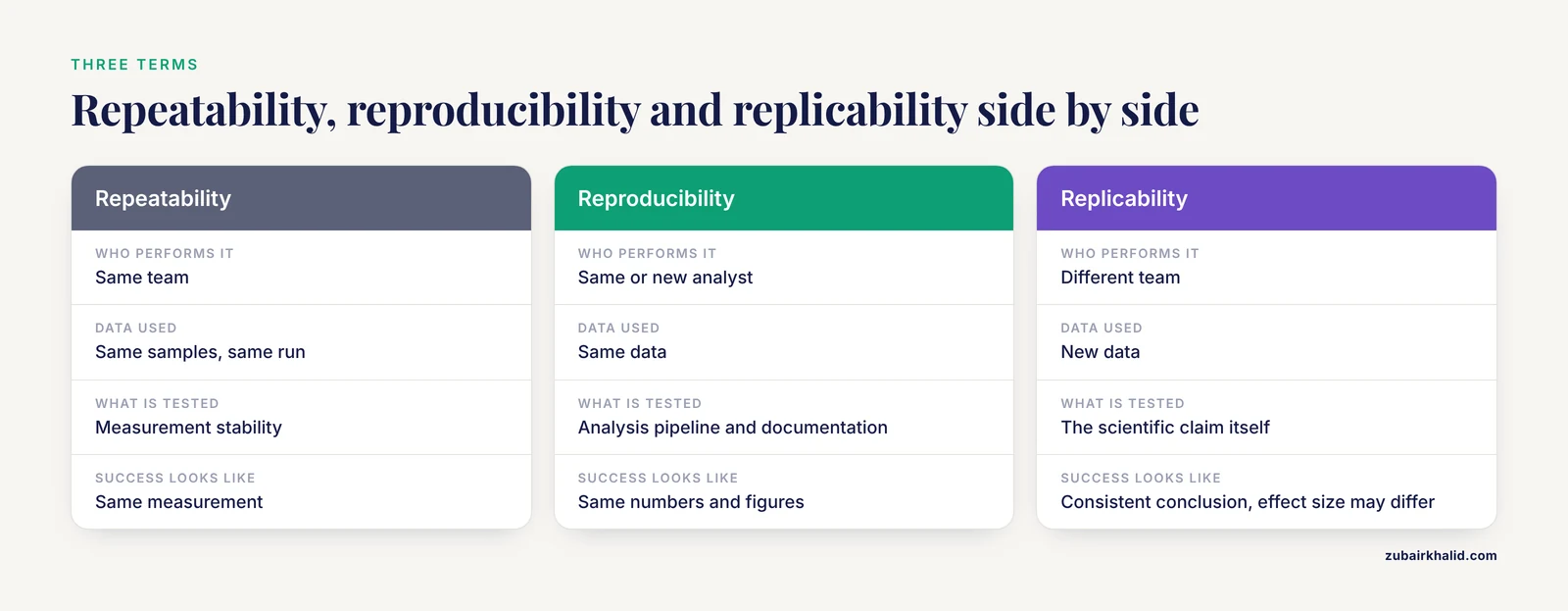
| Feature | Repeatability | Reproducibility | Replicability |
|---|---|---|---|
| Who performs it | Same team | Same or new analyst | Different team |
| Data used | Same samples, same run | Same data | New data |
| What is being tested | Measurement stability | Analysis pipeline and documentation | The scientific claim itself |
| Success looks like | Same measurement | Same numbers and figures | Consistent conclusion, even if effect size differs |
| What you verify in the manuscript | Instrument logs, operator detail | Data availability, code, software versions, parameter settings | Study design power, protocol detail, honest effect sizes |
Why the Distinction Changes What You Verify
The reproducibility vs. replicability interpretation you adopt determines what a reviewer can and cannot check in your manuscript.
Reproducibility is verifiable at the document level. A reviewer or reader either can or cannot access your data, run your code, and match your output. Verification is concrete: do the files exist, do the scripts run, do the outputs match? This is why journals increasingly ask for data and code deposits at submission rather than a promise to share "on request."
Replicability cannot be verified from your manuscript at all. A reviewer cannot rerun your study with new samples. What a reviewer can verify is whether your manuscript contains the information a future replicator would need: exact reagent sources and lot behavior, sample inclusion and exclusion criteria, randomization and blinding procedures, equipment settings, and a realistic description of your effect size rather than an inflated one.
This distinction has a practical consequence that surprises many first-time authors. A manuscript can be perfectly reproducible and still describe a finding that fails to replicate, because reproducibility only confirms that you analyzed your data correctly. It says nothing about whether the pattern in those data generalizes to new samples. Conversely, a study can be hard to reproduce because of missing documentation yet describe a real, robustly replicable effect. The two properties are related through rigor, but they are not the same property.
Why Results Vary: The Science Behind Replication Outcomes
Understanding reproducibility vs replicability explained at the biological level requires asking why the same question can give different answers in different hands. Three forces are at work, and a recent immunology study illustrates all three.
Stochastic variation in biological systems. Immune repertoires, gene expression, and cell signaling all contain genuine randomness. A study published in Immunobiology examined T cell receptor (TCR) sequencing assays, which use antigen-driven clonotypic expansions as a functional readout. In these assays, reliable identification of antigen-specific responses depends on a highly reproducible antigen-agnostic background repertoire, measured as strong clonal overlap between technical replicates [1]. Even within one lab, one sample, one platform, the measured repertoire varies, and the authors found that the magnitude of that variation differed substantially among donors [1].
Sample-specific biology. The same study found that CD4+ clonal overlap was lower than CD8+ overlap in three of four donors, yet in the fourth donor the two were similar when cells were fresh, and CD4+ overlap actually exceeded CD8+ overlap after cryopreservation [1]. A reviewer comparing that result to a single-donor pilot study would see an apparent contradiction. The contradiction is not fraud or sloppiness. It is donor-to-donor variation in baseline repertoire structure, which the authors tied to a striking finding: the intrinsically lower baseline clonality of the CD4+ T cell repertoire was strongly associated with lower reproducibility of subsequent clonotypic expansions [1]. In other words, a property of the biological sample, measured before the experiment, predicted how reproducible the downstream readout would be.
Pre-analytical handling. Cryopreservation was associated with reduced repertoire overlap overall in that study, but there was no consistent evidence that the effect differed between CD4+ and CD8+ assays [1]. Handling steps that sit outside the formal experimental protocol can shift results across labs. A replicating team that freezes samples differently, or uses fresh cells where the original study used frozen ones, may see a different noise floor before testing the hypothesis at all.
The design lesson generalizes far beyond immunology. If the variability of your readout depends on a property you can measure in advance, such as baseline clonality, then that property belongs in your manuscript. Documenting it turns an apparent replication failure into an explainable result and gives the replicating team a variable to match or stratify on.
Methods Reproducibility: The Build Instructions Test
Reproducibility in experimental and methods papers is tested the way a furniture kit is tested. A stranger with the written instructions and reasonable access to the stated materials should end up with the thing you built.
A 2026 methods paper on a simulation task trainer for emergency medicine shows exactly what separates reproducible methods publications from fragile ones. The authors describe earlier published low-fidelity creations that were time consuming to make, required specific simulation equipment, or could not easily be reused [2]. One published creation had inspired their design, but the main structure was no longer available for purchase, which meant no one could rebuild that earlier model as described [2]. Others were less anatomically accurate, which limited the fidelity of practice for the most intimate parts of the procedure [2].
The authors' solution was to design their task trainer so it could be reproduced and recreated by the educator with flexible starting materials [2]. The trainer addresses a real training gap. Priapism management is time-sensitive, clinical opportunities to perform dorsal penile nerve block and corporal aspiration are rarely practiced, and physicians who understand the urgency may still never perform the procedures outside simulation, where learners at all levels can practice in a safe setting [2].
The manuscript lesson is direct. A methods paper lives or dies on three verifiable claims, all visible in this example:
- Material availability. If your method depends on a specific commercial item, state what happens when that item is discontinued. Substitutable materials make a method reproducible. A single irreplaceable component makes it an artifact.
- Build or run cost in time and equipment. Earlier trainer designs were described as time consuming or equipment dependent [2]. If your protocol demands something unusual, say so plainly rather than leaving the replicator to discover it.
- The fidelity tradeoff. Low-fidelity creations with poor anatomical accuracy limited what learners could practice [2]. Reproducibility is not the same as simplicity. A method that is easy to rebuild but too crude to answer the question is not a useful method. State what your design sacrifices and why.
The same three tests apply to wet-lab protocols, computational pipelines, and survey instruments. Where can the pipeline break? What must be substituted when a reagent or tool disappears? What fidelity was traded away, and does that tradeoff limit the conclusions?
A Reproducibility Checklist for Your Manuscript
Run this reproducibility checklist against your draft before submission. Each item corresponds to something a reviewer, editor, or replicating reader will try to verify.
Data
- Raw data are deposited in a public repository or a controlled-access repository with a stated access procedure. A private "available on request" statement is increasingly treated as no access at all.
- The deposited files are the true raw outputs of the instrument, not hand-edited intermediates. If you filtered or corrected anything, that step belongs in documented code, not in silent edits.
- Every figure and every reported statistic can be traced to a specific file or table in the deposit.
- Sample metadata are complete: collection dates, processing batches, donor or subject identifiers in coded form, and the measured pre-existing properties of the samples, such as the baseline clonality values that predicted assay reproducibility in the TCR sequencing study [1].
Code and analysis
- Analysis scripts are deposited, version-controlled, and runnable from the raw data to the final figures with a stated entry point.
- Software versions, package versions, and any parameter settings or seeds are recorded. A pipeline that gives different answers on different library versions is not reproducible in any useful sense.
- Every exclusion rule, outlier rule, and transformation is implemented in code, not described only in prose. If the text and the code disagree, reviewers will treat that as a red flag.
- Randomized or stochastic steps document how randomness was controlled, so a rerun reaches your numbers rather than a different random draw.
Methods and materials
- Reagents, cell lines, and biological materials are identified precisely enough for a replicating lab to obtain equivalents, including the critical variables your readout depends on.
- The protocol includes the steps a newcomer would get wrong: incubation windows, handling choices such as fresh versus cryopreserved cells, and calibration states. The cryopreservation finding in the TCR study, reduced repertoire overlap overall with no consistent CD4- or CD8-specific pattern, is exactly the kind of handling effect that belongs in print rather than in lab folklore [1].
- If the method depends on physical materials or equipment, the manuscript states whether substitutes work and what happens when a component becomes unavailable, the standard set by the task trainer paper [2].
- Limitations of fidelity or resolution are stated explicitly, following the example of published trainer designs whose anatomical accuracy constrained their use [2].
Statistics and inference
- The primary outcome and the analysis plan are identifiable in the manuscript, so a reader can distinguish the planned test from exploratory ones.
- Effect sizes are reported with uncertainty, not only p values. Replicability depends on the true effect size, so an honest estimate is the single most useful number you can give a replicating team.
- If sample properties predict the stability of your readout, say so. The finding that baseline TCR clonality predicted clonotypic expansion reproducibility is a model for this kind of statement: it tells the next team what to measure before they invest in the full experiment [1].
Language
- The manuscript uses "replicate," "repeat," "reproduce," and "replicate" correctly. Technical replicates are repeated measurements of the same sample. Biological replicates are independent samples. "We replicated the finding" should only appear when you or others ran a new study, not when you reran the analysis.
- Claims are matched to their evidence. A single reproducible analysis of one dataset supports a claim about that dataset. Only convergent results across datasets or labs support a claim about the world.
What Reviewers and Editors Actually Verify
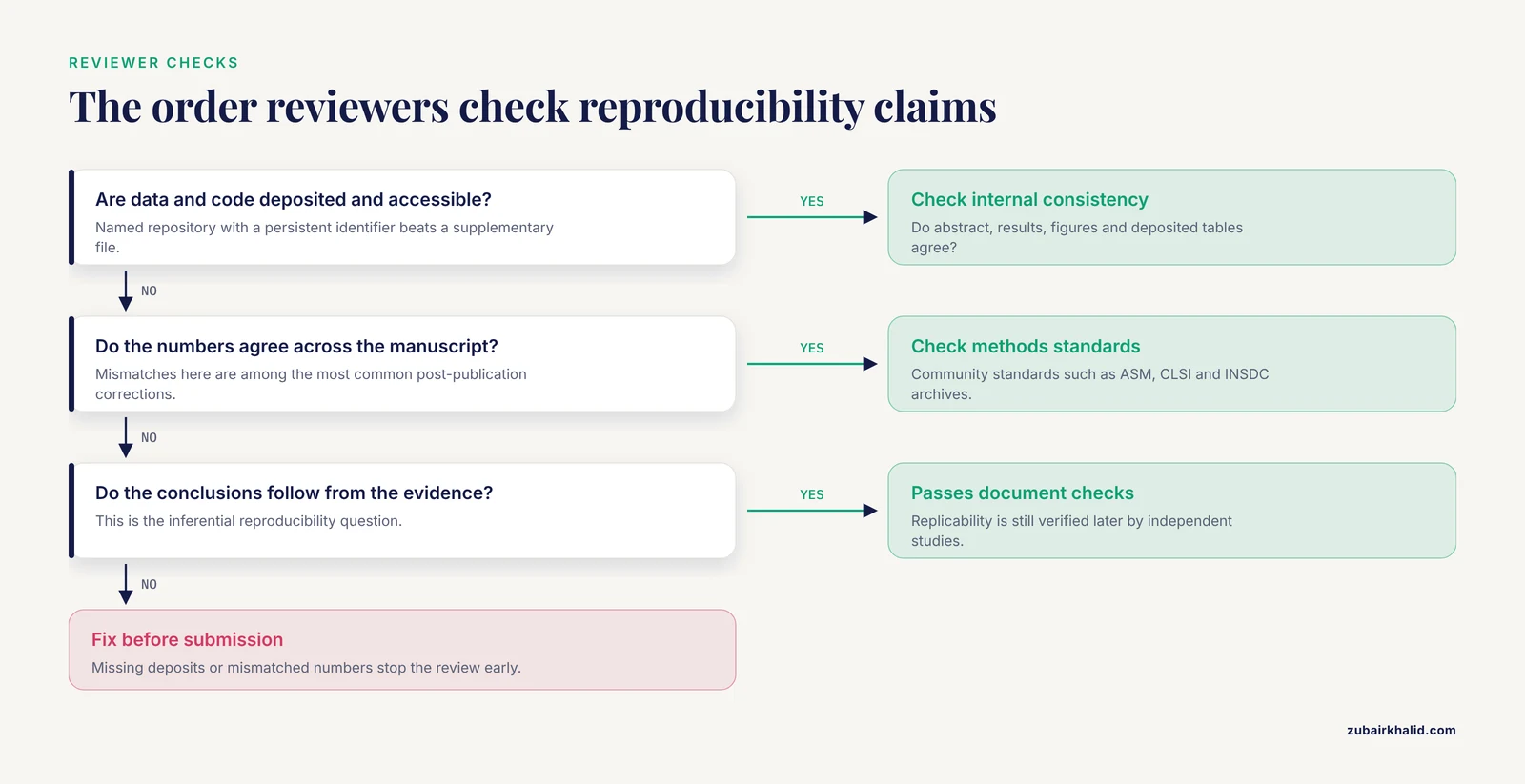
Editors triage reproducibility claims in a predictable order. Knowing the order helps you place the right information where reviewers look first.
First, availability statements. Reviewers check whether data and code are deposited, where, and under what access terms. A named repository with a persistent identifier beats a supplementary file, which in turn beats "on request."
Second, internal consistency. Reviewers check whether the numbers in the abstract, results, figures, and deposited tables agree. Mismatches here are among the most common post-publication corrections.
Third, methods completeness against community standards. For microbiology work this means the standards set by bodies such as the American Society for Microbiology. For clinical microbiology, the Clinical and Laboratory Standards Institute publishes the consensus methods that reviewers expect to see cited. For sequence data, reviewers expect deposition consistent with the INSDC partner archives, including NCBI, and accession numbers in the manuscript.
Fourth, the inference layer. Reviewers ask whether the conclusions follow from the evidence, which is the inferential reproducibility question. A manuscript can pass the first three checks and still fail here if the language overreaches.
Replicability, as noted above, is never verified by the reviewer of the original paper. It is verified over years, through citations, reanalyses, and independent studies. Your job at submission is to make replication possible, not to prove it has happened.
Common Mistakes and Limitations
Treating "replicated in triplicate" as replication evidence. Technical replicates quantify measurement noise. They do not test whether the finding generalizes to new samples, new donors, or new labs. A conclusion supported only by technical replicates of pooled samples is a conclusion about those pooled samples.
Claiming reproducibility without depositing anything. A statement that "the analysis is fully reproducible" carries no weight unless the reader can actually obtain the data and code. Reviewers check.
Hiding the fragile steps. Every pipeline has steps that depend on judgment or local conditions. Omitting them does not protect the paper. It guarantees that the first serious replication attempt will diverge in exactly those steps, and the divergence will be attributed to your paper.
Conflating fidelity with reproducibility. The simulation literature makes the difference vivid. Earlier low-fidelity trainers were limited by anatomical accuracy, while the newer design prioritized rebuildability with flexible materials [2]. A method can be easy to reproduce and too crude for its purpose, or accurate and nearly impossible to rebuild. Name which tradeoff you made.
Assuming your readout is equally stable for all samples. The TCR sequencing work showed donor-dependent overlap, with three of four donors showing lower CD4+ than CD8+ overlap and the fourth showing a different pattern depending on fresh versus cryopreserved cells [1]. If your readout's stability varies with sample biology, a single mean variability estimate in the methods section understates the problem.
A limitation that applies to every checklist, including this one. Checklists verify the verifiable. They cannot tell you whether your conclusion is true, and they cannot substitute for pilot data that establish the effect is large enough to survive a replication attempt. Individual manuscripts, like individual cases, need expert review, which is what peer review exists to provide.
What Remains Uncertain
Open questions remain at every layer of reproducibility vs. replicability.
At the terminology level, fields still disagree. Psychology, computational science, and biomedicine use overlapping vocabularies with different boundaries, and the National Academies consensus acknowledged that a single community-wide nomenclature has not settled the debate. When you write, define your usage in the manuscript rather than assuming the reader shares it.
At the measurement level, the TCR study leaves questions open that its own authors flag as important for experimental design. How baseline clonality behaves across larger donor cohorts, and whether cryopreservation effects can be mitigated by protocol changes, are not resolved by a four-donor comparison [1].
At the systems level, the field still lacks agreed quantitative thresholds for what counts as acceptable clonal overlap, acceptable reproducibility of a pipeline, or acceptable replication of an effect size. Those judgments remain contextual, made field by field and journal by journal.
Frequently Asked Questions
What does reproducibility vs replicability mean?
Reproducibility means the same team or an independent analyst can rerun your analysis on your data and get your results. Replicability means a different team can run a new study on the same question and reach a consistent conclusion.
Can a study be reproducible but not replicable?
Yes. Reproducibility confirms the analysis was done correctly on the original data. It says nothing about whether the pattern holds in new samples, so a perfectly reproducible result can still fail replication.
What is the difference between a technical replicate and a biological replicate?
A technical replicate repeats the measurement on the same sample to estimate measurement noise. A biological replicate is an independent biological sample, such as a different donor or animal, and only biological replicates support generalization.
Do I need to make my data public for reproducibility?
For the result to be verifiable, a reader needs access to the data and code, either in a public repository or in a controlled-access repository with a stated access route. A promise to share on request is generally not considered verification.
What is a reproducibility checklist and when should I use it?
A reproducibility checklist is a pre-submission audit of data availability, code, software versions, methods detail, and claim-to-evidence matching. Use it before every submission and again before depositing files, because the two steps catch different errors.
How do reviewers verify reproducibility claims?
Reviewers check that data and code are deposited and accessible, that numbers are internally consistent across the manuscript and files, that methods meet community standards, and that conclusions follow from the evidence. They cannot verify replicability from the manuscript.
Does reproducibility prove a finding is true?
No. Reproducibility only establishes that the analysis produces the reported numbers from the reported data. Truth of the underlying claim is a question about the world, addressed by replication across independent samples and laboratories.
What should I do if my result is reproducible but fails to replicate?
Report the failure and look for sample-level variables that explain it, the way baseline TCR clonality predicted assay reproducibility. A documented, explained non-replication is a contribution, and suppressing it is both an ethical failure and a lost opportunity to refine the question.