How to Build a Reproducibility Checklist for Collaborative Research
By Dr. Zubair Khalid, DVM, MS, PhD ·

By the end of this guide, you will be able to draft, version, and enforce a reproducibility checklist for a multi-person research project. You will know which items belong on the checklist at each phase of a study, how to store the checklist so it changes only through review, how to attach verifiable evidence to each item, and how to run a dry test that proves the checklist works before anyone depends on it.
To follow the walkthrough, you need a plain-text editor, Git installed on your computer, an account on a Git hosting service such as GitHub, and, optionally, a container tool such as Docker or Apptainer. A shared spreadsheet can hold an early draft, but the finished checklist should live inside the project repository as a plain-text file so it travels with the code and data it governs.
A reproducibility checklist is a living document that lists, for each phase of a project, the artifacts, standards, and evidence that must exist before that phase counts as complete. It is not a formality. It is the mechanism that turns good intentions about scientific collaboration into verifiable states of the project.
Why Collaborative Projects Lose Reproducibility
Reproducibility in a solo project is mostly a documentation problem. In a collaboration, it becomes an information management problem, because every handoff between people is a chance for context to disappear.
The evidence for this is direct. In interviews with 52 team members across 11 clinical and translational research teams, researchers described how inconsistent management of information slowed workflows, created frustration, and reduced trust in the completeness of research outputs, while teams that managed information well reported greater workflow efficiency, stronger shared awareness, and more confidence in their own findings [1]. The practices that mattered spanned ordinary activities: team meetings, data collection, dissemination, and overall project management [1]. In other words, reproducibility is not lost in one dramatic moment. It leaks through routine coordination.
Independent reproduction attempts show the same pattern from the outside. As part of a Global BioImage Analysts' Society initiative, analysts tried to reproduce the core findings of a published microscopy study on presynaptic actin nanostructures. The original paper reported novel biology but lacked sufficient methodological detail in the image analysis, which limited how far reproduction could go. The analysts could replicate qualitative results only through frequent contact with the corresponding author, and they concluded that sharing example datasets, depositing manual annotations, and documenting manual decision criteria and consensus procedures are essential for reproducible bioimage analysis [2].
Publication-stage disclosures tell a similar story. In a review of 1,385 articles across ten high-impact ophthalmology journals published between 2018 and 2023, only 326 articles, or 23.54 percent, included a data sharing statement, with journal-level rates ranging from 3.88 percent to 66.67 percent, and even clinical trials reached only 27 percent [3]. A data sharing statement is a formal declaration of whether and how data can be accessed, reused, or shared, and its absence signals that validation was never planned as part of the workflow [3].
The lesson for checklist design is simple. Write the checklist around handoff points: between sites, between experimentalists and analysts, between the team and a repository, and between the project and its future readers.
What a Reproducibility Checklist Covers
A useful checklist is organized by project phase, because each phase produces different artifacts and fails in different ways. The phases below mirror the activities that collaborative teams actually manage: planning, data collection, analysis, dissemination, and archiving [1].
Every checklist item should have the same anatomy:
- ID, a short stable label such as
DC-03for the third data collection item. - Requirement, one sentence stating what must be true.
- Owner, the single person accountable, even if many people contribute.
- Evidence, the concrete artifact that proves the requirement is met, such as a checksum file, a merged pull request, or a signed agreement.
- Status, one of
open,in review, ormet.
The evidence field is what separates a checklist from a wish list. An item without evidence cannot be audited, and an item without an owner is nobody's job.
How to Build a Reproducibility Checklist for Collaborative Research, Step by Step
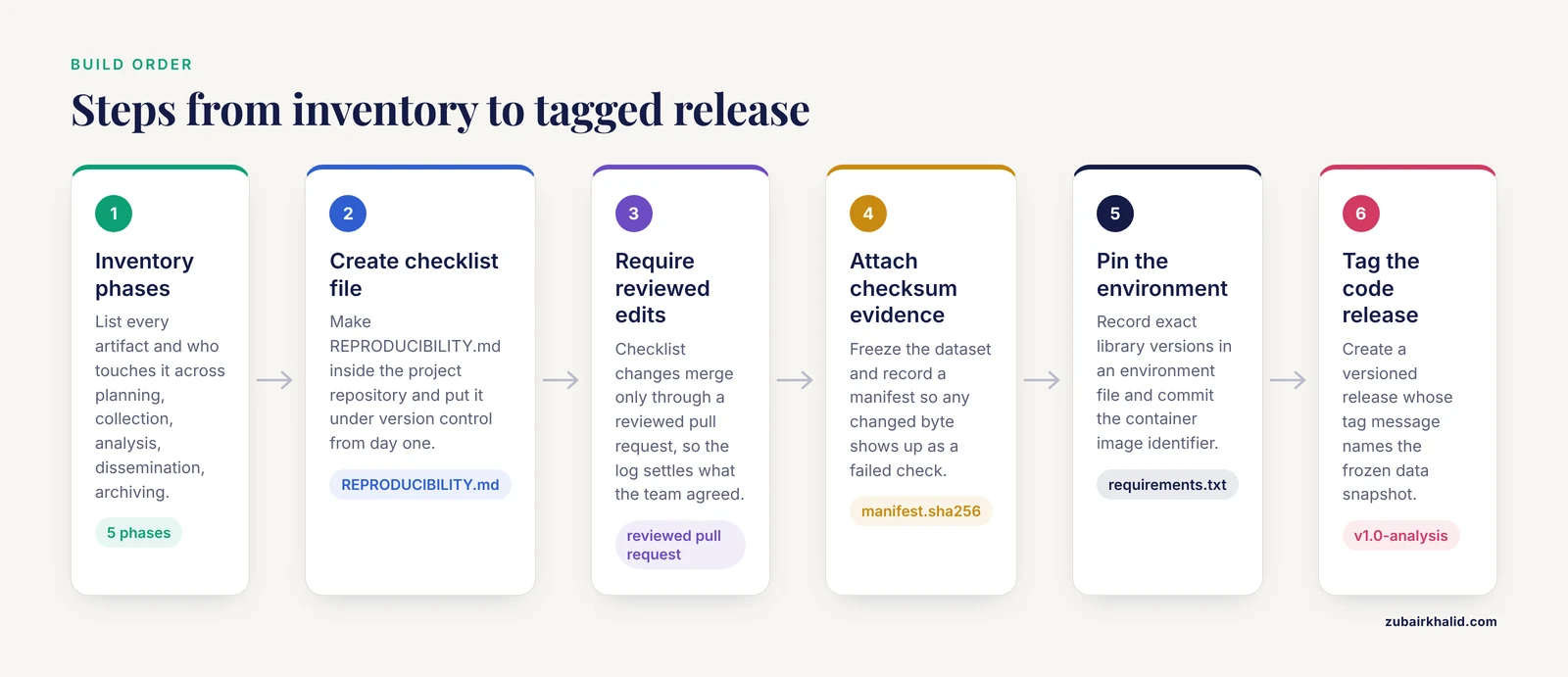
This walkthrough uses a running example: a two-site pilot study that collects survey measures and blood biomarkers, then runs a shared statistical analysis. Adapt the specifics to your field.
Step 1: Inventory the phases and artifacts
Before writing any checklist item, list what your project will produce and who touches it. For the pilot study:
- Planning: protocol, consents, site agreements, choice of standardized measures.
- Data collection: raw data files, metadata, collection logs at each site.
- Analysis: frozen dataset, analysis code, software environment, results.
- Dissemination: manuscript, data sharing statement, code release.
- Archiving: deposited data and code, retention of governance documents.
At the planning stage, agree on measurement instruments across sites. Using consensus-based, validated protocols improves comparability of data collected at different sites. The PhenX Toolkit, a public knowledgebase of validated measurement protocols for genomic, clinical, translational, and epidemiological research, currently offers 1,010 protocols developed through expert working groups precisely for this purpose [4].
Step 2: Create the repository and the checklist file
Put the checklist under version control from day one, so every change is attributable and reviewable:
mkdir cross-site-pilot
cd cross-site-pilot
git init
Expected output:
Initialized empty Git repository in /home/you/cross-site-pilot/.git/Then create a file named REPRODUCIBILITY.md. A short template skeleton looks like this:
# Reproducibility Checklist: cross-site-pilot

Phase: PLANNING
- [ ] PC-01 Protocol version frozen and archived. Owner: A. Rivera.
      Evidence: protocols/protocol_v1.0.pdf committed to repo.
- [ ] PC-02 Standardized measures selected for all sites. Owner: M. Chen.
      Evidence: measure IDs recorded in docs/measures.md.

Phase: DATA COLLECTION
- [ ] DC-01 Each site uses the same file naming and folder layout.
      Owner: site leads. Evidence: layout spec in docs/data_layout.md.
- [ ] DC-02 Metadata recorded for every batch. Owner: M. Chen.
      Evidence: metadata CSV committed with each data drop.

Phase: ANALYSIS
- [ ] AN-01 Dataset snapshot frozen and checksummed. Owner: S. Okafor.
      Evidence: manifest.sha256 in data/frozen/.
- [ ] AN-02 Software environment pinned. Owner: S. Okafor.
      Evidence: environment file plus container image digest.
- [ ] AN-03 Analysis code reviewed by a second person. Owner: S. Okafor.
      Evidence: merged pull request with reviewer approval.

Phase: DISSEMINATION
- [ ] DI-01 Data sharing statement drafted. Owner: A. Rivera.
      Evidence: statement text in manuscript source.
- [ ] DI-02 Code release tagged and archived. Owner: S. Okafor.
      Evidence: release tag and archived repository link.
This structure is the core of a practical reproducibility checklist collaborative research format: phase, item, owner, evidence, and a checkbox that flips only when the evidence exists.
Step 3: Commit the checklist and require review
git add REPRODUCIBILITY.md
git commit -m "Add reproducibility checklist v1"
Expected output:
[main (root-commit) a1b2c3d] Add reproducibility checklist v1
 1 file changed, 24 insertions(+)
 create mode 100644 REPRODUCIBILITY.md
Adopt a rule that checklist edits merge only through a reviewed pull request. The GitHub workflow adapts well to laboratory research: experiments can be designed and organized with issues and project boards, documentation and analyses live under version control, and the whole history is inspectable later [5]. When the checklist itself is versioned, disagreements about what the team agreed to are settled by the log, not by memory.
A common early error is running Git commands outside the repository folder. The exact message is:
fatal: not a git repository (or any of the parent directories): .gitThe fix is to change into the project directory first, or run git init if the repository was never created.
Step 4: Attach evidence with checksums
The analysis phase depends on a frozen dataset, so prove the freeze with checksums. A checksum is a fixed-length fingerprint computed from a file's bytes. If even one byte changes, the fingerprint changes.
sha256sum data/frozen/*.csv > data/frozen/manifest.sha256
sha256sum -c data/frozen/manifest.sha256
Expected output:
cohort_master_v1.csv: OK
biomarker_panel_v1.csv: OK
If a file was modified after freezing, the output changes to:
cohort_master_v1.csv: FAILED
sha256sum: WARNING: 1 computed checksum did NOT match
That warning is the checklist working as designed. Stop, investigate the change, and either restore the frozen file or formally re-freeze the dataset with a new version and a new manifest, recorded in the checklist.
Step 5: Pin the software environment
Every machine that touches the analysis must run the same software versions. Record exact versions in an environment file:
# requirements.txt
pandas==2.2.3
numpy==2.1.0
scikit-learn==1.5.2
statsmodels==0.14.4
Install with:
pip install -r requirements.txtFor stronger guarantees, containerize the environment so the operating system and library stack are captured as an image [5]. The checklist item is satisfied by the environment file plus the image identifier, both committed to the repository. Unpinned environments are among the most common sources of irreproducibility, because a collaborator who installs current library versions months later is effectively running different software.
Step 6: Pair the data snapshot with a tagged code release
When results are ready for submission, create a versioned release of the analysis code that corresponds to the frozen data snapshot:
git tag -a v1.0-analysis -m "Analysis code matching data snapshot frozen_v1"
git push origin v1.0-analysis
Expected output is silent for the tag command and a confirmation line for the push, such as:
To github.com:your-lab/cross-site-pilot.git
 * [new tag]         v1.0-analysis -> v1.0-analysis
Pairing a cited data snapshot with a versioned, environment-specific code release in a companion repository lets reviewers and readers run and verify the exact analysis that produced the reported results, and it aligns the project with open-science goals of transparency and verifiability [6]. The checklist item is met when the tag exists, the tag message names the data snapshot, and the repository link appears in the manuscript.
A Worked Reproducibility Checklist Collaborative Research Template
The skeleton in Step 2 expands into a full template once owners and evidence are filled in. Here is the populated example for the two-site pilot, compressed:
# Reproducibility Checklist: cross-site-pilot (v2, 2026-11-11)

## PLANNING
- [x] PC-01 Protocol v1.0 frozen. Owner: A. Rivera.
      Evidence: protocols/protocol_v1.0.pdf (commit 4f8e21a).
- [x] PC-02 Consensus measures selected. Owner: M. Chen.
      Evidence: PhenX protocol IDs 2201, 4210 listed in docs/measures.md.
- [x] PC-03 Data sharing agreement signed by both sites. Owner: A. Rivera.
      Evidence: signed PDF in governance/, access logged.

## DATA COLLECTION
- [x] DC-01 Shared layout spec. Owner: site leads.
      Evidence: docs/data_layout.md, both sites confirmed in issue #7.
- [x] DC-02 Metadata per batch. Owner: M. Chen.
      Evidence: metadata CSVs committed with drops 1 and 2.

## ANALYSIS
- [x] AN-01 Dataset frozen. Owner: S. Okafor.
      Evidence: data/frozen/manifest.sha256, verified 2026-10-02.
- [x] AN-02 Environment pinned. Owner: S. Okafor.
      Evidence: requirements.txt plus container image digest
      sha256:9c1d... committed.
- [x] AN-03 Code review. Owner: S. Okafor.
      Evidence: pull request #14 merged with one approval.

## DISSEMINATION
- [ ] DI-01 Data sharing statement in manuscript. Owner: A. Rivera.
      Evidence: pending, draft in ms/statement.md.
- [ ] DI-02 Tagged code release. Owner: S. Okafor.
      Evidence: pending, planned tag v1.0-analysis.
Notice three features. Checkboxes are flipped only when evidence exists. Every version-changing decision (protocol freeze, dataset freeze, code release) has a commit or tag as its anchor. And the checklist records its own version and date, so the document's history is auditable alongside the project's.
Choosing Research Collaboration Tools to Enforce Each Item
A checklist states requirements. Research collaboration tools make requirements automatic or at least cheap to verify. The table below maps common requirements to the tool categories that enforce them.
| Checklist requirement | Tool or standard | What it enforces | Checklist phase |
|---|---|---|---|
| , - | , - | , - | , - |
| Auditable project history and task assignment | Git hosting with issues and project boards [5] | Every decision and file change is attributable | All phases |
| Predictable data organization | Community data structure standards such as BIDS [7] [8] | Identical folder and file naming across sites | Data collection, archiving |
| Comparable measurements across sites | Consensus protocol libraries such as PhenX [4] | Same validated instrument everywhere | Planning, data collection |
| Controlled access to sensitive data | Cloud-based trusted research environment [7] | Access rules and formal data sharing agreements | Governance, all phases |
| Identical analysis environment | Pinned requirements plus container image [5] | Same software on every machine and rerun | Analysis |
| Verifiable published results | Versioned code release paired with data snapshot [6] | Reviewers can rerun the exact analysis | Dissemination |
| Documented reuse conditions | Data management plan and repository deposition [9] | Metadata, licensing, and access conditions recorded | Archiving |
Two of these deserve brief explanation. BIDS, the Brain Imaging Data Structure, is a community standard that specifies folder and file naming for imaging data, which makes datasets interoperable across sites and pipelines [7] [8]. A trusted research environment is a secure, remotely accessed computing space where sensitive data can be analyzed without leaving controlled infrastructure. One such platform for intracerebral EEG research was built around six specifications, including secure access to sensitive datasets, standardized data organization, controlled web-based access, provision of analysis software, a governance model with formal data sharing agreements, and alignment with FAIR principles, and it now hosts 34 institutions across 10 ongoing projects [7].
FAIR stands for Findable, Accessible, Interoperable, and Reusable, and it is the reference framework for data that must be discovered and reused by others [9] [6]. The checklist should reference FAIR explicitly in the archiving phase, because documentation standards, data management plans, and shared code and workflows are what make those four properties real in practice [9].
Governance, Privacy, and Data Sharing Items
Collaborative research usually crosses institutional, and sometimes national, boundaries. Governance items belong on the checklist from the planning phase, not the submission phase.
- Consent for sharing. Confirm that participant consent covers data sharing, not just data collection, and record the evidence as the approved consent language [10].
- De-identification and legal review. Sensitive datasets, such as radiographs, scans, and electronic health records, are often heterogeneous, distributed across institutions, and subject to privacy regulations such as GDPR and HIPAA, so the checklist should require documented de-identification or privacy-preserving techniques before any transfer [11].
- Cultural and community governance. Some datasets carry obligations beyond individual consent. The CARE Principles for Indigenous Data Governance, which prioritize collective benefit, authority to control, responsibility, and ethics, provide a framework for sharing data that respects Indigenous knowledge, and the checklist should reference them whenever they apply [12].
- Realistic access timelines. Cross-border secondary use of health data shows how long governance can take. In a four-country study of researcher user journeys, data access approval times ranged from a few months to over a year, and researchers faced challenges at discovery, access, use, and finalization stages [13]. Put the access request on the checklist as a planning-phase item with a long lead time.
Each governance item needs its own evidence field: a signed agreement, an approval number, or a documented de-identification procedure. An unverified claim that "the data are anonymized" is not evidence.
Checklist Items for AI-Assisted Work
If any part of the project uses large language models or other generative AI, the checklist needs items covering disclosure and human oversight, because these tools introduce specific reproducibility and integrity risks.
A practical workflow for generative AI in quantitative analysis treats the tool as an assistant, never a decision-maker, and includes human review plus disclosure of AI use as explicit steps, with a synthetic-data-first approach as a privacy safeguard when developing analysis code [14]. A scoping review of 74 studies on large language models in scholarly workflows documents the failure modes that disclosure items should target: hallucinated evidence, fabricated references, biased evaluation, and unclear boundaries between assistance and delegation [15].
Model-based analyses also need validation items. In a systematic review of AI applications in chronic rhinosinusitis, assessed studies showed substantial heterogeneity in clustering schemes, and 87.1 percent carried a high overall risk of bias under the PROBAST+AI framework, largely because performance was evaluated on apparent or internal validation rather than independent external evaluation [16]. If your collaborative project includes predictive modeling, add a checklist item requiring independent validation data and pre-specified evaluation metrics before any model result is treated as a finding.
How to Verify the Checklist Actually Works
A checklist is a hypothesis until someone has used it. Verify it with a dry run before results depend on it.
- Pick one output, such as a single figure or table, that depends on the frozen dataset and the tagged code.
- Ask a competent colleague who did not work on the project to reproduce it using only the repository, the checklist, and the frozen snapshot. No verbal explanations.
- Time the attempt and record every point where the reproducer had to ask a question or guess.
- Convert each point of confusion into a new checklist item or a sharpened evidence requirement.
This mirrors how structured reproduction initiatives operate, where close collaboration between the original authors and the reproducing analysts was needed to recover qualitative findings when methodological detail was missing [2]. The goal of the dry run is to remove the need for that rescue contact. If an outside analyst can regenerate your figure without messaging anyone on the team, the checklist has done its job.
Track verification as its own checklist item, with the reproducer's log as evidence. Repeat the dry run at each major milestone, because drift between the checklist and reality accumulates quietly.
Common Mistakes and Limitations
- Writing the checklist at the end. A checklist drafted during manuscript preparation can only describe the past. Its value comes from forcing decisions, such as consent scope, file layout, and environment pinning, before data exist. Put the first version in the repository before the first data collection session.
- Items without owners or evidence. "Data will be shared" is not an item. "Data sharing statement committed, owner A. Rivera, evidence: statement text merged to main" is an item. Audit your checklist for items you could not objectively verify.
- Treating information management as clerical work. The collaborative teams that managed information inconsistently did so partly because information practices were devalued compared with more visible data-related work, and the cost appeared later as slow workflows and reduced trust [1]. Budget real meeting time for checklist review.
- Assuming shared vocabulary. Terms that seem obvious inside one team can fragment across sites. Terminology research shows the problem is general: a scoping review of labels describing the 24-hour cycle of activity, sedentary behavior, and sleep found multiple overlapping terms in active use, which makes findings hard to compare and build on [17]. Define every domain term your checklist uses in a glossary file inside the repository.
- Ignoring governance until submission. Access agreements, de-identification review, and repository deposition have lead times measured in months. Sequencing them at the end converts a reproducibility plan into a delay.
- Confusing storage with documentation. Depositing files in a repository satisfies findability and accessibility. Reusability requires comprehensive metadata, open formats, and documented decision criteria [9] [10] [2]. Checklist items should demand the metadata, not just the upload.
- Letting AI use go undocumented. Undisclosed generative AI assistance in analysis or writing creates accountability gaps that surface at review or after publication [15] [14]. One checklist item covering disclosure is cheap insurance.
- A checklist cannot replace judgment. The checklist enforces verifiable states, but it cannot decide study design, interpret ambiguous consent language, or guarantee that a reproduced result is scientifically correct. Individual projects require tailored scientific judgment, and clinical studies in particular require review by the appropriate regulatory and ethics bodies at your institution.
Frequently Asked Questions
What is a reproducibility checklist in collaborative research?
It is a versioned document that lists, per project phase, the requirements, owners, and evidence needed for each part of a study to be repeatable by others. It functions as the contract between collaborators about what "done" means.
When should the checklist be created?
At project planning, before data collection begins. Early items such as consent scope, standardized measures, and file layout are cheap to set then and expensive or impossible to retrofit later.
How is a reproducibility checklist different from a data management plan?
A data management plan describes how data will be handled and shared over the project's life, usually for a funder. The checklist is operational: it breaks those commitments into owned, evidence-backed items tracked inside the repository and verified during the project.
How detailed should the checklist be for a small lab versus a multi-institution collaboration?
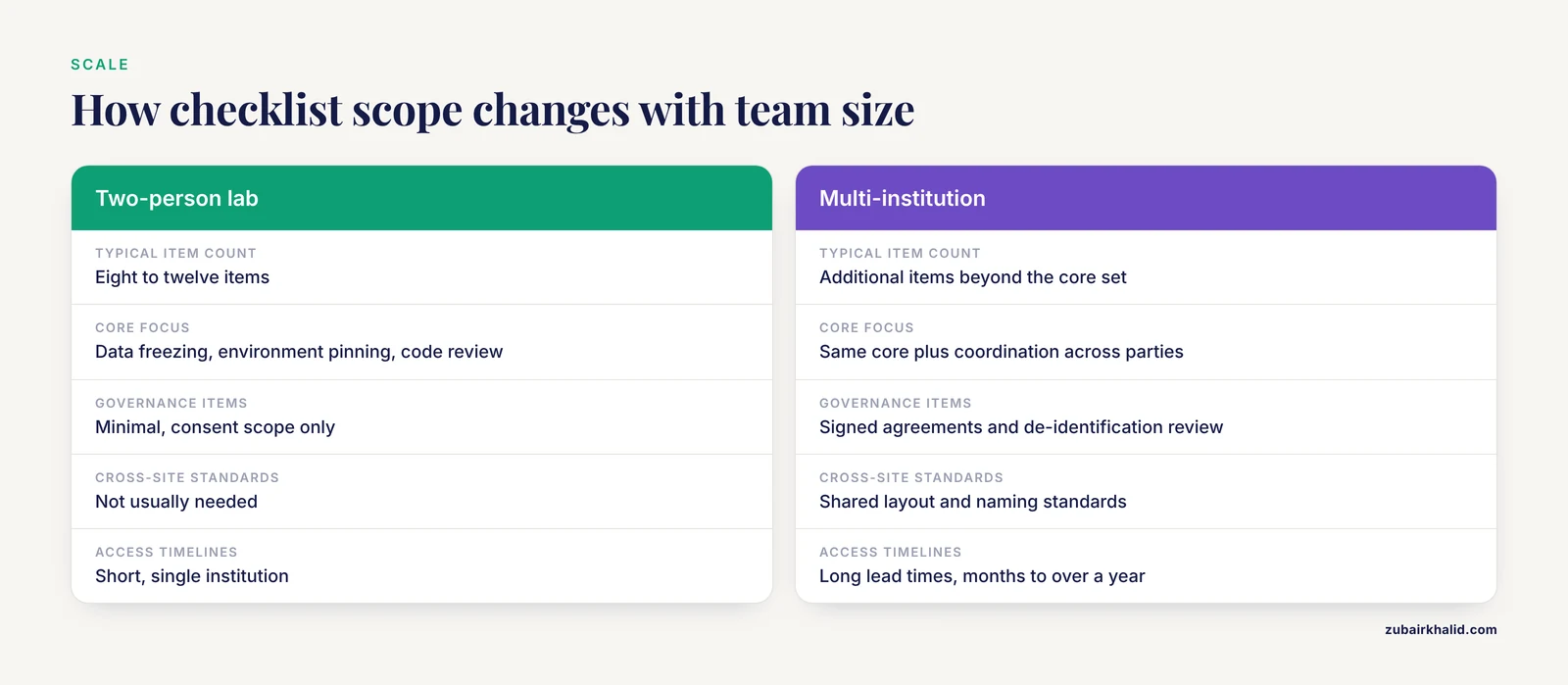
A two-person lab may need eight to twelve items focused on data freezing, environment pinning, and code review. Multi-institution projects need additional items for governance agreements, cross-site data structure standards, and access timelines, which scale with the number of independent parties.
How do we handle sensitive or regulated data on the checklist?
Add governance items requiring documented de-identification or privacy-preserving techniques, signed data sharing agreements, and consent language that covers sharing, with the legal and ethical frameworks of your institutions named in the evidence.
Should the checklist cover AI tools?
Yes, if any workflow uses them. Add items for disclosure of AI use, human review of AI-assisted outputs, and, for predictive models, independent validation with pre-specified metrics.
How do we get collaborators to actually use the checklist?
Keep it short, give every item one owner, review it in existing team meetings rather than separate ones, and route all edits through pull requests so the team sees changes rather than hearing about them.
How often should the checklist be updated?
At every phase transition and whenever a dry run or audit exposes a gap. Each update should be a reviewed commit, so the checklist's own history remains auditable alongside the project.
Sources
- Where did it go? How Information Management Practices Impact Rigor and Reproducibility in Collaborative Clinical and Translational Research.
- Presynaptic actin nanostructures: A reproducibility case study.
- Evaluating the prevalence and application of data sharing statements in high-impact ophthalmology journals.
- PhenX Toolkit: a knowledgebase that enables consistent data collection and facilitates cross-study analysis and data reuse.
- GitHub is an effective platform for collaborative and reproducible laboratory research.
- Research Code Sharing in Support of Gold Standard Science.
- The Human Intracerebral EEG Platform: A Cloud-Based Trusted Research Environment for Collaborative SEEG Research in Epilepsy and Neuroscience.
- Democratizing data sharing and processing of routine MRI data acquired for neuroimaging research.
- Waste Not, Want Not: How to Make Your Data Futureproof Through Good Data Sharing Practices.
- Open research data in human movement analysis: Swiss-initiated-guidelines for broader scientific communities.
- Data sharing for responsible artificial intelligence in dentistry: a narrative review of legal frameworks and privacy-preserving techniques.
- The case for data sharing in traditional, complementary, and integrative medicine research.
- User journeys in cross-European secondary use of health data: insights ahead of the European Health Data Space.
- Partnering With Generative Artificial Intelligence for Quantitative Data Analysis in Nursing Research: A Practical Workflow for Ethical Collaboration.
- From assistance to accountability: a systematic scoping review of LLMs in responsible scholarly review, research integrity, and scientometrics.
- Artificial Intelligence in Chronic Rhinosinusitis: From Molecular Profiling to Personalized Clinical Management-A Systematic Review.
- Terminology for describing the 24-h cycle of physical activity, sedentary behaviour, and sleep: a scoping review.