Reference Managers for Clinical Research Teams
By Dr. Zubair Khalid, DVM, MS, PhD ·

A reference manager is software that stores, organizes, and formats the scientific papers a team reads and cites, and the single biggest difference between the options is whether the library lives on one person's computer or in a shared cloud workspace the whole team can edit. The rule of thumb for choosing: if two or more people on the team write manuscripts together, pick a tool with a shared library, granular permissions, and institutional data governance support. If most team members only read and file papers, a lightweight individual tool is enough.
This guide covers the reference manager options clinical research teams actually use, the pros and cons of each, the criteria that decide real purchases, and the mistakes that cost teams weeks of cleanup work. It also clarifies what a reference manager is not, because that confusion drives most bad purchases.
Why Clinical Research Teams Need Shared Reference Management
Clinical research is a team sport by design. A single trial protocol or observational analysis typically involves physicians, coordinators, statisticians, pharmacists, and research nurses working from the same evidence base. Reviews of the clinical research workforce describe research nurses as core members of multidisciplinary research teams whose duties and coordination directly affect trial quality [1]. Similar patterns appear across the care system, where clinical pharmacist practitioners on primary care teams carry defined responsibilities for complex patients and depend on shared evidence to justify medication decisions [2]. In wound care, multidisciplinary teams span nurses, physicians, dietitians, physiotherapists, and quality improvement professionals, each contributing different literature streams to a shared care standard [3].
When every member maintains a private folder of PDFs, the team pays predictable costs. Duplicate downloads, version conflicts between drafts, inconsistent citation formats, and missed key references all follow. A review of writing competence in clinical research settings found that research self-assessment scores improved measurably on the literature review subscale after structured support, which suggests that literature handling is a trainable skill rather than a fixed trait [4]. A reference manager is the infrastructure for that skill.
There is also an integrity dimension. A systematic review of plagiarism in medical academic writing identified unawareness of research ethics, poor writing skills, and publication pressure as the leading causes, and concluded that prevention plus detection software plus institutional sanctions together keep plagiarism in check [5]. A team library with accurate metadata, deduplication, and consistent citation styles removes one of the most common accidental pathways to plagiarism, which is the sloppy paraphrase of a paper the writer no longer has in front of them.
Finally, shared reference management supports fair credit. Research on partnership practices identifies co-authorship, agreements, and collaborative product ownership as domains where explicit, written practices prevent conflict [6]. A shared library with notes and annotations creates a timestamped record of who found and synthesized which evidence, which helps when authorship discussions come later.
What a Reference Manager Actually Does
A reference manager performs four core jobs.
- Metadata capture. It imports citation records (title, authors, journal, year, DOI) directly from databases such as PubMed, Scopus, and Web of Science, or from publisher websites, so nobody types references by hand.
- PDF storage and annotation. It stores the full-text files alongside the metadata and lets readers highlight and comment.
- Organization. It provides folders, tags, saved searches, and deduplication so a team of five does not end up with five copies of the same guideline.
- Citation formatting. It inserts in-text citations into Word, Google Docs, or LaTeX and generates a formatted bibliography in the required style, such as AMA, Vancouver, or APA.
Clinical teams should understand the boundary of the tool. A reference manager does not design a study, manage an electronic case report form, or screen abstracts for a systematic review. Teams that expect one product to do everything usually buy the wrong product for the job they actually have.
Reference Manager for Clinical Research Teams Options: Pros and Cons
These are the tools most commonly deployed in clinical research settings. The descriptions reflect long-established product characteristics, and no pricing is given because institutional licensing varies widely.
Zotero
Zotero is a free, open-source reference manager maintained by a nonprofit. It captures references with a browser connector, stores PDFs, and inserts citations into Word, LibreOffice, and Google Docs.
- Pros. No license cost, strong PDF capture, open file formats that avoid vendor lock-in, group libraries with member roles, and a large community that builds plugins.
- Cons. Free storage has size limits, so large shared PDF collections require a paid storage plan or third-party sync. Some institutions do not provide formal support contracts for it, which matters when an IT department wants a vendor to call.
Zotero is often the best starting point for a small team or a department with no budget line for software.
EndNote
EndNote is a long-established, licensed reference manager that runs as a desktop application with an online sync component. It is deeply embedded in many academic medical centers, often through site licenses.
- Pros. Handles very large libraries, offers deep control over citation styles including edited and customized output styles, integrates tightly with Web of Science records, and is familiar to senior investigators and journal editors.
- Cons. It is a paid product with per-seat licensing, collaboration across organizations is clunkier than in cloud-native tools, and the desktop-first model complicates work across operating systems.
EndNote remains the pragmatic answer when the institution already holds a site license and the team works with large, style-intensive manuscripts.
Mendeley
Mendeley is a free reference manager owned by Elsevier, combining a reference library, PDF reader, and a researcher profile and network component.
- Pros. No cost, decent annotation tools, reference extraction from imported PDFs, and straightforward group libraries.
- Cons. It is closed-source and owned by a publisher, which some teams view as a conflict-of-interest concern when citing competitor-journal content. Development pace and feature changes follow the owner's commercial priorities rather than user votes.
Mendeley suits individual clinicians and small groups who want a zero-cost tool with a polished interface.
Paperpile
Paperpile is a browser-based reference manager built around Google Workspace, with tight Google Docs integration.
- Pros. Excellent for teams that draft in Google Docs, clean metadata cleanup, shared libraries, and no local installation.
- Cons. It is a paid subscription tied to the Google ecosystem, and teams committed to Microsoft Word get less benefit. Institutions without Google Workspace integration may face onboarding friction.
Paperpile is the natural pick for a research office that already lives in Google Docs.
ReadCube Papers
ReadCube Papers is a subscription reference manager with strong PDF reader features, including enhanced article viewing and note syncing.
- Pros. Good reading experience, web importer, cross-device sync.
- Cons. Subscription cost, smaller collaboration ecosystem, and fewer institutional deployments than the tools above, which can complicate handoffs when team members rotate.
Covidence, Rayyan, and Screening Tools (Not Reference Managers)
Teams running systematic reviews often encounter Covidence or Rayyan. These are screening and evidence-synthesis platforms. They import references, help two reviewers screen titles and abstracts, and export PRISMA-compatible counts. They do not manage a general team library or format manuscripts. Most serious teams pair a screening platform with a reference manager and export records between them in RIS or BibTeX format.
Bibliometric Software (Adjacent, Not a Substitute)
When a team needs to map a research field rather than manage day-to-day reading, bibliometric tools come into play. A recent bibliometric analysis of geriatric nutritional assessment literature searched Web of Science Core Collection and Scopus and analyzed thousands of records using the R bibliometrix package, VOSviewer, and CiteSpace [7]. Those tools quantify publication trends, co-authorship networks, and keyword clusters. They complement but do not replace a reference manager, and the same database exports (Web of Science and Scopus records) feed both categories of software.
Side-by-Side Research Software Comparison
The table below summarizes the reference manager for clinical research teams options that appear most often in real deployments.
| Tool | Deployment model | Team collaboration | Cost model | Best fit |
|---|---|---|---|---|
| Zotero | Cloud library with desktop and web apps | Shared group libraries with member roles | Free core, paid storage tiers | Small to mid-size teams, budget-conscious departments |
| EndNote | Desktop application with online sync | Shared groups via online sync | Per-seat license, often institution-wide | Large libraries, style-heavy manuscripts, institutions with site licenses |
| Mendeley | Cloud library with desktop and web readers | Shared groups | Free with publisher account | Individual clinicians and small groups |
| Paperpile | Browser-based, Google Workspace native | Shared libraries | Subscription | Teams drafting in Google Docs |
| ReadCube Papers | Cloud with desktop and mobile readers | Limited sharing | Subscription | Individual heavy readers |
| Covidence or Rayyan | Cloud screening platforms | Reviewer roles for screening | Subscription, institutional deals common | Systematic review teams (paired with a reference manager) |
| VOSviewer or bibliometrix | Desktop or R-based analysis | Not collaborative by design | Free | Field mapping and bibliometric reports |
No single row wins every column. The decision criteria below resolve the trade-offs.
Choosing the Best Reference Manager for Clinical Research Teams: The Criteria That Decide
1. Data governance and patient data boundaries
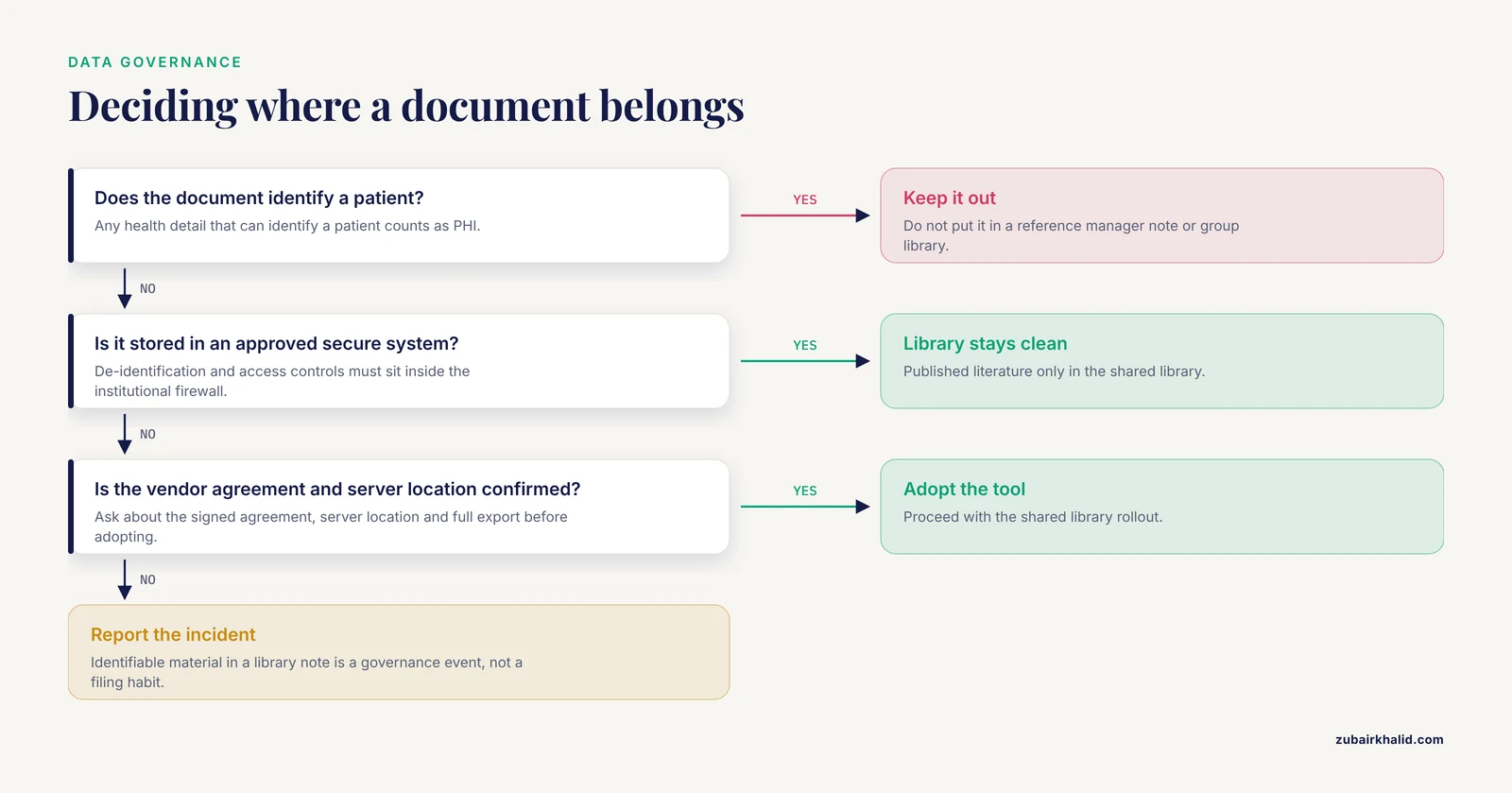
The first filter is institutional, not technical. Clinical research teams work under data governance rules that limit where identifiable data can live. A framework for clinical AI projects lists technical data management, ethical and regulatory governance, and de-identification pipelines as prerequisite domains for any production-grade system [8]. The same logic applies at smaller scale to reference libraries: a reference manager cloud account is not an approved location for protected health information (PHI), which is any health detail that can identify a patient.
A practical rule keeps the two worlds separate. Store de-identified case vignettes in an approved secure environment, and keep the reference library limited to published literature. Work on secure sandboxes for preclinical AI evaluation demonstrates the pattern, running de-identification pipelines and access controls entirely inside an institutional firewall before any data reaches a shared tool [9]. If a team member pastes a patient chart excerpt into a reference manager note to "remember the case," that is a governance incident, not a filing habit.
Before adopting any tool, confirm three things with the institution: whether the vendor has a signed agreement, where the data servers sit, and whether the tool can be exported in full if the contract ends.
2. Team size and turnover
Clinical research staff rotate. Coordinators finish studies, fellows graduate, and new roles such as physician associates are integrated into existing teams with varying levels of structured onboarding support, a challenge documented in NHS case studies across five organizations [10]. A reference manager should survive that churn.
The test is simple. Can a new member be added to the shared library with read or write access in under five minutes, and does the library retain everything when a departing member is removed? Cloud-native tools (Zotero groups, Paperpile, Mendeley groups) handle this best. Desktop-centric workflows where one coordinator holds the master library create a single point of failure every time she leaves.
3. Writing workflow
Match the tool to the drafting environment. Teams writing in Google Docs get the most from Paperpile or Zotero. Teams producing journal submissions in Microsoft Word, which remains the dominant format for many clinical journals, often prefer EndNote or Zotero's Word plugin. Check that the tool supports the citation styles your target journals require. AMA (American Medical Association) style and Vancouver style (numbered citations in order of appearance) dominate clinical journals, and a tool that renders a style poorly will create days of manual correction at submission time.
4. Database coverage in the team's field
A reference manager is only as good as its import paths. Clinical teams pull from PubMed daily, and systematic review teams additionally need Embase, Scopus, Web of Science, and trial registries. Verify that the browser connector captures records from every database the team searches, including the gray literature sources that reviews increasingly depend on. A scoping review of multidisciplinary pressure injury teams, for example, drew on MEDLINE, CINAHL, Cochrane Library, PEDro, and Web of Science alongside gray literature and reference screening [3]. If your tool cannot ingest a record type cleanly, the team will fall back to hand-typed references, which is where metadata errors begin.
5. Cost and support reality
Budget operates at two levels. The first is license cost, which ranges from free (Zotero, Mendeley) to per-seat subscriptions. The second, often larger, is the cost of inconsistent tooling. A team where half the members use EndNote and half use Zotero spends more time merging libraries than either license would have cost. Standardize on one tool per team, even if individual members keep personal accounts elsewhere.
Worked Scenarios
Scenario A: A five-person research nurse team writing a service evaluation
A nursing group at a hospital is preparing a manuscript on a research support model. Published work in this space shows that structured research support services measurably improved nurses' self-assessed research competence, including the literature review subscale [4]. The team has no software budget, drafts in Word, and rotates members.
Fit. Zotero. Free, shared group library, Word plugin, and open export formats. The team lead creates a group library, adds the two most active members as editors, and grants everyone else read access. One naming convention is agreed: article PDFs stay unrenamed, and the team uses tags such as background, methods-reference, and journal-club rather than folders, because tags survive reorganization.
Scenario B: A hospital pharmacy group building a drug-safety review
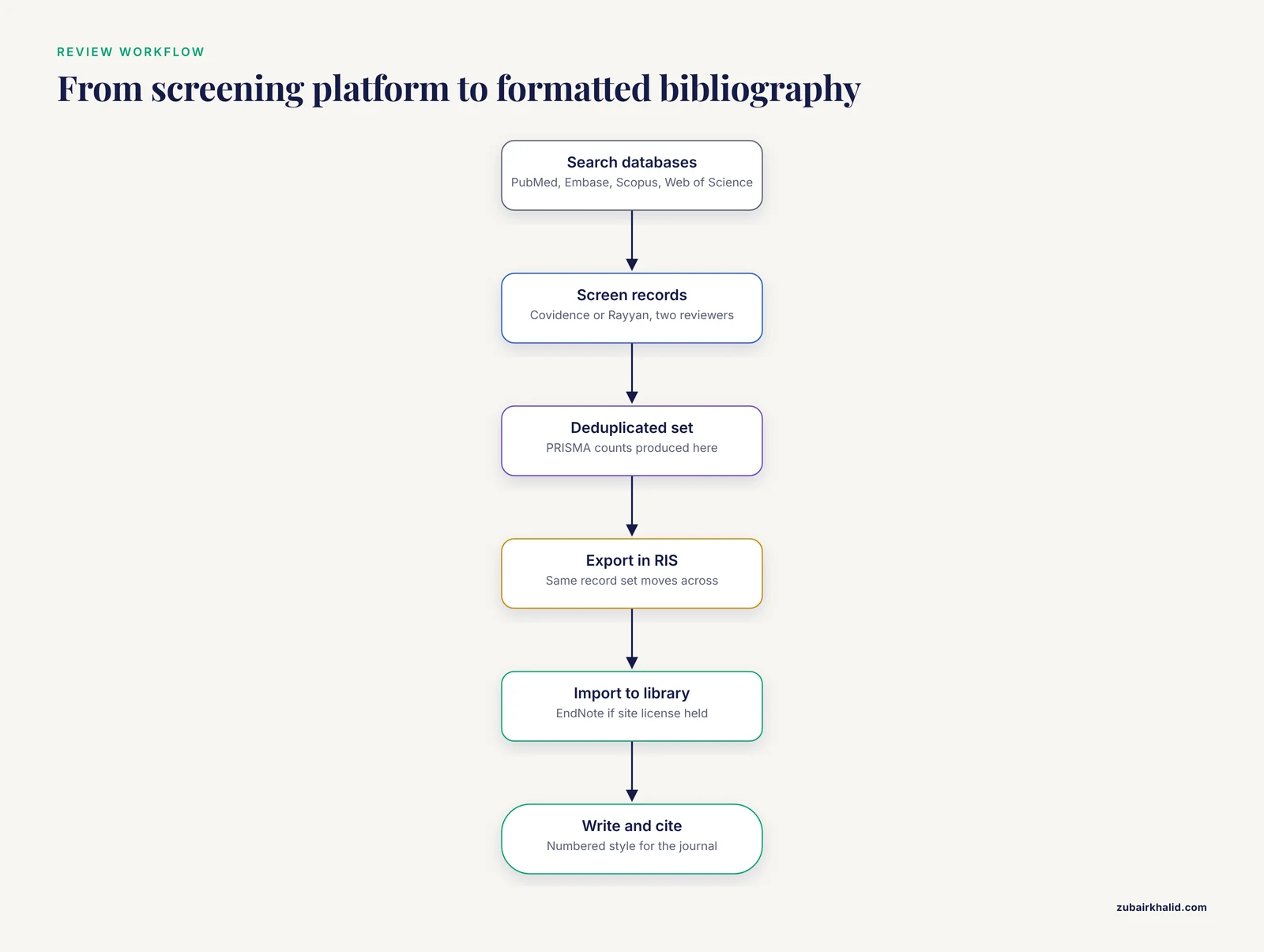
A pharmacovigilance team is synthesizing adverse drug reaction evidence across treatment regimens, a task shaped like published cohort work that compared reaction profiles between two multidrug regimens for leprosy using structured causality assessment [11]. The team needs a screening platform for the abstract review and a reference manager for the writing phase.
Fit. Covidence or Rayyan for screening, paired with EndNote for the manuscript if the institution has a site license and the target journal uses a numbered style. Export the deduplicated records from the screening tool in RIS format and import them into the reference manager so the bibliography is built from the same record set that produced the PRISMA counts.
Scenario C: A multidisciplinary diagnostic or treatment committee maintaining an evidence base
Multidisciplinary teams demonstrate strong collective accuracy when they work from a shared assessment process, as shown in a classic evaluation of community psychogeriatric teams where team diagnoses agreed with independent research psychiatrists in 90 to 99 percent of cases [12]. To keep that accuracy current, the team needs a living library of guidelines and key papers.
Fit. Paperpile or Zotero, whichever matches the committee's document environment. Set a recurring monthly task where one member tags newly published guidelines, so the shared library functions as the committee's current-evidence list rather than an archive.
Scenario D: An AI-oriented clinical research group
A team developing a clinical prediction tool must document its reference standard, data provenance, and prior model performance across a project lifecycle that runs from data curation through external validation [8]. Its literature needs are heavy on methods papers and validation studies, and its data governance constraints are strict.
Fit. Zotero or EndNote depending on the drafting environment, with the explicit rule that no patient-level material enters the library. Methods papers are tagged by pipeline stage, so the methods section of each future manuscript can be assembled from a filtered view of the library.
Common Mix-Ups
Mix-up 1: Buying a reference manager to run a systematic review. Screening, deduplication reporting, and risk-of-bias tracking are jobs for review platforms. The reference manager stores and formats what the review cites. Plan for both, or for a scripted pipeline using tools such as Zotero with R exports.
Mix-up 2: Confusing a reference manager with bibliometric software. VOSviewer, CiteSpace, and bibliometrix analyze patterns across thousands of records to map a field [7]. They do not insert citations into your manuscript. Teams occasionally purchase analysis software expecting writing features.
Mix-up 3: Letting each member pick a personal tool. Library merging at manuscript time is slower and error-prone. Standardize per team, allow personal accounts for individual reading.
Mix-up 4: Treating the shared library as private. A shared library is a governance surface. Access should reflect the same role discipline that clinical teams apply elsewhere, and published work on research partnerships emphasizes written agreements, defined roles, and transparent communication as the mechanisms that keep collaborations healthy [6].
Mix-up 5: Assuming automatic metadata is correct. Database records occasionally carry wrong author order, missing DOIs, or duplicated entries. Spot-check the highest-visibility citations in every manuscript. Reviewers notice reference errors, and a wrong citation undermines an otherwise strong paper.
Common Mistakes and Limitations
- Importing without cleaning. Every large library accumulates duplicates after multiple database searches. Run the deduplication routine before each manuscript, not after submission.
- Relying on one style definition forever. Journals update style requirements. Re-verify output against the target journal's current author guidelines for every submission.
- Storing patient data in the library. Reference manager cloud accounts are not clinical data systems. Keep case material in approved environments with de-identification, following the governance pattern used for clinical AI evaluation projects [8] [9].
- Assuming the tool fixes integrity problems. Software detects copied text after it exists. The preventive work is training on citation ethics and giving writers time, which the plagiarism literature identifies as the primary remedies alongside detection tools [5].
- Ignoring the exit path. Export the full library with PDFs on a schedule, in a tool-independent format such as BibTeX or RIS with a folder of PDFs. Vendor changes and contract lapses happen without warning.
- Expecting software to substitute for mentorship. Skills such as framing a reviewable question and synthesizing evidence improve with structured support, as demonstrated in nursing research capacity programs [4]. The reference manager supports that development. It does not replace it.
- Overlooking role clarity. Multidisciplinary work succeeds when duties are explicit, a finding that recurs in analyses of clinical research teams [1] [10]. Assign a library owner with the authority to enforce naming conventions and pruning.
One limitation applies to individual cases everywhere in clinical work: any specific decision about patient care or a specific study's data handling needs review by the responsible clinician, the institutional review board, or the data governance office, not by a software checklist.
Frequently Asked Questions
What is the best reference manager for clinical research teams?
There is no single best tool. Teams that draft together and rotate members do best with a cloud-native shared library such as Zotero, Paperpile, or Mendeley. Teams embedded in institutions with EndNote site licenses and heavy Word-based manuscript production usually stay with EndNote. The deciding factors are your drafting environment, your institution's data governance agreements, and staff turnover, not benchmark scores.
Can a reference manager store patient data or protected health information?
No. Reference manager accounts, including cloud group libraries, are not approved repositories for protected health information. Keep published literature in the library and keep any patient-derived material inside approved secure systems with de-identification and institutional access controls. If identifiable material ends up in a library note, treat it as a reportable governance event.
Do we need a reference manager if we already use Covidence or Rayyan?
Yes, because they do different jobs. Screening platforms manage title, abstract, and full-text review for a systematic review and produce the PRISMA record flow. A reference manager holds the team's broader library, supports annotations, and formats citations in the manuscript. Export the deduplicated screening records into the reference manager so the bibliography matches the review.
Which citation style should our team use?
Use the style your target journal specifies. AMA and Vancouver, both numbered styles, dominate most clinical journals, while APA appears in psychology-adjacent and education-focused venues. Configure the tool's style once per manuscript, and verify the generated references against the journal's current author guidelines before submission.
How do we move a whole team from email attachments to a shared reference library?
Appoint a library owner, import existing PDF folders in bulk, run deduplication once, agree on tags and a minimal folder structure, and give every member access on day one rather than phasing it in. Expect two to four weeks of adjustment, and pair the rollout with a short training session covering the citation plugin, because plug-in unfamiliarity is the usual reason people quietly revert to old habits.
Are tools like VOSviewer and CiteSpace reference managers?
No. They are bibliometric analysis tools that map publication trends, co-authorship networks, and keyword clusters across large record sets from databases such as Web of Science and Scopus. They read exported records rather than managing your day-to-day reading, and they do not write citations into manuscripts. Use them when you need a field overview or a bibliometric report, alongside a reference manager.
Sources
- An exploration and analysis of the role positioning, duty comparison, and career development path of clinical research nurses in developed and developing countries.
- Clinical pharmacist practitioners on primary care teams play an important role in caring for complex patients with diabetes.
- Does teamwork make the dream work? A scoping review of multidisciplinary teams in pressure injury prevention and management.
- Application of a nursing research order-service model based on a "demand-resource" linkage mechanism.
- The confounding factors leading to plagiarism in academic writing and some suggested remedies: A systematic review.
- Identifying practices for meaningful health research partnerships: series of rapid environmental scans.
- Mapping the scientific research on geriatric nutritional assessment (2016-2025): A bibliometric analysis.
- A practical guide to the implementation of AI in orthopaedic research-Part 4: Prerequisites for a successful orthopedics AI-driven project in terms of interdisciplinary collaboration, data management, ethical approval and technology.
- A Secure User Interface for Preclinical Evaluation of AI in Patient Portal Message Management: Tutorial.
- Development, integration, retention, and career progression of physician associates/assistants in UK NHS hospitals and clinical teams: a multiple-case qualitative study.
- Adverse reactions induced by MDT/WHO (Rifampicin+Clofazimine+Dapsone) and ROM (Rifampicin+Ofloxacin+Minocycline) regimens used in the treatment of leprosy: a cohort study in a National Reference Center in Brazil.
- An evaluation of the multidisciplinary approach to psychiatric diagnosis in elderly people.