How to Write a Methods Section for a Psychology Lab Report
By Dr. Zubair Khalid, DVM, MS, PhD ·

By the end of this guide, you will be able to write a Methods section that a stranger could use to repeat your study exactly. You will know which subsections APA 7 expects, what belongs in each one, how to phrase participant counts and exclusion numbers, and how to fix the errors that markers flag most often. You will also get a fill-in template and a complete worked example you can adapt.
Have on hand before you start:
- Your ethics or Institutional Review Board (IRB) approval details, including the protocol number
- The full names, authors, and years of every questionnaire or task you used
- Your recruitment dates, participant numbers, and exclusion counts
- The software and version numbers you used for presentation and analysis
- The Publication Manual of the American Psychological Association, 7th edition, or your department's local style guide
Where the Methods Section Fits in a Lab Report Format
A standard psychology lab report follows the APA structure: Title page, Abstract, Introduction, Method, Results, Discussion, and References. The Method section sits between the Introduction and the Results. The Introduction argues why the study exists. The Results report what you found. The Method explains what you did, in enough detail that another researcher could reproduce the study from your words alone.
That reproduction standard is called replication. It is the single test every sentence in your Methods section must pass. If a sentence does not help someone repeat the study, it usually belongs somewhere else or nowhere at all.
Why is the bar so high? Because small methodological choices change what a study means. A review of smartphone-based stress measurement found 108 eligible studies using self-report methods in daily life, and those studies differed in which instrument they used, how often prompts appeared, and what response options participants saw [1]. Two studies can both claim to measure "perceived stress" while using different items on different schedules, which makes their results hard to compare. Your Methods section exists to close that gap for your own study. It pins down exactly which version of the construct you measured and how.
The Five Subsections, and What Goes in Each One
Most psychology lab reports organize the Method section into three to five labeled subsections. The four below are the core set. Some departments also ask for a Design subsection at the start and a Data Analysis subsection at the end. Check your assignment brief, because requirements vary by course.
Participants
Report who took part, how many, how they were recruited, how many were excluded and why, and what they received in return. Use standard APA abbreviations: N for the total sample, M for mean, SD for standard deviation. Report age as a mean and standard deviation rather than only a range.
Design
State the design in one or two sentences. Name the independent variable (the factor you manipulated or compared), its levels, and the dependent variable (the outcome you measured). State whether the design is between-subjects (different participants in each condition), within-subjects (the same participants in all conditions), or mixed.
Materials or Measures
List every questionnaire, stimulus set, apparatus, or software you used. For each published measure, give the authors, year, number of items, response scale, and reliability from your sample if you calculated it, such as Cronbach's alpha. For custom materials, describe them fully enough to rebuild them, and put long stimulus lists in an appendix.
Procedure
Walk the reader through the study in the order a participant experienced it. Cover consent, instructions, task order, timing, randomization or counterbalancing, and debriefing. Use numbered or ordered steps when the sequence matters.
Data Analysis (when required)
Name the software and version, the statistical tests, the alpha level you used to judge significance, and any exclusion rules applied to the data before analysis.
A Psychology Lab Report Methods Section Example, Line by Line
The following example uses a fictional but realistic study: a two-condition experiment testing whether smartphone notifications impair performance on a sustained-attention task. Every number is illustrative. The phrasing, however, is the pattern you should copy.
Step 1: Draft the Participants Subsection
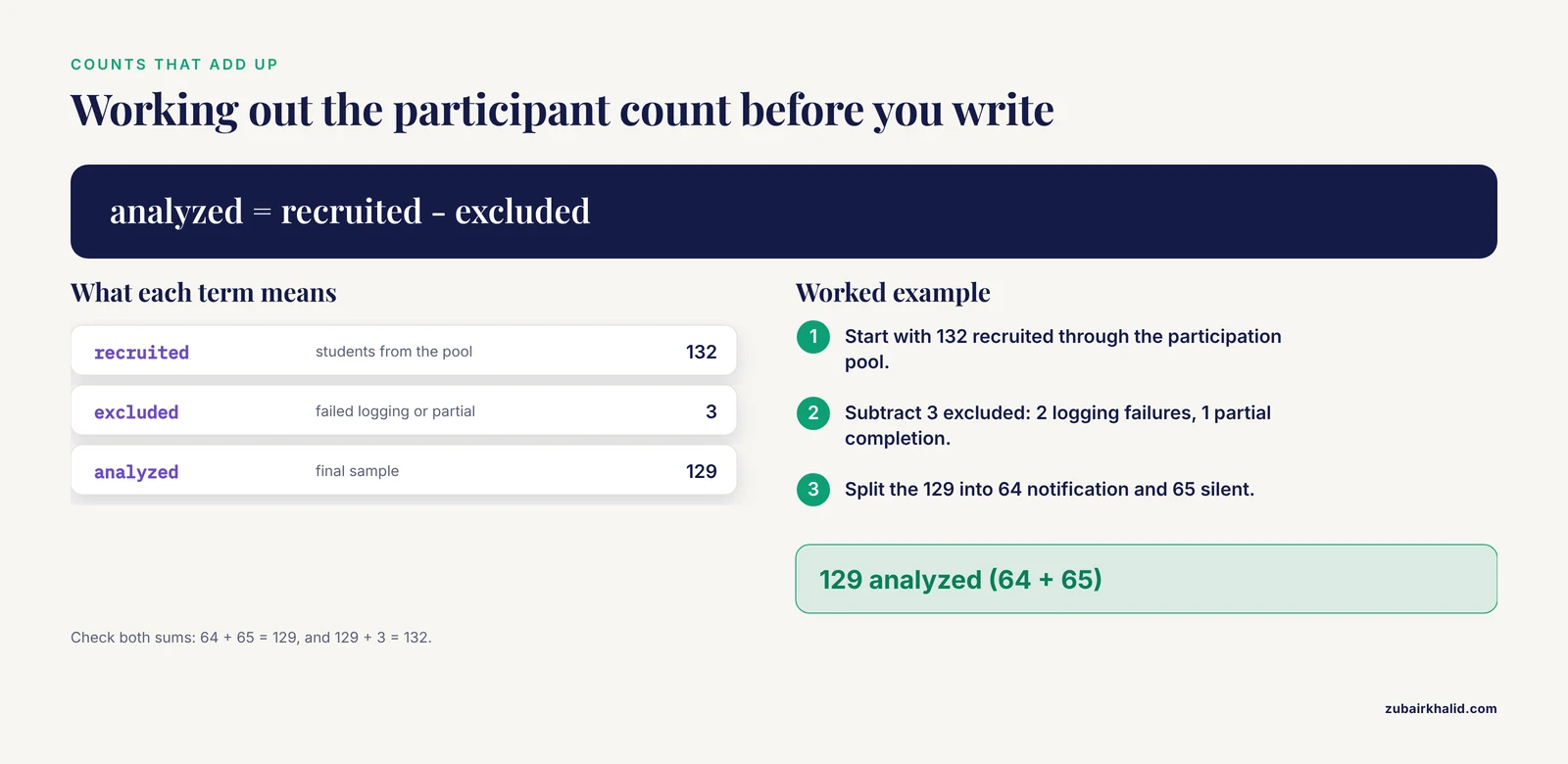
Work through your recruitment records and produce the arithmetic first. Doing the math before you write prevents the most common error in this subsection, which is a participant count that does not add up.
Worked count:

  132 recruited through the research participation pool
-   3 excluded (response-time logging failed on 2 devices,
    1 partial completion)
= 129 analyzed

  Condition split after exclusion:
  Notification condition: 64
  Silent condition:       65
Now turn that arithmetic into APA prose:
Participants

The sample comprised 132 undergraduate students recruited through the
university research participation pool. Participants ranged in age from
18 to 34 years (M = 20.1, SD = 2.6). Of these, 78 identified as women,
51 as men, and 3 reported another gender identity. Three participants
were excluded before analysis because the recording software failed to
log response times on two devices and one session ended partway through,
leaving a final sample of 129 (64 in the notification condition, 65 in
the silent condition). Participants received one course credit. The
procedure was approved by the university Institutional Review Board
(protocol 2025-041).
Expected output check: every number in the prose traces to a record, and the excluded participants plus the analyzed sample equal the recruited total. If a reader adds 64 + 65, they get 129. If they add 129 + 3, they get 132.
Step 2: Draft the Design Subsection
Design

The study used a between-subjects design with one independent variable,
notification condition (notification present versus notification
absent). The dependent variable was sustained attention, operationalized
as the mean response time on correct trials of a Sustained Attention to
Response Task (SART) and the number of commission errors. Participants
were assigned to conditions using block randomization with blocks of
four.
Notice what this paragraph does. It names the design type, defines the independent variable and its levels, defines the dependent variable in operational terms (mean response time and error count, not the vague phrase "attention"), and states how assignment happened.
Step 3: Draft the Materials or Measures Subsection
For each measure, give five pieces of information: full name, citation, item count, response scale, and reliability.
Materials

Sustained Attention to Response Task (SART). The SART presents single
digits (1-9) at 1,000 ms intervals, and participants press the spacebar
to every digit except 3. The task contained 225 trials, of which 25 were
no-go trials (the digit 3). The primary outcomes were mean response time
on correct go trials and the proportion of no-go trials on which a key
was pressed.

Perceived Stress Scale (PSS-10; Cohen, Kamarck, & Mermelstein, 1983).
The PSS-10 contains 10 items rated on a 5-point scale from 0 (never) to
4 (very often). Scores range from 0 to 40, with higher scores indicating
greater perceived stress. Cronbach's alpha in the present sample was .84.
The scale was administered once, at the end of the session.

Apparatus. The task ran in PsychoPy (version 2024.1.4) in a browser on
13-inch laptops with identical refresh settings across testing stations.
The level of detail here is not optional decoration. Reviews of how researchers measure psychological constructs in daily life show wide variation in instrument choice, prompt timing, and response format even when the target construct is the same, and the completeness of validity and reliability reporting varies just as widely [1]. A reader who knows only that you measured stress, but not which scale with which anchors at which moment, cannot compare your findings to anyone else's.
Step 4: Draft the Procedure Subsection
Procedure

Participants signed up for a 45-minute laboratory session. After
providing written informed consent, each participant completed the SART
on a laptop. In the notification condition, standardized push
notifications appeared at 30-second intervals during the task. In the
silent condition, the phone remained face down and out of reach.
Condition assignment was determined by block randomization before the
session. After the SART, participants completed the PSS-10, a short
demographics form, and a funnel debriefing that probed for hypotheses
suspicion. Sessions lasted between 38 and 47 minutes. Participants were
then fully debriefed and awarded course credit.
Every timing, every ordering decision, and every control step appears here. If a later Results finding depends on something the procedure controls, such as the 30-second notification interval, the reader can find it in this subsection.
Step 5: Draft the Data Analysis Subsection (if required)
Data Analysis

Analyses were conducted in R (version 4.4.1) with the afex package.
Mean response times were computed after removing response times below
200 ms and above 2,000 ms (1.9% of correct go trials). Group differences
were tested with an independent-samples t test, with Cohen's d reported
as the effect size. The significance criterion was alpha = .05,
two-tailed.
The data-cleaning numbers here are illustrative. The pattern is what matters: state the exclusion rule, the proportion of data it removed, the test, the effect size, and the alpha level. A reader can then reproduce not only your data collection but your analysis decisions.
A Fill-In Template You Can Adapt
The template below compresses the example into a skeleton. Replace the bracketed fields with your own study details.
Participants
  N recruited = [___], recruited via [___] between [date] and [date].
  Age: M = [___], SD = [___]. Gender: [___ women, ___ men, ___ other].
  Exclusions: [n] for [reason], leaving N = [___].
  Compensation: [___]. Ethics approval: [board name, protocol number].

Design
  [Between-subjects / within-subjects / mixed] design.
  Independent variable: [___], levels [___].
  Dependent variable: [___], operationalized as [___].
  Assignment/order: [randomization or counterbalancing method].

Materials
  [Measure 1]: [authors, year], [n] items, rated [scale anchors].
  Scores range [___], higher = [___]. Reliability: alpha = [___].
  [Measure 2 / task / apparatus]: [full specification, software,
  version, settings].

Procedure
  1. [Consent: format, duration]
  2. [Task or manipulation: timing, settings, control steps]
  3. [Additional measures in order]
  4. [Debriefing and compensation]
  Session length: [___ to ___ minutes].

Data Analysis
  Software: [name and version]. Exclusion rules: [rule, % removed].
  Tests: [test names]. Alpha = [___].
Summary Table: The Methods Section at a Glance
| Subsection | Core question it answers | Typical length | Most common error |
|---|---|---|---|
| Participants | Who, how many, from where | 1 paragraph | Counts that do not add up, missing exclusions |
| Design | What kind of study, what varied, what was measured | 1-2 sentences | Naming the variable but not the operational measure |
| Materials or Measures | Exactly what was used | 1 paragraph per measure | Citing a scale without items, anchors, or reliability |
| Procedure | What happened, in what order | 2-3 paragraphs | Missing timing, ordering, or control details |
| Data Analysis | How the data were handled | 1 short paragraph | Naming a test without cleaning rules or alpha |
How Much Detail Is Enough? The Replication Test
A useful habit is to imagine a researcher in another country trying to rebuild your study with nothing but your report. Anything they would have to guess is something you left out. Published scoping reviews demonstrate this problem at scale. An umbrella review of physical environmental determinants of physical activity had to screen 28 systematic reviews and 3 meta-analyses and evaluate the methodological quality of each before it could draw any conclusion [2]. That kind of synthesis is only possible when individual studies report their methods completely, because a reviewer weighting evidence by quality needs to see exactly how each study was conducted. Your Methods section is the unit of evidence that larger reviews build on.
Three details deserve extra care because they are the ones readers most often need and most often find missing.
Instrument identity. Name the exact measure, not the construct. "Perceived stress" is a construct. "The PSS-10, scored 0 to 40" is a measurement. The distinction matters because reviews of stress measurement in daily life document many different self-report instruments and schedules in use, with differing levels of validity evidence reported [1].
Timing and schedule. When did each measure happen relative to the manipulation? If participants completed a questionnaire on paper, in the lab, once, say so. If you collected repeated reports on phones during daily life, name the method, which in that literature is called ecological momentary assessment, and specify the prompt schedule [1].
Handling of departures from plan. If a session was cut short, a device failed, or a script changed midway, report it in the Participants or Procedure subsection with the affected count. Silence about deviations is the fastest way to lose a marker's trust.
Pilot Testing and Planning Before You Write
The Methods section reads best when the study itself was planned with the same discipline. A well-run project documents its plan before data collection starts, then reports it. Protocol papers in health research show this pattern clearly. A scoping review protocol on terminology for isolated older adults states its review objectives, its databases, and its search dates in advance, and records that the search strategy was piloted in one database before being applied across eight [3]. The pilot step is the part students skip most often, and it is the part that saves the most trouble. Run your full procedure on two or three people before collecting real data. Then write down every bug you found and every fix you made, because your final Methods section should describe the corrected procedure, not the flawed first attempt.
Markers and reviewers apply the same lens. When they judge methodological quality, they look for whether the design, sampling, measures, and analyses were specified clearly enough to support the conclusions drawn [2]. A Methods section that reads like it was written from memory the night before the deadline rarely survives that reading. One that reads like it was reconstructed from dated planning notes usually does.
Style Rules for the Methods Section
- Past tense throughout. The study already happened. Write "Participants completed the task," not "Participants complete the task."
- First person is acceptable in APA 7. "We assigned participants to conditions" is now preferred over stilted passive constructions, although passive voice remains fine when the actor genuinely does not matter.
- No results and no interpretation. Never write "as will be shown, the groups differed." Report the recipe, not the cake.
- Define every abbreviation at first use. For example, "Institutional Review Board (IRB)" on first mention, "IRB" after that.
- Use APA italics conventions for statistics. N, M, SD, p, and d appear in italics in formatted text.
- Label subsections with centered bold headings in APA 7 formatted manuscripts, or follow your department's formatting sheet if it differs.
Common Mistakes and Limitations
Counts that do not reconcile. If your Participants subsection says 132 were recruited and 129 were analyzed, the three exclusions must be explained somewhere. Markers routinely check this arithmetic, and unexplained gaps cost more marks than the sentence explaining them would.
Copying the measure name without the citation. Writing "we used a stress questionnaire" gives a reader nothing. Name the instrument, cite it, and give the item count and anchors.
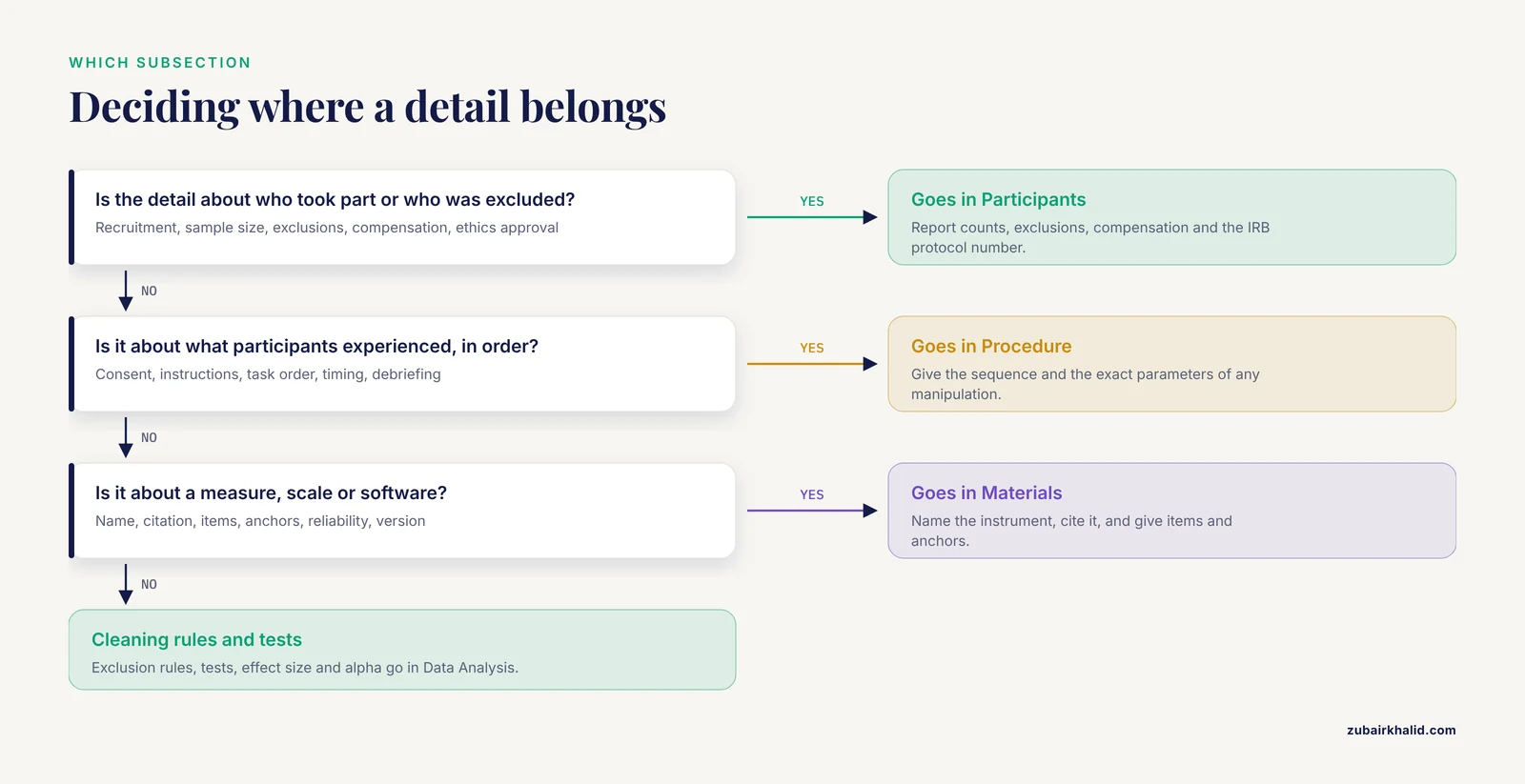
Burying the manipulation. If your study manipulated anything, the manipulation belongs in Procedure with its exact parameters, not in the Introduction or the Discussion.
Including results-adjacent commentary. Sentences like "this exclusion improved data quality" drift into interpretation. State the rule and the count, then stop.
Vague apparatus reporting. "A computer" is not replicable. Software name, version, and the settings that affect timing or display belong in Materials.
Confusing Procedure with Data Analysis. Cleaning rules and statistical tests go in the Data Analysis subsection, not scattered through Procedure.
Forgetting ethics. Approval body and protocol number belong in Participants. Their absence is the single most common reason a lab report gets returned for revision.
One honest limitation applies to this whole guide. Course requirements vary, and some departments specify local formats that override parts of APA style, so the assignment brief always wins over any general guide. For decisions about your own data and ethics obligations at your institution, consult your instructor or your institution's research ethics office.
How to Check Your Work Before Submitting
Run this five-point audit against your draft.
- The stranger test. Could a competent researcher in another lab repeat the study using only your Methods section? Mark every point where they would have to guess.
- The arithmetic check. Add recruited minus excluded. Does it equal analyzed? Add condition sizes. Do they equal analyzed?
- The coverage check. Does every measure named in the Introduction appear in Materials, and every measure in Materials appear somewhere in Results?
- The tense check. Search your draft for present-tense verbs about the study itself. Convert them to past tense.
- The construct check. For each dependent variable, can you point to the sentence that operationalizes it? If not, the Design or Materials subsection needs a revision.
Next Steps
Once the Methods section is solid, draft the Results section, because the two must interlock. Every variable you promised to measure here must surface there as a number. Then revisit the Introduction to confirm that the hypotheses stated there match the design described in your Design subsection. If your course allows appendices, move full stimulus lists, the complete questionnaire text, and screenshots of the task there, and refer to them from the Methods section. For longer projects, consider depositing your materials and analysis code in an open repository such as the Open Science Framework, then citing that deposit in the Materials subsection, which lets your replication standard extend beyond the page.
Frequently Asked Questions
How long should a Methods section be in a psychology lab report?
There is no fixed length, but 500 to 900 words is typical for an undergraduate lab report, and the length should scale with study complexity. A single-questionnaire survey needs less space than a mixed design with a manipulation, and a subsection that runs past a page usually contains material that belongs elsewhere.
Should the Methods section be written in past or present tense?
Use past tense throughout, because the study was completed before you wrote about it. Present tense is reserved for general truths, such as "The SART measures lapses in attention," and for references to tables and figures that exist in the present document.
What is the difference between Materials and Apparatus?
Materials traditionally covers questionnaires, stimulus sets, and scales, while Apparatus covers hardware and software. Many departments now merge the two under a single Materials heading, and APA 7 permits either arrangement, so follow your course guidance.
Do hypotheses belong in the Methods section?
No. Hypotheses belong at the end of the Introduction. The Methods section describes what you did, and mentioning predictions there usually signals that the Introduction failed to set them up properly.
How do I cite a questionnaire in the Methods section?
Cite the original source in author-date format, for example (Cohen, Kamarck, & Mermelstein, 1983), and if you used a modification or a translation, describe the change and cite the source of the adapted version if one exists.
What goes in Participants versus Procedure?
Participants covers who the people were, how they were recruited, sample size, exclusions, and compensation. Procedure covers what those people experienced in sequence, from consent through debriefing. A useful split is that Participants answers "who," and Procedure answers "what happened and when."
Can I copy my preregistration or research plan into the Methods section?
You can adapt it, and doing so is good practice, but revise it into past tense and update it to reflect what actually happened. A preregistration describes the plan, while the Methods section describes the executed study, and differences between the two should be transparent rather than papered over.
Is a lab report Methods section different from a journal article Method section?
The structure is the same, but journal articles compress and point to supplementary materials for full stimulus lists, whereas a lab report usually must be self-contained within the word limit. A lab report is also read by a marker who grades against a rubric, so explicit subsection headings and complete counts matter more than in many published papers.
Sources
- Measuring Perceived Stress in Healthy Adults in Daily Life: Scoping Review of Smartphone-Based Self-Assessment.
- A life course examination of the physical environmental determinants of physical activity behaviour: A "Determinants of Diet and Physical Activity" (DEDIPAC) umbrella systematic literature review.
- Terminology for "Elder Orphans" and Aging Well: Protocol for a Scoping Review.