How to Write a Project Timeline Narrative for a Grant Proposal
By Dr. Zubair Khalid, DVM, MS, PhD ·

By the end of this article you will be able to draft a project timeline narrative for a grant proposal that maps every specific aim to a defined month range, states measurable milestones, justifies overlaps between aims, and stays consistent with your budget justification. You will also learn how to spot the timeline problems that reviewers flag most often, and how to fix them before submission.
You do not need special software. You need the funding announcement (often called the request for applications or funding opportunity), your draft specific aims page or project summary, a rough budget with personnel effort, the sponsor's formatting rules, and a plain calendar. Everything in this walkthrough can be produced in a text editor and a spreadsheet.
What a Project Timeline Narrative Does
A project timeline narrative is the prose section of a proposal that tells a reviewer when each part of the work will happen, in what order, and how you will know it worked. It usually accompanies or replaces a graphical schedule. In federal applications, the timeline typically lives inside the research strategy or project description, and sponsors such as the National Institutes of Health (NIH) and the National Science Foundation (NSF) expect it to demonstrate that the plan is feasible within the requested project period.
The narrative does three jobs that a chart alone cannot do:
- It explains the logic of the sequence. Reviewers want to know why Aim 2 starts in month 7 rather than month 1, and why Aim 1 must finish before the main analysis begins.
- It connects time to effort. The months you assign to each aim must match the person-months of personnel effort in your budget justification.
- It builds confidence in feasibility. A timeline that includes setup, approvals, hiring, analysis, and writing reads as realistic. A timeline where all three aims run at full speed from month 1 reads as fiction.
Good grant proposal planning treats the timeline narrative as a load-bearing section, not decoration. When a study section or review panel says a proposal lacks feasibility, the timeline is one of the first places they look.
What to Have on Hand Before You Write
Gather these five inputs before drafting:
- The funding announcement. Note the project period length (for example, 3 years or 5 years), any required timeline format, and the page limit for the research strategy or project description.
- Your specific aims or objectives. Each aim needs a defined endpoint, because aims are the units the timeline will schedule.
- A draft budget with effort percentages. You need each key person's percent effort per year to calculate person-months.
- Known external dependencies. Institutional review board (IRB) or animal care committee approval, subaward setup, equipment purchase, and hiring all take real time and belong on the schedule.
- The sponsor's review criteria. NIH reviews investigators, innovation, approach, environment, and feasibility. NSF reviews intellectual merit and broader impacts. Your timeline language should speak directly to the criterion that covers approach and feasibility.
Project Timeline Narrative Grant Proposal Step by Step
This walkthrough uses a worked example: a 3-year (36-month) biomedical research project with three aims, a principal investigator (PI) at 25 percent effort (3 calendar months per year on NIH conventions), a postdoctoral fellow at 100 percent effort in year 1 ramping to realistic levels after, and a research technician. Substitute your own numbers as you go.
Step 1: Fix the project period and count in months, not dates
Write the project in project months, numbered 1 through the final month. Funding start dates move, so month numbering keeps the narrative valid even if the award begins late. A 3-year award is months 1 through 36. State this convention in one sentence at the top of the timeline section so the reviewer reads everything else correctly.
Step 2: Break each aim into phases with endpoints
For each aim, list the phases of work and the deliverable that ends each phase. An aim without an endpoint cannot be scheduled.
- Aim 1, endpoint: a validated dataset from 60 enrolled participants
- Aim 2, endpoint: a completed mechanistic assay series on collected samples
- Aim 3, endpoint: an integrated analysis and a submitted manuscript
Step 3: Draft the milestone schedule
Write the schedule as a plain, dated list before you write any prose. Here is the worked example:
Project period: 36 months (Months 1-36)

Months 1-3   Setup phase
             - IRB protocol submitted month 1, approval expected month 3
             - Postdoctoral fellow recruitment (offer by month 2, start month 4)
             - Purchase and validation of assay equipment (months 1-2)

Months 4-12  Aim 1: participant enrollment and baseline data collection
             - Enrollment target: 60 participants at 8 per month, months 4-11
             - Interim quality check of dataset at month 9 (milestone M1)
             - Aim 1 dataset locked at month 12 (milestone M2)

Months 7-24  Aim 2: mechanistic assays (overlaps with Aim 1)
             - Assay optimization months 7-9 using pilot samples from month 6
             - Full assay runs months 10-22
             - Assay completion (milestone M3) at month 24

Months 18-30 Aim 3: integrated analysis
             - Statistical model development months 18-21
             - Full integration of Aims 1 and 2 results months 22-30
             - Final analysis locked (milestone M4) at month 30

Months 31-36 Closeout phase
             - Manuscript drafting and submission months 31-34
             - Progress report and final data archiving months 34-36
             - No new data collection after month 30 (planned buffer)
The expected output of this step is a schedule where every aim has a start month, an end month, and at least one named milestone with a month number. If any aim lacks a milestone, you are not done with this step.
Step 4: Assign effort and calculate person-months
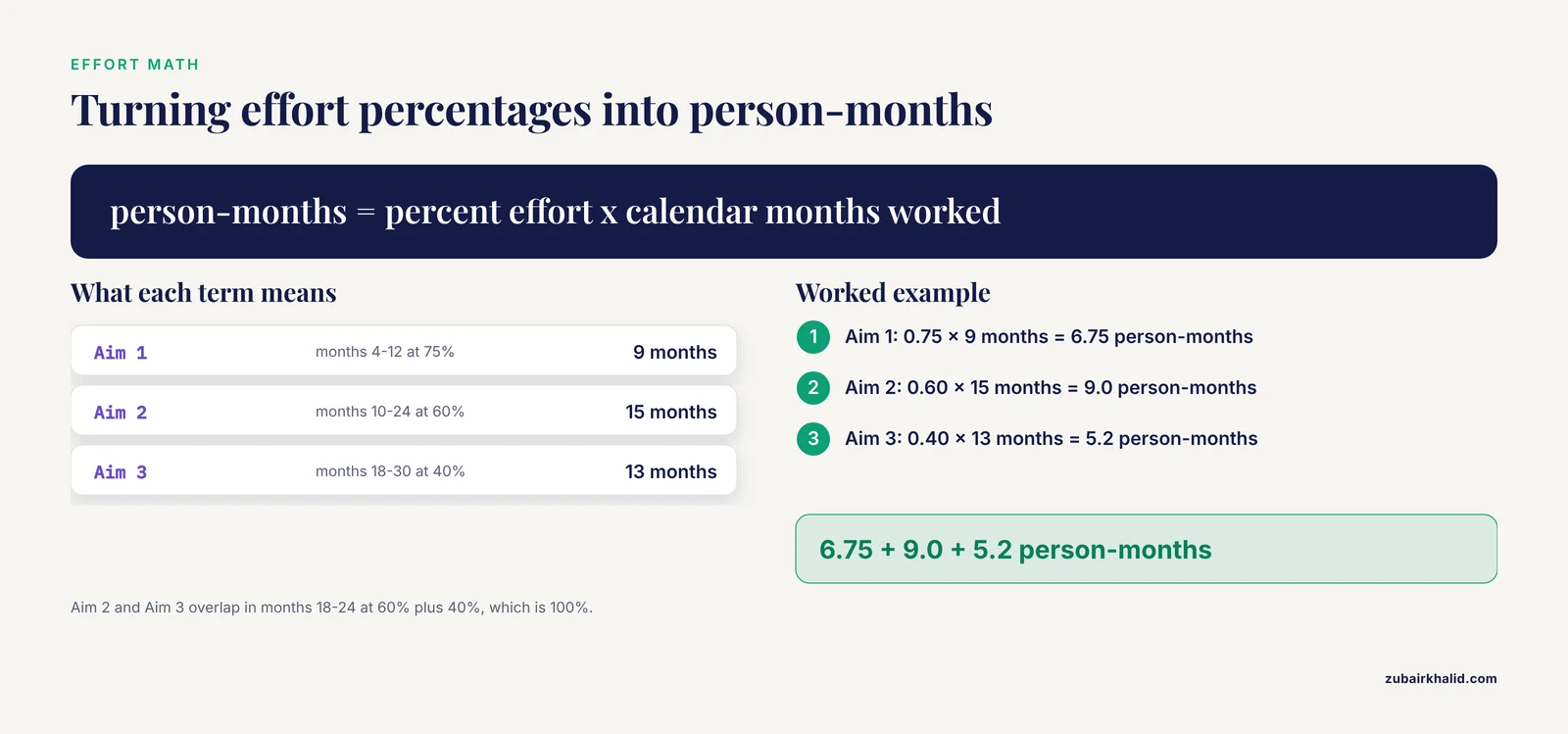
Person-months are the standard unit for linking effort to time. The calculation is the percent effort multiplied by the calendar months worked. The NIH convention treats 100 percent effort over 12 months as 12 person-months, and a 50 percent effort person working 12 calendar months contributes 6 person-months.
Postdoctoral fellow
  Aim 1: months 4-12 (9 months) at 75% effort = 6.75 person-months
  Aim 2: months 10-24 (15 months) at 60% effort = 9.0 person-months
  Aim 3: months 18-30 (13 months, overlapping with Aim 2) at 40% effort = 5.2 person-months
  Calendar months on project: months 4-30 = 27 months, within the 36-month period

Research technician
  Aim 1: months 4-12 at 50% effort = 4.5 person-months
  Aim 2: months 7-24 at 50% effort = 9.0 person-months

Check: the fellow's Aim 2 and Aim 3 efforts overlap in months 18-24.
Combined there: 60% + 40% = 100%, which is feasible for a full-time fellow
but leaves no slack. Flag this in the narrative or reduce one effort level.
The expected output is a total person-month figure for each person that matches the effort percentages in your budget justification. If the budget says the fellow is at 75 percent in year 1 and your timeline implies 100 percent, one of the two documents is wrong and reviewers will find it.
Step 5: Sequence the aims and justify every overlap
Now state the logic of the sequence. Each overlap needs a one-sentence justification, and each dependency needs a named predecessor.
Dependency map (written as a list, not a chart)

Aim 1 -> Aim 2: Aim 2 uses samples collected under Aim 1, so assay
  optimization begins at month 7 using the first pilot samples (available
  at month 6) rather than waiting for the full dataset at month 12.

Aim 1 + Aim 2 -> Aim 3: Aim 3 integrates both datasets, so it cannot
  start its integration phase before month 22, when both assay runs and
  enrollment are substantially complete.

Critical path: months 4-12 enrollment drives everything downstream.
  If enrollment finishes 2 months late, Aim 3 integration still fits
  inside month 36 because months 31-36 hold no new data collection.
  Stated slack: 2 months.

Decision point (go/no-go) at month 9 (milestone M1): if the interim
  quality check shows enrollment below 5 participants per month, the
  recruitment window extends 2 months and Aim 2 assay scale-up is
  delayed correspondingly. This contingency is pre-planned, not improvised.
The expected output is a short list of predecessor relationships, a stated critical path, and at least one contingency with a defined trigger and response. This is the material most proposals omit and most reviewers ask about.
Step 6: Convert the schedule into prose
The narrative is prose. Convert the schedule into two or three paragraphs per project year, in past-tense-free future language, with month numbers in parentheses. A worked example paragraph:
In months 1 through 3, the project will complete setup activities. The IRB protocol will be submitted in month 1 with approval anticipated by month 3, and the postdoctoral fellow will be recruited with a start date of month 4. Aim 1 will begin in month 4 and run through month 12, enrolling 60 participants at a rate of 8 per month (months 4 through 11). An interim quality review at month 9 (milestone M1) will confirm the enrollment rate and data completeness. The Aim 1 dataset will be locked at month 12 (milestone M2).
Notice what this paragraph does: it names months, names a rate, names a milestone, and names the milestone number. A reviewer can check any claim against the schedule in under a minute. That checkability is the entire point of a timeline narrative.
Step 7: Cross-check against the budget and the sponsor's rules
Before the draft is done, verify four alignments:
- Every month range in the narrative falls inside the project period.
- Every effort percentage in the narrative matches the budget justification for the corresponding budget year.
- Every deliverable in the narrative matches a deliverable or milestone listed elsewhere in the proposal (for NIH, the milestones and timelines section of the research strategy).
- The narrative fits the sponsor's page limit without shrinking the approach section below its needs.
The Parameters That Matter
The following table summarizes the core elements of a timeline narrative, the question each answers, and example phrasing you can adapt.
| Element | Question it answers | Example phrasing |
|---|---|---|
| Project months | When does each activity happen? | "Aim 2 assay runs will occur in months 10 through 22." |
| Milestones | How will we know a phase is done? | "Milestone M2: Aim 1 dataset locked at month 12." |
| Deliverables | What tangible output ends each aim? | "Deliverable: validated dataset from 60 participants." |
| Dependencies | Why does the work happen in this order? | "Aim 2 begins at month 7 using pilot samples generated at month 6." |
| Effort allocation | Who does the work, and for how long? | "The fellow contributes 6.75 person-months to Aim 1." |
| Contingencies | What happens if a step slips? | "A 2-month enrollment delay triggers a corresponding Aim 2 delay within existing slack." |
| Decision points | Where will the team reassess? | "Go/no-go review at month 9 (milestone M1)." |
| Buffer | Where is slack for analysis and writing? | "Months 31 through 36 are reserved for analysis and manuscript preparation." |
Two parameters deserve extra care. First, milestone specificity. "Optimization complete" is not a milestone. "Assay coefficient of variation below 15 percent across three independent runs" is, because it is verifiable. Second, buffer placement. Place buffer at the end of the project and between dependent aims, never inside a milestone. A buffer inside a phase is not a buffer, it is padding that inflates the phase and invites questions about what fills the extra months.
Troubleshooting: Reviewer Critiques and Their Fixes
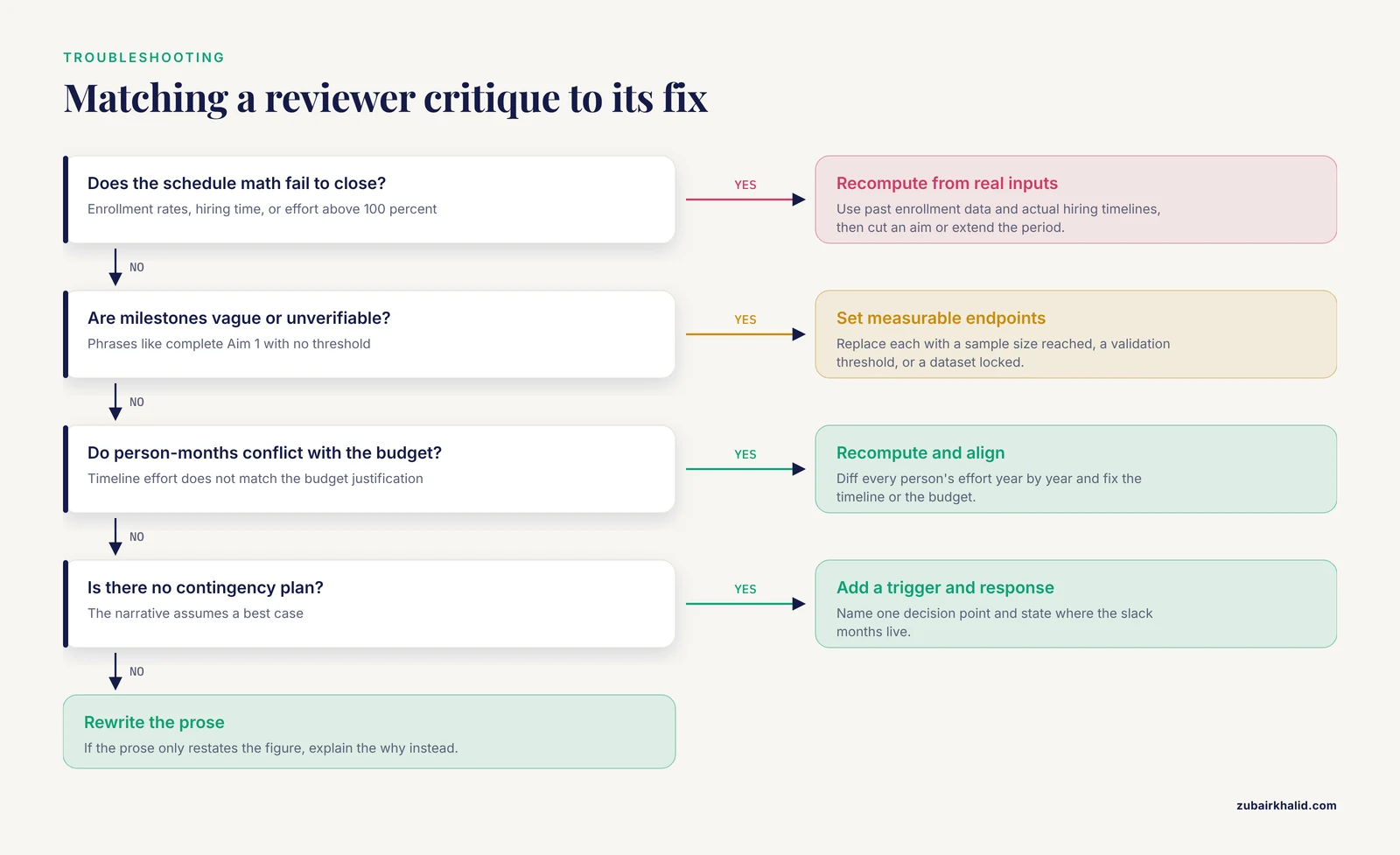
When a timeline narrative fails, reviewers use recognizable phrases. Treat these as error messages, each with a specific fix.
"The timeline is overly ambitious for the proposed aims." This critique means the math does not close. Common causes include enrollment rates above anything the site has achieved before, an aim that assumes data collection finishes before recruitment starts, or personnel effort that exceeds 100 percent when aims overlap. The fix is to recompute the schedule from real inputs: past enrollment data from your own site, actual hiring timelines from your human resources office, and a summed effort check for every person. If the project does not fit, cut an aim or request a longer period rather than compressing the schedule.
"Milestones are vague and lack measurable outcomes." This critique means the milestones cannot be verified. Replace every milestone of the form "complete Aim 1" with a measurable endpoint, such as a sample size reached, a validation threshold met, or a dataset locked. Each milestone should be checkable by a reviewer who does not know your field.
"The timeline does not align with the budget justification." This critique means the person-months conflict. Recompute every person's effort from the timeline and compare to the budget year by year. Align the timeline to the budget or the budget to the timeline, and do the same check for equipment, animal per-diems, or participant payments that the schedule implies.
"No contingency planning is evident." This critique means the narrative assumes a best case. Add at least one decision point with a trigger and a response, and state where the slack lives (usually the final buffer months).
"The timeline narrative duplicates the figure without adding information." This critique means the prose merely restates a Gantt chart. The prose should carry the logic the figure cannot: the reasons for the sequence, the contingency plan, and the effort calculations. If your prose and figure say the same thing, rewrite the prose to explain the why.
How to Check Your Timeline Narrative Before Submission
Run this verification sequence after drafting:
- Month check. Confirm every activity has a start and end month inside the project period, and that no month is assigned to two full-effort activities for the same person.
- Milestone check. Confirm each aim has at least one named, measurable milestone with a month number.
- Effort check. Recompute person-months from the timeline and diff them against the budget justification. Any mismatch is a defect.
- Dependency check. Confirm each aim's start month is consistent with the availability of its predecessor's outputs. If Aim 2 needs Aim 1's full dataset, Aim 2 cannot do its full-scale work before Aim 1's dataset lock month.
- Readability check. Give the narrative to a colleague outside your subfield and ask them to state, in one sentence, when the project's riskiest step happens and what happens if it fails. If they cannot, the contingency language is buried.
- Consistency check. Confirm the narrative, the abstract, and the specific aims page all state the same project period and the same headline milestone months. Reviewers notice contradictions between sections quickly.
Common Mistakes and Limitations
These are the timeline mistakes that appear repeatedly in weak proposals, and the honest limits of what a timeline can promise.
- Scheduling from the ideal start date. Awards arrive late. Build the plan in project months so a delayed start date does not invalidate the narrative.
- Ignoring setup time. IRB approval, hiring, equipment installation, and subaward setup consume the first months of most real projects. A timeline that begins productive data collection in month 1 signals inexperience.
- Running every aim from month 1. Parallel aims with no stated dependencies look either unplanned or padding. If aims truly run in parallel, say why, and confirm no single person is double-booked.
- Personnel arithmetic errors. Overlapping aims with effort percentages that sum above 100 percent for one person are a recurring and easily caught defect. Do the addition.
- Milestones that no one could fail. A milestone that is guaranteed to be met carries no information. Use thresholds that could, in principle, trigger the contingency plan.
- No buffer. Projects with zero scheduled slack invite the overly ambitious critique. Reserve the final months for analysis and writing.
- Treating the timeline as binding forever. An awarded timeline is a plan, not a contract frozen at submission. Sponsors expect progress reports against milestones, and approved rebudgeting or no-cost extensions can adjust dates. Write the narrative as a plan you would actually want to be held to.
- A narrative that contradicts the chart. If you include both a graphic schedule and prose, every month number must agree. Contradictions between your own sections cost more credibility than either section alone.
One honest limitation: a timeline narrative cannot make an infeasible project feasible. It can only make a feasible project legible. If your own scheduling math shows the work does not fit the requested period, the correct response is to resize the project, not the schedule.
Next Steps in Grant Proposal Planning
After the timeline narrative is drafted, fold it into the rest of the proposal. Update the budget justification to match the effort calculations. Add the milestone months to the abstract if the sponsor's format allows. Ask a senior colleague or a mock review panel to read the timeline section first, because feasibility objections surface there before they surface anywhere else. If you want structured training, a research grant writing course or your institution's grant development office will typically provide timeline templates, example funded narratives, and a red-team review. NIH and NSF both publish application guides and reviewer-facing criteria on their own sites, and reading the reviewer perspective, not just the applicant instructions, is the fastest way to learn what a funded timeline narrative sounds like.
Frequently Asked Questions
How long should a project timeline narrative be?
For most federal research proposals, two to four paragraphs of prose per project year, plus a milestone list, is sufficient. Follow the sponsor's page limit first, and compress the prose rather than the milestones if space runs short.
Should I use a Gantt chart or a prose narrative?
Use both if the sponsor permits, with the chart showing timing and the prose explaining sequence, dependencies, and contingencies. If only one format is allowed, prose carries more information because it can state reasons, not just dates.
How much overlap between aims is reasonable?
Overlaps of a few months that reflect real dependencies, such as assay optimization beginning on pilot samples, strengthen a proposal. Overlaps that exist only to compress the schedule, or that push one person's effort above 100 percent, weaken it.
What if my project depends on external approvals like IRB review?
Put the approval on the schedule with a realistic duration and state a start month for the dependent work that assumes approval arrives on time. If approval is the critical path, name it as such and describe the contingency.
Do later years of a multi-year award need the same timeline detail?
Yes, though the granularity can decrease. Year 1 should be scheduled by month, while later years can be scheduled by quarter if the sponsor allows, provided milestones remain measurable and dated.
How do I write a timeline for a mentored career development award?
Combine the research timeline with career development milestones, such as mentored training activities, skill acquisition, and transition to independence, each with target months. Sponsors for these awards expect both tracks to be visible and mutually consistent.
Can I change the timeline after the award is made?
Yes, within sponsor rules. Sponsors generally allow rebudgeting and, in some cases, no-cost extensions, and progress reports are reviewed against milestones. Describe the change process honestly in the narrative rather than promising rigid dates.
How far in advance should I start grant proposal planning?
Start at least three to four months before the submission deadline. Getting input on the specific aims and the timeline from mentors and colleagues takes longer than writing the narrative itself, and late input usually forces rework of the schedule and the budget together.