Project Management Certification Costs for Scientists
By Dr. Zubair Khalid, DVM, MS, PhD ·

By the end of this guide you will be able to do three things. First, you will be able to list every cost component that sits behind a project management certification, including the ones most scientists forget. Second, you will be able to apply a reusable project management certification cost formula, either in a spreadsheet or in a short Python script, and check your arithmetic against a worked example. Third, you will be able to judge whether the credential fits your research career, and build the whole decision into a research project plan template you can show a supervisor or a funding office.
Before you start, have four things on hand. You need a shortlist of one to three certifications you are seriously considering. You need current fee information from each certifying body, because fees change and this article deliberately does not publish prices on their behalf. You need your employer's or university's training policy, which determines who pays. Finally, you need a spreadsheet or a Python installation, since the walkthrough below uses both.
Why Scientists Pursue Project Management Certification
Research project management is the application of project management methods, such as scope definition, scheduling, budgeting, risk tracking and stakeholder communication, to research activities. A grant-funded study, a multi-site clinical collection, a core facility upgrade, and a genome annotation pipeline all behave like projects. They have fixed start dates, deliverables, limited budgets, and people who do not report directly to you.
The motivation for certification is well documented. In a Spanish study of 106 professionals, including certifying bodies, training institutions, government services and international organizations, project management certification emerged as a powerful tool for improving employability, with effects visible both inside organizations and in the external labor market [1]. A survey of 30 certified Project Management Professional (PMP) credential holders found that certification supports up-to-date training, standardization of practice, and continuous development of project performance, and that certified managers viewed it as a source of competitive advantage [2]. For a scientist moving from the bench toward program management, core facility leadership, or industry, those findings describe the benefit side of the ledger. The cost side is what the rest of this article quantifies.
What a Certification Actually Costs
A frequent planning error is to treat the exam fee as the whole cost. In reality a certification purchase has several layers, and the layers interact. Survey literature on training resources notes that while some learning materials are free of charge, others are paid and some are quite expensive, particularly accredited programs that lead to professional certification, which is why many students defer certification until after employment [3].
The components you should expect are:
- Exam fee. The fixed charge to sit the certification examination. Certifying bodies publish this on their own fee pages.
- Membership fee. Many bodies offer optional membership that changes the exam price and unlocks member-rate materials. Whether membership is net-positive depends on the arithmetic in your own calculation.
- Prerequisite training hours. Some credentials require documented training hours before you can sit the exam. This is often the largest single line item.
- Study materials. Textbooks, question banks, simulation software, and courses. The literature is explicit that this range runs from free to expensive [3].
- Retake reserve. A budgeted allowance for a second attempt, in case the first attempt falls short.
- Renewal or recertification. Most credentials expire on a multi-year cycle and require continuing education or a renewal fee. This is the component people most often omit, and it multiplies the base cost over a career.
- Travel and logistics. Test center travel, or the time cost of a proctored online session.
- Time cost. The hours you spend studying are hours you are not publishing, grant writing, or earning. For a salaried scientist this is an opportunity cost rather than a cash outflow, but a serious budget includes it.
The Project Management Certification Cost Formula
The project management certification cost formula gathers the components above into one expression:
C_total = C_exam + C_member + C_prep + C_materials
          + n_retakes × C_retake
          + C_renewal × (Y_cycle / Y_renewal)
          + C_travel
          + H_study × W_hour

C_per_year = C_total / Y_cycle
Each symbol means the following:
| Symbol | Component | Question to answer | Type |
|---|---|---|---|
| C_exam | Exam fee | What does the certifying body charge per attempt? | Fixed |
| C_member | Membership | Is membership required, and does it reduce other lines? | Fixed, optional |
| C_prep | Prerequisite training | How many training hours does the credential demand, and what do approved providers charge? | Variable |
| C_materials | Books, question banks | Free resources first, paid resources only where needed | Variable |
| C_retake | One retake attempt | What is the discounted retake fee? | Contingent |
| n_retakes | Expected retakes | Honest estimate, usually 0 or 1 | Variable |
| C_renewal | Renewal fee per cycle | What does recertification cost? | Recurring |
| Y_renewal | Renewal cycle length | Usually stated in years by the certifying body | Fixed |
| Y_cycle | Your planning horizon | Three to five years is typical | Your choice |
| C_travel | Travel, proctoring | Distance to a test center? | Variable |
| H_study | Study hours | Your realistic estimate, not the provider's minimum | Variable |
| W_hour | Value of one hour | Your hourly compensation or grant value | Variable |
| C_per_year | Annualized cost | The number to compare across options | Derived |
The annualized figure, C_per_year, is the most useful output, because it lets you compare a cheap credential with a short renewal cycle against an expensive credential with a long one on equal terms.
How to Calculate Project Management Certification Cost, Step by Step
This walkthrough shows how to calculate project management certification cost in seven steps. The dollar values below are placeholders chosen to make the arithmetic easy to follow. They are illustrative numbers for the worked example, not published prices. Replace every one of them with a quote from the relevant certifying body or training provider before you rely on the result.
- Collect the fee inputs. Open the fee page of each certifying body on your shortlist and record the exam fee, membership fee, retake fee, and renewal fee, plus the renewal cycle length in years.
- Collect the training inputs. Note any mandatory training hours and the price of an approved course that satisfies them. Add the price of question banks or textbooks you would actually buy.
- Estimate study hours and their value. Choose a realistic H_study. If you value your time at your postdoc or staff scientist hourly rate, use that number for W_hour. If you prefer a cash-only budget, set W_hour to zero and record that decision.
- Set the planning horizon. Pick Y_cycle, commonly three to five years, and match it to the renewal cycle so the annualized figure is meaningful.
- Run the formula. The script below implements it.
# Project management certification cost calculator
# Every value below is an illustrative placeholder.
# Replace each one with a real quote before using the result.

exam_fee    = 400      # placeholder, first attempt
membership  = 130      # placeholder, optional annual membership
prep_course = 350      # placeholder, mandatory training hours
materials   = 90       # placeholder, book plus question bank
retake_fee  = 250      # placeholder, discounted second attempt
n_retakes   = 0.5      # planning assumption: half a retake expected
renewal_fee = 60       # placeholder, per renewal cycle
y_renewal   = 3        # placeholder, renewal cycle in years
y_cycle     = 3        # planning horizon
travel      = 40       # placeholder, test center travel
h_study     = 40       # placeholder, realistic study hours
w_hour      = 0        # set to 0 for a cash-only budget

c_total = (exam_fee + membership + prep_course + materials
           + n_retakes * retake_fee
           + renewal_fee * (y_cycle / y_renewal)
           + travel
           + h_study * w_hour)

c_per_year = c_total / y_cycle

print(f"Total certification cost over {y_cycle} years: ${c_total:,.2f}")
print(f"Annualized cost: ${c_per_year:,.2f}")- Check the output. With the placeholder values above, the expected output is:
Total certification cost over 3 years: $1,170.00
Annualized cost: $390.00
You can verify this by hand. The fixed block is 400 + 130 + 350 + 90 = 970. The retake reserve is 0.5 × 250 = 125. The renewal term is 60 × (3 / 3) = 60. Travel adds 40, and the time term is 40 × 0 = 0. So 970 + 125 + 60 + 40 = 1,170, and 1,170 divided by 3 gives 390 per year.
- Sanity-check the result. Two checks catch most errors. If your annualized figure is smaller than the renewal fee divided by the renewal cycle, you have misplaced a term. If your total is smaller than the exam fee alone, a component is missing or negative. In a spreadsheet, the same calculation is one formula, for example
= (B2 + B3 + B4 + B5) + B6*B7 + B8*(B9/B10) + B11 + B12*B13, with each input in its own labeled cell so reviewers can audit it.
A common runtime error in the Python version is a TypeError from pasting a string such as "400" into a numeric field. The fix is to strip the quotes or wrap the input with float(). A second common error is a ZeroDivisionError from leaving y_renewal at 0, which the guard if y_renewal > 0: prevents.
Project Management Certification Cost Worked Example for Scientists
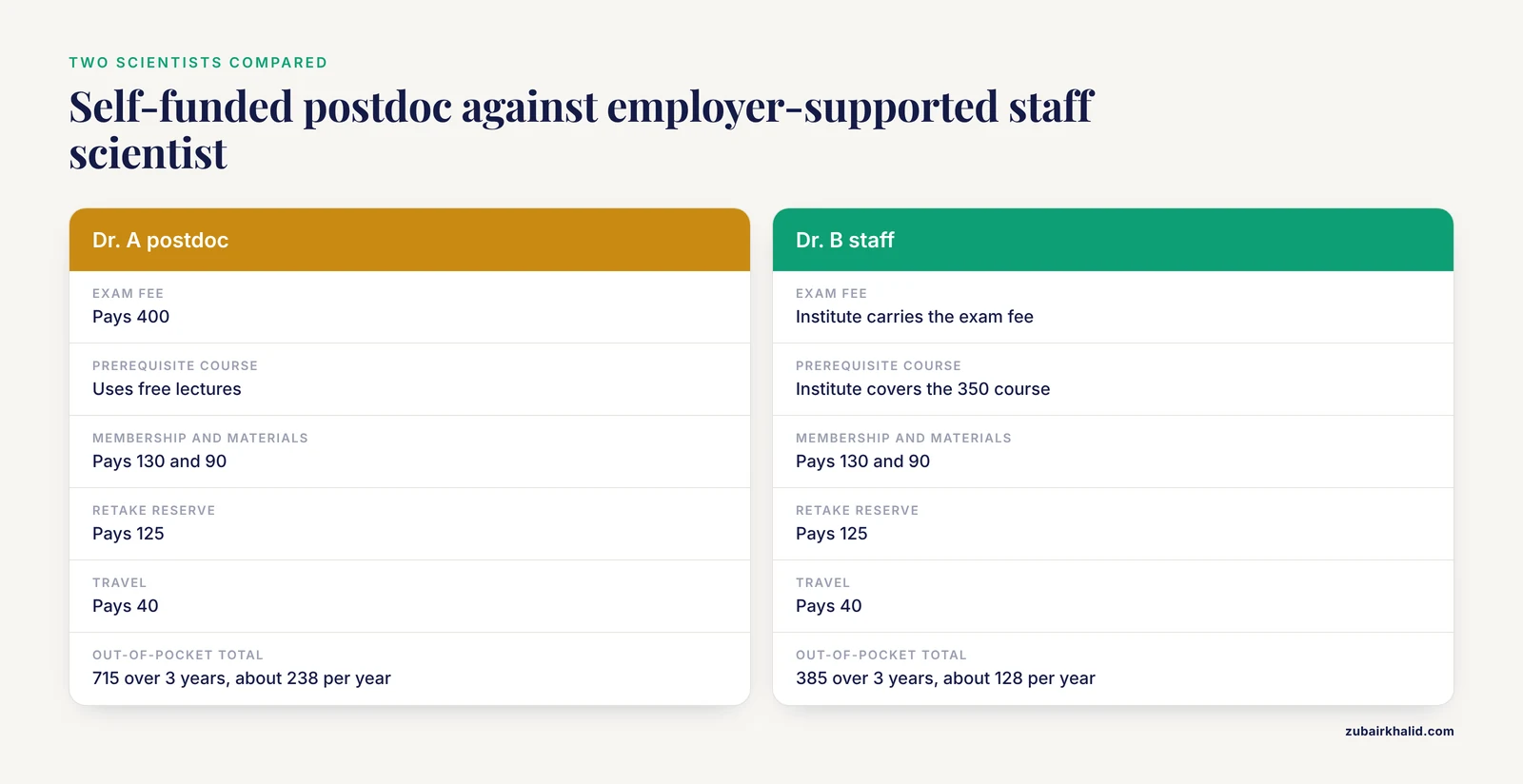
The formula earns its keep when you compare scenarios. Here is a project management certification cost worked example for two scientists, again using placeholder values rather than published prices.
Scenario A, Dr. A, self-funded postdoc. Dr. A pays the exam fee of 400, buys a 90 question bank, uses free lectures for the mandatory training hours by choosing a provider whose materials are free of charge, and sets W_hour to 0 because the budget is cash-only. The retake reserve is 125 and travel is 40. Total over a 3-year horizon is 400 + 90 + 125 + 40 + 60 = 715, or about 238 per year.
Scenario B, Dr. B, staff scientist with employer support. Dr. B's institute covers the 350 prerequisite course under its training budget, which the e-learning literature identifies as a realistic arrangement, since many medium and large employers maintain generous per-employee training budgets for courses and certifications [3]. Dr. B still pays membership of 130, materials of 90, the retake reserve of 125, and travel of 40. The out-of-pocket total is 385 over 3 years, about 128 per year, while the institute carries 350 plus the exam fee.
The instructive comparison is not the totals. It is which lines move when funding changes. Employer support usually removes the training line, the largest variable item, while leaving the exam, renewal, and time components untouched. That asymmetry is why Step 1 of the walkthrough begins with your employer's training policy rather than with the certifying body.
Choosing Among Certification Bodies
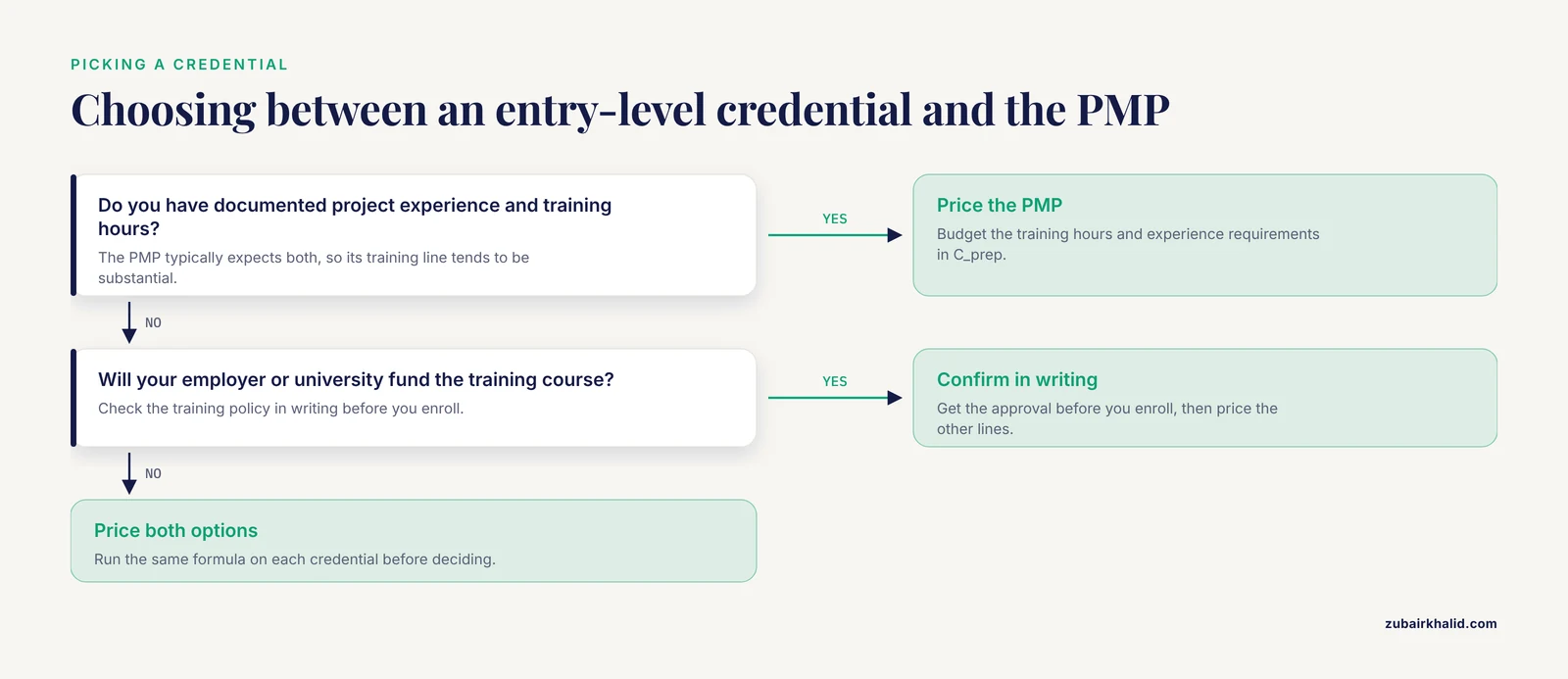
Three families of credential dominate the discussion for scientists, and the choice affects every line of the formula.
The Project Management Professional (PMP) credential, administered by the Project Management Institute, is the most widely cited in the survey literature. Certified managers report that it standardizes practice and signals competence to employers [2], and dedicated study guides exist to structure exam preparation [4]. The PMP typically expects documented project experience and training hours, so its C_prep line tends to be substantial.
The International Project Management Association (IPMA) family uses the Individual Competence Baseline, known as ICB 4.0, which covers perspective, people, and practice competence areas. IPMA Level D is the entry-level certification in this system, and it is assessed by examination across those competence areas [5]. For scientists without formal project titles, an entry-level credential can be a lower-risk first purchase because the experience barrier is smaller.
IPMA also certifies the people who teach and coach project management. Its CCT credential for consultants, coaches, and trainers is built on the ICB4CCT standard, uses a competency-based assessment model, and has a three-level structure with defined candidate requirements [6]. This matters to scientists who want to train others in research project management rather than only manage projects themselves.
One more practical point belongs here. Training and certification markets differ by country, and a content analysis of the Ukrainian market, for example, showed how higher education institutions and providers of additional education organize preparation for international certification with its aims of confirming competence and competitiveness [7]. Wherever you are, list the nationally available approved providers before you price C_prep, because availability constrains the formula.
Cutting Costs Without Cutting Pass Chances
Several evidence-based interventions change the relationship between what you spend and what you get.
Structured, technology-supported courses can compress both failure risk and time. In a controlled study of an AI-constructed certification course built on knowledge graphs, intelligent agents, and personalized learning paths, the pass rate of trainees increased by 60 percent while learning time fell by 17 percent, which the authors describe as breaking the linear relationship between time spent and effect achieved [8]. If a comparable course costs more than a conventional one, the reduced H_study and reduced n_retakes can offset the premium in the formula.
Simulation-based preparation changes exam outcomes directly. In a quasi-experimental study of IPMA Level D preparation, 178 candidates who completed simulation-supported training achieved higher overall examination scores than a reference cohort of 455 who took the same course without the simulation, with statistically significant differences concentrated in selected People-domain competence areas of ICB 4.0 [5]. Where a simulation module is an add-on purchase, it belongs in C_prep, and its value shows up as a lower expected retake count.
Free formative tools exist for some credentials. Researchers built an automatic e-assessment tool for IPMA certification candidates that converts open-text answers into ontological representations, compares them with reference answers, and tells users which concepts they missed and which references to read, allowing self-evaluation at one's own pace [9]. Tools of this kind reduce the paid materials line at no cash cost.
Finally, timing matters. Because many employers fund training after employment rather than before it, deferring certification until you hold a position with a training budget is itself a cost-reduction strategy, and one that the literature describes as common practice [3].
Does the Investment Pay Back?
The return side of the ledger has both direct and indirect evidence.
On employability, the Spanish expert consultation found certification effects across internal company aspects, such as role recognition inside the organization, and external labor market aspects, such as credibility with new employers [1]. On performance, a mixed-methods Nigerian study of building projects ranked inadequate site management and supervision first among contributors to cost and schedule overruns, with a relative importance index of 0.7877, ahead of improper construction techniques at 0.7215 and consultant inexperience at 0.7213 [10]. The translation for a scientist is direct. The competencies certification trains, planning, supervision, and change control, are the same competencies whose absence produces overruns, and overruns in research mean exhausted grants and truncated aims.
Two further studies sharpen the argument. An investigation asking whether project management training is a root cause of project failures framed inadequate preparation as a plausible upstream factor in failure [11]. An analysis of critical success factors in United Nations projects examined the impact of certification and training on project success alongside other factors [12]. None of these studies prices the return in dollars, and this article will not invent a salary figure. What they support is a qualitative claim. Certification is associated with better employability and, through better-managed practice, with fewer of the failures that destroy research value.
Building the Decision Into a Research Project Plan Template
The cleanest way to manage the certification purchase is to treat it as a small project and use the same research project plan template you would apply to a grant deliverable. A usable template has six blocks.
- Scope statement. One paragraph naming the target credential, the target exam window, and what is explicitly out of scope, such as a second, higher-level credential.
- Work breakdown structure. Decompose preparation into tasks, for example syllabus review, question bank completion by domain, one full mock exam, and application submission, each with an owner and a duration.
- Schedule. Place the tasks on a calendar anchored to the exam date, with a buffer week before the exam.
- Budget. Enter the outputs of the cost formula, C_total and C_per_year, as the budget baseline, and record who funds each line.
- Risk register. List the top risks with mitigations. The two highest-value entries are usually a failed first attempt, mitigated by the retake reserve, and schedule collapse during a grant deadline, mitigated by the buffer week.
- Stakeholder log. Record your principal investigator, grants office, and any employer training administrator, with what each must approve and by when.
This exercise does double duty. It controls the certification purchase, and it is itself practice in research project management, which is the competence the credential is supposed to certify.
Common Mistakes and Limitations
- Budgeting the exam fee alone. The formula exists because the exam fee is one of eight lines. Renewal and prerequisite training are the lines most often forgotten, and renewal recurs for a career.
- Using published figures that have expired. Certifying bodies change fees, membership structures, and renewal rules. Every number in your budget must come from a current fee page or a written quote, not from a blog, including this one, which publishes no prices by design.
- Trusting the provider's minimum study estimate. Providers quote optimistic H_study values. Underestimating study hours understates the time cost and inflates the retake probability in the same direction, so both errors compound.
- Assuming employer funding without written confirmation. Get the training policy and the approval in writing before you enroll. Verbal support is not a budget line.
- Ignoring currency. If you will pay fees in a currency other than your salary, exchange-rate movement is a real risk, and a 10 percent buffer on C_exam is a reasonable planning adjustment.
- Confusing correlation with causation in the payoff studies. The employability and performance findings are associations from surveys and quasi-experiments, [5]. They support planning, not guarantees.
- Buying a second credential before using the first. The renewal obligations stack. Finish one cycle before starting another.
- Skipping the spreadsheet audit. A single misplaced cell changes the annualized figure silently. Have a colleague check the formula the way you would check a qPCR plate map.
Frequently Asked Questions
How much does a project management certification cost for a scientist?
There is no single answer, because the total is the sum of exam, membership, prerequisite training, materials, retake reserve, renewal, travel, and time components, and each certifying body sets its own fees. Build the total with the formula in this article using current quotes from the certifying bodies on your shortlist.
What is the project management certification cost formula?
The formula is C_total = C_exam + C_member + C_prep + C_materials + n_retakes × C_retake + C_renewal × (Y_cycle / Y_renewal) + C_travel + H_study × W_hour, and the annualized figure is C_total divided by Y_cycle. Each symbol is defined in the table above.
How do I calculate the cost per year of a certification?
Add up every component over one full renewal cycle, then divide by the number of years in that cycle. This annualized figure is the right basis for comparing a low-cost credential with a short renewal cycle against a high-cost credential with a long one.
Can I get certified without paying for a prep course?
Often, partly. Some resources are free of charge, and free formative tools exist for some credentials, but mandatory training hours and exam fees usually remain. Whether a paid course is worth it depends on whether the expected reduction in retakes and study time offsets its price in the formula.
Will my university or employer pay for a project management certification?
Possibly. The literature describes medium and large employers maintaining generous per-employee training budgets that cover courses and certifications, so check your institution's training policy in writing before you enroll. Employer funding typically removes the largest variable line, the prerequisite training.
Is certification worth it for a research career?
The evidence supports real benefits. A Spanish study of 106 professionals found certification improved employability both inside organizations and in the external labor market, and certified PMP holders report standardization and performance benefits. Treat the credential as an investment to evaluate with the formula, not as a guaranteed return.
Which certification should an early-career scientist choose?
An entry-level credential with a modest experience requirement, such as IPMA Level D, is a common first step, while the PMP suits scientists who already have documented project experience. Match the choice to your experience level, then price each option with the same formula.
How much study time should I budget?
Build a realistic personal estimate from your syllabus, your weekly schedule, and your deadline buffer, rather than adopting a provider's minimum. Structured and simulation-supported courses have been shown to improve pass outcomes or reduce learning time, so investing in better preparation can lower both the hours and the retake risk.
Sources
- The Effect That Project Management Certification Has on Employability: Agents' Perceptions from Spain
- The Role of Certification on Project Management: Perspective of PMP Certified Project Managers
- LEARNING TO SUPPORT ONLINE TRAINING IN SOFTWARE PROJECT MANAGEMENT FOR BETTER WORK-LIFE BALANCE
- PMP, Project Management Professional (Certification Study Guides)
- Simulation-based Learning and Project Management Certification Outcomes: Evidence from IPMA Level D Training
- IPMA CCT certification: providing competence for consultants, coaches, and trainers in project management
- PECULIARITIES OF PROFESSIONAL TRAINING AND CERTIFICATION OF PROJECT MANAGERS IN UKRAINE
- Teaching Reform and Practical Exploration of Online IT Certification Training Courses Empowered by AI: -A Case Study of “Information System Project Management Professional”
- FORMATIVE E-ASSESSMENT TOOL TO FACILITATE THE TRAINING OF PROJECT MANAGEMENT PROFESSIONALS
- Impact of Project Management Practices on Cost and Time Overruns in Construction Projects in Nigeria
- Project management training : the root cause of project failures?
- Investigating Critical Factors for Project Success and the Impact of Certification/Training: The United Nations Context