How to Choose Preliminary Data for a Grant Proposal
By Dr. Zubair Khalid, DVM, MS, PhD ·

Preliminary data is evidence you already hold, before the grant is submitted, that shows your proposed project can work, while everything else in the proposal is a promise about what you will do later. The rule of thumb for choosing is simple: pick the data that retires the single riskiest assumption behind your specific aims, not the data that looks most impressive on a slide. A beautiful experiment that answers a question no reviewer was worried about will not move your score. A modest experiment that proves your central method works in your system often will.
This guide walks through the main preliminary data for grant proposal options, compares them side by side, works through realistic scenarios, and catalogs the mistakes that cost people funding. It is written for graduate students, postdocs, and early-career faculty planning their first serious application, though established investigators pivoting into a new area will find the comparison useful as well.
What Preliminary Data Is and Why Reviewers Score It
Preliminary data, sometimes called pilot data, is any result you have generated or can legitimately cite before submission that supports the feasibility of your project. Feasibility means the reviewer believes your team can execute the plan with the people, instruments, model systems, and timeline you describe. Grant-writing guides aimed at clinical and surgical investigators consistently list strong preliminary data among the highest-leverage elements of a competitive proposal, alongside a clear hypothesis and a well-constructed budget. Reviews of grant-writing practice reach the same conclusion from the program side, where faculty development sessions on maximizing funding treat preliminary data as a core scoring asset rather than an optional extra [1].
The reason reviewers weight it so heavily is structural. Grant writing has become an institutionalized practice across academia, and funding agencies increasingly evaluate not just the idea but the credibility of the team and the plan behind it [2]. Your idea section argues that the question matters. Your preliminary data section argues that you specifically can answer it. Those are different claims, and they need different evidence.
Workshops that teach grant writing as a craft, including sessions that walk applicants through realistic budgets, persuasive narratives, and common application pitfalls, reinforce the same principle with examples from funded applications [3]. The pattern across all of this guidance is consistent. Reviewers want to see a chain of reasoning that runs from a known problem, to a specific gap, to a plan, to evidence that the plan is executable.
What reviewers actually check
When a study section reads your preliminary data, four questions are usually in play.
- Feasibility. Can the proposed experiments actually be done, in this system, at this scale?
- Competence. Does this team have hands-on experience with the key methods, or at least a credible path to acquiring it?
- Continuity. Does each specific aim rest on at least one supporting data point, published or unpublished?
- Rigor. Were the pilot experiments designed and analyzed well enough that the results can be trusted?
A proposal that aces the first two but fails the fourth often scores worse than one with less data and better controls, because reviewers read weak pilot design as a preview of how the funded work will be run.
Preliminary Data for Grant Proposal Options
There is no single best preliminary data for grant proposal success. The right choice depends on your career stage, your system, and the specific risk your aims carry. Here are the six options that cover nearly every situation, each explained on its own terms.
Option 1: Pilot Data From Your Own Lab
This is unpublished work you generate specifically in preparation for the application. It might be a western blot showing your knockout actually knocks out the protein, a pilot recording session showing your preparation yields usable signals, or a first pass through an assay giving a coefficient of variation low enough to detect the effect you care about.
The strengths are substantial. The data can be tailored exactly to your aims, which no other option allows. It demonstrates hands-on capability with the methods you are proposing. It is current, which matters because reviewers notice when the most recent citation supporting your approach is a decade old.
The cons are equally real. Pilot data costs time and money you may not have. There is a genuine risk the results come back ambiguous, and you then face the choice of delaying submission or reframe. Because the data is unpublished, reviewers must take your word for how it was generated, so the way you present it has to carry extra weight in methods detail and quantification.
Option 2: Published Data From Your Own Group
Your own peer-reviewed papers are the strongest form of track-record evidence. They are citable, they have survived review, and they establish that your lab produces trustworthy results. For a continuation application, your previous publications are effectively the primary preliminary data.
The limitations show up when you are entering new territory. Published work answers the question it was designed to answer, which is often close to but not identical with your new aims. Reviewers will notice if you stretch an old figure to cover a new claim. There is also a competitive dimension. Once your key results are published, other groups can build on them, so the window between having the result and having the funded project to extend it matters for novelty.
Option 3: Published Data From Other Groups
Citing other labs' work is the weakest standalone form of preliminary data but a necessary supporting layer. It establishes that a method is feasible in principle, that a reagent works, or that a biological phenomenon exists. It cannot establish that you can do it.
The mistake to avoid here is presenting a literature finding as if it were your own feasibility evidence. Reviewers read that as padding. What works better is a paired structure: cite the external result, then show your own small demonstration that the approach runs in your hands or your system. The external citation establishes the principle, and your pilot establishes your capability.
Option 4: Secondary Analysis of Existing Data and Biobank Material
Existing datasets, archived specimens, and retrospective clinical records can generate preliminary data quickly and cheaply. This option is especially powerful for clinical, epidemiological, and translational proposals where the hard part is assembling a cohort.
A concrete illustration of the typical scale comes from a retrospective real-world evaluation of extended-release trazodone in 74 outpatients with comorbid major depressive disorder and sedative-hypnotic use disorders, assessed at baseline and again at one and three months, with depressive symptoms measured on a standard rating scale [4]. Notice what that design is and is not. It is a modest, single-arm, retrospective series, exactly the kind of analysis that can be pulled together from existing records before a submission deadline. It is not a randomized trial, and the authors of such studies generally do not claim it is. As preliminary data, this scale is a feature. It shows the cohort exists, the measures are collectable, and the signal is worth a funded, properly powered follow-up.
The cons of secondary analysis are real. The data was collected for someone else's question, so coverage of your variables may be incomplete. Access agreements, data use restrictions, and institutional approvals can take longer than expected. Quality control is on you, and reviewers may probe how missingness and measurement error were handled.
Option 5: Method and Computational Validation Data
For technology-driven or data-driven proposals, the riskiest assumption is often that a method works. Preliminary data here means validation runs, benchmark comparisons, cross-validated model performance, or a demonstration that a pipeline produces sensible output on a small real dataset.
This is the option where methodological discipline matters most, because analysis pitfalls in a pilot are easy for a quantitative reviewer to spot. In longitudinal biomarker research, for example, recurring problems include poorly defined lead time, performance metrics such as sensitivity and specificity that are inherently time-dependent, and immortal time bias introduced when patients are classified based on an event that happens later during follow-up [5]. If your computational preliminary data involves longitudinal measurements, defining your time zero and your classification rules before you generate the pilot numbers will save you from building an aim on a biased estimate.
Option 6: Qualitative Preliminary Findings
For proposals with qualitative or mixed-methods components, preliminary data usually means a small set of pilot interviews or focus groups plus a demonstration of your analytic approach. The standard here is different from quantitative work, and reviewers familiar with qualitative methodology evaluate it differently.
Guidance on presenting qualitative findings emphasizes that effective themes are specific analytic constructs linking participants' experiences to broader concepts, rather than generic labels or topic summaries that just repeat the interview questions [6]. Participant quotations should be presented as interpreted material embedded in your analytic narrative, not as isolated fragments. A pilot analysis of two or three transcripts, presented with a genuine theme, a divergent case, and your coding logic, does more to establish qualitative feasibility than a large unfocused interview corpus.
A note on collaborator data
Data generated in a collaborator's lab can serve as preliminary data if the role is explicit. Name the collaborator, describe what they contributed, include a letter of support, and be honest that the work happened outside your lab. Reviewers respond well to this when it fills a genuine capability gap and poorly when it looks like borrowed credibility for methods you will run yourself.
Side-by-Side Comparison
The table below is the core of the decision. It lays out the preliminary data for grant proposal pros and cons in one place so you can match an option to your situation.
| Option | What it looks like | Strengths | Weaknesses | Best fit |
|---|---|---|---|---|
| Own-lab pilot data | New unpublished experiments run for the proposal | Tailored to your exact aims, shows hands-on capability, current | Costs time and money, risk of ambiguous results, uncited so presentation carries the burden | Any proposal where the key risk is whether a method works in your system |
| Your published papers | Peer-reviewed results from your group | Citable, review-tested, establishes track record | May be stale, may not match the new question, reduces novelty margin | Continuation applications, established programs extending prior work |
| Others' published work | Cited feasibility evidence from the literature | Cheap, establishes the principle, frames the gap | Says nothing about your capability, reads as padding if used alone | Supporting layer under your own pilot, early idea-stage planning |
| Existing datasets or biobanks | Retrospective records, public repositories, archived specimens | Fast and inexpensive, can support effect-size estimates, shows the cohort exists | Collected for another question, access and approval delays, quality control burden | Clinical, translational, and data-heavy proposals on a deadline |
| Method or computational validation | Benchmarks, cross-validation, assay runs on real samples | Directly retires technical risk, quantifiable performance | Exposes analytical weaknesses if the pilot itself is flawed | Technology development, bioinformatics, instrument-heavy projects |
| Qualitative pilot findings | A few pilot interviews with a worked coding example | Demonstrates analytic competence, surfaces unforeseen themes cheaply | Judged by different standards, easy to present superficially | Mixed-methods, behavioral, and implementation proposals |
Read down the strengths column and a pattern emerges. Options that are cheap and fast are usually weaker as evidence of your specific capability. Options that are strongest as evidence take the most time. That trade is the fundamental constraint of grant proposal planning, and it is why preliminary data generation should start months before the writing does.
The Criteria That Decide Real Choices
Knowing the options is not the same as choosing among them. Five criteria do most of the deciding in practice.
Which risk does the data retire?
List your specific aims. For each one, write down the single assumption that, if false, kills the aim. Then look at your candidate preliminary data and ask which assumption it addresses. The best preliminary data for grant proposal success is almost always the dataset that matches your riskiest assumption, because that is what the reviewer is silently checking. Data addressing your third-largest risk is a nice-to-have. Data addressing your largest risk is the difference between a score with funding potential and a polite rejection.
Is the evidence yours or borrowed?
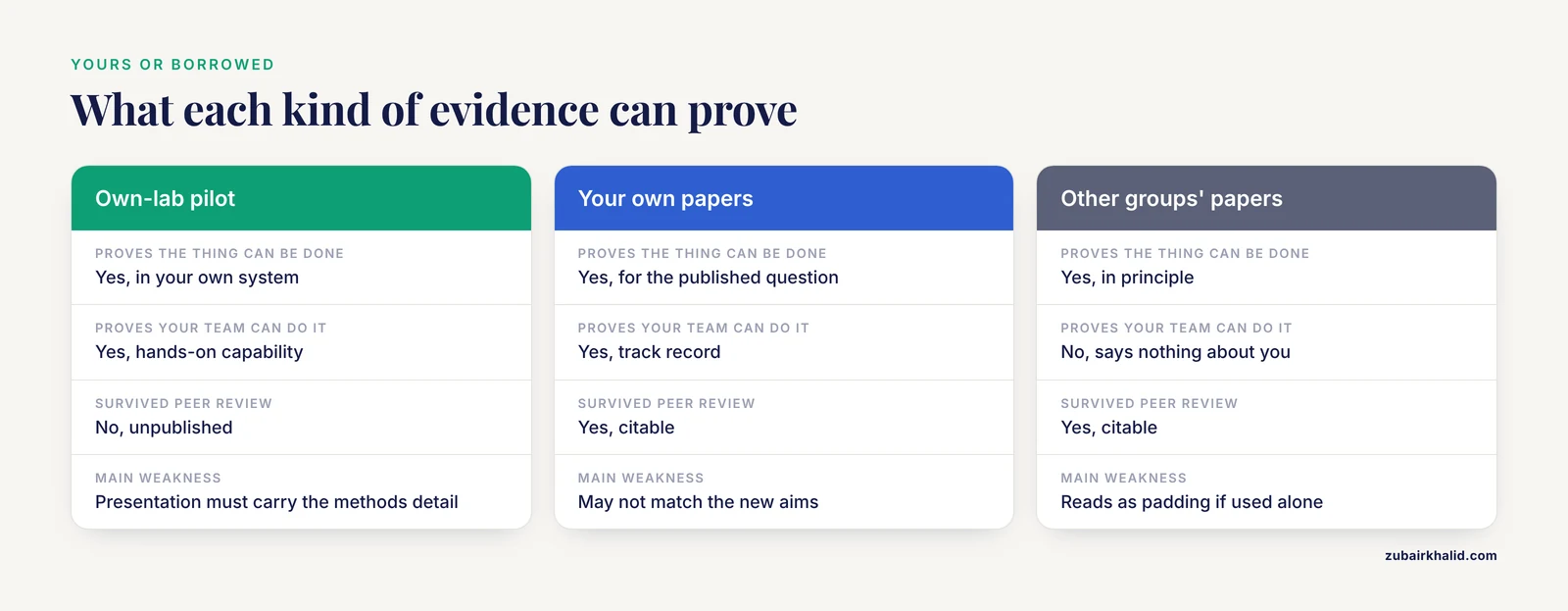
Feasibility claims have two parts, that the thing can be done and that you can do it. Literature citations only support the first part. Every proposal needs some literature, but the center of gravity of your preliminary data section should be work your team produced, in your system, with your hands or your pipelines.
How rigorous is it?
Reviewers judge your pilot the way they will judge your funded work. Sample size, controls, replication, and a stated analysis plan all get scrutinized. Guidance on common research-writing errors emphasizes that problems in data collection, interpretation, and results presentation are among the mistakes that most directly damage credibility [7]. The same standard applies to a grant application, with the added difficulty that unpublished pilot data has not been through peer review to catch those problems for you.
How current is it?
Data older than roughly five years starts to raise quiet questions about whether the system, reagent, or pipeline still works as described. If your strongest evidence is old, pair it with one small current demonstration to show the approach is alive in your lab today.
How much is enough?
Enough preliminary data means enough to support feasibility of each aim, and no more. If your pilot data fully answers the research question, reviewers will reasonably ask why the study needs funding. The pilot should open the door, not walk through it. In practice this means one to three figures that each carry a specific claim, with the rest in supplementary material.
Worked Scenarios
Abstract criteria become clearer when applied. Here are four situations that cover most readers of this article.
Scenario 1: An early-career investigator with a small lab. You have one published paper from your postdoc and a new faculty position with limited startup remaining. Your riskiest assumption is that your assay works in the new model organism. The best choice is a single focused pilot experiment in the new system, run by you, even if it is small. Pair it with your published postdoctoral work to establish track record. Skip the temptation to generate three half-finished pilot datasets. One clean, relevant, honest pilot beats three vague ones.
Scenario 2: An established lab pivoting into a new area. Your published record is strong but in a different question domain. Reviewers will believe you can run a lab but may doubt you can handle the new method. The highest-value preliminary data is a collaboration-supported demonstration of the new method, plus a small pilot in your own system showing the two halves connect. Reference the external work, show your own bridge experiment, and name the collaborator who supplied the methodological depth.
Scenario 3: A mixed-methods behavioral or implementation project. Your riskiest assumptions are that the population is reachable and that your measures produce interpretable data. Pilot a short interview series and present a worked thematic analysis. Follow the standard the qualitative-methods literature sets: themes that are specific and revealing rather than generic topic labels, with quotations integrated into your interpretation rather than dropped in as decoration [6]. A pilot coding framework is genuinely persuasive preliminary data here.
Scenario 4: A clinical trial proposal with eligibility criteria that are still being refined. Sometimes the preliminary data at stake is not an experiment but a definition. In axial spondyloarthritis research, a post hoc analysis of a phase 3 randomized trial compared an established 2009 imaging definition for patient eligibility against preliminary data-driven cut-offs proposed in 2021 for inflammatory and structural lesions on sacroiliac joint MRI, examining whether patients selected under each definition differed in baseline characteristics and treatment response [8]. The lesson generalizes. Preliminary criteria, whether they define eligible patients, classify imaging findings, or threshold a biomarker, gain credibility when they are stress-tested against an established standard and shown to behave sensibly. If your proposal depends on a new classification scheme, pilot that scheme against the old one before submission.
Common Mix-Ups
Several confusions come up repeatedly when people select preliminary data. Each one is avoidable once named.
Preliminary data versus literature review. A literature review establishes that a gap exists. Preliminary data establishes that your plan can fill it. A paragraph of citations is not preliminary data no matter how well written.
Pilot study versus preliminary data. A pilot study is a complete small study with its own question, often about feasibility of procedures. Preliminary data is any evidence supporting your proposal. A pilot study can supply preliminary data, but preliminary data does not require a formal pilot study.
Data that answers a different question. This is the most common substantive mistake. An investigator has strong data on topic A and builds the proposal around topic A's methods applied to topic B, presenting the topic A data as if it established feasibility for B. Reviewers see through this quickly. If your data supports the methods but not the question, say exactly that and let the methods claim stand on its own.
Overselling underpowered results. Presenting a pilot with a small sample as proof of an effect invites a reviewer to challenge the statistics. Present the same result as evidence of feasibility and a magnitude estimate that justifies the powered study, and it works for you.
Burying the key figure. If the one result that retires your main risk is in supplemental file three, most reviewers will never see it. The preliminary data section, like the introduction of a paper, determines whether the reader keeps reading with confidence, and common introduction pitfalls such as unclear framing and weak synthesis of prior work are exactly the problems that lose readers early [9] [10].
Common Mistakes and Limitations
Beyond the mix-ups in how data is chosen, there are recurring execution mistakes in how preliminary data sections are built and written.
Starting too late. Preliminary data generation is a months-long activity, not a writing-phase activity. Structured grant-proposal templates treat the needs statement, project description, budget, and evaluation plan as components that must support each other, and data generated without reference to that structure tends not to slot into any of them [11]. Build the data plan during grant proposal planning, alongside the aims, not after them.
Drowning the reviewer. Some applicants respond to anxiety about data by including everything. The result is a section where the two figures that matter are buried under six that do not. Editors of scientific journals report that recurring weaknesses in core elements, rather than a lack of information, are what most often sink manuscripts, and the remedy is purposeful revision focused on those core elements [12]. The same discipline applies to a data section. Cut until only load-bearing evidence remains.
Carrying pilot flaws into the proposal. If your pilot has an undefined time zero, a misclassified subgroup, or a metric that shifts with follow-up duration, a methodologically alert reviewer will find it, and the damage extends to the whole proposal because the pilot is read as a sample of your future work. The longitudinal-analysis literature documents how easily lead time, time-dependent sensitivity, and immortal time bias creep into studies of repeated measurements [5]. Pilot your analysis plan the way you pilot your experiment.
Writing errors that undercut trust. Grammatical problems, inconsistent formatting, and citation errors are individually small but collectively signal carelessness, and research-writing reviews identify them as credibility risks even when the underlying science is sound [7]. Survey work on student and professional writing finds that content, organization, and language problems co-occur and compound each other [13]. A preliminary data section with sloppy figure labels invites the inference that the data collection was similarly loose.
Presenting qualitative data as topic summaries. A common failure in qualitative reporting is listing themes that merely restate the interview guide. Guidance on thematic analysis stresses that themes should capture shared meanings, divergences, and nuance, functioning as analytic constructs rather than subtitles [6]. Reviewers experienced with qualitative work check for exactly this.
A structural limitation to state honestly. All preliminary data is, by definition, limited. Samples are small, follow-up is short, and controls are incomplete. Reviewers know this and do not expect definitive proof. What they expect is honest framing, a clear statement of what the pilot does and does not show, and a demonstration that the full study addresses the gaps. Proposals that hide pilot limitations tend to have those limitations discovered for them.
Building Preliminary Data Into Grant Proposal Planning
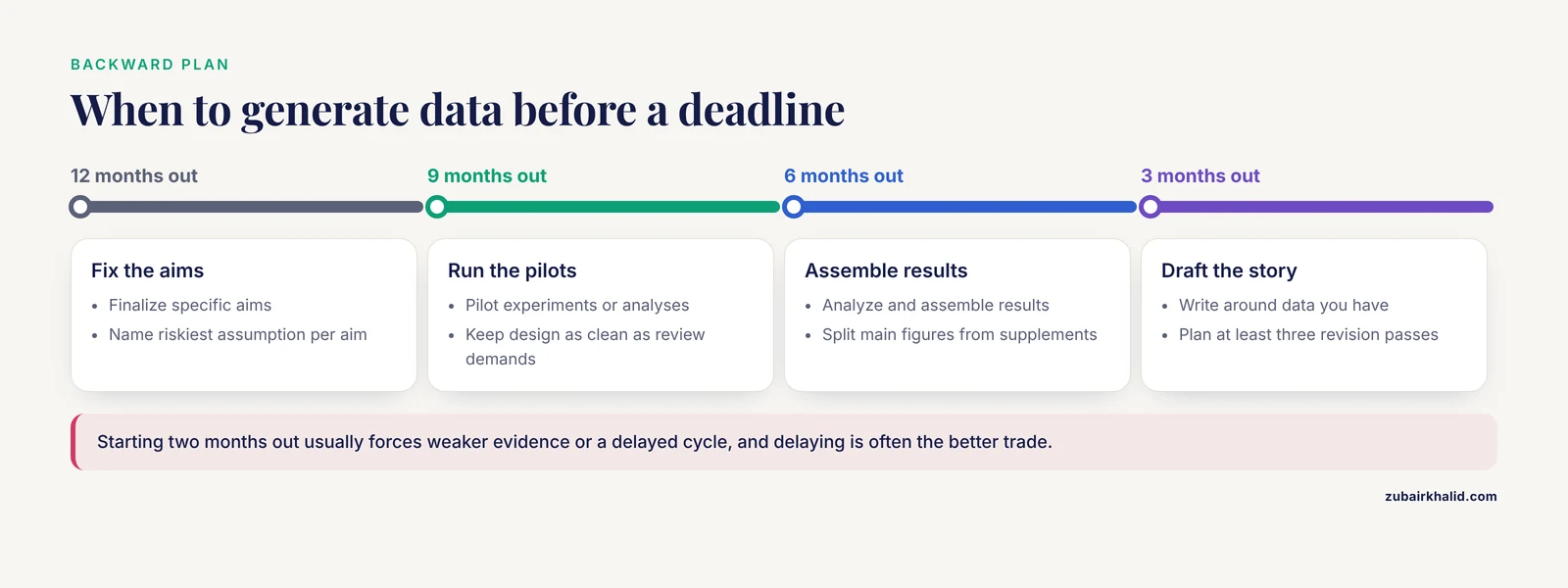
Because data generation takes longer than writing, the sequencing of grant proposal planning matters. A workable backward plan looks like this. Twelve months before a typical federal deadline, finalize the specific aims and identify the riskiest assumption behind each one. Nine months out, run the pilot experiments or analyses that address those assumptions, keeping the design as clean as a future reviewer would demand. Six months out, analyze and assemble the results, deciding what goes in the main figures and what goes in supplements. Three months out, draft the narrative around the data you actually have, not the data you hoped for.
The narrative matters as much as the data. Comprehensive grant-writing guides walk through funding identification, proposal preparation, narrative and budget development, and even post-submission processes as one connected workflow, because weaknesses in any stage weaken the others [14]. Introductory workshops make the same point at a smaller scale, teaching applicants to decode grant terminology, build realistic budgets, and write persuasive narratives as integrated skills rather than separate tasks [3].
For people who learn best in a structured setting, a research grant writing course is worth the investment, particularly one that includes review of draft aims and data sections. The institutional shift toward formalized grant-writing training reflects how central the skill has become to an academic career, and instruction with worked examples and interactive feedback consistently outperforms reading advice alone [3] [2]. Whether you learn through a course, a mentor, or a writing group, the mechanism is the same. Someone who has served on a review panel reads your preliminary data section and tells you which figure confused them. That single piece of feedback is usually worth more than another month of experiments.
One final point on revision. Good preliminary data sections, like good manuscripts, emerge through multiple drafts rather than a single pass, and editors who see large volumes of scientific writing emphasize purposeful, repeated revision of core elements as the difference between acceptable and compelling [12]. Plan for at least three passes over the data section, one for content, one for the story each figure tells, and one for polish.
Frequently Asked Questions
How much preliminary data does a grant proposal need?
Enough to show that each specific aim is feasible, which usually means one to three strong figures addressing your riskiest assumptions rather than a complete body of work. Reviewers penalize both too little data, which reads as an untested idea, and too much data, which reads as a project that is already done.
Can published papers count as preliminary data?
Yes, both your own papers and papers from other groups count, though they serve different roles. Your own publications establish track record and capability, while other groups' papers establish that an approach is possible in principle but need to be paired with your own demonstration to prove you can execute it.
Do exploratory or career development awards require preliminary data?
Requirements vary by mechanism, and some exploratory and training awards are explicitly designed to fund work before preliminary data exists. Read the funding announcement carefully, because it will state what level of preliminary data the reviewers expect, and tailor your application to that stated expectation rather than to generic advice.
Can I use a collaborator's data as preliminary data?
Yes, if you are transparent about it. Name the collaborator, describe exactly what they generated, include a letter confirming their role and continued involvement, and use the data to fill a genuine gap in your team's capability rather than to dress up a proposal that lacks its own evidence.
What if my pilot results are negative or ambiguous?
Negative results can still serve as useful preliminary data if they show the system works and the measurement is sound, because they let you revise the hypothesis honestly. Ambiguous results usually mean the pilot needs more replication or better controls before submission, and proceeding with a muddy figure rarely pays off.
How far before a deadline should I start generating preliminary data?
Plan on six to twelve months before the submission deadline, because experiments fail the first time, approvals take longer than expected, and analysis always reveals something you did not anticipate. Applicants who start data generation two months out are usually forced to submit weaker evidence or delay a cycle, and delaying is often the better trade.
Sources
- The Pearls and Pitfalls of Grant Writing: Maximizing Your Funding
- The Way We Ask for Money… The Emergence and Institutionalization of Grant Writing Practices in Academia
- Intro to Grant Writing
- Extended-Release Trazodone in Comorbid Major Depressive and Sedative-Hypnotic/Anxiolytic Use Disorders: A Real-World Preliminary Evaluation of Multidimensional Outcomes.
- Common analysis pitfalls in longitudinal ctDNA studies: lead time, sensitivity and immortal time bias.
- Thematic Analysis in Qualitative Research: Common Pitfalls and Practical Insights for Academic Writing
- Navigating the Pitfalls in Research: Avoiding Common Errors While Writing a Paper
- Comparison of the established ASAS definition and preliminary proposed data-driven cut-offs for inflammatory and structural MRI lesions in the sacroiliac joints for eligibility of patients with nonradiographic axial spondyloarthritis in clinical trials.
- Writing an Impactful Introduction in Business and Management Research: Avoiding Common Pitfalls
- Common mistakes in writing introduction of a scientific journal article
- Teaching Paper: Writing a Grant Proposal
- Avoiding Common Writing Mistakes That Make Your Editors and Reviewers Cringe
- An Analysis of Common Errors in English Essay Writing by Students at Thu Dau Mot University
- Grant Writing Mastery