Poster Message vs Abstract: Key Differences
By Dr. Zubair Khalid, DVM, MS, PhD ·

A poster message is one short, visual takeaway designed to grab attention and start a conversation, while an abstract is a compact written summary of an entire study that readers scan before deciding to read the full paper. The rule of thumb is simple: use an abstract when you need to report the complete structure of your work in text, and use a poster message when you need one memorable point that survives being read in three seconds from across a room. If you can only have one artifact for a conference, the abstract usually gets you into the meeting and the poster message determines whether anyone stops at your board.
This article walks through the difference between poster message and abstract formats, explains what each one is for, compares them on the criteria that actually matter when you have to choose, and shows you where researchers most often mix them up.
Why the Confusion Exists
Both the abstract and the poster summarize research, both appear at scientific meetings, and both are often written at the last minute from the same draft manuscript. That shared origin is exactly why they get conflated. Many researchers write their abstract, paste it onto a large canvas, add some charts, and call it a poster. The result is a document that is too dense to read standing up and too visual to serve as a citable record of the work.
The two formats solve different communication problems. An abstract competes for attention in a long list of other abstracts, usually on a website or in a program booklet, where a committee member or attendee decides in under a minute whether your work sounds worth pursuing. A poster competes for attention in a loud hall full of competing visual stimuli, where a passerby decides in seconds whether to walk over. Different problems, different tools.
What a Poster Message Is
A poster message is the single central idea your poster communicates. Communication researchers describe the poster as a medium that transmits a message through graphical synthesis, one that earns attention through originality, contrast, and a clear center of interest [1]. The message is not the poster itself. The poster is the vehicle, and the message is the one sentence, reinforced by the title and the key figure, that you want a stranger to carry away.
A well-formed poster message has these properties:
- It is a complete claim, not a topic. "Screen time and children" is a topic. "A family-based education package helped parents set household screen-use rules for school-aged children" is a message.
- It fits in one breath. If you cannot say it aloud in roughly ten seconds, it is still a paragraph, not a message.
- It is supported by one dominant visual. The best posters are built around a single figure that makes the claim obvious, with the message stated in the title or in a large banner statement near the top.
- It is calibrated to the audience. The meaning a poster delivers depends on the cultural background, prior knowledge, and motivations of the people reading it, so the message must be defined precisely for a specific target audience [1].
Because posters are read opportunistically, in a hallway conversation or during a coffee break, the message has to work even if the viewer never reads a single methods detail. Classic guidance on poster preparation emphasizes that a good poster communicates a simple message and stimulates discussion, which requires identifying the vital ingredients and rejecting superfluous material [2].
What an Abstract Is
An abstract is a condensed written summary of a research project, typically 150 to 300 words, that reports the question, methods, key results, and conclusion in proportion. Abstracts serve two distinct functions that beginners often blur:
- Submission function. Conference organizers and journal editors use abstracts to decide what gets accepted. The abstract is the entire audition.
- Record function. Once published in a program or indexed in a database, the abstract becomes a permanent, searchable snapshot of the work that other researchers use to decide whether to retrieve the full paper.
Abstracts follow a conventional structure, usually background or introduction, methods, results, and conclusion. That same conventional structure is a suitable starting point for many posters, with modification, which is one reason the two formats feel related [2]. The important distinction is proportion. An abstract gives roughly equal textual weight to all four sections. A poster compresses background and methods to a minimum and gives most of its real estate to results.
Abstracts also carry a known scientific limitation worth understanding early in your career. A study of abstracts from the American Association of Neurological Surgeons annual meeting found that only 49.3 percent of abstracts were eventually published as full papers, that 18.1 percent of those published papers differed in their message from the original abstract, and that positive results were 40 percent more likely to be published than negative ones [3]. In other words, an abstract is a preliminary claim, not a verified finding. Treat every abstract you read, including your own, as work in progress.
Side-by-Side Comparison
The table below is the core of the poster message vs abstract decision. Read it as a set of design constraints, not just a list of differences.
| Criterion | Poster Message | Abstract |
|---|---|---|
| Format | One sentence or short statement, usually reinforced by a headline and one key figure | Structured or unstructured paragraph, typically 150 to 300 words |
| Primary medium | Visual display (printed or digital poster) at a meeting, hallway, or public venue | Written text in a program, journal, or indexed database |
| Reading time available | A few seconds to a few minutes, often with the author present to explain | A minute or two of silent reading, no author present |
| Purpose | Attract attention, deliver one takeaway, start a conversation | Report the full arc of the study, enable screening and citation |
| Amount of detail | Minimal, only what supports the central message | Complete structure: background, methods, results, conclusion |
| Audience interaction | Dialogic, the author answers questions in real time | Static, no chance to clarify |
| Lifespan | The event itself, plus whatever photos and conversations persist | Permanent, searchable, citable |
| Selection role | Rarely used for acceptance decisions, delivers value after acceptance | The main basis for acceptance at conferences and journals |
| Evaluation standard | Can a passerby state your message after 10 seconds? | Can a reader understand what you did, found, and concluded without the full paper? |
| Common failure mode | Too much text, diluted message, poster reads like a paper on a wall | Overclaiming results that later change before full publication [3] |
Poster Message or Abstract: How to Decide
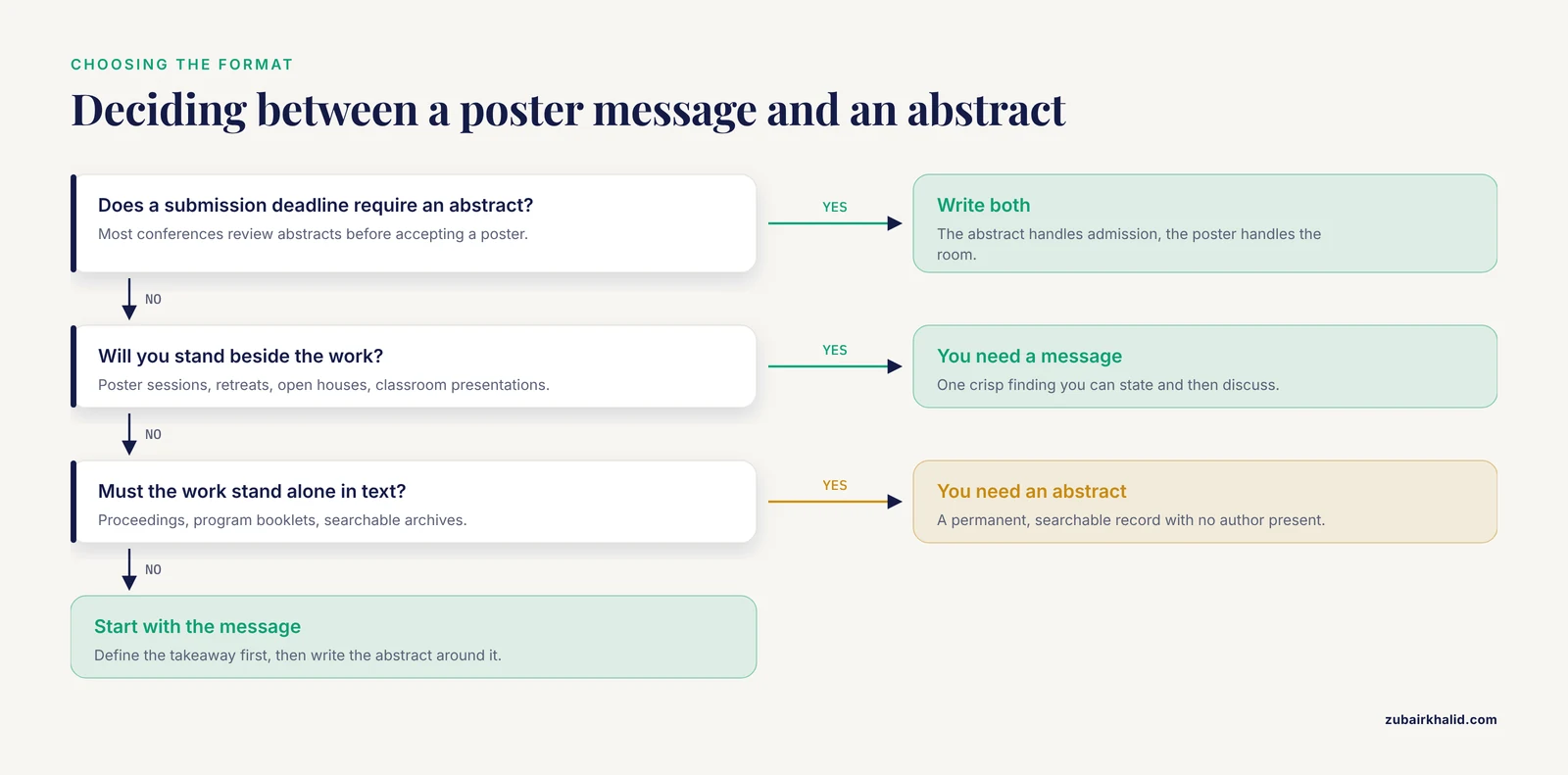
Use this sequence when you are unsure which format a situation calls for.
- Is there a submission deadline that requires an abstract? Most conferences require an abstract for review regardless of whether your final presentation is a talk or a poster. In that case you write both, and the abstract handles admission while the poster handles the room.
- Will your audience be standing near you? If the answer is yes, you need a poster message. Poster sessions reward people who can state one finding crisply and then talk about it.
- Will your audience encounter the work without you? If the work must stand alone in text, for example in meeting proceedings or a searchable archive, you need an abstract.
- Do you need the message first or the summary first? Working order matters. The strongest workflow is to define the poster message first, then write the abstract around it, then build the poster from the abstract. Deciding the single takeaway early prevents the most common poster failure, which is a display that summarizes everything and emphasizes nothing.
When to Use a Poster Message
Choose a poster message when your goal is engagement rather than documentation. The clearest use cases are:
- Conference poster sessions, where you will stand beside your work for a scheduled block of time.
- Departmental retreats and lab open houses, where visitors range from specialists to outsiders.
- Classroom and training settings, where students present a single project outcome.
- Public-facing science communication, where the audience has no background in your field.
Public health work illustrates the point well. Health education materials delivered to families often include posters alongside booklets and digital tools, because a poster can put a single behavioral message in front of people in the home without requiring sustained reading [4]. That everyday example translates directly to science: if your goal is a change in what someone thinks or does after a brief encounter, a poster message is the right instrument.
Choose an abstract instead when your goal is record and access. Journal submissions, thesis-proposal documents, grant letter-of-intent stages, and conference review processes all live on abstracts.
How to Make a Scientific Poster Around a Message
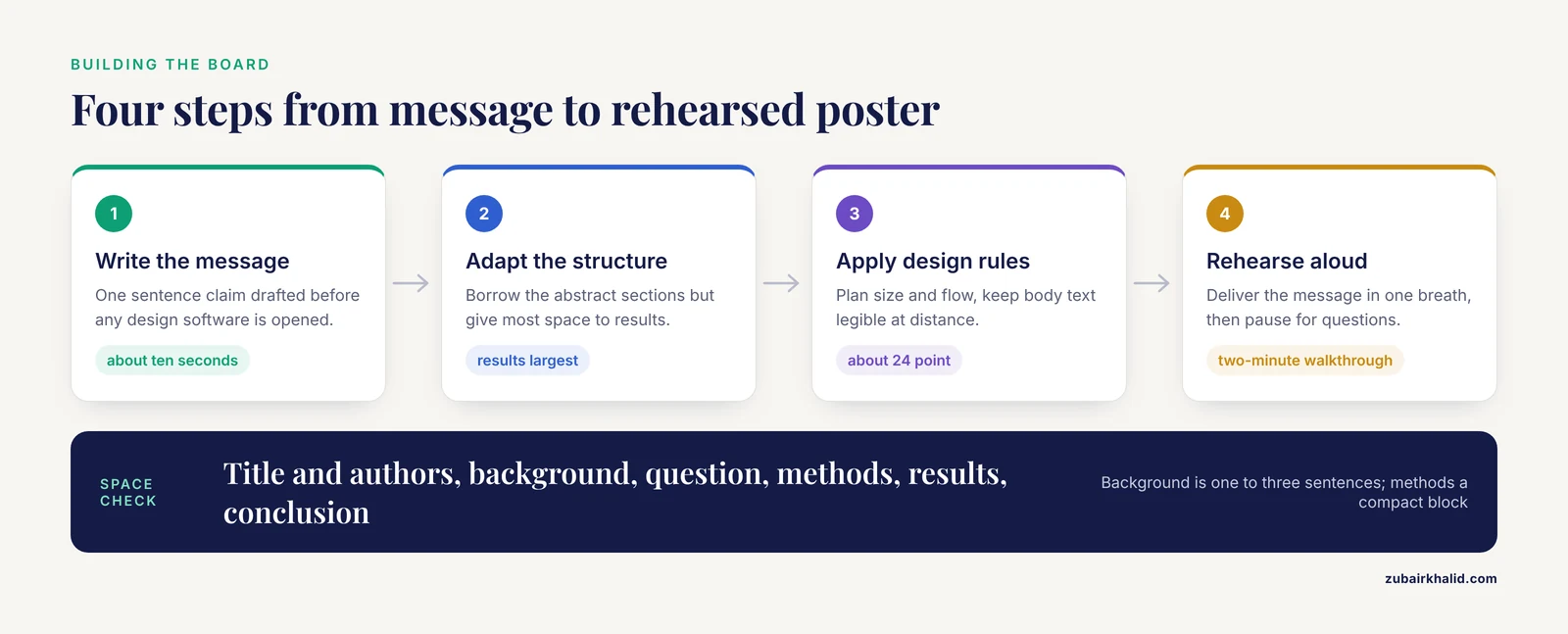
If you know the message, building the poster becomes a filtering exercise. Standard guidance breaks the task into planning the content, planning the physical layout, and refining the graphical details [2].
Step 1: Write the Message First
Draft the one-sentence claim before you open any design software. A useful test is to imagine a colleague asking what your poster says. Your answer is your message. Everything on the board either supports that sentence or gets cut. Poster preparation guides stress that rejecting superfluous material is where most of the effort goes [2].
Step 2: Adapt the Standard Structure
Borrow the abstract's structure but change the proportions [2]. A typical research poster allocates space roughly as follows:
- Title and authors, where the title should state the message, not just name the topic.
- Background, one to three sentences.
- Question or hypothesis, one sentence, visually distinct.
- Methods, reduced to a compact block or a simple flow of steps.
- Results, the largest section, anchored by one dominant figure.
- Conclusion, restating the message in slightly different words.
Suitable poster topics span clinical trials, surveys, qualitative studies, and case reports, and the section contents should be adjusted to the study type [2]. A qualitative study, for example, may give more space to themes and illustrative quotes than to statistics.
Step 3: Apply Research Poster Design Principles
Research poster design has a few rules with strong consensus across guides:
- Size, shape, and flow must be planned before content is finalized, because rearranging later wastes time [2]. Check the meeting's specified dimensions, commonly around 36 by 48 inches or A0 portrait, before you design anything.
- Reading order should be obvious. Column-based layouts that read left to right work because viewers start at the top left without instruction.
- Text must be legible at distance. Body text below roughly 24 point font fails the hallway test. Titles and the poster message should be readable from several meters away.
- Images and slogans must be identified easily. Effectiveness depends on instant recognition of the visual elements, on visual attractiveness, and on a clear focus at the center of interest.
- Avoid ambiguity. Confusing or contradictory visuals can send conflicting messages, and negative or alarming framings can backfire with the audience.
Step 4: Rehearse the Verbal Version
The poster message you wrote in step 1 becomes your opening line in the session. Practice delivering it in one breath, then pausing. Visitors will ask questions, and the poster only needs to provide enough scaffolding for that conversation to succeed.
Writing the Abstract After the Message
Once the message exists, the abstract becomes easier to write because it has a destination. A solid abstract for a typical life science study contains:
- One or two sentences of background establishing why the question matters.
- One sentence stating the objective or hypothesis.
- Two or three sentences of methods, naming the design, subjects or samples, and the main analysis.
- Two or three sentences of results, with the key numbers.
- One sentence of conclusion that should echo your poster message.
If your conclusion sentence cannot be reduced to your poster message, or if your poster message cannot be defended by the results in your abstract, one of the two is wrong. That internal consistency check catches more problems than any formatting rule.
Worked Scenarios
Scenario 1: First Conference Presentation
A graduate student finishes a survey project on laboratory safety habits. The conference requires an abstract by March and a poster by June. The message is "Most respondents skipped one specific safety step despite rating safety as important." The student writes the abstract first because the deadline demands it, then extracts the message, then designs the poster so that the survey's key chart sits at eye level in the center with the message as the title. The abstract earns acceptance, the poster earns conversation.
Scenario 2: Same Study, Two Artifacts
A team completes a mixed-methods study on family health routines. For the academic audience they write a structured abstract reporting the interview approach, the participant group, and the refinements identified for their education package [4]. For a community health fair they build a poster whose message is a single actionable sentence addressed to parents. The findings are the same, but the two artifacts share almost no text, because the audiences, reading conditions, and goals differ.
Scenario 3: Choosing Only One
A small department asks a researcher to contribute either an abstract for the program or a poster for the lobby. The audience will walk past the work without the researcher present. Here the abstract wins, because a poster without its author is a static summary with no one to explain it, and an abstract in a program is at least a searchable record.
Common Mix-Ups
Copying the abstract onto the poster. This is the most frequent error and the reason many poster sessions feel like wall-mounted papers. A 250-word abstract is unreadable at poster distance and buries the message [2].
Treating the abstract as a final result. Because abstracts are brief and preliminary, they can mislead. In the neurological surgery meeting study, nearly half of abstracts never reached full publication and a substantial share of those that did changed their message along the way [3]. Cite the full paper when one exists.
Writing a topic instead of a message. "A Study of Enzyme X in Model Y" tells viewers nothing. A message asserts what you found.
Ignoring the audience when choosing images. Symbols, metaphors, and slogans that resonate with one audience can confuse another, so the message and its visuals must be matched to the specific target audience.
Assuming the poster and abstract should match word for word. They should agree in substance but not in form. The abstract documents, the poster persuades.
Common Mistakes and Limitations
- Writing the poster last. Rushed poster design produces cluttered boards. Careful planning of size, shape, flow, and content saves preparation time and improves the result [2].
- Overloading with data. Every extra table competes with the central message. If a figure does not support the message, save it for the full paper or for handouts.
- Small fonts and low contrast. Posters fail physically before they fail intellectually. Test print at reduced scale and check legibility from across a room.
- Forgetting that abstracts are provisional. Abstracts receive far less scrutiny than peer-reviewed papers, and many never achieve publication at all [3]. Frame conference abstracts accordingly in your CV and in conversations.
- Assuming one message fits all audiences. A message tuned for specialists will not land with the general public, and vice versa. Define the target audience by role, background, and setting before finalizing wording.
- Neglecting the conversation. A poster session is a dialogue. Prepare a two-minute walkthrough and answers to the three most likely questions.
- Skipping the conference's technical requirements. Dimension limits, orientation, and mounting rules vary by meeting, and violations are discovered at the venue when it is too late to fix them.
- Individual situations vary. The advice here covers general practice for research communication, and specific programs, journals, or meetings may impose their own formatting rules that override general guidance.
Frequently Asked Questions
Can I use my abstract as my poster?
You can reuse its content, but not its text. An abstract is a 150 to 300 word paragraph meant for silent reading, while a poster needs a short message, a dominant figure, and minimal text that can be read from a distance. Paste the abstract onto a poster and most visitors will walk past it.
How long should a poster message be?
One sentence, short enough to say aloud in about ten seconds. The title of the poster often carries the message directly, with a supporting banner statement near the top of the board for reinforcement.
Do conferences require both an abstract and a poster?
Most conferences require an abstract for the review and acceptance process, and the poster is what you present after acceptance. Check the meeting's call for papers, because submission requirements and poster specifications are usually stated there.
What makes an abstract unreliable as a source on its own?
Abstracts are brief preliminary reports, and many never become peer-reviewed papers. One analysis of meeting abstracts found that fewer than half were eventually published and that some published versions differed from the original abstract, which is why abstracts should be treated as preliminary information rather than established findings [3].
What is the first step in how to make a scientific poster?
Write your one-sentence message before doing anything else, then check the meeting's required poster dimensions. With the message and the physical constraints fixed, you can select the vital content and reject everything else, which is where most of the effort in a good poster belongs [2].
Does research poster design differ for general audiences?
Yes. For specialist audiences you can keep standard section structure and technical figures. For general audiences, visuals and wording must be instantly recognizable and free of ambiguity, because the effectiveness of a poster depends on how easily its images and slogans are identified by the intended audience.
Sources
- [[The poster as a communication medium].](https://pubmed.ncbi.nlm.nih.gov/12281468/)
- Preparing a poster.
- Charting the course from abstract to published article.
- Refining a Multicomponent Family-Based Health Education Package to Reduce Screen Time Among School-Aged Children: Qualitative Formative Evaluation With Parents and Caregivers.