Using the Pomodoro Technique for Biology Study Sessions
By Dr. Zubair Khalid, DVM, MS, PhD ·
The one-sentence difference between pomodoro options is interval length: the classic 25-minute work block with a 5-minute break suits memorization-heavy biology tasks like flashcards and terminology, while longer intervals of 50 to 90 minutes suit complex tasks like reading a research paper or working through genetics problems. The rule of thumb for choosing is simple: match the work interval to the longest stretch of uninterrupted thought your task needs, then use the breaks for movement, hydration, and quick recall checks rather than screens.
This guide explains what the technique is, why it fits the way biology is learned, compares the main pomodoro technique for biology options side by side, walks through a full worked study session, and covers the mistakes that quietly waste otherwise good study time.
What the Pomodoro Technique Actually Is
Francesco Cirillo developed the technique in the late 1980s as a university student in Rome. He used a kitchen timer shaped like a tomato, which is where the name comes from, since pomodoro means tomato in Italian. The method he described has a small set of rules that have stayed consistent across his own written guides and the many apps built on them.
The core loop looks like this:
- Choose one specific task and write it down.
- Set a timer for 25 minutes.
- Work on that task only until the timer rings.
- Mark one completed pomodoro on paper or in an app.
- Take a 5-minute break away from your desk.
- After four pomodoros, take a longer break of 15 to 30 minutes.
Three supporting rules matter as much as the timer itself. First, an interrupted pomodoro does not count. If a person or notification breaks your focus in a way that demands a response, you abandon the interval and start again, or you defer the interruption by writing it down and returning to the task. Second, intrusive thoughts get captured on paper instead of followed. If you suddenly remember an email you need to send, you jot it down and keep working. Third, you estimate tasks in pomodoros before starting, which builds a realistic sense of how long biology tasks actually take.
The technique is a time-structure wrapper, not a learning method. It tells you when to focus and when to rest. What you do inside each interval determines whether the session produces learning, and that is where biology-specific choices matter.
Why Structured Intervals Fit Biology Study
Biology has a reputation for volume. A single semester of introductory biology can cover cell structure, membrane transport, cellular respiration, photosynthesis, DNA replication, transcription, translation, Mendelian genetics, evolution, and ecology. Success in how to study biology comes less from raw hours and more from how those hours are spent, and decades of cognitive science converge on a consistent answer: active recall, spaced practice, and interleaving outperform rereading and highlighting.
Active recall means retrieving information from memory rather than reviewing it. Closing the book and drawing the electron transport chain from memory is active recall. Rereading your notes on the electron transport chain is not. Spaced practice means revisiting material across days and weeks instead of massing it into one session. Interleaving means mixing related problem types or topics within a session instead of blocking one topic for hours.
The pomodoro structure supports all three practices in a specific way. A fixed interval creates a natural unit for scheduling spaced reviews. A short break at the end of each interval is a natural checkpoint for a one-minute recall test of what you just covered. The break itself has a physiological rationale: memory consolidation and sustained attention both benefit from brief rest periods, and attention research consistently shows that vigilance declines over long unbroken stretches of demanding cognitive work. The exact numbers on the standard 25 and 5 are convention rather than proven law, but the underlying principle of alternating focused effort with genuine rest is well supported.
Biology study methods also vary in the kind of thinking they demand, and this is the key to choosing among pomodoro options. Memorizing the cranial nerves or the phases of mitosis involves many short retrieval cycles, which fits shorter intervals. Working a Hardy-Weinberg equilibrium problem, following a metabolic pathway through multiple branch points, or parsing the methods section of a primary paper requires holding a complex structure in mind for an extended period, which argues for longer intervals. Interrupting deep reasoning mid-chain costs more than interrupting a flashcard run, because rebuilding the mental model takes time.
Pomodoro Technique for Biology Options Compared
There is no single best pomodoro technique for biology. Each variant trades focus depth against fatigue control, and the right choice depends on the task in front of you. The table below is the core of the comparison.
| Option | Work interval | Break pattern | Best biology tasks | Main drawback |
|---|---|---|---|---|
| Classic | 25 minutes | 5 minutes short, 15 to 30 minutes after every 4 cycles | Flashcards, terminology, labeling diagrams, quick recall drills | Too short for complex problems and dense papers |
| Extended | 50 minutes | 10 minutes short, 20 to 30 minutes after every 2 to 3 cycles | Genetics problem sets, biochemistry pathways, lab report writing | Fatigue creeps in late in the interval if breaks are skipped |
| Ultradian | 90 minutes | 15 to 20 minutes after each cycle | Reading primary literature, writing a full section of a thesis or lab report, exam simulation | Hard to schedule, one bad stretch ruins the block |
| Micro | 10 to 15 minutes | 3 to 5 minutes short | Low-motivation days, brutal memorization loads, reviewing mistakes | Frequent switching adds overhead, fewer completed cycles |
| Flowtime | No fixed length | Break when focus fades, minimum 20 to 25 minutes | Open-ended tasks such as data analysis or unstructured reading | No timer discipline, easy to skip breaks entirely |
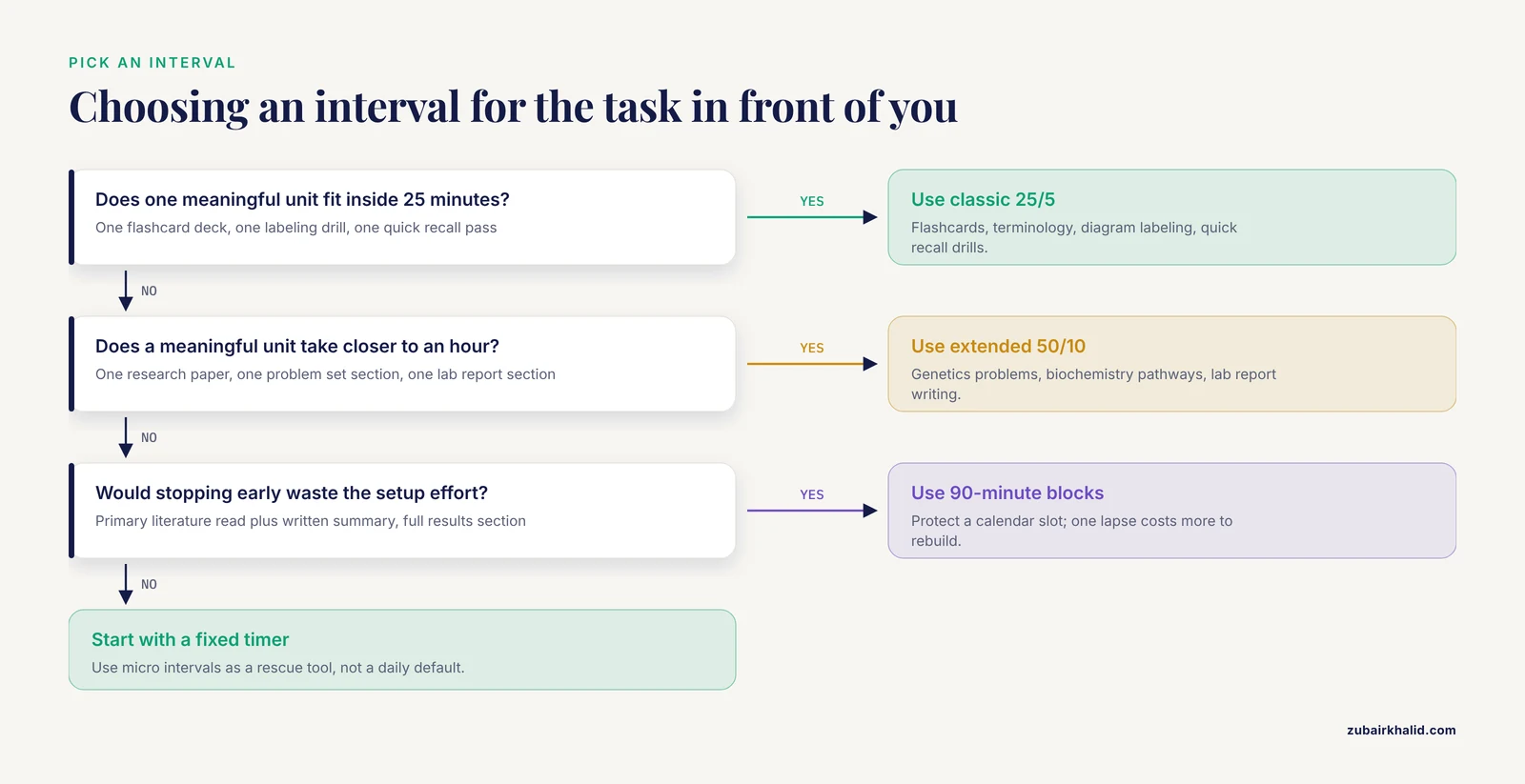
A quick rule for deciding between them: if you can finish a meaningful unit of the task, such as one flashcard deck or one problem set section, inside 25 minutes, use the classic interval. If a meaningful unit, such as one research paper or one multi-part problem, reliably takes closer to an hour, use the extended interval. Reserve the 90-minute block for tasks where stopping early would waste the setup effort, and use the micro interval as a rescue tool rather than a daily default.
Each Option Explained, With Pros and Cons
Classic 25-Minute Pomodoro
The standard version works on a simple rhythm of four 25-minute work blocks separated by 5-minute breaks, followed by one longer break. Its strength for biology is compatibility with flashcard systems. A well-built Anki deck or paper flashcard stack naturally divides into reviewable chunks, and 25 minutes is enough for a focused pass through a deck with honest self-grading. The short interval also makes starting easier on days when motivation is low, because committing to 25 minutes feels manageable in a way that committing to two hours does not.
The pros are simplicity, low startup cost, and a structure that pairs cleanly with active recall at interval boundaries. The cons appear with complex tasks. Diving into the regulation of the citric acid cycle and getting interrupted at minute 25, right as the logic clicks, forces you to rebuild the reasoning after the break. Many students also report that four cycles plus breaks consume closer to two and a half hours than the nominal two hours, so schedule accordingly.
Extended 50/10 Intervals
Doubling the work block to 50 minutes with a 10-minute break is the most popular adaptation among students handling quantitative or dense material. Fifty minutes accommodates a full problem set section, a chapter section with note-taking, or a diagram-heavy pass through an anatomy atlas. The longer break gives enough time for a real walk or a meal, which matters because a 5-minute break rarely fits food.
The main risk is drift. Within a 50-minute block, a student who is passively rereading can lose 20 minutes without noticing, something a 25-minute timer exposes faster. If you choose this option, build one internal checkpoint at the midpoint, such as closing the material and writing three sentences on what you just covered.
Ultradian 90-Minute Blocks
The 90-minute option draws on the observation that alertness cycles in roughly 90-minute waves across the day, though the evidence for applying that rhythm to study scheduling is looser than the basic break principle. The practical case is task-driven: reading a full research article, including figures and methods, or writing a complete results section, benefits from an uninterrupted stretch. Graduate students and upper-level undergraduates doing primary literature work get the most from this option.
The cons are scheduling difficulty and severity of failure. A 90-minute block needs a protected calendar slot, and a single phone check at minute 40 can cost more total focus than the same lapse inside a 25-minute interval because there is so much context to rebuild.
Micro Intervals of 10 to 15 Minutes
Short intervals of 10 to 15 minutes with brief breaks serve two specific purposes. They lower the activation barrier on days when anxiety or fatigue makes starting feel impossible, and they suit rapid-fire memorization tasks such as cramming anatomical directions, drug classes for pharmacology, or taxonomic ranks. The tradeoff is overhead: every transition costs a small amount of refocusing time, and across a two-hour session that overhead adds up. Treat micro intervals as a tool for specific situations, not a default.
Flowtime
Flowtime drops the fixed timer. You start a stopwatch, work until focus genuinely fades or a natural milestone arrives, then take a break proportional to the time worked. The advantage is respecting deep engagement when it happens, which fixed timers can cut short at exactly the wrong moment. The disadvantage is the loss of external discipline. Without a timer promising an end point, students who struggle to stop working often skip breaks entirely, and students who drift lose the early warning a countdown provides. Flowtime suits experienced students who already know their own focus patterns. If you are new to structured study, start with a fixed option and graduate to flowtime later if needed.
How to Use the Pomodoro Technique for Biology: A Worked Session
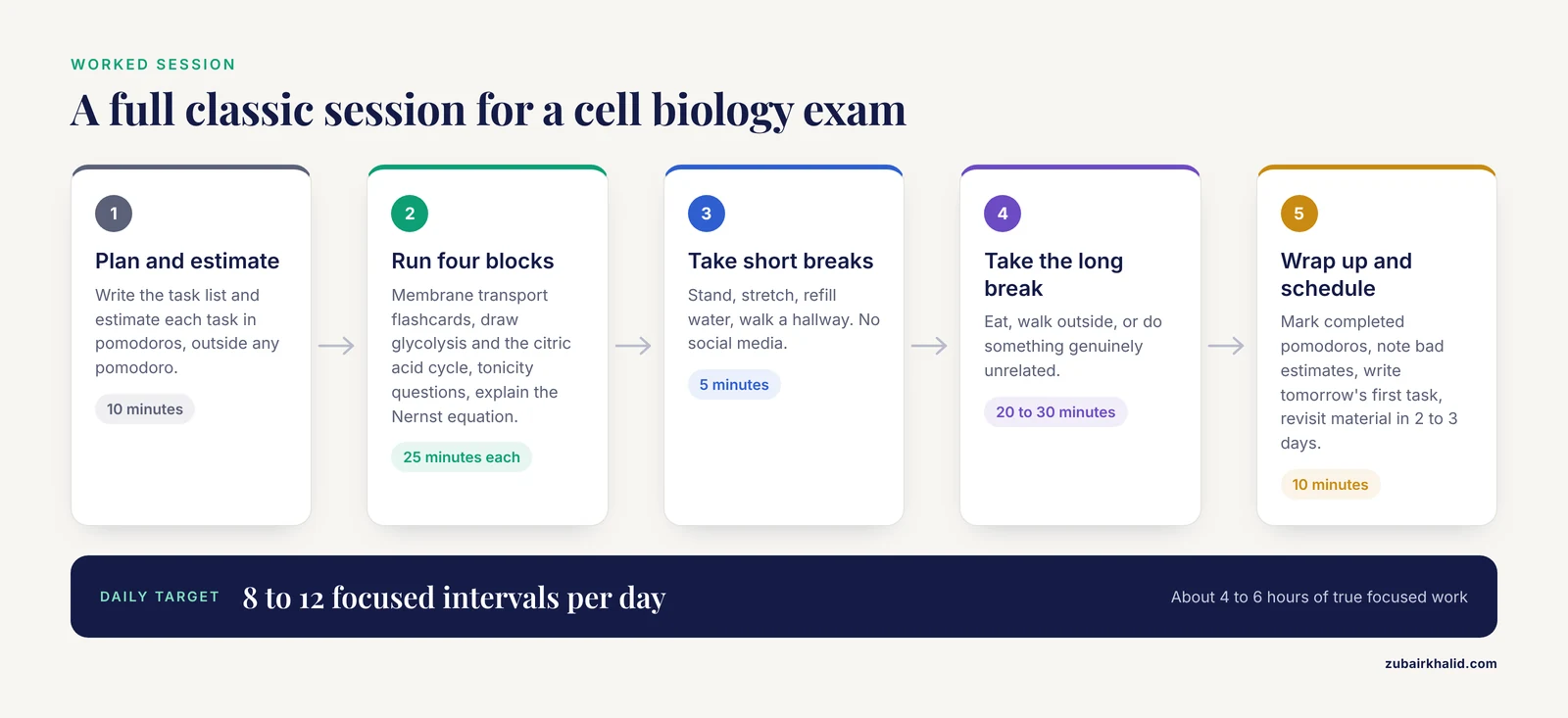
Here is a complete session built around a mid-semester cell biology exam, using the classic option. It shows how the intervals, the breaks, and the study methods interlock rather than running separately.
Before the first timer (10 minutes of planning, outside any pomodoro). Write the task list and estimate each task in pomodoros. A realistic list might read: review and grade flashcard deck on membrane transport (1 pomodoro), redraw glycolysis and the citric acid cycle from memory, then check against notes (1 to 2 pomodoros), complete 10 practice questions on osmosis and tonicity (1 pomodoro), re-derive and explain the Nernst equation to an empty chair (1 pomodoro). Estimation like this is where you discover that "study chapter 7" is not a task, while "draw and self-check the citric acid cycle" is.
Pomodoro 1 (25 minutes). Run the membrane transport flashcards with honest grading. Honest means marking a card wrong when you needed the hint, not when you gave up entirely. End the interval at the timer, even mid-deck.
Break 1 (5 minutes). Stand up, stretch, refill water. Do not open social media. The purpose of this break is letting your attention reset, and a phone scroll accomplishes the opposite while adding nothing to consolidation. A good optional move in the last minute of the break: write down, from memory, the three transport mechanisms you reviewed. That is a free extra retrieval.
Pomodoro 2 (25 minutes). Blank page, draw glycolysis through pyruvate with substrates, enzymes in abbreviated form, and ATP or NADH accounting at each step. When you finish or stall, check against your notes and mark the gaps in red. The gaps are tomorrow's flashcards.
Break 2 (5 minutes). Movement again. Walk a hallway or a flight of stairs. Physical movement during breaks appears repeatedly in advice from learning centers at research universities, and it fits the physiology of sustained attention better than more sitting.
Pomodoro 3 (25 minutes). Practice questions on tonicity, mixed with a few questions from the previous chapter on membrane structure. Mixing is deliberate. Interleaving related topics forces you to choose the right approach for each question, which is the skill exams actually test.
Break 3 (5 minutes). Short, away from the desk.
Pomodoro 4 (25 minutes). Explain the Nernst equation out loud to an empty room, then work two numerical problems with it. Explaining aloud, sometimes called the protégé effect or self-explanation, is one of the most reliable biology study methods because language forces organization that silent reading does not.
Long break (20 to 30 minutes). Eat, walk outside, or do something genuinely unrelated. This is where consolidation gets breathing room, and skipping it is one of the most common self-defeating moves in a study day.
Wrap-up (10 minutes, outside any pomodoro). Mark completed pomodoros next to each task, note where estimates were wrong, and write tomorrow's first task so the next session starts without planning overhead. Schedule the next contact with today's material for 2 to 3 days out. A pomodoro session that is never revisited produces a forgetting curve that erases most of the work within a week.
Run over a week rather than a day, this pattern becomes spaced practice automatically: today's flashcards reappear in two days, the ones you missed reappear tomorrow, and each cycle is a short, defined block of timer-bounded work.
Matching Options to Biology Tasks: Worked Scenarios
Scenario 1, first-year anatomy or physiology exam. The load is dominated by terminology, structures, and function relationships. Use classic 25/5 intervals, one deck or one organ system per interval, and spend the first minute of each break doing a blunt recall dump. Save one 50-minute block per week for cumulative review that mixes old and new units.
Scenario 2, a graduate student reading primary literature. A single paper with dense methods deserves an extended 50/10 block, sometimes two: one for the first full read with margin notes, one for re-reading the figures and asking what each control rules out. If the paper underpins your own project, one ultradian 90-minute block covering the read plus a written summary is often more efficient than fragmenting it.
Scenario 3, MCAT or GRE biology preparation. Prep mixes content review with timed practice. Use extended intervals for content review of weak areas, and reserve classic or even exam-length blocks for full practice sections done under real timing constraints. Timer practice for a timed exam is itself a skill, so simulate the real constraint rather than wrapping it in study-timer logic.
Scenario 4, learning a new lab protocol. Reading a protocol and its rationale fits a classic interval. The hands-on run does not, because a timer that rings mid-centrifugation is worse than useless. For bench work, apply the pomodoro principle only to the preparation and analysis phases, and keep the wet-lab phase governed by the protocol's own timing.
Common Mistakes and Limitations
The most frequent error is treating the timer as the whole method. A student who spends every pomodoro passively rereading a textbook has adopted the schedule of effective studying without any of the substance. The interval boundaries are checkpoints for retrieval practice. If the last minute of a work block does not include some form of testing yourself, the structure is running empty.
The second error is break sabotage. Five minutes of short-form video does not restore attention, and it often overruns badly. Breaks work best when they involve standing, moving, looking at something far away, or getting water. A screen break trades one kind of cognitive load for another.
Third, rigid adherence in the wrong direction. If a fixed timer rings while you are mid-derivation and the reasoning is flowing, the best move is usually to finish the current unit, or at minimum write a one-line note capturing where you were, before breaking. Conversely, pushing through 25 minutes of staring at the same paragraph is a signal to break early rather than a schedule to honor. The technique serves the work, not the reverse.
Fourth, bad estimation. New users chronically underestimate pomodoro counts for reading and problem sets, then feel like failures when a chapter takes six intervals instead of two. Estimation accuracy improves with a log, and the log itself becomes useful data about which biology topics genuinely cost more time.
Fifth, using pomodoros to dignify cramming. Four hours of timer-structured cramming the night before an exam produces short-lived gains and misses the spacing effect entirely. The technique organizes time within a session. It does nothing to distribute sessions across weeks, and that distribution is where most of the retention benefit lives.
One honest limitation deserves a direct statement. The specific numbers, 25 minutes, 5 minutes, a long break after four cycles, come from one practitioner's system rather than from controlled trials comparing interval lengths. Research on attention, breaks, and spaced learning supports the general pattern of focused work punctuated by rest, but it does not crown one interval length as universally superior. Individual working memory, task type, and even time of day shift the optimum. Finally, sustained study struggles that persist despite good structure, sleep, and schedule can reflect health issues, and a student in that situation should talk with a healthcare provider or their campus counseling or accessibility office.
Frequently Asked Questions
Is the classic 25/5 the best pomodoro technique for biology?
It is the best default for memorization-heavy work such as flashcards, terminology, and diagram labeling, and it is the easiest option to start with. For complex problem sets, dense textbook sections, or primary literature, an extended 50/10 interval usually fits better. The best choice depends on the task, not on the technique having one correct setting.
How do I handle lab work or long protocols with pomodoros?
Apply pomodoros to the phases you control, such as reading the protocol, planning calculations, and analyzing data. Do not interrupt an active wet-lab procedure for a timer, because protocol steps follow their own required timing and a mid-step break can ruin a sample.
Can I combine pomodoros with flashcards and spaced repetition?
Yes, and the combination is stronger than either alone. Use one pomodoro per flashcard deck or topic, use break boundaries for quick recall dumps, and schedule each deck's reappearance across days so the pomodoro sessions themselves become your spaced repetition schedule.
What should I do if I get interrupted during a pomodoro?
If the interruption truly requires a response, abandon the interval, handle it, and start a fresh pomodoro. If it can wait, write the interruption on a capture list within a few seconds and return to the task. A pomodoro that is broken in a way you chose to allow does not count as completed.
Does the exact interval length matter scientifically?
No single interval length has been proven optimal in controlled comparisons. What research supports is the general principle that focused effort punctuated by genuine rest beats long unbroken sessions. Pick an interval that matches your task's natural thought units and adjust based on your own logged results.
How many pomodoros should I aim for in a day?
Most students sustain roughly 8 to 12 focused intervals per day across one or two sessions, which corresponds to about 4 to 6 hours of true focused work, with the remainder of study time going to breaks, review, and lighter tasks. Chasing larger numbers usually produces longer hours with worse retention rather than more learning.