PMP vs. PRINCE2 for Scientists
By Dr. Zubair Khalid, DVM, MS, PhD ·
The difference between PMP and PRINCE2 for scientists comes down to what each one certifies. The PMP (Project Management Professional) certifies your personal knowledge and experience of general project management practice, while PRINCE2 certifies that you can apply one specific, prescriptive project method. The rule of thumb is simple. If you already lead projects in a US-style industry, clinical, or academic setting and you want a portable, experience-based credential, pursue the PMP. If your organization, consortium, or funder works under a controlled, stage-gated delivery method, or you lack the documented management history the PMP requires, start with PRINCE2 Foundation and build from there.
This article explains each credential on its own terms, puts them side by side, and shows how both connect to the day-to-day reality of research project management. It ends with worked scenarios, a research project plan template you can use under either approach, common mistakes, and direct answers to the questions scientists actually ask.
Why scientists end up choosing between these two credentials
Most scientists first meet formal project management when a grant is awarded. The moment a funding agency sends a Notice of Award, the project gains deliverables, reporting deadlines, a budget with spend rates, and milestones that reviewers will check at renewal time. A principal investigator becomes, in effect, a project manager who also runs the experiments. The same shift happens in industry when a research associate is promoted to study coordinator, core facility manager, or program lead.
Formal credentials exist because this transition usually happens without training. Workshops convened at the National Institutes of Health identified leadership development after training as one of the priority gaps for the clinician-investigator workforce, alongside limited research time and high competitive pressure for funding [1]. Structured project management training is one concrete way scientists fill that gap without waiting for an institution to provide it.
PMP and PRINCE2 are the two credentials most likely to appear in a job posting, a consortium agreement, or a professional development plan. They come from different traditions, test different things, and open different doors. Choosing well requires understanding what each one actually is.
What the PMP is, and who it suits
The PMP is a credential issued by the Project Management Institute (PMI), the professional body for project management based in the United States. It certifies an individual against the content of the PMBOK Guide and related PMI standards, which describe broad project management practice across industries.
Three features define the PMP.
It is experience-gated. You cannot sit the PMP exam as a beginner. PMI requires documented experience leading projects: 36 months of project leadership if you hold a four-year degree, or 60 months without one, plus 35 hours of project management education. Your application can be audited, so the hours must be real and describable. For scientists, this requirement matters. Time spent managing a subproject of a grant, coordinating a multi-site sample collection, or running a core facility upgrade all count. Time spent only doing bench work does not.
It is knowledge-based and broad. The exam is a multiple-choice test covering how projects are initiated, planned, executed, monitored, and closed, including predictive (waterfall), agile, and hybrid approaches. The current PMI framework is organized around principles and performance domains rather than a rigid process list. The credential says, in effect, that you understand the full terrain of project management and have practiced it.
It must be maintained. Certified holders keep the credential by logging Professional Development Units (PDUs), with 60 PDUs required over each three-year cycle. This keeps the credential current but adds an ongoing commitment.
The PMP suits scientists who already operate as de facto project managers. A study section coordinator who tracks enrollments across three sites, a genomics core manager who schedules instrument time and staff, or a senior postdoc who coordinates a multi-lab collaboration all accumulate the kind of experience PMI expects. For this group, the PMP converts existing work into a recognized, portable credential.
What PRINCE2 is, and who it suits
PRINCE2 (PRojects IN Controlled Environments) is a project management method, not just a credential. It originated as a UK government standard and is now maintained by PeopleCert, which acquired Axelos, the company that managed the method. Where the PMP certifies broad knowledge, PRINCE2 certifies competence in one defined way of running projects.
The method is built on a famous structure: seven principles, seven themes, and seven processes. Its signature features include:
- A maintained business case that justifies continuing the project at every stage.
- Management by stages, where work is planned, authorized, and reviewed in chunks rather than all at once.
- Defined roles in a project board structure, with explicit decision rights.
- Managing by exception, where managers set tolerances for time, cost, and quality and only intervene when those tolerances are threatened.
- Formal change control, so scope changes are assessed and approved rather than absorbed silently.
PRINCE2 is examined at two levels. PRINCE2 Foundation tests that you understand the method's terminology and structure. There is no prerequisite, so a scientist with no formal management title can take it immediately. PRINCE2 Practitioner tests whether you can apply the method to a realistic project scenario, and it must be renewed on a three-year cycle to stay current.
PRINCE2 suits scientists working in environments where the method is the local language. This includes European government agencies, EU-funded consortiums, parts of the pharmaceutical and biotech industry operating under European programs, and any organization that has formally adopted PRINCE2 as its delivery standard. In those settings, knowing the vocabulary of stage plans, exception reports, and project boards is practical workplace literacy, not résumé decoration.
The method also rewards scientists who want scaffolding. If you have never managed a formal project and the open-ended breadth of the PMBOK feels abstract, PRINCE2 gives you a step-by-step process to follow from project initiation to closure.
PMP vs. PRINCE2 for scientists at a glance
The table below is the core of the comparison. Read the rows as questions you would ask before committing money and study time.
| Feature | PMP | PRINCE2 |
|---|---|---|
| Governing body | Project Management Institute (PMI) | PeopleCert (formerly Axelos), originating as a UK government standard |
| What it certifies | Broad personal knowledge of project management practice and demonstrated experience | Ability to apply one specific, prescriptive project method |
| Underlying framework | PMBOK Guide and PMI standards, covering predictive, agile, and hybrid approaches | Seven principles, seven themes, seven processes |
| Entry requirements | 36 months of project leadership with a four-year degree (60 months without), plus 35 hours of project management education | None for Foundation. Practitioner requires Foundation (or an equivalent prior credential) |
| Exam format | Single multiple-choice exam, scenario-driven | Foundation exam plus a scenario-based Practitioner exam |
| Levels | One credential | Two levels, Foundation and Practitioner |
| Maintenance | 60 PDUs per three-year cycle | Practitioner renewal every three years. Foundation does not expire |
| Character | Flexible, principle-based, industry-neutral | Prescriptive, process-based, document-driven |
| Strongest fit | US industry, clinical research organizations, established project leads | European government and consortium work, method-driven organizations, beginners |
| Weakest fit | Scientists with no documented leadership hours | Organizations that do not use the method |
The difference between PMP and PRINCE2 for scientists, criterion by criterion
Philosophy: certifying a person versus certifying a method
This is the deepest difference and the one that decides everything else. The PMP asks, "Does this individual understand project management and have they practiced it?" PRINCE2 asks, "Can this individual run a project the PRINCE2 way?" Neither question is more legitimate. A credential that certifies broad knowledge travels well across employers. A credential that certifies a specific method travels well inside organizations that use that method. When you weigh PMP or PRINCE2 for scientists, start by finding out which question matters for the jobs you want.
Entry barriers and career stage
The PMP's experience requirement makes it a mid-career credential. A doctoral student or early postdoc usually cannot document 36 months of leading projects, so the PMP is often out of reach at the point in a career when people most want a differentiator. PRINCE2 Foundation has no prerequisite, which makes it a legitimate first credential for someone completing a dissertation or starting a first industry role.
This staging matters. A reasonable sequence for many scientists is PRINCE2 Foundation early, then the PMP once real management hours accumulate. The reverse sequence is impossible because of the PMP's prerequisites.
Prescriptive versus flexible delivery
PRINCE2 tells you what documents to produce and what to decide at each stage gate. Scientists trained in protocols often find this comforting. The method resembles a standard operating procedure for running a project, and it produces a consistent paper trail, which is exactly what auditors and consortium coordinators want.
The PMP framework is deliberately broader. It describes the terrain of practice and expects the practitioner to choose tools appropriate to the project. That flexibility suits research, where no two studies are structured alike, but it gives a newcomer less to hold on to.
There is a lesson from adjacent fields about what structure buys you. A systematic review of 24 training and competence guidelines for basic critical care echocardiography found that very few made clear recommendations on foundational elements such as course curriculum or practical supervision, and the authors attributed the variability to expert guidelines that lacked methodologic rigor [2]. The same pattern applies to project governance. Explicit, defined criteria and processes produce more consistent outcomes than ad hoc judgment, which is precisely the argument PRINCE2 makes in favor of its own structure.
Recognition geography and sector fit
Both credentials are global, but their weight differs by sector. In the United States, the PMP is the default listing in job descriptions for project and program manager roles, including roles at clinical research organizations, biotech firms, and hospital research administration offices. In Europe, particularly in government agencies and EU-funded collaborative projects, PRINCE2 appears more often, sometimes named explicitly in role descriptions. Neither credential invalidates the other anywhere. A US employer will not reject a PRINCE2 Foundation certificate, and a European consortium will not reject a PMP. The question is which credential reads as native fluency in the environment you are targeting.
Maintenance burden
Both credentials expire without maintenance. The PMP requires 60 PDUs over three years, which can be earned through courses, webinars, volunteering, and structured self-study. PRINCE2 Practitioner requires renewal every three years through a retake or membership route, while Foundation never expires. If you dislike recurring administrative obligations, note that the PMP's obligation is continuous logging, while PRINCE2's is a periodic renewal event.
When to use PMP: the decision factors
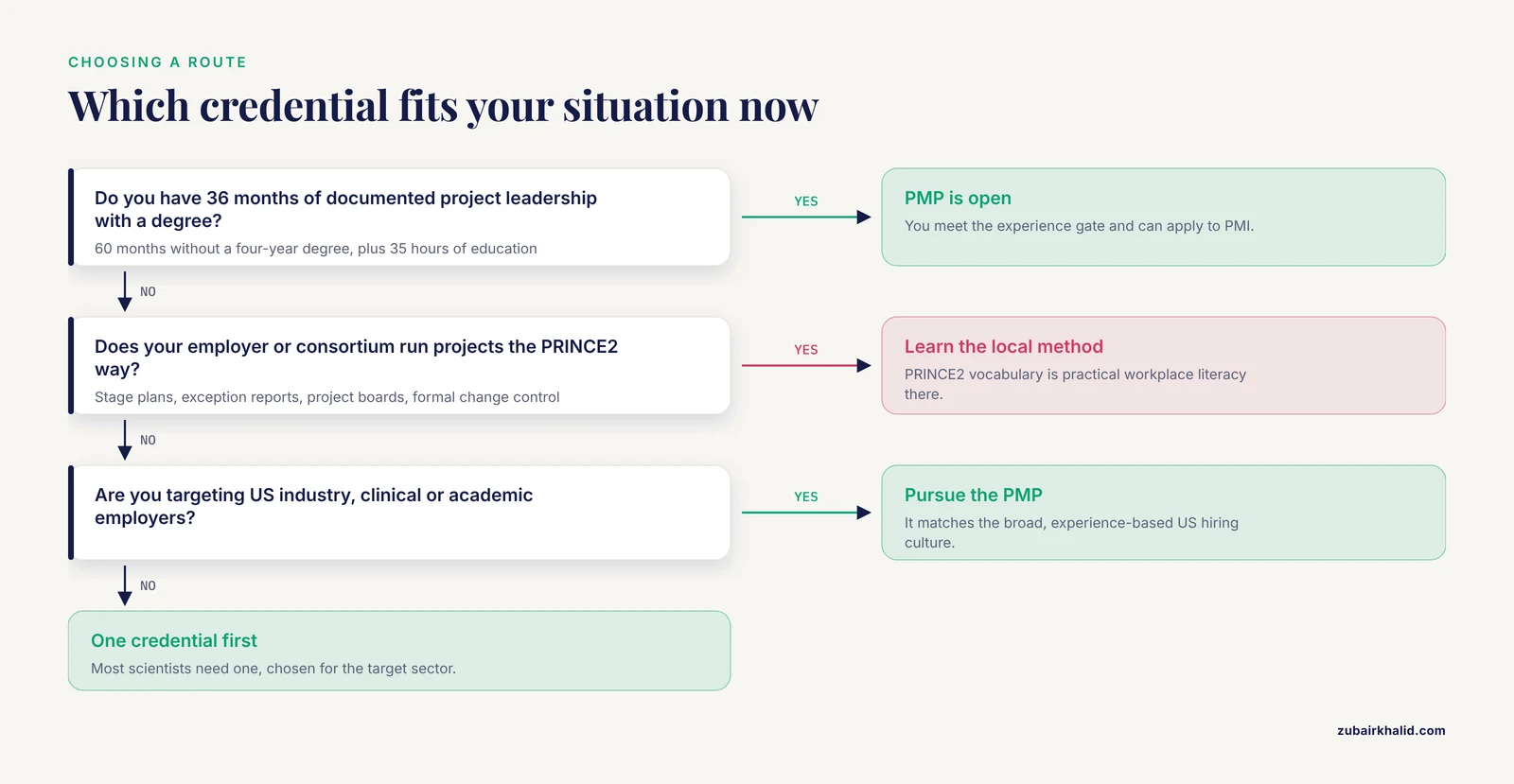
The phrase "when to use PMP" describes two different decisions. The first is when to use PMP-style practices, which is nearly always in research settings. The second is when to pursue the PMP credential, which depends on your situation.
Choose the PMP credential when all or most of the following apply:
- You have already led projects for at least three years in a way you can document, including grants, core facility operations, study coordination, or multi-lab collaborations.
- You are targeting employers in the United States, or global companies with US-style project management offices.
- You want one credential that covers predictive, agile, and hybrid approaches, because your work mixes scheduled milestones with iterative discovery.
- You can commit to the audit process and to ongoing PDU logging.
Choose the PMP as your operating framework, even without the credential, when your project is milestone-driven, has a fixed reporting calendar set by a funder, and needs disciplined scope control. Grant-funded research maps naturally onto PMP practices like work breakdown structures, milestone tracking, and earned-value thinking about budget burn.
Choose PRINCE2 when the following apply:
- Your organization or consortium explicitly uses the method, which is common in European public-sector and EU-funded work.
- You have little or no documented project leadership experience and want an achievable first credential.
- You benefit from prescriptive structure and want a defined process to follow rather than a broad body of knowledge to interpret.
- Your funder requires formal stage gates, business case justification, and change control, which PRINCE2 supplies as built-in features.
How both connect to real research project management
Research projects differ from construction or software projects in ways that matter for credential choice. The end product is knowledge, the timeline is shaped by peer review and ethics approval, and the team often includes collaborators who do not report to the project manager. Both frameworks handle these realities, but differently.
A useful illustration comes from an EU Horizon2020 citizen science project that was forced to rethink its engagement model when pandemic restrictions eliminated face-to-face public interaction. The collaboration responded by converting experiential learning to online formats, creating a multilingual massive open online course on online privacy, adapting an in-person counting event into an online version, and organizing webinars and newsletters run by partners in their local languages [3]. From a project management standpoint, this is a risk response executed under force majeure: the trigger was external, the mitigation involved scope and schedule changes, and the recovery depended on communication plans already in place. A PRINCE2 practitioner would recognize the language of tolerance thresholds, exception planning, and business case review. A PMP holder would recognize risk register management, change control, and stakeholder communication. The project needed both lenses at once, which is the honest answer to the question of whether the frameworks conflict. They do not. They describe the same discipline from different altitudes.
Research project management also carries demands that neither credential emphasizes, such as regulatory compliance, data governance, and reproducibility. Treat the credential as training in delivery discipline, not as a substitute for scientific judgment.
Worked scenarios
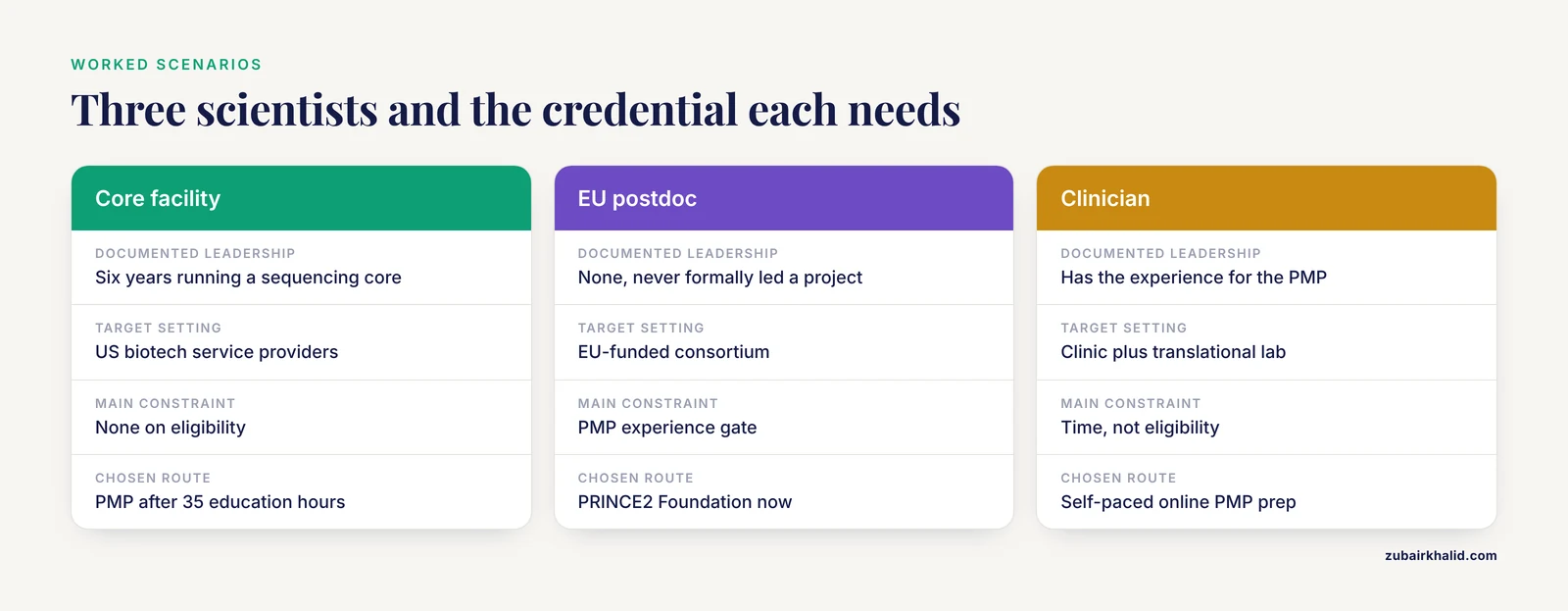
Scenario 1: The core facility manager in the United States
Dr. Raman runs a sequencing core at a US academic medical center. She schedules instrument time, supervises four staff, manages a capital equipment purchase, and coordinates with three departments. She has six years of this work behind her and holds a doctorate. She is applying for director-level roles at biotech service providers, which are US-based companies.
Her situation hits every PMP criterion. She has the documented leadership hours with room to spare, her degree shortens the requirement to 36 months, and her target employers list the PMP in postings. PRINCE2 would add vocabulary but would not match what her job market recognizes. Her plan: complete 35 hours of project management education through a structured course, apply to PMI, prepare for the exam over three to four months of self-study, and schedule the exam before her application window closes.
Scenario 2: The early-career scientist in an EU consortium
Dr. Okafor is a second-year postdoc in a university lab that participates in a multi-country EU-funded consortium. The consortium's coordination office sends templates for stage plans, milestone reports, and deliverable descriptions. She has never formally led a project and has no documented management hours.
The PMP is out of reach for now, and the consortium's working language is closer to PRINCE2 anyway. Her plan: take PRINCE2 Foundation immediately, since no prerequisite blocks her, learn the method's documents because they mirror what the coordination office already requests, and revisit the PMP in five years if her career moves toward independent project leadership. In the meantime, she manages the consortium's public engagement work package, applying stage-based planning so that disruptions, such as the shift to online engagement her consortium peers experienced during the pandemic, can be absorbed without losing the deliverable [3].
Scenario 3: The clinician-investigator balancing two careers
Dr. Lee is a physician-scientist splitting time between a clinic and a translational research lab. She leads a clinical study and contributes to a basic science program. Her institution offered a structured self-paced certificate course internally, and she completed it alongside clinical duties. The feasibility of that format is well documented. A 24-module self-paced online certificate course in fundamental pathology, delivered asynchronously over six months at a major cancer center, was completed by 29 working professionals from across a large medical campus, demonstrating that modular online training fits around full-time scientific and clinical jobs [4].
Her constraint is time, not eligibility. She has the documented experience for the PMP but cannot attend live classes. Her plan: use the same asynchronous, self-paced format that made the pathology course workable, choosing a PMI-recognized online education provider for the 35-hour requirement, then take the PMP exam when her institution's annual professional development window opens. PRINCE2 would serve her only if she later joins a European collaborative program.
A research project plan template that works with either framework
Whichever credential you pursue, the practical output is the same: a plan document that funders, collaborators, and auditors can read. The following research project plan template is deliberately neutral, with notes on where each framework attaches its own terminology.
- Objectives and success criteria. State the aims in measurable terms, mirroring the specific aims page of your grant. PRINCE2 calls this the project product description. PMP practice calls it the scope statement.
- Business case or justification. One page on why the project deserves resources and what happens if it stops. PRINCE2 requires this to be maintained at every stage. Grant writers will recognize it as the significance section paired with the budget justification.
- Work breakdown structure. Decompose the project into work packages: sample collection, assay development, data analysis, manuscript preparation. Each work package gets an owner and a definition of done.
- Schedule with milestones and stage gates. Lay milestones on a timeline and define go/no-go decision points. PRINCE2 formalizes these as stage boundaries. Grant reviewers see them as milestones.
- Roles and responsibilities. Use a responsibility matrix so that every deliverable has one accountable person. PRINCE2's project board structure slots in here for consortium work.
- Budget and effort tracking. Track spending against the award and effort against commitments. Review both at every stage gate, not just at renewal.
- Risk register. List risks with likelihood, impact, owner, and mitigation. Include external triggers such as supply chain failures, facility closures, or public health restrictions, because a pandemic-era citizen science project showed how quickly external events can force a pivot of the entire engagement model [3].
- Change control. Define who can approve a change to scope, timeline, or budget, and require a short written record. This prevents silent scope creep and protects you at renewal.
- Communication plan. Specify what reports go to whom, how often, and in what format. Consortium projects and multi-site studies fail on communication more often than on science.
- Data management and closure criteria. Define what the project delivers at the end, where data and code live, and what documentation closes the record.
Fill this template once at project start, review it at each stage gate, and you have implemented the substance of both frameworks regardless of which certificate, if any, ends up on your wall.
Common Mistakes and Limitations
Booking the PMP exam before confirming eligibility. PMI audits applications. If your documented leadership hours do not hold up, you lose the exam fee and months of timeline. Document your hours first, write them out in a form you could defend, then apply.
Confusing PRINCE2 Foundation with Practitioner. Foundation proves you know the vocabulary. Practitioner proves you can apply the method to a scenario. Listing Foundation as equivalent to Practitioner in an interview will be exposed quickly by anyone who uses the method daily.
Treating the credential as training in experimental design. Neither the PMP nor PRINCE2 teaches hypothesis formulation, statistical power, study design, or regulatory science. They teach delivery discipline. Scientists sometimes expect the certification to make them better researchers and are disappointed. It makes them better at running the project that contains the research.
Assuming one credential is only valid in one country. Both credentials are recognized internationally. The regional patterns described here reflect hiring conventions and sector norms, not legal restrictions. Rejecting PRINCE2 because you live in the United States, or skipping the PMP because you work in Europe, throws away options.
Studying the framework without applying it. Both exams, particularly the PMP and PRINCE2 Practitioner, use scenario questions. Candidates who memorize terms without practicing application to realistic project situations underperform. Apply the framework to your actual research project while you study, which doubles as completing your plan template.
Ignoring maintenance from day one. PDU logging for the PMP and three-year renewal for PRINCE2 Practitioner are easy to defer and painful to recover. Put the maintenance requirement in your calendar the week you pass.
One limitation applies to everything above. Certification requirements, exam formats, and renewal rules change periodically, and individual career situations vary widely, so verify current requirements directly with PMI and PeopleCert before committing time and money.
Frequently Asked Questions
Can I use my dissertation or a grant-funded project as PMP experience?
Yes, if you led the project rather than only executing it. Document the months during which you planned the work, directed its execution, and managed scope, timeline, or budget, and be ready to describe it if audited. Time spent purely doing experiments under someone else's direction does not qualify.
PMP or PRINCE2 for scientists moving into industry in the United States?
The PMP is the stronger default for US industry because it is the credential US job postings list most often and it matches the broad, experience-based hiring culture. Consider PRINCE2 instead if the specific employer uses the method or if you do not yet meet the PMP's experience requirement.
Which certification is faster to obtain?
PRINCE2 Foundation is faster because it has no experience prerequisite and covers a single defined method. The PMP takes longer because of the 36 to 60 month experience requirement plus 35 hours of education, followed by a demanding exam.
Do I need both credentials?
No. Most scientists need one, chosen for their target sector. Both become worthwhile only in specific cases, such as a scientist who works across US and European consortiums, or someone whose employer formally adopts PRINCE2 after they have already earned the PMP.
Does either certification help with writing grant proposals?
Indirectly. Both frameworks train you in objectives, milestones, budget justification, and risk planning, which are the same elements grant reviewers score. Neither replaces the scientific narrative and preliminary data that actually drive funding decisions.
How long should I plan for exam preparation?
Plan for roughly two to four months of consistent self-study for the PMP after completing the 35 education hours, and one to two months for PRINCE2 Foundation. Scenario-based exams, including PRINCE2 Practitioner, reward practice with realistic project situations over pure memorization.
Sources
- Clinician-Investigator Training and the Need to Pilot New Approaches to Recruiting and Retaining This Workforce.
- Methodologic Quality of Guidelines for Training or Competence Processes for Basic Point-of-Care Echocardiography in Critical Care: A Systematic Review of the Literature.
- Force majeure impact on citizen science: Perspective from an EU funded project.
- Enhancing Pathology Knowledge for Biomedical Scientists: Pilot Cohort Study of a Comprehensive Self-Paced Tutorial for Bridging Fundamental Concepts With Translational Applications.