How to Get PMP Certified as a Scientist
By Dr. Zubair Khalid, DVM, MS, PhD ·

By the end of this guide you will be able to do four things: confirm that your research experience qualifies you to sit for the Project Management Professional (PMP) exam, complete the required 35 contact hours of project management education, submit a clean application to the Project Management Institute (PMI) that survives an audit, and build a study plan weighted to the actual exam content. You will also leave with a reusable research project plan template you can apply to your own studies, which makes both your application and your exam preparation stronger.
Have the following on hand before you start: a current resume or biosketch, a list of the research projects you contributed to with start and end dates, a copy of your highest degree or transcript, access to the PMI website for the current Project Management Professional (PMP) Handbook, and a spreadsheet or notebook for tracking study hours. The PMP is administered by PMI, the professional body that owns the credential, so every requirement below traces back to PMI's published eligibility rules and exam content outline.
Why PMP Certification Fits Research Careers
Scientists run projects. A grant-funded study has a defined scope, a budget period, milestones, deliverables, a funder as a stakeholder, and risks that can derail the whole timeline. What most scientists lack is a shared vocabulary and formal framework for that work, and the workforce literature makes the gap visible. Reviews of clinician-investigator training identify leadership development after training as a recurring unmet need for physician-scientists, alongside competition for research funding and the challenge of balancing dual obligations [1]. The same structural problem applies to PhD-track researchers: the science is taught, the management is absorbed by trial and error.
The PMP credential addresses that gap with a portable, exam-verified standard. For a scientist, the payoff shows up in three places. First, inside the lab, because formal research project management reduces the missed milestones and unmanaged risks that quietly burn grant years. Second, on a resume, because hiring managers in biotech, pharma, clinical research organizations, and core facilities recognize the credential immediately. Third, in career flexibility, because the PMP is role-neutral, so it follows you from the bench into program management, clinical operations, or grants administration.
A realistic caveat: the PMP verifies management process knowledge, not scientific judgment. It complements your domain expertise rather than replacing it. With that framing set, here is the working process.
What PMI Requires Before You Apply
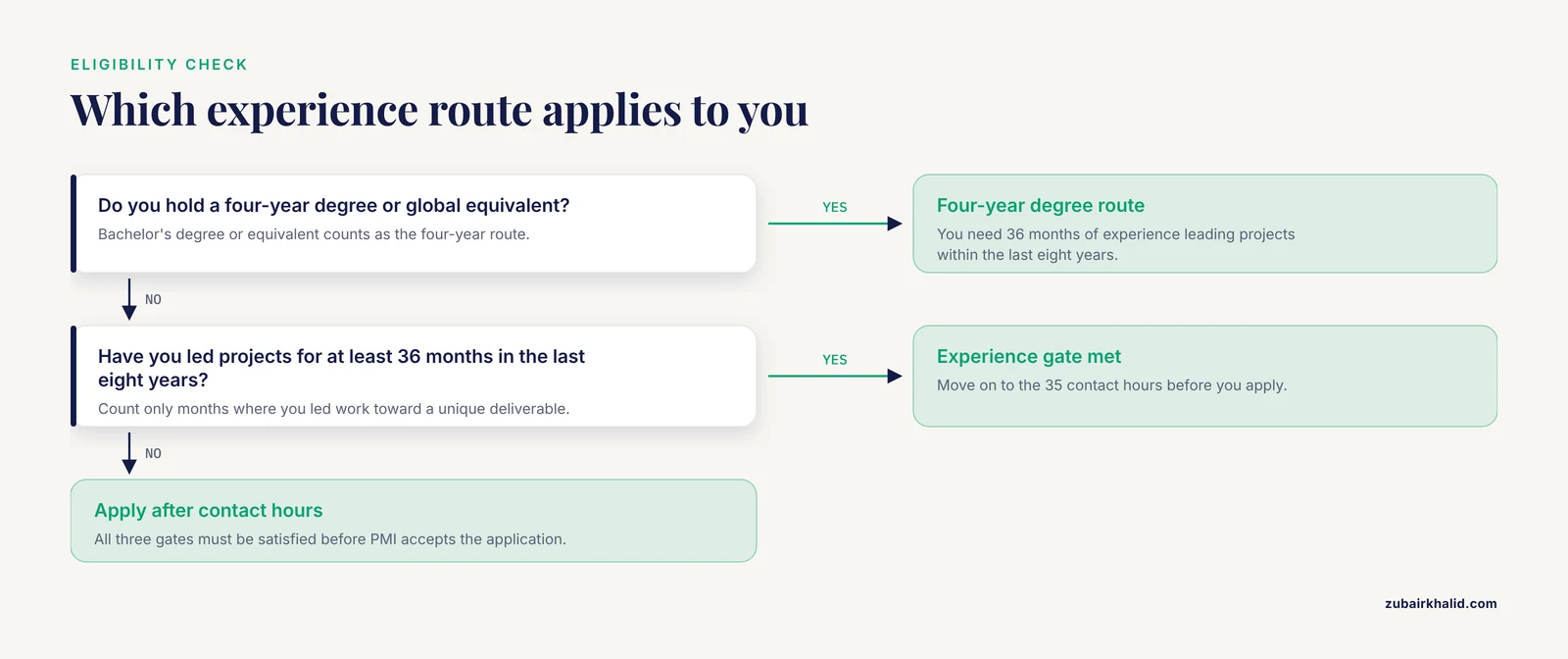
PMI sets three eligibility gates. All three must be satisfied before your application is accepted.
- Education. A four-year degree (bachelor's or global equivalent), or a secondary degree (high school diploma or associate degree) if you follow the longer experience route.
- Project experience. With a four-year degree, a minimum of 36 months of experience leading projects. With a secondary degree, a minimum of 60 months. Experience must have been gained within the last eight years.
- Project management education. 35 contact hours of project management instruction, completed before you apply. A CAPM (Certified Associate in Project Management) certification in good standing can substitute for the 35 hours.
Two definitions matter here. A project, in PMI's usage, is temporary work with a defined beginning and end that produces a unique result, so running a three-year study to answer a specific research question qualifies, while ongoing routine duties such as general lab maintenance do not. A contact hour is one hour of instruction in project management content, and it must come from a training provider, a university course, a PMI chapter course, or an employer-sponsored program, not from reading on your own.
PMI audits a percentage of applications. If you are audited, you must supply documentation such as degree transcripts and contact information for supervisors who can verify your project experience. Building your application so it passes an audit cleanly is the single best habit in this whole process.
Step-by-Step: How to Get PMP Certified as a Scientist
Step 1. Inventory Your Research Experience and Check Eligibility
List every research effort where you led work toward a specific outcome. For most scientists, strong candidates include a dissertation project, a multi-year funded study, an instrument or assay validation campaign, a multi-site collaboration you coordinated, or a core facility buildout. Coursework, rotations with no deliverable, and routine lab upkeep do not count. PMI measures experience in months of project leadership, not total hours, and you cannot count the same calendar months twice for overlapping projects.
Run the arithmetic with a script rather than by hand, because overlapping dates cause most eligibility errors. This Python snippet converts your project dates into eligible months:
from datetime import date

projects = [
    {"name": "Longitudinal [cohort study](/blog/guides/cohort-studies-a-practical-guide-to-design-conduct-and-interpretation)", "start": date(2021, 3, 1), "end": date(2023, 6, 30)},
    {"name": "Assay validation project", "start": date(2023, 7, 1), "end": date(2024, 12, 31)},
]

def months_between(start, end):
    return (end.year - start.year) * 12 + (end.month - start.month) + 1

total = 0
for p in projects:
    m = months_between(p["start"], p["end"])
    print(f'{p["name"]}: {m} months')
    total += m

print(f'Total eligible months: {total}')
print('Meets 36-month route (four-year degree):', total >= 36)
print('Meets 60-month route (secondary degree):', total >= 60)
Expected output for the two non-overlapping projects above:
Longitudinal cohort study: 28 months
Assay validation project: 18 months
Total eligible months: 46
Meets 36-month route (four-year degree): True
Meets 60-month route (secondary degree): False
If your projects overlap, count the overlapping calendar window only once and describe each project's distinct leadership role in the application narrative instead. A PhD dissertation counts as one project even if it spanned five years, and the months you spent on coursework or coursework-only years do not count.
Step 2. Complete the 35 Contact Hours
Choose a provider and complete the education requirement. You have three practical routes: a PMI Authorized Training Partner, a university or community college project management course, or a self-paced online course that issues a completion certificate stating 35 contact hours.
Quality varies enormously between providers, so evaluate them the way you would evaluate any training program. Formal appraisal work in medical education shows why this matters. A systematic review of 24 training guidelines for basic critical care echocardiography found that very few made clear recommendations on core elements such as introductory course physics, instrumentation, image acquisition theory, or curriculum content, and the review used a structured critical appraisal tool (AGREE-II) to score guideline quality [2]. Translate that lesson directly: before paying for a 35-hour course, check that the syllabus explicitly covers the exam domains, states the contact-hour count, and describes how content maps to the current PMP Exam Content Outline. A provider that cannot show that mapping is a poor bet.
Structured, modular, self-paced formats work well for scientists, who are used to asynchronous learning around bench schedules. A useful model comes from a pathology training course piloted at MD Anderson, which delivered 24 instructional modules over six months in an asynchronous online format to 29 participants and organized each module around explicit educational objectives [3]. When comparing providers, favor that architecture: modular lessons, stated objectives per module, and a certificate issued on completion.
Step 3. Submit the Application and Prepare for Audit
Create an account on the PMI website, start the PMP application, and fill in each project with dates, your role, hours you personally spent leading each phase, and a short narrative of what you directed. Write narratives that a supervisor could verify from records: what the project's objective was, what decisions you owned, and what the deliverable was. Then, in case you are selected for audit, contact the references you listed before submitting. An audited applicant who has already confirmed supervisor contacts resolves the audit in days, while one who listed a retired PI without warning can lose weeks.
Step 4. Build a Weighted Study Plan
Once approved, you have a fixed eligibility window to schedule and take the exam, so build the study calendar immediately. The PMP exam contains 150 scored questions delivered in 230 minutes, and questions are distributed across three domains defined in the current exam content outline.
| Domain | What it covers | Weight on the exam |
|---|---|---|
| People | Leading teams, managing stakeholders, supporting team performance, resolving conflict | 42% |
| Process | Scheduling, budget, scope, risk, quality, procurement, change control, Agile and hybrid delivery | 50% |
| Business Environment | Compliance, project benefits and value, organizational change support | 8% |
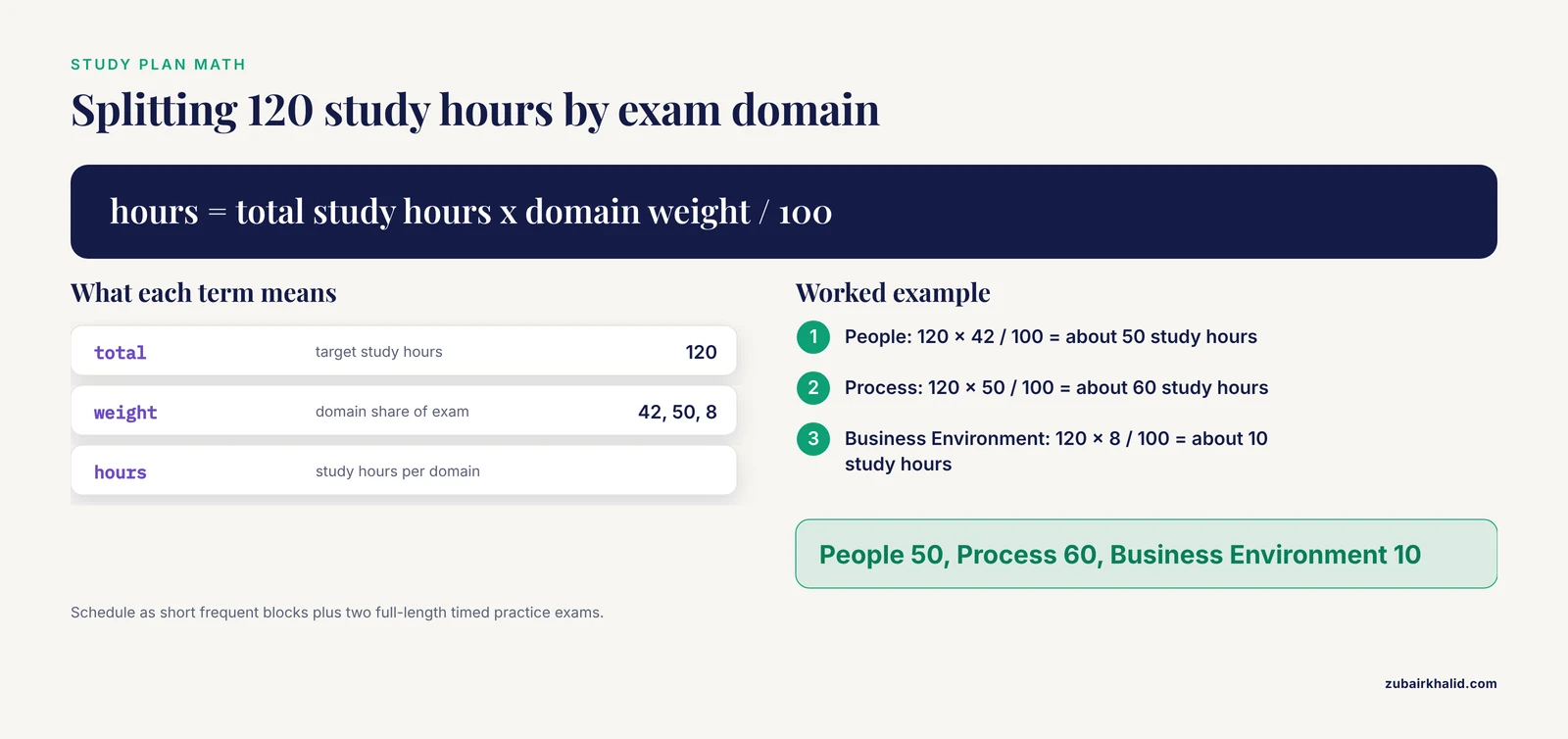
Weight your study hours to match. For a target of 120 total study hours, the allocation works out as follows:
exam_domains = {"People": 42, "Process": 50, "Business Environment": 8}
total_study_hours = 120

for domain, weight in exam_domains.items():
    hours = total_study_hours * weight / 100
    print(f"{domain}: {weight}% of the exam, about {hours:.0f} study hours")
Expected output:
People: 42% of the exam, about 50 study hours
Process: 50% of the exam, about 60 study hours
Business Environment: 8% of the exam, about 10 study hours
Schedule those hours as short, frequent blocks, because bench scientists lose long uninterrupted study days to experiment timing. Two 45-minute blocks on reading days plus one longer weekend block is a durable pattern. Do at least two full-length timed practice exams under exam conditions before your test date.
Step 5. Take the Exam
You can test at a Pearson VUE center or through an online proctored session. Arrive with a government-issued ID matching your PMI account exactly. During the exam, manage the clock by domain question count: with 150 scored questions in 230 minutes, you average just over 90 seconds per question, so flag long scenario questions and return to them rather than burning seven minutes on one situational judgment item. Most questions present a scenario and ask you to pick the best next action, and the exam rewards process discipline over intuition.
Step 6. Maintain the Credential
The PMP is not a one-time certificate. You must earn 60 Professional Development Units (PDUs, PMI's continuing education credit) over each three-year certification cycle, split across education and giving-back categories per the PMI Continuing Certification Requirements program. Mark the renewal deadline on your calendar the day you pass, because the easiest PDUs to earn are the ones accumulated gradually through webinars and chapter meetings rather than crammed in month 34.
A Research Project Plan Template You Can Reuse
The exam assumes you have lived the process, and the cheapest way to gain that lived experience is to manage your next study like a formal project. The template below is a compact research project plan template in YAML, the same structure you can paste into any project repository or grant workspace. Filling it out for a real study exercises the People, Process, and Business Environment domains simultaneously, and it gives you concrete language for your application narratives.
project_name: "Dose-response screen for candidate compound CK2i-3"
objective: "Determine IC50 shift under hypoxia versus normoxia across three cell lines"
sponsor: "Internal seed fund"
start: 2025-09-01
end: 2026-05-31
milestones:
  - name: "Assay optimization"
    due: 2025-11-15
    deliverable: "Z-prime factor above 0.5 on the 96-well protocol"
  - name: "Full dose-response runs"
    due: 2026-02-28
    deliverable: "Curated dataset with replicate-level QC flags"
  - name: "Manuscript draft"
    due: 2026-05-15
    deliverable: "Submission-ready draft for the target journal"
risks:
  - description: "Primary antibody lot fails validation mid-study"
    likelihood: medium
    impact: high
    response: "Validate an alternate lot during milestone 1 and keep a confirmed backup aliquot at -20 C"
  - description: "Hypoxia chamber downtime"
    likelihood: low
    impact: high
    response: "Written contingency agreement with the neighboring core for chamber access"
stakeholders:
  - role: "Principal investigator"
    engagement: "Approves milestone gates, weekly 30-minute check-in"
  - role: "Funding program officer"
    engagement: "Quarterly progress report and annual renewal package"
  - role: "Facility manager"
    engagement: "Biweekly scheduling sync for shared instrument time"
assumptions:
  - "Cell line authentication completes before milestone 1"
  - "Reagent lead times stay under three weeks"
change_control: "Any scope change exceeding one week of effort requires PI sign-off recorded in the project log"
Every element maps to an exam domain. Milestones and risks are Process work. Stakeholder engagement and change control are People work. The sponsor, objective, and benefits statement are Business Environment work. When you later write your application, each filled-out template becomes verifiable documentation of months spent leading a project.
Using Project Management Inside the Lab
The payoff of this credential arrives before the exam passes, because the framework changes how you run research immediately. Three applications deserve attention.
Stakeholder management replaces informal relationship management. Research projects accumulate stakeholders quietly: the PI, co-investigators, the funder, the biostatistician, the animal facility, the IRB. Writing them into a stakeholder register with defined engagement cadences converts vague expectations into scheduled communication, which is exactly what the People domain tests.
Risk registers prevent predictable disasters. A documented risk register with likelihood, impact, and a planned response for each entry is standard PMI practice, and research provides vivid proof of why. An EU Horizon2020-funded citizen science project described how a once-in-a-century pandemic force majeure eliminated face-to-face public engagement, and how the team mitigated the loss by building an interactive multilingual five-step online learning resource, adapting an in-person counting event to an online format, and running local-language webinars and newsletters to keep public participation alive [4]. That is a textbook risk response plan executed under real pressure: the risk (loss of in-person engagement) was identified, its impact was high, and pre-planned alternative channels preserved the project's objectives. A risk register you update monthly does the same job for reagent supply failures, personnel loss, or equipment downtime.
Change control protects grant timelines. The YAML template's change_control line is the mechanism most labs lack. When a collaborator asks to add an arm to your study in month nine, a written change process forces the conversation about scope, timeline, and budget impact before the commitment is made.
Common Mistakes and Limitations
The most frequent failure points in PMP certification for scientists, and how to avoid each one.
- Counting routine work as project experience. General lab maintenance, recurring duties, and coursework without a unique deliverable do not satisfy PMI's definition of a project. If the work has no defined endpoint and no unique result, leave it off the application.
- Double-counting overlapping projects. If your dissertation and a side collaboration ran in the same calendar months, you can only count those months once. Audits catch this. Use the date-overlap logic from the script in Step 1 and keep non-overlapping spans distinct.
- Choosing a cheap contact-hour provider without scrutiny. The training market is full of low-quality offerings. Apply the same appraisal discipline the AGREE-II review applied to clinical training guidelines, checking for explicit curriculum detail and objective-by-objective structure before paying [2].
- Vague application narratives. "Assisted with experiments" fails an audit. "Led the assay validation campaign, owned the QC decision, delivered the validated protocol used for all subsequent runs" passes. Write narratives with verbs of leadership, not verbs of participation.
- Studying content out of proportion to the exam. Scientists often over-invest in schedule math and under-invest in the People domain, which carries 42% of the exam. Weight your hours to the published domain distribution, as the Step 4 calculation shows.
- Skipping timed practice exams. The 230-minute, 150-question format punishes slow readers. Untimed practice produces false confidence.
- Letting the eligibility window lapse. Once your application is approved, the clock to schedule and pass runs on PMI's fixed timeline. Book your exam date within a week of approval, even if it is two months out.
- Treating the PMP as scientific training. The credential validates management process, not experimental design or domain knowledge. Individual research decisions still require your own scientific judgment and, in clinical and animal work, the relevant institutional and veterinary oversight. Check PMI's current handbook before each application step, because eligibility details are updated periodically.
Frequently Asked Questions
Is the PMP worth it for a scientist?
Yes, if your career direction involves leading projects, programs, or teams rather than only doing experiments at the bench. It carries the most weight in industry settings such as biotech, pharma, clinical operations, and core facility management, where hiring managers screen for the credential directly.
Do I need to have managed people to qualify?
No. PMI requires experience leading projects, not supervising staff. Directing the scientific and logistical course of a study, making scope and quality decisions, and owning deliverables qualifies even if you never had direct reports.
What counts as project experience in research?
Temporary work with a defined start, end, and unique deliverable where you led the effort, such as a funded study, a dissertation project, an instrument validation, or a collaboration you coordinated. Routine lab operations and coursework do not count.
Can I count my PhD work toward the experience requirement?
Yes, the dissertation itself counts as one project for the calendar months you led it. Years consumed by coursework, rotations without deliverables, or qualifying exams do not count, and months cannot be double-counted across overlapping projects.
How long does the whole process take?
Plan on two to six months total, depending on how quickly you complete the 35 contact hours and how prepared you are for the exam. The experience requirement is already met by most mid-career scientists, so the variable parts are the coursework, the application and any audit, and the study period.
What is the PMP exam like?
It is 150 scored questions in 230 minutes, mostly scenario-based questions asking for the best next action, distributed across the People, Process, and Business Environment domains. You can take it at a test center or via online proctoring.
How do I keep the certification after I pass?
Earn 60 Professional Development Units every three years under PMI's continuing certification program and pay the renewal fee. PDUs come from education activities such as courses and webinars and from giving-back activities such as volunteering and creating content.
Is PMP the best credential, or should I consider alternatives?
The PMP is the strongest general-purpose credential for experienced project leaders. The CAPM suits scientists who lack the required months of experience yet, and agile-focused or industry-specific credentials fit roles centered purely on software or clinical trial management. Match the credential to the role you want, not the other way around.
Sources
- Clinician-Investigator Training and the Need to Pilot New Approaches to Recruiting and Retaining This Workforce.
- Methodologic Quality of Guidelines for Training or Competence Processes for Basic Point-of-Care Echocardiography in Critical Care: A Systematic Review of the Literature.
- Enhancing Pathology Knowledge for Biomedical Scientists: Pilot Cohort Study of a Comprehensive Self-Paced Tutorial for Bridging Fundamental Concepts With Translational Applications.
- Force majeure impact on citizen science: Perspective from an EU funded project.