How to Write Plain Language Consent Forms
By Dr. Zubair Khalid, DVM, MS, PhD ·

By the end of this guide you will be able to do four things. You will draft a consent form that a person with no research background can actually understand. You will measure its reading level with free tools and a hand calculation you can check by hand. You will revise the form using structure, design, and testing methods that have published evidence behind them. And you will document the whole process so your ethics committee can see that comprehension, not just compliance, was your goal.
Have these on hand before you start:
- Your study protocol or a draft consent form
- Your institution's consent template or checklist, since most universities and clinical trial units require their own structure
- Python 3 with the free textstat library, or any free readability checker such as the Hemingway Editor web app
- Two or three colleagues, and ideally a few people from your target participant population, who can read a draft and tell you what they understood
Why Plain Language in Consent Forms Matters
Informed consent is a communication process between the researcher and the participant, not a signature at the bottom of a page. It comes from the participant's right to direct what happens to their body and from the researcher's ethical duty to involve them in decisions. The most important goal is that the participant has the chance to be an informed participant in decisions about themselves [1].
Regulatory frameworks such as Good Clinical Practice and the Declaration of Helsinki place informed consent at the center of participant autonomy in clinical trials. Yet reviews of current ethical standards keep finding the same gap. True comprehension across diverse populations remains difficult, especially when interventions are complex or consent moves onto digital tools [2].
The evidence that forms are too hard to read is consistent. In an analysis of consent forms posted on ClinicalTrials.gov for ketamine trials in mental health conditions, the forms ran from 1,681 to 8,637 words, with a mean of 5,031 words. Estimated silent reading time ranged from 7.0 to 36.0 minutes, with a mean of 21.4 minutes. Standard readability indices showed reading levels well above what most adults find comfortable [3]. In a separate audit of 50 consent forms against legal content requirements, 70 percent deviated from what the law required, and the authors identified the elements most often left out [4].
Consent quality is a research ethics problem and a methodological one at the same time. When consent materials are hard to understand, people may self-select out of studies during recruitment in ways researchers cannot see, which hurts representation. A co-designed form for ethnically diverse communities was perceived as easier to understand and more supportive of participation decisions, and the authors argue that consent accessibility is both an ethical and a methodological consideration [5].
There is also a gap between fields. An examination of the top 40 journals each in anthropology, business, and education found that only 8 percent of those 120 journals required ethical review for all studies with human participants, and only 26 percent required informed consent for all such studies. Consent norms that are routine in medical research are still becoming established in the social and behavioral sciences [6]. If you are training in the life sciences and plan to work across fields, treating consent quality as part of responsible conduct of research, rather than a clinical-trial-only concern, will serve you well.
Key Terms Defined
Before the walkthrough, four terms you will see throughout.
Informed consent is the process by which a person learns what a study involves and agrees to take part voluntarily. The form documents this process, but the process itself comes first.
The consent form (often called the ICF, or informed consent form) is the written document. In many jurisdictions a participant information sheet describes the study and a shorter consent form captures the agreements. Some institutions combine both into one document called a PICF, or participant information and consent form [5].
Readability refers to how easily a reader can process written text. Readability formulas estimate this from sentence length and word length, producing a score such as a US school grade level.
Teach-back is a comprehension check in which the reader explains the study back in their own words. It is the most direct way to find out whether a form actually works, and it appears as one of the key application domains for modern consent tools [7].
Step by Step: Writing a Plain Language Consent Form
Step 1. List the required content before you write anything
Collect your institution's checklist and list every element your ethics committee requires. The standard set includes who the researchers are, the purpose of the study, what participants will do and for how long, foreseeable risks, expected benefits, reasonable alternatives, how confidentiality is protected, compensation or treatment for injury, whom to contact with questions, a statement that participation is voluntary, and the right to withdraw at any time.
A content audit of 50 consent forms found that 70 percent missed required elements, and the most commonly overlooked items were exactly the kind participants need to make decisions [4]. Working from a checklist before drafting prevents this. Some of the most frequently skipped elements involve what happens to participants, such as what care they receive if harmed, and how their data will be handled.
If your study uses apps, wearables, or sensors, add technology-specific elements. A review of 25 consent forms from real digital health studies, checked against a framework built from national research ethics guidance with 63 attributes and 93 subattributes, found that none of the forms fully covered the required or recommended ethical elements. The best form reached only 73.5 percent completeness on required attributes, and the gaps clustered around technology-specific risks. The review also identified elements missing from guidance itself, including commercial profit sharing, study information disclosure, and sharing results during the study [8]. Write these into your checklist if your study touches digital data.
Step 2. Draft each element in plain language
Write in the second person, in the active voice, with sentences of roughly 15 to 20 words. Define every technical term the first time it appears. Use concrete comparisons instead of abstract procedures. Here is the kind of rewrite that makes a measurable difference.
Jargon version: "Participants will be randomized to receive either the investigational product or placebo in a 1:1 allocation."
Plain version: "If you join, a computer will randomly place you in one of two groups, like flipping a coin. Half the group gets the study drug. Half gets a placebo, a pill with no medicine in it."
Common swaps worth memorizing:
| Instead of | Write |
|---|---|
| Randomization | "A computer will assign you to a group by chance, like flipping a coin" |
| Placebo | "A pill (or injection) with no medicine in it" |
| Adverse event | "A side effect or any harm" |
| Phlebotomy | "A blood draw" |
| Longitudinal follow-up | "We will check in with you every six months for two years" |
| De-identified data | "Your name will be replaced with a code before anyone analyzes the data" |
| Withdraw from the study | "You can stop taking part at any time, and you do not have to give a reason" |
Patients themselves describe what they want from plain language information. In interviews with people living with multiple sclerosis, participants described information needs that change across their disease journey, along with specific motivators and deterrents for seeking that information. They evaluated plain language materials for whether they supported decision making, not just whether the words were simple [9]. The practical lesson is that plain language is not simplification for its own sake. Every section should answer a question the participant is actually asking, such as "What will happen to me?" or "What happens to my data?"
Step 3. Measure readability with a free tool
Two formulas cover most needs.
Flesch Reading Ease scores text from 0 to 100, where higher is easier. Scores around 60 to 70 are traditionally called plain English.
Flesch-Kincaid Grade Level converts similar inputs into a US school grade. A score of 8.0 means an average eighth grader should manage the text. Many ethics committees expect consent forms at or below roughly an eighth-grade reading level, and the ketamine trial audit cited above found forms far above any such level [3].
The formulas:
Flesch Reading Ease = 206.835 - 1.015 x (words per sentence) - 84.6 x (syllables per word)

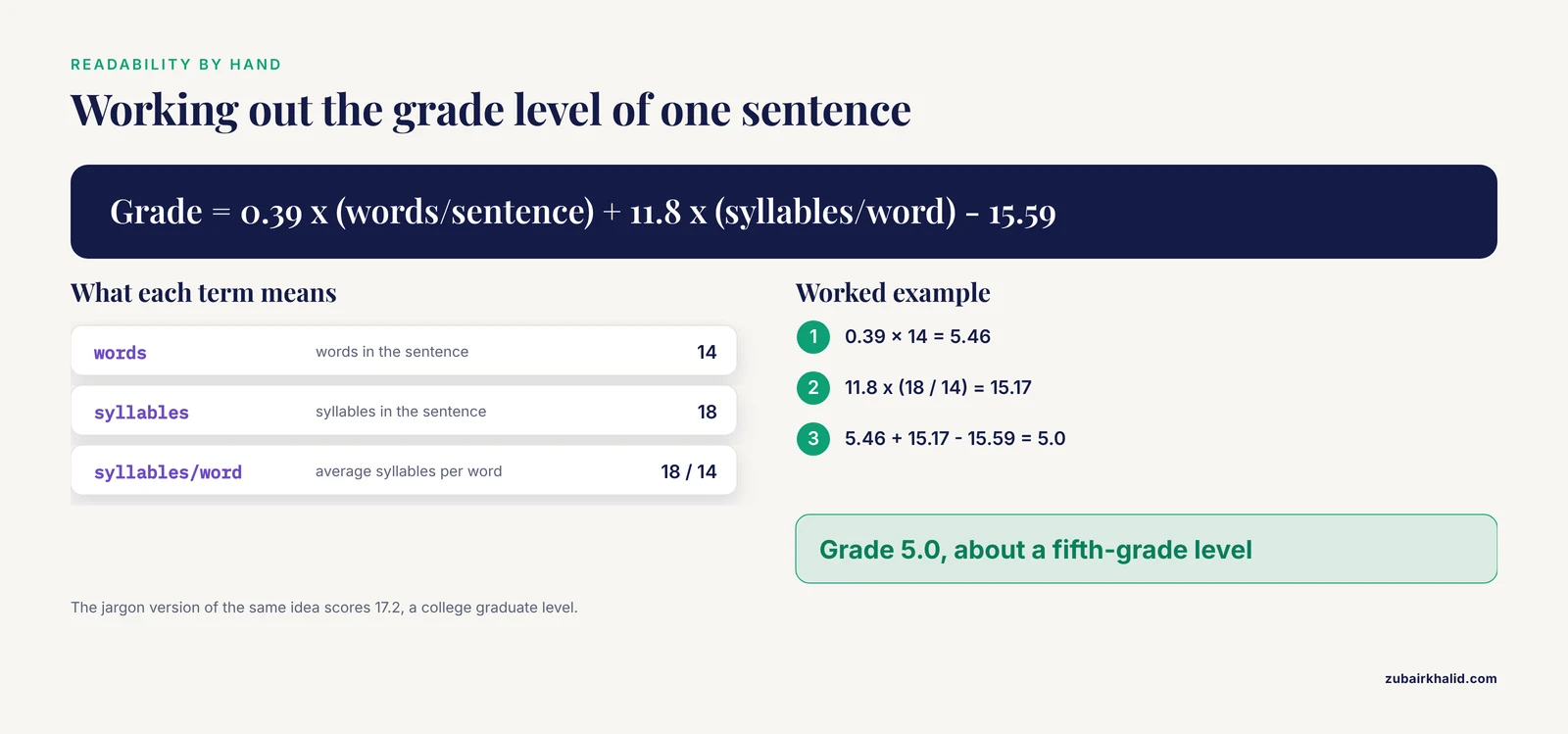
Flesch-Kincaid Grade = 0.39 x (words per sentence) + 11.8 x (syllables per word) - 15.59
Here is the hand calculation for the plain sentence from Step 2, "If you join, a computer will randomly place you in one of two groups." It has 14 words and 18 syllables in one sentence.
Flesch-Kincaid Grade = 0.39 x 14 + 11.8 x (18 / 14) - 15.59
                     = 5.46 + 15.17 - 15.59
                     = 5.0   (about a fifth-grade level)

Flesch Reading Ease  = 206.835 - 1.015 x 14 - 84.6 x (18 / 14)
                     = 206.835 - 14.21 - 108.77
                     = 83.9  (easy)
Now the jargon version, "Participants will be randomized to receive either the investigational product or placebo in a 1:1 allocation." It has 16 words and about 36 syllables when read aloud.
Flesch-Kincaid Grade = 0.39 x 16 + 11.8 x (36 / 16) - 15.59
                     = 6.24 + 26.55 - 15.59
                     = 17.2  (college graduate level)

Flesch Reading Ease  = 206.835 - 1.015 x 16 - 84.6 x (36 / 16)
                     = 0.2  (very difficult)
One sentence swap moved the grade level from fifth grade to graduate school. That is the size of the lever you are working with.
To check a whole draft, install the free textstat library and run this script.
import textstat

with open("consent_draft.txt") as f:
    text = f.read()

words = len(text.split())
print("Words:", words)
print("Reading time at 200 words per minute:", round(words / 200, 1), "minutes")
print("Flesch-Kincaid grade:", textstat.flesch_kincaid_grade(text))
print("Flesch reading ease:", textstat.flesch_reading_ease(text))
Expected output for a typical early draft:
Words: 3200
Reading time at 200 words per minute: 16.0 minutes
Flesch-Kincaid grade: 11.4
Flesch reading ease: 41.0
Install the library first if you need to:
pip install textstatReading time at 200 words per minute is a common silent-reading estimate. The ketamine audit used established indices including Flesch-Kincaid, the Gunning Fog Index, the Flesch Reading Ease Score, and the Fry Readability Graph, plus document length and estimated silent reading time [3]. Using at least two formulas gives you a more stable picture than either alone.
Step 4. Fix what the numbers flag
High grade levels almost always trace back to three causes: long sentences, long words, and passive voice. Split any sentence over about 20 words. Replace nominalizations with verbs, so "administration of the intervention" becomes "we will give you the treatment." Convert "participants will be monitored" to "we will watch for side effects."
Understand what the formulas cannot do. They count sentence and word length, not meaning. A form can score well and still be misleading if it buries a risk in a happy paragraph. Treat the score as a screening tool that tells you where to look, and use the comprehension test in Step 6 as the real check.
Step 5. Improve structure and design
How a form looks affects how well it works, not just how it feels. In a between-subjects experiment with six versions of an online consent form, varying interactivity, readability, and visual formatting, interactive formats significantly improved both comprehension and perceived readability. The study also found that individual differences such as self-efficacy and trust in science influenced how well any given version worked.
Practical moves that follow from this evidence:
- Use descriptive headings that match the participant's questions ("What will happen to me?" rather than "Study procedures")
- Break paragraphs into three or four sentences at most
- Put bullets and white space around risks and rights
- Add simple visuals where they clarify a procedure or a timeline
- For online consent, add interactive elements such as clickable sections, knowledge checks, or progress indicators
Step 6. Test with real people, then revise
Run a teach-back session. Give someone the draft, wait while they read it, then ask them to tell you in their own words what the study involves, what the main risks are, and what happens to their data. Note every point they get wrong or skip. Revise those sections. Repeat.
Go further when you can. A participant information and consent form redesigned together with a consumer advisory group and researchers, then piloted in community workshops, was perceived by participants and facilitators as easier to understand and more supportive of engagement with the consent process [5]. In dementia research, public involvement activities with people with lived experience and their carers surfaced concerns that went beyond understandability, including respect and autonomy, and kept the values and interests of participants central throughout the process [11]. Co-design takes more time than a desk edit, but it catches problems no formula can see.
Step 7. Document the process
Keep your checklist, each draft, the readability scores, and notes from your teach-back sessions. Submit them with your ethics application. This is the responsible conduct of research part of the job. It shows reviewers that consent comprehension was tested, not assumed, and it gives you a baseline to improve on for your next study.
Using AI Tools Carefully
Large language models, the technology behind tools like ChatGPT and Gemini, can now help with consent materials across several documented domains: generating glossaries, producing plain language revisions, creating visual aids, improving accessibility and formatting, translating into other languages, supporting teach-back and comprehension validation, and powering interactive chat-based consent [7].
The evidence on quality, however, says treat AI output as a first draft. In a cross-tool evaluation, five generative AI tools each drafted informed consent documents across six simulated research scenarios, producing 30 documents assessed by three blinded trained assessors on a 4-point rubric. Mean ethical robustness scores ranged from 2.8 to 3.1 and completeness from 2.3 to 2.7, indicating moderate adequacy. Readability was assessed with the Flesch-Kincaid Grade Level index, and agreement between assessors was measured with Fleiss' Kappa. No tool reliably produced forms that were complete and ethically robust on their own [12].
A sensible workflow is to let an AI tool produce a structural skeleton or rewrite a paragraph you have already fact-checked, then verify every factual claim yourself, run the readability screen, and take the result through teach-back testing and ethics review. The AI does the typing. You remain responsible for the accuracy and the ethics.
Special Situations
Online and electronic consent
Electronic consent raises its own regulatory questions about protecting participant rights, data protection, and confidentiality, and it suits some trial types better than others [13]. If you move consent online, the design evidence still applies. Interactive formats improved comprehension in the experimental work described above [10], so a static PDF of your paper form is usually the weakest option, not the safest one.
Decentralized trials
Decentralized clinical trials, where participants take part from home with digital tools, change four elements of the consent procedure. Informing participants and testing their understanding works differently without a face-to-face conversation. Freedoms and burdens shift, because the technology itself adds responsibilities. Trust between researcher and participant has to be built remotely. And privacy takes on broader impacts, because technologies shape behavior and social relations in ways existing regulatory frameworks do not immediately address [14]. If your study is decentralized, write a consent section on what the technology itself asks of participants, not just the study procedures.
Data reuse and genomics
When data may be reused for future studies, tiered consent gives participants choices, for example whether to allow reuse only for this disease area, any health research, or any research. Dynamic consent platforms maintain ongoing online engagement so participants can revisit those choices over time. Work on the ethical reuse of African genomic data emphasizes that consent processes must be transparent and built through open dialogue among all stakeholders, both to protect participants and to develop best practice from a shared knowledge base [15]. In plain language terms, a tiered form needs each tier explained as a concrete choice with consequences, not as a legal option list.
Participants who may face capacity questions
Research with adults with intellectual disability shows what respectful consent design looks like when capacity varies. A systematic review of US social-behavioral research identified themes around guiding principles, strategies to enhance informed and voluntary consent, approaches to consent capacity, and supporting both one-time and ongoing decisions. The manuscripts largely reflected disability rights principles: promoting the right to be included and to make one's own decisions based on relevant information, risks, and benefits [16]. In dementia research, people with lived experience emphasized both understandability and respect for autonomy, with fluctuating capacity handled through ongoing involvement rather than a single signature event [11].
Common Mistakes and Limitations
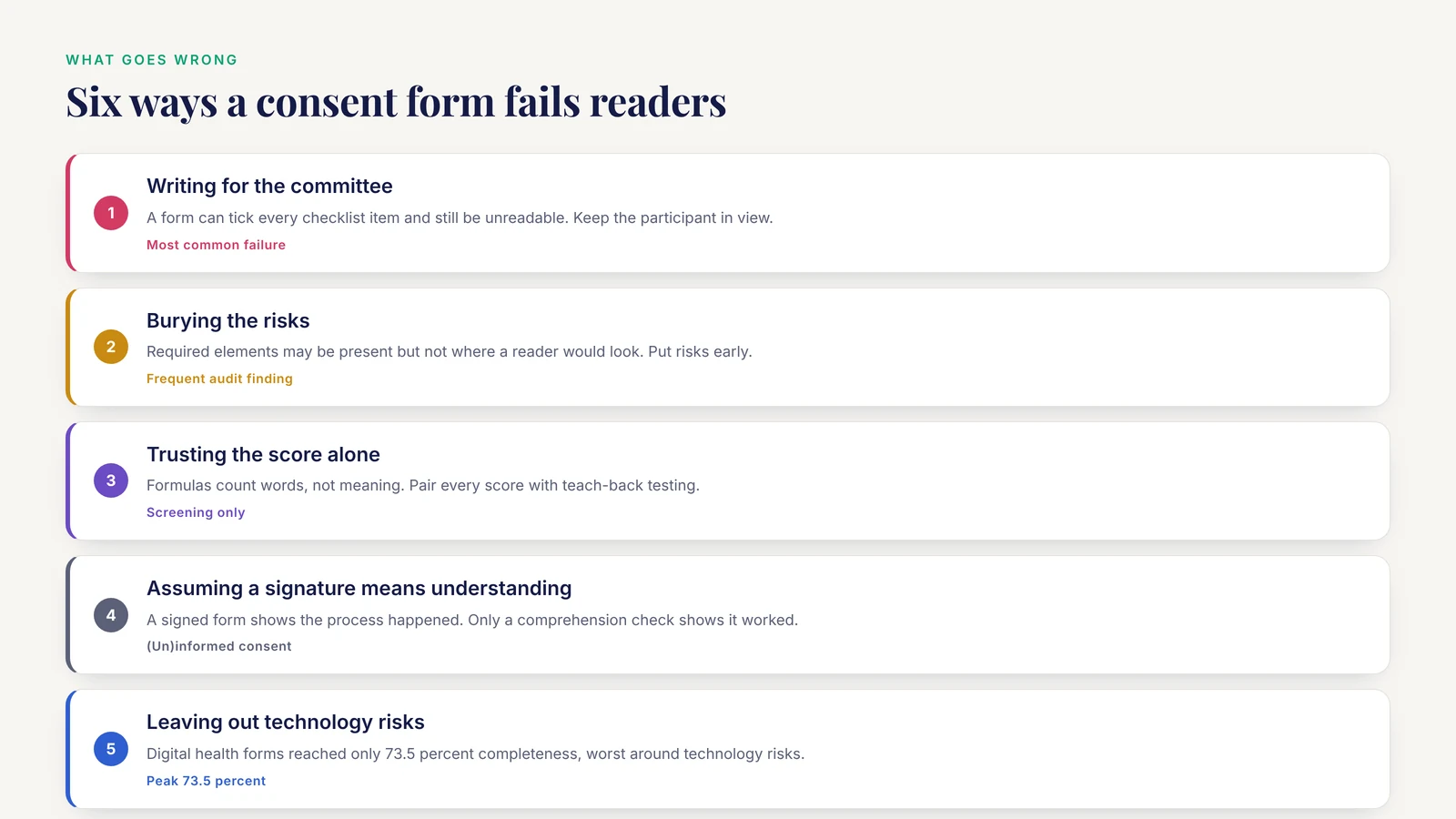
Writing for the ethics committee instead of the participant. The most common failure mode. A form that satisfies a checklist item by item can still be unreadable. Keep two mental audiences in view and satisfy both.
Burying the risks. A frequent audit finding is that legally required elements exist somewhere in the form but not where a reader would look for them [4]. Risks and rights belong early, in prominent sections with plain headings.
Trusting the readability score alone. Formulas measure sentence and word length. They cannot detect a misleading emphasis or a missing fact. Pair the score with teach-back testing every time.
Assuming a signature means understanding. Research on consent procedures in psychology under EU data protection law asked to what degree participants are actually informed by common consent procedures, and the title's answer, "(Un)informed Consent," reflects the concern that routine procedures often fall short of genuine understanding. A signed form documents that the process happened. Only a comprehension check shows that it worked.
Leaving out technology-specific risks. The digital health review found completeness on required attributes peaked at 73.5 percent, with the worst gaps around technology risks [8]. If your study collects data through devices or apps, write about data flows, storage, sharing, and profit in specific terms.
Translating without retesting. A form that scores well in English says nothing about the reading level of its translation. Re-run teach-back sessions with speakers of each target language.
One form for everyone. Diverse populations have different needs, and co-design with community representatives is the documented way to close that gap [5]. A single form that works for everyone rarely exists. Plan for versions and revisions.
Limitations of this guide. Readability formulas are proxies, not proof of understanding. This guide covers writing and testing, not the full regulatory review of your study, which your own ethics committee governs. Individual studies carry specific requirements that only your committee and your institution's template can settle.
Frequently Asked Questions
What reading level should a consent form aim for?
Many ethics committees expect consent forms at or below roughly an eighth-grade reading level, and you should confirm the expectation with your own committee. Use the Flesch-Kincaid Grade Level and Flesch Reading Ease scores as your screening tools, then verify actual understanding with teach-back testing.
How long should a consent form be?
As short as the required elements allow. Published audits show real consent forms often run to several thousand words and require twenty minutes or more of silent reading, which is far beyond what most readers will give. Cut anything the checklist does not require and move necessary detail into an appendix or a conversation.
What is teach-back?
Teach-back is a comprehension check where you ask someone to explain the study in their own words after reading the form. What they get wrong or leave out tells you exactly which sections to revise.
Can I use AI to write my consent form?
Yes, as a first draft only. Evaluations of five AI tools found moderate adequacy on ethical robustness and completeness, so every claim, risk statement, and required element needs human verification before the form goes to your ethics committee.
Do interactive elements really help with online consent?
Yes. A controlled experiment with six versions of an online consent form found that interactive formats significantly improved both comprehension and perceived readability compared with static presentation.
What is tiered or dynamic consent?
Tiered consent offers participants explicit choices about how their data or samples may be used, such as for this study only or for future research. Dynamic consent adds an online platform so participants can revisit and change those choices over time.
How do I write consent for people facing language or literacy barriers?
Co-design the form with community representatives, use accessible visuals and simple structure, and test the translated version with native speakers. A co-designed participant information and consent form developed this way was perceived as easier to understand and more supportive of participation decisions.
Do social science and behavioral studies need consent forms too?
Increasingly yes, though norms vary. A review of 120 high-impact journals in anthropology, business, and education found only 26 percent required informed consent for all human participant studies, so check your target journal and your institution rather than assuming a field-wide standard.
Sources
- INFORMED CONSENT AS A LEGAL PROTECTION FOR PATIENTS
- Enhancing ethical standards in clinical trials: A deep dive into regulatory compliance, informed consent, and participant rights protection frameworks
- Readability of informed consent forms from ClinicalTrials.gov in ketamine clinical trials for mental health conditions: a cross-sectional analysis.
- The big Cs of the informed consent form: compliance and comprehension.
- A co-designed participant information and consent form was perceived as more accessible by ethnically diverse communities: lessons from community-based implementation.
- Ethical review and informed consent guidelines of high impact anthropology, business, and education research journals
- Large Language Models in Informed Consent - Opportunities, Evidence, and Challenges.
- Bridging ethical gaps in digital health research: a framework for informed consent aligned with NIH guidance
- Patient Preferences Towards Plain Language Resources During their Multiple Sclerosis Journey: A Qualitative Interview Study.
- Enhancing comprehension of online informed consent: the impact of interactive elements and presentation formats
- Informed consent in dementia research: how Public Involvement can contribute to addressing “old” and “new” challenges
- Cross-tool evaluation of artificial intelligence-drafted informed consent documents: A 3-level study.
- Electronic informed consent
- The Ethics of Decentralized Clinical Trials and Informed Consent: Taking Technologies’ Soft Impacts into Account
- Informed consent and ethical re-use of African genomic data
- Responsible Inclusion: A Systematic Review of Consent to Social-Behavioral Research with Adults with Intellectual Disability in the US