Top 10 Peer-Reviewed Data Journals for Life Sciences
By Dr. Zubair Khalid, DVM, MS, PhD ·
A peer-reviewed data journal publishes a citable, referee-checked description of a dataset, while a data repository stores and serves the dataset files themselves. Rule of thumb: deposit the files in a public repository first, then publish the description in a data journal when your dataset is complete, reusable, and useful to other researchers, but is not yet the basis for a full hypothesis-driven paper.
This guide covers the peer-reviewed data journals life sciences researchers actually use, how they differ from repositories, and how to pick between them. Data sharing policies vary widely across journals indexed in Journal Citation Reports, a pattern documented in a recent cross-disciplinary survey that itself went through open, publicly visible peer review [1][2][3]. That variability is exactly why choosing the right venue matters. A dataset described in a data journal gets a digital object identifier (DOI), a fixed citation, and a referee's stamp on the metadata, which makes the work findable and reusable long after a project ends.
What a Data Journal Is, and How It Differs from a Data Repository
A data repository is a storage service. It holds files (sequences, imaging archives, spreadsheets, code), assigns a persistent identifier, and serves them to anyone with the right access level. Repositories do not judge whether the data are worth using. They host.
A data journal is a scholarly publication. It publishes an article, usually a few pages long, whose subject is the dataset itself: how it was generated, what it contains, what quality checks it passed, and how to reuse it. The article goes through peer review, receives a DOI, and appears in indexing databases. In practice the two are paired. Most data journals will not accept a description unless the underlying files sit in a public repository.
A simple data repository comparison comes down to four questions:
| Feature | Data repository | Data journal |
|---|---|---|
| Primary job | Store and serve files | Describe and validate a dataset |
| Peer review | No | Yes |
| Gives you a citable article | No (gives a dataset DOI) | Yes (article DOI plus dataset DOI) |
| Counts as a publication | No | Usually yes, by institutional rules |
A useful way to think about the pairing comes from work on finding online scientific resources. Many life science databases and tools are introduced only inside peer-reviewed papers, and search systems such as OReFiL were built to crawl MEDLINE abstracts and open-access articles to index those resources, precisely because well-documented resources are scattered across the literature [4]. A data journal article puts your dataset in that literature in a structured way.
Why Data Journals Exist at All
The tension between open data and peer review is old. In 1996, Adams and Venter argued in Science against forcing the release of raw DNA sequence data on the scientific community before quality review, a debate that helped define the norms data journals now operate under [5]. Twenty years later, the opposite concern dominates: data are often locked away or poorly described.
The pressure is visible in the figures themselves. An analysis of the journal Cell sampled 1,725 figures and 160 tables from research articles published between 1974 and 2014 and found that data graphics increased by more than sixfold over that period, reflecting the growth of imaging technology and large-scale data analysis in biology [6]. Modern experiments produce datasets far too large to be fully presented in a conventional article, which is exactly the gap data journals fill.
Funder and journal policies have pushed in the same direction. A survey of data sharing policies across life, health, and physical sciences journals indexed in Journal Citation Reports examined how many journals require, encourage, or merely suggest data deposition, and reviewers with expertise in research data sharing scrutinized that work in the open [1][2][3][7]. The overall trend across these policy studies points one way: more venues expect public deposition, and a data journal article is one clean way to comply.
How the Top 10 Were Evaluated
Scholarship on evaluating journals gives a stable set of criteria: peer review quality, acceptance rate, longevity, open access availability, inclusion in indexing and abstracting services, citation analysis, and expert opinion [8]. This list applies those criteria with a life sciences filter. Two extra practical factors matter for data papers specifically:
- Metadata standards. The journal should require deposition in a recognized public repository and structured metadata, not just a link to a lab hard drive.
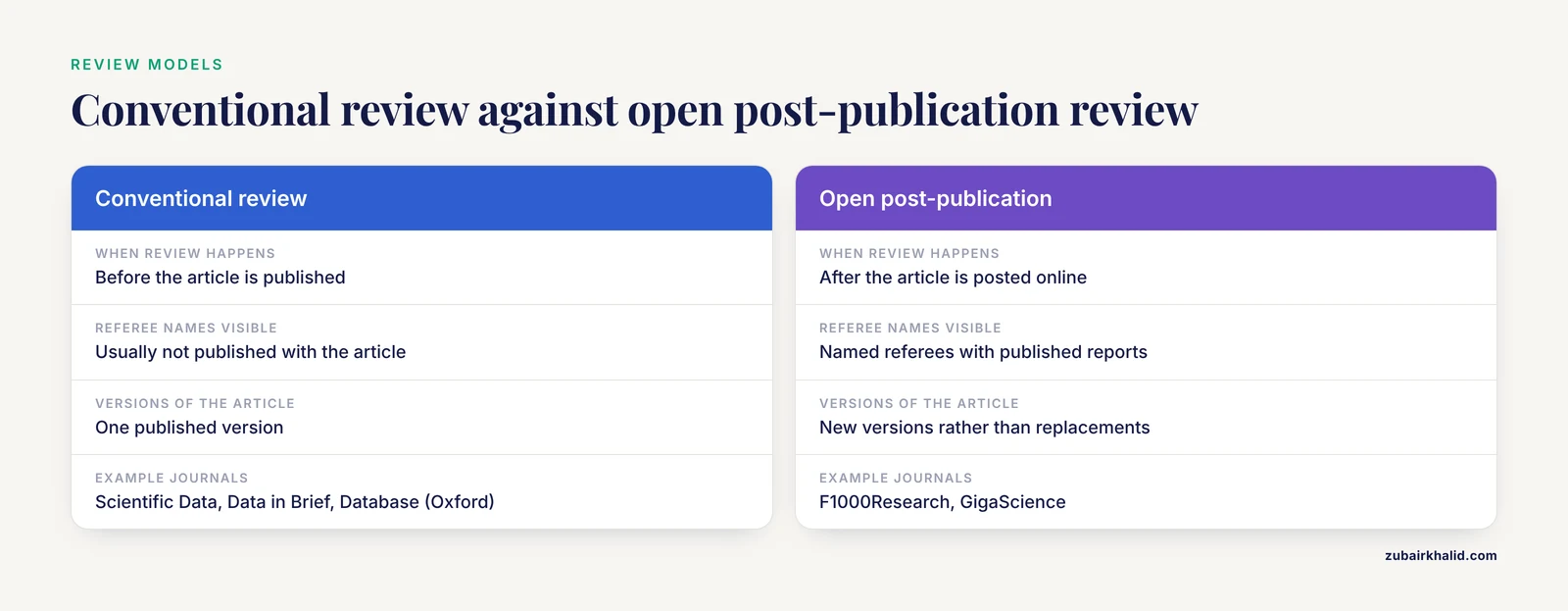
- Review model fit. Some data journals use traditional pre-publication review. Others, such as F1000Research, post the article first and review it openly afterward.
Rigorous process matters regardless of model. Some open access journals, for example, run every manuscript through similarity checks and contribution declarations before review even begins, following globally accepted publishing ethics recommendations [9]. Peer review is not free. One survey of 354 reviewers estimated the cost of peer review at about US$1,272 per reviewer per year, or US$1.1 to 1.7 billion for the scientific community annually [10]. A journal that takes review seriously is spending real expert time on your metadata, so treat the review as part of your dataset quality control.
The Top 10 Peer-Reviewed Data Journals for Life Sciences at a Glance
| # | Journal (publisher) | Core article type | Peer review model | Best fit |
|---|---|---|---|---|
| 1 | Scientific Data (Nature Portfolio) | Data Descriptor | Conventional review with technical assessment of the data and metadata | Broad life sciences, single well-curated datasets |
| 2 | GigaScience (Oxford University Press) | Full data-focused research articles | Open review, article linked to its own repository (GigaDB) | Very large omics, imaging, and integrative datasets |
| 3 | Data in Brief (Elsevier) | Short data article | Conventional review | Datasets disconnected from a specific hypothesis, often as a companion paper |
| 4 | BMC Research Notes (BMC, Springer Nature) | Data note or short research note | Conventional review | Small, useful datasets and negative results needing a permanent home |
| 5 | Database (Oxford) | Database and curation description | Conventional review | New biological databases, curation pipelines, and resource releases |
| 6 | Trials (BMC, Springer Nature) | Trial protocols, results, and raw trial data | Conventional review | Clinical trial datasets with privacy controls |
| 7 | F1000Research (Taylor & Francis group) | Data note, software tool article, research article | Post-publication open review with named referees and versioning | Fast release of datasets and reproducibility-focused work |
| 8 | Data (MDPI) | Dataset description | Conventional review, rapid turnaround | Datasets that span disciplines or do not fit niche journals |
| 9 | Nucleic Acids Research (Oxford University Press) | Database issue paper and resource description | Conventional review | Sequence, structure, and pathway databases aimed at broad use |
| 10 | Data Science Journal (CODATA) | Data practice and dataset description | Conventional review | Data management, curation, and reuse methodology with life science examples |
The Ten Journals, One at a Time
1. Scientific Data
Scientific Data launched in 2014 and is the venue most life scientists think of first. Its signature format, the Data Descriptor, documents how a dataset was generated, what quality controls it passed, and where it lives. The journal requires deposition in recognized public repositories wherever they exist, and reviewers assess whether the metadata meet community standards rather than whether the conclusions are novel. That technical focus is the point: Scientific Data explicitly does not judge the significance of your findings, only the quality and reusability of your data.
Pros: strong indexing, high recognition, careful metadata review. Cons: expects polished, repository-ready data, and the submission templates take real effort to complete.
2. GigaScience
GigaScience launched in 2012 for big data biology. It publishes full research articles alongside or built around massive datasets, and it operates its own linked repository, GigaDB, so the paper and the files stay connected. GigaScience suits multi-omics projects, genome assemblies, imaging atlases, and consortium outputs where the dataset is a primary contribution rather than a supplement. Its peer review is open, meaning the referee reports and author responses travel with the article.
Pros: handles datasets too large for most venues, integrated repository, transparent review. Cons: overkill for a modest dataset, and preparing the scale of documentation it expects is a project of its own.
3. Data in Brief
Data in Brief, launched by Elsevier in 2014, publishes short data articles across all sciences, with a heavy life sciences share. The format is deliberately simple: describe the data, describe how it was generated, state where it is stored. A common pattern is publishing a Data in Brief article as a companion to a longer research paper in another journal, with a formal link between the two. It is also the standard fallback when a dataset was generated but the parent study was never published, perhaps because a project ended or a result was negative.
Pros: fast, straightforward, accepts data tied to unpublished research. Cons: short format means limited narrative context, and some evaluation committees weigh short data articles lightly.
4. BMC Research Notes
BMC Research Notes, launched in 2008, publishes short research notes and data notes in an open access format. It fits datasets that are too small for a dedicated data journal profile but too valuable to leave in a drawer: a pilot study's measurements, a validated set of reagents, a revised protocol with new output files. Peer review is conventional, and the journal explicitly welcomes technically sound work regardless of perceived novelty.
Pros: low-friction route to a citable record, welcomes small datasets and null results. Cons: articles are brief, and the venue carries less visibility than Scientific Data for equivalent work.
5. Database (Oxford)
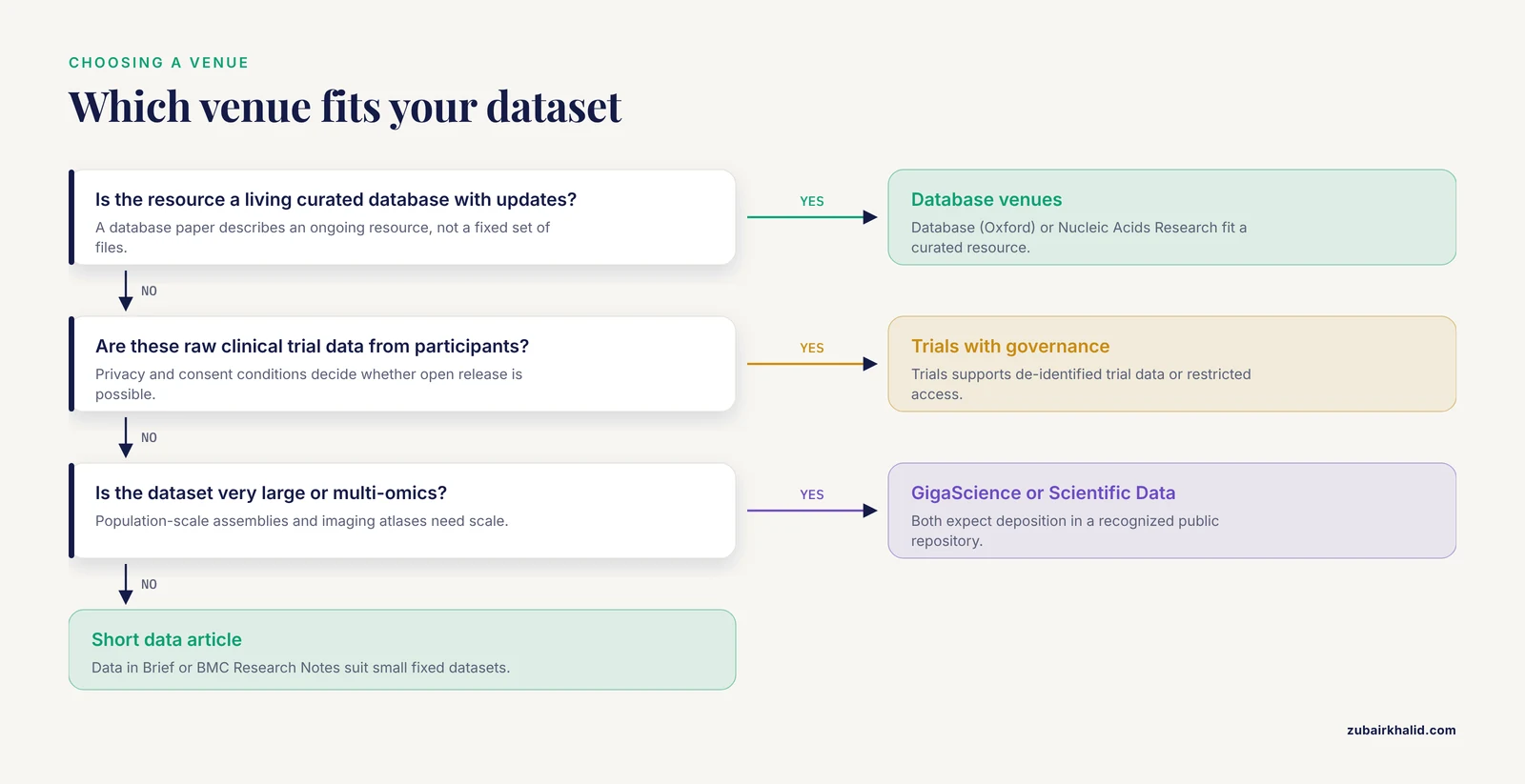
Database (the Journal of Biological Databases and Curation) launched in 2009. It publishes descriptions of biological databases, curation efforts, and data integration resources. If your group built a database, a curated annotation set, or a pipeline that turns raw records into something biologists can query, this is a natural venue. The article type overlaps with, but is distinct from, a dataset description: a database paper describes an ongoing curated resource, while a data paper describes a fixed dataset.
Pros: audience of curators and bioinformaticians, open access, focused scope. Cons: expects sustained maintenance of the resource, and reviewers will probe update practices and sustainability.
6. Trials
Trials, launched in 2006, occupies a special position because it engages directly with the hardest data sharing problem in biomedicine: raw clinical trial data. The journal's founders laid out the case for publishing raw data from randomized controlled trials and named the central obstacles, including patient privacy where explicit consent for publication is absent, and questions of data ownership that most journal policies do not clearly resolve [11]. Trials supports publishing trial datasets with appropriate de-identification and governance, and the same analysis outlines restricted-access repositories as an alternative when open release is not ethical [11].
Pros: purpose-built for clinical trial transparency, strong policy alignment with funder mandates. Cons: human subject data require careful consent review, which can disqualify older datasets.
7. F1000Research
F1000Research, launched in 2012, inverts the usual sequence. Articles, including data notes, are posted online within days, and peer review happens afterward in the open, with named referees and published reports. Each version of the article carries a status such as Approved or Approved with Reservations, and revisions produce new versions rather than replacements. This model suits researchers who need a citable record fast, for example to satisfy a funder deadline, and those comfortable having referee reports visible from day one.
Pros: speed, transparency, versioning, named reviewers. Cons: the article is public before it is fully vetted, and some readers treat early versions without reservations as final.
8. Data (MDPI)
Data is an open access journal from MDPI that publishes dataset descriptions across the sciences, including life sciences datasets that span traditional disciplinary boundaries. The format is lean, review is conventional, and turnaround is fast. Its breadth is both a feature and a limitation. A mixed dataset, say environmental sampling plus metagenomic sequencing, may fit poorly in a single-domain venue but land comfortably here.
Pros: fast, genuinely interdisciplinary, simple submission format. Cons: lower name recognition than the Nature Portfolio or BMC titles, so check how your institution values it.
9. Nucleic Acids Research
Nucleic Acids Research is best known as a conventional molecular biology journal, but it has a long-running annual database issue and publishes descriptions of biological databases and web resources year-round. A database paper in Nucleic Acids Research serves a different purpose than a data paper: it announces a working resource, documents its content and query interface, and asks reviewers to judge whether the resource is technically sound and useful. For sequence, structure, and pathway databases intended for community-wide use, it remains one of the most visible venues in the field.
Pros: enormous readership among molecular biologists, strong indexing and citation history. Cons: competitive acceptance, and the annual database issue has a fixed submission cycle.
10. Data Science Journal
Data Science Journal, published by CODATA (the Committee on Data of the International Science Council), covers data management, curation, metadata, and reuse practices, with life science data as a recurring theme. It fits researchers writing about how data should be organized and reused, including case studies of real datasets and evaluations of curation workflows. It is broader than a pure life sciences venue, which helps when your contribution is a data practice or standard rather than a specific biological dataset.
Pros: focused readership of data professionals, open access, good fit for methods and policy papers. Cons: narrower biological audience, and it is not a venue for describing one particular experiment's files.
Pros and Cons of Peer-Reviewed Data Journals in the Life Sciences
Before comparing the options further, it helps to weigh the format itself.
Pros:
- Citable credit. A data paper gets a DOI and appears in indexing services, so colleagues can cite your dataset properly instead of citing "unpublished data."
- Referee-checked reuse value. Review confirms the data are complete, documented, and technically interpretable, which raises the odds strangers can actually use them.
- Policy compliance. When journals require data availability statements, a published data paper resolves the requirement unambiguously.
- Credit for negative and orphan results. Datasets from studies that never produced a headline finding still get a permanent, reviewed record.
Cons:
- Limited career weight. Some hiring and promotion committees discount data articles compared with hypothesis-driven papers. Check your institution's rules before spending effort.
- Review capacity is strained. Reviewer recruitment is a real constraint. A six-year analysis of five mid-tier ecology journals found that the proportion of review requests leading to completed reviews held steady or declined modestly, from around 0.47 to 0.44 in one journal between 2009 and 2015 [12]. Slow review turnaround affects data journals like any other.
- Author fees may apply. Most data journals are open access, which typically means an article processing charge paid from grant or institutional funds. Confirm the current fee schedule with each journal directly.
- Not a substitute for interpretation. A data paper describes what the data are, not what they mean.
Comparing Data Journals on the Criteria That Decide Real Choices
When researchers ask which of the best peer-reviewed data journals for life sciences work they should use, four practical questions decide the answer.
1. Does your dataset have a natural repository? Sequence data, proteomics, imaging, and crystallography all have established community repositories. Scientific Data and GigaScience both expect deposition there. If no domain repository exists, a journal with its own repository (GigaDB for GigaScience) or a generic institutional repository becomes the fallback.
2. How large and complex is the dataset? A few dozen tabular rows fit Data in Brief or BMC Research Notes. A population-scale genome assembly needs GigaScience or Scientific Data.
3. Do you need speed or polish? F1000Research gives you a citable record in days, with review completing in public afterward. Scientific Data gives you a heavily vetted descriptor but a slower path.
4. How will your institution count it? Journal prestige is associated with how published studies get cited, as shown in emergency medicine research where prestige and study characteristics together shaped citation outcomes [13]. That does not mean prestige should drive your choice, but it does mean the venue's name recognition can affect how the article is received by colleagues who never open it.
One caution about shortcuts. Comparing preprints to their published versions, researchers found that peer-reviewed articles had modestly higher completeness of reporting, with an absolute difference of about 5.0 percent for independent samples and 4.7 percent for paired comparisons, favoring the peer-reviewed versions [14]. The differences were small, which is reassuring for open review models, but it confirms that review does add measurable polish to how data and methods are reported.
Worked Scenarios
Scenario 1: The finished project with no paper. A postdoc leaves a lab after generating RNA sequencing data for 60 samples. The project lost funding. The right path is to deposit the raw reads and counts in a sequence archive, then write a Data in Brief article describing the cohort, the library preparation, and the quality metrics. The dataset becomes citable and reusable rather than lost.
Scenario 2: The clinical trial dataset. A team finishing a randomized controlled trial wants to share de-identified participant data. The privacy and consent problems are not trivial, and the governance questions are not fully settled across the field [11]. Trials is the aligned venue, with the explicit caveat that data collected without consent for broad release may need restricted access rather than open deposition.
Scenario 3: The new database. A bioinformatics group builds a curated resource for a protein family, with a web interface and regular updates. That is a database, not a one-time dataset, so Database (Oxford) or Nucleic Acids Research fits better than Data in Brief. The reviewers will ask about update procedures and long-term maintenance, so document those before submitting.
Scenario 4: The consortium dataset. A multi-institution consortium generates a million-image microscopy collection. The scale, the integration with analysis code, and the consortium authorship pattern point to GigaScience, where the article and the GigaDB record stay linked.
Common Mix-Ups
- Confusing the two DOIs. Your dataset gets a DOI at the repository. Your article gets a DOI at the journal. They are different objects and should cite each other.
- Assuming a data paper blocks a later research paper. Most data journals explicitly allow, and encourage, a companion interpretive paper. Check each journal's policy on prior or simultaneous publication, then structure the two articles so they do not overlap in text.
- Treating a preprint as a data paper. A bioRxiv preprint is not peer reviewed and does not satisfy data publication requirements. If you want the speed of a preprint with the standing of a publication, a post-publication review venue such as F1000Research is the closer match.
- Mixing database papers and data papers. A database paper describes a living curated resource. A data paper describes a fixed set of files. Submitting a database description to a data journal (or the reverse) usually gets returned before review.
- Assuming a figure-heavy manuscript is a data paper. Data graphics have grown more than sixfold in leading life science journals since 1974 [6], so plots alone no longer signal a data contribution. What makes a data paper is structured metadata and a public deposition, not charts.
Common Mistakes and Limitations
- Depositing files without a metadata standard. Reviewers at data journals routinely reject descriptions when the repository record lacks structured metadata, such as sample annotations and processing steps. Write the metadata first, deposit second, draft the article last.
- Publishing human subject data without checking consent. Explicit consent for data publication is a genuine barrier identified in the clinical trial data literature, and agreed-upon policies for handling it remain uneven across journals [11]. Older datasets collected before broad-consent language existed may be legally and ethically unsuitable for open release.
- Assuming all "data journals" are equivalent. They differ in review model, metadata requirements, and audience. A rejection from Scientific Data on metadata grounds does not predict the outcome at Data in Brief.
- Ignoring conventional journals with strong data policies. A data journal is one option among several. The Journal Citation Reports survey of data sharing policies shows that many conventional journals now mandate deposition as well, so a hypothesis-driven paper may already satisfy your funder [1][2][3][7].
- Budgeting no time for the review itself. Peer review consumes real expert labor, on the order of US$1,272 per reviewer per year in estimated time value [10]. Expect rounds of revision on metadata, and treat referee questions as free dataset quality checks.
- Career decisions need human input. This article explains venues and criteria. Whether a specific data paper advances your specific case for a degree, a grant, or tenure requires advice from a mentor or your institution's research office, who know the local rules.
Frequently Asked Questions
What is the difference between a peer-reviewed data journal and a data repository?
A repository stores and serves your dataset files and gives them a dataset DOI, with no evaluation. A data journal publishes a peer-reviewed article describing the dataset, giving you a citable publication while pointing readers to the repository record. The two work as a pair.
Do data journal articles count as real peer-reviewed publications?
Yes, articles in the journals listed here are peer reviewed and carry DOIs, so they count as publications by most definitions. Whether they carry equal weight to a hypothesis-driven paper for hiring, tenure, or grant review depends on your institution's rules, which you should verify directly.
When should I publish a data paper instead of waiting for a full research article?
Publish the data paper when the dataset is complete and reusable but the interpretive study is delayed, unpublished, or never going to happen. A companion data paper released before the main article can also establish priority on the dataset itself.
Are these journals open access?
Most of the top peer-reviewed data journals for life sciences are open access, which typically means an article processing charge for authors. Fee schedules change, so confirm the current charges on each journal's own site before submission.
Can I publish human subject data in a data journal?
Sometimes. Human subject data require de-identification and consent conditions compatible with release, and for clinical trial data the field has identified patient privacy and ownership as persistent obstacles, with restricted-access repositories as a recognized alternative [11]. Review the consent forms before committing to an open venue.
How do I find out whether a dataset already has a data paper?
Search the literature for the dataset name, the sample identifiers, and the repository accession numbers, and check whether the repository record links to a publication. Search systems that index online resources from peer-reviewed papers, such as the OReFiL approach of crawling MEDLINE abstracts and open access articles [4], illustrate why linking repository records to published descriptions is the norm.
Sources
- Peer Review #4 of "Data sharing policies of journals in life, health, and physical sciences indexed in Journal Citation Reports (v0.2)"
- Peer Review #4 of "Data sharing policies of journals in life, health, and physical sciences indexed in Journal Citation Reports (v0.1)"
- Peer Review #3 of "Data sharing policies of journals in life, health, and physical sciences indexed in Journal Citation Reports (v0.2)"
- OReFiL: an online resource finder for life sciences
- Should non-peer-reviewed raw DNA sequence data release be forced on the scientific community?
- Change in the graphics of journal articles in the life sciences field: analysis of figures and tables in the journal “Cell”
- Peer Review #1 of "Data sharing policies of journals in life, health, and physical sciences indexed in Journal Citation Reports (v0.1)"
- Criteria for Evaluating Journals in the Scholarship of Teaching and Learning in Agriculture, Natural Resources, and the Life Sciences
- Life Sciences, Medicine and Biomedicine - supporting open access publishing
- Scientific sinkhole: estimating the cost of peer review based on survey data with snowball sampling
- Towards agreement on best practice for publishing raw clinical trial data.
- Is it becoming harder to secure reviewers for peer review? A test with data from five ecology journals
- Journal prestige, publication bias, and other characteristics associated with citation of published studies in peer-reviewed journals.
- Comparing quality of reporting between preprints and peer-reviewed articles in the biomedical literature