Peer Review of Lab Notebooks: The Buddy System
By Dr. Zubair Khalid, DVM, MS, PhD ·

By the end of this article you will be able to set up a recurring peer review of lab notebooks with a partner, run a structured 30-minute review session, write a review record that a principal investigator or auditor can act on, and fix the most common notebook problems before they cost you an experiment. You will also get a working lab notebook template, a comparison of paper and electronic lab notebooks for review workflows, and a short script that flags incomplete entries automatically.
To follow the walkthrough you need a notebook to review (paper or electronic), a willing partner, and 30 minutes every one to two weeks. If your lab uses an electronic lab notebook (ELN), you will also need access to an export or a shared review view. If you want to run the automated checks, you need Python 3 on a Mac, Linux machine, or Windows with the Windows Subsystem for Linux, plus a text editor. Everything else is pen and paper.
Why Peer Review of Lab Notebooks Matters
A lab notebook is the permanent record of what you did, when, and what happened. In patent disputes, authorship disputes, and data integrity investigations, the notebook is often the primary evidence of who did the work and when. Grant agencies and journals increasingly treat documentation quality as part of research integrity, and institutions that manage GLP (Good Laboratory Practice, a regulatory framework for studies that support regulatory submissions) work have formal requirements for dated, signed, and corrected records.
Most notebook failures are not fraud. They are drift. Dates get skipped during a busy week, concentrations get written from memory at the end of the day, and a reagent lot number lives in someone's head instead of on the page. Six months later, nobody can reconstruct the experiment, and a result that took weeks to generate cannot be defended or repeated.
Waiting for a principal investigator to catch these problems does not work. PIs review notebooks rarely, usually only before a publication or a grant report, when the fixable problems are months old. The buddy system fixes the timing problem. Two lab members at a similar level review each other's notebooks on a fixed schedule, catching drift within days instead of months. Because the reviewer is a peer, not a supervisor, the conversation stays collaborative. You are checking that the record is complete and usable, not judging the science.
The buddy system also produces a side effect that many labs find more valuable than the review itself: it spreads good habits. When one person adopts a clear convention for recording gel image identifiers, the convention travels through reviews to their partner and then to the rest of the lab.
What the Buddy System Is
The buddy system is a simple pairing arrangement. Two researchers agree to review each other's lab notebooks on a fixed schedule, against a fixed checklist, with written records of each review. Neither person is the other's supervisor. Both people are both reviewer and reviewed.
Three design choices make or break the system.
Fixed cadence. Reviews happen on a schedule, such as every other Friday, not "when we get around to it." A review that waits three months reviews a notebook the writer can no longer remember, which defeats the purpose. The point of peer review of lab notebooks is to catch gaps while the experiment is still fresh enough to reconstruct.
Fixed scope. The buddy checks documentation quality, not scientific judgment. The checklist asks whether dates are sequential, whether reagents are identified with enough detail to order a replacement, whether corrections follow a single standard, and whether every figure and dataset in the notebook has an identifier that can be matched to a stored file. The buddy does not decide whether the experiment was well designed. That distinction keeps the relationship comfortable and keeps reviews fast.
Written output. Every review produces a short written record with findings and agreed actions. Verbal feedback evaporates. A one-paragraph review record creates accountability and gives the principal investigator a paper trail if documentation questions come up later.
The pairing does not need to be within the same project. A structural biologist paired with a molecular biologist often reviews more effectively than two people on the same project, because neither assumes shared context that the notebook fails to state. The rule of thumb is simple: if the reviewer cannot follow the experiment from the notebook alone, the notebook is incomplete.
A Lab Notebook Template Built for Review
Review is fast when notebooks are written to a predictable shape. The template below works for both paper and electronic notebooks. If your lab already has a required format, keep it and use this as the minimum content check. Each entry should contain the following fields.
| Field | What goes in it | Example |
|---|---|---|
| Date and experiment ID | Full date and a unique identifier | 2026-03-11, EXP-041 |
| Purpose | One sentence on the goal | Test pH 6.0 to 7.5 for binding assay |
| Materials and reagents | Identity, concentration or amount, manufacturer, lot number, expiration | Tris-HCl 50 mM, pH 7.4, lot AB1234, exp 2027-01 |
| Instrument and settings | Instrument name and all parameters that affect output | Plate reader, excitation 485 nm, gain 60 |
| Procedure | What you actually did, in order, with deviations noted | Steps 1 through 6 as planned, except step 4 incubated 25 min |
| Raw data | Where the data physically lives, with a file or image identifier | Gel image IMG-2026-0311-A on lab drive |
| Observations | Anything unexpected, in real time | Well B3 edge effect, possible evaporation |
| Analysis and conclusion | What the data show and what comes next | pH 7.0 highest signal, repeat with n=3 |
| Signature and date | Name, signature or electronic attestation, date signed | J. Alvarez, signed 2026-03-11 |
Two fields cause the most arguments, so set conventions at the start. First, real-time recording. Entries should be written during the experiment or the same day, because reconstruction from memory is where errors enter. Second, corrections. In a paper notebook, a mistake gets a single line through it so it stays readable, with the correction, initials, and date written next to it. Never erase, white out, or overwrite. In an electronic notebook, corrections should be made as new entries or version-stamped edits that leave the original visible, not silent overwrites. Both conventions exist so the record shows what you first thought, what you later learned, and when you learned it.
Peer Review of Lab Notebooks: Step by Step
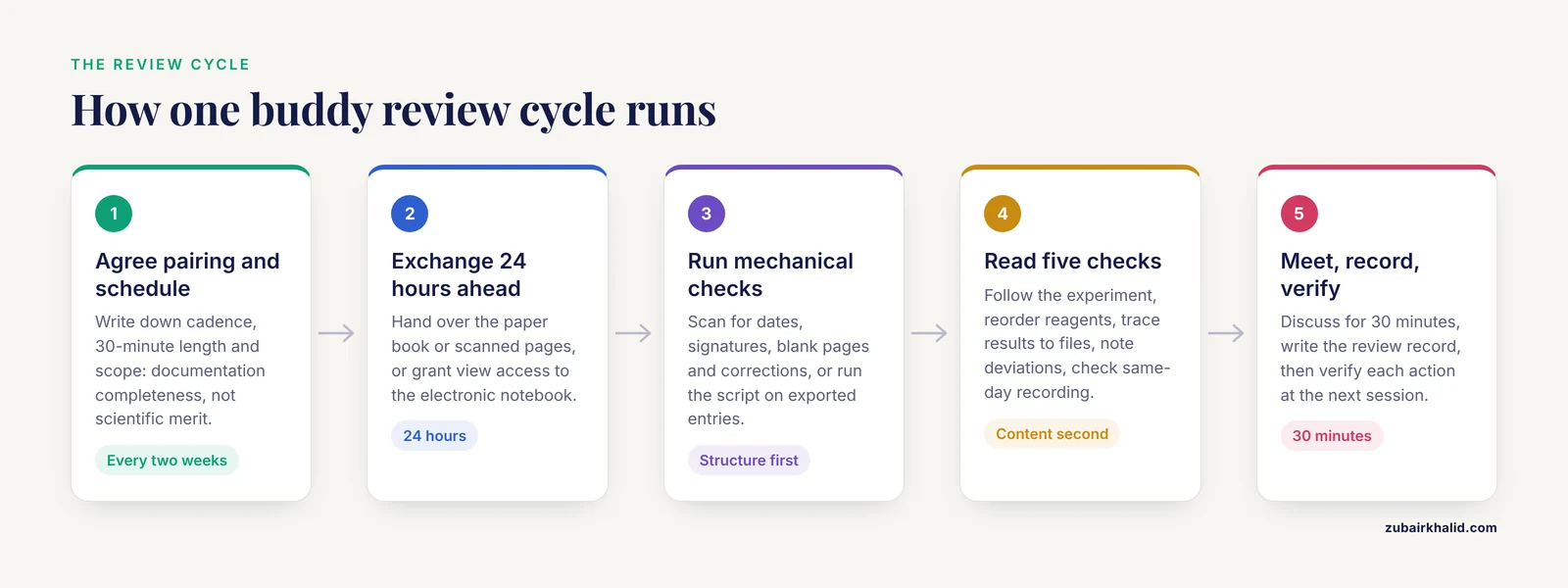
This walkthrough sets up a buddy pair and runs the first full review cycle. Adjust names and dates to your lab.
Step 1. Agree on the pairing and the schedule
Sit down with your chosen partner and agree on three things in writing. The cadence (every two weeks works for most experimental labs, weekly for fast-moving or regulated work), the length (30 minutes is enough), and the scope (documentation completeness, not scientific merit). Put this in a shared document or a first notebook entry so the agreement itself has a date.
Step 2. Exchange notebooks 24 hours before the review
The reviewer reads the notebook before the meeting, not during it. Reading in advance is what separates a useful review from a folder-flipping session. For paper notebooks, hand over the physical book or a scanned page range. For electronic notebooks, export the period under review or grant view access. A 24-hour lead time gives the reviewer enough room to write notes and flag questions.
Step 3. Run the mechanical checks
Before reading content, check structure. For paper notebooks this is a page-by-page scan: are dates present and sequential, is every page signed, are there gaps or blank pages, do corrections follow the single-line rule. For electronic notebooks, the same checks can be partly automated. The following Python script scans a folder of markdown entries exported from an ELN and flags entries missing a date header, a signature line, or containing unresolved placeholders.
import re
from pathlib import Path

problems = []
for f in sorted(Path("entries").glob("*.md")):
    text = f.read_text()
    if not re.match(r"^## \d{4}-\d{2}-\d{2}", text):
        problems.append(f"{f.name}: missing date header")
    if "Signed:" not in text:
        problems.append(f"{f.name}: missing signature line")
    if re.search(r"\bTODO\b|\bTBD\b", text):
        problems.append(f"{f.name}: unresolved TODO")

if problems:
    print("\n".join(problems))
else:
    print("All checks passed")
Save this as check_notebook.py in the folder that contains your entries directory, then run it from the command line.
python3 check_notebook.pyExpected output for a notebook with two incomplete entries looks like this.
2026-03-11_binding-curve.md: missing signature line
2026-03-13_pH-screen.md: unresolved TODO
Each part of the script does one job. Path("entries").glob("*.md") collects every markdown file in the entries folder. The regex ^## \d{4}-\d{2}-\d{2} checks that the file starts with a heading in ISO date format, such as ## 2026-03-11, which means four digits, a hyphen, two digits, a hyphen, two more digits. The search pattern \bTODO\b|\bTBD\b matches the words TODO or TBD as whole words, so a mention of "todomycin" would not trigger a false flag. If your lab writes different placeholders, such as XXX, add them as another alternative separated by a vertical bar.
If your entries are plain text files rather than markdown, the same checks run with standard Unix tools. To count entries that punt a detail forward instead of recording it, which is one of the most common notebook defects, use grep (a command-line search tool that prints lines matching a pattern).
grep -rn "see above\|as before\|same as last time" entries/ | wc -lExpected output:
7Each match is a place where a reader must trust memory or hunt through earlier pages. Some references back are legitimate, but seven of them in a month of entries usually means critical values, such as buffer compositions, are being inherited instead of recorded.
Step 4. Read for the five completeness checks
With structure confirmed, read the period under review against five questions.
- Can I follow this experiment without asking the author? Every entry should let a trained stranger repeat the work.
- Could I reorder every reagent from what is written? This tests lot numbers, concentrations, and expiration or receipt dates.
- Does every result trace to a stored file? Each figure, gel, plate, or dataset in the entry needs an identifier that matches a stored image or file, not a vague note like "gel looked fine."
- Are deviations recorded as deviations? When the actual procedure differed from the plan, the difference should be explicit and timed.
- Is the record complete the same day it was created? Late-filled entries should say when they were written and why.
Step 5. Annotate, do not edit
The reviewer writes observations on sticky notes, margin comments, or a separate review document. The reviewer never writes in the author's notebook. This keeps authorship clean, which matters for the evidentiary value of the record, and it keeps the author in control of their own document.
Step 6. Meet and discuss for 30 minutes
A workable agenda is five minutes of the reviewer's summary, fifteen minutes walking through findings in page order, five minutes agreeing on actions, and five minutes scheduling the next review. Disagreements about conventions, such as how much detail a common protocol reference needs, get settled by writing the convention down once in the shared agreement document, then applying it identically to both notebooks afterward.
Step 7. Write the review record
Every session ends with a dated written record. The following worked example shows the format. It is short enough to write in five minutes and specific enough to act on.
Notebook review, 2026-03-14
Notebook: M. Okafor, NB-04, entries 2026-02-28 through 2026-03-13
Reviewer: J. Alvarez

Checks passed: dates sequential, corrections struck and initialed,
all reagents carry lot numbers, gel images referenced by file ID

Findings:
1. Entry 2026-03-04: buffer pH recorded as "about 7", exact value
   missing from both the entry and the bench sheet
2. Entry 2026-03-11: sample B3 lacks gel image identifier,
   image described only as "the good one"
3. Entry 2026-03-13: experiment ID absent, first entry in this
   notebook without one

Actions:
- M.O. to add pH from bench sheet and annotate the correction,
  by 2026-03-18
- M.O. to add image identifier IMG-2026-0311-A to entry 2026-03-11,
  by 2026-03-18
- M.O. to backfill experiment ID for 2026-03-13 as EXP-043,
  by 2026-03-18

Next review: 2026-03-28
File review records where both partners can find them, such as a shared drive folder named notebook-reviews. The record dates the review itself, which is useful evidence that the lab maintained documentation oversight.
Step 8. Fix, then verify
The author completes the agreed actions before the next review date. Corrections in a paper notebook follow the same single-line rule as any other correction, with the addition date and initials so the timeline stays honest. In an electronic notebook, add an amendment entry that references the original entry rather than editing it silently.
At the start of the next session, the reviewer spends two minutes verifying each previous action before moving to new material. Unverified actions from one review carry forward to the next one. Two consecutive cycles of the same finding is the trigger for Step 9.
Step 9. Escalate patterns, not incidents
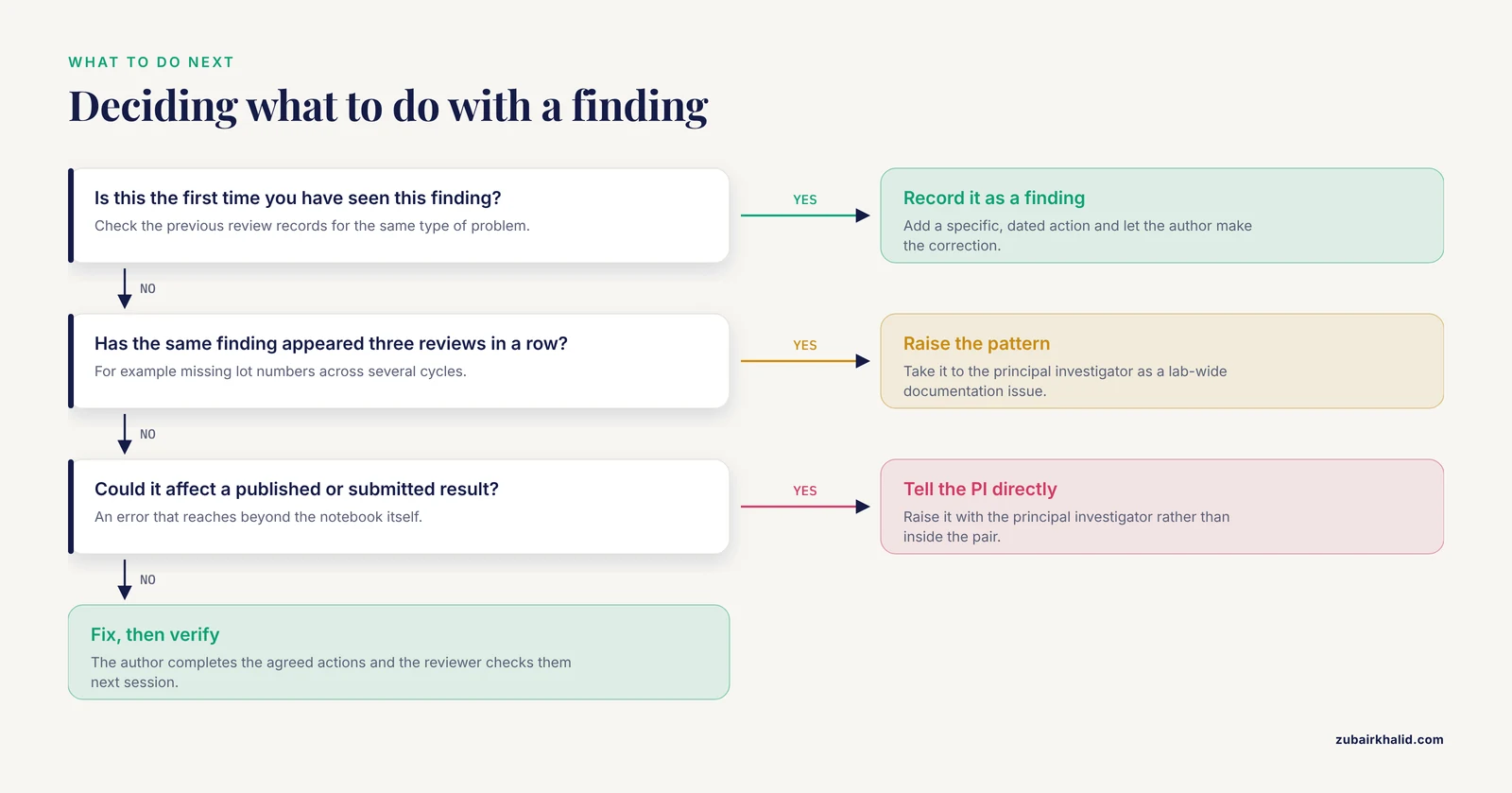
If the same type of finding recurs, for example missing lot numbers three reviews in a row, the pair raises the pattern to the principal investigator as a lab-wide documentation issue, not as an individual failing. The framing matters. Recurring findings almost always mean the lab lacks a convention, such as a printed bench sheet that prompts for lot numbers, and the fix is a process change.
Step 10. Rotate partners quarterly
Every quarter, re-pair. Rotation spreads conventions across the whole lab, prevents the review from hardening into one pair's private habits, and keeps the workload from falling on a single relationship. After two rotations, most four to eight person labs have every member reviewing with every other member at least once, which is usually enough to converge on a single house style.
Reviewing Paper Notebooks Specifically
Paper notebooks need three additional checks that electronic systems handle automatically.
Continuity. Bound notebooks should have no blank pages and no gaps between entries. Draw a diagonal line through any page left blank, with initials and a date, so nobody can add content there later. If a notebook ends mid-experiment and a new one starts, the old notebook's last page should say "continued in NB-05" and the new one should say "continued from NB-04."
Witnessing. Some work, particularly GLP studies and patent-sensitive projects, requires that entries be witnessed, meaning a second person signs and dates the page to confirm they observed the work. A buddy review is not witnessing. Witnessing must happen at the time of the work, by someone who saw it happen. If your project requires witnessed entries, the buddy can be a witness for their own experiments, but the two functions have different timing and different legal weight.
Loose materials. Taped-in gel photos, printouts, and supplier certificates must be taped fully within the page boundary with dated tape over the edge, or cross-referenced by identifier to a stored file. Loose inserts fall out and get lost, so the review should flag any result that exists only as a loose insert.
Electronic Lab Notebook Comparison for Buddy Review
An electronic lab notebook changes what the reviewer checks, because timestamps, versions, and access records become automatic. The comparison below describes categories of tools by their review-relevant properties. Evaluate any specific product against your institution's requirements, because export formats, audit trail access, and data ownership terms vary by plan and by institution.
| Property | Paper notebook | Self-hosted open ELN (for example eLabFTW) | Institution-hosted ELN (for example Benchling, LabArchives, RSpace) |
|---|---|---|---|
| Timestamping | Manual, only as trustworthy as the habit | Automatic per entry | Automatic per entry |
| Version history | None, corrections are physical strikes | Automatic, prior versions retained | Automatic, prior versions retained |
| Review access | Hand over the book or scan pages | Grant review role, no export needed | Grant view access, no export needed |
| Automated completeness checks | None | Possible on exports, as in the script above | Varies, some platforms support required fields |
| Data export on leaving | Take the book if policy allows | Full export, you control the format | Export available, format and completeness depend on platform and plan |
| Attachment traceability | Manual identifiers for stored files | Files linked inside entries | Files linked inside entries, some validate links |
Three practical consequences follow for the buddy system. First, electronic notebooks remove most arguments about dates and signatures, so review time shifts toward content completeness, which is where human judgment is still needed. Second, electronic notebooks create a new failure mode the paper system never had: attachments that live outside the entry or links that break, so the review must verify that every attached file opens and matches the identifier written in the text. Third, check your institution's position on ELN adoption and export before committing a project to one platform, because the record must remain accessible after people leave.
Buddy System Tips That Hold Up in Practice
Review forward, not backward. Start reviewing from the current week and work backward only as far as the 30 minutes allow. A pair that starts at the beginning of a six-month-old notebook will burn out before reaching the present.
Review your own notebook first. Before the first buddy session, run the checklist on your own entries and fix what you find. This calibrates both partners on what the checklist means and makes the first live review shorter.
Keep a conventions page. Maintain a single shared page listing house conventions, such as how to record a reused antibody lot or how to name gel image files. Every convention dispute ends by adding a line there. Within a few months this page becomes the lab's de facto documentation standard.
Check the negative space. The most important review question is often about what is missing. If a week has no entries, the review should establish whether nothing was done, work happened in a different notebook, or entries were never written. All three answers lead to different fixes.
Timebox ruthlessly. Thirty minutes, findings in page order, no tangents into experimental design. If a finding would take more than a minute to discuss, it goes on the action list for the author to resolve with their PI separately.
Make the actions small and dated. An action like "improve reagent documentation" never happens. An action like "add lot numbers for the three buffers used on 2026-03-04, by Friday" happens in ten minutes.
Let new members join by being reviewed first. A new lab member learns the house style fastest by having their own notebook reviewed in their first month. Being reviewed is a better teacher than watching someone else get reviewed.
Common Mistakes and Limitations
Reviewing the science instead of the record. The most common way buddy systems collapse is the reviewer drifting into commenting on experimental design, statistical choices, or interpretation. That conversation belongs in lab meeting. When it invades a notebook review, the reviewed person stops bringing their notebook, and the system dies. Restate the scope at the start of each session until it sticks.
Skipping the written record. Pairs that stop writing review records lose the cadence within a semester. The written record is the accountability mechanism and the evidence trail. If writing it feels like overhead, note that it takes five minutes and replaces an hour of reconstructing events later.
Inconsistent correction handling. Overwriting errors, erasing pencil, or writing corrections without dates quietly destroys the timeline a notebook exists to preserve. A correction without a date makes it impossible to know what was known when, which is exactly the question a notebook answers in a dispute.
Backfilling without disclosure. Writing an entry days after the experiment without recording that it was written late is a serious defect, worse than the gap it hides. Late entries are acceptable when dated as late entries. Undisclosed backfill is not.
Treating the review as a compliance checkbox. If the pair signs off without actually reading, the system produces paperwork and no quality. The mechanical checks in the script help here, because they force the reviewer to look at specific entries rather than skim.
Pairing people who never interact. Two buddies in different buildings with no shared floor or shared coffee time will not sustain a schedule. Pick a partner you already see weekly.
Ignoring the limits of the system. Buddy review improves documentation completeness. It does not verify that the recorded results are true, it does not substitute for the PI's oversight responsibility, and it does not satisfy regulatory requirements that call for independent witnessing or quality-unit review in GLP work. Individual studies with regulatory obligations need the formal documentation structure their sponsor or institution specifies, and this informal system runs alongside it, not instead of it.
Frequently Asked Questions
How often should notebook buddy reviews happen?
Every one to two weeks for most experimental labs, with two weeks being the standard starting cadence. Weekly reviews suit fast-moving projects, regulated work, or a new member's first month. Anything longer than a month loses the main benefit, which is catching gaps while the work is still fresh.
Can my buddy be someone from a different lab or project?
Yes, and a different-project partner is often better. Someone outside your project cannot fill in gaps from shared context, so they find them faster. The one requirement is shared familiarity with the general techniques, so the reviewer can judge whether the recorded detail is sufficient.
What should I do if I find an error in my buddy's notebook?
Record it as a finding in the review record with a specific action and deadline, and let your buddy make the correction themselves using the standard correction convention. Never correct their notebook directly. If the error suggests a problem with a published or submitted result, raise that with the principal investigator rather than handling it inside the pair.
Does the buddy system replace witness signatures or formal quality review?
No. A buddy review is a peer check of documentation completeness, and it is not witnessing. Witnessing requires a second person who observed the work to sign at the time it was done. Formal GLP or quality-system review has its own requirements that buddy review does not satisfy, so run the buddy system alongside those structures where they apply.
How does buddy review work with electronic lab notebooks?
The same five completeness checks apply, with timestamps and version history handled automatically by the platform. Reviewers typically get view access rather than receiving exports, and they add two electronic-specific checks: every attachment opens, and every file identifier in the text matches a stored file. Silent edits are the electronic equivalent of overwriting, so corrections should appear as amendments or retained versions.
What happens when my buddy and I disagree about a standard?
Write the convention down once in a shared conventions page and apply it identically to both notebooks from then on. Most disagreements are about how much procedural detail a common protocol reference needs, and a single written line settles that permanently. If the disagreement is substantive rather than stylistic, ask the principal investigator to decide.
How do I introduce the buddy system into a lab that has never done it?
Start with one voluntary pair and one full review cycle, then show the PI the first written review record as evidence of what the system produces. Voluntary pairs spread the practice faster than a mandate, because early adopters refine the checklist before the whole lab inherits it. A lab-wide rollout usually follows within two or three rotations.
Is a signed entry the same as a reviewed entry?
No. A signature attests that the author wrote the entry and stands behind it. A review record attests that a second person checked the entry against the documentation checklist and found it complete or recorded findings. The two carry different information, and a well-run lab produces both.