How to Interpret Peer Review Confidentiality Rules
By Dr. Zubair Khalid, DVM, MS, PhD ·

Peer review confidentiality rules are the obligations that keep a submitted manuscript, the reviewer reports about it, and the identities of the reviewers out of public view during and after evaluation. Interpreting these rules means asking three questions every time a situation arises: who holds the duty of confidentiality, exactly what material the duty covers, and what exceptions the editor or the law allows.
Those three questions matter because the rules are not written as a single statute. They come from journal policies, editor associations, professional codes, and court decisions, and they are applied case by case. This article explains the peer review confidentiality rules in plain language, shows how experienced reviewers and editors interpret them, and describes where the law enters the picture in the United States.
What Peer Review Confidentiality Rules Mean
In plain language, the rule says this: once a journal sends you a manuscript to review, you become a temporary custodian of someone else's unpublished work. You may read it, evaluate it, discuss it with the editor, and in limited cases consult people the editor has approved. You may not circulate it, quote it, teach from it, use its data, or reveal the identity of the authors or reviewers to anyone else.
The duty rests on three parties at once.
- Reviewers hold the most visible duty. They receive the manuscript directly and see material that has not been published anywhere.
- Editors hold a broader duty. They see every submission, every review, and the internal editorial correspondence of the journal.
- Authors also carry limited duties. They generally should not identify reviewers they have guessed at, should not discuss the manuscript's status publicly while it is under review, and should not contact reviewers directly.
Several textbook and review treatments of publication ethics place confidentiality among the core obligations of peer review, alongside competence, impartiality, and timeliness [1],, [2]. The Committee on Publication Ethics (COPE), a body that publishes guidance adopted by thousands of journals, has issued specific guidelines on ethical issues in peer review, and confidentiality is a central element of that guidance [3].
The word "confidential" here has a narrower meaning than it does in clinical medicine or law. Nobody expects a peer reviewer to keep a secret forever in the way an attorney keeps a client's confidence. The practical expectation is that the manuscript, the reviews, and the identities stay private until the work is published, at which point the paper itself becomes public, although the reviewer identities usually stay private unless the journal uses open review.
Why Journals Treat Manuscripts as Confidential
Confidentiality is not a formality. It protects real interests, and understanding those interests is the foundation of sound interpretation.
Protection of unpublished data. A manuscript under review often contains findings that have not appeared anywhere else. If those findings leak, the authors can lose priority for the discovery, and a competitor could race to publish first. Surveys of publication ethics identify theft or premature disclosure of ideas as one of the recognized harms in the peer review stage [4], [5].
Candid evaluation. Reviewers write more honestly when they know their names will not reach the authors by default. Confidentiality of reviewer identity supports the frank criticism that the process depends on, [7].
Fair treatment of authors. An author who submits a paper has not yet agreed to let the world see the work, warts and all. Public circulation of a rejected or unfinished manuscript could damage careers, harm patent prospects, or invite harassment.
Legal exposure. Confidential peer review documents are exactly the material that litigants in product liability cases, patent disputes, and professional disciplinary investigations would like to obtain. Journals resist producing these documents, and as described below, courts in the United States have often backed that resistance [8].
Integrity of the scholarly record. Ethics analyses of scientific communication list the ethics of peer review as one of the key issues that a functioning scientific communication system must solve, and confidentiality is one of the rules that keeps the system trustworthy [9].
Peer Review Confidentiality Rules Explained: The Core Duties
Interpretation becomes easier when you break the rules into their component duties. The list below reflects the standard guidance that journals and publication ethics bodies give reviewers and editors [3], [10].
- Do not share the manuscript. The reviewer may not give the manuscript, the supplementary files, or the review form to anyone else without the editor's permission.
- Do not use the content. The reviewer may not use unpublished data, methods, figures, or ideas from the manuscript for personal or professional advantage before the work is published.
- Protect identities in both directions. In single-blind review, the reviewer knows the authors but the authors do not know the reviewer. The reviewer must not reveal their own role to the authors or to colleagues outside the process. In double-blind review, the reviewer must also avoid steps that would unmask the authors to themselves or the reviewer to the authors.
- Declare conflicts of interest. A reviewer who has a close collaboration, a financial stake, or a competitive relationship with the authors should decline the review and return the manuscript. Confidentiality and conflict disclosure work together because confidentiality alone cannot fix a biased evaluation.
- Consult only with permission. If a reviewer needs a colleague's expertise to judge a method, the correct step is to ask the editor first. The editor decides whether that person can be brought in under the same confidentiality obligation.
- Communicate through the journal. Reviewers should send their comments through the submission system or the editor, not directly to the authors, unless the journal's policy explicitly allows direct contact.
- Destroy or archive the material appropriately. After the decision, the reviewer should not keep copies of the manuscript or reuse them in a database of other people's work.
These duties apply to anyone the reviewer brings into the process, including graduate students asked to help. The reviewer remains responsible for the trainee's conduct, which is why permission from the editor is part of the rule rather than a courtesy [3].
Situations Where Interpretation Gets Harder
| Situation | What the rule usually requires | Where interpretation gets harder |
|---|---|---|
| , - | , - | , - |
| Sharing with a lab colleague | Not allowed without editor approval | Co-reviewers formally invited by the editor may see the paper |
| Using an idea before publication | Forbidden | Ideas the reviewer already had independently are a gray area |
| Revealing reviewer identity | Forbidden by default | Open peer review journals publish identities by design |
| A court subpoena for review files | The journal, not the reviewer, responds | Courts weigh competing policies, described below |
| Posting a review certificate online | Allowed only if it reveals no manuscript content | Certificates often name the journal and date, which can narrow anonymity |
| Using an AI chatbot on the manuscript | Increasingly restricted by journals | Policy varies by journal and is still developing |
Legal Interpretation: What Courts Have Said in the United States
Confidentiality rules are ethical rules, but they have acquired legal weight in the United States. The most detailed treatment comes from an analysis in JAMA by Parrish and Bruns, who examined what happens when journals are drawn into other parties' litigation or investigations and receive requests or subpoenas for confidential peer review documents [8].
Their analysis describes several legal principles on which journals have based their resistance to producing confidential documents.
- The journalist's privilege. Some courts have treated journals as akin to members of the press, which in some jurisdictions provides qualified protection against disclosing unpublished source material.
- The scholar's privilege. Courts have recognized, in some circumstances, a protection for scholars and their sources that limits discovery of academic materials.
- The burdensomeness of response. Producing complete peer review files, including all internal correspondence, can impose a heavy burden on journal staff, and courts can weigh that burden against the value of the material to the requesting party.
- The Federal Rules of Civil Procedure. These rules protect against attempts to obtain expert opinion testimony without compensation, which matters when a litigant wants peer review records to attack or recruit an expert.
Parrish and Bruns also describe illustrative cases in which courts affirmed the confidentiality of peer review conducted by journals [8]. In a related line of reasoning, a 1992 analysis of a court decision reported that public policy barred discovery of peer review material and the deposing of peer review participants [11].
For the working scientist, the practical interpretation of these cases is straightforward. Confidential peer review documents are not automatically protected by a blanket legal privilege the way attorney-client communications are. Protection depends on the jurisdiction, the type of case, and the arguments the journal makes. The reliable course of action for a reviewer who receives a subpoena or a discovery request is to notify the journal's editor and legal counsel rather than to respond independently [8].
How to Interpret the Rules in Real Situations
Rules are easy to state and hard to apply. The following scenarios show how the three interpretive questions, duty, scope, and exception, work in practice.
A colleague asks to see a paper you are reviewing because the method overlaps her work. The duty is yours, the scope includes the whole manuscript, and no exception applies without the editor. The correct answer is to decline and offer to write to the editor requesting formal co-review status. If the editor agrees, the colleague inherits the same confidentiality obligations you hold [3].
You realize the manuscript cites your own work incorrectly in a way that undermines its argument. You may correct the record about your own published work. What you may not do is disclose the manuscript's content to others while complaining about it. The correction goes to the editor, in the review, where it belongs.
You recognize the paper. Even without the author list, the topic, the writing style, and the preprint server version can identify a submission. Recognizing the work does not end your duty. It may however create a conflict of interest, and a conflict is grounds to recuse and return the manuscript to the editor.
The manuscript is already posted as a preprint. A preprint is public, so the findings themselves are no longer secret. The manuscript version, the reviews, and the editorial correspondence remain confidential. You may read the preprint on the server, but you may not tell anyone that you reviewed it or share the journal's version of the record.
A former student asks what you thought of a recent paper in your field. After publication, discussing the published paper is normal scientific conversation. What stays off the table is the identity of the reviewers, the content of the reviews if the journal does not publish them, and any information about the editorial process.
You are asked to review for a journal and to post your reviewer certificate on a professional profile. Publishing the fact that you reviewed for a journal in a given period is generally acceptable and increasingly encouraged for career recognition. A 2025 analysis in the Journal of Academic Ethics examines the ethical questions that arise when reviewers share credentials on social media, and concludes that the practice requires care so that certificate details do not combine with other information to expose the identity of the manuscripts involved [13].
Digital Era Risks: Email, Social Media, and AI Tools
The classic confidentiality rules were written for paper manuscripts sent through the mail. Digital tools create new leak paths that the same rules now have to cover.
Email and cloud storage. A manuscript forwarded to a personal account, stored in a shared folder, or annotated with comments visible to collaborators is a disclosure risk. Keep review materials in the journal's submission system wherever possible.
Social media. Complaints about slow reviews, screenshots of review comments, and celebratory posts about a reviewer certificate can each reveal protected information. The ethics literature on reviewer credentials and social media treats these combinations as a genuine risk rather than a theoretical one [13].
Large language models. Uploading a confidential manuscript to a public AI chatbot transmits the full text to a third party outside the editorial process. A 2023 analysis of AI-mediated peer review argues that the legitimacy of AI involvement depends on alignment with the norms of scholarship, including the confidentiality expectations that define appropriate conduct, and describes a spectrum from norms to counternorms across communities. Scoping reviews of generative AI in healthcare have proposed ethics checklists designed for integration into peer review and publication systems, reflecting the same concern that AI tools be brought inside accountable workflows rather than used informally [14],. Reviews of the broader research publishing system likewise flag the improper use of AI tools as a growing threat to academic integrity [15], [16].
The interpretation principle that carries over from the paper era is this: any tool that copies the manuscript outside the journal's controlled system counts as sharing, even if no human at the tool company ever reads the text. Journals differ in how strictly they apply this principle, so the reviewer's obligation is to check the journal's stated policy before using any AI assistance.
How Confidentiality Fits Into Research Ethics
Confidentiality is one thread in the larger fabric of research ethics and responsible conduct of research. Reviews of ethical pitfalls in scientific publishing cover authorship disputes, plagiarism, data fabrication, conflicts of interest, duplicate publication, and challenges in peer review as a connected set of risks, and confidentiality failures often connect to the others [4]. The same frameworks trace their lineage to the classic norms of scientific conduct described in analyses of scientific communication ethics [9].
Two empirical observations are worth knowing. First, studies of peer review ethics show that reviewers and authors do not always agree on which elements of the process matter most, and that a reviewer's own reviewing experience shapes their understanding of the ethical rules, which suggests that training and mentoring improve interpretation [12]. Second, ethical lapses are not rare curiosities. One review of publishing ethics reports survey evidence that a considerable proportion of scientists admit questionable research practices, and that roughly 1 in 50 acknowledged fabricating or falsifying data at least once in their career [4]. Confidentiality rules exist in part because trust, once broken at the review stage, is difficult to rebuild.
International peer review congresses and the resulting literature have treated confidentiality as a recurring theme since the modern study of peer review began, and the consensus across that literature is that the process works only when participants treat the material as borrowed rather than owned [7], [6], [5].
Common Mistakes and Limitations
The most frequent errors in interpreting peer review confidentiality rules are practical and avoidable.
- Assuming confidentiality ends at rejection. A rejected manuscript is still unpublished work. The duty continues after the decision letter arrives.
- Treating a departmental seminar as private. Presenting the unpublished findings of a manuscript you are reviewing to a seminar audience is a disclosure, no matter how small the room.
- Forgetting that the review itself is confidential. Reviewer comments belong to the journal and the authors. Posting your own review, or a mocked-up version of it, online violates the duty even when your intent is to praise the paper.
- Bringing in help without asking. Asking a spouse, a statistician, or a student for a quick look breaks the rule even when the helper signs nothing and keeps silent.
- Confusing anonymity with confidentiality. Anonymity protects identities. Confidentiality protects the material. A double-blind journal still needs full confidentiality of the manuscript, and an open-review journal still needs full confidentiality before the review is published.
- Assuming the law will protect you personally. Court decisions have often upheld journal confidentiality, but the protection is uneven and applies case by case. A reviewer who ignores a subpoena without legal advice takes a personal risk [8].
- Assuming AI tools are neutral infrastructure. Whether an AI assistant may handle a confidential manuscript depends on the journal's policy and the tool's data practices, and the policies are still settling,.
One limitation deserves plain acknowledgment. This article explains general principles and the published legal and ethical literature. A specific dispute, especially one involving a subpoena, an institutional investigation, or a formal allegation of misconduct, needs advice from the journal's editor, your institution's research integrity officer, or an attorney.
Frequently Asked Questions
What do peer review confidentiality rules mean in simple terms?
They are the obligations that stop reviewers, editors, and authors from sharing a submitted manuscript, the review comments, and the participant identities with anyone outside the editorial process. The duties usually last until the paper is published, and some duties, such as protecting reviewer identity, can continue indefinitely.
Can I share a manuscript I am reviewing with a colleague or student?
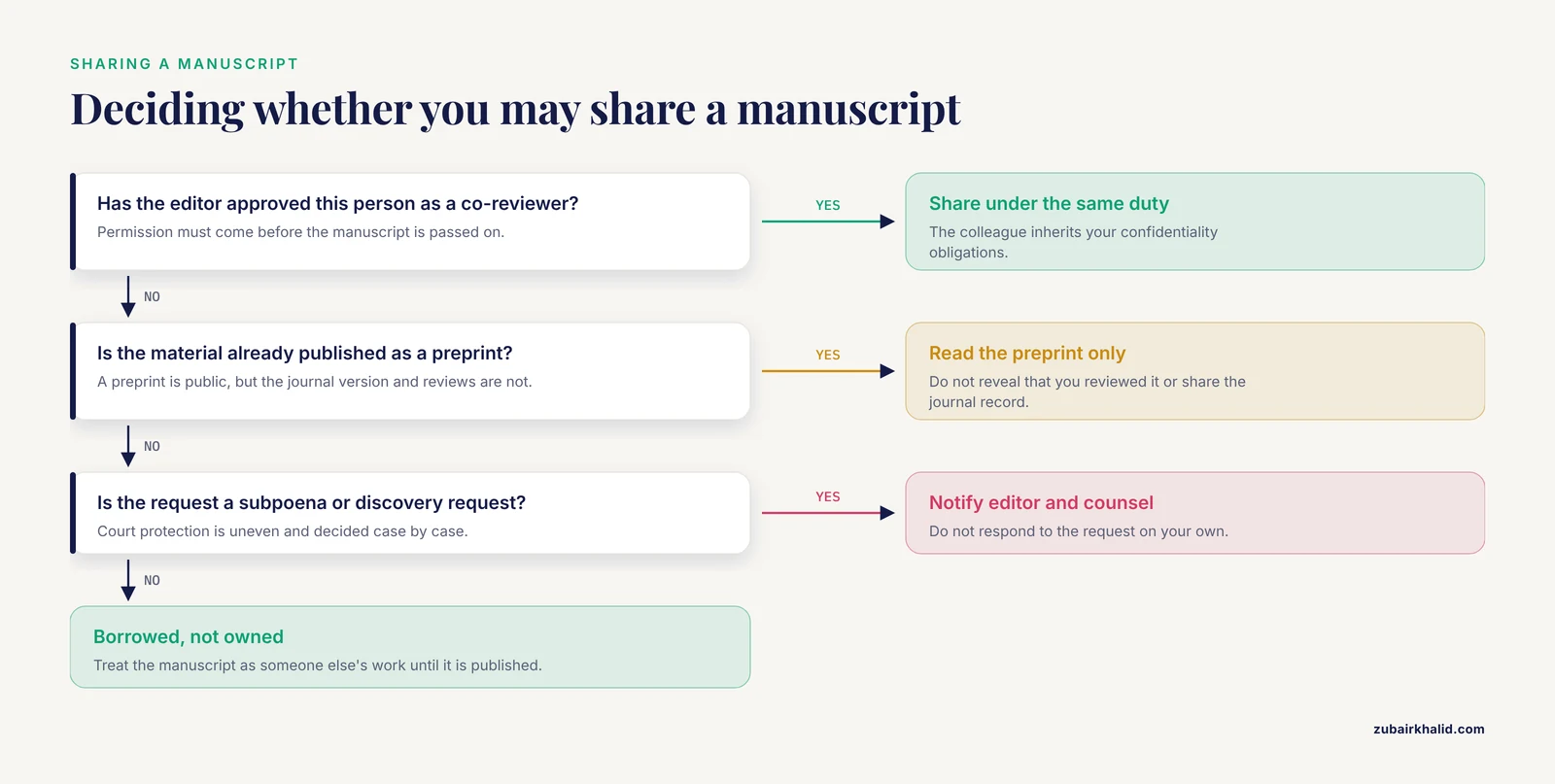
Not without the editor's permission. If a colleague's expertise is genuinely needed, write to the editor and request formal approval. Once approved, the colleague takes on the same confidentiality duty you hold.
Can I use an idea from a manuscript I reviewed in my own research?
No. Using unpublished data, methods, or ideas from a manuscript for your own advantage before the work is published is a recognized ethical violation in publication ethics frameworks.
Are peer review documents legally protected in the United States?
Sometimes, but not automatically. Courts have affirmed journal confidentiality in illustrative cases, using principles such as the journalist's privilege, the scholar's privilege, and objections based on the burden of producing documents, yet no universal privilege covers all peer review material [8].
Does confidentiality end when the paper is published?
The manuscript's content becomes public on publication, but other duties continue. Reviewer identities usually stay confidential, unpublished review comments stay confidential in closed-review journals, and your role as a reviewer should not be disclosed unless the journal uses open review.
Can I post my reviewer certificate or review record on social media?
A certificate showing that you reviewed for a journal is generally acceptable, but analyses of this practice warn that certificate details combined with other information can expose confidential manuscripts, so share credentials without naming specific papers or review periods that narrow the identification.
Can I use ChatGPT or another AI tool to help me review a manuscript?
Only if the journal's policy permits it. Uploading a manuscript to a public AI tool sends the confidential text to a third party outside the editorial process, and current ethics guidance treats that as a disclosure unless the tool operates inside an approved workflow [14],.
Do single-blind and double-blind review change the confidentiality duties?
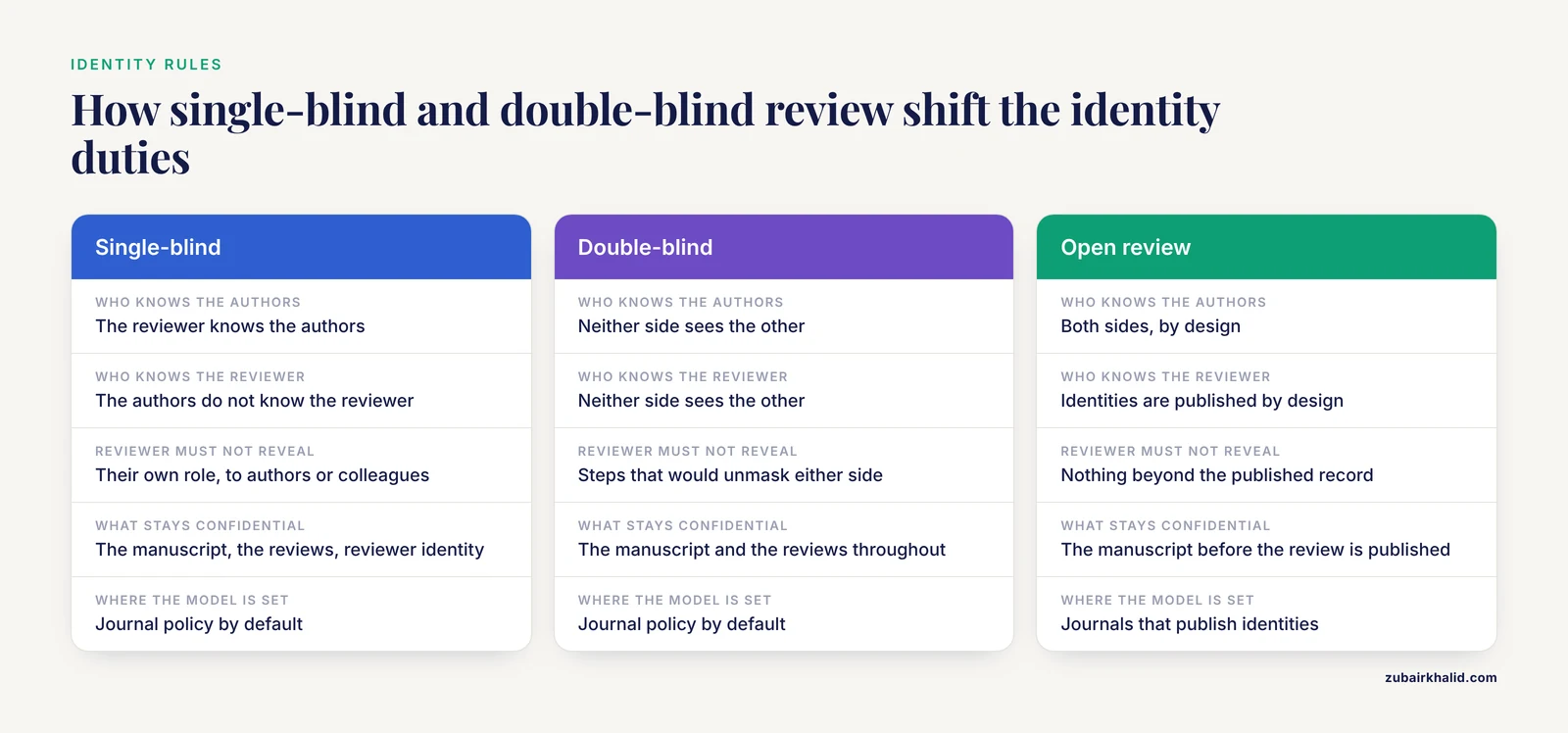
The material duties stay the same, but identity rules shift. In single-blind review, you must not reveal your identity to the authors. In double-blind review, you must also avoid actions that would reveal the authors' identities to yourself or your own to them, such as searching for the preprint or reverse-lookups of the submission.
Sources
- The Peer-Review System and Ethical Standards in Publishing
- Peer Review: Issues in Physical Medicine and Rehabilitation
- Addressing ethical issues in peer review - new guidelines available from COPE
- Ethical Pitfalls in Scientific Publishing
- Ethical issues in publication.
- Peer review process, open-access publication, and ethical issues in scientific communications
- Peer Review in Biomedical Publication: Fourth International Congress,
- US legal principles and confidentiality of the peer review process.
- Ethical issues in developing a scientific communications system
- Principles of Scientific Writing and Biomedical Publication
- Court rules public policy bars discovery of peer review material and deposing of participants.
- Peer review ethics in Iranian LIS scholarly journals: a comparison between views of reviewers and authors
- Social Media and Peer Review: An Ethical Glance at Sharing Reviewer Credentials
- Generative artificial intelligence and ethical considerations in health care: a scoping review and ethics checklist
- High Costs, Long Waits, and Ethical Dilemmas: A Review of Challenges in Academic Publishing
- A systematic review of ethical considerations of large language models in healthcare and medicine