How to Use Peer Feedback to Improve Your Thesis Draft
By Dr. Zubair Khalid, DVM, MS, PhD ·
Peer review of a draft is the cheapest quality check available to a graduate student, and many students waste it. They send a 200 page file with the words "any feedback?", receive a scattering of comma fixes and praise, and conclude that peer feedback does not work. The problem is process, not people. This guide gives you a working peer feedback thesis draft protocol: prepare a review-ready draft, brief two to four classmates, collect their comments in a structured log, triage every comment with a scoring rule, revise in ordered passes, and verify that the revision fixed what reviewers actually flagged.
By the end you will be able to:
- Build a thesis timeline with feedback rounds built in rather than bolted on
- Produce a review copy with line numbers and correct sharing permissions
- Turn loose reviewer comments into a triaged, decision-ready log
- Revise in an order that avoids wasted work
- Verify the revision with three concrete checks before your advisor sees the draft
Have these on hand before you start:
- A complete or near complete draft, as a word processor file and a PDF
- A word processor with commenting (Microsoft Word, Google Docs, or LibreOffice Writer)
- A spreadsheet program for the comment log
- A PDF reader that supports margin comments, such as Adobe Acrobat Reader
- Your department's thesis handbook and formatting checklist
- A calendar with your advisor review date and defense window already marked
A full cycle takes about three weeks for a chapter-length draft and about six weeks for a whole thesis. Most of that time is scheduling and bookkeeping, and the payoff is a draft your advisor can review on substance instead of typos.
What Peer Feedback Can and Cannot Do
Peers read your thesis the way your committee will, as fresh readers who do not share your assumptions. That makes them good at catching specific problems: unclear arguments, broken chapter structure, inconsistent terminology, missing context a newcomer needs, and figures that only make sense after someone explains them aloud. Those problems are hard for you to see, because after months of work you read what you meant, not what you wrote.
Peers cannot do two jobs. They do not hold the scientific judgment your advisor holds, so a peer who says your sample size seems small is raising a question for your advisor, not settling it. They also do not hold the approval authority your committee holds, so the cleanest peer review on campus guarantees nothing by itself. Use peers to make the draft clear, complete, and internally consistent. Use your advisor to judge whether the science is sound and sufficient.
Structure separates useful peer feedback from a pile of margin notes. The comment "I got lost here" is useful once. A log that records where each reader got lost, why, and what you did about it stays useful through revision, advisor review, and defense preparation. The protocol below builds that log.
How to Plan a Thesis Timeline That Leaves Room for Feedback
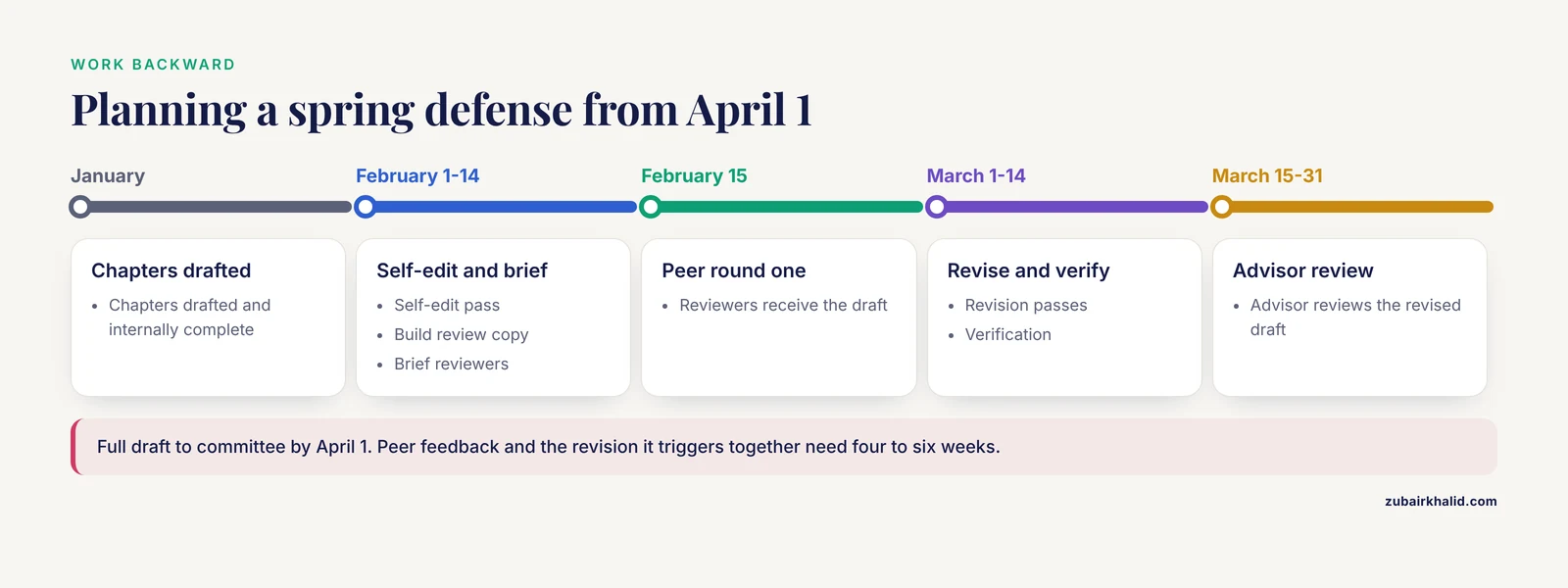
Planning a thesis is easier backward. Start from the date the finished draft must reach your committee, then subtract every stage that has to happen first. The two stages students forget are peer feedback and the revision it triggers, which together need four to six weeks.
Worked backward plan for a spring defense:
Target: full draft to committee by April 1

April 1        Full draft to committee
March 15-31    Advisor review of the revised draft
March 1-14     Revision passes and verification (peer round one)
February 15    Peer reviewers receive the draft (round one)
February 1-14  Self-edit pass, build review copy, brief reviewers
January        Chapters drafted and internally complete
Three parameters control the plan:
- Reviewer turnaround. Seven to ten days per round for a chapter-length draft, agreed with each reviewer before you send anything. A date agreed in advance is a commitment, a date implied in an email is a hope.
- Buffer. One week of slack per feedback round. A reviewer who gets sick or travels should not move your defense date.
- Rounds. One full peer round, one targeted follow-up on revised sections, then the advisor round. More peer rounds rarely help before the advisor has judged the science.
The most common planning mistake is sequencing peer feedback after the advisor round. Late peer comments reopen questions the advisor already closed, and you lose weeks reconciling them. Peer feedback belongs before the advisor round, on a draft complete enough to judge.
A Peer Feedback Thesis Draft Protocol, Step by Step
The protocol has seven steps. Each step lists the actions, the parameters that matter, and the output you should expect.
Step 1: Choose and Brief Your Reviewers
Pick two to four reviewers with different jobs:
- One person in your subfield who can judge methods, statistics, and figure design
- One person outside your subfield who represents the naive reader your committee members will partly be
- If available, one person who has already defended and knows what the genre demands
Send a brief with every request. The brief bounds the review, which keeps turnaround short and comments usable.
Subject: Thesis draft review, 30 pages, comments by March 14

What you are reviewing: Chapter 3 (Results) and Chapter 4 (Discussion) of my
thesis on drought response in switchgrass. 30 pages, line numbered PDF.

Three questions:
1. Does each result in Chapter 3 support exactly one claim in Chapter 4?
2. Where did you lose the thread or want a citation?
3. Are the figures readable without the captions?

How to respond: margin comments in the shared PDF. Do not fix typos.
Deadline: comments back by March 14, so I can revise before my advisor
sees the draft on March 28.
Expected output: each reviewer confirms the deadline in a reply, and the comments that return answer the three questions instead of wandering across the manuscript.
Parameters that matter:
- Scope. One or two chapters per reviewer per round. A whole thesis in one pass produces shallow comments and slow reviewers.
- Questions. Two or three specific questions beat "any feedback?", because they tell reviewers where their attention has the highest value.
- Format. Margin comments in one shared file, so every thread stays anchored to its text.
If your program has no obvious peers, look for a graduate writing group, a lab meeting slot, or your university writing center, which many graduate schools run for thesis writers at any stage.
Step 2: Prepare a Review-Ready Draft
Do a self-edit before anyone else reads. Fix typos, broken cross-references, placeholder citations, and unfinished sentences. Reviewers who see surface noise spend their attention on commas instead of arguments, and you get a worse review from the same people.
Then make the copy easy to comment on. In Word, turn on line numbers under Layout, then Line Numbers, then Continuous, so reviewers can cite a line instead of describing a page. In LaTeX, load the lineno package and switch numbering on:
\usepackage{lineno}
\linenumbers
Expected output: continuous line numbers down the left margin of the compiled PDF, so a comment can say "line 214" instead of "the paragraph after the bootstrapping figure".
If you use Google Docs, set the share role to Commenter before sending the link. If you circulate a PDF, export it with commenting allowed. Name every file with a date, for example thesis_ch3_2026-03-01.docx, and keep one folder per round so nobody edits a stale copy.
Check the result: open the shared link in a private browser window. You should see the document in Commenter mode, with line numbers visible and commenting enabled.
Fixes for Tool Failures That Block Feedback
- Google Docs shows a "You need access" screen when a reviewer opens your link. Fix: open the Share dialog and change the role from Viewer to Commenter, or add the reviewer by email address.
- A PDF reader shows a message like "You do not have permission to add comments to this document" when the PDF was exported with commenting off. Fix: re-export with commenting enabled, or share the word processor file instead.
- Word shows "This modification is not allowed because the selection is locked" when editing restrictions are on. Fix: open the Review tab, choose Restrict Editing, then Stop Protection.
- A reviewer comments on the wrong version because two files had similar names. Fix: date-stamped filenames and one folder per round, as in Step 2.
Step 3: Collect Feedback in a Structured Log
As comments arrive, transcribe each one into a spreadsheet row. The log is the single place where every comment, classification, and decision lives, and it makes round two faster than round one.
Use this schema:
id,section,location,quote,type,effort,decision
001,Methods,p. 42,"Why is each treatment replicated only three times?",validity,20,revise
002,Discussion,p. 61,"Passive voice through this whole paragraph",style,5,revise
003,Chapter 2,p. 25,"I lost the argument between sections 2.2 and 2.3",structure,90,revise
004,Discussion,p. 58,"You never address the alternative explanation",missing,60,revise
005,Introduction,p. 8,"This paragraph never says what problem you solve",clarity,25,revise
006,Results,p. 47,"You call this heat shock here and treatment A on page 44",consistency,10,revise
Expected output: the file opens as seven columns. The quote column holds the reviewer's words, the type column holds your classification, and the decision column starts as revise and ends as your final call.
Parameters that matter:
- Type vocabulary. Six types cover almost everything: validity, missing, clarity, structure, consistency, style. Step 4 defines them.
- Effort. Your estimate, in minutes, of what a real fix costs. Estimate high, because lowball estimates push hard work into time slots that do not exist.
- One row per comment. If a reviewer packs three issues into one comment, split it into three rows. Mixed rows get mixed decisions, and mixed decisions get lost.
Step 4: Triage Every Comment With a Scoring Rule
Do not edit while you triage. Read every comment once, wait a day, then classify. First reactions are defensive, and the day between reading and deciding is where honest classification happens.
The table maps each comment type to what it sounds like, what it usually means, the first action, and the weight used for scoring.
| Comment type | What it sounds like | What it usually means | First action | Weight |
|---|---|---|---|---|
| Validity | Is n = 3 enough to support this claim? | A method or statistic may not carry the claim | Check the analysis, add a justification, or soften the claim | 3 |
| Missing | You never address the alternative explanation | A needed element is absent | Draft the missing passage or add the citation | 3 |
| Clarity | I do not understand this paragraph | A sound idea is buried in tangled writing | Rewrite the passage for a first-time reader | 2 |
| Structure | This belongs in Methods | Content sits in the wrong section | Move or merge the content | 2 |
| Consistency | You use two names for the same treatment | Terminology, units, or numbers disagree | Standardize with find and replace | 1 |
| Style | Too much passive voice in this section | Sentence level polish | Batch the edits for the final pass | 1 |
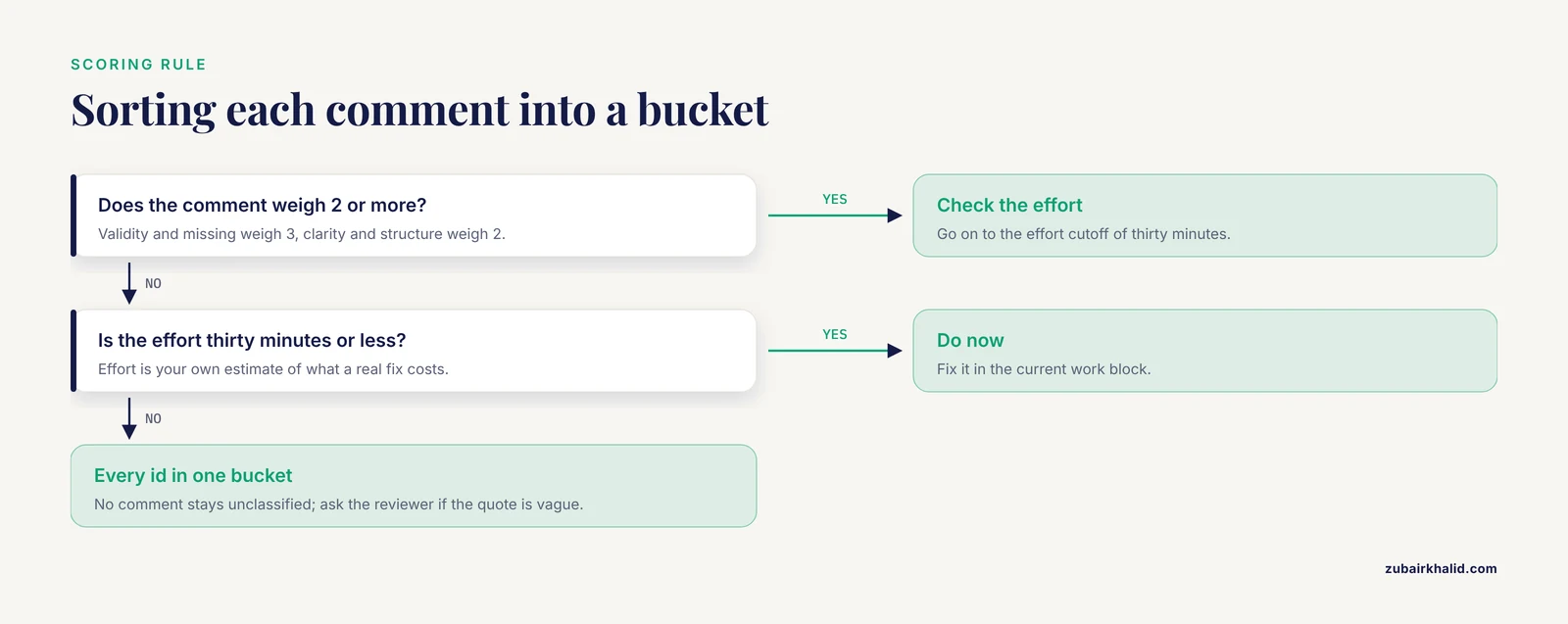
Two parameters drive the triage:
- Weight. Validity and missing comments can change whether a chapter's claims hold, so they outrank everything. Style comments matter, but they never change a conclusion.
- Effort cutoff. Thirty minutes separates quick fixes from scheduled work.
Apply the rule with a short script:
weights = {"validity": 3, "missing": 3, "clarity": 2, "structure": 2,
           "consistency": 1, "style": 1}

comments = [
    {"id": "001", "type": "validity", "effort": 20},
    {"id": "002", "type": "style", "effort": 5},
    {"id": "003", "type": "structure", "effort": 90},
    {"id": "004", "type": "missing", "effort": 60},
    {"id": "005", "type": "clarity", "effort": 25},
    {"id": "006", "type": "consistency", "effort": 10},
]

for c in comments:
    w = weights[c["type"]]
    if w >= 2 and c["effort"] <= 30:
        c["bucket"] = "do now"
    elif w >= 2:
        c["bucket"] = "schedule"
    else:
        c["bucket"] = "batch"

for c in sorted(comments, key=lambda x: (weights[x["type"]], x["effort"])):
    print(c["id"], c["type"], c["effort"], c["bucket"])
Expected output:
001 validity 20 do now
004 missing 60 schedule
005 clarity 25 do now
003 structure 90 schedule
002 style 5 batch
006 consistency 10 batch
Worked example: comment 001 questions a replication number, weighs 3, and needs about 20 minutes to fix by adding a justification and a citation. It lands in do now. Comment 003 says a chapter loses its argument, weighs 2, and needs a 90 minute restructure. It lands in schedule, booked as its own work block rather than squeezed between small tasks.
Check the result: every comment id appears in exactly one bucket, and no comment is unclassified. If you cannot classify a comment, the quote is probably too vague, so ask the reviewer what they meant before deciding.
Step 5: Revise in Passes, Global Before Local
Fixing a comma inside a paragraph you are about to delete wastes the comma. Revise in this order:
- Argument pass. Work the do now and schedule buckets, which hold the weight 2 and 3 comments. Fix validity problems, draft missing content, repair structure. Move chapter by chapter and leave sentence level wording alone.
- Section pass. Reread each section against the biology thesis structure described below, and move anything sitting in the wrong place.
- Consistency pass. Run find and replace for every term reviewers flagged. Check that units, gene names, statistical test names, and treatment labels match across Methods, Results, and Discussion.
- Line pass. Apply the batch bucket in one sitting, at the end, when nothing above it will move.
For the Results and Discussion pass, work from a checklist:
Results and Discussion checklist
[ ] Every figure caption states n, the statistical test, and what error bars show
[ ] Every claim in the Discussion maps to a specific result in the Results
[ ] No result appears in the Discussion that never appeared in the Results
[ ] The limitations paragraph names the two biggest weaknesses plainly
[ ] Terminology matches across Methods, Results, and Discussion
[ ] The abstract states the question, the approach, the main result, and the implication
Claims often need tightening during this pass. A claim a reviewer flagged as vague usually lacks its anchor:
Before: These findings suggest that drought priming improves recovery.
After:  Primed plants regained leaf area faster than unprimed plants after
        rewatering, which supports the priming hypothesis from Chapter 1.
Write or rewrite the abstract last, after the Results and Discussion are stable, because it compresses both.
Step 6: Verify the Revision
Verification answers one question: did the revision fix what reviewers flagged, without breaking anything else? Run three checks.
First, the structure audit. Count words per section and compare the proportions with your program's expectations:
sections = {
    "Abstract": 292,
    "Introduction": 3800,
    "Materials and Methods": 5100,
    "Results": 7400,
    "Discussion": 6200,
}

total = sum(sections.values())
for name, words in sections.items():
    print(f"{name}: {words} words, {words / total:.0%} of the main text")
print(f"Total: {total} words")
Expected output:
Abstract: 292 words, 1% of the main text
Introduction: 3800 words, 17% of the main text
Materials and Methods: 5100 words, 22% of the main text
Results: 7400 words, 32% of the main text
Discussion: 6200 words, 27% of the main text
Total: 22792 words
In this example the Results and Discussion together carry about 59 percent of the main text, a common pattern in experimental biology theses. Compare your proportions with your department's handbook rather than with any universal rule, because thesis formats differ between programs.
Second, the decision audit. Filter the comment log so every row shows a final decision: revise, reject with a one line reason, or defer to the advisor. No blank cells. A blank cell means the comment resurfaces in the next round.
Third, the cross-check. Reread the abstract against the final Discussion and confirm the main claims match. Confirm every figure and table is cited somewhere in the text, in order. Run the spellcheck and your citation manager's document report one last time.
Step 7: Close the Loop and Run the Follow-Up Round
Send each reviewer a short delta summary: what you changed, what you rejected and why, and what you deferred. Then request one targeted follow-up pass on the revised sections only, with a three to five day deadline. The targeted pass protects reviewer time and catches collateral damage from large edits, such as an argument that broke when a section moved.
One full round plus one targeted pass is usually enough before the advisor round, then stop. Extra peer rounds before the advisor sees the draft polish sentences while scientific problems wait.
Where Peer Feedback Matters Most in a Biology Thesis Structure
Most biology theses follow the IMRaD pattern (Introduction, Methods, Results, and Discussion), expanded into chapters with an abstract, references, and appendices. Feedback value is not spread evenly across that structure, so spend reviewer attention where it pays.
- Abstract. Written last, read first. Peers verify that a reader can state your question, approach, main result, and implication after a single reading. If a peer cannot, the abstract fails its one job.
- Introduction. Peers verify the funnel: broad context, the specific gap, your question, your approach, and a closing roadmap. The most common peer finding here is a missing problem statement, which is what comment 005 in the sample log captures.
- Materials and Methods. A subfield peer checks whether another student could repeat the work: model organism strain, reagent sources, equipment, software versions, and statistical tests all named with enough detail to reproduce.
- Results. Peers check that every figure and table is self-explanatory, that captions carry n and test details, and that the text interprets the figures rather than repeating them.
- Discussion. Peers check that each claim traces to a specific result, that alternative explanations get honest treatment, and that limitations appear before the closing significance paragraph.
- References and appendices. Peers notice missing citations in passing, but a citation manager report does this job more reliably than any human reader.
Introduction, Results, and Discussion deserve the most reviewer hours. Methods problems matter most to the one subfield reader you assigned that role in Step 1.
Peer Feedback Thesis Draft Protocol Tips
These tips target the places where the protocol breaks in practice.
- Assign roles, not just chapters. One reviewer reads figures only, one reads methods only. Role-based reviews produce deeper comments than general reads.
- Ask for stop points. Ask each reviewer to mark the exact sentence where they got confused or stopped believing a claim. Stop points locate problems precisely, which halves revision time.
- Timebox the review. Two to three hours per reviewer for a chapter-length draft. A timeboxed review gets done, an open-ended one drifts for weeks.
- Use the same rubric in both directions. When you review a classmate's draft, classify your own comments with the same six types. Giving feedback trains the judgment you need for receiving it.
- Keep a decisions journal. One line per rejected comment, with the reason. The journal stops round two from relitigating round one.
- Read twice, decide once. Read all feedback for understanding, wait 24 hours, then triage. Decisions made in the first hour are usually defensive.
- Tell your advisor. Mention that peer review is happening and what it covers. Surprises at the advisor stage cost goodwill you will want at defense time.
- Thank reviewers in writing and credit them in the acknowledgments. Reviewers who feel useful say yes to round two.
Common Mistakes and Limitations
These are the common mistakes that waste a feedback round, followed by the limits of the method.
- Collecting feedback too late. Peer feedback after the advisor round reopens settled questions and burns weeks. Schedule it before the advisor sees the draft.
- Sending an unbriefed draft. A large file with the message "any feedback?" returns silence or line edits. Always send the brief from Step 1.
- Treating every comment as a command. Reviewers are sometimes wrong. The log exists so you can reject a comment with a recorded reason, not to force compliance.
- Rejecting everything defensively. The mirror error. If more than a third of comments end as rejected, reread them after a day before defending that ratio.
- Editing while triaging. Triage is classification, revision is construction. Mixing them means vague comments never get resolved and hard comments never get scheduled.
- Losing threads across file formats. Comments pasted from a PDF into a new document lose their anchors. Keep one review file per round and transcribe comments into the log, do not copy the document.
- Letting peers line edit early. Style comments on an unstable structure get thrown away when the structure changes. Hold the batch bucket until the argument pass is done.
- Skipping verification. Without the decision audit and cross-check, the same comment reappears next round, and reviewers stop writing detailed notes.
Limitations. This protocol is a workflow, not a quality guarantee, and it assumes a conventional research thesis with an advisor and a committee. Departmental rules, formatting requirements, and your advisor's judgment override anything suggested here. If your program uses a different format, such as a thesis by publication, adapt the steps to that structure and follow your graduate school's rules.
Frequently Asked Questions
How many reviewers should read my thesis draft?
Two to four is the practical range. Three works for most chapters, because it gives you a subfield reader, a naive reader, and a spare if one reviewer drops out.
When should I ask peers for feedback on my thesis draft?
After the full draft exists and your own edit pass is done, and before your advisor's formal review. A draft that is 80 percent complete gets useful comments, a fragment gets sympathy.
What should I do when I disagree with a comment?
Log it, evaluate it against your data and your department's requirements, then either revise or reject it with a one line reason in the decision column. Never leave a comment unclassified.
Is peer feedback a substitute for my advisor's review?
No. Peers make the draft clear, complete, and readable. Your advisor judges whether the science is sound and sufficient, and your committee holds the approval authority.
How do I give useful feedback on someone else's draft?
Run the same protocol in reverse: read against two or three specific questions, comment in the shared file, and mark the exact sentence where you got lost.
How long should reviewers get with my draft?
Seven to ten days per round for a chapter-length draft, agreed before you send the file. Targeted follow-up passes on revised sections need only three to five days.
What if two reviewers contradict each other?
Find the question underneath each comment, because contradictions usually point at the same weakness from two directions. If the evidence does not settle it, defer the pair to your advisor with both quotes attached.
How many feedback rounds should I run before my advisor sees the draft?
One full round plus one targeted follow-up on the revised sections. More rounds polish sentences while scientific problems wait for the advisor round.