Consent and Assent in Pediatric Biobanking: How to Choose
By Dr. Zubair Khalid, DVM, MS, PhD ·

Consent is the legally binding permission given by a parent or guardian for a child's samples and data to be stored and used, while assent is the child's own affirmative agreement to take part. The rule of thumb for choosing: the younger the child and the more open-ended the biobank, the more weight falls on parental permission, and the older and more capable the child, the more your process should center the child's own assent, dissent, and eventual reconsent as an adult.
This guide walks through what consent and assent mean in pediatric biobanking ethics, compares the main process options side by side, and shows how to match an option to a real study.
Why Pediatric Biobanking Is Different
A biobank is a facility for the collection, preservation, storage, and supply of biological samples and associated data, following standard procedures so the material can support scientific and clinical use [1]. Pediatric biobanks store blood, tissue, saliva, and linked health data from children, often for decades. That time span creates ethical problems that adult biobanks never face.
First, the participant cannot give full legal permission. Parents or legal representatives generally provide informed consent, and children's own opinions are sought alongside, a pattern documented across laboratories in ten European countries [2]. Second, the child matures during the life of the biobank. A sample drawn at age six may still be in storage when that person turns twenty-six. Third, the science keeps moving. Modern pediatric biobanks support biomarker discovery, molecular stratification, and analyses that were not foreseeable when the sample was collected, which raises questions about future reuse that a one-time signature cannot fully settle [3].
Ethical scholarship has responded by reframing consent itself. Rather than a single signing event, consent is increasingly treated as an ongoing process with sustained participant engagement, a trend expected to shape the field for years to come [4]. A major review of the pediatric biobanking landscape in Europe describes a shift away from parental permission alone toward recognizing the minor's own positive agreement, confirming that the child is the research participant, not the parents [5].
What Consent and Assent Actually Mean
Informed consent is the voluntary agreement of a legally authorized person, here a parent or guardian, after receiving adequate information about the study's purpose, procedures, risks, benefits, data handling, and the right to withdraw. Consent is a legal act. Under the US Common Rule framework (45 CFR Part 46, Subpart D), research with children generally requires parental permission and, when capable, the child's assent, with the institutional review board (IRB) judging whether assent is required and how it should be documented.
Assent is the child's affirmative agreement to participate. Because the child cannot legally consent, assent is not a substitute for parental permission. It sits alongside it. The concept is relatively young in research ethics, and although many guidelines mention it, few explain what it is actually for [6].
Dissent is the child's expressed refusal or objection. A child who says no, or who shows sustained reluctance, can veto participation even when a parent has signed the consent form. How biobanks treat dissent, along with informing the child and preserving voluntariness, emerged as a defining theme in a four-country case study of pediatric biobanks including LifeLines, PIAMA, Young-HUNT3, and the Oxford Radcliffe Biobank's contribution to the Children's Cancer and Leukaemia Group tissue bank [7].
Reconsent is asking the participant, once they reach the age of majority, to decide again whether their stored samples and data may continue to be used. This is one of the issues that separates pediatric biobanking from adult biobanking, alongside capacity to consent and the consequences of genetic results for the child and family [8].
Side-by-Side Comparison of the Main Options
| Option | Who holds the decision | Child's role | Best suited for | Main strength | Main drawback |
|---|---|---|---|---|---|
| Parental permission only | Parent or guardian | None | Very young children, minimal-risk residual tissue, emergency settings | Simple, fast, legally clean | Ignores the child entirely, weakest for older children |
| Permission plus one-time assent | Parent decides legally, child agrees | Signs or verbalizes agreement once | Short-term studies, children roughly 7 to 14 | Satisfies standard IRB expectations | Static, may not reflect a maturing child |
| Permission plus assent with honored dissent | Parent and child together, child can refuse | Active voice, refusal respected | School-age children and adolescents in longitudinal collection | Respects the developing person, builds trust | Requires staff time, refusal may shrink the cohort |
| Personalized assent | Parent decides, child engaged individually | Content and process tailored to the individual child | Longitudinal pediatric biobanks aiming at ongoing engagement | Formative for the child, supports long-term relationships | Resource-intensive, needs researcher judgment |
| Deferred consent and reconsent at majority | Former child participant decides as an adult | Full decision authority after maturing | Birth cohorts and biobanks storing samples into adulthood | Restores autonomy at the right moment | Logistically complex, sample may be used for years before reconsent |
| Electronic consent and assent platform | Parent and child, digitally documented | Interactive, age-adapted content | Large biobanks seeking scalable, engaging processes | Strong comprehension and preference among teens and adults | Needs ethics review, focus groups flagged formatting and definition gaps |
The Options on Their Own Terms
Parental Permission Alone
Here the parent or guardian signs an informed consent document covering storage and future research use, and the child is not formally asked. This model appears in practice where children are very young or where the biobank operates under broad, minimal-risk conditions. The European survey of pediatric biobanking practice found that informed consent was generally given by parents or legal representatives, with children's opinions sought frequently but not universally [2]. Permission alone is defensible only for children too young to form any view about participation. Once a child can understand, in age-appropriate terms, that a piece of their body will be stored and used, permission alone starts to look like a missed obligation.
Permission Plus One-Time Assent
This is the default model most researchers know. The parent consents, the child receives a simplified information sheet, and the child signs an assent form if willing. It satisfies the regulatory baseline and works reasonably for bounded studies. Its weakness in biobanking is durability. A signature taken at age eight says nothing about the views of the eighteen-year-old whose sample is still in the freezer. Consent form analyses in Canada found that whether the scope of parental permission allows for a child's assent, dissent, or future consent varies widely across major centers, one of six emerging issues identified in pediatric consent documents [9].
Permission Plus Assent With Honored Dissent
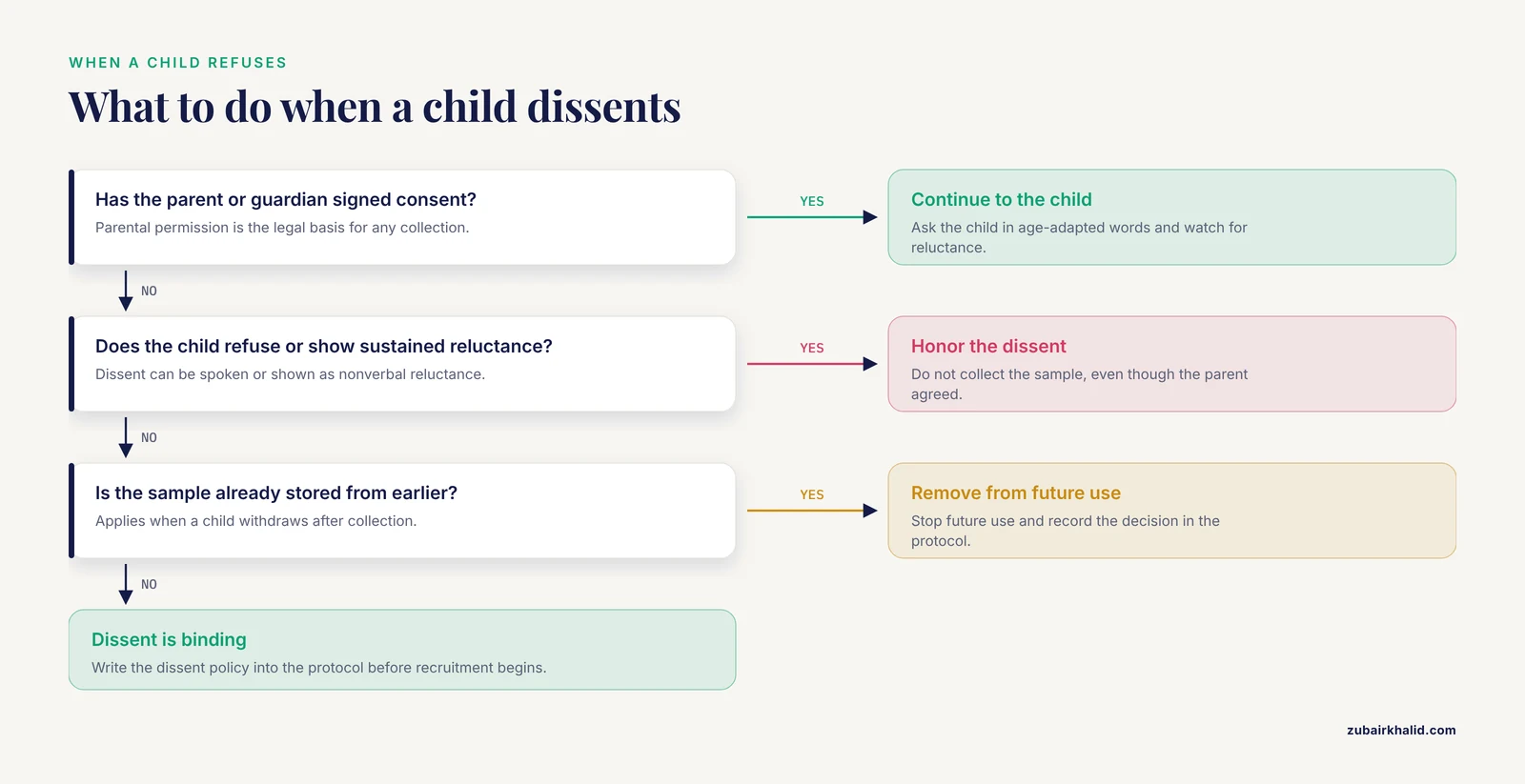
This model treats the child's no as operative. If a child dissents, the sample is not collected or is removed from future use, even though the parent consented. Adolescents themselves back this approach. In a survey of adolescents and parents at BC Children's Hospital and Vancouver high schools, clinic participants rated assent as more important and felt that parental consent alone was insufficient, and their willingness to donate specimens was higher than that of school participants [1]. The suggested age for assent had a median of 14.5 years among adolescent responses and 16 years among parental responses, with school parents the most conservative group [1].
The intensive care setting shows why dissent matters even under stress. In a study of adolescent and young adult patients and parents in the pediatric intensive care unit, all but one adolescent or young adult wanted a say in whether their samples would be used, while parents were divided, with 55 percent favoring child involvement in decisions [10]. Researchers concluded that efforts should improve comprehension and involvement of adolescents and young adults in these decisions [10].
Personalized Assent
Personalized assent adjusts both the content and the process of assent to the individual child [11]. Content tailoring means the information sheet matches the child's reading level, prior experience with research, and health situation. Process tailoring means the conversation happens at a suitable time, in a suitable setting, with room for questions, and possibly across more than one visit. The ethical case rests on engagement rather than autonomy. Giesbertz and colleagues argue that understanding assent as a junior version of informed consent adds little, because most children cannot make fully autonomous decisions and other safeguards protect against harm better. Engagement grounds, by contrast, fit the realities of childhood and give assent real value [6].
The payoff is practical as well as moral. Investing in the assent procedure is formative for the child, and the investment can result in ongoing engagement, important longitudinal information, stability for the research infrastructure, and increased participant knowledge about research activity [11]. The authors argue the assent procedure itself is formative, and that this investment should be a requirement for pediatric biobank research [11].
Deferred Consent and Reconsent at the Age of Majority
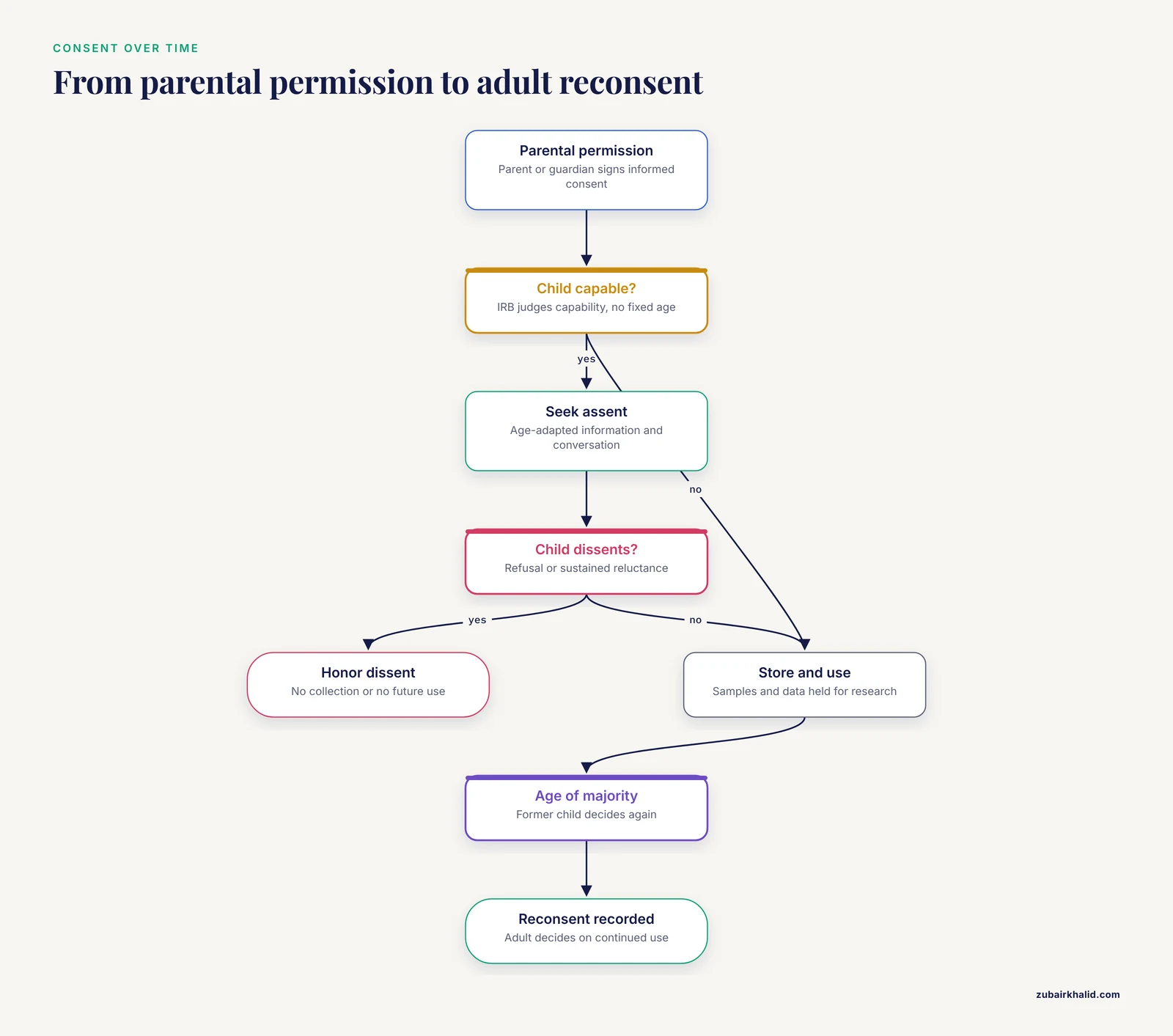
Deferred consent asks a maturing participant to affirm or refuse continued use of samples collected earlier. Reconsent at the age of majority is the formal version. Young people broadly accept both. In a co-produced survey of 102 children and young people in North East England, 91.2 percent found prospective consent acceptable, and 84.3 percent found deferred consent acceptable, with themes of altruism, benefits outweighing individual risk, frugality, and convenience recurring [12]. Notably, 72.3 percent had no prior knowledge of biobanking, which itself argues for educational content in any assent process [12].
Birth cohort studies have already operationalized these transitions. Investigators of six birth cohort studies with genetic components in Canada, Denmark, England, France, the Netherlands, and the United States reported handling initial parental consent followed by assent or consent from the maturing child, along with withdrawal and sample protection procedures [13]. Precision medicine raises the stakes, because governance must now manage evolving child autonomy, the significance of dissent, transition to adulthood, future sample reuse, and the distinction between consent to donate a sample and the legal basis for processing the associated personal data [3].
Electronic Consent and Assent Platforms
Electronic consent (e-consent) delivers study information through an interactive, multimedia platform and records the decision digitally. A prototype built for the BC Children's Hospital BioBank was tested with children, teens, and adults through surveys and focus groups. Teens and adults preferred online consent to paper (38 percent and 42 percent versus 17 percent and 16 percent), while children expressed no preference. Understanding was high across the board, with 100 percent of children, 92 percent of teens, and 98 percent of adults agreeing or strongly agreeing that they understood all the information given during the online process [14]. Focus groups with teens and adults still requested improvements in formatting and clearer explanation of terms like ongoing donation and privacy measures, and the finalized platform went forward for research ethics board approval [14]. E-consent is a delivery mechanism, not an ethical shortcut. It still requires the same underlying decisions about who is asked, what dissent means, and what happens at the age of majority.
How to Choose: The Criteria That Decide Real Cases
Biobank characteristics drive the choice. The multiple-case study of four pediatric biobanks concluded that a biobank's characteristics influence its motives for involving children, and those motives in turn shape how children are involved and how voluntary their participation can be [7]. Use the same logic. Ask five questions of your own protocol.
- What is the biobank's purpose and time horizon? A disease-specific bank drawing samples during routine clinical care has different obligations than a general-purpose bank storing samples for unforeseeable future studies. Open-ended future use pushes you toward assent with honored dissent and planned reconsent at majority [3][4].
- How old and how capable is the child population? There is no single legal assent age in the United States. IRBs determine capability, and empirical preferences give context. Adolescents in the BC survey placed the median suggested assent age at 14.5 years, while parents suggested 16 [1]. Younger children can still give simple verbal assent and meaningful dissent.
- What does dissent mean operationally? Decide before recruitment whether dissent blocks enrollment, blocks specific future uses, or triggers recontact. Make the policy explicit in the protocol and the assent materials so the child's refusal has a predictable consequence.
- Is the consent a document or a process? Treating consent as a process with ongoing engagement is the direction the field is moving [4]. If your biobank will recontact families, plan the assent conversation as the first step in a relationship, not the last [11].
- What capacity assessment will you use? A review of 330 research protocols involving participants with impaired consent capacity found that direct assessment by investigators was the most common method (32.7 percent), only 26 percent of studies used validated instruments, and biobank protocols made up 6.1 percent of the sampled studies [15]. For adolescents whose capacity is uncertain, specify in advance who assesses understanding and how.
Pros and Cons at a Glance
Readers searching for the pros and cons of pediatric biobanking ethics consent assent options usually want a tradeoff summary. Here it is, compressed.
Parental permission only. Pros are administrative simplicity and clear legal authority. Cons are exclusion of the child's voice and poor fit for adolescents, who themselves view permission alone as insufficient [1].
One-time assent. Pros are regulatory compliance and low cost. Cons are that it captures a single moment in a developing person's life and does not anticipate reconsent.
Assent with honored dissent. Pros are respect for the child and higher perceived legitimacy among adolescent participants [1][10]. Cons are potential cohort attrition and the need for staff trained to recognize dissent, including nonverbal reluctance.
Personalized assent. Pros are formative value for the child, longitudinal engagement, and infrastructure stability [11]. Cons are researcher time, the absence of a fixed script, and dependence on the moral responsibility and integrity of the researcher, as the concept's own proponents note [6].
Deferred consent and reconsent at majority. Pros are restoring decision authority to the person it belongs to and improving acceptability, which young people rate highly [12]. Cons are logistics of recontact, the risk of losing touch over years, and the awkward interval during which samples are usable before the participant has reaffirmed.
E-consent. Pros are strong comprehension ratings, teen and adult preference for online delivery, and scalability [14]. Cons are development cost, the need for ethics board review of the platform itself, and unresolved clarity around terms such as ongoing donation that even focus groups found confusing [14].
Worked Scenarios
Scenario 1: A 9-year-old with leukemia joining a hospital tissue bank during treatment. The parent signs consent covering storage and future research use. The child receives a brief, age-adapted assent conversation, since a child undergoing repeated procedures can understand that extra blood will be stored to help other sick children. Honor any refusal. Because the sample will outlast childhood, flag the record for reconsent at the age of majority, the practice described at the BC Children's Hospital BioBank [8].
Scenario 2: A population birth cohort enrolling infants for 20-year follow-up. Parents consent at enrollment with a broad, clearly described scope. Build a scheduled recontact calendar so the maturing participant receives assent materials at developmentally appropriate ages, then full reconsent at majority. Birth cohorts in six countries already handle this sequence of initial consent followed by assent and consent from the maturing child [13]. Distinguish, in your governance documents, the consent to donate a sample from the separate legal basis for processing personal data, a distinction highlighted in the precision medicine era [3].
Scenario 3: An adolescent PICU patient and a biorepository request. Time pressure is real, but the evidence says adolescents in this setting want a say, with all but one adolescent or young adult in the PICU study wanting input on whether their samples are used [10]. Use a two-step approach. Obtain parental permission immediately, seek the adolescent's assent as soon as clinically feasible, and document a later reconsent conversation.
Scenario 4: A large multi-site biobank rolling out e-consent. Follow the BCCHB model. Prototype the platform, collect feedback from children, teens, and adults on content, visuals, and satisfaction, revise based on focus group findings about formatting and term definitions, then submit the finalized version for research ethics board approval before use [14]. Offer a paper alternative, since a minority of teens and adults still preferred it.
Common Mistakes and Limitations
- Treating assent as a rubber stamp. Handing a child a form after the parent has signed, without conversation, converts assent into a paperwork ritual. Assent only has ethical value when the child can genuinely understand, question, and refuse [6].
- Ignoring dissent. The most common operational failure is collecting the sample anyway because the parent said yes. Decide your dissent policy in writing before enrollment begins.
- Forgetting the age of majority. Biobanks that never plan for reconsent leave adult participants whose childhood samples continue in use without their own authorization. Reconsent at majority is a recognized best practice area in pediatric biobanking [8].
- Using adult consent language for children. Comprehension depends on age-adapted content. A survey of young people found most had no prior knowledge of biobanking at all, which means assumptions about baseline understanding are unsafe [12].
- Assuming e-consent fixes comprehension. Even with high comprehension ratings, focus groups identified confusing terms like ongoing donation. Platform design needs user testing with children, not just adults [14].
- Conflating consent to donate with permission to process data. In precision medicine, the legal basis for processing associated personal data is a separate question from consent to sample donation [3].
- Skipping the ethics board review of new consent tools. Novel platforms and personalized assent procedures are themselves research-relevant processes requiring research ethics board review, as the BCCHB e-consent team demonstrated [14].
One limitation applies to everything above. Each protocol is different, and the right process for a specific study depends on its population, jurisdiction, and risk profile, so individual protocols need review by their own research ethics board or IRB rather than a decision based on a general article alone.
Frequently Asked Questions
What is the difference between consent and assent in pediatric biobanking?
Consent is the legally binding permission a parent or guardian gives for a child's samples and data to be collected, stored, and used. Assent is the child's own affirmative agreement, which accompanies but never replaces parental permission, and dissent is the child's refusal, which many biobanks treat as binding.
At what age should a child be asked for assent?
There is no fixed legal age. US regulations leave the judgment of capability to the IRB. In one adolescent and parent survey, the median suggested assent age was 14.5 years among adolescents and 16 years among parents, though younger children can give simple assent and meaningful dissent.
What happens if a child dissents but the parents consent?
The ethically supported practice is to respect the child's dissent and not collect or use the sample, even though the parent has legal authority. Biobanks should define dissent policy in advance and explain it in both the consent and assent materials.
Do pediatric biobanks need to reconsent participants when they turn adults?
There is growing consensus that they should. Reconsent at the age of majority is one of the defining ethical issues of pediatric biobanking, and birth cohorts and hospital biobanks increasingly build it into governance so the former child regains full decision authority.
Is electronic consent a good option for pediatric biobanks?
Yes, when it is user-tested and ethics reviewed. In testing at a pediatric hospital biobank, teens and adults preferred online consent to paper, comprehension ratings were very high across age groups, and focus group feedback improved formatting and clarified terms before approval.
Can one broad consent cover all future uses of a child's samples?
Broad consent can cover storage and future research use within a clearly described scope, but it does not remove other obligations, including assent, honored dissent, ongoing engagement, and reconsent at the age of majority, especially as precision medicine adds a separate legal basis for data processing.
Sources
- Opinions of Adolescents and Parents About Pediatric Biobanking.
- Pediatric biobanking: a pilot qualitative survey of practices, rules, and researcher opinions in ten European countries.
- Paediatric biobanking in the era of precision medicine: ethical, regulatory, and scientific challenges from childhood to adulthood.
- Ethical and legal considerations for pediatric biobank consent: current and future perspectives.
- Paediatric biobanking for health: The ethical, legal, and societal landscape.
- Clarifying assent in pediatric research.
- Consent procedures in pediatric biobanks.
- Ethical Challenges for Pediatric Biobanks.
- Emerging issues in paediatric health research consent forms in Canada: working towards best practices.
- Biobanking in the Pediatric Critical Care Setting: Adolescent/Young Adult Perspectives.
- Personalized assent for pediatric biobanks.
- Biobanking and consenting to research: a qualitative thematic analysis of young people's perspectives in the North East of England.
- Handling ethical, legal and social issues in birth cohort studies involving genetic research: responses from studies in six countries.
- Development of a Multimedia Electronic Consent Platform for Biobanking and Research Utilizing Opinions from Children, Teens, and Adults.
- Research Involving Participants With Impaired Consent Capacity: An Examination of Methods to Determine Capacity to Consent.