Paper vs. Electronic Lab Notebooks: A Practical Decision Framework
By Dr. Zubair Khalid, DVM, MS, PhD ·

A paper lab notebook is a physical, bound record you write and sign by hand, while an electronic lab notebook (ELN) is software that stores your experimental records digitally so you can search, share, back up, and audit them. The practical difference between paper and electronic lab notebooks comes down to one tradeoff: paper gives you unmatched flexibility at the bench with almost no setup, while an ELN gives you search, collaboration, and data integrity features that paper cannot match.
The rule of thumb is simple. Choose paper when you work alone, generate small amounts of data, and think best with a pen in your hand. Choose an ELN when your experiments generate large datasets, when other people need to read your records, when compliance or intellectual property matters, or when your data is born digital anyway. Most working scientists eventually land on a hybrid, and that is a legitimate answer too. This article gives you the decision framework, the side-by-side comparison, and the worked scenarios you need to pick with confidence rather than by habit.
Why this decision matters more than it used to
For most of the twentieth century, the laboratory notebook was the last paper component of an experiment. Every other step, from data acquisition to analysis to publication, went digital. The notebook stayed on paper largely by tradition, and that mismatch created real problems: experimental records trapped in a physical volume that could be lost, could not be searched, and could not be shared without a photocopier.
Researchers have been trying to fix this for a long time. Surveys of scientists found that despite the increasingly digital nature of research, adoption of purpose-built ELNs lagged because of cost, ease of use problems, and accessibility issues across different devices and operating systems [1]. Meanwhile, the volume of data a typical life science experiment produces kept growing. Modern experiments generate large datasets that simply cannot be documented on paper, which is why many researchers see ELNs as a promising path toward better reproducibility and transparency practices [2].
The landscape has changed since the early days. The first online ELNs appeared in the late 2000s, built with permissions systems, controlled sharing, audit trails, electronic signatures, and search, and developed in direct collaboration with working scientists [3]. Cloud platforms, general note-taking tools, and purpose-built ELNs now compete for the same job. That abundance is good news, but it also makes the paper versus electronic decision harder, because "electronic" is no longer one thing. A decision framework helps you cut through the noise.
What each option actually is
The paper lab notebook (pLN)
A paper notebook is a bound or spiral volume where you record procedures, observations, raw readings, and ideas in ink, usually dated and signed. Its core strengths are flexibility and immediacy. You can write anything, sketch anything, tape in a printout, and start working with zero training. A well-kept paper notebook is also a durable, tamper-evident legal record, which is why patent offices and many institutions have historically accepted it as evidence of conception dates.
Its weaknesses are equally concrete. Data retrieval from paper notebooks is labor intensive, notebooks can be misplaced, and a single notebook is a single point of failure that loses every entry in the volume if it disappears [4]. Sharing means photocopying or transcribing. Search means flipping pages.
The electronic lab notebook (ELN)
An ELN is software designed for recording experiments, typically with structured entries, attachments, timestamps, search, and access control. Purpose-built ELNs add features paper cannot offer at all: audit trails that log who changed what and when, electronic signatures, permissions systems that let you share one experiment with a collaborator without exposing the whole notebook, and integration with instruments and data management systems [3][5].
ELNs also support practices that go beyond recordkeeping. They can be tasked with functions not commonly found in paper notebooks, such as inventory control, and they enable automatic archiving, data duplication, and searchable indices [4]. Because records are digital from the start, an ELN makes it far easier to share a notebook alongside a publication, which one researcher has proposed as a standard practice to increase transparency and reduce biased or incomplete reporting of results [6].
The hybrid
A hybrid approach uses paper for bench-side freehand capture and an ELN as the system of record, with photographs or scans of key pages uploaded into the electronic system. Many labs run this way in practice, especially during a transition period. The hybrid keeps the strengths of each format but adds a translation step, and that step is where discipline matters. An unscanned paper page is an orphan record.
Side-by-side comparison
The table below is the core of the paper vs. electronic lab notebooks decision. Rate each row against your own lab situation.
| Criterion | Paper lab notebook | Electronic lab notebook |
|---|---|---|
| Flexibility at the bench | Total. Write or sketch anything, tape in anything | Good, but constrained by the interface and templates |
| Freehand drawing and annotation | Native | Limited. Workarounds include snapshots and drawing add-ons [7] |
| Search and retrieval | Manual page flipping | Instant, full-text search across all entries |
| Data volume handling | Poor. Modern large datasets cannot realistically be documented on paper [2] | Strong. Built for large datasets, images, spreadsheets, and instrument exports [8][2] |
| Collaboration and sharing | Photocopies or transcription | Controlled sharing with permissions, often in real time [3][8] |
| Data integrity and compliance | Depends entirely on the writer's discipline | Audit trails, electronic signatures, versioning, and streamlined good documentation practices [3][8] |
| Backup and loss risk | Single physical copy. Loss of the volume loses all entries [4] | Automatic archiving and duplication when configured properly [4] |
| Remote access | None. The notebook sits on the bench | Real-time and remote monitoring of experiments from any authorized device [8] |
| Cost | Low per unit, but recurring and invisible in staff time | Software licenses and training costs. Cost has been a major adoption barrier for available ELNs [1] |
| Learning curve | Essentially none | Real. Lack of training has restricted ELN use in academic settings [8] |
| Integration with instruments and LIMS | None. Manual transcription | Possible and increasingly common, but integration paths are not always well established [5] |
| Legal and IP value | Long-standing acceptance as a signed, dated record | Electronic signatures and audit trails provide equivalent or stronger evidence when configured correctly [3] |
| Adoption disruption | Zero. It is the default | High in a paper-based environment. Adoption is usually disruptive at first [5] |
When to use paper
There are honest reasons to stay on paper, at least for part of your work. Use a paper notebook when most of the following are true:
- You work solo or in a very small lab. If nobody else needs your records on a day-to-day basis, the collaboration advantage of an ELN is largely theoretical.
- Your data volume is small. If a typical experiment fits in a few pages of handwritten observations plus a handful of instrument printouts taped in, paper handles it fine.
- You think by writing and sketching. Reaction schemes, circuit doodles, and quick calculations happen faster on paper for many people. Users in both electronic and paper camps reported the inability to freehand into a notebook as a real limitation of electronic methods in one translational lab study [7].
- You have no reliable institutional software support. If your institution will not provide, license, or back up an ELN, forcing one onto a shaky foundation creates worse records than paper.
- You are in a short project with no compliance requirements. A two-week rotation project may not justify the setup cost of any new system.
Notice what is missing from this list: any claim that paper is more "scientific." It is not. Paper's advantages are practical, not epistemic, and every one of them has a cost on the other side of the table, chiefly in retrieval, sharing, and loss risk [4].
When an ELN wins
The electronic case is strongest in four situations.
First, when data is born digital. Almost all data acquisition, analysis, presentation, and archiving in modern research already happens with electronic tools, and the documentation should live where the data lives [9]. If your experiment produces gigabytes of imaging data or spreadsheet exports, a paper notebook is only an index pointing at files scattered across devices, and that gap is exactly where data integrity problems begin [9].
Second, when collaboration or oversight matters. Cloud-based ELNs enable enhanced data sharing, streamlined workflows, and real-time remote monitoring. In a bioprocess engineering teaching lab, implementing an ELN improved learning outcomes, simplified information exchange, and allowed superior data integrity compared with paper, and student responses indicated the ELN was better than paper for compliance [8]. The same logic applies to any lab where a supervisor, collaborator, or successor needs to read your records without borrowing your desk.
Third, when compliance, reproducibility, or intellectual property is at stake. Purpose-built ELNs provide audit trails, electronic signatures, and controlled sharing, which are the structural features that regulators and patent processes care about [3]. Good documentation practices, meaning the standardized habits that make records trustworthy and complete, are easier to enforce when the system itself prompts and timestamps them [8].
Fourth, when integration would pay off. ELN benefits increase when the notebook connects to laboratory information management systems, chromatography data systems, analytical instruments, and scientific data management systems [5]. If your lab runs samples through instruments continuously, an integrated electronic record reduces transcription errors at the point where paper notebooks generate them most.
The decision framework, step by step
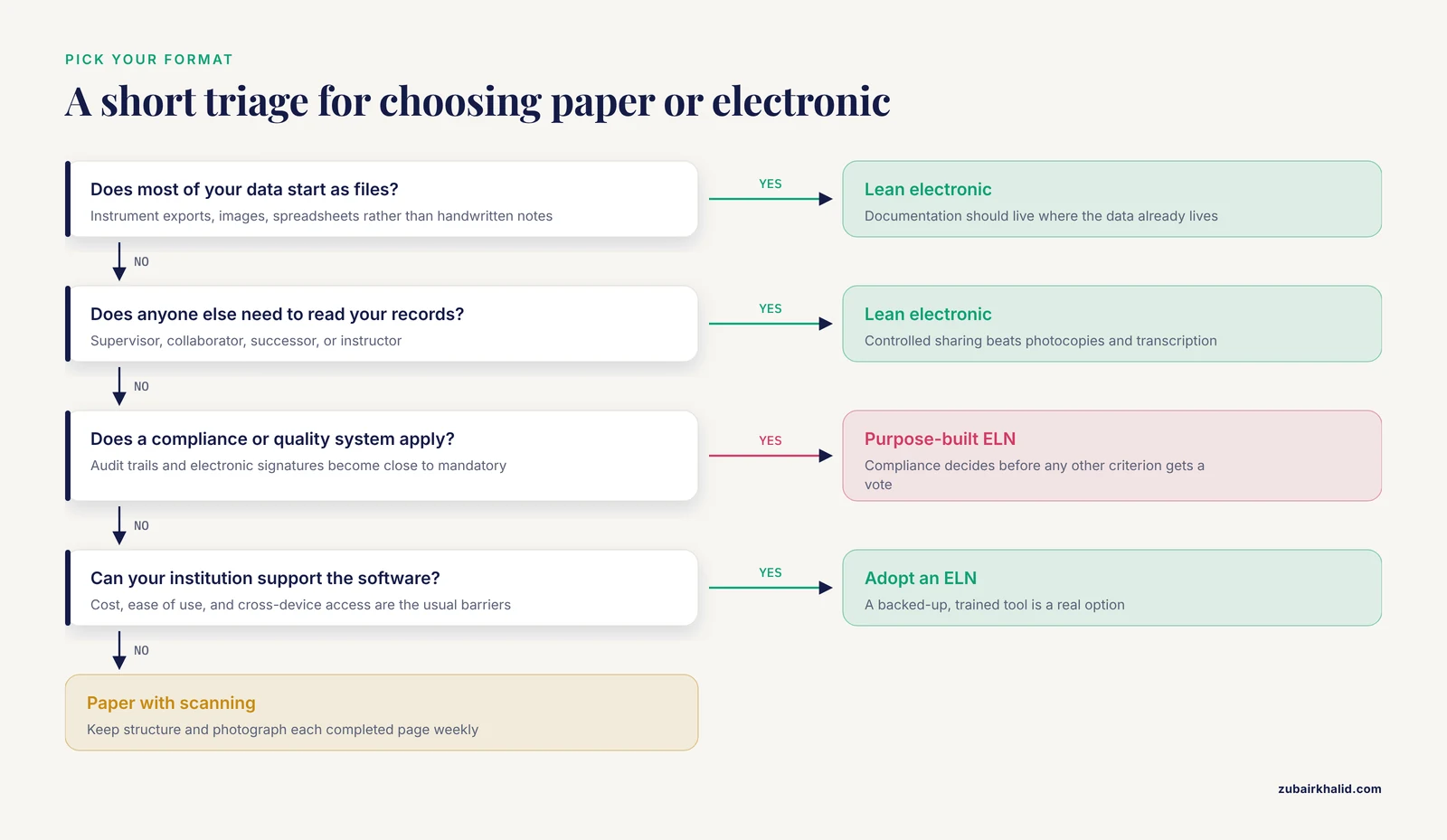
Work through these six questions in order. Each answer pushes you toward paper, toward an ELN, or toward a hybrid.
- Where does your data originate? If most of it starts as files on instruments or computers, lean electronic. If most of it starts as handwritten observation, lean paper or hybrid.
- Who else needs to read your records? Nobody but you favors paper. Anyone else favors electronic.
- What does compliance require? If you work in a regulated or quality-driven environment, a purpose-built ELN with audit trails and electronic signatures is close to mandatory [3]. If nothing formal applies, this criterion carries no weight.
- What can your institution actually support? Cost, ease of use, and cross-device accessibility are the three barriers that most consistently block ELN adoption [1]. A tool your IT office will not back up is not a real option.
- How do you and your lab members actually work? If people resist the interface, they will keep parallel paper records, and dual systems are worse than either one alone. Training matters here. Academic implementation of an ELN succeeded partly because the course invested in training and iterative improvements to the user experience over two subsequent years [8].
- Can you commit to a hybrid discipline? If you choose paper, decide now how paper records get digitized and archived, and write that rule down.
If you answered electronic on three or more of the first four questions, adopt an ELN. If you answered paper on most of them, stay on paper but borrow the ELN habits that matter most, especially consistent structure and regular backup by scanning. If your answers split evenly, you are the natural audience for a hybrid.
Worked scenarios
Scenario 1: A first-year graduate student in molecular biology
Priya does plasmid cloning and small-scale cell culture. Her data is a mix of handwritten observations, gel photos, and a few spreadsheet files per week. She works mostly alone, her advisor rarely reads her notebook directly, and her institution provides no licensed ELN.
The framework points to paper with structured scanning. Her freehand-heavy work style suits paper, her data volume is small, and her institutional support is absent. To borrow the electronic habits that matter, she should keep every entry dated, photograph each completed page weekly, and store the photos in a dated cloud folder. That single habit removes paper's biggest weakness, the single-point-of-failure loss risk [4], at almost no cost.
Scenario 2: A university lab course with thirty students
A bioprocess engineering teaching lab adopted a cloud-based ELN to train students in electronic record keeping, good documentation practices, and data integrity. The result was streamlined workflows, quick data recording and archiving, enhanced sharing and collaboration, and better compliance, with user experience measures improving across two subsequent years of the course [8].
Teaching labs are a near-ideal ELN use case. Instructors need to see student records remotely, students need to share group work, and the course itself has a pedagogical goal of teaching modern documentation. Paper fights all three goals.
Scenario 3: An academic translational medicine lab
A translational lab at NYU School of Medicine tested whether an ELN could fully replace paper notebooks by running every routine experimental record through a general note-taking tool for six months. The team concluded that the advantages of the electronic approach greatly outweighed the inability to freehand, and they solved the freehand problem with imported snapshots and drawing add-ons rather than giving up [7].
The lesson generalizes. The most common paper advantage, freehand capture, has workable electronic substitutes. If freehand is the only thing keeping your lab on paper, that reason is weaker than it feels.
Scenario 4: A materials science collaboration across institutions
Two labs use different ELN platforms and need to exchange structured experimental data between them. Until recently, that interoperability problem had no general solution, and platform choice created data lock-in. A newly described server-based tool now connects disparate ELN systems through Python APIs, letting researchers map and transfer values and entry types between platforms, demonstrated by connecting chemistry and materials science ELNs [10].
The practical takeaway for anyone choosing a platform today is to ask the interoperability question before signing up. Ask how your data leaves the system, in what format, and whether automated exchange with your collaborators' systems is possible [10].
Scenario 5: A quality-driven industrial lab
A lab operating under a quality management system needs signed, traceable records for every run. Purpose-built ELNs in the quality assurance and quality control category exist precisely for this, as one of five market categories identified in a review of 35 ELN products, alongside pools for biology, chemistry, general research and development, and multidiscipline use [11]. Here the decision framework terminates at compliance before any other criterion gets a vote.
An electronic lab notebook comparison that actually helps
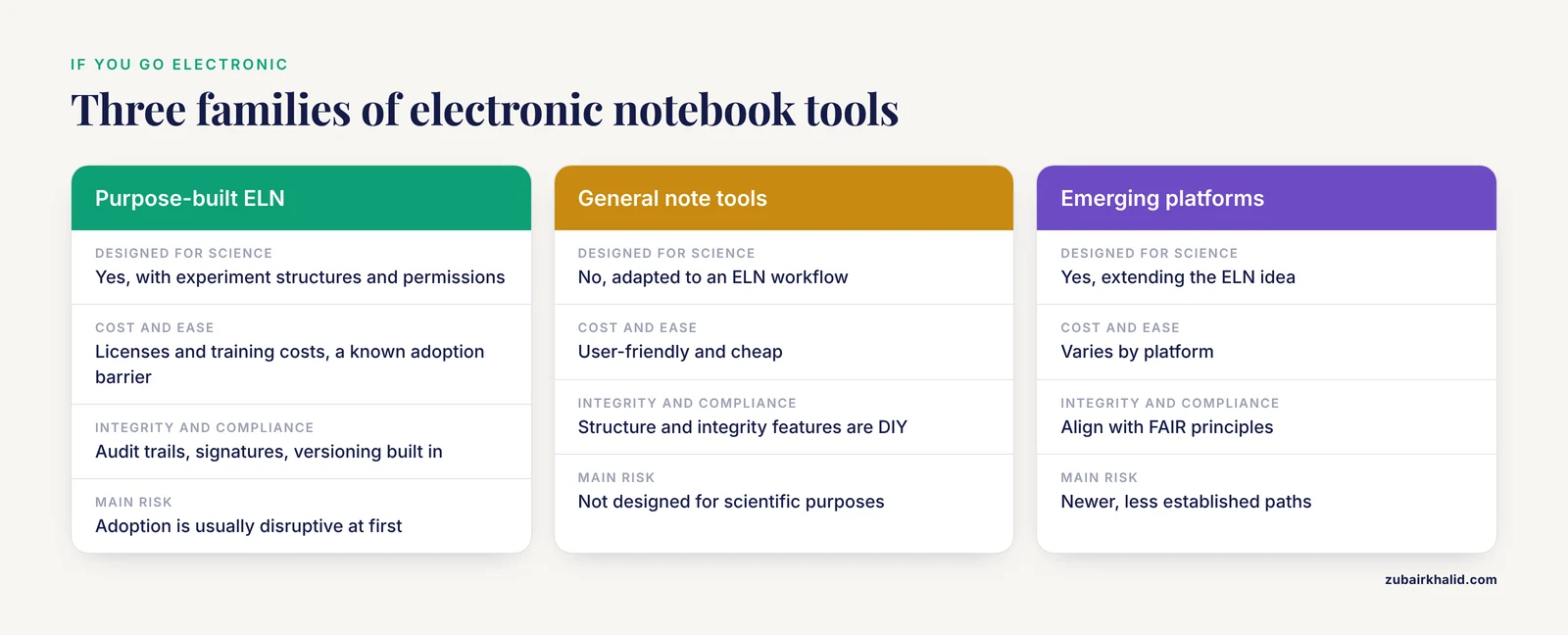
If the framework points you electronic, the next decision is which kind of electronic tool. There are three broad families.
Purpose-built ELNs are designed for scientific documentation, with experiment structures, audit trails, signatures, and permissions [3]. They range from quality-system products to free-form research tools, and reviews have grouped the market into categories such as quality environments, biology, chemistry, research and development, and multidiscipline pools to help labs shortlist candidates [11]. Modern ELNs are described as indispensable for data management, collaboration, and documentation in research laboratories [10].
General note-taking tools such as Evernote or Microsoft OneNote can serve as ELNs with some adaptation. In a biomedical research institute survey, respondents preferred OneNote over a scientifically designed commercial ELN, and a practical guide exists for adapting OneNote to an ELN workflow that can be adjusted to other general-purpose tools [2]. The tradeoff is real: these tools are user-friendly and cheap, but they were not designed for scientific purposes, so structure, integrity features, and compliance support are DIY projects [2].
Emerging and specialized platforms extend the ELN idea. Recent work formalizes artificial intelligence workflows as ELN protocols and treats AI execution as ELN experiments, aligning with FAIR principles, which stand for findability, accessibility, interoperability, and reusability of data [12]. Minimum-information checklists for reporting, such as guidelines developed for therapy experiments, have been implemented both as an ELN and as a simple spreadsheet format, showing that structured documentation standards can live in either medium [13].
Whichever family you choose, evaluate candidates against the barriers documented in the user studies: total cost, ease of use, and whether it works across the devices and operating systems your lab actually owns [1]. A platform that fails any of those three tests will not be adopted, no matter how impressive its feature list.
Your lab notebook template, in either format
The format debate matters less than structure. A good lab notebook template, paper or electronic, captures the same core elements. The idea has formal backing: minimum information checklists exist precisely so that experiments are recorded in a systematic, unambiguous fashion that allows aggregation and reuse of data [13].
A workable template includes:
- A unique experiment or study identifier. Labs that adopt structured identifiers can link experiments to samples, data files, and reports. Guidance on setting up unique study IDs exists specifically to maintain and enhance best documentation practices [9].
- Date, time, and operator name. Electronic systems timestamp automatically [3]. On paper, you must date and initial every page by hand.
- Purpose and hypothesis. One or two sentences stating why the experiment exists.
- Methods and protocol version. Enough detail that a competent colleague could repeat the work. Link or reference the full protocol rather than transcribing it.
- Raw data and observations. Readings, photographs, instrument outputs, and anomalies, recorded as they happen, not reconstructed later.
- Deviations. Any departure from the protocol, with a note on why. Undocumented deviations are where reproducibility dies.
- Results and interpretation. What happened and what you think it means, kept clearly separated.
- Signatures or sign-off. A dated signature closes the entry. Electronic versions use electronic signatures backed by audit trails [3].
- Links to samples and files. If your ELN integrates sample management, tie each entry to the physical aliquots it consumed. Integrated sample and experiment management reduces lost and mislabeled samples, clarifies relationships between samples and experiments, reduces experimental error, and improves search and productivity [14].
Common Mistakes and Limitations
Mistake 1: Treating the ELN as a paper notebook with a screen. An ELN is not just a replacement for paper. It is a new method of storing and organizing data, and labs that simply mirror their paper workflow in software capture none of the search, sharing, or integration benefits [4]. Redesign the workflow, not just the medium.
Mistake 2: Choosing a platform before mapping your data. Labs that pick software first end up fighting their own data types. List what you actually produce, images, spreadsheets, instrument files, chemical structures, then choose the tool that handles that list.
Mistake 3: Ignoring interoperability and lock-in. The proliferation of diverse ELN platforms creates real challenges for researchers who need to exchange data between systems [10]. Before adopting, test the export. If your data cannot leave cleanly, you are building on rented ground.
Mistake 4: Skipping training and assuming intuition. Limited training and a shortage of people with ELN knowledge have restricted adoption in academic and industry labs, which often continue relying on cumbersome paper recordkeeping [8]. Budget real training time, and improve the setup based on user feedback over subsequent cycles, as the teaching lab example did [8].
Mistake 5: Running parallel paper and electronic systems indefinitely. If people keep a shadow paper notebook because the ELN is inconvenient, you have two incomplete records instead of one complete one. Fix the inconvenience, often an ease-of-use or accessibility problem [1], or formally designate which system is authoritative.
Mistake 6: Assuming digital means backed up. An ELN on a laptop with no institutional backup is a single point of failure with extra steps. Confirm where the data lives, how it is archived, and how duplication works [4].
Mistake 7: Documenting after the fact. Records reconstructed from memory at the end of the week are not records, they are summaries. Both formats require capture at the bench, at the moment of the observation.
A limitation worth naming plainly. The notebook, whether paper or electronic, does not make your science correct. What it does is preserve the raw data trail so that questions about results can be answered later. That function has teeth. In one published case, a paper was retracted after lab members found significant discrepancies in the reproducibility of results, and the discrepancies came to light only because raw data available at the core facility could be retrieved and examined against the reported findings [15]. Trustworthy recordkeeping is what makes that kind of investigation possible at all.
Finally, the framework above is a decision aid, not a policy. Individual institutions, funding agencies, and regulatory bodies impose their own recordkeeping requirements, and your lab's specific obligations always override general advice.
Frequently Asked Questions
What is the main difference between paper and electronic lab notebooks?
Paper notebooks are flexible, freehand, and require no setup, but they are hard to search, hard to share, and easy to lose. Electronic lab notebooks trade some flexibility for search, controlled collaboration, automatic backup, audit trails, and the ability to handle large digital datasets directly.
When should I choose paper over an ELN?
Choose paper when you work mostly alone, your data volume is small, your workflow is freehand-heavy, and your institution offers no software support. If any of those conditions changes, revisit the decision.
Can an ELN completely replace a paper notebook?
In many settings, yes. A translational research lab that recorded all routine experimental information in a general note-taking tool for six months concluded that it effectively replaced paper notebooks, with freehand limitations solved using imported snapshots and drawing add-ons [7].
Can I use OneNote or Evernote as my lab notebook?
You can, with adaptation. Survey respondents at one biomedical institute actually preferred OneNote over a purpose-built commercial ELN, and published guides explain how to adapt these general tools to an ELN workflow [2]. Accept that you will build the structure and integrity features yourself.
How do I choose between the many ELN platforms?
Shortlist by category first, since reviews group products by audience such as quality environments, biology, chemistry, or general research use [11]. Then evaluate the three barriers that sink most adoptions: cost, ease of use, and cross-device accessibility [1]. Finish by testing export and interoperability before committing.
What should every lab notebook entry contain?
At minimum, a unique experiment identifier, date and operator, purpose, methods or a protocol reference, raw data and observations as they happen, documented deviations, interpretation, and a dated signature or sign-off. Structured minimum-information checklists formalize this idea and can be implemented in either medium [13].
Sources
- Electronic lab notebooks: can they replace paper?
- A quick guide for using Microsoft OneNote as an electronic laboratory notebook.
- eCAT: Online electronic lab notebook for scientific research.
- Make it better but don't change anything.
- Electronic laboratory notebooks progress and challenges in implementation.
- Scientific honesty and publicly shared lab notebooks: Sharing lab notebooks along with publication would increase transparency and help to improve honesty when reporting results.
- Using Evernote as an electronic lab notebook in a translational science laboratory.
- Implementation and use of cloud-based electronic lab notebook in a bioprocess engineering teaching laboratory.
- Electronic Lab Notebooks and Experimental Design Assistants.
- ELNdataBridge: facilitating data exchange and collaboration by linking Electronic Lab Notebooks via API.
- A review of electronic laboratory notebooks available in the market today.
- Empowering chemists in drug design: Delivering AI solutions through an ELN framework at the enterprise level.
- Guidelines for information about therapy experiments: a proposal on best practice for recording experimental data on cancer therapy.
- The benefits of integrated systems for managing both samples and experimental data: An opportunity for labs in universities and government research institutions to lead the way.
- RETRACTED: In vitro and in vivo evaluation of degradation, toxicity, biodistribution, and clearance of silica nanoparticles as a function of size, porosity, density, and composition.