How to Avoid Overpromising in Grant Proposals
By Dr. Zubair Khalid, DVM, MS, PhD ·

Overpromising in grant proposals most often starts with a single habit: writing the aims from the outcome backward. A writer decides what the finished story should say, then drafts the proposal as if that story were already guaranteed. The first thing to check, before any other revision, is whether each specific aim describes a question you can honestly fail to answer. If an aim reads like a scheduled discovery rather than a testable hypothesis, you have found the core problem.
Overpromising means committing in writing to results, timelines, or impact that your methods, preliminary data, or budget cannot realistically support. Reviewers read thousands of proposals. They know the difference between ambition and inflation, and they penalize inflation because it signals inexperience with real experimental work. This guide covers the causes of overpromising in grant proposals, a diagnostic sequence for finding inflated claims in your own draft, a troubleshooting table for the most common symptoms, and concrete rewriting techniques that show how to fix overpromising without making the proposal sound weak.
What Overpromising Looks Like in a Draft
Overpromising rarely announces itself. It hides in ordinary sentences that sound confident and harmless. The most common forms are:
- Outcome verbs. "This project will identify the mechanism driving X" promises a discovery. "This project will test whether protein Y regulates X" promises an experiment. The second version is just as ambitious, and it is honest about uncertainty.
- Best-case timelines. A five-year plan in which every experiment works the first time, every reagent arrives functional, and every animal model behaves as published. Reviewers who run labs know this plan is fiction.
- Milestones that are actually goals. A milestone such as "identify three novel regulators" can fail. A milestone such as "complete proteomic profiling of 40 samples" is a process you control. Proposals that confuse the two give reviewers nothing to hold you accountable to except luck.
- Impact statements that skip steps. "Findings will transform early cancer detection" jumps from a bench experiment to clinical practice without the intermediate validation, regulatory, and deployment work that the proposal does not fund.
- Preliminary data stretched past its shape. Two pilot experiments presented as proof that the central hypothesis holds, when they only show the assay runs.
Each of these forms has the same underlying mechanism. The writer substitutes the emotional arc of the project (what everyone hopes will happen) for the operational plan (what will actually be done, measured, and reported). Reviewers notice the substitution quickly, because the operational details are exactly what an experienced reader scans for first.
The Causes of Overpromising, From Most Common to Rarest
Understanding why proposals overpromise makes the fixes easier to apply. The causes below are ordered by how often they appear in real drafts.
1. Writing under excitement rather than under plan
The most common cause is timing. Writers draft the aims section during the phase of greatest enthusiasm, often before the methods are worked out, then retrofit the methods to match the promises. The result is a document where the excitement is structural. Grant proposal planning that starts with the methods and works forward to the claims produces the opposite structure, and it is the single most effective prevention.
2. Misreading what reviewers reward
Many writers believe reviewers fund certainty. In practice, reviewers fund credible uncertainty, meaning hypotheses stated sharply, with failure defined and alternatives ready. A proposal that admits the central question might resolve negatively, and explains what the project still delivers in that case, reads as more fundable, not less. Writers who have not yet served on a study section often get this backward, and the pattern is reinforced by reading funded aims pages that compress years of de-risking work into three confident sentences.
3. Missing methodological depth
A subtler cause is not knowing where a method actually breaks. Proposals written by writers new to a technique tend to promise what the technique promises in review articles rather than what it delivers at the bench. Hot research areas amplify this problem because the published literature is itself optimistic, and a proposal built on optimistic citations inherits their optimism.
A concrete illustration comes from circulating tumor DNA (ctDNA) research, where ctDNA refers to fragments of tumor DNA circulating in the blood. ctDNA has emerged as one of the most promising biomarkers in oncology, with proposed applications ranging from minimal residual disease detection (meaning the small amount of cancer that remains after treatment) to prognosis and treatment monitoring. A 2026 viewpoint in EBioMedicine examined recurring methodological and statistical pitfalls in longitudinal ctDNA studies and found that even core performance language was shaky. The authors showed that metrics such as sensitivity (the fraction of truly positive samples a test correctly detects) and specificity (the fraction of truly negative samples correctly called negative) are inherently time-dependent in this setting, and that problems with how lead time is defined distort reported performance [1]. A proposal writer citing the enthusiastic headlines of this field, without the analytical caveats, would promise a level of diagnostic certainty that specialists know the current literature does not deliver.
4. Institutional and deadline pressure
Co-principal investigators, department chairs, and collaborators sometimes push for stronger language, particularly in impact sections, because they are optimizing for a different audience. This cause is rarer than enthusiasm but harder to fix, because the writer must push back on a senior colleague in writing.
5. Genuine misunderstanding of the science
The rarest cause is a real conceptual error, where the writer does not realize that the proposed experiment cannot distinguish between the competing hypotheses. This cause is rare because most writers who lack the conceptual grounding also lack the confidence to promise outcomes. When it does occur, only external review by a domain expert catches it.
A Diagnostic Sequence for Your Own Draft
Work through this sequence after completing a full draft, not during writing. Each step takes minutes and each one catches a distinct failure mode.
Step 1. Underline every promise verb. Mark each instance of "will identify," "will prove," "will establish," "will determine the role of," and "will transform." For each, write down the experiment that would deliver it and the experiment that would refute it. Any promise without a refuting experiment is a red flag.
Step 2. Test each aim against failure. For each specific aim, ask what the project contributes if the aim fails. If the answer is nothing, the aim is written as a guarantee. Rewrite it as a question with interpretable outcomes in both directions.
Step 3. Audit the timeline against failure. Trace the critical path, meaning the sequence of experiments that everything else depends on. If year one rests on a single construct, a single cell line, or a single reagent lot, the plan has a single point of failure. Reviewers mark these.
Step 4. Match every quantitative claim to a source. Every number in the proposal (effect size, sample size, expected fold change, timeline in months) should trace to your own preliminary data, a published study you cite, or a vendor specification. Unsourced numbers are the fingerprints of overpromising.
Step 5. Read the impact section as a skeptic. Ask which claims would survive a reviewer who has watched a decade of biomarker candidates fail in validation. Claims about biological insight survive. Claims about clinical transformation, made from unfunded early-stage work, usually do not.
Troubleshooting Table: Symptoms, Causes, and Fixes
This table is the core repair reference. Find the symptom that matches your draft, confirm the cause, and apply the fix.
| Symptom | Likely cause | How to confirm | Fix |
|---|---|---|---|
| Aims read as guarantees ("This study will reveal...") | Outcome written before methods | Swap in the verb "test" and check whether the aim still makes sense | Rewrite each aim as a hypothesis or question with defined success criteria |
| Timeline has no room for failed experiments | Plan built from best-case assumptions per experiment | Count how many steps in year one must all succeed for year two to start | Add buffer time, start with the highest-risk aim, and state what you do if it fails |
| Milestones describe discoveries, not work | Goals and milestones conflated | Ask whether the milestone could fail and still produce a reportable result | Define process milestones (samples collected, assay validated, dataset locked) plus explicit go/no-go criteria |
| Large conclusions drawn from one or two pilots | Enthusiasm substituting for evidence | List every claim and the exact experiment supporting it | Scale the claim's strength to the data, or add a small pilot to the proposal |
| Feasibility section describes the field, not your lab | Feasibility borrowed from literature | Check whether sentences say "the field has shown" instead of "our laboratory has" | Cite your own publications, named equipment, and collaborator roles |
| "Data will be analyzed statistically" with no plan | Analysis treated as an afterthought | Look for the primary endpoint, the model, and the sample-size rationale | Name the endpoint, the statistical test or model class, and the basis for sample size |
| Impact section leaps from bench to clinic | Pressure to demonstrate translational value | Check whether any intermediate validation steps are described | State a staged impact, with the funded stage described concretely and later stages framed as conditional |
| Methods section copied from a landmark paper | Technique depth missing | Check whether parameters, controls, and known failure modes are discussed in your context | Adapt the method to your system and cite the adaptation decisions |
How to Fix Overpromising: Rewriting Techniques That Work
These are the working solutions, organized by the part of the proposal they repair. Each technique preserves ambition while restoring credibility.
Rewrite the verbs
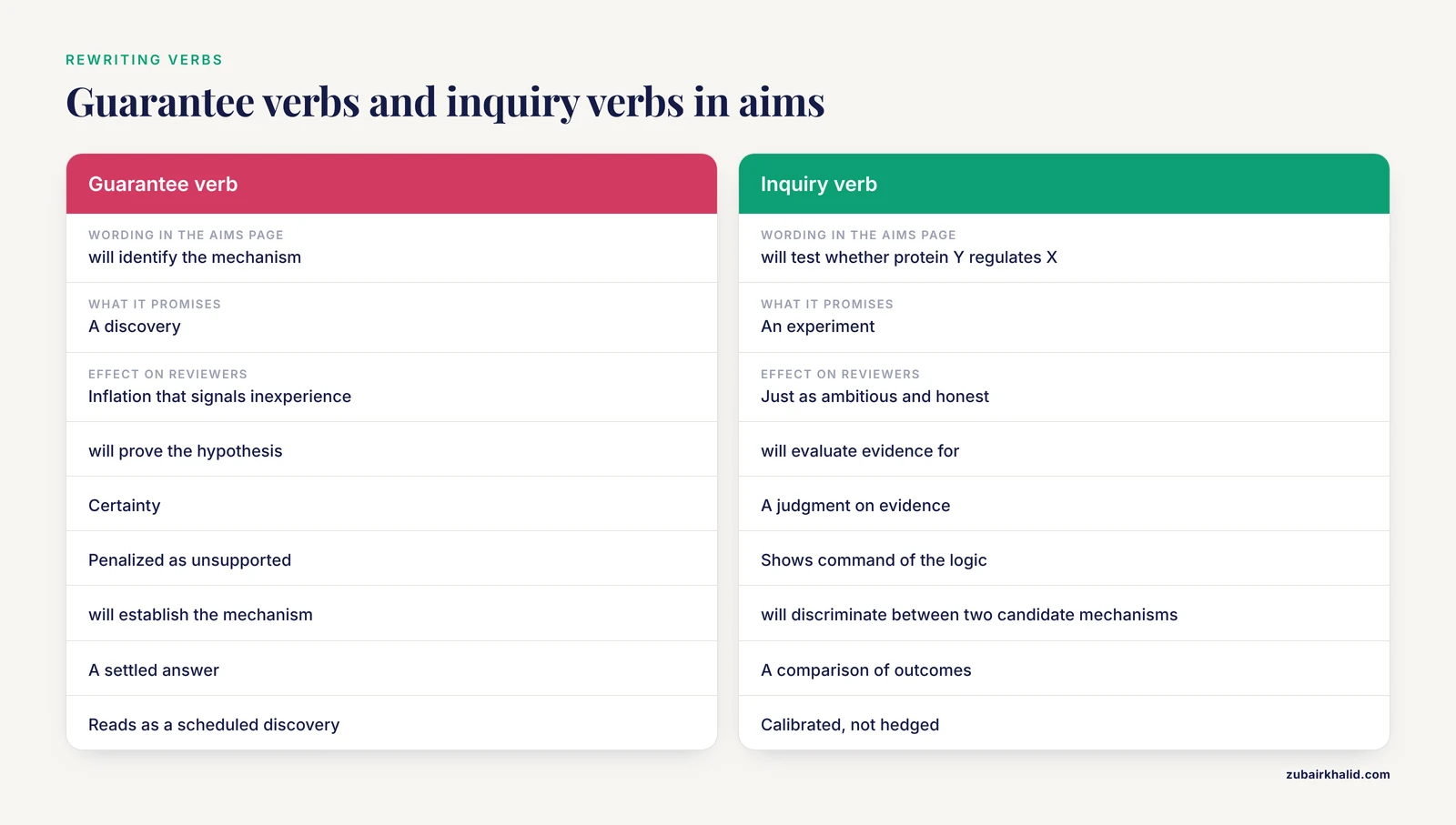
The fastest and most effective fix is a verb audit. Replace guarantee verbs with inquiry verbs across the aims page:
- "will identify" becomes "will test whether," "will determine whether," or "will estimate"
- "will prove" becomes "will evaluate evidence for"
- "will establish the mechanism" becomes "will discriminate between two candidate mechanisms"
Note that this is not hedging. A hedged proposal says "we hope to explore." A calibrated proposal says "we will run experiment X, which distinguishes outcome A from outcome B, and either result advances the field for a stated reason." The second sentence is stronger than the first version of either, because it shows command of the experimental logic.
Build alternatives into the design
Reviewers reward plans that anticipate failure. For each aim, add one or two sentences describing the fallback: if approach A underperforms, approach B addresses the same question with a known trade-off. The ctDNA literature offers a useful model of this discipline. When the EBioMedicine authors examined pitfalls in longitudinal ctDNA analysis, they showed why immortal time bias arises when patients are incorrectly classified as always positive based on becoming positive during surveillance, a subtle design flaw that inflates apparent test performance [1]. They handled the incompleteness of the field deliberately, stating that the viewpoint paper aims to sensitize the community and raise awareness of the pitfalls rather than offer definitive solutions, because more evidence is needed first [1]. That sentence structure, which names what is known, names what is not, and explains why, is exactly the register a strong proposal aims section should use.
Ground quantitative claims in named evidence
Every performance number in a proposal needs an anchor. In biomarker-driven projects this is where many drafts collapse, because writers quote headline figures from the literature without their conditions. The ctDNA viewpoint demonstrates the danger. Because sensitivity and specificity are time-dependent in longitudinal ctDNA studies, and because lead time definitions vary between studies, a single quoted accuracy figure can be meaningless outside its original sampling design [1]. In a proposal, the correct move is to state the number, cite the study, and state the design condition under which the number was obtained, then explain how your study design compares. This costs three sentences and removes the most common reason biomarker proposals lose credibility with expert reviewers.
Convert milestones into a decision structure
Write milestones as a decision tree expressed in text. For each aim, specify:
- The deliverable (what artifact exists when the milestone is complete)
- The quality criterion (what measurement decides whether the deliverable is usable)
- The go/no-go rule (what result triggers the alternative approach)
- The timeline (when the decision point falls)
This structure does double duty. It shows reviewers that failure is survivable, and it gives the funded project a management framework that program officers can monitor.
Scale the impact claim to the funded work
State impact in stages. The funded stage gets concrete description. Later stages get conditional framing: "If the aim 2 validation succeeds, the resulting assay would justify a larger study of diagnostic performance, which this proposal does not fund." Reviewers read staged claims as sophistication. Unstaged claims read as either naivety or salesmanship.
Grant Proposal Planning Practices That Prevent Overpromising
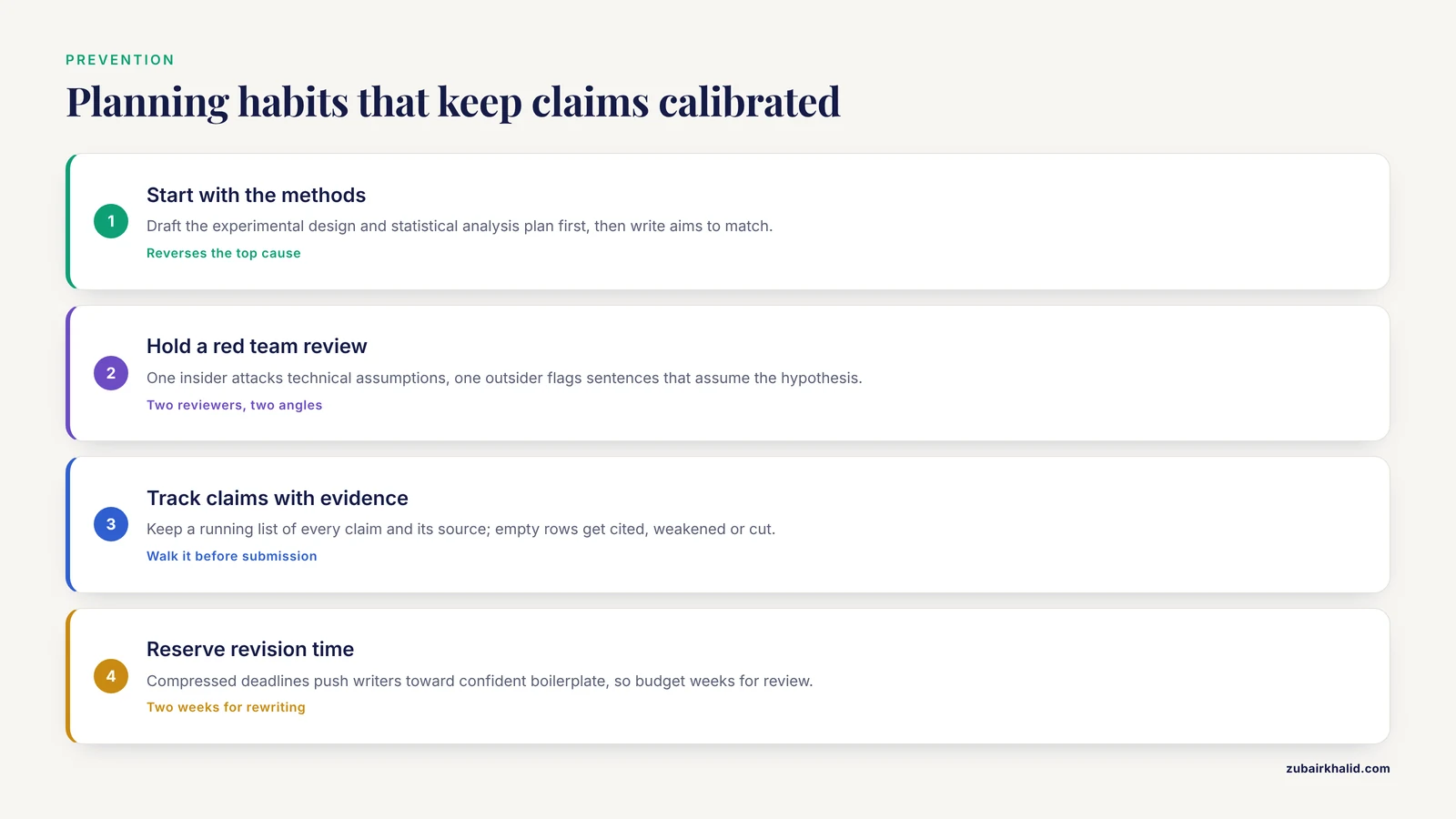
The solutions above repair a draft. These practices prevent the damage from forming, and they belong in every grant proposal planning cycle.
Start with the methods, not the aims. Draft the experimental design first, including the statistical analysis plan, then write the aims to match what the design can deliver. This reverses the most common cause of overpromising at its root.
Hold a red team review. Recruit one colleague from inside your subfield and one from outside. The insider attacks the technical assumptions. The outsider flags sentences that only make sense if the reader already believes the hypothesis. Both perspectives catch inflated language that the writer has gone blind to.
Track claims in a separate document. While drafting, keep a running list of every claim with its evidence source. Before submission, walk the list. Any claim with an empty evidence column either gets a citation, gets weakened, or gets cut.
Read funded proposals in your mechanism, not just your field. Calibrated language is easier to learn from examples. Study how successful proposals in your funding mechanism phrase uncertainty, alternatives, and milestones.
Budget realistic time for revision. Overpromising spikes when the deadline compresses, because writers default to confident-sounding boilerplate under pressure. A planning calendar that reserves two weeks for external review and rewriting produces measurably calmer language than a calendar that reserves two days.
Where a Research Grant Writing Course Helps
A structured research grant writing course addresses overpromising in ways that self-directed revision often misses. Courses with real reviewer feedback expose writers to the actual scoring conversation, where inflated claims get named and discounted in real time. Courses that include mock study sections are particularly valuable because writers hear reviewers distinguish, out loud, between an ambitious claim and an unsupported one. Look for courses that use actual proposal drafts rather than hypothetical examples, that include reviewers who have served on the relevant study sections, and that require at least one full revision cycle between feedback rounds. A course that only teaches structure will improve the document's appearance but will not change the calibration of its claims.
Common Mistakes and Limitations
Mistake: confusing calibration with weakness. The most common rewriting error is overcorrection. Writers who strip all confidence from the proposal produce a document reviewers score as unfundable for a different reason. The target is confidence in the plan and honesty about the outcomes, not timidity about either.
Mistake: fixing language while keeping the underlying plan inflated. Rewriting verbs on top of a best-case timeline produces a proposal that reads humbly and still cannot be executed. Fix the design first, then the language.
Mistake: treating one successful revision as permanent. Overpromising creeps back with each new proposal, particularly when co-investigators introduce their own inflated sections. The claim-evidence tracking habit needs to run every cycle.
Limitation: funding mechanisms differ. This guide describes patterns common across biomedical grant mechanisms. Specific agencies weight feasibility, preliminary data, and impact differently, and their reviewer instructions take precedence over general advice. Read the funder's own review criteria before applying any technique here.
Limitation: individual proposals need expert review. No general guide substitutes for domain-specific feedback on your actual draft. Share the finished proposal with colleagues who have reviewed for the mechanism you are targeting, and treat their calibration judgments as more authoritative than any general rule.
Frequently Asked Questions
What does overpromising in grant proposals actually mean?
It means committing in writing to results, timelines, or impact that your methods, data, or budget cannot realistically support, usually through guarantee-style verbs, best-case timelines, and impact claims that skip required validation steps.
What are the most common causes of overpromising in grant proposals?
The most common cause is drafting the aims from the desired outcome backward before the methods are planned, followed by misreading reviewer values, thin methodological knowledge, pressure from senior collaborators, and, rarely, genuine conceptual misunderstanding.
How can I tell if my own proposal overpromises?
Underline every promise verb, test each aim against failure, trace the timeline's critical path, match every number to a source, and read the impact section as a skeptical expert. Any claim that fails one of these checks needs revision.
How do I fix overpromising without sounding less ambitious?
Replace guarantee verbs with inquiry verbs, describe alternatives for each risky step, anchor every number in cited evidence, and stage the impact claims. These changes preserve the scientific ambition while removing the unsupported certainty, and reviewers score the calibrated version higher.
How much preliminary data do reviewers expect?
Reviewers expect enough to show the central approach works in your system, typically meaning the key assay runs, the model behaves as expected, and the main measurement is feasible. The exact amount depends on the mechanism and the risk level of the proposal, so check recent funded examples in your program.
What makes an aim ambitious but achievable?
An ambitious achievable aim states a sharp question, names the experiments that answer it, defines what both possible outcomes would mean, and includes a fallback for the highest-risk step. The ambition lives in the question, and the credibility lives in the plan.
Can a research grant writing course help me avoid overpromising?
Yes, especially courses with mock study sections and real reviewer feedback, because hearing reviewers separate ambitious claims from unsupported ones teaches calibration faster than self-study. Prioritize courses that review actual drafts and include reviewers from your funding mechanism.
How early should grant proposal planning begin?
Start planning at least several months before the deadline, long enough to draft methods first, collect any missing pilot data, run a red team review, and reserve two weeks for revision. Compressed timelines reliably produce inflated language.