Overcoming Resistance to Data Sharing in Research
By Dr. Zubair Khalid, DVM, MS, PhD ·

By the end of this guide you will be able to prepare a research dataset for public deposit, write the documentation a stranger needs to reuse it, verify file integrity with checksums, and answer the objections that most often stall data sharing in a lab or consortium. You will also walk away with a reusable reproducibility checklist you can adapt to any project.
To follow the walkthrough you need four things on hand: a dataset you want to share, a plain text editor or spreadsheet program, access to a command line terminal, and an account on a data repository such as a generalist archive or a domain specific database. No specialized software is required.
Why Researchers Resist Sharing Data
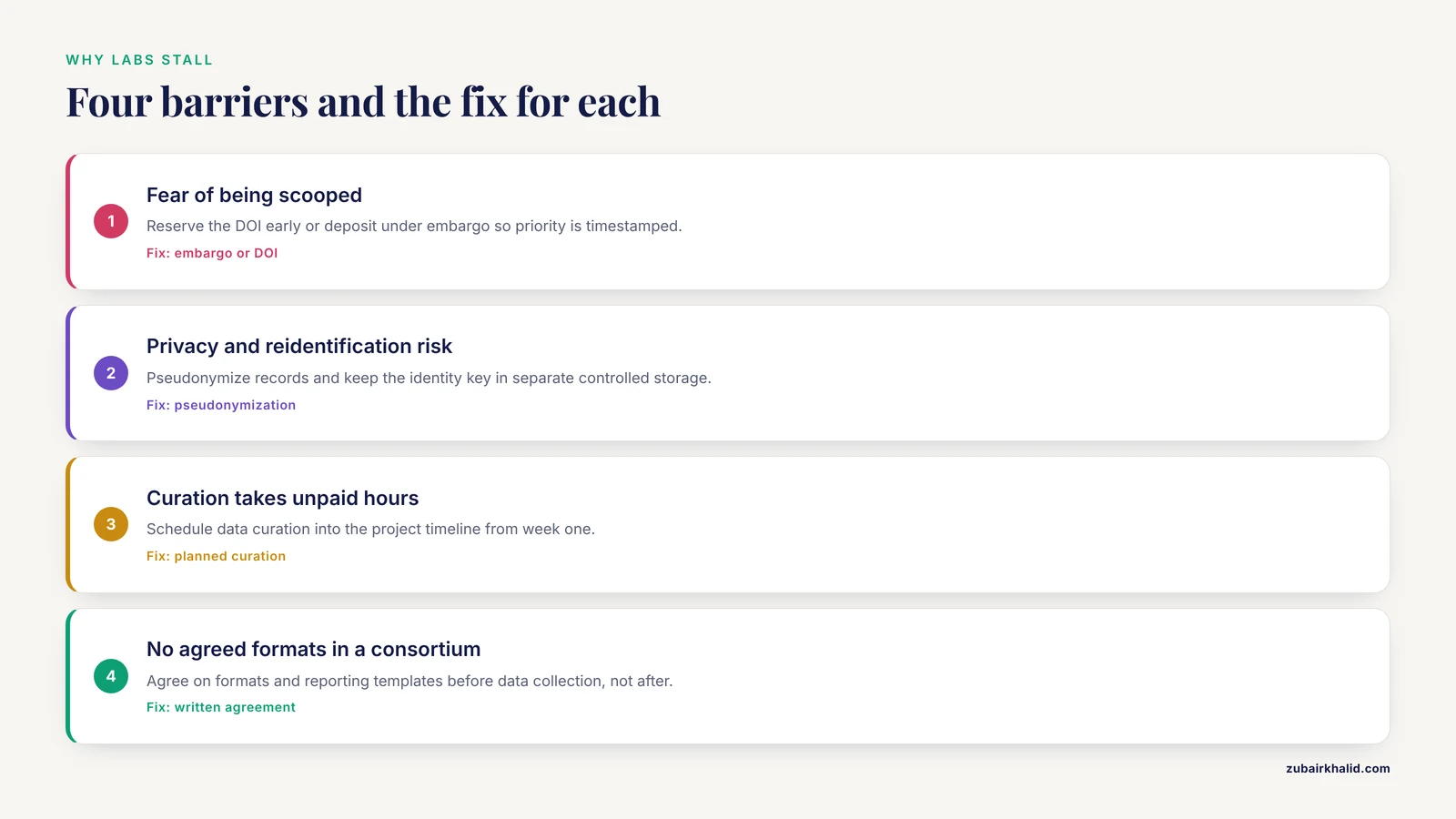
Resistance to data sharing rarely comes from bad motives. It comes from predictable, well documented pressures that act on individual researchers and on institutions. A systematic review of knowledge management in health settings identified the recurring barriers: resistance to change, preference for traditional methods, entrenched habits, inconsistent knowledge sharing, integration difficulties, resource intensive processes, and concerns about data privacy and quality [1].
Each of those barriers has a research specific face. A graduate student fears being scooped before the paper is out. A clinician worries that patient records could be reidentified. A lab head knows that curating metadata takes unpaid hours. A consortium discovers mid project that no one agreed on file formats or reporting templates. In surveillance work, an assessment of veterinary laboratories in India found that the absence of mechanisms for sharing data was one of the main gaps preventing laboratories from joining an integrated network, alongside funding and standard operating procedures [2]. The same pattern appears in environmental monitoring, where a European pilot study of harmonized antimicrobial resistance monitoring in surface waters identified missing data sharing mechanisms as a core obstacle that the pilot had to solve through agreed protocols and common reporting [3].
Open science scholarship names the same trio of obstacles from the other direction. Reviews of open science practice list data privacy concerns, limited resources, and resistance to cultural change as the principal challenges, and they propose countermeasures such as ethical guidelines, education programs, funding advocacy, interdisciplinary dialogue, and patient engagement [4].
The first move in overcoming resistance to data sharing is therefore diagnostic, not motivational. Name which barrier applies to your situation, because each barrier has a different, concrete fix.
What You Get in Return
The benefits are not abstract. Reviews of open science practices report improved research quality, increased public trust, accelerated innovation, and stronger evidence based decision making when data, code, and materials are shared alongside publications [4]. In computational fields, the shift from closed proprietary systems to open data and open source tools demonstrably expanded collaboration and reproducibility over four decades, and the adoption of the FAIR principles, which stand for Findable, Accessible, Interoperable, and Reusable, reinforced both sharing and reuse [5].
Sharing also makes your own work reproducible. Reproducible research means that another person, or you six months later, can rerun the analysis on the same data and obtain the same numbers. A dataset deposited with documentation is the raw material for that.
Finally, sharing compounds across projects. The European surface water pilot showed that harmonized protocols plus shared reporting produced harmonized baseline data that no single country could have generated alone, and it validated methodological choices across institutions [3]. That is the payoff side of overcoming resistance to data sharing.
Overcoming Resistance to Data Sharing in Research Step by Step
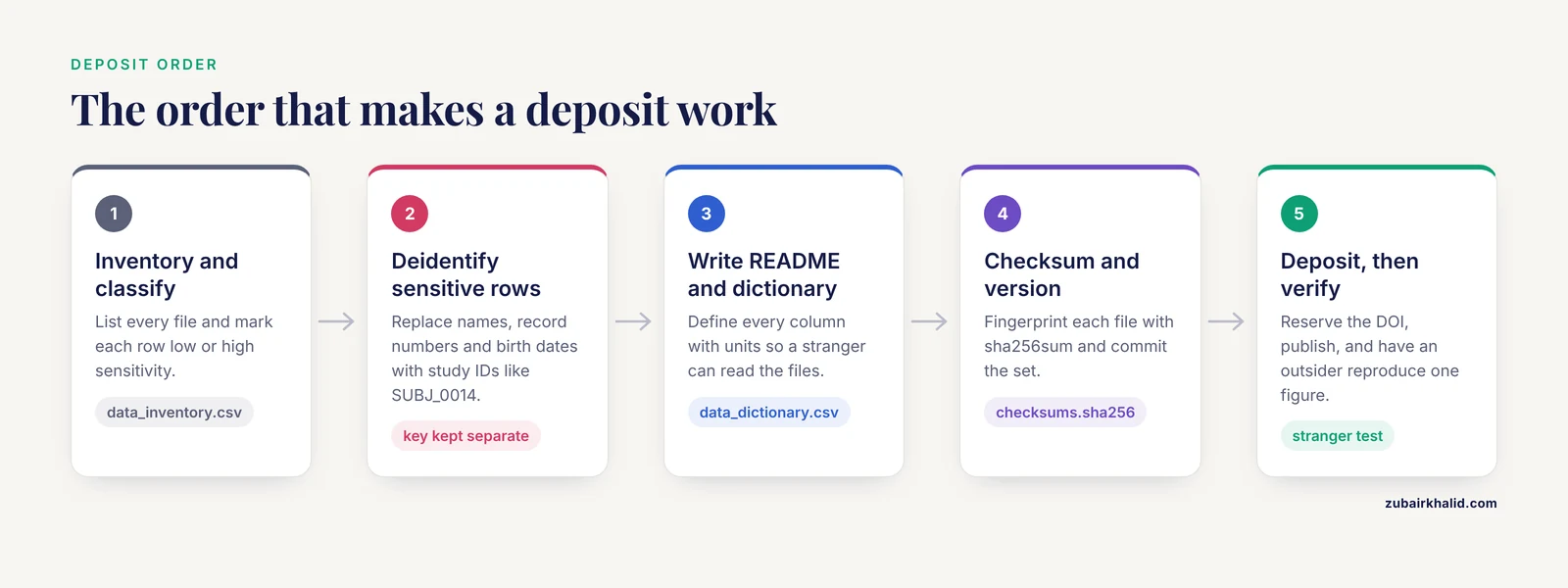
This walkthrough takes a generic project, a study with tabular measurements plus a codebook, from cluttered folder to published dataset with a citable identifier. Adapt the details to your field. Domain archives for sequences, structures, or images follow the same logic with field specific metadata.
Step 1: Inventory Your Data and Classify Sensitivity
List every file, what it contains, and whether it can leave your hands as is. Create a file called data_inventory.csv with this structure:
file,contents,sensitivity,share_as
raw/measurements.csv,per sample readings,low,public
raw/clinic_log.csv,patient names and dates of birth,high,not_shareable
processed/measurements_clean.csv,cleaned readings with study IDs,low,public
code/analyze.R,analysis script,low,public
docs/protocol.pdf,study protocol,low,public
The sensitivity column drives every later decision. High sensitivity rows get deidentified in Step 2 or excluded. Low sensitivity rows go to the public deposit.
Step 2: Deidentify Anything Human or Sensitive
For human subjects data, pseudonymization detaches directly identifying details from the data and reconnects them through secure identifiers called pseudonyms. This protects privacy by design while still allowing linkage and, where truly necessary, controlled reidentification [6]. In practice that means replacing names, medical record numbers, exact addresses, and full dates of birth with study IDs such as SUBJ_0014, and storing the mapping between real identities and study IDs in a separate, access controlled key file that never enters the repository.
A minimal deidentification pass in any scripting language looks like this:
import pandas as pd

df = pd.read_csv("raw/clinic_log.csv")
df["study_id"] = ["SUBJ_{:04d}".format(i) for i in range(1, len(df) + 1)]
df = df.drop(columns=["name", "mrn", "dob"])
df[["study_id", "age_band", "sex", "site"]].to_csv(
    "processed/measurements_clean.csv", index=False
)
Keep the identity key on encrypted institutional storage under your ethics protocol. If your project participates in a multi site consortium, ask whether the consortium already runs a shared pseudonymization service, because research networks increasingly deploy common pseudonymization tools so that every site generates identifiers in the same format [6].
Step 3: Write the Documentation a Stranger Would Need
Two files do most of the work. The first is a README.md at the top of your dataset folder:
# Soil metagenomics pilot, 2025

Data from 48 soil cores sampled at three sites, May 2025.
Each row of measurements.csv is one core.

Files
- data/measurements_clean.csv : cleaned readings, one row per core
- code/analyze.R              : reproduces all figures and tables
- checksums.sha256            : file integrity fingerprints

Variables are defined in data_dictionary.csv.
Analyses require R version 4.3 or later.
Contact: lab email on the associated manuscript.
The second is a data_dictionary.csv that defines every column:
column,description,units,allowed_values
site,sampling location,,A|B|C
ph,soil pH,,3.0 to 9.5
biomass_g,dry microbial biomass,grams,numeric
sample_date,core collection date,ISO 8601,YYYY-MM-DD
A dataset without a data dictionary is the single most common reason deposited data goes unused. Ten minutes here saves every future user an email to you.
Step 4: Version Your Work and Generate Checksums
A checksum is a fixed length fingerprint of a file. If even one byte changes, the fingerprint changes. Sharing checksums lets anyone verify they downloaded exactly what you deposited.
From your project root, run:
sha256sum data/*.csv code/*.R > checksums.sha256
cat checksums.sha256
Expected output looks like this:
a3f8d2e91b7c44e0...  data/measurements_clean.csv
77b1c9f0e2a833d6...  data/data_dictionary.csv
5de2f80a91c3b477...  code/analyze.R
Anyone can later verify the files with:
sha256sum -c checksums.sha256which prints OK next to each intact file. For version history, initialize a repository:
git init
git add README.md data_dictionary.csv checksums.sha256
git commit -m "Prepare dataset v1.0 for deposit"
The expected output ends with a line like main 3f9c1a2] Prepare dataset v1.0 for deposit followed by the file count. If you see fatal: not a git repository, you ran the command outside the folder you initialized. Change into that directory with cd and rerun.
Step 5: Choose a Repository and a License
The right home for your data depends on discipline, size, and sensitivity. The table below summarizes the standard options.
| Option | Best for | Key feature |
|---|---|---|
| Generalist repository (for example Zenodo, Dryad, or figshare) | Tabular data, code, documents of any discipline | Assigns a citable DOI and accepts any file type |
| Domain specific archive (for example NCBI sequence or structure archives) | Sequence, structure, and similar field data | Enforces community metadata standards that downstream tools expect |
| Journal supplementary deposit | Small files tied to one paper | Simple, but often lacks a DOI or versioning |
| Controlled access repository | Human genomic or other sensitive data | Requires requester approval, keeps data findable but gated |
Two principles apply across all rows. First, prefer the repository your community already uses, because shared standards, such as the chemical identifier standards that unified data integration in chemistry, are what make deposits interoperable rather than merely online [5]. Second, pick a license explicitly. A deposit with no license is legally reusable by no one. Permissive licenses such as CC BY are the common default for data, with attribution required.
Step 6: Deposit and Publish
On a generalist repository the workflow is consistent: upload the folder from Step 4, fill in the metadata form (title, creators, abstract, license, funding), and publish. Publishing mints a persistent identifier, most commonly a DOI, and most repositories let you reserve the DOI before publishing so you can include it in your manuscript during review. Reserve the identifier, upload, paste the reserved identifier into your data availability statement, then publish.
Do not rely on the repository's upload interface as your only copy. Your institution's storage and the deposit should mirror each other, with the checksum file confirming both copies match.
Step 7: Cite, Verify, and Close the Loop
Cite the dataset in your paper's reference list exactly as you would a paper, using the DOI, and reference it in the data availability statement. Then verify the result the way a stranger would: open a fresh browser, download the deposit, run sha256sum -c checksums.sha256 in the downloaded folder, and hand the files to a colleague who was not on the project with one instruction, reproduce Figure 2. If they succeed without emailing you, the deposit is done. If they fail, their first question tells you exactly which piece of documentation to add.
Overcoming Resistance to Data Sharing in Research Tips
These tips address the human and institutional side, where most stalled deposits actually fail.
Treat sharing as a workflow, not an afterthought. Knowledge management research in health settings distinguishes human centered strategies from information technology centered strategies, and finds that both are needed [1]. Schedule data curation into the project timeline from week one, so documentation is written while the details are fresh rather than reconstructed two years later.
Train before you mandate. Capacity building measurably raises confidence. A three day bioinformatics workshop in Cameroon taught data sharing procedures alongside web based analysis tools, and participants showed a substantial increase in confidence, with most reporting no confidence beforehand in identifying sequencing workflows or analyzing genetic data with web tools [7]. A half day internal workshop on your lab's deposit pipeline costs less than the cleanup hours it saves.
Adopt existing standards instead of inventing your own. Community driven standards, from shared file formats to identifier systems, are what turned isolated datasets into an interoperable ecosystem in computational chemistry [5]. Check whether your field already has a metadata standard and a preferred archive before designing anything new.
Build trust and align incentives. Analysis of international agreements shows that compliance improves when leaders frame incentives around the interests of the parties, build a culture of trust through mutual assurance, and design agreements with flexibility, data sharing provisions, and dispute settlement mechanisms [8]. Inside a consortium, the translation is straightforward: agree in writing up front who gets authorship on reuse papers, set embargo windows so the data producers publish first, and define what happens when someone wants an exception.
Start with a pilot. The European environmental monitoring pilot did not attempt global harmonization on day one. Ten countries tested harmonized protocols, built capacity, overcame technical barriers, and generated baseline data before scaling [3]. A two dataset internal pilot at your institution will surface the friction points cheaply.
Use staged access for contested data. If full openness is blocked by privacy or competitive concerns, offer an embargo, a controlled access tier, or a pseudonymized version first. Pseudonymization is used in nearly every biomedical study precisely because it balances privacy protection against the need for data linkage [6], and it often converts a hard no into a workable yes.
The Reproducibility Checklist
Copy this checklist into your project repository and tick each item before deposit. It doubles as your data availability plan and satisfies most journal and funder policies.
reproducibility_checklist:
  data:
    raw_data_identified: true        # sources and collection method documented
    sensitive_rows_removed_or_pseudonymized: true
    identity_key_stored_separately: true
  documentation:
    readme_written: true
    data_dictionary_complete: true   # every column defined with units
    software_versions_recorded: true
  integrity:
    checksums_generated: true        # sha256sum file present
    checksums_verified_after_copy: true
  access:
    repository_chosen: true
    license_assigned: true           # CC BY or field equivalent
    persistent_identifier_reserved: true
  verification:
    stranger_test_passed: true       # outsider reproduced one figure
    dataset_cited_in_manuscript: true
Items you cannot tick honestly become your to do list. That is the practical use of a reproducibility checklist: it converts a vague aspiration, reproducible research, into seven verifiable yes or no questions.
Common Mistakes and Limitations
Publishing "data available on request" with no mechanism behind it. This is the most common failure mode in practice. Reviewers increasingly reject it, and requests to corresponding authors often go unanswered when people move institutions. Deposit the data or state a real controlled access route.
Depositing files with no data dictionary. Column names like v2, x3, and flag are meaningless to outsiders and to your future self. Every column needs a row in the dictionary.
Over sharing identifiable data. Uploading raw clinical logs with names and dates is a privacy violation, not diligence. Pseudonymize first, keep the key off the deposit, and check reidentification risk for small subgroups, where rare combinations of attributes can single someone out even after direct identifiers are removed.
Under sharing out of caution. Stripping so much context that the data cannot be interpreted defeats the purpose. If you remove a variable for privacy reasons, say so in the README rather than leaving a silent gap.
Ignoring the license. A deposit without a license is unusable by others no matter how complete the files are. Choose one deliberately.
Assuming everyone has your software. Note versions and dependencies in the README. Code that runs only on your machine with an untracked package version is not reproducible.
Treating harmonization as optional in consortia. Networks that skip shared protocols and reporting templates re create the gaps seen in surveillance assessments, where absent mechanisms for sharing data blocked participation entirely [2]. Agree on formats before data collection, not after.
Skipping the stranger test. Checksums passing only proves the files copied correctly. Only a successful reproduction attempt by someone outside the project proves the deposit actually works.
One limitation applies throughout. Decisions about human subjects data, consent scope, and institutional policy belong to your ethics board and data protection office, so route sensitive cases through them before depositing anything.
Frequently Asked Questions
What does overcoming resistance to data sharing in research actually mean?
It means identifying the specific barriers, such as fear of being scooped, privacy risk, curation effort, or institutional inertia, and applying targeted fixes like embargoes, pseudonymization, scheduled curation time, and clear credit mechanisms rather than arguing about openness in the abstract.
What is the first step if I am worried about being scooped?
Deposit with an embargo or reserve the DOI early, so your priority is timestamped and citable while the files stay under embargo until your paper appears.
How do I share human data legally?
Pseudonymize the records, keep the identity key in separate access controlled storage, confirm consent scope with your ethics board, and deposit either the pseudonymized public version or a controlled access version through an approved gateway.
What is a reproducibility checklist and what goes in it?
It is a short yes or no list covering data classification, deidentification, documentation, checksums, repository choice, licensing, and an outsider reproduction test, which you complete before depositing a dataset.
Do I have to share raw data or is processed data enough?
It depends on your field's norms and funder rules, but the safe default is raw data plus the processing code, because processed data alone often cannot be independently checked or reanalyzed.
What license should I choose for shared data?
For most datasets a permissive license with attribution, such as CC BY, is the default, but confirm your institution's policy and use any field specific license conventions your target repository recommends.
How do I get credit for shared data?
Publish the dataset with a persistent identifier, cite it in your paper's reference list, and negotiate reuse authorship terms in writing within your consortium before deposit.
What if my collaborators or institution resist sharing?
Run a small internal pilot, present the funder and journal requirements, propose embargoes and controlled access for contested items, and align incentives in a written agreement so every party's interests are addressed, which is the approach shown to improve compliance in large scale collaborations.
Sources
- Knowledge management strategies and models in health context: a systematic review.
- An integrated surveillance network for antimicrobial resistance, India.
- Making Waves: towards a harmonized approach for monitoring antimicrobial resistance in European surface waters.
- Open science practices in traditional, complementary, and integrative medicine research: A path to enhanced transparency and collaboration.
- The evolution of open science in cheminformatics: a journey from closed systems to collaborative innovation.
- A Scalable Pseudonymization Tool for Rapid Deployment in Large Biomedical Research Networks: Development and Evaluation Study.
- Enable, empower, succeed: a bioinformatics workshop Harnessing open web-based tools for surveillance of bacterial antimicrobial resistance.
- Bridging the commitment-compliance gap in global health politics: Lessons from international relations for the global action plan on antimicrobial resistance.