Overcoming Resistance to New Collaboration Tools in Research Teams
By Dr. Zubair Khalid, DVM, MS, PhD ·

Overcoming resistance to collaboration tools in research starts with a single observation: in most teams, the new platform adds work before it removes any. The tool was usually selected by a principal investigator, an administrator, or an IT committee, then announced to the people who will actually use it. Those people already have a workflow that works well enough, and every hour spent learning a new interface is an hour taken from experiments, analyses, or manuscripts. Resistance follows naturally, and it looks like silence in the new chat channel, files that never get uploaded, and meetings that drift back to email within two weeks.
The first thing to check is simple. Pick one recurring task that the tool is supposed to improve, such as sharing an analysis script, editing a manuscript, or requesting a reagent. Count the steps the task takes in the old workflow and in the new one. Then watch a team member who did not choose the tool attempt the task for the first time without help. If the new route takes more steps, more clicks, or more waiting, you have found your problem, and no amount of encouragement will fix it until the friction is removed.
Scientific collaboration has grown to a scale where ad hoc coordination no longer works. A bibliometric analysis of nano-drug delivery research for lung cancer identified 2,452 publications produced by 12,539 researchers across 2,689 institutions in 55 countries between 1998 and 2024 [1]. Teams of that size and spread cannot run on email threads and shared drives that nobody maintains. Research collaboration tools exist because the underlying problem is real. The task is not to persuade people that collaboration matters. The task is to remove the specific obstacles that make each tool feel like a burden.
Why Research Teams Resist New Collaboration Tools
Resistance in research settings is rarely stubbornness. It is usually a rational response to how the rollout was designed. The causes below appear in nearly every failed adoption, ordered roughly by how often they occur.
The switching cost lands on the wrong people. The person who chose the tool often benefits from it immediately, because they gain oversight and coordination. The people who pay the cost are trainees and early-career staff, who must migrate files, learn new conventions, and answer questions in a new place while still hitting deadlines. When the benefit and the burden fall on different people, adoption stalls.
The tool duplicates an existing workflow. If the team already tracks samples in a spreadsheet, comments on manuscripts in email, and shares code on a department server, a new platform that handles all three poorly competes against three systems that each work acceptably. People revert to the channel with the lowest friction, and the new tool becomes a second place to check rather than the only place to work.
Nobody knows the rules for data and credit. Sensitive data raises real anxiety. Researchers face a genuine tension between the open science imperative to share data under the FAIR principles, meaning data that are Findable, Accessible, Interoperable, and Reusable, and the stringent requirements of data protection regulations for health information [2]. If a team has not been told who can see a file, whether access is logged, and what happens when someone leaves, the safest personal choice is to keep data where it has always been.
The tool was designed without its end users in mind. A review of pangenome resources in rice breeding found that even mature, high-value research resources fail to enter practice partly because of the lack of breeder-friendly genotyping tools [3]. The pattern generalizes. Powerful software built for specialists will not be adopted by bench scientists, clinicians, or administrators unless someone adapts the interface and the workflow to them.
Training was a lecture, not a practice. A study of collaborative learning among postgraduate students found that collaboration does not emerge automatically. It required emotional safety, guided mediation that redistributed participation, and scaffolded interaction over time [4]. A one-hour demo produces none of those conditions, so skills learned in the demo fade before the first real task arrives.
Power dynamics run deeper than software. In participatory research, adult facilitators struggled to share power with youth co-researchers even when they wanted to. A collaborative autoethnography of those facilitators found that internal reactions, habit, and unexamined assumptions blocked equitable collaboration, and that deliberate reflective practice helped them overcome those barriers [5]. The same dynamic appears in research teams. A new tool that flattens hierarchies, for example by letting anyone comment on the analysis or flag a problem in the shared protocol, can feel threatening to people whose authority depends on controlling information flow.
The history of the team matters. Most labs have buried at least one abandoned platform. Each failed rollout makes the next one harder, because veterans reasonably expect the new tool to disappear within a year and see no point in migrating their work.
Troubleshooting Table: Symptoms, Likely Causes, and Fixes
Use this table as the core diagnostic reference. Match the symptom you observe, confirm the cause before acting, then apply the fix.
| Symptom | Likely cause | How to confirm | Fix |
|---|---|---|---|
| Nobody logs in after the kickoff meeting | The tool was announced, not chosen | Ask each member what task they used it for in week one | Restart with one shared task everyone completes in the tool weekly |
| Files appear but discussion stays in email | Email remains the record of authority | Trace where the last five decisions were actually made | Declare the new tool the single record of truth and stop making decisions in email |
| Senior staff quietly opt out | Hierarchy and established habit | Compare login activity by role | Give the most skeptical senior member a task where the tool saves visible time, such as version control on a grant document |
| Members hesitate to upload project data | Governance uncertainty | Ask whether anyone can state who can access what | Set up role-based permissions, variable-level access control, and audit logs before asking for uploads [2] |
| Enthusiasm after training, collapse within a month | Skills taught without scaffolded practice | Review early real-world uses for repeated errors | Replace lectures with iterative practice on live tasks, refining the setup between rounds [4] |
| The tool is praised in meetings but unused in practice | Social desirability masking real friction | Check unmoderated usage logs, not self-reports | Run a friction hunt, remove steps, and cut features nobody touches |
| Two sites or two labs use different platforms | No cross-institution agreement | Count how many systems hold project files | Hold a structured alignment workshop with written outcomes [6] |
| Adoption collapses after the champion leaves | Single point of dependence | Ask who besides the champion can administer the tool | Train at least two administrators and document procedures |
The Most Common Causes, From Frequent to Rare
Added Steps Before Removed Ones
The mechanism here is cognitive. Established workflows run automatically, while a new tool forces deliberate thought for every action. Under deadline pressure, deliberation loses. This means the fix is not motivation, it is arithmetic. Before asking anyone to change, remove steps from the new workflow until it is at least as short as the old one for the team's three or four most common tasks. If a shared protocol template, a preconfigured project space, or a script that auto-populates the new system can cut clicks, do that first.
Parallel Systems and Email Gravity
When a new tool runs alongside the old system, every piece of information must be recorded twice or exists in only one place. Team members resolve that ambiguity by choosing the channel everyone already reads, which is almost always email. The mechanism is network gravity: a communication platform is valuable exactly in proportion to how many colleagues answer in it. A single influential holdout can keep the entire team on the old channel. The fix is a decision, not a persuasion campaign. Leadership must stop making decisions through the legacy channel, even when that feels slower at first, because a collaboration tool that is not the record of truth is just decoration.
Data Governance Anxiety
This cause is less common than friction but far more consequential, because a single mishandled dataset can end a project. Developers of the TRACE environment, a Trusted Research Access and Collaboration Environment for sensitive health data, observed that researchers lack efficient, affordable tools for responsible sharing and that existing solutions are often difficult to use, expensive, or missing features such as variable-level access control and auditable workflows [2]. Their design response is a useful checklist for any rollout of research collaboration tools: granular permissions at the variable level, provisioning into a sealed analysis environment, consistent standard operating procedures, and reproducibility at the level of both data and analysis code [2].
A short safety note applies here. Before any pilot involves human data, confirm that the platform has passed your institutional security and privacy review. Never upload protected health information, identifiable patient data, or unpublished regulated results to a tool that has not been approved for that data class, even for a demonstration.
Healthcare research teams adopting advanced digital systems face the same pair of obstacles. A systematic review of digital twins in hospital operations found that, alongside clear benefits in monitoring and workflow planning, challenges related to data integration and ethics remained unresolved across the 70 studies reviewed [7]. Raising those concerns openly, rather than letting them smolder as unnamed unease, is itself part of the fix.
Tools Built Without the End User in Mind
The history of cheminformatics offers the clearest long-range evidence on what makes research tools stick. For decades the field ran on proprietary software and restricted data access, which limited collaboration and reproducibility. Adoption of open-source tools such as the Chemistry Development Kit and RDKit, open data resources such as PubChem, and shared standards such as the International Chemical Identifier transformed the field, and community-driven movements reinforced open methodology. The review of that history credits standardization and the FAIR principles with making data sharing and reuse routine [8]. The lesson for any team rolling out a platform today is that interoperability and open standards are not luxuries. A tool that cannot exchange data with the systems your collaborators already use will be abandoned regardless of its features.
Missing Psychological Safety and Scaffolding
The design-based study of collaborative learning identified the specific conditions under which collaborative behavior appeared: emotional safety, meaning willingness to speak without fear of evaluation, guided mediation that redistributed participation, and scaffolded interaction [4]. Those conditions translate directly to research teams. Members will not ask basic questions about a new tool in front of the person who chose it, so early mistakes stay hidden until they become abandonment. Structured early practice, rotated facilitation, and explicit permission to report problems are the practical equivalents.
Power Sharing Discomfort
Resistance to new collaboration tools in research teams sometimes has nothing to do with the software. When a platform makes every contribution visible and traceable, it redistributes influence. The participatory research literature documents that facilitators needed deliberate self-reflective practice to share power comfortably, and that mindfulness-based reflection helped them become present enough to collaborate equitably [5]. In a lab context, the equivalent is naming the change out loud. Tell the team that the shared protocol document is meant to be edited by anyone, that the analysis repository accepts pull requests from trainees, and that this redistribution is intentional.
Rare but Real: Incentive Structures
The rarest cause is also the hardest to fix locally. Career advancement in science rewards publications, not tool maintenance or data curation, so the member who spends a week migrating the team's archive receives no credit. The open science movement has confronted this directly, with national data infrastructure projects such as NFDI4Chem aiming to make research data management sustainable over the long term rather than dependent on individual volunteers [8]. At the team level, the practical response is to write tool stewardship into annual evaluations and to rotate the burden explicitly.
A Diagnostic Sequence You Can Follow in Two Weeks
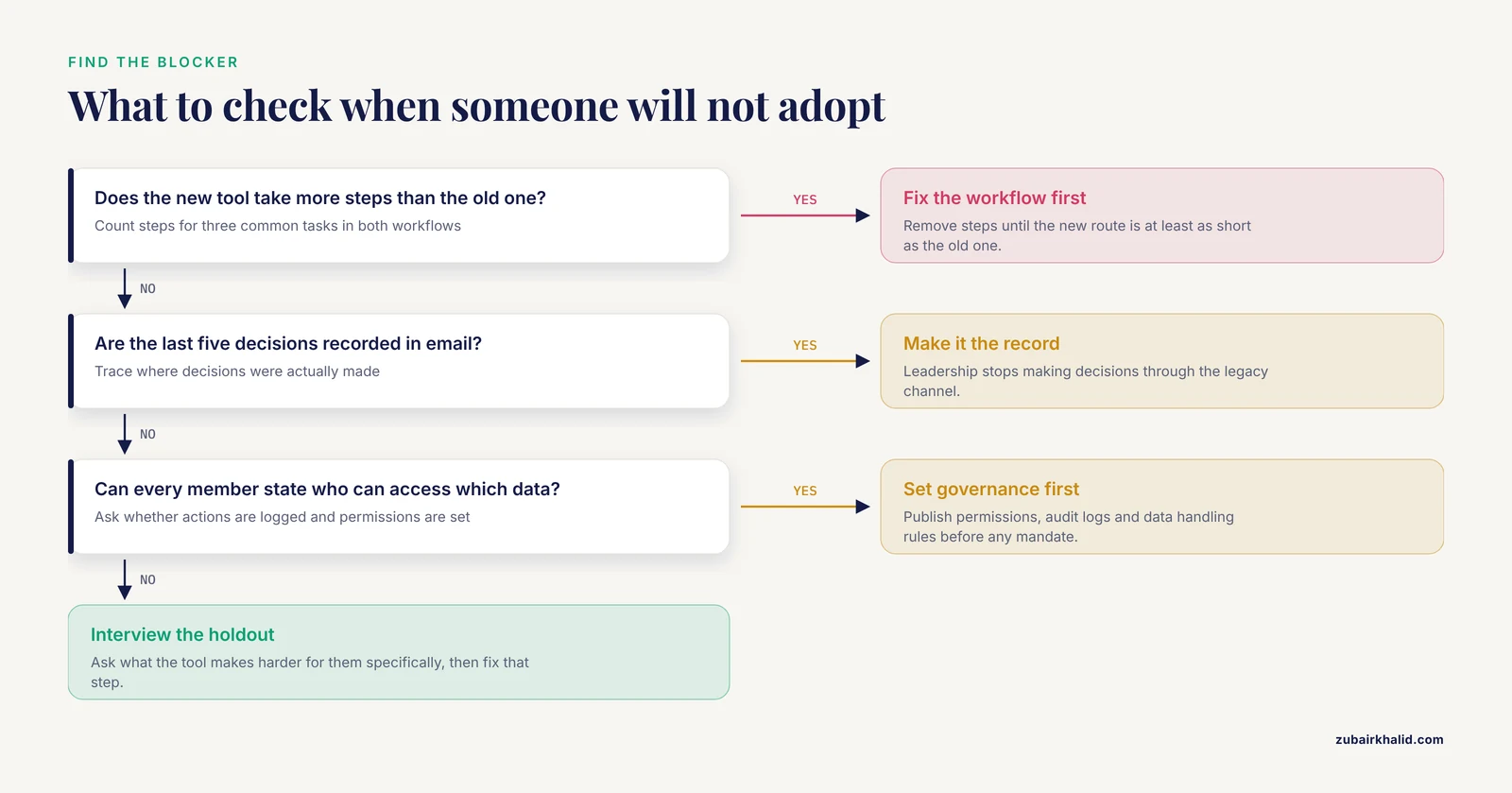
Work through these steps in order. Each one eliminates a cause before you spend effort on the next.
- Measure the friction. Count steps for three common tasks in both the old and new workflows. If the new route is longer, fix the workflow before fixing the people.
- Trace the decisions. Identify where the last five project decisions were recorded. If they live in email or hallway conversations, the tool is not yet the record of truth.
- Check usage by role. Compare login and contribution logs across seniority levels and sites. Skewed patterns point to hierarchy or cross-institution misalignment rather than skill gaps.
- Ask the governance question. Can every member state who can access which data and whether actions are logged? If not, governance is the blocker, and it must be resolved before any mandate.
- Interview the holdouts individually. Ask each person what the new tool makes harder for them specifically. Vague answers signal social desirability. Specific answers, such as a missing export format or a double data entry step, are fixable.
- Test the safety conditions. Observe whether junior members ask questions in the shared channel. Silence there predicts silent abandonment later.
Solutions: How to Fix Resistance to Collaboration Tools in Research
Run a Task-Anchored Pilot, Not a Tool Rollout
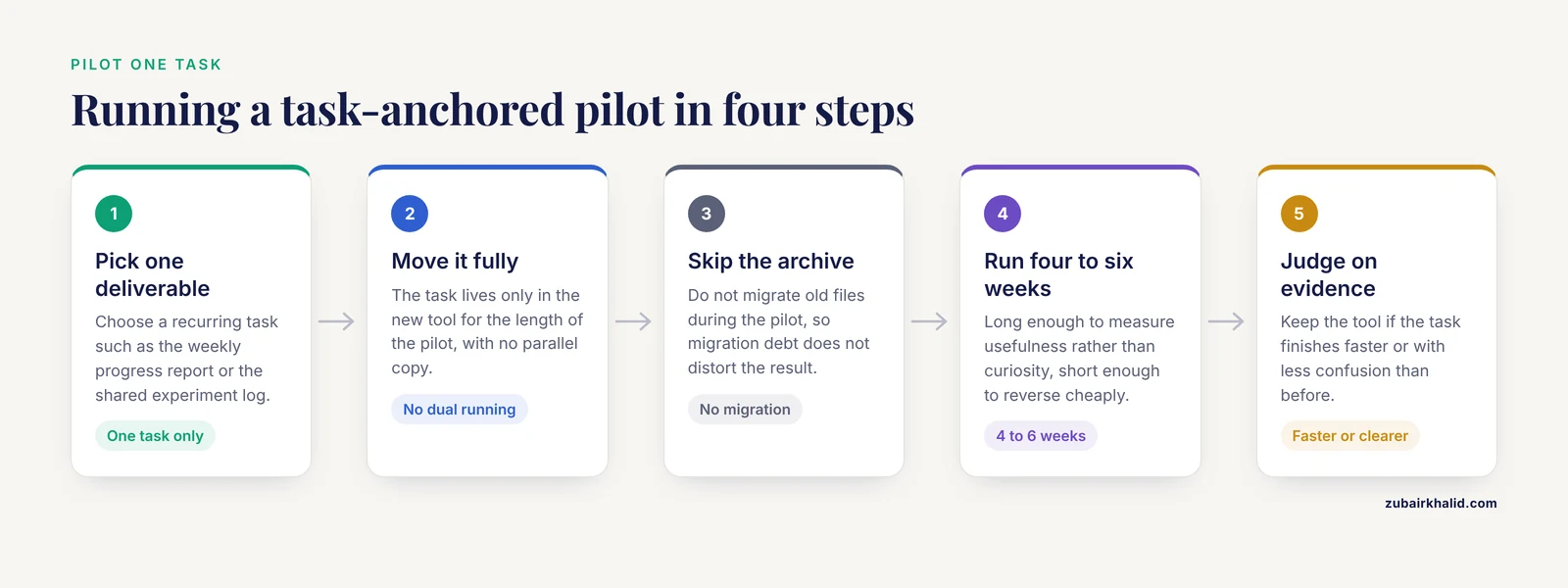
Choose one recurring deliverable, such as the weekly progress report or the shared experiment log, and move it fully into the new tool for four to six weeks. Do not migrate archives during the pilot. The pilot succeeds when the team completes the task faster or with less confusion than before, and it fails honestly when it does not. Anchoring adoption to a task rather than to the software itself gives skeptics a concrete basis for judgment.
Lower the Threshold to Entry
The TRACE project set out explicitly to lower the threshold for researchers to share sensitive data responsibly, and to build a system that existing institutional staff could operate rather than one requiring dedicated technical hires [2]. That design philosophy applies to every adoption. Configure the new platform so the default state is usable, with project templates, predefined permissions, and integrations into tools the team already relies on. Every manual setup step you can eliminate converts a potential holdout into a user.
Design Training as Iterative Collaboration
Borrow the design-based research loop. Implement, observe, refine, and implement again [4]. Run a first session on live team work rather than demo data, observe where people struggle, change the configuration or the instructions, and repeat. Pair every new user with a peer rather than an evaluator, because the emotional safety condition predicts whether questions get asked at all [4].
Set Governance Before You Set Deadlines
Publish a one-page document that states where each data class lives, who can access what, how actions are audited, and what happens when someone leaves the team. Model the content on the features that made TRACE credible to researchers, including variable-level access control, auditable and reproducible workflows, and support for the data-sharing elements highlighted in the 2025 SPIRIT and CONSORT statements [2]. For teams handling clinical or operational data, note that unresolved data integration and ethics questions are documented failure points in comparable technology adoptions [7] and should be answered before rollout, not after an incident.
Align Stakeholders Early, Including Those Outside the Lab
Modern scientific collaboration increasingly includes patients, community partners, and public health institutions, not just co-investigators. The hepatology literature on patient advocacy describes stakeholder ecosystems spanning clinical, community, and institutional levels, and emphasizes that patient perspectives must be integrated into research itself [9]. If your new collaboration tool will touch any partner outside the core team, involve their representatives in tool selection. A platform that excludes the patient organization or the field epidemiologist from the workflow will be circumvented by the people it excludes.
Use Structured Workshops for Cross-Group Alignment
When multiple institutions must agree on shared tooling, a structured in-person or virtual workshop outperforms months of email. The WINSA workshop in Bogotá brought together experts from 13 South American countries and territories across academia, public health institutions, and international organizations to assess status, identify priorities, and strengthen regional collaboration [6]. The transferable elements are the format, a defined agenda of presentations plus working discussions producing written priorities, and the representation, every group that will touch the system in the room at once.
Show the Payoff With Evidence, Not Slogans
Skeptics respond to data. Bibliometric research offers it. In an analysis of 2,122 studies on resistance to PD-1 and PD-L1 inhibitors, the United States ranked second in publication volume but led in international collaboration, and the most influential institutions and authors in the field were embedded in collaborative networks [10]. A bibliometric analysis of ferroptosis research in non-small cell lung cancer covered 964 publications from 52 countries and was conducted explicitly to guide future investigations and promote interdisciplinary collaborations [11]. Collaboration correlates with visibility and influence, and showing that correlation in your own field is more persuasive than asserting that the new chat app will transform the lab.
Plan for Sustainability From Day One
The cheminformatics history shows that open tools survived because communities and national infrastructure took responsibility for their continuity [8]. Apply the same thinking at team scale. Budget maintenance time, designate two administrators, and define sunset criteria, meaning the written conditions under which you would retire the tool. Teams trust a platform more when its exit path is documented, because adoption then feels like a reversible choice rather than a trap.
Common Mistakes and Limitations
Mandating before fixing friction. A mandate cannot overcome a workflow that takes more steps than the one it replaces. People will comply minimally and keep their real work elsewhere.
Stacking tools. Adding a fifth platform to a team that has not fully adopted the first four multiplies confusion. One tool per job, and no more.
Confusing training with adoption. Attendance at a session predicts nothing about behavior a month later. The design-based evidence shows collaboration emerges from repeated, scaffolded practice under safe conditions, not from instruction alone [4].
Treating resistance as irrational. Most resistance is information. The holdout who says the tool breaks their export pipeline is describing a bug, not an attitude.
Overstating the evidence base. Much of what is known about tool adoption in research comes from case studies, design-based research, and systematic reviews of specific technologies [7], [4], not from large controlled trials comparing rollout strategies. Treat the practices in this article as well-supported principles that require local adaptation, and expect individual teams to respond differently.
Ignoring the migration debt. Every week of dual running doubles the eventual cleanup. Set an end date for the legacy system and honor it.
Prevention Practices for the Next Rollout
Prevention is cheaper than repair. Before your team adopts its next platform, apply these habits.
- Select with the users. Put the postdocs, technicians, and external partners who will live in the tool on the evaluation committee, not just leadership.
- Map workflows first. Document the three most common collaborative tasks and score candidate tools against them, including integration with existing analysis software and standards [8].
- Write the governance page first. Permissions, auditability, and data handling rules should exist before the first login [2].
- Pilot one task, then decide. Four to six weeks on a single deliverable produces better evidence than any vendor demonstration.
- Train by doing, then refine. Replace the demo with iterative practice on live work, adjusting between rounds [4].
- Build redundancy. Two trained administrators, written procedures, and documented exit criteria keep the tool alive through staff turnover.
- Reward stewardship. Recognize tool maintenance in evaluations so the burden does not fall permanently on the most willing volunteer.
- Review annually. Reassess whether each collaboration tool is still the record of truth for its job, and retire what is not.
Frequently Asked Questions
Why do researchers refuse to use new collaboration tools even when the tools are clearly better?
Because the benefits usually arrive months later while the costs, migration, learning, and double data entry, arrive immediately. Adoption improves when the team first removes friction from the new workflow and then anchors it to a single recurring task so the advantage becomes concrete within the first week.
What is the most common cause of resistance to new collaboration tools in research teams?
The most common cause is added steps. The tool was selected without the end users and requires more actions for common tasks than the workflow it replaces. Counting the steps for three recurring tasks in both systems usually confirms this within an hour.
Should we make the new tool mandatory or optional?
Make one task mandatory and everything else optional. Requiring that the weekly progress report, experiment log, or analysis handoff lives only in the new tool establishes it as the record of truth, while leaving secondary uses voluntary preserves goodwill during the transition.
How do we handle sensitive data concerns during adoption?
Resolve governance before rollout. Publish who can access which data, use role-based and variable-level permissions, enable audit logs, and confirm the platform passed institutional security review. Never place protected health information in an unapproved system, even for a demonstration.
How long should a pilot run before deciding whether to keep a tool?
Four to six weeks on a single recurring deliverable is usually enough. Shorter pilots measure curiosity rather than usefulness, and much longer pilots accumulate migration debt that makes reversal painful regardless of the evidence.
What do we do when only part of the team adopts and the rest stay on email?
Find where decisions are actually being recorded and move decision-making fully into the new tool. Parallel systems fail because email remains the authority. When leadership stops making calls through the legacy channel, the network effect shifts toward the platform.
How can we convince a skeptical principal investigator or senior colleague?
Offer a task where the tool saves them personal time, such as version control on a grant document or an auditable record of data access for a sponsor. Senior adoption often follows a demonstration of individual benefit rather than arguments about team efficiency.
How do we measure whether tool adoption actually succeeded?
Use behavioral records rather than opinions. Track the share of project decisions recorded in the tool, the number of members who contributed within the past week, the time taken to complete the anchor task compared with the old workflow, and whether the platform survives the departure of its original champion.
Sources
- Global research trends and emerging hotspots in nano-drug delivery systems for lung cancer: a comprehensive bibliometric analysis (1998-2024).
- FAIR by design (TRACE): A Trusted Research Access & Collaboration Environment.
- Challenges in Bringing Pangenome Research Into Breeding: A Case Study in Rice.
- A design-based approach to collaborative learning in flipped classrooms: Fostering socio-cognitive and psychological competencies among female Saudi postgraduates.
- "My resistance melts away": The role of mindfulness in supporting participatory researchers' efforts to share power with youth co-researchers.
- Challenges and opportunities for strengthening South American responses to insecticide resistance in disease vectors: Lessons from the WINSA workshop in Bogotá, Colombia.
- Digital Twins for Hospital and Healthcare Operations: A Systematic Review of Resource Allocation, Infection Control, and Workflow Optimization.
- The evolution of open science in cheminformatics: a journey from closed systems to collaborative innovation.
- Integrating patient advocacy into hepatology practice - Current perspective and future directions.
- A bibliometric analysis of resistance to PD-1/PD-L1 inhibitors.
- Emerging research themes in ferroptosis research for non-small cell lung cancer: a bibliometric and visualized analysis.