Open-Source vs. Commercial Research Software: A Decision Framework
By Dr. Zubair Khalid, DVM, MS, PhD ·

Choose commercial software when you need vendor accountability, polished interfaces, and validated support for regulated or high-throughput routine work. Choose open-source software when you need transparency, customization, reproducibility, and freedom from licensing costs, especially for methods development and novel analyses. Most productive laboratories end up running both, and the real skill is knowing which model fits each specific task in your pipeline.
This article is a research software comparison grounded in recent peer-reviewed evaluations across proteomics, metabolomics, microbiome analysis, molecular modeling, motion capture, surgical planning, and pharmacokinetics. By the end, you will have a concrete framework for deciding where each software model belongs in your own work.
What Open-Source and Commercial Research Software Actually Mean
Open-source software makes its source code publicly available under a license that permits inspection, modification, and redistribution. Examples in the life sciences include R and its packages, Python-based tools such as scikit-learn, QIIME 2 for microbiome analysis, MS-DIAL for mass spectrometry data processing, and large language models such as Llama 3, whose weights can be downloaded and run on local hardware [1][2].
Commercial (proprietary) software is sold or licensed by a company that keeps the source code closed. The vendor controls the code, releases updates on its own schedule, and provides support contracts, documentation, and often validated installation packages. Examples relevant to bench scientists include Compound Discoverer for Orbitrap metabolomics data, Ion Reporter for sequencing data on the Ion Torrent platform, and commercial LLMs such as GPT-4, Claude, and Gemini [1][3][2].
Two clarifications prevent most confusion. First, "free of charge" and "open source" are not the same thing. Some commercial tools are free for academic use, and some open-source licenses restrict commercial redistribution. What defines open source is access to the code, not the price tag. Second, the choice is not ideological. A recent review of proteomics software argues that closed-source, platform-specific tools restrict innovation and impose hidden costs on the community, while open-source tools aligned with the FAIR principles (Findable, Accessible, Interoperable, Reusable) promote transparency and reproducibility [4]. That argument is strongest in some contexts and weakest in others, which is exactly why a framework is useful.
Why This Decision Shapes Your Science, Not Just Your Budget
Three forces have pushed software choice from an administrative detail to a scientific one.
Reproducibility pressure. Scientific discovery now relies on software as much as on experimental methods, particularly in fields such as proteomics where computational tools handle mass spectrometer setup, data analysis, and interpretation [4]. When the analysis pipeline lives inside closed code that reviewers cannot inspect, reproducibility claims rest on trust rather than verification. Open code lets any reviewer download the exact version you used and rerun the analysis.
Data complexity. Modern datasets are heterogeneous in format and subject matter, and storing, tracking, and responsibly sharing them has become a central challenge in bioinformatics and health research. A 2025 review of data management strategies for bioinformatics assessed both open-source and commercial solutions for building data lakehouse infrastructure, a model that combines the flexibility of a data lake with the governance of a data warehouse [5]. The tools you pick at the infrastructure stage determine what analyses are possible years later.
Cost and access inequality. Licensing fees concentrate capability in well-funded laboratories. Open-source projects explicitly aim to remove that barrier. A recent pharmacokinetics paper notes that commercial software carries licensing costs while existing open-source alternatives often lack integrated, user-friendly workflows, and it responds by building a free browser-based application for non-compartmental analysis and bioequivalence testing [6]. Similar motivation appears in behavioral neuroscience, where an open-source auditory brainstem response system was built to be roughly 50 times cheaper than closed-source alternatives, at a total hardware cost of about $400 [7].
Where Each Model Wins: Evidence From Real Comparisons
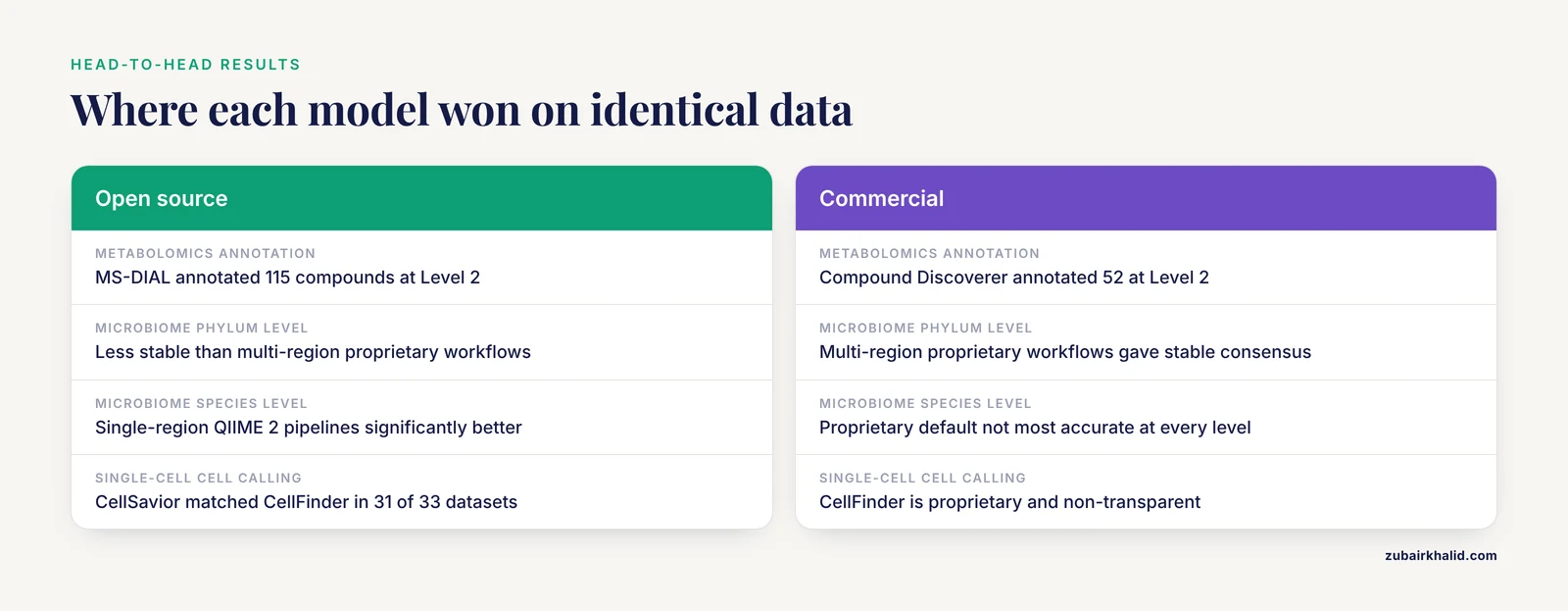
The most useful research software comparisons come from studies that ran both an open-source and a commercial tool on the same data and reported the differences. Several such head-to-head evaluations exist across life science domains, and their results are instructive precisely because neither side wins everywhere.
Mass spectrometry and metabolomics
In untargeted GC-Orbitrap-HRMS metabolomics for food authentication, researchers compared the open-source MS-DIAL tool against the commercial Compound Discoverer on the same thyme datasets, using geographical differentiation of Spanish versus Polish samples as the test case [3]. The commercial tool putatively annotated 52 compounds at confidence Level 2, while MS-DIAL annotated 115 at the same level. Both approaches showed that feature detection is heavily affected by unknown metabolites, background signals, and duplicate features that must be assessed before multivariate analysis. The lesson is not that open source simply wins. The lesson is that pipeline behavior differs enough between tools that your biological conclusions can depend on which one you chose, so reporting the tool and version is part of the methods.
A parallel review of LC-MS data processing for RNA modification analysis reaches a similar position from the other direction. It observes that reliance on commercial software can restrict accessibility, flexibility, and customization for researchers, and catalogs open-source tools that offer cost-effective, transparent, and adaptable alternatives, while noting that each tool has strengths, limitations, and specific suitable applications [8].
Sequencing and genomics pipelines
Microbiome researchers using the Ion Torrent S5 platform evaluated the proprietary Ion Reporter software against eight open-source pipelines built on QIIME 2 and the SILVA database, benchmarked against a commercial fecal reference standard with a shotgun-sequenced profile [2]. The results were nuanced. At the phylum level, multi-region proprietary workflows produced stable consensus predictions. At the species level, single-hypervariable-region open-source pipelines significantly outperformed the alternatives. The choice of denoising algorithm, DADA2 versus Deblur, significantly affected alpha diversity calculations across all configurations. For a researcher, this means the proprietary default is not automatically the most accurate at every taxonomic level, and open-source pipelines are not automatically better. Matching the pipeline to the question matters more than the license.
In single-cell DNA sequencing, cell calling (deciding which barcodes represent real cells rather than background noise) has typically relied on proprietary, non-transparent pipelines such as those on the commercial Tapestri platform. An open-source algorithm called CellSavior, which uses ensemble clustering across multiple distance metrics, recapitulated the commercial CellFinder annotations in 31 of 33 datasets, about 93.9 percent. In the two discordant cases, the open-source tool yielded more biologically interpretable annotations [9]. This is a strong demonstration that open methods can match commercial performance while adding inspectability.
On the data infrastructure side, the bioinformatics lakehouse review emphasizes that available open-source and commercial options differ in how well they balance scalability with governance, and that the field is still early in adopting lakehouse architectures [5]. Institutions choosing between managed commercial data platforms and self-assembled open-source stacks are making a multi-year commitment either way.
Instrumentation and measurement hardware
Some of the clearest open-source wins appear where commercial instruments are expensive and inflexible.
An open-source system for measuring auditory brainstem responses in mice, called OpenSABR, is built around a commercially available Texas Instruments ADS1299 recording chip and costs about $400, roughly 50 times cheaper than closed-source alternatives. It produced data consistent with prior published work, and its authors note that the open design could be customized to record other biosignals such as EMG, ECG, and evoked potentials, something a sealed commercial box cannot offer [7].
Similarly, commercial equipment for measuring the optomotor response in mice is expensive, and its proprietary software and fixed hardware geometry restrict custom stimulus protocols. An open-source recording system lowered both financial and practical barriers, enabling quantification of visual acuity and contrast sensitivity, detection of age-related visual decline, and evaluation of visual deficits in retinitis pigmentosa model mice [10].
In motion analysis, open-source pose estimation frameworks such as OpenPose, MediaPipe, AlphaPose, and DensePose run on commercial cameras including Intel RealSense and StereoLabs ZED to deliver markerless 2D and 3D kinematics at a fraction of the cost of traditional motion capture systems. The review notes these 2D systems are economical and straightforward but face limitations with out-of-plane movements and environmental factors [11]. A related open-source framework for analyzing driver behavior from video achieved over 96 percent accuracy for glance and automation-mode detection and cut manual video analysis time by more than 90 percent [12].
Virtual reality research shows both sides of the coin. The open-source VRrec tool captures head, hand, and body motion data during third-party VR experiments with no coding required, but it cannot read application-level events, so paradigms requiring millisecond-accurate synchronization with in-app objects remain limited [13]. Knowing such boundaries before you commit is the whole point of a decision framework.
Clinical, translational, and applied analysis
Open-source tools are increasingly credible even in high-stakes settings. A pilot study in oral surgery used open-source software tools plus 3D printing for in-house planning of mandibular reconstructions with free fibula flaps, planning cases within 24 hours. Accuracy metrics were satisfactory, with a mean Hausdorff distance of 1.22 mm and a mean Dice coefficient of 0.77 between planned and postoperative outcomes, and the approach saved time and cost compared with outsourced planning [14].
In transfusion medicine, antibody panel interpretation has remained manual and expertise-intensive, and existing commercial software is closed source and often omits enzyme-phase, cold-phase, and dosage-sensitive exclusion rules, limiting third-party verification. An open-source rule-based web application called IrregulAB retained the complete reference antibody set in 93 percent of development panels and 91 percent of held-out validation panels, and produced at least one valid explanatory antibody combination in 87 and 89 percent of those panels respectively [15]. The transparency argument is unusually strong here, because closed interpretive logic cannot be locally adapted or independently audited.
Population health research gained an open-source R Shiny dashboard, the GBD Analysis Suite, which consolidates 11 analytical modules for Global Burden of Disease style research into a single code-free web interface, deliberately designed to remove the technical barrier for investigators in resource-limited settings [16]. This illustrates a distinct open-source value proposition, democratizing sophisticated analyses for users who will never write code.
Large language models
Proprietary LLMs such as GPT-4, Claude 3, and Gemini dominate attention in medical AI, but a radiology review argues that open-source LLMs such as Llama 3 hold key advantages for medical institutions, including data privacy, local deployment, and customization through fine-tuning and retrieval-augmented generation. Adoption has been slower partly because of unfamiliarity, computational infrastructure demands, and a shortage of community tools, which the authors address with an implementation tutorial and released code [1]. Here the tradeoff is stark. Commercial models are easier to start with, while open models offer control over where your clinical data goes and how the model behaves.
The Decision Framework: Seven Questions Before You Choose
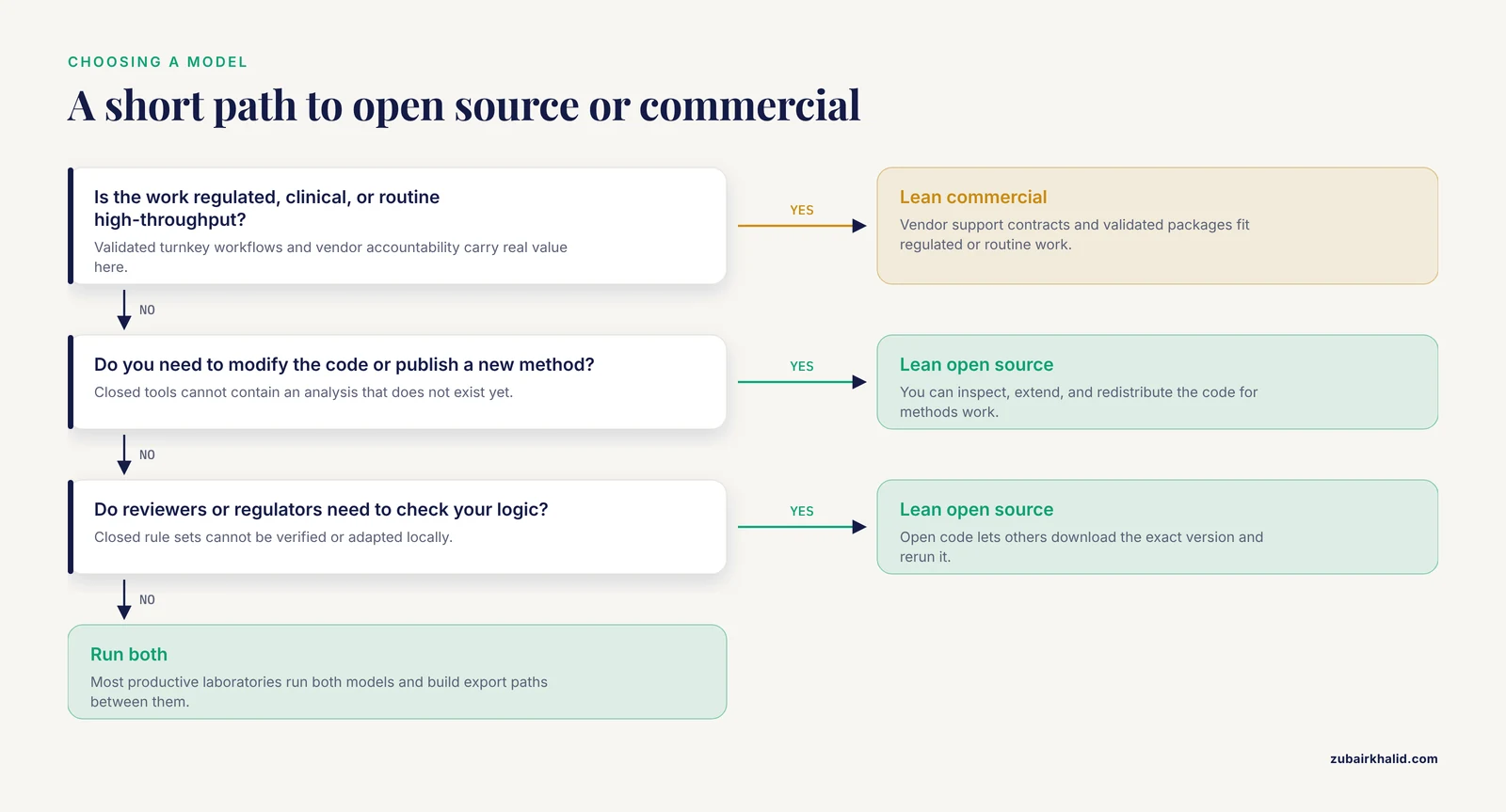
Work through these questions in order for each tool or pipeline decision. The goal is a defensible choice you can document in your methods section.
1. Is an analysis answer or a long-term capability the deliverable? If you need a one-time answer to a routine question, a commercial tool with a polished interface may get you there fastest. If you are building a capability your lab will reuse, extend, and publish methods around, open source pays compounding dividends because you can modify and redistribute it.
2. Does reproducibility or auditability carry weight in your field? Proteomics and other omics fields increasingly treat open, FAIR-aligned software as the standard for transparent, reusable analysis [4]. Clinical interpretive software also benefits from inspectability, as the IrregulAB case shows, because closed rule sets cannot be verified or adapted locally [15]. If reviewers, regulators, or collaborators need to check your logic, open source has the structural advantage.
3. How close are you to the methodological frontier? If the analysis you need does not exist yet, closed tools cannot contain it. Open-source ecosystems are where new algorithms appear first, and they let you test new ideas without waiting for a vendor roadmap [17][9]. If your work uses fully standard, vendor-supported workflows, the commercial tool's validation and support are worth more.
4. What are the true costs on each side? Commercial costs are visible: licenses, renewals, per-seat fees. Open-source costs are hidden but real: staff time for installation and maintenance, compute infrastructure, training, and the risk of a maintainer abandoning the project. The bioinformatics lakehouse review highlights that flexibility and governance both carry engineering effort regardless of licensing model [5].
5. Who needs to use it? For a code-free interface that lab members with no programming background can operate, commercial tools and polished open-source applications both exist. The GBD Analysis Suite and NCA Assistant show that open-source projects can now deliver code-free, browser-based interfaces that rival commercial usability [16][6]. Do not assume open source means a command line.
6. Are there validation data comparing the tools on your data type? Before committing, look for head-to-head studies in your domain. The metabolomics [3], microbiome [2], and single-cell [9] comparisons cited above all found meaningful differences between open and commercial pipelines on identical data. If no comparison exists for your application, that uncertainty itself should shape how cautiously you interpret results.
7. What happens when something breaks? With commercial software, you file a ticket and the vendor fixes it or does not. With open source, you can read the code, post an issue, patch it yourself, or hire someone to. Foundation-backed projects add another layer. The Open Molecular Software Foundation, a US nonprofit, provides governance, administrative infrastructure, and dedicated research software staffing for community projects such as Open Force Field, Open Free Energy, OpenFold, and OpenADMET, giving open-source molecular modeling some of the institutional stability traditionally associated with vendors [17].
Comparison Table: Open-Source vs. Commercial Research Software
| Dimension | Open source | Commercial |
|---|---|---|
| , - | , - | , - |
| Source code access | Full, inspectable, modifiable [4] | Closed, vendor-controlled [15] |
| Up-front cost | Usually zero license fee [7] | Licensing costs, often recurring [6] |
| Hidden costs | Installation, maintenance, training, compute [5] | Renewals, upgrade lock-in, per-seat fees [8] |
| Customization | Unlimited, at your own effort [7] | Limited to vendor options [10] |
| Support model | Community, issue trackers, foundations [17] | Contracts, help desks, SLAs |
| Reproducibility | Strong, exact versions can be shared [4] | Weaker, depends on vendor releases [9] |
| Typical accuracy in head-to-head tests | Comparable or better in several published cases [3][2][9] | Comparable or more stable in some configurations [2] |
| Regulatory and clinical readiness | Often research-use only [7] | Often validated for regulated workflows |
| Best fit | Methods development, novel pipelines, budget-limited settings [16][14] | Routine high-throughput work, regulated contexts, turnkey needs |
Common Mistakes and Limitations
Treating the choice as permanent. Pipelines evolve. A laboratory that starts with a commercial tool for routine processing often adds open-source modules for custom statistics, and vice versa. Building export paths between the two from day one avoids data silos.
Assuming open source is always free in practice. Hardware, compute, and personnel time are real costs. The $400 auditory brainstem response system still required auxiliary hardware and software design work [7]. Budget for the engineering, not just the license you avoided.
Assuming commercial equals validated. Commercial tools reduce but do not eliminate analytical error. The metabolomics comparison found that both the commercial and open tools produced feature lists contaminated by unknowns, background signals, and duplicates requiring careful manual review [3]. Vendor polish is not a substitute for quality control of your own data.
Assuming open source equals accurate. In the microbiome benchmark, open-source pipelines significantly outperformed proprietary ones only at the species level with single hypervariable regions, while proprietary multi-region workflows were more stable at the phylum level [2]. Tool choice interacts with experimental design in ways no license model predicts.
Ignoring version and environment documentation. An open pipeline is only reproducible if you record exact versions, parameters, and environments. A closed pipeline is unreproducible no matter how carefully you document it, which is precisely the critique raised in proteomics [4].
Overlooking community health. An open-source project with an inactive maintainer is a liability. Check recent commits, issue responsiveness, and whether an organization such as a foundation provides governance [17].
Forgetting scope limits of research tools. Several open systems are explicitly built for research and not approved for clinical use in humans [7]. The surgical planning study was a pilot in eight patients [14]. Match the tool's validation status to the stakes of your application.
A general limitation. Every comparison above reflects specific datasets, versions, and platforms. Software changes quickly in both directions, and any conclusion from a single benchmark has a short shelf life. Re-evaluate your stack periodically rather than inheriting decisions from old papers.
What Is Still Uncertain
Several questions remain open across the field. Long-term sustainability of open-source scientific software is still being solved, and domain-specific foundations like OMSF are a recent and evolving answer rather than an established norm [17]. Data lakehouse architectures for bioinformatics remain underexplored, with limited discussion in the current literature, so best practices for heterogeneous research data are still forming [5]. Open-source LLMs in medicine lack the familiarity, infrastructure, and tooling that commercial models enjoy, and their clinical deployment raises unresolved accuracy, privacy, and regulatory questions [1]. And for most specialized instrument-adjacent analyses, rigorous head-to-head benchmarks between open and commercial tools simply do not exist yet, which means many researchers choose on anecdote rather than evidence [8]. Individual research decisions should weigh your own data, staff skills, and institutional constraints, and consult your institution's research computing support where available.
Frequently Asked Questions
What is the difference between open-source and commercial research software?
Open-source software publishes its source code under a license that permits inspection, modification, and redistribution, while commercial software keeps its code closed and is licensed by a vendor. The difference is access to the code, not necessarily price.
Is open-source research software always free?
No. Open source means the code is available, not that using it costs nothing. Many open-source tools carry no license fee, but they can require spending on compute hardware, maintenance, and staff training, and some open licenses still restrict commercial redistribution.
Which is more accurate, open-source or commercial analysis pipelines?
Neither category is inherently more accurate. Head-to-head studies find task-specific results. In one metabolomics benchmark the open-source tool annotated more compounds at confidence Level 2 than the commercial tool, while in a microbiome benchmark the proprietary platform was more stable at the phylum level and open pipelines won at the species level [3][2].
What are good examples of open-source research software in the life sciences?
Widely used examples include QIIME 2 for microbiome analysis, MS-DIAL for mass spectrometry data processing, R and R Shiny for statistics and dashboards, Llama 3 as an open-weight language model, and OpenPose or MediaPipe for markerless pose estimation [1][2][8][11].
When should a laboratory pay for commercial software?
Pay for commercial software when you need vendor support contracts, validated turnkey workflows, regulated or clinical deployment, or polished interfaces for routine high-volume processing where customization is unnecessary. Vendor accountability has real value for infrastructure you cannot afford to maintain yourself.
How do I evaluate the hidden costs of open-source software?
Count installation and configuration time, compute infrastructure, training, ongoing maintenance, and the risk of project abandonment. A useful exercise is estimating the person-hours your team would spend per year keeping the tool running and comparing that to the license fee of the commercial alternative.
Can open-source software be used in clinical or regulated settings?
Sometimes, but validation status matters. The OpenSABR auditory system is explicitly intended for research and not evaluated or approved for clinical use in humans, while open-source clinical decision-support tools are emerging with transparent, rule-based designs intended for trained personnel [7][15]. Check the tool's intended use and your institution's validation requirements before clinical deployment.
How do I keep an open-source analysis reproducible?
Record the exact software version, parameters, operating environment, and input data, and share them with your publication. Open source makes reproducibility possible because others can obtain and rerun your exact code, which is a core argument for FAIR-aligned open software in fields such as proteomics [4].
Sources
- Open-Source Large Language Models in Radiology: A Review and Tutorial for Practical Research and Clinical Deployment.
- Evaluating 16S metagenomics data analysis pipelines using an Ion Torrent sequencer for human gut microbiome research.
- Comparison of data processing strategies using commercial vs. open-source software in GC-Orbitrap-HRMS untargeted metabolomics analysis for food authentication: thyme geographical differentiation and marker identification as a case study.
- Open-Source and FAIR Research Software for Proteomics.
- Review of open-source software for developing heterogeneous data management systems for bioinformatics applications.
- NCA Assistant: An Open-source R/Shiny Interface for Non-compartmental Pharmacokinetic Analysis, Bioequivalence Testing and Study Planning.
- Assessing hearing and hearing loss in mice with OpenSABR (Open-source System for Auditory Brainstem Response).
- Open-source liquid chromatography-mass spectrometry data processing tools for RNA modification analysis.
- CellSavior: an open-source framework for improved cell calling in targeted single-cell DNA sequencing.
- An open-source platform for measuring optomotor responses in mice.
- Commercial vision sensors and AI-based pose estimation frameworks for markerless motion analysis in sports and exercises: a mini review.
- An Integrated Open-Source Framework for Automated Analysis of Driver Activity, Glance, and Vehicle Automation Mode.
- VRrec: A zero-coding open-source VR body-motion capture tool for behavioral research.
- Realizing in-house algorithm-driven free fibula flap set up within 24 hours: a pilot study evaluating accuracy with open-source tools.
- IrregulAB: An open-source rule-based engine for automated red cell antibody panel interpretation.
- Open-Source R Shiny Dashboard (Global Burden of Disease Analysis Suite) for Multimethod Burden of Disease Research: Development and Evaluation Study.
- The Open Molecular Software Foundation (OMSF) and the Growing Role of Open Source Software in Molecular Modeling.