Open Source Project Management Software for Research
By Dr. Zubair Khalid, DVM, MS, PhD ·

Open source project management software for research is software you can inspect, modify, and self-host to coordinate tasks, samples, data, and people across a research project, while commercial tools charge subscriptions and lock your workflows behind a vendor. The rule of thumb for choosing is simple: pick the tool that matches your project's actual bottleneck, whether that is task coordination, sample and data tracking, or reproducibility, and prefer the option your team has the skills and time to maintain over the one with the longest feature list.
This guide walks through the realistic options, the criteria that actually decide which one fits, the honest pros and cons, and how project management choices connect to reproducible research.
Why Research Projects Break Ordinary Project Management Tools
A research project is not a software sprint or a marketing campaign. It has reagents and plasmid stocks, datasets that must stay linked to consent and metadata, analyses that must be rerun months later exactly as they were first run, and collaborators who join mid-project with no memory of earlier decisions. A task board that says "run Western blot" carries none of that context.
This is why the most useful way to think about the field is in layers. At the top sits general-purpose project management: task boards, milestones, Gantt charts, meeting notes. Beneath it sits research-specific infrastructure: sample and construct databases, data governance layers, provenance systems, and domain analysis platforms. Many of the failures researchers blame on "project management software" are actually failures to notice that these layers are separate problems. A lab that adopts a task board but keeps plasmid records in a spreadsheet has solved neither problem well.
There is also a governance dimension. Research on foundation software ecosystems shows that open source communities thrive under differentiated participation rules, with stricter obligations on large platform players and more flexibility for independent contributors, and that calibrated rules can improve measured ecosystem health by 15 to 40 percent compared with uniform mandates [1]. The practical translation for a research group is that your internal contribution and maintenance rules should also be tiered. Expect more from the core maintainers on your team than from casual contributors, and write that expectation down.
The Main Open Source Project Management Software for Research Options
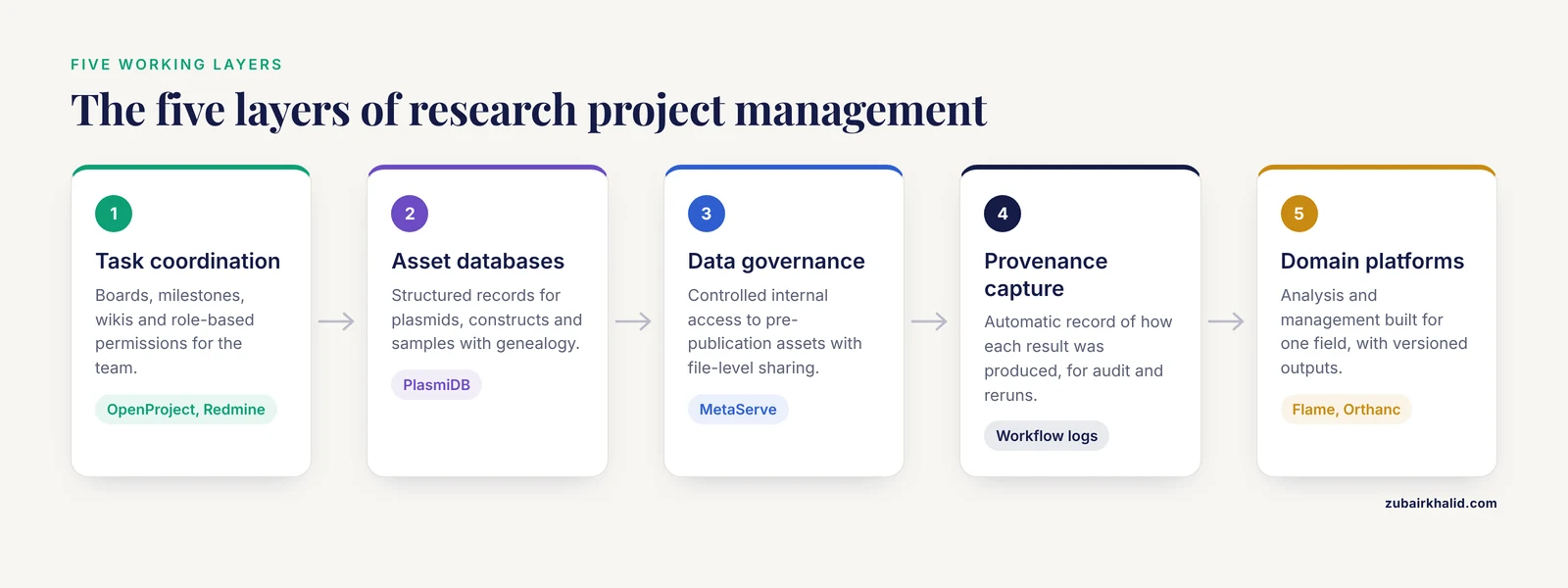
The options fall into five working categories. Each solves a different slice of the research management problem.
- General-purpose project management suites. Self-hostable tools in the tradition of OpenProject, Redmine, Taiga, and Focalboard provide task boards, issue tracking, wikis, timelines, and role-based permissions. They are general knowledge tools, built for any team, and they need no domain customization to start.
- Lab-specific collection databases. Tools purpose-built for tracking physical and molecular research assets. PlasmiDB, an open source, web-based database for plasmid lifecycle management, is the clearest published example. It stores structured plasmid metadata, tracks plasmid genealogy across cloning generations and inter-laboratory exchanges, implements project-based access control, and supports collaborative workflows involving staff, students, and core facilities [2].
- Research data governance and delivery layers. Tools that manage pre-publication research assets inside an institution. MetaServe is a lightweight, open source layer that registers and delivers heterogeneous assets, from sequencing files and processed matrices to imaging data and tabular files, with role-based controls, explicit file-level sharing, and operational traceability, without requiring repository-grade standardization [3].
- Provenance and workflow infrastructure. Systems that automatically record the trace of a research task and its resulting data. Data provenance technologies capture how each result was produced, which is the foundation for reproducible research and auditable workflows [4].
- Domain-specific open source platforms. Analysis and management systems built for one research domain. Examples include the GBD Analysis Suite, an open source R Shiny dashboard consolidating 11 analytical modules for burden-of-disease research into a code-free web interface [5], Flame, an open source framework for predictive model development with versioned model repositories and unique model IDs [6], and mature open source PACS platforms such as Orthanc, DCM4CHE, DCMTK, and Dicoogle for medical imaging management [7].
Side-by-Side Comparison
| Category | Representative tools | Best for | Core strengths | Watch-outs |
|---|---|---|---|---|
| General-purpose PM suites | OpenProject, Redmine, Taiga, Focalboard | Task coordination, milestones, onboarding new staff | Mature features, self-hosting, broad community documentation | No research domain awareness, records live separately from data |
| Lab collection databases | PlasmiDB | Multi-user labs managing shared construct or sample collections | Genealogy tracking, project-based access control, Docker deployment [2] | Domain-specific, one system per asset type |
| Data governance layers | MetaServe | Core facilities and institutional teams handling pre-publication omics and mixed assets | Metadata-aware retrieval, role-based access, path-manifest export [3] | Institutional scope, not a public repository replacement |
| Provenance systems | Provenance-enabled workflow middleware | Projects where results must be auditable and rerun | Automated capture of the research task trace [4] | Adoption requires workflow discipline from day one |
| Domain platforms | GBD Analysis Suite, Flame, Orthanc, DCM4CHE, Dicoogle | Domain-specific analysis and management workloads | Code-free interfaces [5], model versioning [6], mature imaging support [7] | Each covers one domain, evaluation burden falls on you [7] |
The Options in Detail
General-Purpose Project Management Suites
These tools answer the question "who is doing what, by when, and what did we decide." For a research group, the high-value features are issue templates (so a requested analysis arrives with the needed inputs specified), milestones mapped to grant reporting dates, and a wiki that absorbs the protocol notes that would otherwise live in someone's email.
The strength of this category is maturity. These projects have large user bases, so installation guides, migration paths, and integration plugins are easy to find. The weakness is equally clear: none of them knows what a plasmid, a sequencer run, or an ethics approval is. Treat them as the coordination layer only, and pair them with a lower layer from the categories below.
Lab-Specific Collection Databases
When the management problem is physical or molecular assets, a purpose-built database beats a task board every time. PlasmiDB illustrates the pattern well. Built on a standard LAMP architecture (Linux, Apache, MySQL, PHP) and deployable via Docker, it was designed for extensibility without modification of the core database schema, and a gene module links genetic targets to associated plasmids, primers, and CRISPR reagents. In the originating laboratory it manages nearly 700 plasmids and generates declaration files for reporting automatically [2].
The lesson generalizes beyond plant molecular biology. If your lab's most frequent traceability failures involve a specific asset class, constructs, cell lines, antibodies, or field samples, look first for an open source database built for that asset class before forcing a generic tool to imitate one.
Research Data Governance Layers
Between the raw data on a storage server and the final public repository lies a gap that generic project tools do not fill: controlled internal access to pre-publication assets. MetaServe addresses this by combining file-type recognition, partial automatic metadata extraction for selected formats, manually supplied project and biological annotations, and indexed faceted retrieval, with authenticated web download and viewer handoff for compatible services such as cellxgene [3]. For a core facility serving many labs, this kind of layer is effectively the project management system for data.
Provenance and Workflow Systems
Provenance systems record, automatically, the chain of transformations that turned raw data into a published figure. In the learning health system context, implementing reproducibility and auditability throughout the workflow is what establishes trust in the research process, and provenance capture makes the documented path from data to result explicit rather than reconstructed from memory [4]. Disciplines with centralized execution environments, such as bioinformatics, adopted this early, while fields built on distributed and heterogeneous software are earlier on the adoption path [4]. For project management purposes, the takeaway is that your workflow engine's execution log is part of your project record, and choosing tools that preserve it is a project management decision, not merely a technical one.
Domain-Specific Open Source Platforms
Three published examples show what "managed well" looks like inside a domain. The GBD Analysis Suite integrates established R packages including forecast, segmented, ggplot2, and plotly into modules covering data import, choropleth mapping, joinpoint regression, decomposition, and forecasting, deliberately lowering the technical barrier for investigators in resource-limited settings [5]. Flame stores models in a repository supporting versioning, identifies each model with a unique ID, and includes documentation formatted to widely accepted standards, which makes collaborative model development practical [6]. In medical imaging, a structured four-criteria comparison identified Orthanc, DCM4CHE, DCMTK, and Dicoogle as the most mature open source PACS options [7]. Each of these embodies the same design principle: versioned, identified, documented outputs, which is precisely what project management for research should produce.
How to Compare Options: Criteria That Decide Real Choices
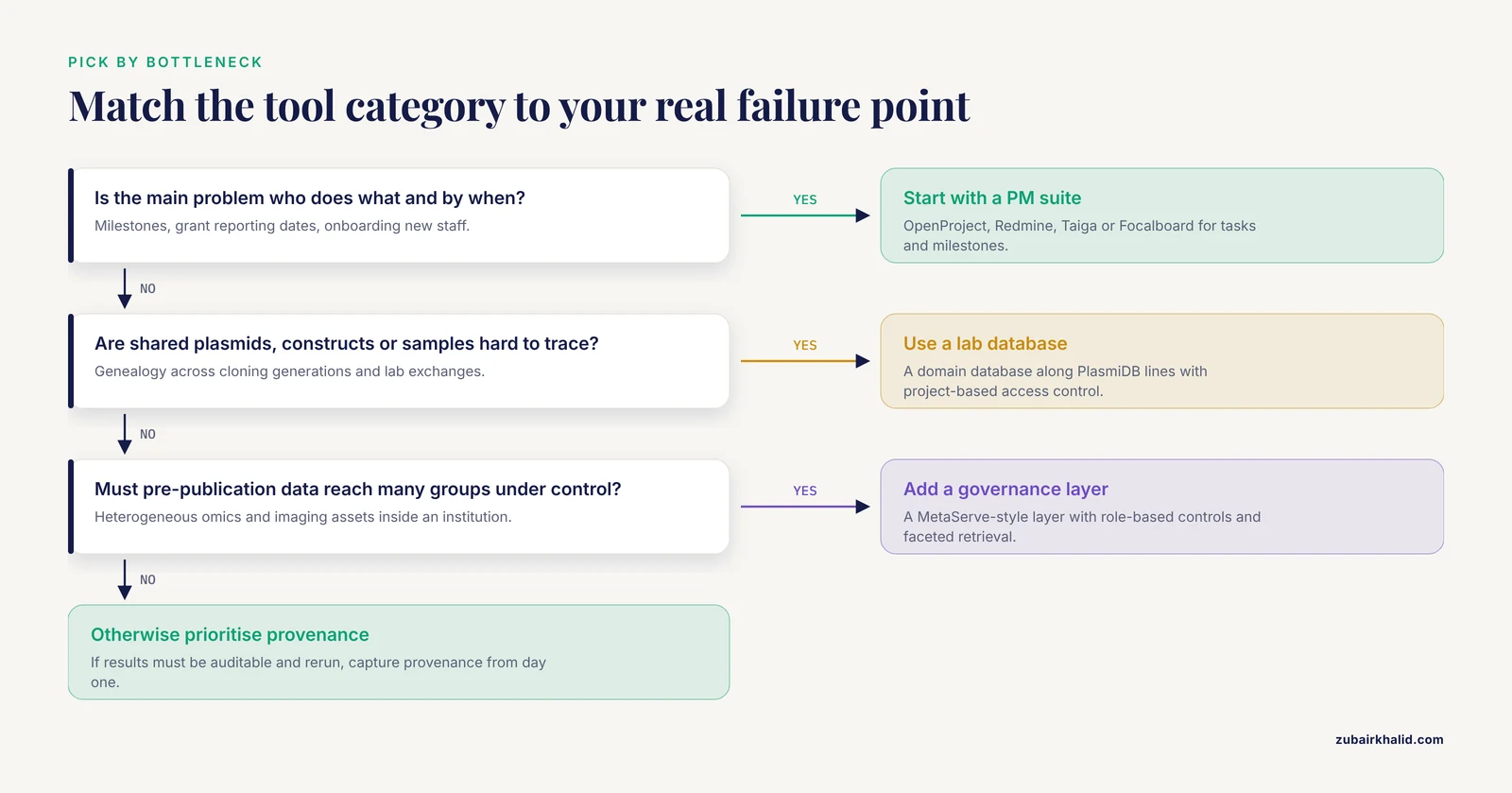
Published evaluations of open source systems converge on a small set of decision criteria, and you can borrow them directly.
Use a structured comparison, not impressions. When researchers assessed open source PACS platforms for a hospital in Guinea, they applied a simple comparison approach based on four explicit criteria rather than free-form vendor impressions, which produced a defensible shortlist of the most mature options [7]. Write your criteria down before you look at demos. A Delphi study that distilled 121 candidate criteria down to 6 consensus priorities for evaluating colonoscopy CADe software shows how much a pre-agreed short list sharpens a comparison that would otherwise sprawl [8].
Weight documentation and integration effort heavily. A detailed robotics case study found that one open source control framework failed in integration because of minimal documentation and a tightly coupled architecture, while a second succeeded largely because of structured integration documentation [9]. The same "framework gap" appears constantly in research software adoption. A tool with mediocre features and excellent documentation routinely beats a more capable tool you cannot get running.
Expect organizational factors to dominate technical ones. An overview of nine systematic reviews on free and open source electronic health record systems found that implementation success was influenced more by institutional and organizational factors than by technical features, with reported challenges including organizational barriers, uncertainty about volunteer-led development communities, and concerns over set-up, customization, and training costs [10]. Translate this to your own setting: the question is not only "is the software good" but "does our institution have someone who will own it."
Check access control against your real collaboration structure. Multi-user research environments need project-based access control that separates staff, students, and external collaborators [2], and role-based controls with explicit file-level sharing for data assets [3]. If a candidate tool cannot express your actual permission structure, skip it regardless of its other virtues.
Interrogate sustainability, not just the license. Reviews of open source health technologies consistently flag uneven documentation, limited standardization, interoperability barriers, and technical expertise gaps as recurring challenges, and note that openness alone does not ensure accessibility, safety, or sustainability [11].
Open Source Project Management Software for Research: Pros and Cons
Pros:
- No per-seat subscriptions. Budget shifts from recurring license fees to one-time setup and ongoing maintenance, which matters for labs with fluctuating personnel.
- Full data ownership. Self-hosting keeps sensitive datasets, participant identifiers, and unpublished results on infrastructure you control, which is a prerequisite for many data governance policies.
- Inspectability supports reproducible research. Because the tool itself is auditable, you can verify how it stores, transforms, and records your data rather than trusting a black box.
- Extensibility. PlasmiDB was designed for extension without schema modification [2], and Flame allows source code extension for unlimited model customization [6]. Commercial tools rarely offer that.
- Proven fit in demanding settings. A computerized health management information system in rural India, running on generic open source software since its third version, showed no major hardware problems, more than 95 percent data accuracy, and worker-reported usefulness for service delivery, workplans, and reports [12]. Open source systems demonstrably run reliably in low-resource, high-stakes environments.
Cons:
- You are the support department. There is no vendor to call. Volunteer-led communities vary in responsiveness and longevity [10].
- Hidden setup and training costs. Even with no license fee, customization, migration, and training consume real staff time [10], and the initial computerization of even two small health centers required substantial upfront investment [12].
- Uneven documentation. Poor documentation can sink an otherwise capable tool, as the robotics integration study demonstrated directly [9].
- Fragmentation across domains. You may need one tool for tasks, another for constructs, a third for data governance, and a fourth for analysis, and integration between them is your problem to solve.
- Evidence is heterogeneous. Many open source tools are prototypes or early implementations, and their scalability and sustainability vary across settings [11].
Worked Scenarios
Scenario 1: A five-person molecular biology lab drowning in construct records. The bottleneck is not task tracking, it is traceability of plasmids and reagents across students rotating through the lab. The right first move is a domain database along PlasmiDB lines, with project-based access control and genealogy tracking [2], paired with a lightweight task board for weekly planning. Adopting a heavyweight PM suite alone would leave the actual problem unsolved.
Scenario 2: A core facility serving a dozen research groups. The bottleneck is controlled delivery of heterogeneous pre-publication data. A governance layer like MetaServe, with role-based controls, faceted metadata retrieval, and path-manifest export for downstream workflows [3], sits at the center. A general PM suite handles scheduling and service requests on top.
Scenario 3: A clinical research group preparing for an audit. The bottleneck is demonstrating where every result came from. Here the priority is provenance capture built into the analysis workflow from day one [4], plus versioned, identified, documented outputs of the kind modeled by model repositories with unique IDs [6]. Retro-fitting provenance after the fact is far harder, which shapes the whole tool selection order.
Open Source Tools for Reproducible Research and a Reproducibility Checklist
Reproducible research means that a second person, or you yourself in two years, can rerun the analysis on the same data and obtain the same result. Project management tooling either supports this or quietly undermines it. Open source tooling helps in concrete ways: open benchmark datasets with hosted code and data, such as the OpenClustered R package with its 19 clustered datasets on GitHub [13], open source search algorithms that make multi-algorithm consensus validation feasible in proteomics [14], openly released machine learning software with documented performance, such as RCT classification models reaching an AUROC of 0.987 with the code provided for practical use [15], FAIR-aligned data capture templates, with the Template Wizard offering over 60 harmonized data entry templates and an open source parser producing machine-readable formats [16], and privacy-preserving infrastructure services like the Mainzelliste pseudonymization service for record linkage [17]. Even AI evaluation workflows now explicitly measure response reproducibility, querying models repeatedly and scoring within-case consistency across hundreds of physician-scored responses [18].
Use this reproducibility checklist when setting up any new project's tooling:
- Every dataset has a unique identifier and a recorded source.
- Every analysis is version controlled, with the exact software versions recorded.
- Data capture uses structured, machine-readable templates aligned to community standards where they exist [16].
- The workflow engine or provenance layer records the transformation path from raw data to each result [4].
- Intermediate and final outputs carry version identifiers, following the model repository pattern [6].
- Access permissions are role based and match your actual team structure [3].
- Person-level data is pseudonymized before any linkage or sharing step [17].
- Any benchmarking uses openly available comparison datasets where possible [13].
- A README in the project repository states how to rerun the analysis end to end.
- The maintenance owner for each tool is named, with a backup person.
Common Mistakes and Limitations
Choosing by feature checklist instead of bottleneck. Teams pick the tool with the most checkboxes and discover it does not touch their actual failure point. Diagnose the bottleneck first, then match the category.
Ignoring documentation quality during evaluation. The single best predictor of integration success in the robotics case study was the presence of structured integration documentation [9]. Run a real pilot, not a demo tour, before committing.
Assuming free means cheap. The dominant challenges reported for open source health systems were organizational: set-up effort, customization, training, and uncertain volunteer community capacity [10]. Budget staff time honestly.
Letting the project record live outside the tools. If decisions, protocols, and provenance live in chat threads and personal spreadsheets, no PM software will save the project. The tools only work when the record actually goes into them.
Treating the tool as the reproducibility plan. Software alone does not make research reproducible. Provenance technologies facilitate reproducible research only when the workflow is designed so that the trace is captured [4]. The checklist above is the human discipline, the tools are the enforcement.
A final limitation applies to individual situations: specific institutional constraints, existing infrastructure, and funder requirements vary enough that a pilot evaluation in your own environment, on your own data, is the only definitive test.
Frequently Asked Questions
What counts as open source project management software for research?
Any software with an open license that you can inspect, modify, and typically self-host to coordinate research work. That includes general task and milestone tools, lab-specific asset databases, data governance layers, and provenance systems. The research-specific categories matter most in practice because generic tools do not track samples, constructs, or data lineage.
Which is the best open source project management software for research?
There is no single best tool, because the right choice depends on your bottleneck. Published evaluations consistently show that structured comparison against pre-agreed criteria, documentation quality, and organizational fit decide outcomes more than raw feature counts [7][10]. Match the tool category to your failure point and pilot it on real work before committing.
Is open source project management software really free?
The license is free, the total cost is not. Setup, customization, migration, and training consume staff time, and long-term maintenance depends on your institution or the volunteer community [10]. In practice you exchange a recurring license fee for an internal responsibility you must staff.
How does project management software support reproducible research?
It preserves the link between tasks, data, versions, and decisions. Provenance-enabled systems automatically capture the trace of the research task and its resulting data, which establishes the auditability that reproducible research requires [4]. Versioned, uniquely identified outputs, as implemented in open model repositories, extend that chain through to final results [6].
What belongs on a reproducibility checklist?
The essentials are unique dataset identifiers, version-controlled analyses with recorded software versions, machine-readable structured data capture, automatic provenance recording, versioned outputs, role-based access controls, pseudonymization for person-level data, and a named maintenance owner for every tool [4][16][17][3].
Do we need dedicated IT staff to run self-hosted tools?
For anything multi-user and long-lived, yes, at least part of one person's time. Modern deployment packaging such as Docker lowers installation effort, as PlasmiDB's deployment model shows [2], but backups, updates, access management, and troubleshooting need an identified owner with a backup. Single-user desktop tools are the exception.
Sources
- Can tiered open-source mandates optimize innovation? A differential game study osn platform vs. independent project dynamics in foundation software ecosystems.
- PlasmiDB: an open-source and customizable database for plasmid lifecycle management in multi-user, multi-project plant molecular biology laboratories.
- MetaServe: a lightweight, metadata-aware governance and delivery layer for pre-publication research omics data.
- Embedding data provenance into the Learning Health System to facilitate reproducible research.
- Open-Source R Shiny Dashboard (Global Burden of Disease Analysis Suite) for Multimethod Burden of Disease Research: Development and Evaluation Study.
- Flame: an open source framework for model development, hosting, and usage in production environments.
- Assessing Available Open-Source PACS Options.
- Creating a standardized tool for the evaluation and comparison of artificial intelligence-based computer-aided detection programs in colonoscopy: a modified Delphi approach.
- Practical Integration of Open-Source Control Architectures on Custom Quadruped Robots: Simulation Validation and Hardware Interfacing.
- Use and characteristics of free/libre and open source electronic health records: an overview of reviews.
- Open-source health technologies for epidemiological research and public health surveillance.
- Evaluation of computerized health management information system for primary health care in rural India.
- OpenClustered: an R package with a benchmark suite of clustered datasets for methodological evaluation and comparison.
- An evaluation, comparison, and accurate benchmarking of several publicly available MS/MS search algorithms: sensitivity and specificity analysis.
- Machine learning for identifying Randomized Controlled Trials: An evaluation and practitioner's guide.
- A template wizard for the cocreation of machine-readable data-reporting to harmonize the evaluation of (nano)materials.
- Optimization of the Mainzelliste software for fast privacy-preserving record linkage.
- Development of a Framework for Evaluating Large Language Model Safety and Reliability: a Proof-of-Concept Evaluation.