Top 10 Online Project Management Courses for Scientists
By Dr. Zubair Khalid, DVM, MS, PhD ·
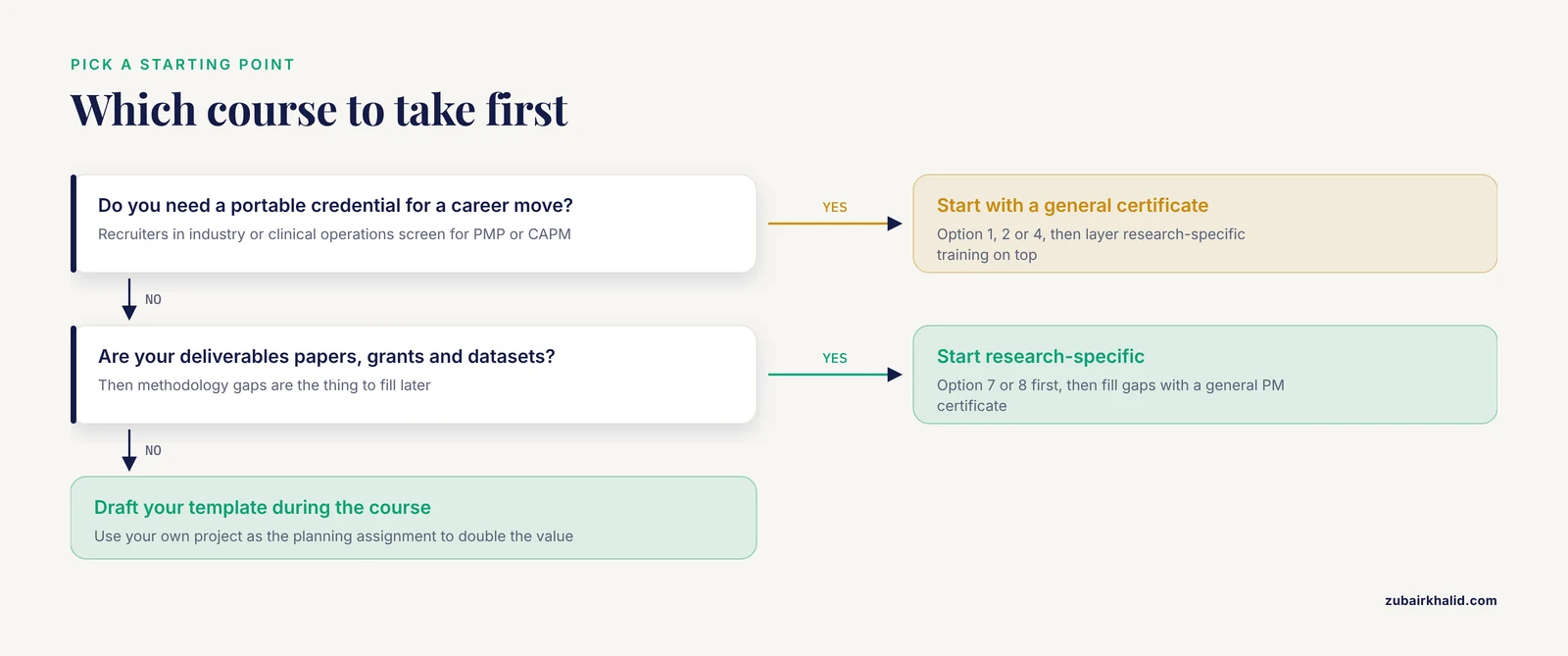
General project management courses teach scheduling, budgeting, and stakeholder communication, while research project management adds the pieces generic courses skip, such as grant milestones, data management plans, and experiments that fail on schedule. The rule of thumb for choosing between the best online project management courses for scientists is simple: if your deliverables are papers, grants, and datasets, start with a research-specific or research-adjacent course and fill the methodology gaps with a general PM certificate. If you need a portable, employer-recognized credential for a career move, start with a general certificate and layer research-specific training on top.
This article compares the top 10 online project management courses for scientists, explains the formats online science training actually uses, walks through three career scenarios, and shows how to turn any course into a working research project plan template.
What Research Project Management Adds to Generic Training
A commercial construction project and a translational research project both have budgets, deadlines, and teams. The difference is what dominates the risk profile. In research, the largest risks are usually data integrity, staff continuity, and the fact that the core experiment may not work.
Data risk is the clearest example. High-throughput structural biology laboratories generate vast amounts of raw experimental data, and the traditional summary of that work in a peer-reviewed paper captures only a fraction of what was produced. Descriptions of methodology are increasingly pushed into online supplementary materials that may not be reviewed as thoroughly as the main manuscript, which creates trouble when results need to be rechecked or reproduced [1]. A project manager in a research setting therefore treats documentation, file organization, and raw data retention as scheduled deliverables, not afterthoughts. Generic PM courses rarely cover this, and it is one of the strongest arguments for choosing training designed around research project management.
The personal payoff is also documented. When 50 medical students completed an individual research project course and wrote structured reflections, analysis of their writing produced three categories of learning: thinking as a scientist, working as a scientist, and personal development. Beyond scientific skills, students reported gains in self-confidence, self-discipline, independence, and time management [2]. Managing a real project is itself the training, and a good course structures that experience rather than replacing it.
Career stage matters too. Clinician-investigators and similar dual-role scientists face discontinuous research opportunities, competing clinical obligations, and a need for leadership development after formal training ends, which is why flexible, modular training has become a priority in workforce planning [3]. Online courses fit that constraint better than semester-long classroom programs.
What Online Courses for Scientists Actually Look Like
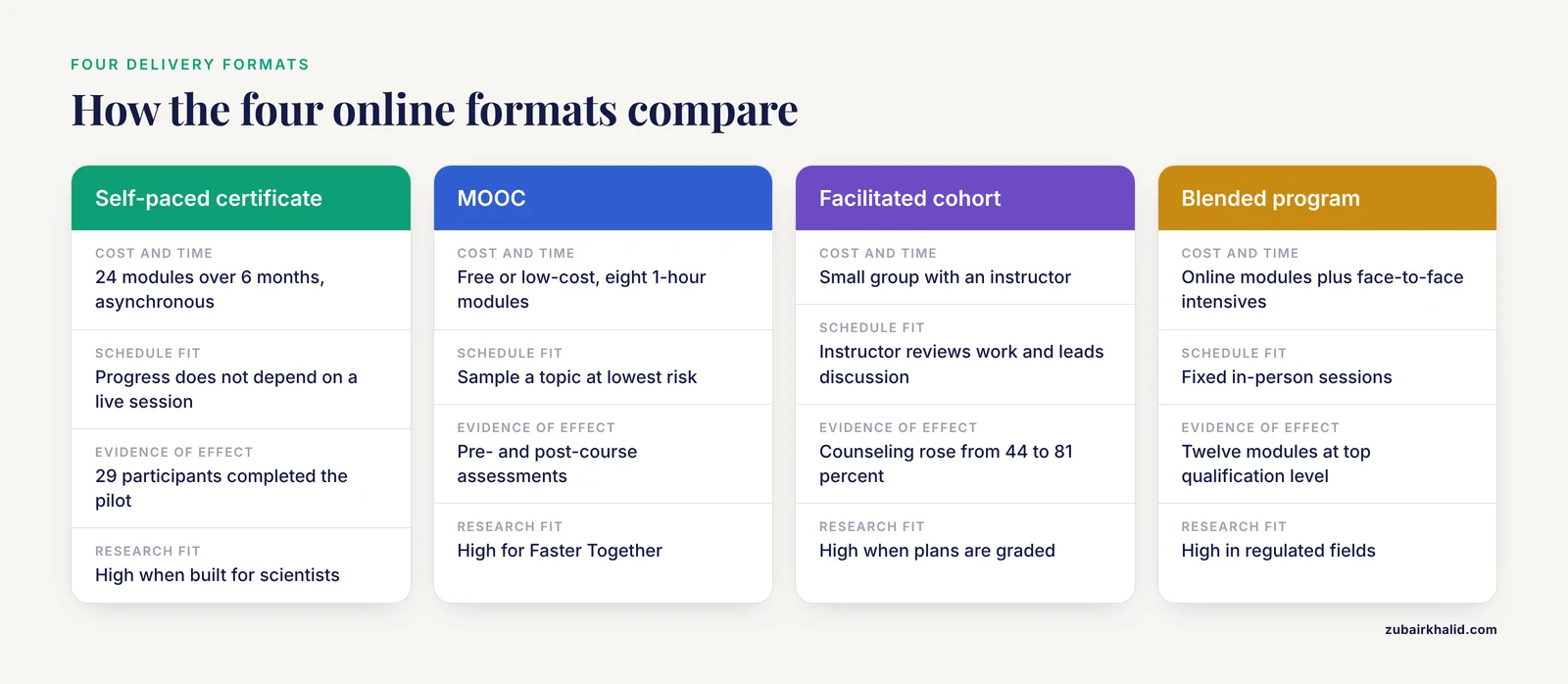
Before comparing specific options, it helps to know the four delivery formats you will encounter, because the format drives cost, time commitment, and how much you retain.
Self-paced asynchronous certificate courses. A well-documented example is a 24-module pathology certificate course built for basic and translational scientists at MD Anderson and the Texas Medical Center. It ran over 6 months in an asynchronous CANVAS learning management format, with each module organized around explicit educational objectives, and 29 participants completed the pilot [4]. This format suits scientists with unpredictable bench schedules because progress does not depend on a live session.
Massive open online courses (MOOCs). A MOOC is a free or low-cost online course open to anyone, typically built around video lectures, readings, and automated quizzes. Faster Together, a MOOC designed to help research team members improve the recruitment of minorities in clinical trials, was implemented on Coursera and divided into eight 1-hour modules with video presentations and reading assignments, and knowledge was measured with pre- and post-course assessments [5]. MOOCs are the lowest-risk way to sample a topic.
Facilitated cohort courses. In this format, a small group moves through the material together with an instructor who reviews work and leads discussion. An evaluation of the TEACH online course in tobacco cessation counseling, taken by 62 health care providers with direct clinical duties, found that the proportion reporting they provided cessation counseling rose from 44 percent at baseline to 81 percent at 6-month follow-up, a sustained behavior change measured with paired statistical tests [6]. Facilitation appears to matter for whether training changes practice.
Blended programs. Blended learning combines online modules with face-to-face intensives. The European EUTEMPE-RX project, built to train medical physics experts in diagnostic and interventional radiology to the highest European qualification level, developed twelve course modules that deliberately combined online teaching with in-person sessions [7]. Scientists in regulated or equipment-heavy fields should expect this hybrid pattern at the advanced level.
The Top 10 Online Project Management Courses for Scientists, Compared
The list below mixes general PM certificates with research-specific programs, because research project management skills live in both worlds. Prices and schedules change constantly, so verify current details on each provider's official page before enrolling.
| # | Course or option | Format | Research fit | Best for |
|---|---|---|---|---|
| 1 | Google Project Management Certificate (Coursera) | Self-paced MOOC-style specialization | Moderate | Scientists new to formal PM vocabulary |
| 2 | Project Management Principles and Practices specialization, UC Irvine (Coursera) | Self-paced specialization | Moderate | A structured introduction to the classic PM cycle |
| 3 | edX professional certificate programs in project management | Self-paced, academic-led | Moderate | Learners who prefer university-backed content |
| 4 | PMI e-learning and CAPM or PMP preparation | Self-paced plus exam prep | Low to moderate | Scientists who want a portable credential |
| 5 | LinkedIn Learning project management paths | Short self-paced video courses | Low to moderate | Quick gap-filling during a busy experiment cycle |
| 6 | University extension certificates in project management | Cohort or self-paced, credit-bearing | Moderate | Career changers needing formal credit |
| 7 | Faster Together MOOC on clinical trial recruitment (Coursera) | Eight 1-hour modules | High | Clinical research coordinators and trial staff |
| 8 | Self-paced institutional certificate courses (MD Anderson-style model) | 24 modules over 6 months, asynchronous | High | Scientists who want deep, structured topic training |
| 9 | Facilitated interprofessional CE cohorts (TEACH-style model) | Cohort with instructor and follow-up | High | Teams that need behavior change, not just knowledge |
| 10 | Blended consortium programs (EUTEMPE-RX-style model) | Online modules plus in-person intensives | High (regulated fields) | Medical physicists and similar advanced specialists |
1. Google Project Management Certificate (Coursera)
This entry-level certificate walks through the full project lifecycle, from initiation and planning to execution and closure, using common tools such as Gantt charts, sprint boards, and project charters. For a scientist, the value is vocabulary and artifacts. After completing it, you can write a charter for a mouse study or a sequencing run, define milestones a funding agency would recognize, and speak the language a program manager at a biotech company expects. It assumes no background and moves at a self-set pace, which fits bench schedules. The limitation is that its examples come from business settings, so you will need to translate every template into research terms yourself.
2. Project Management Principles and Practices Specialization, UC Irvine (Coursera)
This four-course specialization covers the classic PM framework in more depth than a single survey course, including scope definition, scheduling, budgeting, and risk. It suits scientists who already informally run projects, such as a postdoc coordinating a multi-lab collaboration, and who now need formal structure. Expect to produce actual planning documents as coursework, which you can adapt into a research project plan template for your own lab. The pace is self-directed, and the assignments use generic business scenarios rather than research ones.
3. edX Professional Certificate Programs in Project Management
edX hosts project management programs built by universities and, in some cases, aligned with the Project Management Institute's certification framework. The academic style tends to include more theory, such as organizational behavior and decision analysis, which resonates with scientists who want to know why a method works before applying it. These programs are typically structured as a sequence of graded courses with a capstone. The tradeoff is less flexibility than standalone short courses, and content skews toward industry projects rather than grant-funded research.
4. PMI E-Learning and CAPM or PMP Preparation
The Project Management Institute offers self-paced e-learning and exam preparation for its credentials, including the Certified Associate in Project Management (CAPM) for early-career professionals and the Project Management Professional (PMP) for experienced practitioners. This is the option to choose when a credential itself is the goal, for example when moving into clinical program management or industry operations where recruiters screen for PMP. The coursework is rigorous about formal methodology but says almost nothing about research contexts, institutional review boards, or grant administration. Treat it as a credential engine, not as research training.
5. LinkedIn Learning Project Management Paths
LinkedIn Learning offers short video courses covering Gantt charts, agile methods, resource planning, and specific tools. Individual courses run a few hours, which makes them ideal for gap-filling. If a collaborator asks you to manage a shared procurement budget next quarter, a two-hour budgeting course may be all you need. The limitation is depth. These courses build skills, not credentials, and there is no cohort or instructor feedback.
6. University Extension Certificates in Project Management
Many public and private universities offer project management certificates through their extension or continuing education schools, often credit-bearing and taught by practicing program managers. These suit scientists planning a career transition into research administration, clinical operations, or industry project roles, where a transcript matters. Courses usually run in academic terms, so start dates are fixed. Expect more time and money than a MOOC and a credential with institutional weight behind it.
7. Faster Together MOOC on Clinical Trial Recruitment (Coursera)
This is the clearest example in the research-training literature of a well-built, research-specific online course. Developed by a transdisciplinary group using community-engaged research principles and implemented on Coursera, it consists of eight 1-hour modules with videos, readings, and pre- and post-assessments of knowledge, attitudes, and intentions regarding minority recruitment in clinical trials [5]. It does not teach Gantt charts, but it teaches a core management competency for clinical research teams, and it demonstrates the MOOC format at its best. Clinical research coordinators should treat it as a complementary skill alongside formal PM training.
8. Self-Paced Institutional Certificate Courses for Scientists
Some academic medical centers now build multi-month, self-paced certificates aimed specifically at scientists. The model to look for is the one MD Anderson used for its pathology course: 24 instructional modules delivered over 6 months in an asynchronous learning management system, each with defined educational objectives and a certificate on completion [4]. When evaluating any self-paced certificate, whether in project management or another domain, this structure is the benchmark. Ask whether the course publishes its objectives per module, how long access lasts, and whether assessment is more than an automated quiz. Research offices, professional societies, and academic medical centers increasingly offer PM-themed versions of this format.
9. Facilitated Interprofessional Continuing Education Cohorts
The TEACH evaluation provides the strongest published evidence that online training can change behavior when it includes facilitation and follow-up. Sixty-two health care providers completed the course, and self-reported counseling practice rose from 44 percent to 81 percent at 6 months [6]. For scientists, the lesson is that a facilitated cohort, where an instructor reviews your actual project plans and peers critique them, converts knowledge into practice far better than passive video. Look for cohort-based PM courses that require you to submit a real project plan, ideally one for your own research, as graded work.
10. Blended Consortium Programs for Regulated Specialties
In fields where competence is formally defined by a qualification framework, advanced training tends to be blended. EUTEMPE-RX, a European Commission-supported project, built twelve modules at the highest European qualification level for medical physicists, deliberately mixing online teaching with face-to-face sessions [7]. If you work in a regulated specialty such as medical physics, radiation safety, or clinical laboratory science, check whether your professional body endorses a blended PM or leadership program, because a purely online general course may not satisfy employer or regulator expectations.
Online Project Management Courses for Scientists: Pros and Cons
Weighing the online project management courses for scientists pros and cons comes down to four tradeoffs that hold across nearly every option.
Advantages.
- Schedule fit. Asynchronous formats exist precisely because scientists cannot commit to fixed class times, and the 6-month self-paced MD Anderson model shows that long, structured programs can run without live sessions [4].
- Low-cost entry. MOOCs let you audit a topic before committing money, and the Faster Together course delivered eight full training hours on a major public platform [5].
- Documented effectiveness. Online training is not inherently inferior. The TEACH cohort showed sustained practice change at 6 months in a facilitated online format [6], and research project courses produced measurable gains in time management and independence [2].
- Immediate application. Because you take the course while working on a real project, every template and exercise can be applied to live data within days.
Disadvantages.
- Generic examples. Most commercial PM courses use business case studies, so translating scope statements and risk registers into grant aims and experimental contingencies is your job.
- Credential confusion. A certificate of completion is not a professional certification, and employers treat them differently.
- Weak assessment in some MOOCs. Automated quizzes measure recall, not the ability to manage an actual project, so course quality varies.
- Missing research-specific content. Data management plans, reproducibility, ethics approvals, and multi-site collaboration agreements are rarely covered in general curricula, even though data management failures in high-throughput research are a documented, serious problem [1].
How to Choose: Three Worked Scenarios
Scenario 1, the late-stage PhD student. You are two years from defending, coordinating experiments across two labs, and considering industry jobs. Choose option 1 or 2, a self-paced general specialization. Your goal is vocabulary and templates you can apply immediately to your thesis project, and the certificate becomes a line on your resume. Skip credential prep for now.
Scenario 2, the clinical research coordinator. You manage participant recruitment and site logistics for trials. Start with option 7, the Faster Together MOOC, since its eight 1-hour modules fit around clinic hours and its content is directly about your daily work [5]. Then add a general PM course such as option 1 or 4 to formalize scheduling and budgeting skills. If your institution offers a facilitated cohort, prefer it, because the TEACH evidence shows facilitated formats drive durable practice change [6].
Scenario 3, the early-career principal investigator. You just received your first grant and now manage staff, budgets, and data across a small team. A general MOOC is too shallow. Look for option 6 or option 8, a structured certificate or institutional program, and prioritize any course that requires you to submit a real project plan for feedback. Pair the coursework with the project plan template below, and treat data management planning as a graded deliverable given the reproducibility risks documented in high-throughput research [1].
Building Your Research Project Plan Template
Whatever course you take, the deliverable that matters most is a one-page-to-five-page research project plan template you reuse for every study. Courses supply generic versions. Adapt them with the following research-specific sections.
- Objective and success criteria. State the scientific question and define in advance what a definitive result looks like. Consensus methods show how this works in practice. In a modified Delphi process, 25 experts generated 121 candidate criteria for evaluating colonoscopy software, narrowed them to 54 in-scope items, and ranked them over multiple rounds until 6 priority criteria remained [8]. Write your success criteria before the experiment starts, with the same discipline.
- Milestones with decision points. For each milestone, specify the go or no-go condition. Research differs from business projects here, because a failed experiment can be an informative result rather than a slip in the schedule.
- Data management plan. Name where raw data goes, in what format, with what backup, and who can access it. Document methods as thoroughly as you would need to repeat the experiment, because published supplementary methods are often reviewed less carefully than main manuscripts and may be the only record of what was actually done [1].
- Roles and dependencies. Assign each task to a named person, including collaborators at other sites.
- Risk register. List the top five risks, for example reagent lot failure, animal protocol delay, key staff departure, with a mitigation for each.
- Communication plan. Set the meeting cadence, the reporting format, and how remote participants stay engaged. Recent experience from an EU-funded citizen science project showed that collaborative research can keep running under forced remote conditions when engagement is deliberately redesigned, including through webinars, multilingual resources, and asynchronous participation [9].
- Timeline with slack. Add buffer time before any externally fixed date, such as a grant report or abstract deadline.
Draft this template during your course, not after it. Most courses include a planning assignment, and using your own project as the assignment doubles the value of the tuition.
Evaluating Course Quality Before You Enroll
Marketing pages rarely distinguish good courses from weak ones, so borrow the appraisal logic used for training guidelines. A systematic review of 24 training guidelines for basic critical care echocardiography applied the AGREE-II appraisal tool and found that very few guidelines made clear recommendations about foundational elements such as course curriculum or practical experience requirements [10]. When you evaluate a PM course, apply the same skepticism. Clear signs of quality include published learning objectives per module, named instructors with research management experience, a defined assessment method, and evidence of evaluation, ideally against a recognized framework. The TEACH study, for example, explicitly evaluated its course against a defined level of an established evaluation framework rather than relying on satisfaction surveys [6]. A course that cannot state how it will be evaluated usually has not been.
One further quality signal is whether the course developers used structured consensus methods to define content. The colonoscopy software evaluation study showed how a Delphi process converts scattered expert opinion into a short, ranked set of priority criteria [8]. Course syllabi built through similar structured expert processes tend to be tighter than syllabi assembled from convenience.
Common Mistakes and Limitations
- Taking the course before defining the problem. Enrolling in a 40-hour program to solve a scheduling problem you could fix with a shared calendar wastes a quarter of your research time. Write down the three management failures that hurt your last project, then pick the course module that addresses them.
- Confusing certificates with certifications. A certificate documents that you completed a course. A certification, such as the PMP, requires meeting experience thresholds and passing an external exam. Read the provider's own terminology carefully.
- Ignoring the facilitation effect. Choosing the cheapest fully automated option when your real goal is behavior change contradicts the available evidence, which favors facilitated formats for durable practice change [6].
- Copying business templates unmodified. A commercial risk register template has no field for "experiment produced an uninterpretable result." Edit every template against your research project plan template structure before adopting it.
- Treating data management as an IT problem. The documented failure mode in high-throughput science is not lost files, it is methods and raw results that cannot be reconstructed years later, which is an ownership and planning failure [1].
- Assuming one course is enough for a regulated role. In fields with formal qualification frameworks, blended and endorsed programs, not general online certificates, are the recognized route [7].
- A limitation of this guide. Course catalogs, prices, and schedules change frequently, and individual career situations vary. Verify all details on official provider pages before paying, and seek advice from a mentor or institutional research office for decisions specific to your situation.
Frequently Asked Questions
Do I need a PMP credential to manage a research project?
No. Most academic research project management runs on documented competence, not certification. Pursue a credential such as the PMP or CAPM mainly when targeting industry or clinical operations roles where recruiters screen for it.
Can online courses teach project management as well as in-person training?
For knowledge and templates, yes. For durable behavior change, facilitated online cohorts have the strongest published evidence, with one such course showing sustained practice improvement at 6 months [6]. Prefer a facilitated format when changing your own habits is the goal.
How long do these online courses take?
Anywhere from a few hours for a short video course to 6 months for a structured self-paced certificate, based on documented programs in the research training literature. Check the stated time commitment per module before enrolling.
Should I take a general PM course or a research-specific one first?
If your deliverables are papers, grants, and datasets, take a research-specific course first and fill methodology gaps with a general PM certificate. If you need a portable credential for a career move, reverse the order.
What software do I need alongside a course?
Courses typically teach generic tools such as Gantt charts and task boards. For research, pair any course with your institution's approved systems for scheduling, file storage, and documentation, and adapt course templates to those systems rather than adopting new software the course happens to feature.
Are free online courses good enough?
Free MOOCs are good enough to learn concepts and sample a field, and some, like the Faster Together course, are well designed and rigorously assessed [5]. They are usually not sufficient when you need a credential, instructor feedback, or a portfolio of graded project plans.
Sources
- Data management in the modern structural biology and biomedical research environment.
- What is the reward? Medical students' learning and personal development during a research project course.
- Clinician-Investigator Training and the Need to Pilot New Approaches to Recruiting and Retaining This Workforce.
- Enhancing Pathology Knowledge for Biomedical Scientists: Pilot Cohort Study of a Comprehensive Self-Paced Tutorial for Bridging Fundamental Concepts With Translational Applications.
- Design and implementation of a massive open online course on enhancing the recruitment of minorities in clinical trials - Faster Together.
- Performance Change in Treating Tobacco Addiction: An Online, Interprofessional, Facilitated Continuing Education Course (TEACH) Evaluation at Moore's Level 5.
- EUTEMPE-RX, an EC supported FP7 project for the training and education of medical physics experts in radiology.
- Creating a standardized tool for the evaluation and comparison of artificial intelligence-based computer-aided detection programs in colonoscopy: a modified Delphi approach.
- Force majeure impact on citizen science: Perspective from an EU funded project.
- Methodologic Quality of Guidelines for Training or Competence Processes for Basic Point-of-Care Echocardiography in Critical Care: A Systematic Review of the Literature.