NIH vs. NSF Grant Proposals: Key Differences
By Dr. Zubair Khalid, DVM, MS, PhD ·

The core difference between NIH and NSF grant proposals is their mission. The National Institutes of Health (NIH) funds research aimed at human health and disease, and its reviewers judge proposals primarily on scientific rigor, especially the soundness of the experimental approach. The National Science Foundation (NSF) funds basic research and education across science and engineering, and its reviewers judge proposals on two named criteria: intellectual merit and broader impacts.
The rule of thumb is simple. If your project targets a disease mechanism, a clinical outcome, a therapeutic strategy, or a public health question, NIH is usually the right home for the proposal. If your project asks fundamental questions in biology, chemistry, physics, computing, engineering, or the social and behavioral sciences, and its health relevance is indirect, NSF is usually the better fit. Many projects could plausibly go either way, and the difference between NIH and NSF grant proposals then comes down to how you frame the work, which criteria you write to, and which agency's review process your proposal can survive.
Both agencies rely on expert peer review, and a systematic comparison of federal funders found that their criteria ultimately ask a small, shared set of questions about mission fit, scientific quality, and return on investment [1]. But the wording, weighting, and mechanics of those questions differ enough that a proposal written for one agency often reads as generic or off-target to reviewers at the other. This article explains each agency on its own terms, compares the features that decide real funding choices, and walks through worked scenarios so you can plan your submissions deliberately.
What NIH Proposals Are Built For
NIH is a medical research agency with a mission centered on health. Its intramural and extramural portfolios span basic biomedical science, translational work, clinical trials, behavioral research, and training. When you write an NIH proposal, you are answering a question that reviewers at NIH study sections ask constantly: does this work move understanding of health or disease, and is the plan technically sound enough to deliver a meaningful answer?
The flagship mechanism is the R01, an unsolicited investigator-initiated research project grant. NIH also supports career development awards, commonly called K awards, which pair protected research time with structured mentoring for early-career scientists [2]. K awards exist in disease-specific and career-stage-specific flavors, and they are often the first independent award a clinical or translational researcher holds. Training and capacity-building are also part of the portfolio. For example, the NIH Fogarty International Center has funded bioethics training programs that produced measurable gains in leadership, teaching, and publication outcomes for trainees across a decade of investment [3].
NIH proposals are organized around a Specific Aims page, a tightly constrained one-page summary of the problem, gap, hypothesis, and experimental plan, followed by a Research Strategy section that details significance, innovation, and approach. Reviewers at NIH study sections score the application on defined criteria, and empirical work has shown that the approach score is the strongest predictor of the final priority score, meaning the technical plan carries exceptional weight in NIH review [4]. NIH funding is also a visible marker of productivity in many biomedical fields, and tools like the NIH RePORTER database, which lists funded projects and dollar amounts, are routinely used to benchmark departments and investigators [5]. Bibliometric studies have even found a linear correlation between h-index, a measure of publication impact, and NIH grant dollars at the investigator level.
What NSF Proposals Are Built For
NSF supports fundamental research and education across all fields of science and engineering. Its proposals are judged against two explicit criteria. Intellectual merit asks how the work advances knowledge within and across fields. Broader impacts asks how the project benefits society, typically through education, broadening participation of underrepresented groups, infrastructure, dissemination, and societal relevance [7].
The flagship mechanism for early-career faculty is the CAREER award, which integrates a research program with an education plan. For established investigators, NSF offers standard project grants across its directorates. NSF proposals open with a Project Summary of roughly one page, often structured as an overview, intellectual merit statement, and broader impacts statement, followed by a Project Description with a page limit set by the solicitation.
Broader impacts deserve special attention because they are a distinct genre of writing. A move analysis of 91 stand-alone Broader Impacts sections from NSF proposals identified a three-part rhetorical structure, labeled Contextualize-Demonstrate-Predict, in which writers establish context, demonstrate concrete planned activities, and predict outcomes. The same analysis found that funded and unfunded proposals distributed these moves differently, which suggests that how you articulate broader impacts, not just whether you include them, affects competitiveness [7]. NSF reviewers also pay close attention to how well the proposal fits the agency's mission, and programs exist specifically to bring new communities into NSF's applicant pool, such as structured mentoring that encouraged first-time NSF submissions from community college researchers [8].
The Core NIH vs. NSF Grant Proposal Differences at a Glance
The table below summarizes the differences that matter most when you are deciding between the two agencies and planning a proposal. Because both agencies revise solicitations and application guides regularly, treat the structural details as typical patterns rather than fixed rules, and always confirm the current solicitation before you write.
| Feature | NIH | NSF |
|---|---|---|
| Mission | Human health and disease | Fundamental research and education across science and engineering |
| Typical scope | Focused hypothesis-driven projects with defined endpoints | Fundamental questions, often with an integrated education or workforce component |
| Signature early-career mechanism | K awards (mentored career development) [2] | CAREER awards (research plus education plan) [9] |
| Core review criteria | Significance, investigator, innovation, approach, environment, overall impact [1] | Intellectual merit and broader impacts [1] |
| Signature framing document | Specific Aims page [9] | Project Summary with explicit intellectual merit and broader impacts statements [9] |
| Review venue | Standing study sections with assigned reviewers [2] | Rotating panels assembled by program officers |
| Scoring culture | Criterion scores, priority scores, percentile concepts, plus active experimentation with ranking methods [10] | Merit review panel consensus built around the two criteria |
| Emphasis on economic or societal impact | Framed mainly through health relevance | Explicitly required through Broader Impacts [11][7] |
| Success rates | Among the lowest of the major funding agencies surveyed internationally [11] | Also among the lowest of the major funding agencies surveyed internationally [11] |
| Public funding record | RePORTER database of funded projects and dollars [5] | Award search and program pages by directorate |
Review Criteria: The Same Questions, Asked Differently
A comparison of review criteria across ten US federal funding agencies found that despite different wording, most agencies evaluate proposals against roughly eight fundamental questions, all tied to two overarching goals: the research fits the agency's mission, and the agency gets a strong return on its investment [1]. This finding is reassuring for grant proposal planning, because it means the core persuasive job is similar everywhere. You must show fit, feasibility, value, and capability.
What differs is the weighting and the language. NIH decomposes review into named scored criteria. Reviewers assign separate scores for significance, approach, investigator, innovation, and environment, and these feed an overall priority score. Text analysis of R01 critiques confirmed that approach scores predict priority scores across the board, which is a strong argument for investing heavily in the experimental design and its potential problems and alternatives [4]. The same study found that critique content and scores could differ by principal investigator sex, particularly for renewal applications, a documented feature of NIH peer review that applicants and mentors should be aware of [4].
NSF, by contrast, asks reviewers to synthesize their judgment into two named criteria. Intellectual merit is broadly analogous to the combination of significance, innovation, and investigator quality at NIH. Broader impacts has no true NIH equivalent at the same level of prominence. At NIH, societal benefit is usually folded into significance and health relevance. At NSF, it is a standalone scored dimension with its own rhetorical conventions, and proposals that treat it as an afterthought tend to lose ground to proposals that build it into the project design. A systematic international comparison of funding agencies also noted that US agencies, including NIH and NSF, put more emphasis on the economic and societal impact of research than agencies such as the German DFG or the Swiss SNSF, which de-emphasize those criteria [11].
Proposal Structure: Specific Aims versus Project Summary
The difference between NIH and NSF grant proposals is visible on page one. An NIH Specific Aims page is a one-page argument. It states the problem, the gap in knowledge, the central hypothesis, and the specific aims, usually three or so concrete experimental objectives. It reads like the opening of a scientific paper crossed with a strategic plan. Reviewers form strong first impressions from this page, and much of NIH grantsmanship training is devoted to sharpening it.
An NSF Project Summary serves a different rhetorical function. It must explicitly address intellectual merit and broader impacts, often under those literal headings. The Project Description that follows can be more expansive than a typical NIH Research Strategy, and the CAREER variant weaves a multi-year education plan into the research narrative. Because NSF expects the two criteria to be addressed directly, successful NSF writers learn a distinct skill: articulating societal benefit in concrete, evaluable terms rather than generic promises. The move analysis of Broader Impacts sections provides a practical template for this, mapping how funded proposals contextualize the problem, demonstrate planned activities, and predict outcomes [7].
The writing demands are similar enough that narrative training transfers. A structured bootcamp for early-career faculty, which admitted 11 NIH R-series applicants and 9 NSF CAREER applicants into a 20-person cohort, taught both groups the And-But-Therefore narrative framework and had them draft abstracts and their respective framing documents, the Specific Aims or Project Summary. Before the program, participants rated their comfort with storytelling at 45 on a 100-point visual analog scale, their preparedness at 39, and their funding confidence at 39. Demand for the 20 slots ran at 30 applicants, which signals how much early-career researchers want exactly this kind of cross-agency training [9].
Review Process: Study Sections versus Merit Panels
NIH review runs through standing study sections. A assigned set of reviewers writes detailed critiques of each application, and the full study section discusses and scores a subset. Experienced facilitators who have served on NIH study sections are a standard feature of grant writing programs, precisely because understanding how study section reviewers think is central to writing a fundable application [2]. NIH has also experimented with how scores are aggregated. A recent proposal analysis described a score-then-rank protocol, in which reviewers additionally rank their top proposals, combined through a joint statistical model called the Mallows-Binomial model to resolve ties and ordering ambiguities in funding decisions [10]. The practical takeaway for applicants is that NIH review is quantitative, criterion-driven, and highly sensitive to weaknesses in approach.
NSF review is organized by program officers who assemble rotating panels for each competition. Panelists discuss proposals in batches and converge on merit recommendations. The process is less standardized across directorates than NIH study sections, and program officer judgment about portfolio balance and mission fit carries real weight. For applicants, this means that talking with the relevant NSF program officer before submitting is a normal and encouraged step, something with no clean NIH equivalent.
One caution applies to both systems. Peer review outcomes are noisy. A single rejection at NIH may reflect reviewer composition as much as proposal quality, and NIH itself continues to test methods such as ranking-based aggregation precisely because summary statistics of review ratings have known limitations, including ties and unclear ordering of funding preference [10]. Resubmission, revision, and seeking feedback from mentors who have served on panels are standard parts of the process at both agencies.
Success Rates, Award Design, and Funding Culture
Both NIH and NSF are highly competitive. In a systematic comparison of six major research funding agencies that also included the German DFG, the Austrian FWF, the Dutch NWO, the UK's UKRI, and the Swiss SNSF, NIH and NSF showed the lowest success rates of the group, while agencies like the Swiss SNSF were described as far more generous in both success rates and funding levels [11]. For a US applicant this comparison is largely academic, since NIH and NSF are the two dominant federal funders for academic life science research, but it puts the competitive environment in perspective. Expect low success rates at both agencies and plan to submit repeatedly.
The comparison study also found major differences between agencies in grant design, including lot size, meaning the size of individual awards, grant duration, and the amount of overhead paid, and it argued that these design features are likely to influence research outcomes [11]. In practical terms, NIH R01 awards and NSF standard grants differ in typical budgets, project periods, and what a funded year buys, so you should model your actual resource needs against the mechanism you choose rather than assuming one size fits all.
NIH funding also functions as a career currency in biomedical fields. A 15-year comparison of anesthesiology department chairs found that in 2020, 52 of 100 academic departments had evidence of NIH funding, and that departmental training grants and chair-level NIH funding are tracked as markers of scholarly standing [5]. A cross-sectional study of 1,287 faculty across 29 departments found that h-index correlated linearly with NIH grant amount, illustrating how tightly funding and publication metrics are read together in academic evaluation [6]. NSF funding carries analogous weight in non-biomedical fields, and NSF awards, especially CAREER awards, are often treated as the decisive credential for tenure cases in engineering, computing, and the mathematical and physical sciences.
When to Use NIH and When to Use NSF
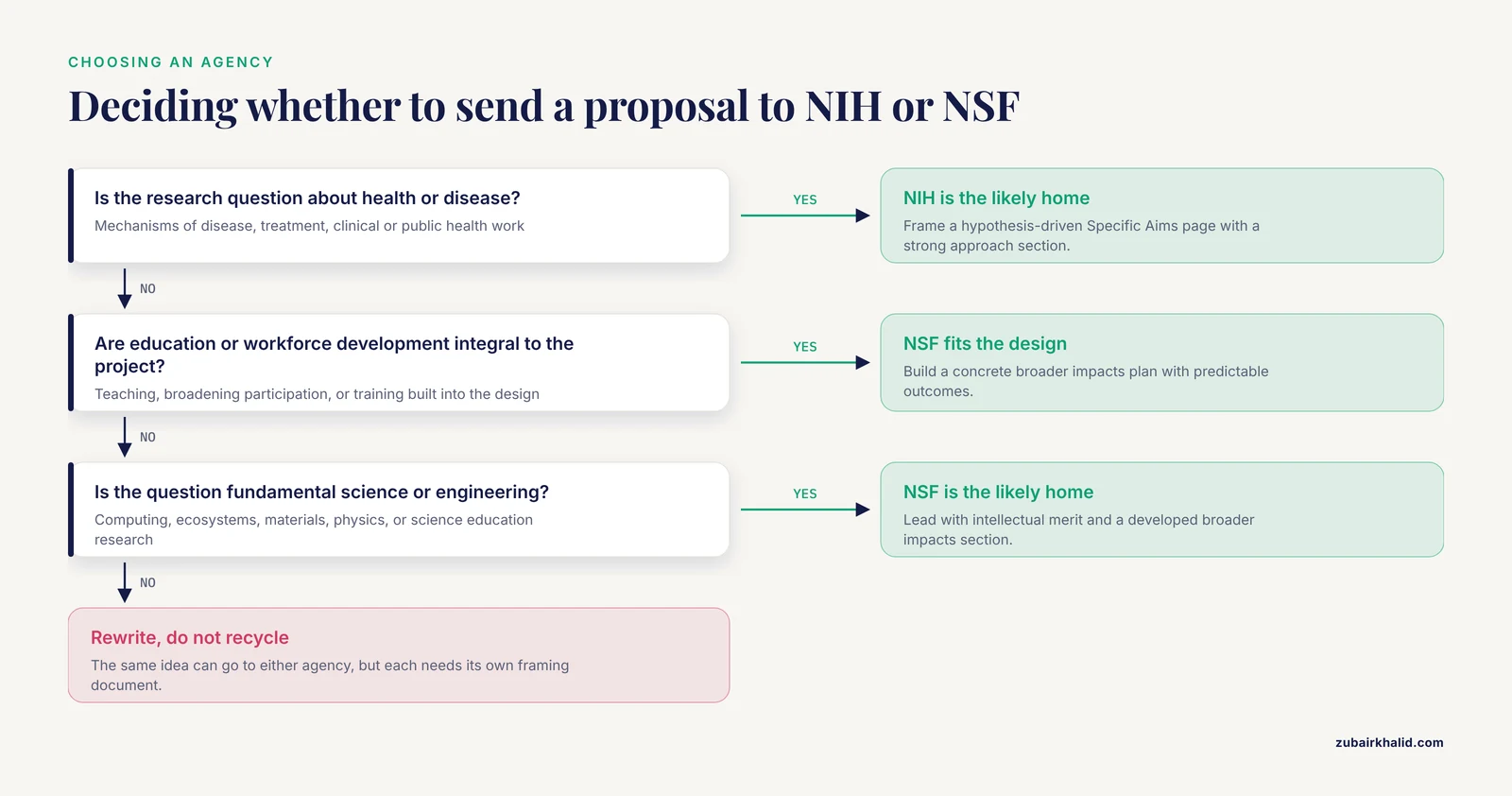
Use NIH when the research question is about health. This includes molecular and cellular mechanisms of disease, physiology, pharmacology, clinical and patient-oriented research, behavioral health, health services, and biomedical training. If your framing document naturally answers the question "how does this improve understanding or treatment of a health condition," NIH mechanisms deserve your attention. Career-stage planning reinforces this choice in clinical fields. An evaluation of a mentored training program for early-career faculty in patient-oriented research found that participants significantly increased both the count and dollar value of their grant awards relative to a matched comparison cohort, with mean annual award dollars rising by 83,427 dollars for participants versus 27,343 dollars for the comparison group, and mean annual proposal counts rising from 0.42 to 2.34 versus 0.77 to 1.07 [12]. Structured NIH-oriented mentoring and training demonstrably changes submission behavior.
Use NSF when the research question is about fundamental science or engineering, or when education and workforce development are integral to the project. NSF is also the natural home when your work spans disciplines that NIH does not organize around, such as computational foundations, ecosystems, materials, or science education research. A mentoring program designed for community college researchers, a group historically underrepresented in NSF's applicant pool, successfully encouraged new NSF proposal submissions, showing that the agency actively cultivates first-time applicants from nontraditional settings [8].
When your project genuinely straddles both worlds, for example neurobiology that could be framed as fundamental circuit science or as a step toward treating a disorder, the practical test is framing, not topic. The same underlying science can often support either proposal, but you must rewrite, not recycle. NIH reviewers will expect a hypothesis-driven aims structure with rigorous approach detail [4]. NSF reviewers will expect an explicit, well-developed broader impacts plan [7]. Submitting a lightly edited document to the other agency is one of the most common and most costly mistakes in grant proposal planning.
Worked Scenarios
Scenario 1. A molecular biologist studying autophagy in neurons. The work could illuminate fundamental cell biology or the mechanisms of neurodegeneration. If the long-term framing is disease relevance, an NIH R-series application with a Specific Aims page built around a testable hypothesis and a tightly argued approach section fits the agency's scoring culture, where approach quality drives priority scores [4]. If the framing is fundamental mechanisms of cellular homeostasis with an educational component, for example integrating research into undergraduate curriculum, an NSF proposal led by intellectual merit and a substantive broader impacts plan fits better [7].
Scenario 2. An early-career clinical investigator in patient-oriented research. A K award is the standard entry point, pairing salary support with protected research time and mentoring [2]. Programs that combine workshop-style training with peer critique and senior faculty feedback on each proposal section have been built specifically for this pathway. One such NIH-focused K writing program at a clinical and translational science hub has enrolled 435 scholars since 2012, with participants drafting and revising proposal sections in small groups under facilitators experienced with NIH study sections [2]. This researcher's grant proposal planning should start with the K mechanism and a long runway to the first R-series submission.
Scenario 3. An engineering faculty member starting a lab. A CAREER award integrates a research program with an education plan and is the canonical NSF early-career submission. Narrative development training designed for both NIH and NSF applicants has been shown to raise preparedness and confidence among CAREER-track writers using the And-But-Therefore framework to draft their Project Summary [9]. This researcher should treat broader impacts as a design problem from day one, building educational and broadening-participation activities into the research plan rather than bolting them on.
Grant Proposal Planning: Building the Skills Both Agencies Reward
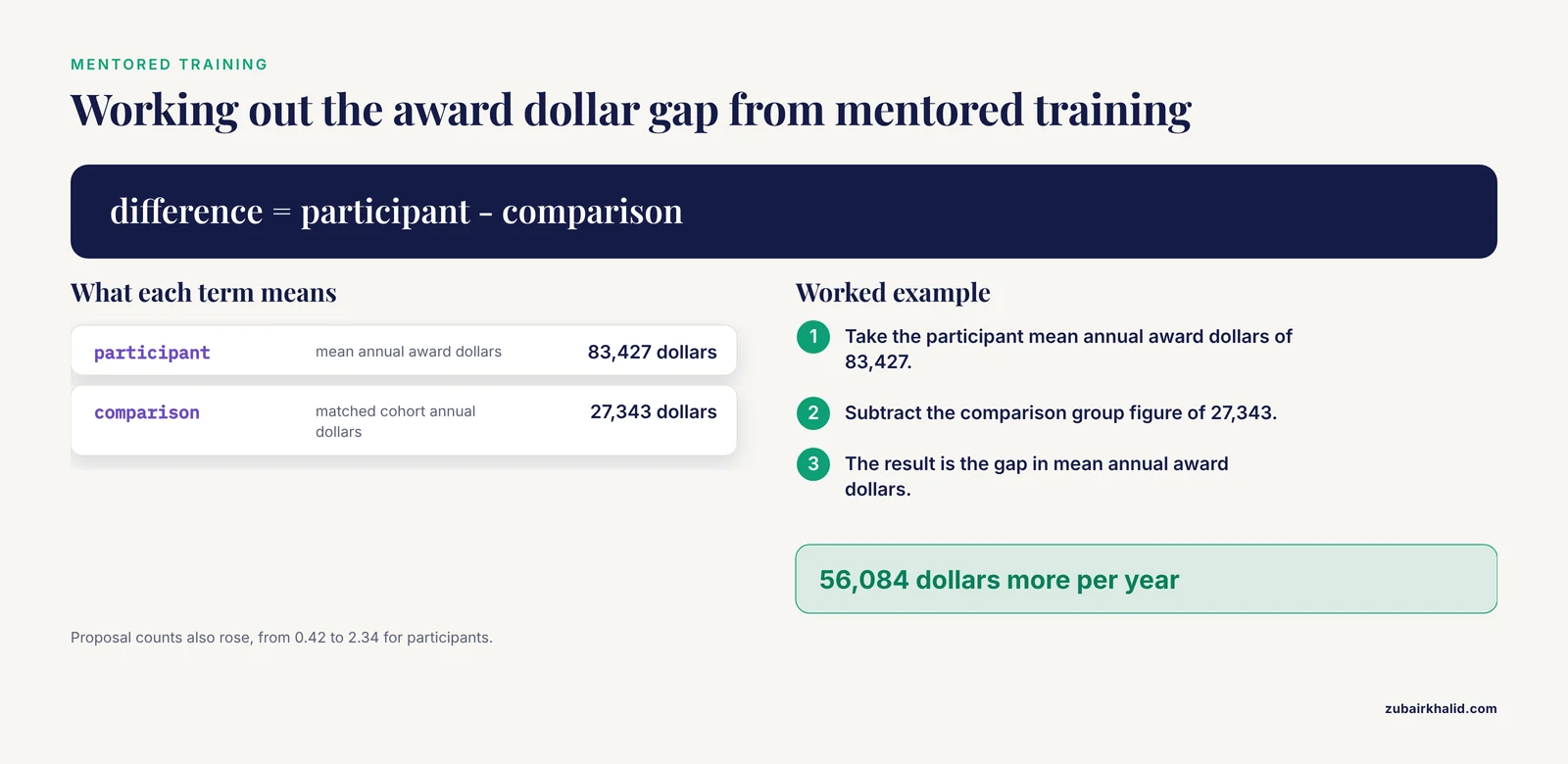
The evidence on training is encouraging. A quasi-experimental evaluation of an interdisciplinary mentored research training program for early-career clinical faculty found that participants significantly outperformed a matched comparison cohort in both proposal submissions and awarded dollars over time [12]. Workshop-based programs focused on specific mechanisms, such as the NIH K writing series with its three-part structure and peer critique from study-section-experienced facilitators, have been implemented at scale, with 435 scholars participating since 2012 [2]. Narrative-focused programs that teach a transferable storytelling framework have served mixed NIH and NSF cohorts and measurably improved participants' self-rated comfort, preparedness, and funding confidence [9].
If you are considering a research grant writing course or program, look for three features that these evidence-supported models share. First, they are mechanism-specific or framework-specific, not generic. Second, they involve iterative drafting with peer and senior review, mirroring what study sections and merit panels actually do. Third, they connect you with mentors who have served on review panels, because inside knowledge of review culture is what turns a technically sound draft into a competitive one. Building these skills before your first submission is one of the highest-return investments an early-career scientist can make, given the low success rates at both agencies.
Common Mistakes and Limitations
Recycling an NIH proposal for NSF, or the reverse. The two agencies reward different writing. An NIH-style aims structure without a developed broader impacts plan reads as incomplete to NSF reviewers [7]. An NSF-style narrative without a rigorous, hypothesis-driven approach section loses ground at NIH, where approach drives the priority score [4]. Rewrite the framing document from scratch for each agency.
Treating Broader Impacts as a throwaway paragraph. At NSF, broader impacts is a scored criterion with recognized rhetorical conventions. Funded and unfunded proposals differ in how they structure these sections, so plan concrete activities with predictable outcomes rather than vague commitments to broadening participation [7].
Ignoring review mechanics. NIH applicants who do not understand study section dynamics, criterion scoring, and the weight of approach critiques write proposals that fail for process reasons rather than scientific ones [2][4][10]. Learn the review system for the agency you are targeting before you write.
Assuming a rejection means the science is wrong. Peer review at both agencies has known statistical and human limitations, which is why NIH has tested ranking-based methods to supplement score aggregation [10]. Low success rates at both NIH and NSF mean strong proposals are routinely declined. Revise and resubmit.
Overreliance on funding metrics as proxies for quality. NIH dollars and h-index correlate in aggregate studies [6], but individual careers vary widely, and departmental comparisons based on funding counts alone, such as the share of departments holding NIH awards [5], flatten important differences in field and career stage.
One practical limitation. Solicitations, page limits, review formats, and success rate figures change. The features described here reflect published comparisons and program structures, but every application decision should be checked against the current agency application guide and the specific funding opportunity. For individual career decisions, mentors at your institution and your office of sponsored programs know the local context that no general guide can supply.
Frequently Asked Questions
What is the main difference between NIH and NSF grant proposals?
NIH proposals argue for research that advances human health and are scored on criteria such as significance and approach, while NSF proposals argue for fundamental research and are scored on intellectual merit and broader impacts. The same project can often be framed for either agency, but the framing document, review criteria, and review culture differ.
Which agency has lower success rates, NIH or NSF?
Both are among the least generous of the major international funding agencies compared in a systematic review, which found that NIH and NSF had the lowest success rates among the agencies studied [11]. Plan for multiple submission cycles at either agency.
Can the same research idea go to both NIH and NSF?
The underlying idea often can, but the proposals cannot be near-duplicates. Each agency expects writing tailored to its own criteria, with NIH emphasizing hypothesis-driven approach detail and NSF emphasizing explicit broader impacts [4][7]. Follow each agency's rules on disclosing other pending support and consult your sponsored programs office before submitting overlapping applications.
What are Broader Impacts in an NSF proposal?
Broader impacts are the potential of the project to benefit society, typically through education, broadening participation, infrastructure, and dissemination. They are one of NSF's two named review criteria, and analysis of funded proposals shows they follow recognizable rhetorical patterns built on contextualizing the problem, demonstrating activities, and predicting outcomes [7].
Do NIH and NSF proposals have different first pages?
Yes. NIH applications lead with a one-page Specific Aims page, while NSF applications lead with a Project Summary that explicitly addresses intellectual merit and broader impacts. Training programs now teach both formats side by side because early-career researchers often target both agencies [9].
Are grant writing programs actually worth the time?
Studies of structured programs report meaningful benefits, including increased proposal submissions and awarded dollars for mentored early-career faculty [12], large-scale workshop participation for NIH career awards [2], and improved confidence and preparedness for both NIH and NSF applicants in narrative-focused training [9]. Programs with peer critique and panel-experienced mentors match the review process most closely.
Sources
- How Do I Review Thee? Let Me Count the Ways: A Comparison of Research Grant Proposal Review Criteria Across US Federal Funding Agencies
- 94 Evaluation of a grant writing workshop designed to increase submission and award rates for career development awards
- Bioethics training programmes for Africa: evaluating professional and bioethics-related achievements of African trainees after a decade of Fogarty NIH investment
- Analysis of NIH R01 Application Critiques, Impact and Criteria Scores: Does the Sex of the Principal Investigator Make a Difference?
- Academic productivity and NIH funding for anesthesiology departmental chairs: A 15-year comparison.
- Comparison of h and m Indices among Departments in McGovern Medical School
- Articulating societal benefits in grant proposals: Move analysis of Broader Impacts
- A successful mentoring approach for encouraging new NSF proposal submissions from community colleges
- 138 Supporting Early-Career Faculty Grant Proposals through Narrative Development Training: A Proposal Narrative Development Program for Early-Career Faculty
- A new approach to grant review assessments: score, then rank
- International differences in basic research grant funding - a sytematic comparison.
- Grant Success for Early-Career Faculty in Patient-Oriented Research: Difference-in-Differences Evaluation of an Interdisciplinary Mentored Research Training Program