NIH Peer Review Process Timeline: Complete Guide
By Dr. Zubair Khalid, DVM, MS, PhD ·

A complete NIH peer review cycle takes about nine to ten months from the day you submit an application to the earliest possible funding start date. That period splits into three phases: scientific review by a study section at roughly three months, advisory council review at roughly six months, and award issuance near the end of the window.
Many applicants assume review moves faster because journals and internal committees do. It does not. Review processes in general can feel opaque, and people who never received formal training in how review works start at a real disadvantage when they try to navigate it [1]. This guide explains the NIH peer review process timeline in plain language, phase by phase, with worked examples and the mistakes that most often delay an application.
What Is the NIH Peer Review Process Timeline?
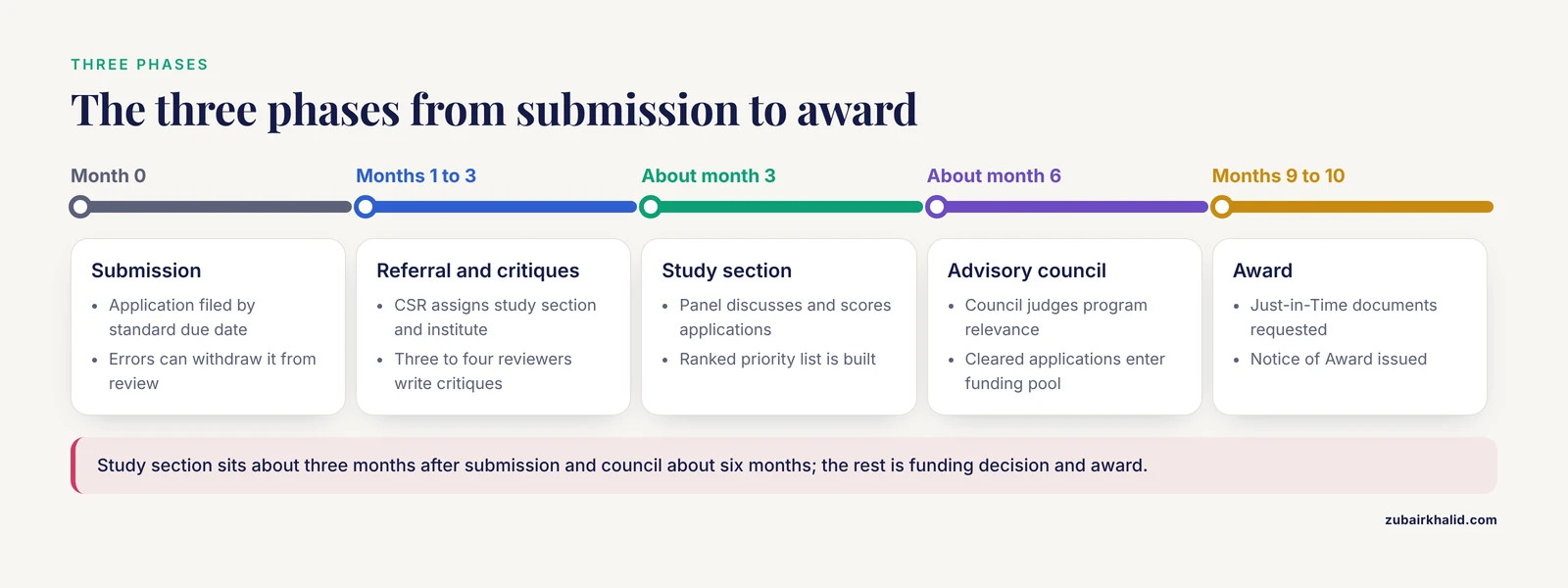
The NIH peer review process timeline is the fixed, predictable sequence of stages an application passes through between submission and award. NIH uses what is officially called a dual review system, meaning two separate groups evaluate every application.
The first group is a study section, formally called a Scientific Review Group. This is a panel of working scientists who judge scientific and technical merit. The second group is an advisory council at the specific NIH institute or center, such as the National Cancer Institute or the National Institute of Allergy and Infectious Diseases. Council members judge program relevance and give an advisory recommendation, but they do not re-score the science.
The Center for Scientific Review (CSR) handles referral and review for the majority of unsolicited research grant applications. For most applications, the phases and their timing look like this.
| Phase | Approximate timing after submission | What happens | Who decides |
|---|---|---|---|
| Submission | Month 0 | Application is submitted by a standard due date | Applicant and grants office |
| Referral and review preparation | Months 1 to 3 | Application is assigned to a study section, reviewers are selected, written critiques are prepared | CSR and the Scientific Review Officer |
| Study section meeting | About month 3 | Panel discusses applications, assigns scores, builds a priority list | Scientific Review Group |
| Advisory council round | About month 6 | Council reviews the outcome for program relevance and recommends action | Institute or center council |
| Funding decision | Months 6 to 9 | Institute staff compare scores against the payline and build funding plans | Institute leadership |
| Award | About months 9 to 10 | Notice of Award is issued and the project can begin | Institute grants management office |
This structure has been stable for decades, which is exactly what makes grant proposal planning possible. You can work backward from known review cycles to decide when to submit.
Phase 1: Submission and Standard Due Dates
NIH accepts most research grant applications on three standard receipt cycles per year. For many mechanisms, including the common R01 investigator-initiated grant, new applications are typically due in February, June, and October. Renewals, revisions, and other activity codes have their own dates on the same cycle pattern, so you must confirm the specific date for your mechanism on the funding opportunity announcement rather than assuming all deadlines match.
Three practical points shape this phase.
First, an application that arrives with administrative errors is not simply reviewed with notes attached. Applications with significant errors or omissions are withdrawn from review, which costs you an entire cycle. Missing biosketches, wrong formatting, budget problems, and incomplete human subjects or vertebrate animal sections are the classic culprits. A withdrawn application restarts the clock from zero at the next cycle.
Second, you can request assignment to a particular study section when you submit. If you skip this, CSR chooses for you based on the science. Assignment requests are not binding, but reviewers who understand your methods and model system will read your work more accurately than reviewers pulled in from an adjacent field.
Third, post-submission materials follow strict rules. You cannot upload new data or edit the science after submission, with narrow exceptions for interim reports or preprints. The scientific record is frozen at the due date, which is one more reason the preparation period matters more than most applicants expect.
Study Section Assignment and Review Preparation
Between submission and the meeting, three things happen.
CSR performs referral. Staff read the application, confirm it fits NIH priorities and the chosen announcement, and assign it to a study section and an institute. If you checked the referral of an application in your submission portal, you can verify the assignment around four to six weeks after the due date and flag mistakes before reviewers are even selected.
A Scientific Review Officer (SRO) manages the panel. The SRO is a scientist employed by CSR who recruits reviewers, handles conflicts of interest, chairs logistics, and serves as your single point of contact after the meeting. Reviewers with any personal or financial relationship to an applicant recuse themselves. Meetings are confidential, and reviewers are not paid for their service.
Three to four assigned reviewers prepare written critiques before the meeting. Each reads the full application, and each drafts commentary against NIH's review criteria. Everyone else on the panel reads parts of the application, typically the specific aims and research strategy.
The review criteria for most research grants are Significance, Investigators, Innovation, Approach, and Environment, each scored separately on a 1 to 9 scale where 1 is exceptional and 9 is poor. The panel also assigns an Overall Impact score on the same 1 to 9 scale, which weighs the criterion scores against the panel's judgment of the application's importance to the field.
The Study Section Meeting: Scores, Discussion, and the Priority List
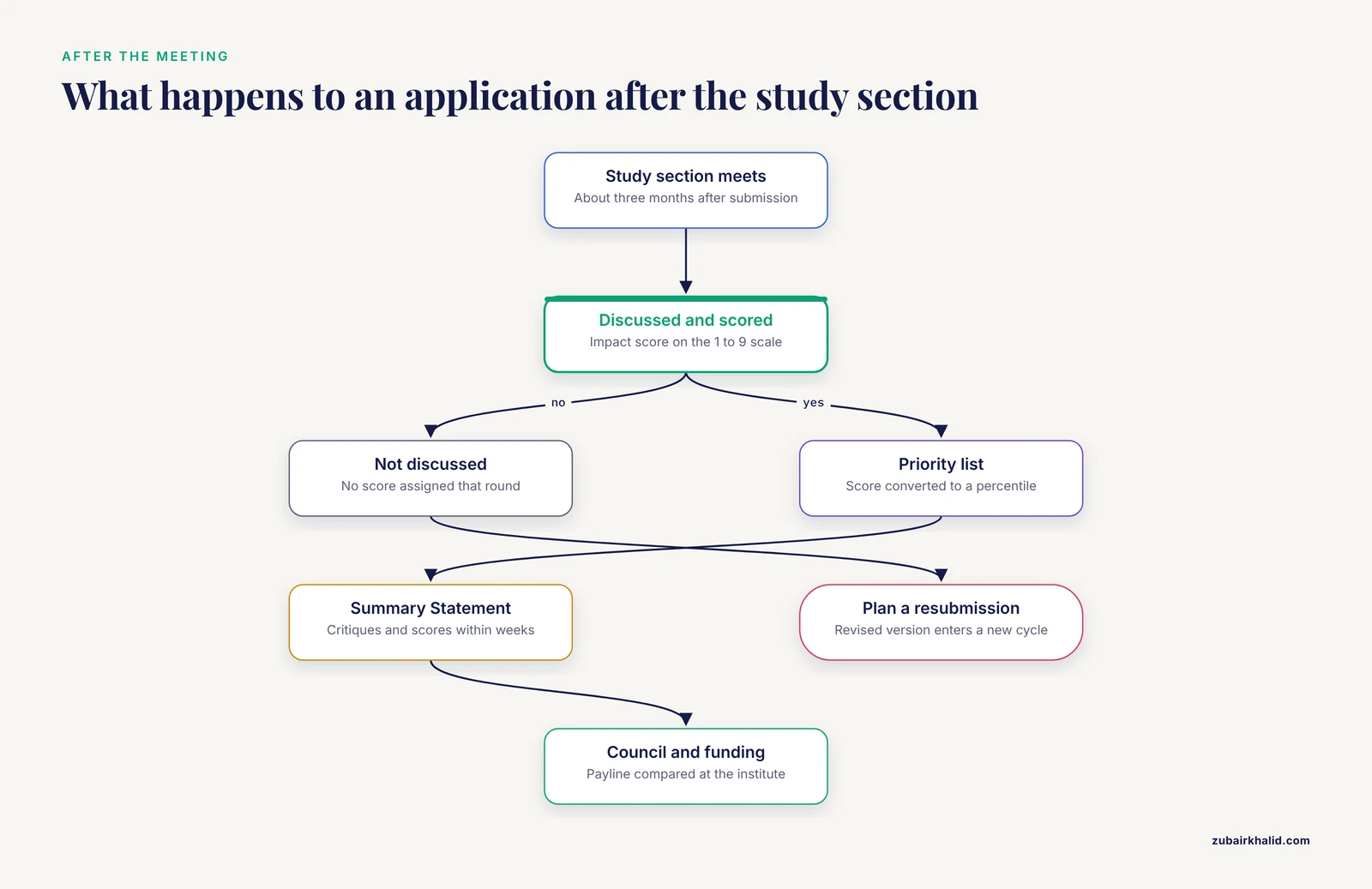
Study section meetings occur roughly three months after the submission cycle. Meetings typically run one to three days, and each application gets a bounded slot, often around 15 minutes for discussed applications.
The meeting follows a predictable script. The SRO introduces the application without naming the applicant. Two or three primary reviewers present their critiques aloud. The panel discusses strengths and weaknesses. The chair may ask whether the application should be scored at all. Then each voting reviewer enters an Overall Impact score electronically, the scores are averaged, and the application receives a final impact score on the 1 to 9 scale.
Two outcomes matter enormously for your planning.
An application that is discussed and scored enters the panel's ranked priority list. That list, not any single number, is what travels forward. For major mechanisms like the R01, CSR converts the impact score to a percentile, which expresses your rank against the pool of similar applications recently reviewed by that panel. A percentile near the institute's payline, the funding cutoff the institute expects that year, positions you for an award.
An application that is Not Discussed receives no score. Panels do this when reviewers judge the application falls below the fundable range, so discussion time goes to applications with a realistic chance. Not Discussed is disappointing but common, and it does not carry any penalty on a resubmission.
You receive your Summary Statement, the written critiques and scores, typically within weeks of the meeting through your eRA Commons account. Nothing in the process is anonymous to you once the meeting ends. The identities of your assigned reviewers, and their individual criterion scores, appear in the document.
Phase 2: Advisory Council Review
About three months after the study section, usually around six months after submission, your application moves to the second level of the dual review system. The institute's advisory council, made up of scientists and public representatives, receives the application file, the Summary Statement, and the study section's recommendation.
Council review is advisory rather than scientific. Council members consider whether the application fits the institute's mission and priorities, whether the proposed work raises concerns the panel was not positioned to judge, and whether the science warrants funding at that rank. They can concur with the study section, flag an application for special consideration, or, rarely, recommend against funding a well-scored application. Council does not re-review the science line by line.
Council meetings occur in fixed cycles, typically in January, May, and September, aligned so that each follows the corresponding study section round. Applications are usually cleared by council within weeks of the meeting. Clearance is not an award. It moves the application into the funding pool.
Phase 3: Funding Decision and Award
Between council and award, institute program and grants management staff do the work that determines whether you actually receive money. Program staff build funding plans considering the payline, the institute's scientific priorities, and portfolio balance. Grants management staff run administrative checks on your budget, your institution, and your other support.
Two steps commonly occupy this window.
Just-in-Time (JIT) is NIH's process for requesting certain certifications only when funding seems likely. After council, an institute may ask you for updated other support documents, human subjects protections, and animal welfare approvals. You do not submit these with the application. Responding promptly here matters because a delayed JIT response can push an award past its intended start date.
Award issuance is administrative but not instant. The institute issues a Notice of Award, your institution accepts it, and your project period begins. For the standard cycles, the earliest start dates fall roughly nine to ten months after submission.
NIH Peer Review Process Timeline Examples: A Worked Year
Concrete examples make the abstract timeline usable for grant proposal planning. Here is the most common R01 pathway, worked as a numbered sequence.
- June 5. You submit your new R01 on the June due date.
- July. CSR completes referral and assignment. You check the assigned study section in eRA Commons and request a change if the fit is poor.
- September to October. Your assigned reviewers write critiques. The panel meets about three months after submission, in early October for this cycle.
- Late October to November. You receive your Summary Statement with the impact score and percentile.
- January. The institute's advisory council meets and clears the application.
- February to March. Program and grants management staff make funding decisions, possibly issuing a JIT request.
- April. The Notice of Award is issued and the earliest start date arrives, roughly ten months after submission.
Push everything one cycle later for a February submission, with study section around June, council around September or October, and an earliest start near December. This cycle mapping is the single most useful thing a first-time applicant can memorize. If you want a project funded in a specific year, count backward ten months from your desired start date, then subtract another two or three months of institutional internal deadlines for budget approvals and routing, and you have your true submission deadline.
A common planning error is treating the submission date as the starting line. In reality, the drafting, internal review, and sign-off period before submission usually takes longer than review itself. Long evaluation timelines are not unique to grant funding, and process design affects speed everywhere in biomedicine. In coverage with evidence development programs, where regulators approve a health technology while requiring further evidence, a scoping review of 136 programs found application-to-coverage decisions averaged 73.7 months, with early identification of decision uncertainties and active stakeholder engagement among the factors that shortened evaluation, and slow patient accrual among the factors that delayed it [2]. The lesson transfers directly. Anticipating what reviewers and administrators will need to see, and gathering it before it is requested, is the most reliable way to keep any formal review process moving.
What Can Change the Timeline
The nine-to-ten-month standard holds only when nothing goes wrong. Real timelines stretch for identifiable reasons.
- Administrative errors. A withdrawn application restarts the entire cycle at the next due date.
- Referral mistakes caught late. If a poor study section assignment is discovered after reviewers are selected, fixing it can push review to a later round.
- Resubmission. If your application is unscored or falls below the payline, a revised version enters the pipeline as a new submission with its own full timeline. Policies on how and when you may resubmit have changed over the years, so check the current NIH policy on resubmissions before planning your revision.
- Institute funding decisions. A percentile above the payline may still be funded if the institute has room or a special interest, and a percentile below the payline in a tight year may not be. This stage involves human judgment about money, not just rank order.
- Mechanism differences. Career awards, training grants, and special initiatives follow the same broad phases but can run on different calendars.
The compressed review cycles seen elsewhere in medicine show how the same tradeoff appears in every peer review setting. In radiation oncology, a pre-treatment peer review program for stereotactic body radiation therapy set a compliance goal of reviewing at least 90 percent of cases before 25 percent of the dose was delivered, using twice-weekly meetings to balance review depth against treatment delays [3]. Review systems always trade thoroughness against speed. NIH resolves that tradeoff by fixing review to quarterly cycles rather than accelerating individual applications, which is why planning around the calendar beats trying to beat it.
Common Mistakes and Limitations
These are the errors that most often cost applicants time, drawn from recurring patterns in how new applicants experience review.
- Treating the due date as the planning date. Institutional routing, budget approvals, and format checks commonly take weeks. Build the full cycle backward from your target start date, not forward from the deadline.
- Ignoring the assignment request. Review by a panel that lacks your subspecialty produces scores that undervalue your approach. Spend the time to choose the right study section.
- Reading the impact score as a grade of your career. The 1 to 9 scale measures that application against that panel's pool in that cycle. Percentiles shift year to year with the applicant pool.
- Responding to the Summary Statement defensively. Reviewers' critiques, even unfair ones, are the raw material for a stronger resubmission. Education literature on peer review emphasizes that responding to reviewer comments point by point, and reframing rejection as input for revision, converts a failed cycle into scholarly growth [4].
- Assuming a good score means money. Council clearance and a percentile below the payline are separate gates. Neither guarantees an award.
- Forgetting that not-discussed applications have no score. If your application is unscored, there is nothing to appeal on scientific grounds in that round. The realistic path is a well-planned resubmission.
- Over-relying on luck in reviewer assignment. You cannot control which reviewers are drawn, and some variance in scores across cycles is unavoidable. Build contingency into your research plan rather than assuming one outcome.
One limitation applies to everything above. Individual institutes, mechanisms, and application types vary, and the only authoritative calendar for your specific application is the funding opportunity announcement and current NIH policy. Confirm dates for your mechanism rather than transferring dates from a different one.
Grant Proposal Planning Around the Review Calendar
Once you know the timeline, you can structure a year of work around it. A practical rhythm looks like this.
Start drafting four to six months before the due date. Write the specific aims first, circulate them to mentors and colleagues, and revise them before drafting the full research strategy. Run at least one internal mock review, where colleagues read the draft as a study section would, before submission. Early-career scientists consistently report that formal training in how review works, and in how to respond to it, was missing from their preparation, and structured strategies for improving submission quality and handling critique measurably improve outcomes [4].
Formal instruction helps close that gap. A research grant writing course, offered by many universities, professional societies, and online platforms, typically walks participants through review criteria, mock study sections, and the mechanics of the dual review system, converting the timeline from an abstraction into a calendar you can plan against.
Mentorship fills the same role informally. In reviews of support programs for medical students, mentorship and advising consistently emerge as one of the best-documented categories of institutional support for people entering research careers [5]. A mentor who has served on a study section can tell you what a panel actually discusses, which matters more than any written rubric.
Waiting also has a psychological dimension. Review outcomes arrive months after you submit, on dates you cannot control. Psychological work on how people sustain motivation under uncertain futures describes hope as grounded in meaning and expressed through agency, the commitment to act in ways that improve your situation even when outcomes cannot be controlled [6]. Translated to the review calendar, that means using the wait productively, drafting the resubmission skeleton or preparing the next project, rather than treating the nine months as idle time.
Common Myths About NIH Review
Several misconceptions circulate among first-time applicants, and each has a concrete answer.
Myth: reviewers are paid professionals. Study section members are practicing scientists who volunteer their time, with travel reimbursed. They review because service is part of academic life, not because review is their job.
Myth: you pay to be reviewed. Peer review at NIH costs the applicant nothing. The same is true of legitimate journals, a misconception that circulates widely among people unfamiliar with publishing, where authors do not pay for standard peer review of a manuscript [1].
Myth: review is a black box where scores are arbitrary. The process is bounded and documented. Criteria are published, critiques are written, scores are averaged from individual reviewers, and you receive all of it in the Summary Statement. The parts that stay confidential are reviewer identities during review and panel deliberations themselves.
Myth: journal review and grant review work the same way. They share vocabulary but differ in structure. Journal peer review produces a binary decision on a manuscript and can iterate through multiple revision rounds with the same editors and reviewers, with decision types that range from accept to reject and everything between [1]. Grant review is a one-pass scored evaluation against fixed criteria by a rotating panel, followed by a second, advisory review. Practical guidance about crafting submissions and responding to reviewers transfers between the two systems, but the calendars and decision logic do not [4].
Myth: you can appeal a bad score. A formal appeal is possible only on narrow procedural grounds, such as evidence of a substantive bias or factual error in review, and it is initiated through your program official and the SRO. It is not a mechanism for relitigating scientific disagreement.
What Is Still Uncertain
Parts of the timeline are inherently unpredictable, and honest planning accounts for them.
The payline at any institute in any fiscal year is unknown until funding decisions are made. Budget environments, institute priorities, and the strength of the applicant pool in a given cycle all shift the cutoff. A percentile that would have been funded two years ago may not be funded now, and the reverse also happens.
Panel composition varies by cycle. The same application reviewed by a slightly different set of reviewers can land in a different percentile, which is why single-cycle disappointment should not be overread.
Resubmission outcomes are probabilistic rather than guaranteed. Revised applications that genuinely address critiques do better on average, but the size of that advantage depends on how substantive the revision is.
None of these uncertainties change the fixed architecture of the process. Submission cycles, the three-month study section interval, and the six-month council interval are reliable. What varies is the human judgment layered on top at the funding stage.
Frequently Asked Questions
How long does the full NIH peer review process take?
For a standard application, about nine to ten months from submission to the earliest award. Study section review occurs around three months after submission and council around six months, with the remaining time spent on funding decisions and award issuance.
What is the dual review system?
It is NIH's two-level evaluation model. A study section of scientific peers judges technical merit, and an advisory council at the institute judges program relevance and gives a non-binding recommendation. Both levels must be passed before funding.
What does an impact score of 1 to 9 mean?
Reviewers rate Overall Impact and each review criterion on a 1 to 9 scale, where 1 is exceptionally strong and 9 is poor. The panel averages individual Overall Impact scores to produce the application's final impact score, which is then converted to a percentile for many mechanisms.
Can I find out who reviewed my application and speak to them?
Reviewer identities during deliberation are confidential, and contact with reviewers is not permitted. After the meeting, your Summary Statement reveals the assigned reviewers and their written critiques, and your program official and Scientific Review Officer are your channels for questions.
What happens if my application is not discussed or not funded?
An unscored application receives no priority score and cannot be funded that cycle. A scored application above the payline may go unfunded if institute resources run short. In both cases, the standard path forward is a revised resubmission that responds directly to the critiques you received.
How soon after review should I plan a resubmission?
Review your Summary Statement as soon as it arrives, meet with your program official, and revise with the next cycle in mind. Resubmission policies on timing have changed in recent years, so confirm the current rule for your mechanism before locking your calendar.
Does requesting a specific study section actually work?
Assignment requests are considered but not guaranteed, and they are worth making when your work spans disciplines. Check your assignment a few weeks after submission and raise any misfit immediately, because correction is far easier before reviewers are selected.
Do all NIH applications follow the same timeline?
The broad three-phase architecture is the same, but timing varies by mechanism, by whether the application is new or competing, and by special initiatives with their own receipt dates. Always confirm dates on the specific funding opportunity announcement for your application.
Sources
- Peeling Back the Curtain: A Primer on the General Peer-Review and Publication Process in Behavior Analysis.
- Coverage with evidence development programs: a scoping review on characteristics and patient access.
- Improving Quality Metrics in Radiation Oncology: Implementation of Pretreatment Peer Review for Stereotactic Body Radiation Therapy in Patients with Thoracic Cancer.
- Educator's Blueprint: Seven Strategies for Turning Peer Review Into Scholarly Growth.
- Beyond admissions: A scoping review of supports for students underrepresented in medicine in the U.S.
- Toward an integrative psychological framework of existential hope: navigating uncertain futures.