How to Submit a Grant Application via NIH eRA Commons
By Dr. Zubair Khalid, DVM, MS, PhD ·

By the end of this article, you will be able to register the accounts required for an NIH application, route your science through your institution, submit an error-free application through Grants.gov and eRA Commons, and track that application through review without panic. The NIH grant submission process is administrative as much as it is scientific, and most first-time applicants lose time to logistics, not ideas.
Here is what you need on hand before you begin:
- An eRA Commons ID for yourself, created by your institution's Signing Official
- The exact funding opportunity number (for example, PA-XX-XXX or RFA-XX-XXX) for the award you are targeting
- Your institution's DUNS/UEI number and Grants.gov registration, which your sponsored programs office manages
- A draft of your research strategy, budget, biosketches, and letters of support from your co-investigators
- A calendar with at least three months of runway before the due date
What the NIH Grant Submission Process Actually Involves
The nih grant submission process has two parallel tracks. The first is scientific. You design a study, write a research strategy, assemble a budget, and collect supporting documents. The second is administrative. Your institution, not you personally, submits the application. You assemble it, your Authorized Organization Representative (AOR, the person legally authorized to sign for your institution) submits it through Grants.gov or a system-to-system connection, and you then track it in eRA Commons, the NIH online system where the application is assembled, validated, and monitored.
Early-career researchers often struggle most with the earliest decisions, not the final click. Deciding which grant fits your career stage, whether the idea is ready, and which funder to approach are the questions that deserve the most time, and a practical primer for early-career hospitalists frames these as the defining steps of the process [1]. Settle those questions first, then move to logistics.
Before You Start: Accounts, Roles, and Registration
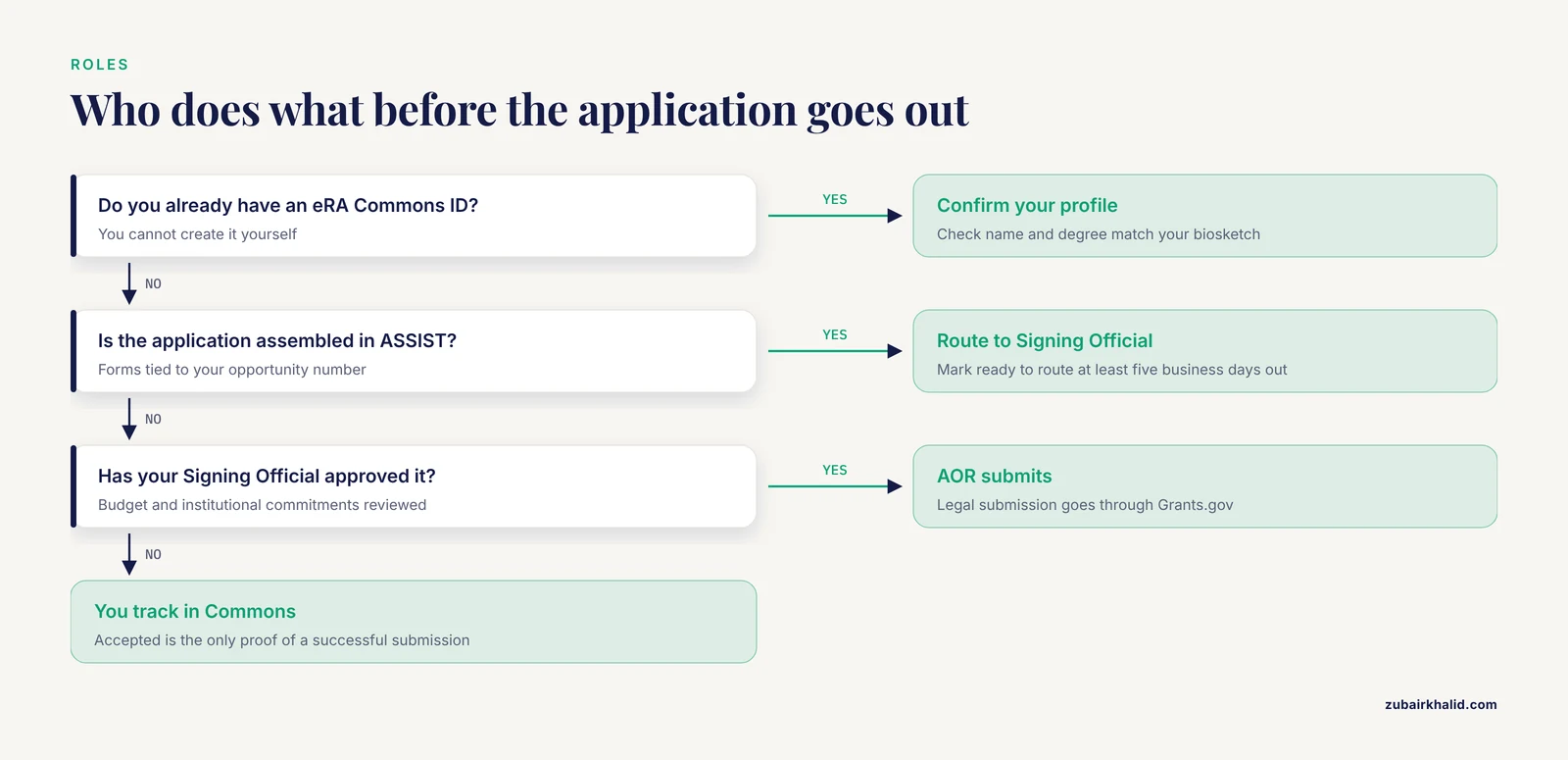
NIH applications involve four roles, and new investigators frequently confuse them.
| Role | Who holds it | What they do |
|---|---|---|
| , - | , - | , - |
| Principal Investigator (PI) | You | Writes the science, holds the eRA Commons ID, assembles the application in ASSIST |
| Signing Official (SO) | Institution admin | Creates Commons IDs for new users and authorizes submission |
| Authorized Organization Representative (AOR) | Institution admin | Legally submits the application through Grants.gov |
| Business Official | Institution grants office | Signs off on budget and financial commitments |
Your eRA Commons ID is your permanent identifier across all NIH interactions, including applications, review, and awards. You cannot create it yourself. Your Signing Official does, and if you have never applied before, request one the moment you decide to pursue a grant, because the ID must exist before your application can be assembled and tracked.
Use this checklist as a code block in your own project notes. Each line should be complete before drafting goes further than the aims page.
REGISTRATION CHECKLIST (run 8+ weeks before due date)

[ ] Signing Official has created my eRA Commons ID
[ ] I have logged into eRA Commons and confirmed my name and degree match my biosketch
[ ] Institution has an active SAM.gov registration with a current UEI number
[ ] Institution is registered with Grants.gov (annual renewal confirmed)
[ ] I have downloaded the exact application package for my funding opportunity
[ ] I know my Signing Official's and AOR's names and contact emails
[ ] My department has committed the cost share or effort, if any
SAM.gov registration and Grants.gov renewal are institutional, but a lapsed registration blocks submission of the entire application, even a perfect one. Ask your research administration office to confirm both dates in writing.
Grant Proposal Planning: Build the Timeline Backward
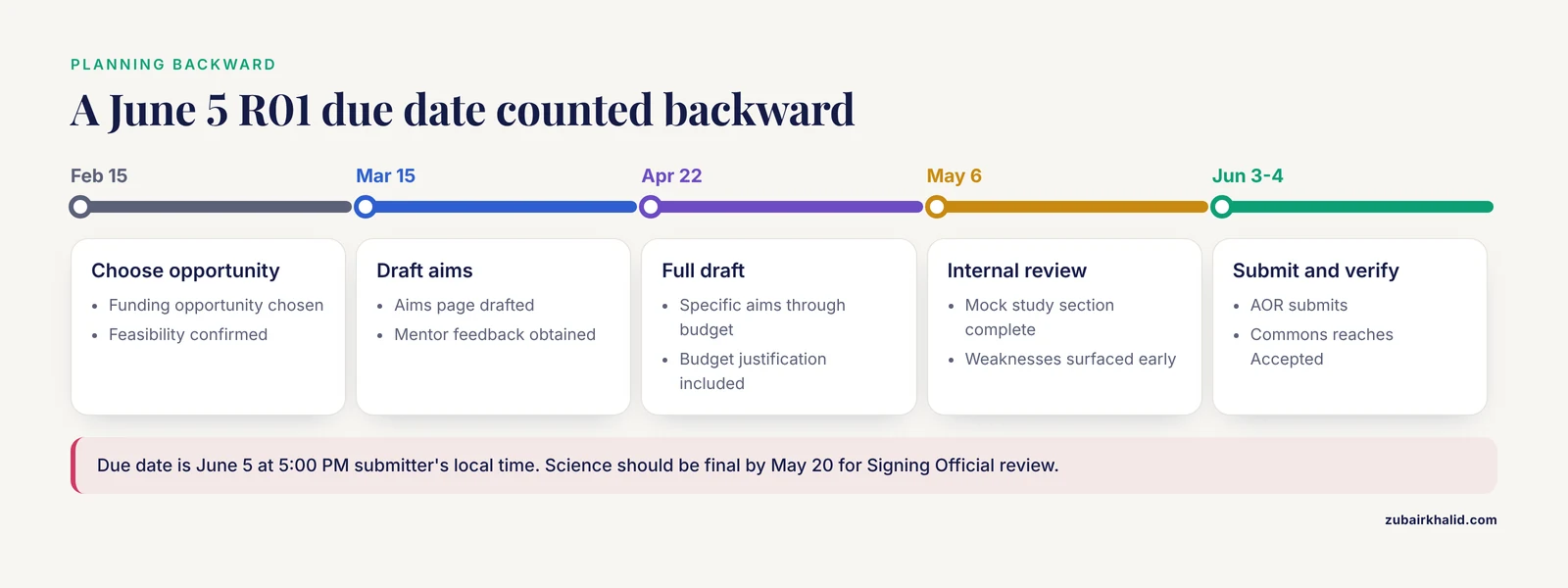
Grant proposal planning works best when you count backward from the due date instead of forward from inspiration. New investigator R01 applications follow three standard NIH receipt cycles per year, with due dates on the fifth of February, June, and October. Career development awards (K awards) and other mechanisms follow their own published cycles in the funding opportunity announcement, so always confirm the date in the specific announcement rather than assuming.
Here is a worked backward plan for a June 5 R01 due date, written as a schedule you can adapt:
BACKWARD TIMELINE (June 5 due date)

June 5 (Day 0)          Due date, 5:00 PM submitter's local time
June 3-4                AOR submits, you verify Commons status reaches "Accepted"
May 20                  All science finalized, routed to SO for review
May 6                   Internal grant review / mock study section complete
Apr 22                  Full draft (specific aims through budget justification)
Apr 1                   Pilot data consolidated, co-investigators confirmed
Mar 15                  Aims page drafted, feedback from mentor obtained
Feb 15                  Funding opportunity chosen, feasibility confirmed
Two elements of this plan deserve emphasis.
First, build in a formal internal review about two weeks before you would otherwise finalize. An internal grant review program modeled directly on the NIH study section, implemented for mentored career development scholars, gave early-career investigators feedback that measurably improved proposal development and was rated positively by participants [2]. Your institution may run something similar, or you can assemble two or three senior colleagues, hand them the specific aims and research strategy, and ask them to score it the way a reviewer would. Mock review works because it surfaces the weaknesses a real reviewer will find while you still have time to fix them.
Second, choose the right opportunity before you write. Sources of funding include federal agencies, foundations, professional societies, institutional awards, and commercial sponsors, and each offers different mechanisms such as pilot grants, career development awards, and independent research grants [1]. A career development award evaluates you and your mentor as much as your science. A pilot grant evaluates feasibility. Matching your stage to the mechanism prevents months of wasted writing. If you have never received formal training in this, a structured research grant writing course, offered by many universities and professional societies, covers aims development and reviewer psychology in a way that self-teaching rarely does.
The NIH Grant Submission Process Step by Step
This walkthrough covers a standard investigator-initiated application assembled in ASSIST, NIH's web-based application tool, which most first-time applicants should use.
Step 1. Download and read the funding opportunity announcement
Search NIH Guide for Grants and Contracts or Grants.gov for your announcement. The announcement (the NOFO) defines the mechanism, the receipt cycle, the page limits, the required attachments, and any special instructions. Download the application package linked from the announcement. Every form in that package is tied to that specific opportunity number, so never mix forms from a previous cycle.
Step 2. Register your eRA Commons credentials and confirm your role
Log in to eRA Commons with the ID your Signing Official created. Under your personal profile, confirm that your name, degree, and email match what will appear on your biosketch. If you will be the PI, your Commons ID goes in field "6. Human Subjects" no, field "Personal Profile," and the Commons ID field on the SF424 Research and Related Senior/Key Person form. Mismatched names between Commons and the biosketch are a classic validation problem, so fix them now.
Step 3. Prepare each form in ASSIST
Log into ASSIST with your Commons credentials, start an application from your funding opportunity number, and complete the forms in order. The core SF424 (R&R) forms include:
- SF424 (R&R) Application for Federal Assistance, the cover form
- Project Summary/Abstract and Project Narrative
- Research and Related Senior/Key Person forms, including your biosketch in SciENcv format
- Budget forms for each year, with a budget justification attachment
- Research Strategy attachment, up to 12 pages for a standard R01, organized as Significance, Innovation, and Approach
- Human Subjects and Vertebrate Animals attachments, if applicable
- Letters of support, uploaded as PDF attachments
As you complete each form, run the built-in validate function. ASSIST flags missing fields, formatting problems in attachments, and inconsistencies between the budget and the personnel before submission, when they are still cheap to fix.
Step 4. Route the application to your Signing Official
In ASSIST, mark the application "ready to route." Your SO receives it, reviews the budget and institutional commitments, and either returns it to you for changes or approves it for submission. This handoff is where most institutional delays occur. Give your research administration office at least five business days before the due date, and more during heavy cycle weeks, because they route dozens of applications in the same window.
Step 5. Submit through Grants.gov and watch the Commons status
Your AOR submits from ASSIST to Grants.gov. Grants.gov runs its own validation pass and then hands the application to eRA Commons, which runs a second, stricter validation against NIH-specific rules. You then watch the application status in the Commons "Status" screen. The statuses follow a known sequence:
| Commons status | What it means | What you do |
|---|---|---|
| , - | , - | , - |
| Pending | Received, not yet checked | Wait, do nothing |
| Received | Passed Grants.gov check, awaiting Commons assembly | Wait |
| Assembled | NIH is assembling the application image | Wait |
| Warnings or Errors | Validation issues found | Read the error email, fix, resubmit |
| Accepted | The application is complete and locked | Verify the image matches your intent |
A Commons status of "Accepted" is the only proof of a successful submission. An email or a Grants.gov confirmation is not. Check the status yourself within 24 to 48 hours of the deadline.
Step 6. Correct errors or view the assembled image
If Commons reports errors, the system emails you and your AOR with the specific error text. Your AOR rejects the application, ASSIST reopens it, you fix the flagged fields, and the corrected version is resubmitted before the correction window closes, which runs five business days for most mechanisms. After acceptance, open the assembled application image in Commons and read every page. This is your one chance to confirm that attachments merged correctly, figures rendered, and nothing from the wrong opportunity package snuck in.
Step 7. Save your tracking numbers
Record three identifiers: the Grants.gov tracking number, the NIH application number, and the eRA Commons application number (format IG1 SEASON-YEAR, such as IG1 SEP-2026). The Commons number is what you use in any correspondence with NIH program staff or review staff.
After Submission: Warnings, Just-in-Time, and Review
Errors stop an application. Warnings do not, but they deserve attention because some warnings indicate a missing item reviewers will notice, such as a missing human subjects education record. Read every warning rather than dismissing the batch.
Several weeks after receipt, the application moves to "Assembled" and then, after NIH administrative review, to "Accepted" or to a "Just-in-Time" request. Just-in-Time (JIT) is NIH's term for the information requested only after an application receives a potentially fundable score: updated other support pages, certifications of human subjects education, and IRB or IACUC approvals where needed. Your institution handles most of the JIT paperwork, but you supply the updated other support, so keep that document current year-round.
Review itself proceeds through a study section, typically three months after the due date, followed by an advisory council round, with the earliest award start about nine to ten months after submission. When summary statements and reviewer critiques arrive, treat them as revision instructions rather than verdicts. Practical guidance on responding to reviewer comments, rebuilding after rejection, and strengthening future submissions emphasizes that critique is the raw material of a stronger next application, not a judgment of your ability [3]. The same authors point out that early-career scholars receive little formal training in navigating review, which is exactly why mock review and mentor feedback loops pay off before submission as well as after [3].
Staying Grounded During the Review Wait
The review period is long, the outcome is uncertain, and the funding system is genuinely unpredictable. Psychological research on hope under uncertainty distinguishes between hope as confident prediction and hope as sustained agency, defining existential hope as the stance of continuing to act meaningfully toward a good future even when current evidence seems to undermine it [4]. That distinction maps neatly onto grant writing. A skilled applicant holds two commitments at once, acting fully on this application while knowing that a single rejection predicts little about the next one. If the wait wears on you, redirect the energy into the next aims page rather than refreshing the status page.
Common Mistakes and Limitations
These are the failures the NIH grant submission process produces most often, in rough order of frequency.
- Registering accounts too late. A new eRA Commons ID, a lapsed SAM.gov registration, or an expired Grants.gov credential can each kill a submission with no fix available on deadline day. Handle all three two months ahead.
- Treating the due date as the submission date. The AOR needs time. Applications routed to the research office on day five are routinely delayed past the deadline, and NIH does not extend for institutional delay.
- Ignoring the assembled image. Applicants who never open the final image in Commons have submitted attachments in the wrong order, misaligned figures, or pages from an old opportunity package, and discover it only after the review.
- Skipping internal review. Investigators who forgo mock review lose the cheapest feedback they will ever get, since the internal grant review model replicates the study section experience and improves proposals before NIH ever sees them [2].
- Misreading the mechanism. Applying for an R01 when the idea supports a pilot grant, or a K award when independence is the goal, wastes a cycle. Fit decisions belong at the front of grant proposal planning, not the end [1].
- Treating a rejection as the end. NIH permits one resubmission of an unfunded application, and revised applications frequently succeed. Interpreting reviewer feedback honestly and deciding between resubmission and an alternative approach is a normal, expected part of the process, not a career verdict [1].
- Leaving other support stale. Outdated other support documents surface at Just-in-Time and delay awards, so maintain them continuously.
One honest limitation applies to this guide. Exact validation error messages, page limits for specific mechanisms, and cycle dates vary by funding opportunity and change across NIH form versions, so the funding opportunity announcement and NIH's own application guides are the final word for any specific submission. And as a practical matter, individual career situations vary enough that a conversation with your mentor or research administration office will sharpen any plan you build from a general guide.
Frequently Asked Questions
What is eRA Commons and why do I need it?
eRA Commons is NIH's online system for registering applicants, assembling applications, tracking submission status, and managing review and awards. You need an ID because NIH cannot accept or track your application without it.
Can I submit my NIH grant application myself?
No. Your institution's Authorized Organization Representative submits the application on behalf of your institution. You assemble and route it, but the legal submission always comes from the organization.
How early should I get my eRA Commons ID?
Request it as soon as you decide to apply, ideally two months before the due date. Your Signing Official must create it, and the ID must exist before ASSIST can assemble your application.
What is the difference between Grants.gov and eRA Commons?
Grants.gov receives the submission and performs an initial validation. eRA Commons then performs a stricter NIH-specific validation, assembles the application image, and shows the status that matters, which is "Accepted."
How long do I have to fix errors after submission?
For most mechanisms, the correction window runs five business days after the due date. Your AOR must reject the application, you fix the flagged issues in ASSIST, and the corrected version is resubmitted within that window.
What does "Just-in-Time" mean?
Just-in-Time is NIH's request for updated information, such as current other support and human subjects education certifications, made after your application receives a potentially fundable score, rather than at initial submission.
How can I get feedback before I submit?
Run an internal review. Programs that replicate the NIH study section, often called internal grant review, have improved proposals and participant satisfaction for early-career investigators [2]. If your institution has no program, ask two or three senior colleagues to review your aims page and strategy at least two weeks before your internal deadline.
Is a research grant writing course worth the time?
Yes, especially for a first application. A structured research grant writing course teaches aims development, reviewer expectations, and budget logic in sequence, which prevents the scattered drafting that costs first-time applicants their first cycle [1].
Sources
- Introduction to Grant Funding: A Primer for Early Career Researchers.
- Internal Grant Review: A Pre-Submission Program for Early-Career Clinical and Translational Researchers.
- Educator's Blueprint: Seven Strategies for Turning Peer Review Into Scholarly Growth.
- Toward an integrative psychological framework of existential hope: navigating uncertain futures.