How to Negotiate Intellectual Property in Research Collaborations
By Dr. Zubair Khalid, DVM, MS, PhD ·

By the end of this guide, you will be able to inventory what each collaborator contributes, choose the right agreement for each part of a project, define foreground intellectual property, run a weighted contribution calculation, redline the clauses that most often damage academic careers, and close a deal with a workable dispute path.
Have these on hand before you start:
- Your institution's intellectual property policy
- The terms and conditions of the grant funding the work
- Standard template agreements from your technology transfer office
- A one-page inventory of each partner's contributions
- The name and email of the person authorized to sign agreements for your institution
No legal training is required. A scientific lead who understands the terms consistently negotiates better outcomes than one who signs whatever arrives.
What Intellectual Property Is Actually at Stake
Intellectual property, or IP, is the set of legal rights over creations of the mind. In research settings, IP means patents on inventions, copyright on code, manuscripts, and figures, trade secrets in methods and know-how, and rights over data and biological materials such as cell lines and antibodies.
Two categories organize every negotiation. Background IP is what a party owns before the project starts, such as an existing patent, a proprietary cell line, or a licensed screening platform. Foreground IP is what the project creates, such as new compounds, assay protocols, datasets, and manuscripts. Most fights concern foreground IP and access to background IP.
IP is also the historical flashpoint of scientific collaboration. Disputes over control of scientific information arise from demands for early access to data, from confidentiality obligations, from proprietary interests in competitive fields, and from government restrictions on the free exchange of ideas, and they track policy shifts in disclosure, university-industry collaboration, and patent rights [1]. Each party at the table carries one of these pressures. A university wants publications and inventor rewards. A company wants exclusivity and freedom to operate. A funder wants public access to results. A negotiation that ignores one of these incentives produces a contract someone will later try to break.
The Agreement Stack: Which Paper Covers What
Research collaborations run on a stack of documents, and each layer does a different job.
A memorandum of understanding, or MOU, records shared intent. Many MOUs are written to be nonbinding, which makes them useful for scoping a partnership and unreliable for IP terms. In international partnerships, proficiency in drafting MOUs and technical agreements measurably shapes negotiation outcomes [2].
A collaboration agreement, sometimes called a research or sponsored research agreement, is the binding core. It defines foreground IP, ownership, publication rights, confidentiality, and commercialization. Comprehensive guidance on drafting collaborative research agreements and related contracts treats each of these clauses as its own negotiation [3].
A material transfer agreement, or MTA, governs the transfer of physical research materials [4].
A data transfer agreement, or DTA, governs the transfer of datasets.
A license grants defined rights to use IP that someone else owns, and it is the usual bridge between co-owned results and commercial products.
| Term | What it decides | Common options | Academic starting position |
|---|---|---|---|
| Foreground IP definition | Which results the agreement governs | Broad ("all results") vs. defined (named inventions, datasets) | Define narrowly, exclude independent work |
| Ownership | Who holds foreground IP | Sole ownership, maker-owns rule, co-ownership, percentage split | Maker-owns, co-ownership for joint work |
| Background IP | Prior assets each party keeps | Listed schedules, project-use licenses, option rights | List precisely, license only for the project |
| Publication | When you can publish | Review delay for patent filing, confidential-data carve-outs | Short fixed delay, thesis and talk carve-outs |
| Materials | Control over biological materials | Simple vs. complex MTA, reach-through rights | Simple MTA for pre-competitive exchange |
| Commercialization | Who can exploit the IP | First-negotiation option, field-of-use licenses, revenue share | Royalty share or nonprofit-use carve-out |
| Dispute resolution | What happens in a deadlock | Escalation ladder, mediation, arbitration, courts | Negotiation, then mediation, then arbitration |
Before You Negotiate: Preparation
Outcomes in international research negotiations track two variables: the strategy each side employs and the contributions each side offers [2]. Preparation converts both into leverage. Do four things before the first meeting.
First, build the contribution inventory. Step 1 below gives the format.
Second, read the documents that bind you before anyone talks. Three matter most: your institution's IP policy, your grant terms, and any umbrella agreement your institutions already share. In the United States, the Bayh-Dole Act lets grantee institutions take title to inventions made with federal funding, with disclosure and reporting duties attached, so federally funded work carries an institutional claim from day one. Your technology transfer office, the unit that manages patenting and licensing for your institution, owns this knowledge. Involve it before the first meeting, not after the draft arrives.
Third, map the power. Researchers negotiating MTAs in biobanking research identified power dynamics between institutions as a defining feature of the process, alongside limited familiarity with MTA procedures and protracted bureaucratic approvals [5]. A seven-year transdisciplinary program spanning more than 450 researchers across 17 countries reached the same conclusion at program scale: power asymmetries between partners shape outcomes as strongly as the written design does [6].
Fourth, assemble a team. Multidisciplinary teams and transparency were the strongest facilitators of successful MTA development in that biobanking study [5]. Bring your tech transfer contact, a senior collaborator, and, for large deals, someone who has closed a sponsored research agreement before.
How to Negotiate Intellectual Property in a Research Collaboration, Step by Step
The nine steps below assume a university lab partnering with a company, but the same sequence works for university-to-university and North-South partnerships.
Step 1. Inventory contributions and background IP
Write one page per party. List every asset entering the project, because the inventory becomes a schedule of the agreement and the basis of your leverage.
CONTRIBUTION INVENTORY (one page per party)

Party: University lab (Partner A)
  background_ip       2 issued patents on the target protein
  personnel           2.0 FTE (1 postdoc, 1 graduate student)
  unique_materials    1 knockout cell line, unavailable elsewhere
  cash_funding        $200,000 (federal grant)
  facilities          BSL-2 lab space, flow cytometry core

Party: Biotech company (Partner B)
  background_ip       1 proprietary screening platform
  personnel           1.0 FTE (1 medicinal chemist)
  unique_materials    none
  cash_funding        $300,000 (sponsored research funds)
  facilities          medicinal chemistry lab
Expected output: a completed sheet for every party. Any blank row is a question for the partner, not an assumption. FTE means full-time equivalent, the effort of one person working full time for one year.
Step 2. Confirm the constraints that bind you
Before the first session, write down three ceilings: what your institution will never transfer, what your funder requires, and what your policy says about inventor shares. These are not negotiating positions. They are walls, and stating them early saves weeks.
Step 3. Choose the lightest instrument that covers the risk
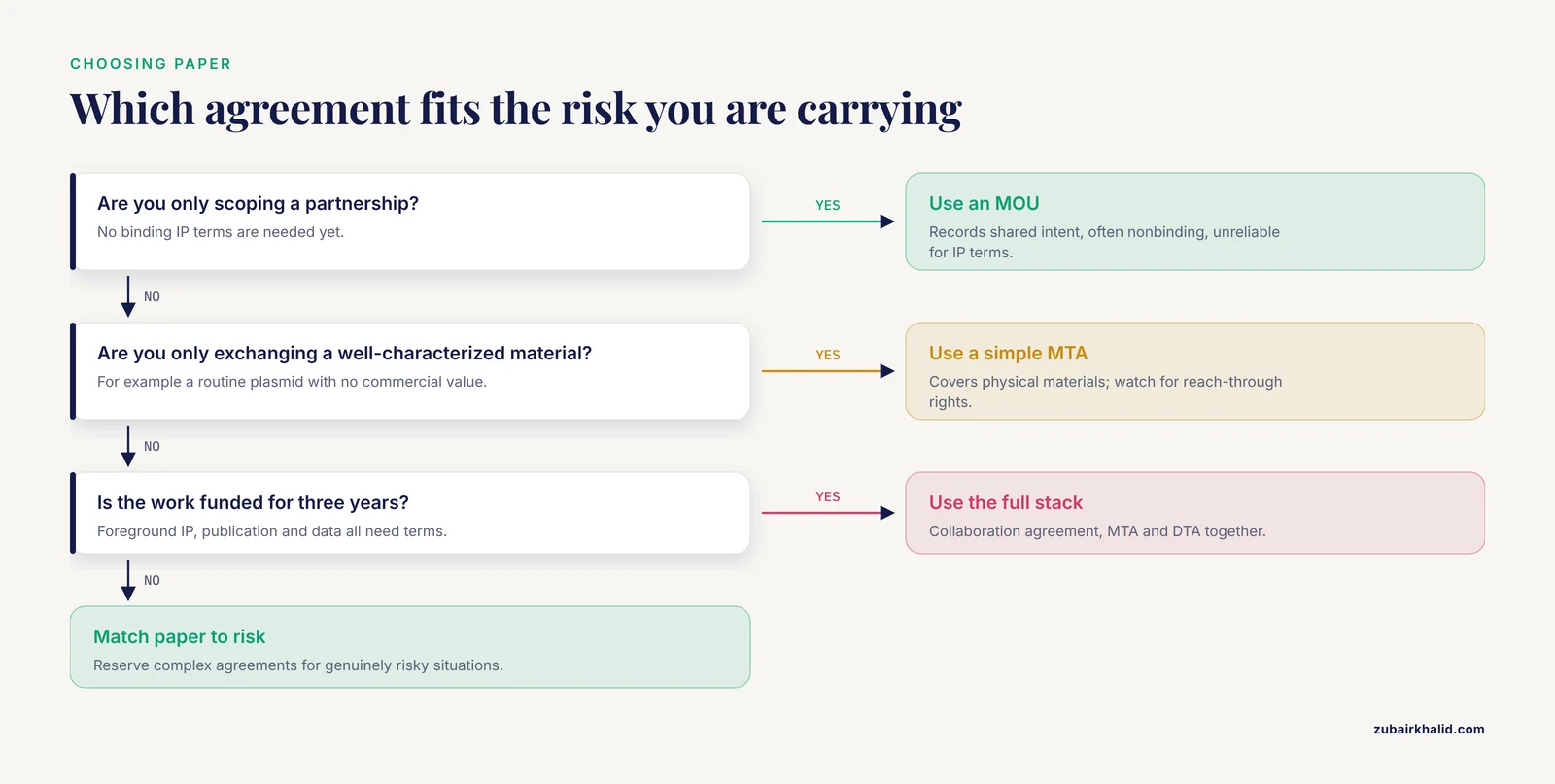
Match paper to risk. A scoping phase may need only an MOU. An exchange of a well-characterized plasmid needs a simple MTA. A three-year funded program needs the full stack: collaboration agreement, MTA, and DTA. Reserving complex agreements for genuinely risky situations is the proportionality principle that runs through modern guidance on research contracts [3], [4].
Step 4. Define foreground IP and the default ownership rule
The single most consequential clause defines what counts as foreground IP and who owns it. Companies often open with a broad grab. Here is a recurring pattern and the standard fix.
COMPANY FIRST DRAFT, CLAUSE 7.2
  "All results, data, and inventions conceived during the
   Program shall be the sole and exclusive property of
   Company."

NEGOTIATED REPLACEMENT, CLAUSE 7.2
  "Inventions made solely by the personnel of one Party
   shall be owned by that Party. Inventions made jointly
   by personnel of both Parties shall be co-owned. Each
   Party may use Foreground IP for internal research and
   teaching without restriction. Commercial exploitation
   of jointly owned Foreground IP requires a license on
   the terms in Schedule C."
Expected output: the company keeps sole ownership of what its chemists invent alone, the lab keeps sole ownership of what its researchers invent alone, and shared inventions get a license path instead of a standoff.
Two cautions. First, define foreground IP by project boundaries rather than the phrase "all results," so discoveries made under other funding stay outside the agreement. Second, understand co-ownership before accepting it. Under US patent law, each co-owner of a patent can generally exploit the invention without the other owners' consent and without sharing proceeds. Co-ownership looks generous and often is not, unless the agreement adds cross-licenses or revenue terms. This is why many institutions prefer the maker-owns rule with a license schedule over a flat 50/50 split.
Step 5. Run a weighted contribution calculation
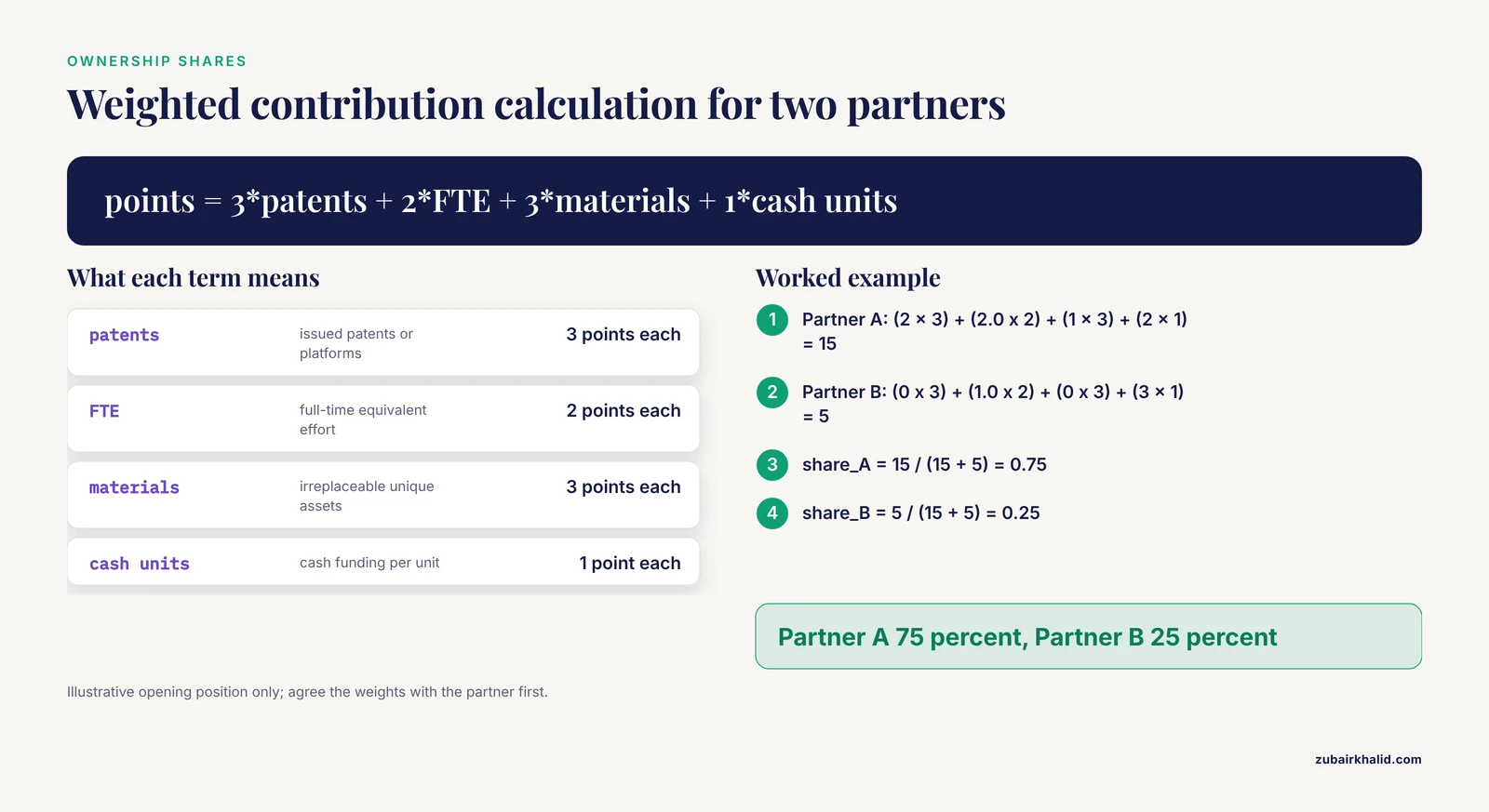
When ownership shares are on the table, put numbers on the table first. The model below is illustrative, so agree on the categories and weights with the partner before anyone plugs in values.
WEIGHTED CONTRIBUTION MODEL (illustrative, adapt the weights)

weights:  background_ip      3 points per issued patent or platform
          personnel          2 points per FTE
          unique_materials   3 points per irreplaceable asset
          cash_funding       1 point per $100,000

Partner A:  (2 x 3) + (2.0 x 2) + (1 x 3) + (2 x 1)
          = 6 + 4 + 3 + 2 = 15

Partner B:  (0 x 3) + (1.0 x 2) + (0 x 3) + (3 x 1)
          = 0 + 2 + 0 + 3 = 5

share_A = 15 / (15 + 5) = 0.75  ->  75 percent
share_B =  5 / (15 + 5) = 0.25  ->  25 percent
Expected output: Partner A 75 percent, Partner B 25 percent, as an opening position. Treat the result as a discussion device, not a verdict. Percentage splits of a patent create accounting duties that outlive the project, so many tech transfer offices trade the split for joint ownership plus field-of-use licenses, meaning licenses limited to a defined application area such as diagnostics or agriculture.
Step 6. Negotiate publication rights with calendar arithmetic
Publication is where academic careers are made and where company lawyers focus their fear. The standard trade is a short, fixed review window that gives the partner time to file a patent application before public disclosure, in exchange for no other delays. Carve out theses, conference presentations, and preprints explicitly, because silent carve-outs become disputes.
PUBLICATION TIMELINE CHECK (illustrative)

  manuscript ready:                  day 0
  company review window negotiated:  30 days
  submission date:                   day 30
  carve-outs:                        thesis, talks, preprints
  funder public access deadline:     runs from publication date

  test: the review window delays submission, so confirm it
        does not push past any funder milestone. Record both
        dates in the term sheet so both parties see the
        same calendar.
Expected output: a publication clause with one number in it, a short delay tied to patent filing, and named carve-outs. If the partner asks for an open-ended delay or a right to suppress "sensitive" results, shorten the window and narrow the carve-out to genuinely patentable subject matter.
Step 7. Paper materials and data with proportionate agreements
MTAs exist both to facilitate the exchange of materials and to protect institutional interests, a dual mandate that frustrates researchers and slows collaborations. The proportionality recommendation is direct: in most pre-competitive research, meaning research whose results are not immediately commercial, a simple agreement suffices, and complex agreements belong only where institutional risk or the commercial value of the materials is high [4].
Watch for reach-through rights, clauses that give the material provider a claim on anything you discover or invent using their material. Reach-through terms on a routine plasmid are a red flag. For data, use a DTA that names the datasets, the permitted uses, storage and deletion duties, and the deposit plan at project close.
Step 8. Agree on dispute resolution before you need it
An arbitration clause is a contract in which parties agree to submit defined disputes to a private, neutral tribunal for a final and binding decision instead of going to court. The clause is the source of the tribunal's authority, and its consensual nature is decisive, since a party cannot be forced to arbitrate a dispute it never agreed to submit [7].
A practical ladder for research collaborations reads: good-faith negotiation between the scientific leads, then mediation, then binding arbitration in a neutral venue. Write the ladder into the agreement. A dispute clause that does not exist cannot be invoked.
Step 9. Close, sign, and maintain the relationship
Before signature, run this check:
- Every schedule is populated, including the background IP lists.
- The publication clause contains a single number and named carve-outs.
- The dispute ladder exists and names a venue.
- The MTA and DTA match the actual materials and datasets in the inventory.
- Both institutions' authorized signers have signed.
Then maintain the relationship, because the contract is only part of the system. Contracting research across thousands of intergovernmental agreements found that when partners share strong connections, contracts tend to be less formal [8]. Survey evidence from 102 firms in cross-sector collaborations traced the chain that makes partnerships work: shared values build trust and commitment, which drive cooperation, which produces relationship learning, the process by which partners improve together [9]. At program scale, dedicated project coordinators and leaders at multiple levels were among the enablers of large transdisciplinary collaboration [6]. Assign a coordinator, keep the inventory current as contributions change, and amend the agreement when the project changes shape.
Negotiation Tips That Change Outcomes
These tips recur across successful scientific collaboration deals.
Lead with contributions, not demands. Negotiation outcomes track the contributions each side offers [2], so open by presenting your inventory and let the numbers argue.
Put the calculation on the table early. A shared model moves the conversation from positions to parameters, and partners can argue about weights without arguing about motives.
Trade across categories. If the partner needs exclusivity in one field, ask for a royalty share, faster publication, or nonprofit-use carve-outs in exchange. Cross-category trades unlock deadlocked single-issue fights.
State your constraints openly. Transparency shapes how negotiated outcomes are received. An analysis of the public consultation record from a major trade negotiation found mixed transparency and a predictable split, with industry submissions favoring stronger IP protections while non-industry comments prioritized access and affordability [10]. Hidden constraints discovered later read as bad faith.
Scale formality to relationship distance. Dense, long-standing ties support leaner paper, while new partnerships need the full stack.
Research Collaboration Tools for IP Work
Institutional templates and clause libraries. Start from your technology transfer office's standard forms. They encode your institution's red lines, they are usually free, and they speed up the other side's review.
Redlining and version control. Track-changes documents with a dated version log beat email chains. Keep one master copy, name files by date and party, and never negotiate from two versions in parallel.
Term sheets and position sheets. Exchange a one-page summary before drafting starts.
IP POSITION SHEET (exchange before the first meeting)

Project:         ACE2 variant screening consortium
Instruments:     1 collaboration agreement, 1 MTA, 1 DTA
Foreground IP:   new binders, assay protocols, screening data
Background A:    2 patents (numbers listed in Schedule B)
Background B:    screening platform (project-use license to A)
Ownership rule:  maker owns sole inventions, joint work co-owned
Publication:     30-day review for patent filing, no other delay
Materials:       simple MTA, no reach-through rights
Data:            DTA with named datasets, deposit plan at close
Disputes:        negotiation, then mediation, then arbitration
Reviewers:       university tech transfer office, company counsel
Expected output: both parties arrive at the drafting session with the same ten lines in front of them, which removes most surprises from the redline round.
AI drafting assistants. In a structured test, ChatGPT-4 drafted a comprehensive 6,847-word data transfer agreement containing all the standard headings, but clause quality varied in clarity and legal precision, and alignment with data protection best practices required refinement. The authors concluded that generative AI is a valuable drafting tool that cannot yet replace human legal expertise [11]. Use AI to produce a first structure, then route every clause through a human with legal expertise.
Shared scientific workspaces. Shared protocols, electronic lab notebooks, and data repositories shrink the surface area for later IP disputes, because authorship and provenance are recorded as the work happens. Good record-keeping is the cheapest IP protection in scientific collaboration.
International Collaborations Add Layers
Trade policy reaches into lab partnerships. An analysis of patents co-invented by researchers from different countries, filed at the United States Patent and Trademark Office by 114 countries and regions between 1990 and 2015, found that both shallow and deep regional trade agreements are positively associated with international research collaboration, with deep agreements showing the stronger association under certain conditions [12]. Shallow agreements mainly cut tariffs. Deep agreements add rules on IP, investment, and services, and that deeper rulebook appears to make cross-border scientific collaboration easier.
Some countries add a government gate. In India, international collaborative biomedical research must clear the Health Ministry's Screening Committee, a mandatory review administered through the Indian Council of Medical Research, before the project can proceed [13]. Identify any such national approval early and build it into the timeline.
Equity decides whether North-South partnerships last. A UK-Kenya-South Africa capacity-building program found that placing early career researchers into multidisciplinary, cross-country teams produced intellectual collaboration, friendship, and respect that sustained future work [14]. Reflect that equity in the agreement itself, through shared authorship norms, local data custody, and capacity commitments.
Licensing terms in health research carry public consequences. A review of essential cancer medicines concluded that patent status is only one factor in access and affordability, with IP rights interacting with trade agreements and pricing policy [15]. Where a collaboration could produce a health product, consider nonprofit-use or humanitarian carve-outs in the license schedule.
Common Mistakes and Limitations
Signing the partner's first draft. First drafts are opening positions. The broad IP grab in Step 4 is a standard opener, and the negotiated replacement is a standard response.
Using a heavy MTA for low-risk materials. Complex agreements with reach-through terms on routine reagents create administrative burdens that slow collaborations, and proportionality says simple agreements belong in pre-competitive research [4]. Match the paper to the risk.
Ignoring power asymmetry. Power dynamics between institutions, limited process familiarity, and protracted bureaucratic approvals are documented barriers to fair MTA negotiation [5], and power asymmetries shape outcomes at program scale as well [6]. Name the asymmetry, involve institutional support early, and never negotiate alone if you are the smaller party.
Over-lawyering a trusted partnership. When partners share strong connections, contracts tend to be less formal, and excessive formality can signal distrust [8]. Scale the paper to the relationship.
Skipping the technology transfer office. Institutional policy and funder terms bind you whether or not you have read them. Early involvement prevents the worst outcome in academic IP, a signed agreement your institution refuses to honor.
Trusting an AI draft unchecked. AI-drafted specialized agreements show variable clause quality and need human legal review [11].
Forgetting competition law. R&D collaborations are also policed by competition authorities. The UK and EU, which long applied identical block exemption rules to R&D agreements, diverged after Brexit, and the UK regime now applies closer scrutiny to what it calls competition in innovation [16]. Terms such as exclusivity and field restrictions can raise competition concerns in some jurisdictions, so flag them for legal review.
One limitation applies to everything above. This guide is educational, and individual agreements carry institution-specific and jurisdiction-specific consequences, so route yours through qualified legal counsel before signature.
Frequently Asked Questions
Who owns what a student or postdoc invents on a collaborative project?
In most universities, the institution owns inventions made by its employees and trainees under its IP policy, and the inventor assigns rights to the institution as a condition of employment or enrollment. In the United States, federally funded inventions typically flow to the grantee institution under the Bayh-Dole framework. Your personal stake usually arrives through institutional inventor reward-sharing policies, so read yours before signing anything.
Do I need a lawyer to negotiate IP terms?
You do not need to be a lawyer to lead the negotiation, but you do need legal review before anyone signs. Route drafts through your technology transfer office or research counsel, and expect the other side to do the same.
What is the difference between an MTA and a DTA?
An MTA covers physical research materials such as cell lines, plasmids, and antibodies. A DTA covers datasets. Many projects need both, and each sets different obligations for use, storage, and disposal.
Can we rely on a handshake or an email chain instead of a contract?
No, not for IP terms. An MOU can record intent without binding anyone, but ownership, licensing, and publication rights need a signed, binding agreement to hold up when interests diverge.
How long can a commercial partner delay my publication?
Negotiate the shortest fixed window that lets the partner file a patent application, and carve out theses, conference talks, and preprints. Any delay must still fit inside your funder's public access requirements, so check the grant terms before agreeing to a number.
What happens if we cannot agree on who owns a joint discovery?
Decide the rule before the discovery exists, because afterward both sides have incentives to fight. If a dispute still arises, a well-drafted escalation clause moves you from negotiation to mediation to arbitration instead of straight to court.
Can AI tools draft our collaboration agreement?
AI assistants produce serviceable first drafts with all the standard headings, but tests of specialized agreements show clause quality varies in clarity and legal precision. Use AI for structure, then have a human with legal expertise review every clause.
Do international collaborations change the IP negotiation?
Yes. Add national approval requirements, export rules, and differing national IP law to your checklist, and confirm any government screening steps before the project starts.
Sources
- Intellectual property: the control of scientific information.
- Negotiation Strategy in The International Research Collaboration
- Drafting effective collaborative research agreements and related contracts.
- Use and misuse of material transfer agreements: lessons in proportionality from research, repositories, and litigation.
- Researchers' perspectives on the use of material transfer agreements in biobanking research; a case of Uganda.
- Large-Scale Transdisciplinary Collaboration for Adaptation Research: Challenges and Insights
- Research Note: A Practical Guide to Drafting Arbitration Agreements
- Integrating Formal and Relational Contracting: The Link Between Network Structure and Contract Design in Interlocal Collaboration Agreements
- Antecedents of Relationship Learning in Business-Non-Profit Organization Collaboration Agreements
- Intellectual property and access to medicines: mapping public attitudes toward pharmaceuticals during the United States-Mexico-Canada Agreement (USMCA) negotiation process.
- How effectively can ChatGPT-4 draft data transfer agreements for health research?
- Do deep regional trade agreements facilitate international research collaboration?
- Indian Council of Medical Research's International Collaboration & Partnerships; Health Ministry's Screening Committee: Facts, figures & procedures
- "You Travel Faster Alone, but Further Together": Learning From a Cross Country Research Collaboration From a British Council Newton Fund Grant
- A multidisciplinary review of the policy, intellectual property rights, and international trade environment for access and affordability to essential cancer medications.
- The UK and EU competition rules for research and development agreements: falling out of lockstep