How to Build a Risk Management Plan for a Multi-Site Research Project
By Dr. Zubair Khalid, DVM, MS, PhD ·

By the end of this article you will be able to build a complete risk management plan for a study running at more than one site. You will construct a scored risk register, assign an owner to every risk, write trigger-based contingency plans, and set a review cadence that survives contact with real fieldwork. You will also see a working Python script that generates a risk register file you can hand to your project manager on day one.
Have these on hand before you start:
- A copy of your protocol, including the site list and target enrollment
- Python 3 installed, or a spreadsheet program if you prefer to work manually
- Names of the principal investigators and coordinators at each site
- Your data management plan, if one exists
- Any ethics or IRB conditions attached to your approval
The core skill here is ordinary research project management applied to a harder setting. A single-site study can absorb a missed shipment or a slow recruiter. A multi-site study multiplies every failure mode by the number of sites, and adds new failure modes that only appear when independent teams must behave identically.
Why Multi-Site Risk Is Different
Multi-site studies fail in ways single-site studies do not, and the published literature names the same culprits repeatedly.
The first culprit is divergence between sites. In a neuropsychological study of 611 children at six sites across South Africa, Zimbabwe, Malawi, and Uganda, the design depended on every site administering the same instruments, the Kaufman Assessment Battery for Children second edition, the Tests of Variables of Attention, the Bruininks-Oseretsky Test second edition, and the Behavior Rating Inventory of Executive Function, at the same three time points over two years [1]. Any drift in how one site administered those tools would have contaminated the pooled analysis. Standardization is a risk item, not a given.
The second culprit is governance and data flow. The Accelerating Medicines Partnership Schizophrenia program, an international observational study of young people at clinical high risk for psychosis, published a detailed account of its data operations precisely because moving sensitive health data between countries and platforms is one of the hardest risk domains in multi-site work. Their solution centered on data stewards rather than data owners, shared data dictionaries, automated pipelines for data flow, quality control protocols, and alignment with the FAIR principles of findability, accessibility, interoperability, and reusability, all while respecting local regulatory and ethical constraints [2].
The third culprit is implementation at the frontline. A qualitative evaluation of a multi-site pilot that expanded Patient-Centered Medical Home teams across six Veterans Affairs sites found that when basic structures and processes such as staffing, huddling, and pre-visit planning were not in place, sites struggled to integrate new roles, and adding certain roles introduced role-clarity problems [3]. The lesson generalizes to research: a protocol that assumes uniform local capability is a risk in itself.
A risk management plan exists to name these problems before they happen, decide in advance who responds, and rehearse the response. The disaster risk reduction literature frames this as three phases, preparedness, response, and recovery, beginning with an honest assessment of needs, risks, and vulnerabilities [4]. The same framing works for a research consortium.
Multi-Site Research Project Risk Management Step by Step
The following walkthrough produces a plan you can actually operate. Each step yields a concrete artifact.
Step 1. Inventory the sites and map the dependencies
List every site, its role, and what the central team depends on it for. A four-site clinical trial comparing DBT plus DBT PE against Prolonged Exposure with suicide risk management across the Veterans Health Administration, for example, depends on each of its four sites for recruitment, treatment delivery, and access to masked assessors who evaluate participants at five points over 16 months [5]. Your dependency map should look similar in structure even if your study is observational.
For each site, record:
- Site identifier and local principal investigator
- Target enrollment or sample contribution
- What the site produces (data, specimens, interventions, referrals)
- What the site consumes from the center (training, kits, payments, data systems)
- Local constraints, including language, regulation, and staffing
The PARAM cohort in India, which extends an existing consortium by enrolling roughly 9,000 participants from the antenatal period to age 30 across eight sites, shows how much variation one map has to absorb. Five of its sites recontact participants from the earlier cohort, and its measures run from questionnaires and clinical examinations to satellite-derived indicators of urbanization and air pollution [6]. Sites with different histories and different measurement burdens carry different risk profiles. Write that down at the start.
Step 2. Build the risk register
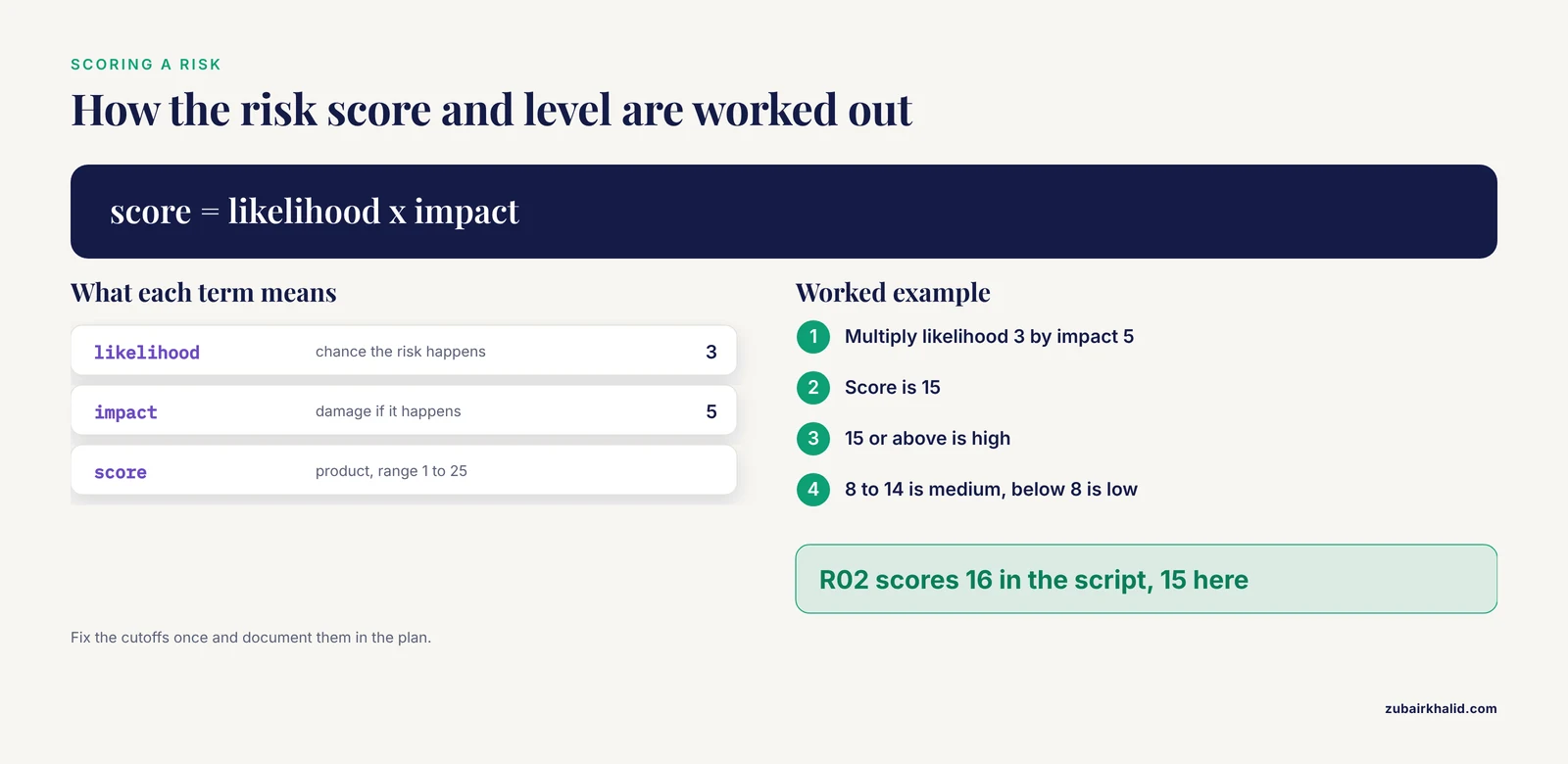
The risk register is the working heart of the plan. Each row is one risk with an identifier, a category, a description, an owner, a likelihood score, an impact score, a computed risk score, and a mitigation.
Score likelihood and impact on a 1 to 5 scale. Multiply them to get a risk score from 1 to 25. Use the same cutoffs across the whole project, for example 15 or above is high, 8 to 14 is medium, and below 8 is low. These thresholds are conventions, not laws, so pick them once and document them.
Here is a script that builds a register and writes it to a CSV file.
import csv

RISKS = [
    {"id": "R01", "category": "Recruitment",
     "description": "Site B enrolls below monthly target",
     "owner": "Site lead, Site B",
     "likelihood": 4, "impact": 4,
     "mitigation": "Monthly enrollment dashboard and backup referral pathway"},
    {"id": "R02", "category": "Data",
     "description": "Site data entries deviate from shared data dictionary",
     "owner": "Data manager, central team",
     "likelihood": 3, "impact": 5,
     "mitigation": "Automated validation on upload, monthly data quality report"},
    {"id": "R03", "category": "Standardization",
     "description": "Assessor at Site C administers outcome measure differently",
     "owner": "Training lead",
     "likelihood": 3, "impact": 4,
     "mitigation": "Central certification, recorded practice sessions, refresher training"},
    {"id": "R04", "category": "Participant safety",
     "description": "Adverse event occurs outside business hours at a site",
     "owner": "Safety officer",
     "likelihood": 2, "impact": 5,
     "mitigation": "24-hour escalation protocol with named on-call contact per site"},
    {"id": "R05", "category": "Technology",
     "description": "Remote monitoring devices fail or lose connectivity",
     "owner": "Technology lead",
     "likelihood": 3, "impact": 3,
     "mitigation": "Device check at each visit, spare inventory, weekly connectivity audit"},
]

for r in RISKS:
    r["score"] = r["likelihood"] * r["impact"]
    if r["score"] >= 15:
        r["level"] = "high"
    elif r["score"] >= 8:
        r["level"] = "medium"
    else:
        r["level"] = "low"

with open("risk_register.csv", "w", newline="") as f:
    writer = csv.DictWriter(f, fieldnames=list(RISKS.keys()))
    writer.writeheader()
    writer.writerows(RISKS)

for r in sorted(RISKS, key=lambda x: -x["score"]):
    print(f'{r["id"]}  {r["score"]:>2}  {r["level"]:<6}  {r["description"]}')
The expected output is a ranked list you can paste into a meeting agenda:
R02  16  high    Site data entries deviate from shared data dictionary
R01  16  high    Site B enrolls below monthly target
R03  12  medium  Assessor at Site C administers outcome measure differently
R05   9  medium  Remote monitoring devices fail or lose connectivity
R04  10  medium  Adverse event occurs outside business hours at a site
The CSV file it writes has one row per risk and one column per field, ready to import into any project management tool. If you prefer a spreadsheet, the same scoring rule is one formula per row:
=IF(H2>=15,"high",IF(H2>=8,"medium","low"))where column H holds the product of the likelihood and impact cells.
Step 3. Assign one owner per risk
Every risk needs exactly one named owner. Committees own nothing. The owner does not personally fix the risk, the owner is accountable for watching the indicator and triggering the mitigation.
Governance structure matters as much as individual ownership. The multi-site behavior risk screening program implemented across six hospital sites used a specific set of implementation strategies: educational and planning meetings, steering committees, identified champions at each site, training materials, facilitation and consultation, and audit with feedback [7]. Translate those directly into research governance. A steering committee meets monthly, a site champion holds daily visibility, and an audit-and-feedback loop keeps the register honest.
Public and patient involvement belongs in governance too. In a large multi-site health services study, public contributors did far more than advise. They attended management, scrutiny, planning, and task meetings, conducted an involvement audit, and shaped recruitment, terminology, and dissemination, with effects that exceeded the original plan [8]. Budget for their time and assign a coordinator, because an unfunded involvement plan is a quiet risk.
Step 4. Separate study-level risks from site-level risks
Two registers operate at once in any multi-site project, and confusing them is a classic failure.
Study-level risks threaten the pooled result. Examples include pooled enrollment falling below the power calculation, divergent outcome administration, or a data platform outage. These belong to the central team.
Site-level risks threaten one site's contribution. Examples include a local staff departure, a site-specific regulatory delay, or a clinic that cannot sustain the intervention schedule. These belong to site leads, and they get discussed at site level and escalated upward when they cross a threshold.
The Adaptive Design study of patient safety practices offers a useful phased structure for rolling out any protocol element across sites. Its implementation ran through four phases: a start-up phase with information and team meetings, a pilot phase testing the prototype across about 100 procedures, a small-scale implementation phase with one or two disciplines, and a full-scale phase covering all disciplines, with teams redesigning and adapting in iterations [9]. Piloting a protocol at one or two sites before full activation converts a standardization risk into a controlled test.
Role ambiguity deserves special attention at the site level. The PCMH pilot evaluation found that role clarity problems appeared when new roles were layered onto teams whose basic processes were weak [3]. In a research setting, the equivalent is a site coordinator who is also a recruiter, a data enterer, and a scheduler. Write the role matrix before enrollment opens.
Step 5. Treat data as a first-class risk domain
Data risk in multi-site work has four faces: privacy, quality, harmonization, and loss.
Privacy and governance. Treat every site and every funder as a data steward rather than an owner. The AMP Schizophrenia program balanced participant privacy against the research community's needs by specifying data capture systems, data dictionaries, security measures, quality control protocols, monitoring, and dissemination through a central archive, with automated pipelines that improved data quality and speed [2]. A risk plan should name the platform, the dictionary, the security controls, and the lawful basis for each data flow between each pair of sites.
Quality. Define validation at the point of entry. Automated checks on upload catch errors while the participant is still reachable, which manual quality control months later cannot.
Harmonization. In the African neuropsychological study, pooled comparison across sites and cohorts relied on linear mixed models adjusting for site, age, sex, and family control variables [1]. Harmonization risk is therefore statistical as well as operational. If one site codes a variable differently, the adjustment absorbs some of the damage but not all of it.
Remote measurement adds its own risks. The ART-CARMA cohort planned to follow 300 adults with ADHD for 12 months using a wrist-worn wearable and smartphone apps for passive monitoring, starting before treatment initiation [10]. Device loss, app uninstallation, battery failure, and connectivity gaps are all predictable, so each needs a register row with a monitoring indicator such as weekly valid-data hours per participant.
Step 6. Plan for participant safety risks
If your study touches vulnerable populations, participant safety is the highest-impact category on the register, and it deserves written escalation paths rather than good intentions.
The DBT plus DBT PE trial treated veterans with recent and repeated self-directed violence, suicidal ideation, and emotion dysregulation at four sites, and it used masked assessors for outcome evaluation [5]. Two risk controls are visible in that design. First, the interventions themselves embed risk management, Prolonged Exposure was augmented with a suicide risk management protocol. Second, assessor masking protects the integrity of safety-relevant outcomes. Your plan should state who assesses risk, with what tool, on what schedule, and who gets called, within what time window, when a threshold is crossed.
The telephone-based psychosocial intervention trial for suicide attempters in India, a multi-site rater-blind two-arm randomized controlled trial with 362 participants followed for six months, shows the same pattern in a different health system. Risk management lives in the protocol structure, the eligibility criteria, the blinded rating, and the follow-up schedule [11], not in a paragraph of good intentions.
Concretely, write for each site: the local escalation contact, the central safety contact, the review interval for safety events, and the criteria for pausing enrollment.
Step 7. Write contingency plans with triggers
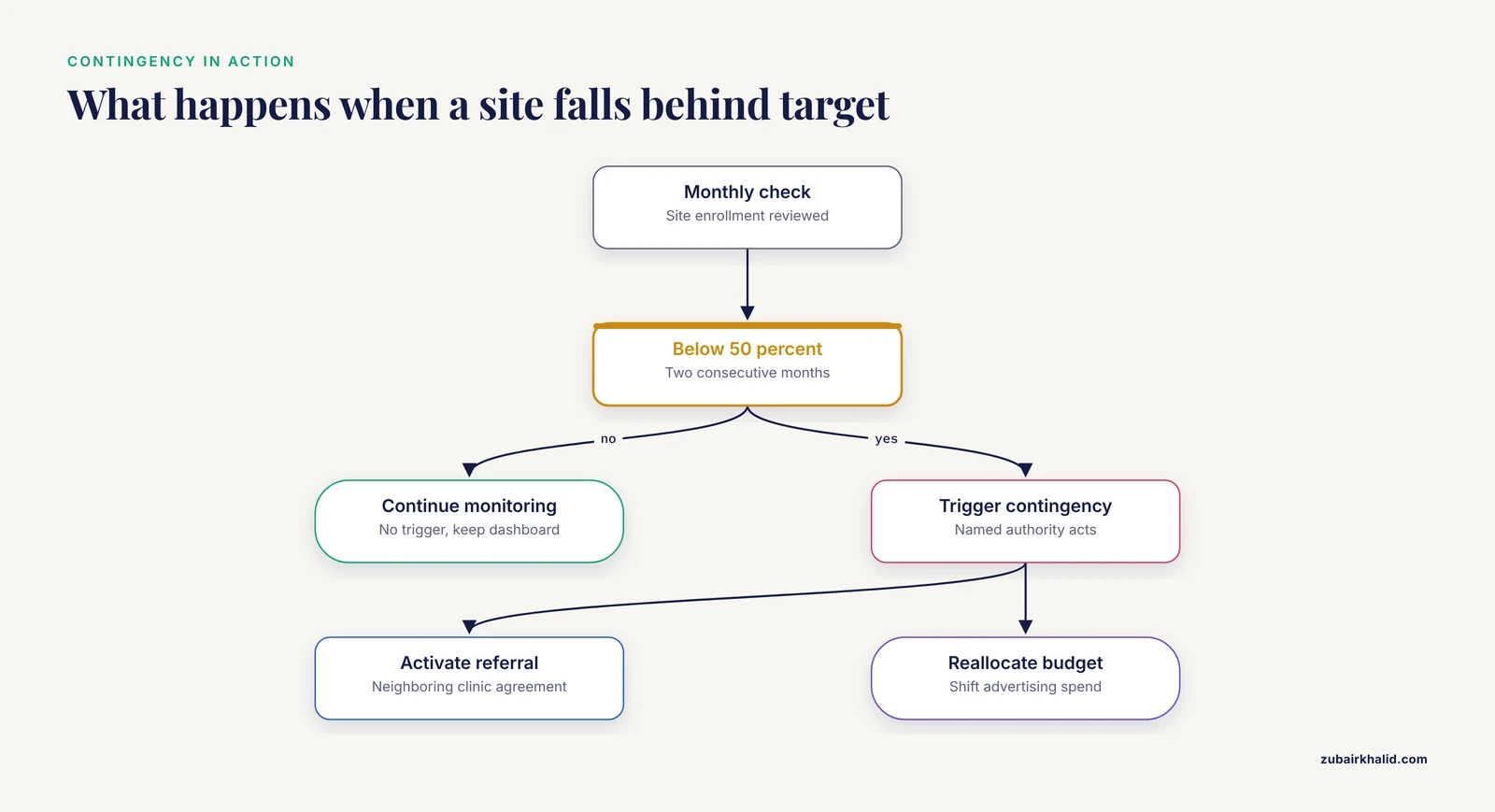
A mitigation reduces the likelihood or impact of a risk. A contingency plan says what you do when it happens anyway. Every high-level risk in the register needs one, and each plan has three parts: a trigger, an action, and an authority.
- Trigger: the observable condition that activates the plan, for example "site enrollment below 50 percent of target for two consecutive months"
- Action: the specific response, for example "activate referral agreement with the neighboring clinic and reallocate advertising budget"
- Authority: the named person empowered to act without waiting for the next steering meeting
The kidney care disaster preparedness roadmap developed through a scoping review of 52 articles organizes this as the ABC4s of preparedness, beginning with assessing needs, risks, and vulnerabilities, and then moves through response and recovery [4]. Borrow the structure. For each phase of your study, write what preparedness looks like, what the first 48 hours of response look like, and what recovery requires.
The small water supplies work in the Nordic countries adds a pointed lesson for continuity planning. Operators there had experienced consequential incidents from heavy rains, drought, changed cold-climate hydrology, and landslides, yet climate change received little attention in official guidelines, and the authors concluded that new threats are best handled by integration into an existing risk-based approach rather than by piling on separate frameworks [12]. In research terms, integrate novel risks, such as an extreme weather event closing a field site, into your existing register and contingency format rather than creating a parallel emergency document nobody reads.
Step 8. Set the review cadence and the audit loop
A plan nobody re-reads is a document, not a control. Fix the cadence in writing.
- Weekly: site-level operational check during active enrollment, run by site leads
- Monthly: steering committee reviews every high risk and every triggered contingency
- Quarterly: full register re-scoring, because likelihoods change as enrollment ramps
- At each milestone: formal gate review before opening the next site or phase
Audit and feedback is what keeps scoring honest. The six-site behavior safety program named audit and feedback as one of its implementation strategies [7], and the same mechanism works for a risk register. Show each site lead their own site's indicators next to the consortium average. Sites that see their numbers behave differently from sites that only hear about them.
Step 9. Document the plan and version it
The final artifact is a versioned document containing: the dependency map from step 1, the risk register from step 2 through step 5, the contingency plans from step 7, the review calendar from step 8, and a change log. Store it where all sites can read it, and give it the same version discipline you give your protocol.
Quick Reference: Risk Categories for Multi-Site Projects
| Risk category | Typical multi-site example | Primary mitigation | Owner |
|---|---|---|---|
| Recruitment | One site enrolls far below target | Enrollment dashboard, backup referral pathway | Site lead |
| Standardization | Outcome measure administered differently at one site | Central certification and refresher training | Training lead |
| Data quality | Entries deviate from the data dictionary | Automated validation on upload | Data manager |
| Data privacy | Cross-border transfer of sensitive records | Stewardship model, defined lawful flows, central archive | Data steward |
| Participant safety | Adverse event at a site after hours | Named on-call escalation per site | Safety officer |
| Technology | Wearable or app data streams fail | Weekly connectivity audit, spare devices | Technology lead |
| Staffing | Key coordinator departs mid-study | Written role matrix, cross-trained backup | Site lead |
| Retention | Participants drop out unevenly across sites | Retention indicator per site in monthly report | Project manager |
| Implementation | Sites lack basic processes for a new procedure | Phased rollout with pilot before full activation | Steering committee |
| External disruption | Extreme weather closes a field site | Trigger-based contingency in the continuity plan | Project manager |
Multi-Site Research Project Risk Management Tips
These are the habits that separate plans that work from plans that decorate a drawer.
Score risks in a room with site representatives present. Central teams systematically underestimate site-level friction. The PRISM-AC trial, a two-arm randomized controlled trial of a resilience intervention for adolescents and young adults with advanced cancer at four academic medical centers, depended on sites for recruitment of 144 participants into a specific screening and intervention schedule [13]. Only the people running those schedules know how fragile they are.
Pilot everything that must be identical. Certification of assessors, recorded practice sessions, and a dress rehearsal of the data pipeline cost days and prevent months of cleanup.
Keep the register short and alive. Fifteen to thirty genuine risks beat two hundred fictional ones. When a risk retires, move it to a closed section rather than deleting it, because the closure record is evidence of an operating process.
Track retention as a leading indicator. A multi-site home-visiting intervention for postpartum depression among low-income Latinas reported a 76 percent completion rate across five sites [14]. Completion percentage is one of the few numbers every site can report monthly, and divergence between sites is an early warning long before it shows up in the analysis.
Give implementation risks the same seriousness as scientific risks. The qualitative evaluation of the VA PCMH pilot found that frontline staff experiences, including role confusion and weak local processes, determined whether a well-designed model succeeded [3]. If your intervention changes what people do at work, treat that change as a risk item with an owner.
Involve stakeholders in risk identification. Public contributors in the GPs in EDs study identified effects on recruitment and terminology that the research team had not foreseen [8]. Ask site staff, patient representatives, and community partners for their top three worries. They are usually your register's best missing rows.
Common Mistakes and Limitations
The most frequent failure patterns in multi-site research project risk management are concrete and avoidable.
Copying one risk list across all sites. Sites differ in staffing, regulation, language, and history. PARAM's eight sites include five that recontact participants from a previous cohort and three that do not, which creates materially different retention risks [6]. Score each site, then roll up.
Scoring without thresholds. If 15 means high this month and 12 means high next month because a meeting got uncomfortable, the register stops meaning anything. Fix the cutoffs in the plan document.
No named owner. A risk assigned to "the data team" is a risk assigned to nobody. Use names.
Confusing mitigation with contingency. "Train the staff better" is a mitigation. "When the site's certification lapse exceeds 60 days, pause its enrollment and retrain within 30 days" is a contingency. You need both, and only the contingency has a trigger.
Treating data governance as paperwork. The AMP Schizophrenia team devoted an entire methods paper to data operations because capture systems, dictionaries, security, quality control, and dissemination interact, and weakness in one undermines the others [2]. Budget real time for this domain.
Letting the register fossilize. Quarterly re-scoring is the minimum during active phases. A register untouched since ethics approval is a liability record, not a management tool.
Ignoring phased rollout. Jumping from protocol approval to full activation at every site removes your chance to learn cheaply. The Adaptive Design study's four-phase structure, start-up, pilot, small-scale, then full implementation, exists precisely to catch problems while they are still inexpensive [9].
Planning only for the science. Delivery risks, role confusion, and adoption failures sink studies as often as design flaws do. The behavior safety program succeeded across six sites because it paired the clinical content with steering committees, champions, training, and audit [7].
One honest limitation applies to every plan. A risk register is a structured guess about the future, and individual events, whether a site emergency or a participant crisis, will sometimes require judgment that no document anticipates. The plan's job is to make those moments rarer and shorter, not to eliminate them.
Using a Research Project Plan Template
A research project plan template becomes genuinely useful for multi-site work when you add risk sections to the standard project sections. Structure your template so each element feeds the next.
- Site dependency map. One table, one row per site, columns for role, outputs, inputs, and constraints.
- Governance roster. Steering committee membership, site champions, and named risk owners.
- Risk register. The CSV structure from step 2, with fixed likelihood, impact, and level cutoffs.
- Contingency annex. One short block per high risk, each with trigger, action, and authority.
- Monitoring calendar. Weekly, monthly, quarterly, and milestone reviews with named chairs.
- Change log. Version, date, author, and a one-line description of every register edit.
Keep the template to five or six pages. The water supplies research found that operators were concerned about being overburdened with multiple guidelines and frameworks, and recommended integrating new concerns into existing risk-based processes instead of adding documents [12]. Your template should absorb new risks, not multiply paperwork.
A good test of the finished plan is the two-question drill. Pick any high risk at random and ask a site coordinator, without warning, "What is the trigger for this risk and who acts on it?" If they can answer, the plan is real. If they cannot, the plan is a file.
Frequently Asked Questions
What is a risk management plan in multi-site research?
It is a versioned document that lists what could go wrong across all sites, scores each risk by likelihood and impact, assigns one named owner per risk, and defines mitigations, triggers, and contingency actions. It also fixes a review calendar so the register is re-scored on a schedule rather than after crises.
What risks are unique to multi-site research projects?
Divergence between sites is the defining risk, including differences in recruitment, staff capability, and how identically staffed teams administer shared protocols. Cross-site data governance, harmonized measurement, uneven retention, and coordination of escalation paths for participant safety are additional risks that single-site studies rarely face.
How often should a multi-site risk register be reviewed?
Run a brief site-level check weekly during active enrollment, a full steering committee review of all high risks monthly, and a complete re-scoring of the register quarterly. Add a formal gate review at every milestone, such as opening a new site or phase.
Who should own risks in a multi-site study?
Every risk needs exactly one named owner who is accountable for watching the indicator and triggering the response. Study-level risks belong to central team members such as the data manager or safety officer, while site-level risks belong to the site lead, with escalation thresholds defined in advance.
How do you manage data privacy risk across multiple sites?
Treat each site and funder as a data steward rather than an owner, define a shared data dictionary, secure each data flow, validate data on upload, and disseminate through a governed central platform. The AMP Schizophrenia program demonstrates this stewardship model with automated pipelines, quality control protocols, and FAIR-aligned operations across international sites.
What should a contingency plan for a research site include?
Three parts: a trigger, meaning the observable condition that activates it, an action, meaning the specific steps to take, and an authority, meaning the named person empowered to act without waiting for the next committee meeting. Every high-level risk needs one, and the trigger must be measurable.
Do small multi-site pilots need a full risk management plan?
Yes, but a proportionate one. A pilot with two or three sites can use a one-page register with ten risks, one governance meeting, and one contingency annex. The value comes from the discipline of writing triggers and owners, not from document length.
What is the most common mistake in multi-site risk management?
Assigning the same generic risk list to all sites with no named owners and no fixed scoring thresholds. The register then has no meaning, nobody acts on it, and it silently goes out of date. Per-site scoring, named ownership, and a fixed review cadence prevent all three failures.
Sources
- African Multi-Site 2-Year Neuropsychological Study of School-Age Children Perinatally Infected, Exposed, and Unexposed to Human Immunodeficiency Virus.
- Enabling FAIR data stewardship in complex international multi-site studies: Data Operations for the Accelerating Medicines Partnership® Schizophrenia Program.
- Expanding Patient-Centered Medical Home Teams in Primary Care: Qualitative Evaluation of Implementation Experiences from a Multi-site Pilot Within the VA Healthcare System.
- A Roadmap for Disaster Risk Reduction and Management in Kidney Care: A Scoping Review and Content Analysis.
- Evaluating psychotherapies for veterans with PTSD at elevated acute risk of suicide: Protocol for a multi-site type 1 hybrid effectiveness-implementation trial.
- The PAthways to Resilience And Mental health (PARAM) project: protocol for a multi-site developmental cohort in India.
- Developing and Implementing a Patient Behaviour Risk Screening, Communication and Care Planning Intervention for Hospital Settings.
- Implementing public involvement throughout the research process-Experience and learning from the GPs in EDs study.
- Adaptive design: adaptation and adoption of patient safety practices in daily routines, a multi-site study.
- ADHD Remote Technology study of cardiometabolic risk factors and medication adherence (ART-CARMA): a multi-centre prospective cohort study protocol.
- Protocol of a Multi-centric Randomized Controlled Trial to Evaluate Efficacy of Telephone-Based Psychosocial Interventions on Future Suicide Risk in Suicide Attempters.
- Small water supplies in Nordic countries: climate change effects, risks and contingency planning.
- Protocol for the promoting resilience in stress management (PRISM) intervention: a multi-site randomized controlled trial for adolescents and young adults with advanced cancer.
- Home Visits for Postpartum Depression Intervention among Low-Income Latinas: Results from the PST4PPD Project.