Mixed Methods Dissertation Timeline: How to Choose
By Dr. Zubair Khalid, DVM, MS, PhD ·

A mixed methods dissertation timeline is the schedule that sequences your quantitative and qualitative strands, and the best choice comes down to one question: do the strands depend on each other's results or not? If your two strands can run at the same time and answer separate parts of one question, pick a convergent parallel timeline. If one strand must inform the other, pick a sequential timeline and budget real months for the handoff between them.
This guide walks through the five main mixed methods dissertation timeline options, compares them side by side, and shows how the choice plays out in real studies. If you are early in dissertation planning, read the options first and the decision criteria second. If you already have a committee-approved topic, jump to the comparison table and worked scenarios.
What a Mixed Methods Dissertation Timeline Actually Schedules
A mixed methods study collects, analyzes, and integrates both quantitative data (numbers, such as survey scores or lab measurements) and qualitative data (words, such as interview transcripts or field notes). Researchers call each data type a strand. The timeline's job is to answer three questions for each strand: when does data collection start, when does analysis finish, and when do the two sets of findings meet?
The taxonomy most methodology textbooks use, formalized by Creswell and Plano Clark, sorts designs by the sequence of the strands and their priority (which strand drives the study). Those two features determine your calendar. A convergent design compresses the schedule because both strands run together. A sequential design stretches the schedule because the second strand cannot start until the first produces results.
Beyond the strands themselves, every mixed methods dissertation timeline has to reserve time for phases that single-method dissertations often skip or shorten:
- Refining the research question so it genuinely needs both data types
- Getting committee sign-off on the design and the sequence
- Ethics review (IRB approval in US programs) covering both instruments
- Developing and piloting a survey, interview guide, or both
- Collecting and analyzing each strand
- Integration, the explicit step where you compare, merge, or explain one set of findings with the other
- Writing, revision, and defense
Integration is the phase dissertation students most often leave unplanned. It is a distinct analytical task with its own methods, such as joint displays or side-by-side comparison of themes and statistics, and it needs its own weeks on the calendar.
The Five Main Mixed Methods Dissertation Timeline Options
Convergent Parallel Timeline
In a convergent parallel design, you collect quantitative and qualitative data during the same period, analyze each strand separately, and merge the results at the interpretation stage. This is the fastest option when you have the capacity to run two data collections at once.
A published example shows the shape clearly. A study of medical students in Saudi Arabia used a convergent parallel design to evaluate module study guides. Students completed structured surveys while separate groups took part in semi-structured focus groups. Each strand was analyzed independently, then the findings were merged. The quantitative arm reached 255 of 490 eligible students, a 52 percent response rate, and found that 43.5 percent were satisfied with the guides, with preclinical students 2.5 times more likely to be satisfied than clinical students [1].
The convergent timeline's calendar advantage is real but often overstated. You save months by overlapping collection, yet you pay for it in parallel instrument development (two piloted tools instead of one), two analysis workstreams, and a merge step that can surface contradictions you must then reconcile in writing.
Sequential Explanatory Timeline (Quantitative First)
In a sequential explanatory design, you collect and analyze quantitative data first, then use those results to shape a qualitative phase that explains them. The calendar cost is the wait between strands. The benefit is that your interviews or focus groups can probe exactly the patterns your statistics revealed, including the surprising ones.
Because the qualitative phase depends on quantitative results, this design punishes delays in the first strand. If your survey response rate comes in low, your interview recruitment is built on a weak base, and the whole downstream schedule slips.
Sequential Exploratory Timeline (Qualitative First)
In a sequential exploratory design, qualitative work comes first, usually to explore a poorly understood phenomenon or to build an instrument, and the quantitative phase follows. This is the standard timeline for implementation research and for instrument development dissertations.
A study of a newly implemented cross-institutional electronic health record system in Norway illustrates a realistic overlapping version of this timeline. The researchers gathered qualitative data through participant observations and physician interviews from September 2023 to January 2024, analyzed it with reflexive thematic analysis, then collected quantitative survey data from January 2024 to July 2024, with the two phases overlapping by about one month [2]. Notice two things. First, the qualitative phase ran roughly five months and the quantitative phase roughly seven. Second, the overlap was small and deliberate, not a full merger of the two collections.
The exploratory timeline suits dissertation students who need to discover what questions to ask before they can measure anything. Its cost is the same as the explanatory version: the second strand waits on the first.
Embedded Timeline
In an embedded design, one strand is nested inside a study organized around the other. A randomized trial with a qualitative substudy is the classic case. The timeline is dominated by the primary strand's schedule, and the secondary strand is slotted into it.
A prospective, longitudinal randomized trial in Gujarat, India, shows this structure at scale. The study enrolled 280 patients with type 2 diabetes, 139 in the control group and 141 in the intervention group, and followed both across five visits within an educational pharmaceutical care program, tracking HbA1c alongside behavioral, medication adherence, psychological, and economic factors [3]. Here the repeated measurement schedule, five visits per participant, defines the calendar, and any additional strands must fit between visit waves.
For a dissertation student, the embedded timeline is attractive when your advisor already runs a trial or longitudinal cohort you can piggyback on. It is a poor choice when you would have to build the primary structure yourself, because you inherit the full logistical weight of a trial on a dissertation budget.
Multiphase or Staged Rollout Timeline
In a multiphase design, the study unfolds in deliberate stages, often with a pilot phase followed by phased implementation. This is the longest timeline option and the one most often required when the research changes practice in a real-world system.
An implementation study integrating VectorCam, an AI-enabled mosquito surveillance tool, into Uganda's national malaria program shows the full architecture. The team first co-designed the implementation package with the Ministry of Health using a human-centered design approach, then ran a two-district pilot phase, then used district-level restricted randomization to assign 12 districts to four sequential rollout waves over a one-year period, evaluating acceptability, feasibility, fidelity, cost, and preliminary effectiveness with qualitative and quantitative methods [4]. Each wave depended on the previous one, which is what makes the design sequential in time even though both data types flow continuously.
A multiphase timeline is rarely the right first choice for a dissertation unless your project is embedded in an ongoing program, because staged rollouts consume calendar time regardless of how efficiently you work.
Side-by-Side Comparison of Timeline Options
| Timeline option | Strand order | Relative duration | Best fit | Main drawback |
|---|---|---|---|---|
| Convergent parallel | Simultaneous | Shortest collection window | Separate facets of one well-defined question | Heavy merge and reconciliation workload |
| Sequential explanatory | Quantitative, then qualitative | Long, front-loaded | Explaining statistical patterns in depth | Second strand waits entirely on the first |
| Sequential exploratory | Qualitative, then quantitative | Long, front-loaded | New or poorly understood phenomena, instrument building | Same dependency risk in the opposite direction |
| Embedded | Secondary strand nested in a primary structure | Driven by the primary study | Students attached to an existing trial or cohort | You inherit someone else's schedule constraints |
| Multiphase / staged rollout | Phased stages with a pilot | Longest | Program evaluation, implementation research | Calendar time fixed by rollout structure, not by effort |
Pros and Cons of Each Mixed Methods Dissertation Timeline
Convergent Parallel
Pros. Fastest route to a complete dataset. Both strands can share one ethics submission and one recruitment push. Merging findings early, rather than at the end of a chain, leaves maximum time for writing the integration chapter.
Cons. You must develop and pilot two instruments before either strand starts, which front-loads the hardest work into the riskiest period. Contradictory findings, which the convergent design is specifically designed to detect, arrive late and can force substantial rewriting.
Sequential Explanatory
Pros. The qualitative phase is targeted and efficient, because interview probes come straight from your own quantitative results. Analysis of the first strand is finished and defensible before the second begins, which committees tend to like.
Cons. Total duration is the sum of both strands. A weak quantitative phase (small sample, poor response rate, null or messy results) propagates directly into the qualitative phase's design.
Sequential Exploratory
Pros. The qualitative phase de-risks the quantitative one. You learn the vocabulary and concerns of your participants before you commit to survey items or outcome measures.
Cons. Same additive duration problem. Also, thematic analysis of exploratory interviews takes longer than students expect, and the delay lands early enough to threaten proposal deadlines.
Embedded
Pros. The primary structure (recruitment, randomization, visit schedule) often already exists, which removes the largest sources of dissertation delay. Data collection can be partly handled by an existing team.
Cons. You control neither the pace nor the timing of the primary study. If the trial's enrollment lags, your dissertation waits.
Multiphase
Pros. Strongest design for causal and implementation questions, and the staged structure produces natural checkpoints where a committee can verify progress.
Cons. The one-year-plus commitment of a staged rollout [4] is typically beyond what a solo dissertation timeline supports without an existing program to attach to.
How to Choose: The Criteria That Decide Real Cases
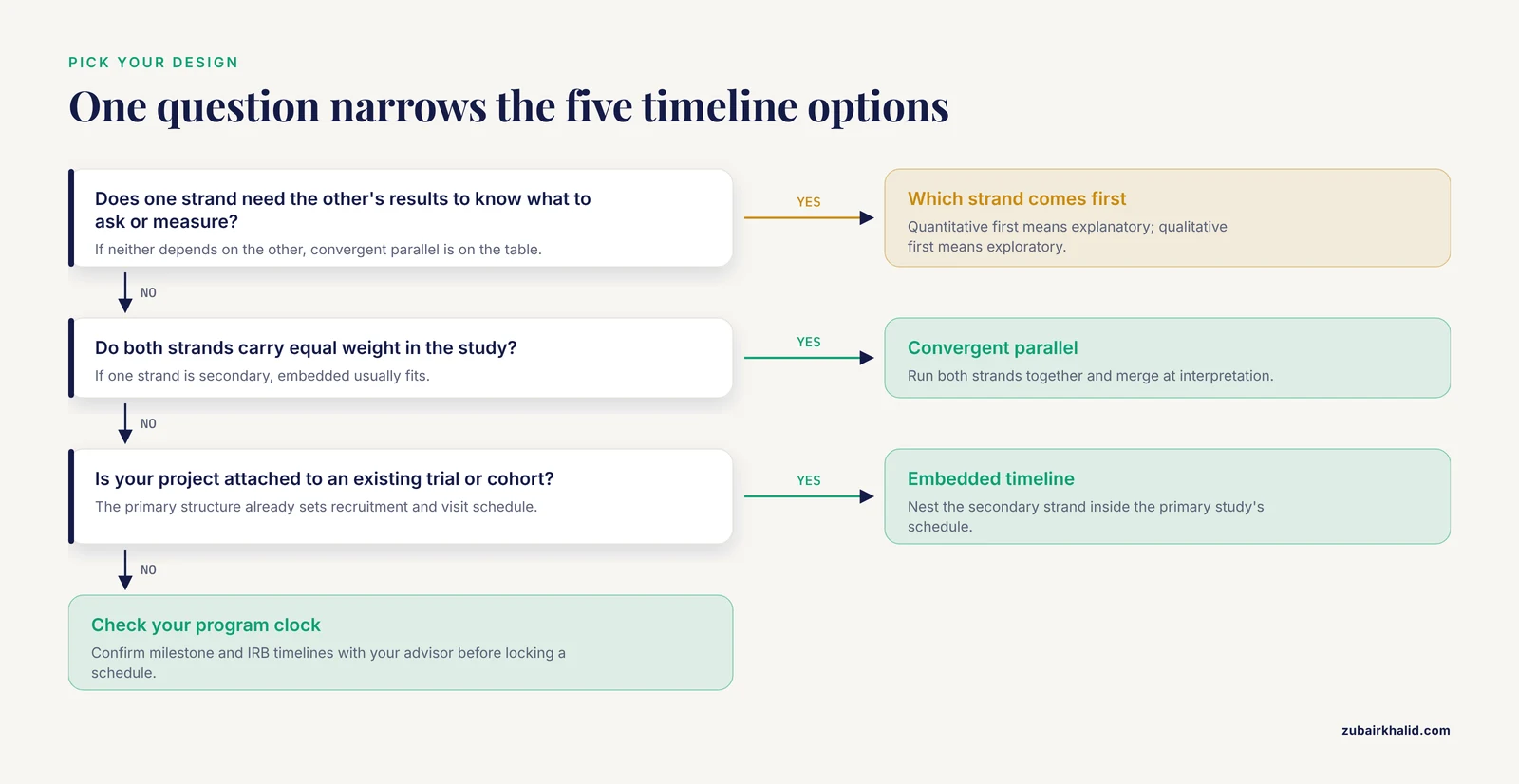
Work through these five questions in order. The first one eliminates most options immediately.
1. Do the strands depend on each other's results? If your qualitative phase needs quantitative findings to know what to ask, the design is sequential explanatory. If your survey needs qualitative work to know what to measure, it is sequential exploratory. If neither depends on the other, convergent parallel is on the table and usually wins on duration.
2. What is the purpose of the weaker strand? If both strands carry equal weight, convergent parallel fits. If one strand is secondary, embedded usually fits.
3. What does your program's clock look like? Dissertation planning has hard external deadlines: funding periods, program milestone reviews, advisor sabbaticals. A sequential design that pushes data collection into your final funded year is a risk regardless of its scientific merits.
4. Can you run two workstreams at once? Convergent parallel looks fast on paper and is fast only if you (or a small team) can genuinely pilot two instruments and analyze two data types concurrently. Solo students often underestimate this.
5. When exactly will integration happen, and who will read it? Every option ends in integration. Decide now whether you will merge at the results level (a joint display in your results chapter) or the discussion level, because that choice determines whether integration is an analytical phase with real calendar time or a writing task you can absorb into drafting.
Worked Scenarios
Scenario 1. You are evaluating whether a new tool works in a real health system. The staged rollout approach fits. The VectorCam study co-designed its package, piloted in two districts, then rolled out across four waves over a year while collecting qualitative and quantitative implementation outcomes continuously [4]. A dissertation version of this works only if the rollout is your partner organization's plan and you are measuring it.
Scenario 2. You want to understand physician or student perceptions of a recent change. An overlapping sequential exploratory timeline fits. The Norwegian EHR study moved from observation and interviews into survey collection with a one-month overlap, finishing qualitative analysis before quantitative analysis concluded [2]. A solo PhD student can copy this shape by starting interviews in the fall and opening the survey in the spring.
Scenario 3. You want to measure satisfaction and hear the reasons behind it, within one academic year. Convergent parallel fits. The Saudi medical education study ran surveys and focus groups in parallel, analyzed each separately, and merged findings, reaching a majority of the eligible cohort [1]. The tradeoff is that both instruments had to be ready before recruitment started.
Scenario 4. Your question involves change over time in a defined population. An embedded or longitudinal structure fits. The diabetes trial followed two groups across five scheduled visits, which fixed the measurement calendar in advance [3]. If you can attach such a structure to an existing cohort, the timeline is feasible. If you cannot, five visits per participant on a dissertation budget is a serious undertaking.
Tracking the Timeline Once It Starts
Choosing a timeline is one task. Holding it is another. Operational research offers a useful model: rather than tracking a single end date, track interval-based metrics with attribution, so you know which phase caused a delay. A proton therapy center's key performance indicator framework did exactly this, measuring intervals such as simulation-to-scheduling time and attributing them to specific workflow components (physician, dosimetry, physics), collected automatically and analyzed longitudinally [5]. A dissertation student can copy the principle with a simple spreadsheet: log the date each milestone completes, and log which phase owns any delay.
Measurement schedule also matters for what your data can show. In a multisite trial comparing accelerated versus standard transcranial magnetic stimulation protocols for depression, both schedules produced meaningful improvement, but the accelerated schedule showed a faster onset of measurable benefit [6]. The parallel for study design is direct: denser measurement points reveal change earlier, which lets you catch a slipping timeline sooner. A monthly progress check beats a semesterly one for the same reason.
Common Mistakes and Limitations
- Treating integration as free. Students schedule both strands and assume the combined write-up happens naturally. Integration is an analytical method with its own workload. Put it on the calendar.
- Choosing convergent parallel to save time, then running the strands serially anyway. If logistics force you to finish one collection before starting the other, you get a sequential timeline's duration without a sequential design's targeted second phase.
- Starting the second sequential strand before the first analysis is done. The entire value of a sequential design is that phase two is informed by phase one. Compressing that handoff destroys the design's logic.
- Piloting only one instrument. Both a survey and an interview guide need piloting. Unpiloted interview guides produce unfocused transcripts that take far longer to code.
- Ignoring recruitment as a timeline variable. The convergent study cited above obtained a 52 percent response rate [1]. Plan your collection window around a realistic response rate, not an optimistic one.
- Committing to a multiphase rollout without an institutional partner. Staged designs consume calendar time that no amount of personal effort recovers.
- Assuming every program counts time the same way. Coursework load, residency requirements, and committee review speeds vary widely between institutions. Confirm your program's milestone expectations with your advisor before locking a schedule, and get IRB timelines for both strands in writing at your institution.
Frequently Asked Questions
Which mixed methods dissertation timeline is fastest?
The convergent parallel timeline, because both strands collect data during the same period. Its speed holds only if you can genuinely run two collections and two analyses concurrently. If you end up working serially, a sequential design with a targeted second phase may serve you better for the same total duration.
How do I pick between sequential explanatory and sequential exploratory?
Ask what you already know. If your phenomenon is well measured and you need to explain the numbers, start quantitative (explanatory). If the phenomenon is poorly understood or you need to build an instrument, start qualitative (exploratory). Your existing literature base, not personal preference for numbers or interviews, should make this call.
Can I overlap my two strands to shorten the timeline?
Yes, and real studies do it. The EHR study cited earlier overlapped its qualitative and quantitative collection by about one month [2]. Overlap works when the second strand does not truly depend on the first's results. If it does depend, overlap only the preparatory work, such as recruitment setup, not the analysis handoff.
Do I need separate ethics approval for each strand?
Usually no. Most US institutions review a mixed methods protocol as one submission covering both instruments, but the timing matters. Submit once both instruments exist, or plan an amendment if the sequential design means your interview guide is finalized after the quantitative phase. Confirm your institution's exact procedure with your IRB office.
How many participants do I need for a mixed methods dissertation?
There is no single number. It depends on your quantitative power requirements and your qualitative saturation goals, and the two are planned separately. Published mixed methods studies span a wide range, from large survey arms like the 255-student study cited above [1] to the focused interview samples typical of implementation work [4]. Your committee and your methodology textbooks should drive the specific targets for your design.
What is the first step in dissertation planning for a mixed methods project?
Write down the dependency between your strands. One sentence stating whether your qualitative phase needs your quantitative results, or the reverse, or neither, determines your design family, and your design family determines your entire mixed methods dissertation timeline. Get that sentence approved by your advisor before you build a month-by-month schedule.
Sources
- Medical students' perceptions of the effectiveness of module study guides: a mixed-methods study in Saudi Arabia.
- Physicians' Perceptions of Information Quality and Access in a New Cross-Institutional Electronic Health Record (EHR) System: Mixed Methods Design.
- Multidimensional associations of HbA1c with behavioural, psychosocial, and economic factors across Educational Pharmaceutical Care Interventional Program (EPCIP) timeline: a prospective, longitudinal, RCT study.
- Integration of VectorCam, an AI-Enabled Mosquito Surveillance Tool, Into Uganda's National Malaria Elimination Program: Protocol for a Mixed Methods Hybrid Type III Implementation Study.
- An operational key performance indicator framework and reference data from a multi-room pencil beam scanning proton therapy center.
- Effects of H-coil TMS on suicidality in major depression: A secondary analysis of data from a multisite randomized trial comparing accelerated to once-a-day stimulation.