The Risk of Misinterpreting Vague Reviewer Comments
By Dr. Zubair Khalid, DVM, MS, PhD ·

The most common cause of misinterpreting reviewer comments is simple. Most reviewers write their comments as private reading notes, composed while moving through the manuscript, and they compress their underlying concern into a few words that make sense only inside their own head [1]. A comment like "the statistics are weak" or "this section needs work" is not a complete instruction. It is the tip of an unstated objection.
The first thing to check is also simple. Before changing anything in your manuscript, copy the comment verbatim into a separate document and read it next to the exact passage it targets. Conn, writing in the Western Journal of Nursing Research, identifies this verbatim copy as the single step that prevents early misinterpretation, because paraphrasing a comment in your own words locks in your first guess before you have examined alternatives. Everything else in this article builds on that habit.
This article explains why reviewer comments become vague, what misreading them actually costs you in time and publication outcomes, how to diagnose a confusing comment, and how to write a reviewer response letter that survives a second round of review.
Why Reviewer Comments Turn Vague
Peer review comments vary widely in specificity and clarity, and that variation is structural, not personal [1]. Several forces produce vague comments, and knowing the cause behind each one tells you how likely your interpretation is to be wrong.
Reviewers write as they read. Many peer reviewers record their reactions as they move through a paper, section by section, rather than composing a single organized critique at the end [1]. This produces comments that lack context. A remark such as "unclear" attached to page 7 may refer to a sentence, a figure legend, or a logical gap that begins on page 4. The reviewer knew which one they meant. You do not.
The comment is aimed at two audiences at once. Reviewers often write remarks that are partly intended for the editor. A line like "I am not convinced the authors have ruled out confounding" is simultaneously a request to the authors and a signal to the editor about the manuscript's fitness. When you read it as only an author, you may miss the severity the reviewer intended.
Anonymity removes the clarification channel. Most reviews arrive unsigned. At the journal Functional Ecology, where reviewer identities are confidential unless a reviewer chooses to sign, only 5.6 percent of reviewers signed their comments, and that proportion rose only slightly over more than a decade of records [2]. An anonymous reviewer cannot be emailed, and a comment you misunderstand cannot be resolved by a quick reply. The only channel left runs through the editor, which adds delay.
Expertise mismatch compresses language. A statistician reviewing a field study, or a clinician reviewing a molecular paper, may flag a problem using shorthand from their own field. The comment "the model is misspecified" is precise to a statistician and opaque to many biologists. The vagueness is an artifact of the vocabulary gap, not of the underlying point.
Time pressure produces telegraphic prose. Reviewers are unpaid volunteers working under deadlines. Telegraphic fragments, rhetorical questions, and single-word verdicts ("weak", "redundant", "speculative") are the natural output of that constraint. A rhetorical question such as "why not use the mutant line here?" is usually a recommendation, but authors routinely read it as idle speculation and ignore it.
Written communication invites expectation-driven reading. Research on written ironic comments shows that a reader's prior expectations shape how a comment is decoded, and that misinterpretations arising this way damage the interaction between the parties. The peer review analogue is direct. If you expect the reviewer to be hostile, you read "the authors should consider" as an attack. If you expect agreement, you read a serious methodological objection as a stylistic nitpick. Your expectation, not the text, often determines your reading.
What Misinterpretation Actually Costs You
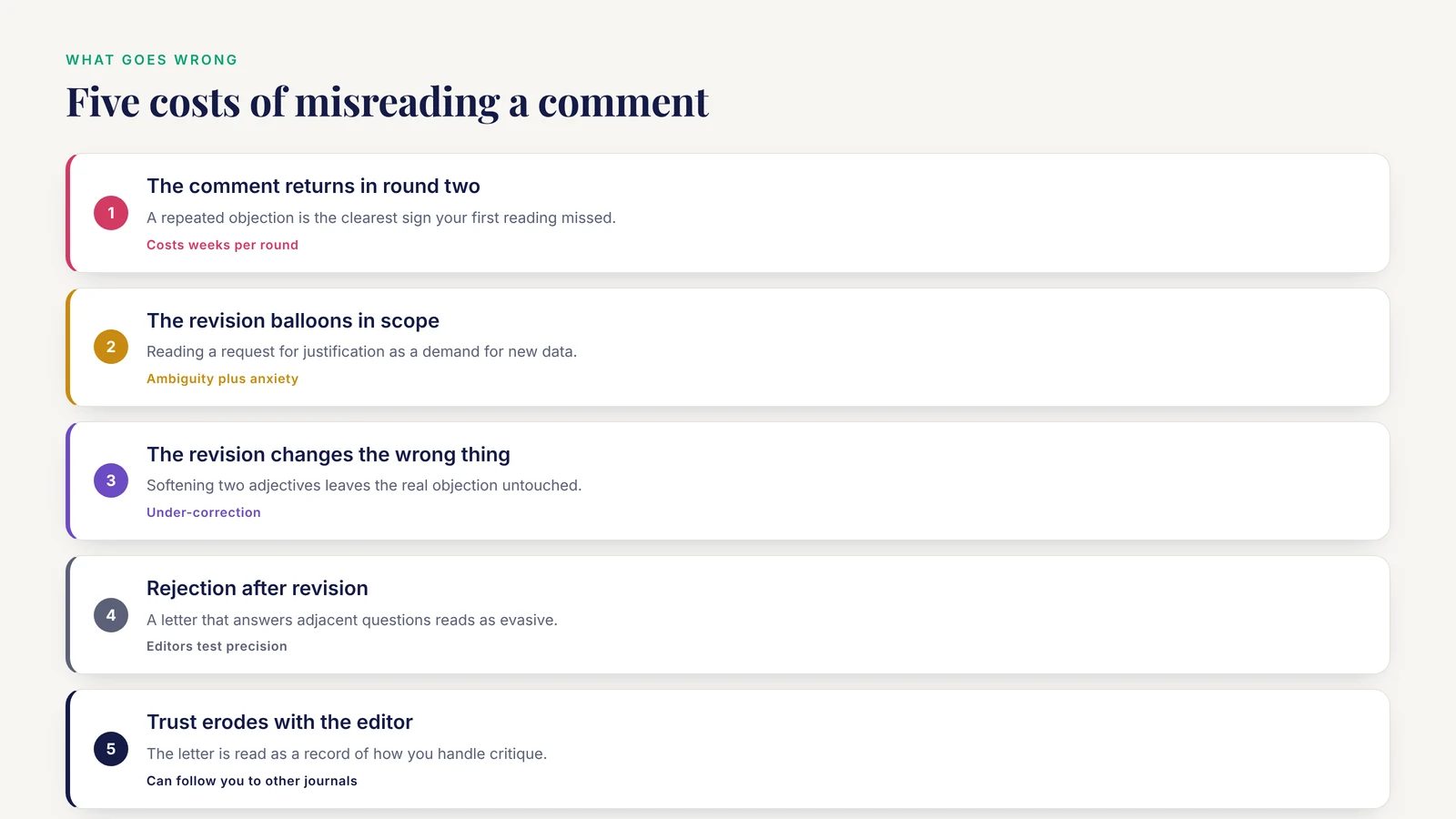
The consequences of misreading a vague comment fall into predictable categories, each with a distinct mechanism.
The comment resurfaces in round two. If you answered what you thought the reviewer asked rather than what they asked, the reviewer will repeat the point, often with sharper wording. A repeated comment in a second review is the clearest external signal that your first interpretation missed. Each such round costs weeks, because the manuscript goes back through the reviewer's queue and the editor's schedule.
The revision balloons in scope. Reading "I am unsure the sample is adequate" as a demand for a full new replicate series, when the reviewer meant a power justification in the text, is a classic over-correction. Authors who guess at the most demanding possible reading sometimes perform analyses or collect data no one requested, and the editor then sees a revision that changed for unstated reasons. Ambiguity plus anxiety produces scope creep.
The revision changes the wrong thing. The inverse error is under-correction. If "the discussion overreaches" means the reviewer doubts your causal claim, and you respond by softening two adjectives, the underlying objection survives untouched. The reviewer reads your new paragraph, finds the same overclaim in different words, and downgrades their recommendation.
Rejection after revision. Editors use the revision round to test whether the authors can respond precisely. A response letter that answers adjacent questions, or a manuscript whose changes do not map onto the comments, reads as evasive even when the authors worked hard in good faith. Manuscripts that had at least one signed, positively rated review were more likely to be invited for revision at Functional Ecology, which tells you that the initial revision invitation itself is a favorable signal worth protecting with careful interpretation rather than squandering on guesswork [2].
New analyses introduce new errors. When authors guess at a statistical complaint and add an unrequested analysis under time pressure, that analysis enters the manuscript without the deliberate design a planned analysis would receive. Reviewers in the next round may then question the addition, creating a cascade.
Trust erodes with the editor. The editor reads your response letter as a record of how you handle critique. A letter that misreads comments, or politely answers points no one made, signals poor communication. That impression can matter at the current journal and at others where the same editor later handles your work.
Troubleshooting Table: Symptoms, Causes, and Fixes
Use this table to match what is happening to the most likely failure mechanism, then apply the fix before you write a single revised paragraph.
| Symptom | Likely cause | How to confirm | Fix |
|---|---|---|---|
| A reviewer repeats the same objection in round two, slightly reworded | Your first response answered a different question | Place the round-one comment, your response, and the round-two comment side by side and compare the object of each | Re-read the original comment against the exact manuscript passage, list the plausible readings, and address the broadest defensible one in round two |
| Your revision changed sections the reviewer never mentioned | You paraphrased the comment from memory instead of copying it | Check whether your revision file contains the verbatim comment text [1] | Rebuild the comment list verbatim, then map each revision to a specific comment by number |
| The revision is far larger than the comments seemed to require | You adopted the most demanding interpretation of an ambiguous comment | Ask a colleague who did not attend your lab meetings to read the comment cold and state what they think it requests [1] | Draft a response that names your interpretation explicitly, so the reviewer can correct it cheaply if you guessed wrong |
| The response letter answers points no reviewer raised | Comments were merged, reordered, or partially absorbed into your own thoughts | Compare the letter line by line against the verbatim comment list | Rewrite the letter in point-by-point form, quoting each comment before answering it, as published response documents routinely do [3], [4] |
| Two reviewers appear to contradict each other | The comments target different levels, for example one criticizes the data, the other the interpretation | Classify each comment by theme and by manuscript location rather than by reviewer [1] | Answer both in the letter, and state plainly where a genuine conflict exists so the editor can arbitrate |
| A comment consists of a single word, for example "unclear" or "weak" | The reviewer wrote while reading and compressed a located objection [1] | Identify the nearest sentence, figure, or paragraph and audit it for the specific flaw implied | Fix the localized defect and state in the letter exactly what you changed and where |
| You feel certain a comment is wrong or unfair | The comment is outside your reading of the evidence, or the reviewer lacks context | Search the literature the reviewer's claim implies and check whether a real ambiguity exists | Respond with evidence rather than rebuttal, and cite the specific data or references that resolve the point [5] |
| The editor's decision letter flags comments you believe you addressed | Your change was real but invisible, for example a new analysis absent from the manuscript text | Search the revised manuscript for the section where each response claims a change | Add explicit sentences to the manuscript itself, with the location cited in the response letter |
A Diagnostic Sequence for Any Unclear Comment
When a specific comment resists interpretation, work through this sequence in order. Each step narrows the space of plausible readings before you commit effort to the wrong one.
- Copy the comment verbatim. Do not summarize, and do not merge it with neighboring comments. Verbatim copying is the documented first defense against early misinterpretation.
- Locate the anchor. Find the manuscript passage, figure, or table the comment most plausibly targets. Reviewers who write as they read usually anchor a comment to a location [1].
- Write down at least two or three possible interpretations. Conn recommends generating multiple interpretations in writing, because the act of recording them retains ideas, stimulates additional readings, and supports revision planning. An interpretation that exists only in your head cannot be tested against the evidence.
- Classify the comment by theme. Group comments into themes such as methods, statistics, framing, clarity, and references. Reviewers often scatter related remarks across the review, so thematic grouping reconstructs the underlying critique that the fragmentary comments express [1].
- Check whether the editor's letter adds context. Editors sometimes restate or elevate a reviewer's point. The decision letter frequently reveals which comments the editor considers decisive.
- Ask an uninvolved colleague to read the comment cold. Conn explicitly recommends obtaining assistance from co-authors and colleagues for difficult comments. Someone without your expectations will often produce a reading you never considered.
- Search for what would satisfy the objection. Ask what evidence, analysis, sentence, or clarification would make the comment disappear. If you cannot name a satisfying action, you have not yet understood the comment.
- If the comment remains ambiguous after all of this, ask the editor. Phrase the question neutrally. Write "Reviewer 2 asks for additional validation. Could the authors clarify whether the intent is a second animal cohort or an orthogonal biochemical assay?" rather than "we do not understand the comment." Editors relay such questions routinely, and a precise question demonstrates engagement rather than incompetence.
A confidentiality note applies at step 6 and anywhere else you seek help. Peer reviewers are anonymous unless they sign their comments, which few do [2], and a manuscript under review is unpublished. Share the comments and revision plans only with co-authors and advisors who have a legitimate role, and never attempt to identify or contact an anonymous reviewer through the editor or otherwise.
Solutions: How to Fix Misinterpretation Before It Happens
The fixes for misinterpreting reviewer comments are organizational, not heroic. They work because they separate the reading of the comment from the revision of the manuscript.
Start early, and build a revision file
Conn's central recommendation is to begin manuscript revisions long before the resubmission deadline, because ample time is essential for understanding confusing comments, thinking, and additional reading. The practical tool is a manuscript revision file, opened the day the decision letter arrives. Every comment goes into that file verbatim, arranged by theme. The file becomes the single source of truth that the response letter and the revised manuscript both reference, which is what prevents the drift between what was asked and what was answered.
Write out competing interpretations
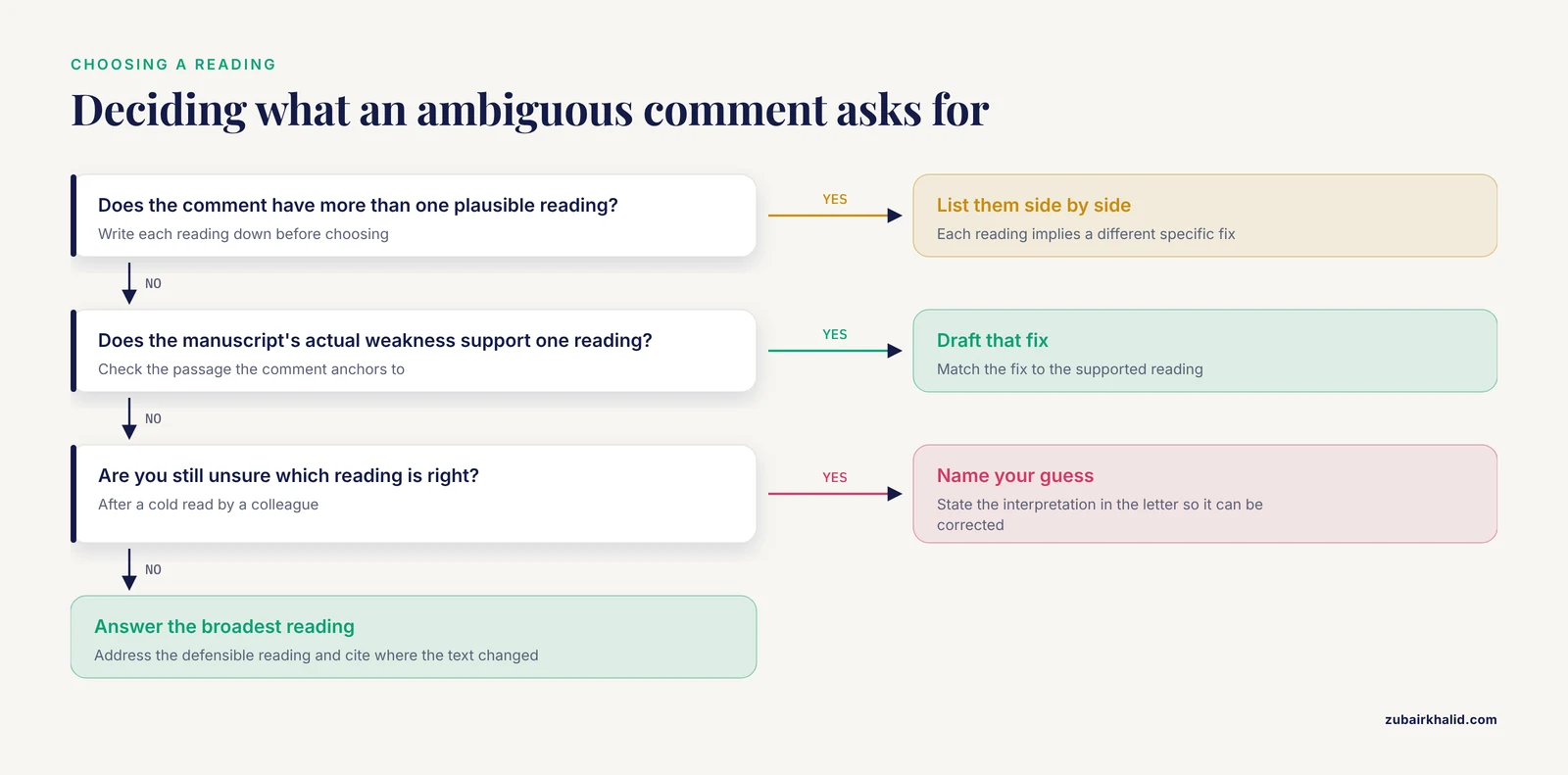
For any comment with more than one plausible reading, write the readings down side by side. This written process, as Conn describes it, often yields a reasonable explanation for an obscure comment that seemed hopeless at first glance. A worked example shows the method. Suppose a reviewer writes "the Western blot quantification is not convincing." Three written interpretations might be that the normalization control was inappropriate, that the quantification lacks replicate-level statistics, or that the figure lacks the original uncropped blots. Each interpretation implies a different, specific fix, and drafting the fixes next to the interpretations usually reveals which reading the manuscript's actual weakness supports.
Treat every comment as actionable until proven otherwise
Reviewers sometimes make comments that seem like observations rather than requests. The safe default is to treat each one as a request for a change, a justification, or an explicit acknowledgment in the response letter. Actual published reviewer reports show the pattern. A structured report on a rat genetics manuscript separated major comments, such as the absence of linkage data and the lack of biochemical evidence that a missense mutation alters gene product function, from minor comments such as an inappropriate quantitative PCR control. Every one of those statements implied a concrete action. Reading the report as a list of implied actions, rather than as commentary, converts vagueness into a work plan.
Answer ambiguous comments explicitly in the response letter
When you must choose an interpretation, name it. Write "We interpreted this comment as a request for replicate-level statistics on the densitometry, and we have added them in Figure 3B. If the reviewer intended a different control, we would be glad to address it." This costs one sentence and converts a silent guess into a correctable one. Reviewers who see their comment restated accurately can confirm or redirect in a single line.
How to Respond to Peer Reviewers
The reviewer response letter is where interpretation becomes visible, and it is also where misinterpretation becomes permanently documented. The structure of a strong response letter is well established in published examples across fields.
Use a point-by-point format
Published author responses consistently quote each reviewer comment verbatim, then respond directly beneath it, then state where the manuscript changed. Examples across disciplines follow this pattern, including a point-by-point response in an atmospheric measurement study [6], a structured response to two named reviewers in a structural geology paper [7], and a numbered response to major and minor revisions in a health economics manuscript [4]. The format is not decorative. Quoting the comment verbatim in the letter performs the same function as copying it into the revision file. It proves to the reviewer that you read the actual words, and it prevents the accidental answers-to-unasked-questions that arise when authors respond from memory.
State the change and its location
Each response should say what you did and where. A response that says "we have added a paragraph to the Discussion, page 12, lines 4 to 9" lets the reviewer verify the change in seconds. A response that says "we have improved the discussion" requires the reviewer to hunt, and reviewers who hunt tend to conclude that nothing changed.
Respond to tone with evidence
Some comments arrive blunt. Reviewers vary in how much they reveal their identity, and unsigned reviews tend to be the critical ones, since reviewers who sign are more likely to rate a manuscript positively [2]. When a harsh comment lands, separate the tone from the content and answer only the content. A published response to reviewer comments on a theoretical paper about rule-governed behavior in children with ADHD modeled this approach, treating the reviewer's theoretical objections as questions to be answered with argument rather than grievances to be deflected [8]. Evidence, cited data, and specific textual changes are the only replies that survive a second review.
Aggregate and acknowledge
When several scattered comments express one underlying concern, say so. "Comments 1, 4, and 9 all concern the independence of the two cohorts. We address them together here" demonstrates that you reconstructed the reviewer's critique, which is the strongest possible signal that you understood it.
Common Mistakes and Limitations
These are the errors authors make most often, stated plainly so they can be checked against your own process.
Paraphrasing comments from memory. Memory smooths ambiguity. A comment you recall as "add replicates" may actually have read "clarify whether replicates were independent or technical." The verbatim copy is the cure.
Reading a single-word comment as global. "Unclear" aimed at one figure legend is a local fix. Treating it as a verdict on the whole paper produces unfocused rewriting that can damage clear sections.
Ignoring rhetorical questions. Questions such as "would a dose-response strengthen this?" are recommendations wearing question marks. Ignoring them guarantees their return in round two.
Assuming the harshest interpretation. Anxiety drives authors to read every comment as existential. Over-correction wastes weeks and introduces unvetted analyses. Multiple written interpretations, evaluated on their merits, prevent this.
Assuming the reviewer is careless or hostile. The more productive assumption is that the reviewer experienced genuine friction while reading. Friction while reading is itself the finding. A reviewer who found a passage confusing was confused, and the revision must remove the confusion regardless of how the comment was worded.
Answering in the letter but not in the manuscript. Editors read the manuscript, and round-two reviewers read the manuscript. A response letter can be flawless while the revised text remains unchanged, and reviewers notice.
Expecting comment quality to reflect reviewer care. Vague comments come from busy, competent people as often as from careless ones [1]. Calibrating your reading effort to the comment's importance rather than its polish is the practical stance.
A final limitation belongs here. Individual manuscripts, journals, and reviewer relationships differ, and no general procedure substitutes for judgment about your specific decision letter and field. When a comment raises a question you cannot resolve with the literature and your co-authors, the editor is the correct person to ask.
Prevention Practices
Prevention of misinterpretation is mostly a matter of fixed habits applied at the moment the decision letter arrives.
Open the revision file the same day. Speed matters less than sequence. Copy every comment verbatim before any discussion of the review begins, so that no paraphrase precedes the source text.
Budget real time for interpretation. Conn's advice to start early exists precisely because understanding confusing comments, thinking, and additional reading all consume time that a deadline-driven revision cannot spare. Treat the first several days as an interpretation phase, not a writing phase.
Assign one person as comment keeper. In multi-author groups, uncoordinated paraphrasing is how verbatim comments decay into folklore. One person maintains the file, and all interpretation is recorded there.
Write the response letter against the file, not the manuscript. Draft each response immediately after re-reading the quoted comment, in point-by-point form, mirroring the format used in published author responses across disciplines [3], [4], [6].
Close every loop. Before submission, audit that every verbatim comment has a response, every response names a manuscript location, and every named location contains the promised change. This three-point check catches nearly every drift between comment, response, and text.
Learn from round two. Any comment a reviewer repeats is a recorded misinterpretation. Reviewing your own round-one responses against round-two comments after acceptance builds the interpretive skill that no guideline can fully supply.
Frequently Asked Questions
What are the consequences of misinterpreting reviewer comments?
The main consequences are repeated review rounds, unnecessary experiments, revisions that change the wrong things, rejection after revision, and erosion of editor confidence. A reviewer who sees the same objection resurface will often harden their position, and an editor who sees responses that miss the comments may question the authors' judgment on the science itself.
Why are peer reviewer comments so vague?
Reviewers typically write comments as they move through the manuscript, which strips context, and they compress their underlying concern into shorthand aimed at readers who share their expertise [1]. Unpaid volunteer work under deadline pressure and unsigned reviews that block direct clarification complete the picture [2].
How do I respond to peer reviewers when I do not understand a comment?
Copy the comment verbatim, write down several plausible interpretations, and pick the reading best supported by the manuscript's actual weaknesses. Then state your interpretation explicitly in the response letter so the reviewer can correct it cheaply if you guessed wrong.
Can I ask the editor to clarify a reviewer comment?
Yes. Editors relay author questions to anonymous reviewers routinely. Ask a neutral, specific question that shows you have already generated interpretations, for example by naming the two readings you are deciding between, rather than asking what the reviewer meant.
What should a reviewer response letter include?
It should quote each comment verbatim, answer it directly beneath the quote, state exactly what changed and where in the manuscript, and remain civil even toward harsh comments. Point-by-point structure is the norm across published author responses in every discipline examined [4], [6].
Should I do every experiment a reviewer suggests?
No. Evaluate each suggestion on its scientific merit and feasibility, and for requests you decline, provide a reasoned justification with evidence in the response letter. What you should never do is silently ignore a suggestion, because silence reads as evasion even when your reason is sound.
When should I start working on revisions after receiving comments?
Start the interpretation phase immediately, well before the resubmission deadline. Conn's guidance is explicit that ample time is needed to understand confusing comments, think, read further, and consult co-authors and colleagues, all of which a compressed schedule forecloses.
What if two reviewers give contradictory advice?
Classify both sets of comments by theme and manuscript location, then determine whether they contradict or merely target different levels, such as data versus interpretation. If the conflict is genuine, explain both positions in the response letter, state your resolution and its justification, and ask the editor to arbitrate if the reviewers remain opposed.
Sources
- Strategies to Manage Unclear Peer Reviewer Comments
- Which peer reviewers voluntarily reveal their identity to authors? Insights into the consequences of open-identities peer review
- Point-by-point Response to Reviewer's Comments Reviewer #1 (remarks to the Author)
- RESPONSE TO REVIEWER ’ S COMMENTS Reviewer ' s report ( Reviewer 2-Ed Wilson ) Major compulsory revisions
- Reviewer's Report
- Number : amt-2010-201 Response to the comments of Reviewer # 2
- Response to comments from Reviewer 1 (Gregory Ballas) and Reviewer 2 (Julien Bailleul) on “Distribution, microphysical properties, and tectonic control of deformation bands in the Miocene accretionary prism (Whakataki Formation) of the Hikurangi subduction zone”
- A Response to Reviewer Comments Regarding the Manuscript, "Rule-Governed Behavior and Self-Control in Children with ADHD: A Theoretical Interpretation"