Lab Report Example for a Microbiology Unknown Project
By Dr. Zubair Khalid, DVM, MS, PhD ·
By the end of this article you will be able to write a complete microbiology unknown lab report: you will know the standard lab report format, see a fully worked microbiology unknown lab report example for a single bacterial isolate, and have a fill-in template you can adapt to your own course. Before you start writing, have three things on hand: your lab notebook with dated observations, your instructor's rubric or assignment sheet, and a reference source for bacterial identification such as Bergey's Manual or your course textbook.
What a Microbiology Unknown Project Asks You to Do
The unknown project is the classic capstone exercise in an introductory microbiology course. You receive a pure or mixed culture coded with a number instead of a name. Your job is to run a logical sequence of tests, record every observation, and identify the organism to genus and species, then defend that identification in writing.
The project tests three skills at once.
- Technique. Aseptic transfers, staining, inoculation of differential and selective media, and reading tests correctly.
- Logic. Choosing each next test based on the previous result, which you document as a dichotomous key or flowchart.
- Scientific writing. Presenting methods, results, and reasoning in the standard lab report format so a reader could repeat your work and judge your conclusion.
The written report is where most points are won or lost. Students who identify the organism correctly but write a disorganized report lose far more credit than students who make a defensible identification error but document their reasoning cleanly.
The Lab Report Format That Works for an Unknown Project
Standard sections carry the weight in this format, and the reason is practical rather than cosmetic. Pathologists at the College of American Pathologists built a standardized heading system for autopsy reports specifically so that third parties could review reports efficiently and electronic systems could search them, and they found that defined categories of information plus fixed heading wording were what made that possible [1]. A microbiology unknown report follows the same logic. Your instructor is the third party reviewing your work, and fixed section headings make their review fast and fair.
The section sequence for a microbiology unknown lab report is:
- Title page
- Abstract (sometimes optional, check your rubric)
- Introduction
- Materials and Methods
- Results
- Discussion
- Conclusion
- References
Two structural rules apply across all sections. Write the body of the report in past tense and passive voice where your course requests it (many instructors now accept first person, so confirm with the rubric), and never place results or interpretations in the Materials and Methods section. Methods describe what you did. Results describe what you saw. Discussion explains what it means. Mixing these is the single most common structural error.
Microbiology Unknown Lab Report Example, Section by Section
The following microbiology unknown lab report example format shows each section filled in for a realistic case. The organism, Unknown #17, was identified as Escherichia coli. Replace the bracketed placeholders and the specific data with your own.
Title Page
Identification of Unknown Bacterium #17

Your Name
Course: BIOL 230L, Section 002
Instructor: Dr. R. Alvarez
Date Performed: September 9 - October 3, 2026
Date Submitted: October 8, 2026
The title states what you did, not the organism's name alone. "Identification of Unknown Bacterium #17" is standard. Keep the date range because it shows the work spanned multiple lab sessions.
Abstract
ABSTRACT

An unknown bacterium labeled #17 was characterized through a
series of morphological, cultural, and biochemical tests. The
isolate was Gram-negative, rod-shaped, and facultatively
anaerobic. Positive results were obtained for catalase, indole,
methyl red, and motility. Negative results were obtained for
oxidase, Voges-Proskauer, citrate utilization, and urease.
Growth on MacConkey agar produced pink, lactose-fermenting
colonies. These characteristics identified the unknown as
Escherichia coli with a high degree of confidence.
Write the abstract last, in under 150 words, and include the four essentials: what you did, the key results, the identification, and your confidence level. Do not cite references in the abstract.
Introduction
INTRODUCTION

The purpose of this exercise was to identify an unknown
bacterium, designated #17, using standard microbiological
techniques. Identification relied on a stepwise algorithm that
began with a Gram stain and proceeded through selective and
differential media and a panel of biochemical tests. The
differential tests used in this project exploit the metabolic
diversity of bacteria: an organism's ability to ferment specific
carbohydrates, hydrolyze tryptophan, or produce particular
end products generates observable changes such as pH indicators
shifting color or gas displacing medium in a Durham tube.
Keep the introduction short, roughly one paragraph to half a page. State the purpose, name the general strategy (a dichotomous key driven by test results), and briefly define any framework your reader needs. Save organism-specific background for the discussion, where you can justify the final identification.
Materials and Methods
Record methods so a peer could repeat them. Note the culture number, media, incubation conditions, and reagents, and cite the lab manual for procedures you did not modify.
MATERIALS AND METHODS

The unknown culture (#17) was supplied in broth by the course
instructor. All procedures followed the BIOL 230L laboratory
manual unless noted. Tryptic soy broth and tryptic soy agar
were used for maintenance. The isolate was streaked for
isolation on tryptic soy agar and incubated at 37 C for 24
hours. A Gram stain was performed using crystal violet,
Gram's iodine, 95% ethanol decolorizer, and safranin.
Catalase activity was tested with 3% hydrogen peroxide.
Oxidase was tested with oxidase reagent on a filter strip.
The isolate was inoculated into tryptone broth (indole),
glucose phosphate broth (methyl red and Voges-Proskauer),
Simmons citrate agar, urea broth, and motility agar.
MacConkey agar was used as a selective and differential
medium. All tubes and plates were incubated at 37 C and read
at 24 and 48 hours. Indole was detected by adding Kovac's
reagent after 48 hours of incubation.
Three details instructors check here: incubation temperature, incubation duration, and the exact reagent names. "Incubated overnight" is too vague. Write "incubated at 37 C for 24 hours."
Results
Present observations only, with no interpretation. Use a table for the test panel and a short narrative for morphology.
RESULTS

The Gram stain showed pink, rod-shaped cells arranged singly
and in pairs (Gram-negative bacilli, Fig. 1). Growth on
MacConkey agar produced dry pink colonies, indicating lactose
fermentation. Table 1 summarizes the biochemical test panel.

Table 1. Biochemical test results for Unknown #17.

| Test          | Result | Observation                        |
|---------------|--------|------------------------------------|
| Catalase      | +      | Rapid bubbling with 3% H2O2        |
| Oxidase       | -      | No color change on reagent strip   |
| Indole        | +      | Red ring after Kovac's reagent     |
| Methyl red    | +      | Red color after MR reagent         |
| Voges-Proskauer | -    | No color change after reagents A/B |
| Citrate       | -      | Slant remained green, no growth    |
| Urease        | -      | Broth remained yellow              |
| Motility      | +      | Growth radiated from stab line     |
| H2S (TSI)     | -      | No black precipitate               |
| Gas (glucose) | +      | Bubble in Durham tube              |
Label every figure and table with a number and caption. Report the observation ("red ring after Kovac's reagent"), not the conclusion ("indole positive, therefore E. coli") in this section. The plus/minus column is for the reader's convenience, the observation column is your actual evidence.
Discussion
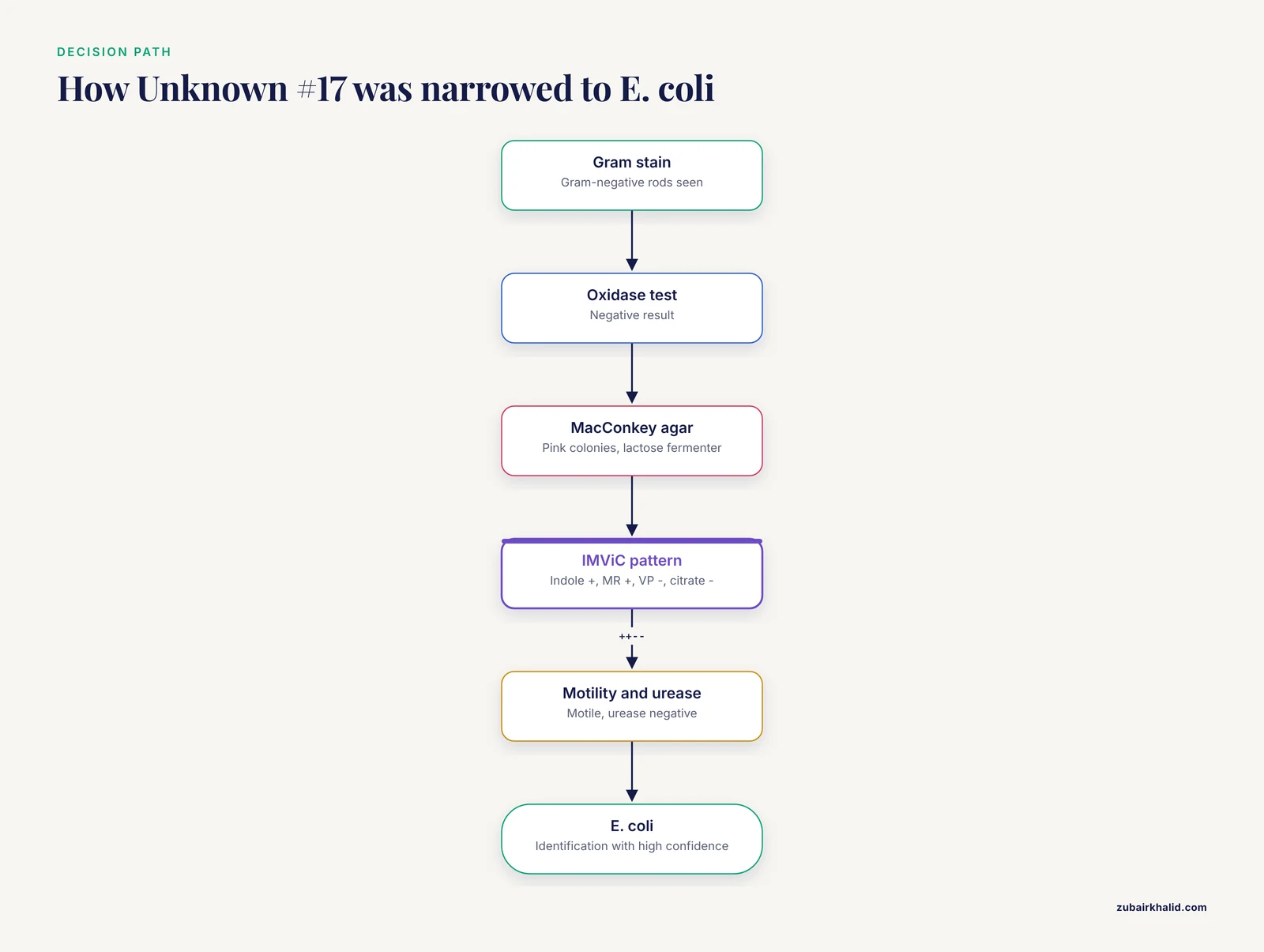
This is the section that earns the most credit and loses the most points. Reconstruct your decision path, present it as a numbered dichotomous key, and justify each branch with your data.
DISCUSSION

The identification of Unknown #17 as Escherichia coli was
reached by the following key:

1. Gram stain: Gram-negative rods
   -> Gram-positive organisms such as Staphylococcus and
      Bacillus were eliminated.
2. Oxidase: negative
   -> Oxidase-positive genera such as Pseudomonas and
      Neisseria were eliminated.
3. Growth on MacConkey agar with pink colonies:
   lactose fermenter
   -> Non-lactose fermenters such as Salmonella and
      Shigella were eliminated.
4. Indole positive, methyl red positive, Voges-Proskauer
   negative, citrate negative:
   -> This IMViC pattern (++--) is characteristic of
      E. coli and distinguishes it from Enterobacter
      aerogenes (--++) and Klebsiella pneumoniae (--++).
5. Motility positive and urease negative
   -> Consistent with E. coli and inconsistent with the
      non-motile, urease-positive Klebsiella.

The IMViC result was the decisive branch. The observed
pattern (indole +, methyl red +, VP -, citrate -) matches the
published pattern for E. coli. Possible sources of error
include a light inoculum in the citrate slant, which can
produce a false negative, and an over-decolorized Gram stain,
which could misclassify a Gram-positive organism. The
consistent rod morphology, lactose fermentation, and full
IMViC pattern make these errors unlikely in this case.
Name the organisms you ruled out at each step. An identification is only as convincing as the alternatives you eliminated. State your confidence honestly and name one or two plausible error sources with the direction of the error they would cause.
Conclusion
CONCLUSION

Unknown bacterium #17 was identified as Escherichia coli on
the basis of Gram stain morphology, lactose fermentation on
MacConkey agar, and a positive indole and methyl red reaction
with negative Voges-Proskauer and citrate results. The
identification was reached with high confidence.
Two to four sentences. Restate the identification and the strongest evidence. Add nothing new.
Why a Template Improves the Finished Report
The worked example above is a template in action. Materials science research describes a template as a structure that imposes defined form on whatever develops around it, and the same principle transfers directly to writing. When you draft into a fixed scaffold of headings, the surrounding prose takes on consistent shape. The practical benefit for students is that the scaffold forces every required element to exist before you polish anything. Fill every heading in the example with at least one accurate sentence, even if rough, before revising any single section.
A template also fixes the heading vocabulary across the whole report. If your Results heading says "Biochemical Test Results," keep that exact phrase in the table title, the abstract sentence, and the discussion. Consistent headings are the reason standardized reporting systems exist in professional laboratory medicine, and the payoff is the same at student scale [1].
Quick Reference Table for the Biochemical Test Panel
The tests below are the standard panel in most introductory courses. Confirm the exact media your lab stocks, because formulations vary by manufacturer.
| Test | What it detects | Positive appearance | Common misread |
|---|---|---|---|
| Gram stain | Cell wall structure | Gram-negative = pink, Gram-positive = purple | Over-decolorizing turns Gram-positive cells pink |
| Catalase | Catalase enzyme | Bubbling with 3% hydrogen peroxide | Using old reagent gives weak or no bubbles |
| Oxidase | Cytochrome c oxidase | Purple color on reagent strip within seconds | Reading after the 30-second window gives false positive |
| Indole | Tryptophan hydrolysis | Red ring with Kovac's reagent | Shaking the tube mixes the ring into the broth |
| Methyl red | Mixed acid fermentation | Red after MR reagent | Orange is not red, orange is a negative or borderline read |
| Voges-Proskauer | Acetoin production | Red after reagents A and B | Reading before the full development time gives false negative |
| Citrate | Citrate utilization | Blue slant with growth | A slant that stays green means negative even with slight growth |
| Urease | Urea hydrolysis | Pink or magenta broth | Weak pink after 48 hours can be a slow positive, note the time |
| Motility agar | Flagellar motility | Growth radiating from the stab | Growth only along the stab line means non-motile |
| MacConkey agar | Lactose fermentation plus bile tolerance | Pink colonies = lactose fermenter | Pale colonies on MAC are non-fermenters, not contaminants |
Two reading rules prevent most errors. First, read tests at the time specified, because indole, oxidase, and VP results change with time and an early or late read flips the result. Second, always confirm a pH indicator result against the uninoculated control tube or plate color from your lab session, not against memory.
How to Verify Your Report Before Submission
Work through this checklist in order. Each step catches a specific class of grading error.
Match every claim to a recorded observation. Read your discussion sentence by sentence. For every phrase such as "indole positive," confirm the corresponding entry exists in your results table. This catches the most heavily penalized error, a conclusion with no supporting data in the report. Check the key against the table. Every branch point in your dichotomous key must reference a test that appears in your results. A key branch citing a test you never performed or never recorded is an automatic deduction in most rubrics. Confirm tense and voice consistency. Methods and results in past tense, introduction and discussion per your instructor's stated preference. Search your draft for "is" and "are" in the methods section, which usually signals a tense slip. Verify numbers and conditions. Temperatures in degrees Celsius, incubation times in hours, reagent concentrations exactly as printed on the bottle. "37 C for 24 hours" appears in the methods of the example above, and that level of precision is the target. Check that no interpretation leaks into Results. Words like "therefore," "indicates," and "suggests" belong in the discussion. Remove them from the results section. Read the abstract last. Confirm it states the final identification and matches the discussion conclusion word for word on the organism name.
As a final sanity check, hand your results table to a classmate and ask which organism they would conclude. If their answer differs from yours, your discussion is not walking the reader through the logic clearly enough.
Common Mistakes and Limitations
The following errors account for the majority of lost credit on unknown projects. Each has a specific fix.
Writing the report in the wrong order. Students who write the abstract first tend to lock in conclusions before the data is organized. Write Methods and Results first, Discussion second, Introduction third, Abstract last.
Stating the identification without eliminating alternatives. A discussion that says "the tests matched E. coli" earns little. The example discussion above earns credit because it names the ruled-out genera at each branch. Always show the key.
Copying test descriptions from the lab manual into Methods. Paraphrasing "the oxidase test detects cytochrome c oxidase" at length is padding. One sentence per test with reagent and condition is enough.
Recording results from memory hours after lab. Biochemical test colors change with time. A urea tube read at 24 hours and recorded from memory at 48 hours may be wrong in either direction. Photograph or record results in the notebook at the time of reading, with the clock time.
Treating a single anomalous result as disposable. If one test contradicts your identification, the correct response is to repeat that test with a fresh subculture and document both runs. Instructors reward the repeat and penalize the silent discard.
A limitation you should acknowledge honestly. Classroom unknown projects use known stock cultures, so your identification is verifiable in a way that clinical identifications are not, and single-person single-run results carry the error sources you name in the discussion. State your confidence level rather than claiming certainty. This same honesty standard scales upward in professional work. One more point applies to every report, and it covers the rest of this article's limits as well as your own. Your report describes your isolate under your lab's conditions, and an individual case with real clinical or research stakes needs confirmation by a qualified professional or clinical laboratory before anyone acts on it.
Where Unknown Reports Lead After Class
The unknown project is a rehearsal for the reporting tasks you will face in professional settings. In clinical genetics education, students at one medical school prepared actual genetic reports from exome sequencing data, and the hands-on preparation of a structured report reinforced the curriculum's learning objectives far better than lecture alone [2]. The reporting skill was the learning objective, exactly as it is in your unknown project.
Professional laboratory reporting is also increasingly structured and machine-checkable. In gynecologic oncology, researchers tested whether large language models could extract disease findings from free-text surgical notes into the fixed fields of a standardized operative report, and the best systems reached F1 scores of about 0.85 at baseline, rising to about 0.90 after the reports were tightened with clearer task instructions and terminology lists [3]. The lesson for a student is direct. Text organized into defined fields is more reliable to review, search, and process than free-form prose, which is exactly why your instructor assigns the fixed lab report format in the first place.
Frequently Asked Questions
How long should a microbiology unknown lab report be?
Most courses expect 4 to 8 double-spaced pages excluding the title page, tables, and references. Follow your rubric over any general rule, because page expectations vary widely between instructors.
What do I do if my test results contradict each other?
Record both results honestly, identify the most likely source of the discrepancy, and repeat the conflicting test from a fresh subculture if time allows. A documented repeat is worth more credit than a discarded anomaly.
Should I write the report in past or present tense?
Use past tense for everything you did and observed, which means Methods, Results, and usually Discussion. Reserve present tense for facts that remain true, such as "E. coli is a Gram-negative bacillus."
Can I use first person in a lab report?
Check your rubric first, because policies differ. Many instructors now accept "I streaked the isolate for isolation," while some still require passive voice such as "the isolate was streaked for isolation."
What is the difference between Results and Discussion?
Results contain only what you observed, organized into tables and figures with no interpretation. Discussion contains your reasoning, including the dichotomous key, the organisms you eliminated, and your confidence in the final identification.
How do I cite Bergey's Manual in my report?
Cite the specific volume and the taxonomic section you consulted, following APA or CSE style as your department requires. If you used the online version, cite the webpage with its date of access.
Do I need to include a dichotomous key or flowchart?
Almost every unknown rubric requires one, either as a numbered key in the discussion or as a drawn flowchart. The example in this article uses a numbered key, which is easier to revise than a drawn diagram.
What do instructors check first when grading an unknown report?
Most instructors check whether the results section supports the stated identification, then whether the discussion eliminates alternatives logically. A correct identification with no supporting logic earns less than a well-argued near miss.
Sources
- The autopsy lexicon: suggested headings for the autopsy report.
- DNA sequencing of anatomy lab cadavers to provide hands-on precision medicine introduction to medical students.
- Automated extraction of ESGO operative report fields from free-text surgical notes using large language models in advanced ovarian cancer.