How to Manage Revisions in a Multi-Author Paper
By Dr. Zubair Khalid, DVM, MS, PhD ·

The decision letter has arrived, four reviewer reports are attached, and the journal gave you two months. Managing revisions in a multi-author paper is the craft of turning that letter into a finished, unified manuscript without losing text, tempers, or co-authors along the way.
By the end of this guide you will be able to set up a single version-controlled master file, convert every reviewer comment into a tracked row with one owner and one deadline, triage conflicting demands with a written scoring rule, merge edits from many authors without losing any of them, harmonize the voice into one readable paper, and assemble a point-by-point response letter that maps each comment to an exact change.
Have these on hand before you start:
- The decision letter and every reviewer report, saved as separate files
- The submitted manuscript in an editable format (Word, LaTeX, or a Google Doc)
- A shared location all co-authors can reach (a Git repository, an Overleaf project, or a shared drive)
- A spreadsheet for the comment tracker
- The author list with roles marked, including who serves as corresponding author
- The journal's own revision instructions, which always take priority over generic advice
What Managing Revisions in a Multi-Author Paper Involves
A single-author revision is a writing task. A multi-author revision is a coordination task laid over a writing task, and the coordination is what breaks. Three forces work against you. Edits arrive in parallel from people with different schedules. Stakes are uneven, because each co-author defends the sections carrying their name. And the final paper must read as one voice even though five people rewrote it.
Research on scientific collaboration treats these as design problems rather than personality problems. A team that has coordinated more than 100 papers from an international collaboration of hundreds of scientists over 15 years found that sharing a paper first as a storyboard, with clear expectations, assignments and deadlines, fosters communication and creates unambiguous opportunities for every author to contribute [1]. Work on papers with 30 or more authors reaches a parallel conclusion: a core team of lead writers should steer content generation while co-authors create content and comment on outlines and drafts, because unstructured mass editing collapses under its own volume [2].
Round structure matters as much as tooling. One published model comes from a European Association for Palliative Care white paper, whose reference group wrote a preliminary draft, circulated it for comment, folded the responses into a second draft, and then invited a wider circle of experts and national organizations to suggest revisions before the final version absorbed that criticism [3]. Inner circle first, full author team second, outside eyes last. The steps below turn that shape into a concrete workflow.
Step-by-Step: Managing Revisions in a Multi-Author Paper
Step 1. Put the Manuscript Under Version Control
One master copy, with every historical state recoverable, is the foundation. For a team comfortable with the terminal, Git does this in four commands:
mkdir manuscript-revision && cd manuscript-revision
git init
git add manuscript-submitted.docx decision-letter.pdf
git commit -m "Import submitted manuscript and decision letter"
Expected output:
[main (root-commit) 3f8a1c2] Import submitted manuscript and decision letter
 2 files changed, 0 insertions(+), 0 deletions(-)
 create mode 100644 manuscript-submitted.docx
 create mode 100644 decision-letter.pdf
The parameters that matter: git init creates the repository in the current folder, git add stages files for the snapshot, and the quoted text after -m becomes the permanent label for that snapshot. Binary files such as .docx show 0 insertions because Git stores whole-file versions, not word counts.
If the terminal is not for your team, Overleaf records every change automatically and lets you label a version, and Google Docs keeps named snapshots under Version history. The principle is identical either way: one master copy, every state recoverable, nobody editing detached duplicates.
Step 2. Convert the Decision Letter Into a Comment Tracker
Never edit directly from the reviewer PDF. Break every comment into one row of a shared spreadsheet:
comment_id,reviewer,section,comment_type,priority,owner,due_date,status
R1.1,R1,Introduction,scope,must,Alvarez,2026-11-18,drafting
R1.2,R1,Methods,statistics,must,Okafor,2026-11-20,drafting
R1.3,R2,Results,clarity,should,Chen,2026-11-22,open
R1.4,R2,Discussion,interpretation,could,Alvarez,2026-11-25,open
The comment ID follows a reviewer-dot-number convention, so R1.2 means reviewer 1, comment 2. These IDs become commit labels, branch names, and response-letter anchors, which is what makes the whole revision traceable from reviewer request to final sentence. The priority column uses three values: must (acceptance likely fails without it), should (strongly expected), and could (genuine improvement, negotiable).
Step 3. Score the Comments Before You Argue About Them
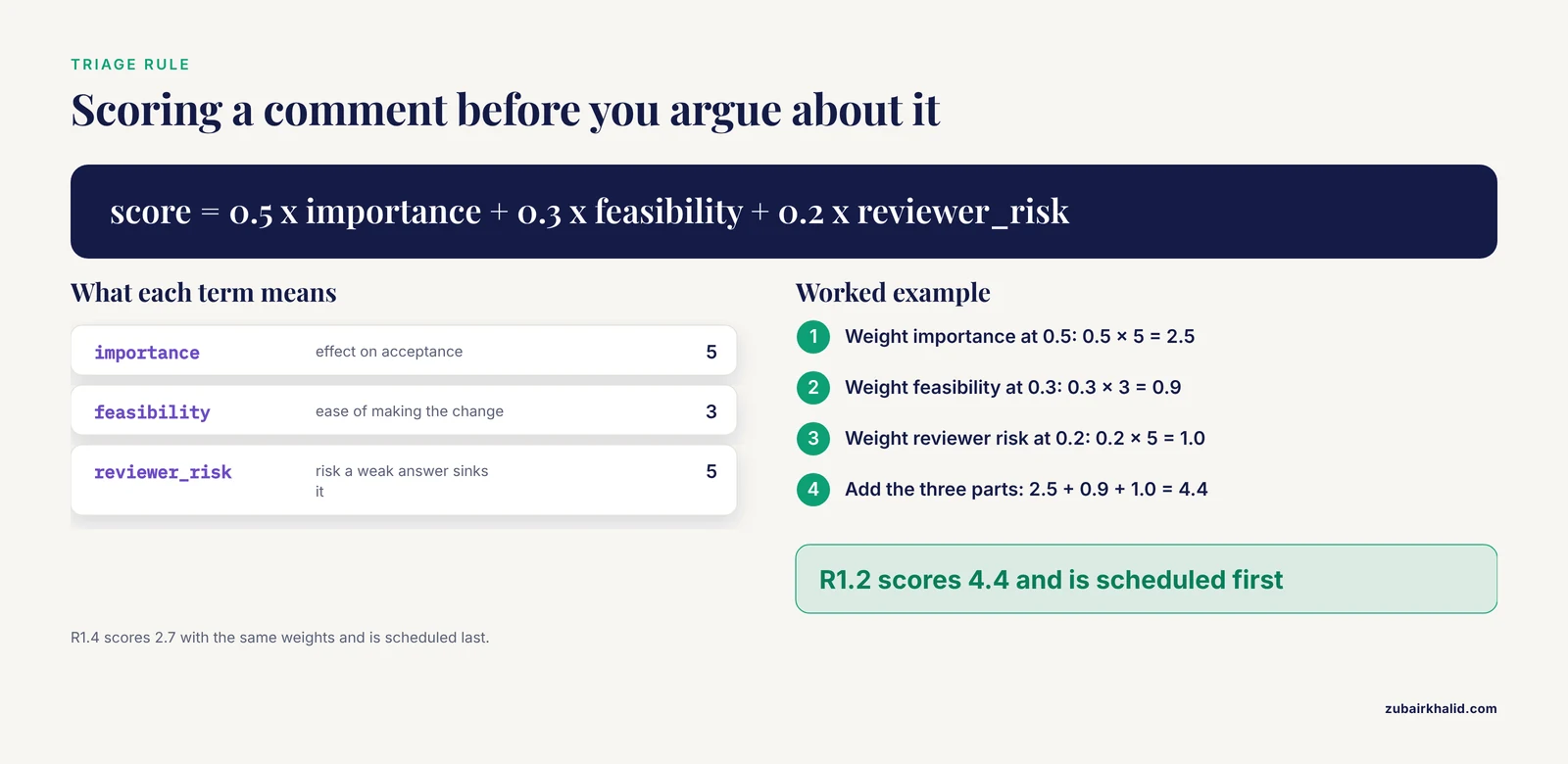
Triage goes better with a written rule than with a meeting. Decision scientists formalize this kind of choice, ranking options against several explicit criteria, as multi-attribute decision making, and simple weighted sums are one standard family of methods in that field [4]. The weights are a team choice, not a law of nature:
# Priority score = 0.5 x importance + 0.3 x feasibility + 0.2 x reviewer_risk
# importance:    how much the comment affects acceptance (1 to 5)
# feasibility:   how easily the team can make the change (1 to 5)
# reviewer_risk: how likely a weak answer sinks the revision (1 to 5)

R1.2  importance 5, feasibility 3, risk 5
      score = 0.5(5) + 0.3(3) + 0.2(5) = 4.4   schedule first
R1.4  importance 2, feasibility 5, risk 1
      score = 0.5(2) + 0.3(5) + 0.2(1) = 2.7   schedule last
The specific weights matter less than having a visible formula. A written rule converts a loud-voice negotiation into arithmetic that any co-author can redo and check.
Step 4. Assign One Owner and One Date to Every Comment
A comment with two owners has none. Name exactly one person per row, and attach a calendar date at the moment of assignment. The storyboard method used by large ecological collaborations pairs every assignment with a deadline precisely so that opportunities to contribute stay unambiguous [1], and that pairing has been tested across 15 years and hundreds of contributing scientists [1].
Run the schedule arithmetic before assigning, so promises fit the clock:
# Scheduling arithmetic (example)
Journal deadline:         60 days from the decision letter
Reserve for harmonizing:  10 days  (voice pass, sign-off, formatting)
Reserve for buffer:        5 days  (illness, holidays, slow replies)
Remaining for content:    45 days
Must-comments:            12, split across 5 authors (about 2-3 each)
Waves needed:             2 waves of parallel work at roughly 10 days each
First internal freeze:    day 45
Two more rules keep this step honest. The corresponding author is the default arbiter when two owners collide. And every must comment gets an owner before any could comment does.
Step 5. Revise on Branches (or in Suggestion Mode)
In Git, each working author takes a branch named after the comment they are answering:
git checkout -b r1-methods-power-analysisOutput:
Switched to a new branch 'r1-methods-power-analysis'The -b flag creates the branch and switches to it in one step. After editing the file, commit with the comment ID first in the message:
git add Methods.tex
git commit -m "R1.2: report post hoc power analysis in Methods"
git push -u origin r1-methods-power-analysis
Output:
Enumerating objects: 5, done.
Counting objects: 100% (5/5), done.
Writing objects: 100% (3/3), 412 bytes | 412.00 KiB/s, done.
Total 3 (delta 0), reused 0 (delta 0), pack-reused 0
To github.com/yourlab/manuscript-revision.git
 * [new branch]      r1-methods-power-analysis -> r1-methods-power-analysis
The -u flag links your local branch to its remote counterpart so later pushes need no arguments. Because the commit message starts with the comment ID, the project history later reads as a checklist of answered comments.
Merging brings the work back into the round branch:
git checkout revision-round-1
git merge r1-methods-power-analysis
Output:
Updating 3f8a1c2..8b4d2e1
Fast-forward
 Methods.tex | 12 ++++++++----
 1 file changed, 8 insertions(+), 4 deletions(-)
Word and Docs teams use the equivalent discipline instead: suggestion mode or Track Changes on the single master file, with one consolidator per section accepting changes in order. Never circulate .docx copies for independent editing, because hand-merged copies lose attribution and text.
When Commands Fail
fatal: not a git repository (or any of the parent directories): .gitmeans you are outside the folder from Step 1. Runcd manuscript-revisionfirst.error: Your local changes to the following files would be overwritten by checkout:means unsaved edits are in the way. Commit them on the current branch, or rungit stashand switch.- Conflict markers
<<<<<<< HEADinside a merged file mean two authors edited the same line. Keep the text matching the agreed change for that comment ID, delete the marker lines, commit, and record the resolution in the tracker.
Step 6. Verify Coverage Before Drafting Responses
Two checks, in order. First, every tracker row must read done or explicitly declined with a one-line reason. Second, the manuscript must actually contain the changes:
git log -5
grep -c "R1\." response-letter.md
git status
Expected outputs:
8b4d2e1 R1.2: report post hoc power analysis in Methods
7c1f9a0 R1.1: narrow the Introduction claim to the tested strain
6e2b8d4 R1.3: relabel Figure 2 axis units
5a9c3f7 R1.4: soften the therapeutic implication in the Discussion
4d0e6b2 R1.5: add missing reagent lot numbers to Methods
The grep -c line prints one number, for example 12, which should equal the number of rows in your tracker. The -U1 context flag on git diff (one line of surrounding text above and below each change) keeps diff output readable when you spot-check a merge. git status should end with nothing to commit, working tree clean before anything gets frozen.
Step 7. Harmonize the Voice in One Pass
Sections rewritten by different authors can read like different papers stitched together. That impression is measurable, not imagined. Stylometry research can classify documents as single- or multi-authored and locate the points where writing style switches, and unsupervised models can decompose a document into authorial components from the text alone [5]. You do not need those algorithms to fix the problem. You need one named editor who makes a single smoothing pass after content edits are frozen, adjusting transitions, tense, and terminology so that one concept keeps one term across the whole paper. Reading the revised Results and Discussion aloud in one sitting catches register shifts that the eye skips.
Step 8. Build the Response Letter and Freeze the File
The response letter is a table, not an essay:
| Comment | Response summary | Change location |
|---|---|---|
| R1.2 | Added a post hoc power analysis and reported the result | Methods, paragraph 3, page 8 |
| R1.4 | Narrowed the claim and added the requested hedge | Discussion, paragraph 1, page 14 |
Three rules govern every row: quote the comment verbatim, answer in one or two sentences, and give the exact location. Where you declined a suggestion, state the reason and point to new text or data that supports your position. Then freeze the package:
git tag -a v1.0-r1-resubmission -m "Resubmission package, all tracker rows closed"
git status
Expected output:
On branch revision-round-1
nothing to commit, working tree clean
The -a flag makes an annotated tag, a named, dated bookmark you can return to if the reviewers see the paper again. Send the tagged files and the response letter to every co-author for written approval before submitting, with an explicit short deadline. Chase non-replies rather than treating silence as consent. After submission, archive the repository and the tracker, because the next revision round reuses both.
Choosing Among Research Collaboration Tools
Pick the smallest toolkit every co-author will actually open. A research collaboration tool nobody logs into is worse than a shared folder everybody uses.
| Job | Tool options | Best fit | Main failure mode |
|---|---|---|---|
| Master file and history | Git repository, Overleaf version history, Google Docs version history | Teams comfortable with branches or LaTeX | Someone edits an old copy outside the system |
| Line-level suggestions | Google Docs suggestion mode, Word Track Changes | Small teams and prose-heavy drafts | Suggestions accepted in bulk without reading |
| Comment tracking | Shared spreadsheet, GitHub issues, kanban board | Any team larger than three | Status column nobody updates |
| References during revision | Zotero group library, Mendeley shared collection | Citation-heavy revisions | Duplicate or orphaned citations after cuts |
| Response letter | Template linked to the tracker | Every revision | Answering themes instead of individual comments |
Two combinations cover most labs. A LaTeX team runs Git or Overleaf with the tracker as a spreadsheet. A Word or Docs team runs suggestion mode on a single master file, appoints one consolidator per section, and keeps the same spreadsheet. Both routes satisfy the non-negotiables: one master copy, one owner per comment, one dated log of changes.
Agree on the Standard Before Anyone Edits
Many revision fights are really fights about what good writing means. Make the standard explicit and cheap to consult. In one pharmacology course, students built the rubric later used to score their own collaborative writing project, and they weighted ideas significantly higher and sentence fluency significantly lower than the departmental faculty rubric, favoring content over mechanics [6]. Papers scored under the two rubrics differed by about half a letter grade, a gap that was not statistically significant [6]. The translation for a revision team is direct: before round one, write down four or five criteria in priority order (claim strength, evidence support, clarity, citation practice, formatting) and get a spoken yes from every author. When a disagreement surfaces later, the list settles it in minutes instead of days.
Document Contributions While You Revise
Every accepted change is a contribution record, so capture it while it happens. Calls for explicit disclosure of individual contributions in multi-author papers go back to a 1983 commentary in the British Medical Journal, and honorary or cosmetic authorship persists largely because contribution records get assembled after the fact rather than during the work [7]. The same commentary warns that unreported or excessive use of AI writing tools blurs the boundary of genuine contribution in the same way [7], so log any AI-assisted rewriting in the tracker alongside human edits and follow the journal's disclosure policy.
Fair division of credit is difficult enough that researchers have proposed formal methods for it, including PageRank-based allocation of credit across the authors of a multi-author paper. A dated log from the revision period makes any such accounting, or the structured contributor statement many journals now request, a lookup instead of a negotiation. For large teams, the storyboard approach documents contributions through its multi-step process itself, which is part of how it defends meaningful authorship against institutional skepticism about many-author papers [1].
Common Mistakes and Limitations
- Working on parallel copies. The moment a file named Manuscript_final_v4_MK_edits.docx exists, the team has two versions of the truth, and a hand merge eventually deletes somebody's paragraph. Keep one master file and bring every edit into it.
- Comments without owners. A comment assigned to the Methods people has no owner. One named person per row. Two names on one comment means zero.
- Assignments without dates. An owner with no deadline is a wish. Large collaborations pair every assignment with a deadline for exactly this reason [1]. Put the date in the tracker at the moment of assignment.
- Mixing content and style edits. If co-authors polish sentences while the argument is still moving, the same passages get rewritten twice and merge conflicts multiply. Content first, style last.
- Debates without a decider. Disagreements need an endpoint. Give the corresponding author the casting vote and log the outcome with its one-line reason.
- Private rubrics. Co-authors weight substance and sentence-level polish differently, and the mismatch surfaces at line-edit stage, the most expensive moment. Agree on the criteria list before round one, as described above.
- Untracked AI polishing. An author runs a paragraph through a chatbot and pastes back fluent text that nobody records. Beyond the journal's disclosure rules, unreported or excessive AI use dilutes genuine contribution the way honorary authorship does [7]. Keep AI-assisted rewrites visible in the tracker like any other edit.
- Contribution logs written at submission. Reconstructing who did what after acceptance invites disputes. Log contributions as edits happen, because credit allocation is hard to do fairly from memory.
- Feedback overload in large teams. Above roughly thirty authors, sending full drafts to everyone for line edits produces thousands of comments nobody can absorb. The published rules for many-author papers recommend a core writing team that consolidates feedback while co-authors comment on outlines and drafts [2].
On limitations: this workflow assumes a revise-and-resubmit decision with addressable comments. A reject-and-resubmit invitation, an appeal, or a transfer to another journal follows timelines set by that journal, which override anything written here. Small teams can collapse Steps 1 and 5 into a shared document with version history, while teams above about thirty authors need the dedicated governance described for many-author collaborations [2]. Authorship disputes the team cannot settle internally belong with a department chair or the institutional research integrity office, not inside the comment tracker.
Frequently Asked Questions
Who decides when two co-authors disagree about a revision?
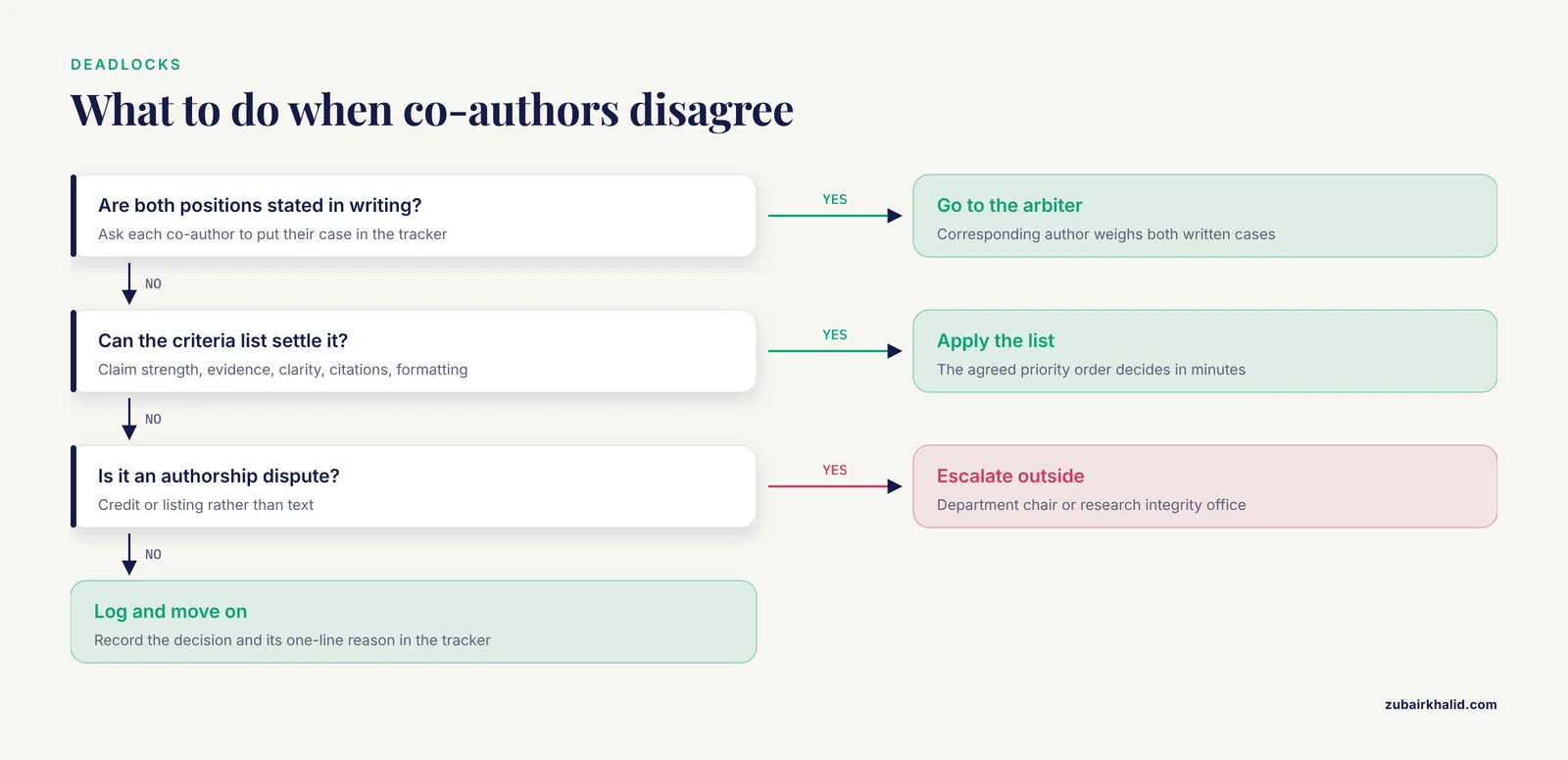
The corresponding author decides, after both positions are stated in writing. Log the decision and its one-line reason in the tracker so the same argument does not reopen in the next round.
What is the fastest way to track who changed what?
Put the manuscript somewhere with automatic version history (Git, Overleaf, or Google Docs) and require every change to reference the comment ID it answers. One labeled commit or suggestion per comment gives a complete audit trail with no extra meetings.
How long should one revision round take?
Set a fixed window of two to three weeks for most mid-sized teams and announce the cut-off date when assignments go out. Open-ended rounds stall because late edits arrive after the response letter is already drafted.
Does every co-author need to approve the final version?
Yes. Every listed author carries responsibility for the published work, so ask each one to confirm approval of the final files in writing. Set an explicit short deadline and chase non-replies rather than treating silence as consent.
What do I do about a co-author who stops responding?
Send one dated message listing their assigned comments and the deadline, then reallocate those comments when it passes. Announce the reallocation to the whole author team so nobody is surprised at submission.
Can we use AI tools during revisions?
Only for tasks the journal permits, such as language polishing, and always under the journal's disclosure policy. Unreported or excessive AI assistance blurs the boundary of genuine scholarly contribution in much the same way honorary authorship does [7].
How do we keep one consistent voice across sections written by different authors?
Freeze content edits first, then have one named editor make a single smoothing pass over the whole manuscript. Style shifts between sections are detectable in research settings, so treat harmonization as a required step rather than optional polish.
What belongs in the response to reviewers?
Quote each comment, state your change in one or two sentences, and give the exact location (page, paragraph, line). Where you declined a suggestion, give the reason and point to new text or data that supports your position.
Sources
- Writing a massively multi-authored paper: Overcoming barriers to meaningful authorship for all
- Ten simple rules for being a co-author on a many-author non-empirical paper.
- An EAPC white paper on multi-disciplinary education for spiritual care in palliative care
- Multi-Attribute Decision-Making Methods as a Part of Mathematical Optimization
- Unsupervised Decomposition of a Multi-Author Document Based on Naive-Bayesian Model
- Student perceptions of scientific writing in pharmacology: Student generation of collaborative rubrics to score a social pharmacology writing project.
- From honorary authorship to AI-assisted writing: two challenges to genuine scientific contribution.