LIMS vs ELN vs SDMS: Which Lab Data Platform Do You Need?
By Dr. Zubair Khalid, DVM, MS, PhD ·

A LIMS tracks samples and their workflow through a lab, an ELN records the narrative of each experiment, and an SDMS captures and organizes the raw files that instruments produce. The rule of thumb is simple: choose by the question your data has to answer. If the recurring question is "where is this sample and what happened to it," start with a LIMS. If it is "what exactly did we do and observe in this experiment," start with an ELN. If it is "where is the raw data file from that instrument run," you need an SDMS. Most mature laboratories eventually run more than one of these systems, and a growing body of laboratory-informatics literature treats them as complementary layers rather than competing products [1].
This research software comparison explains each platform on its own terms, then compares them on the criteria that decide real purchasing choices: data model, workflow direction, compliance needs, and integration. It ends with worked scenarios, common mistakes, and short answers to the questions buyers ask most.
Quick Definitions Before You Compare
LIMS stands for Laboratory Information Management System. It is a system of record for samples and the work performed on them. A LIMS assigns each sample a unique identifier, tracks its chain of custody, records test requests, drives workflows through statuses, stores validated results, and generates reports or certificates of analysis.
ELN stands for Electronic Lab Notebook. It is a system of record for experiments. An ELN captures the intent of an experiment, the protocol used, reagent lot numbers, observations, images, calculations, and interpretations, usually with electronic signatures and timestamps that make the record defensible for patent and publication purposes.
SDMS stands for Scientific Data Management System. It is a system of record for instrument output. An SDMS collects raw data files from chromatographs, spectrometers, plate readers, imagers, and other devices, indexes them with metadata, and makes them searchable and retrievable independent of the vendor software that created them.
A useful shorthand for the difference between LIMS and ELN and SDMS: the LIMS knows about the sample, the ELN knows about the experiment, and the SDMS knows about the file.
Side-by-Side Comparison Table
| Criterion | LIMS | ELN | SDMS |
|---|---|---|---|
| Core question answered | Where is this sample and what is its status? | What did we do and why? | Where is the raw data from this run? |
| Primary data object | Sample, aliquot, test request | Experiment, notebook entry, protocol | Data file, instrument output |
| Data structure | Highly structured, schema-driven | Semi-structured, free text plus templates | Unstructured files plus metadata |
| Workflow direction | Drives the workflow, tells users what to do next | Records the workflow after or during execution | Captures workflow output automatically |
| Typical users | Sample reception, bench analysts, QA, reporting | Scientists, research associates, postdocs | Instrument users, data managers, IT |
| Identity backbone | Sample and aliquot IDs, barcodes | Experiment IDs, notebook pages | File names, instrument metadata, audit trails |
| Compliance anchor | Sample accountability, results traceability, reporting | Data integrity, attribution, IP defensibility | Raw data preservation, retrieval, audit |
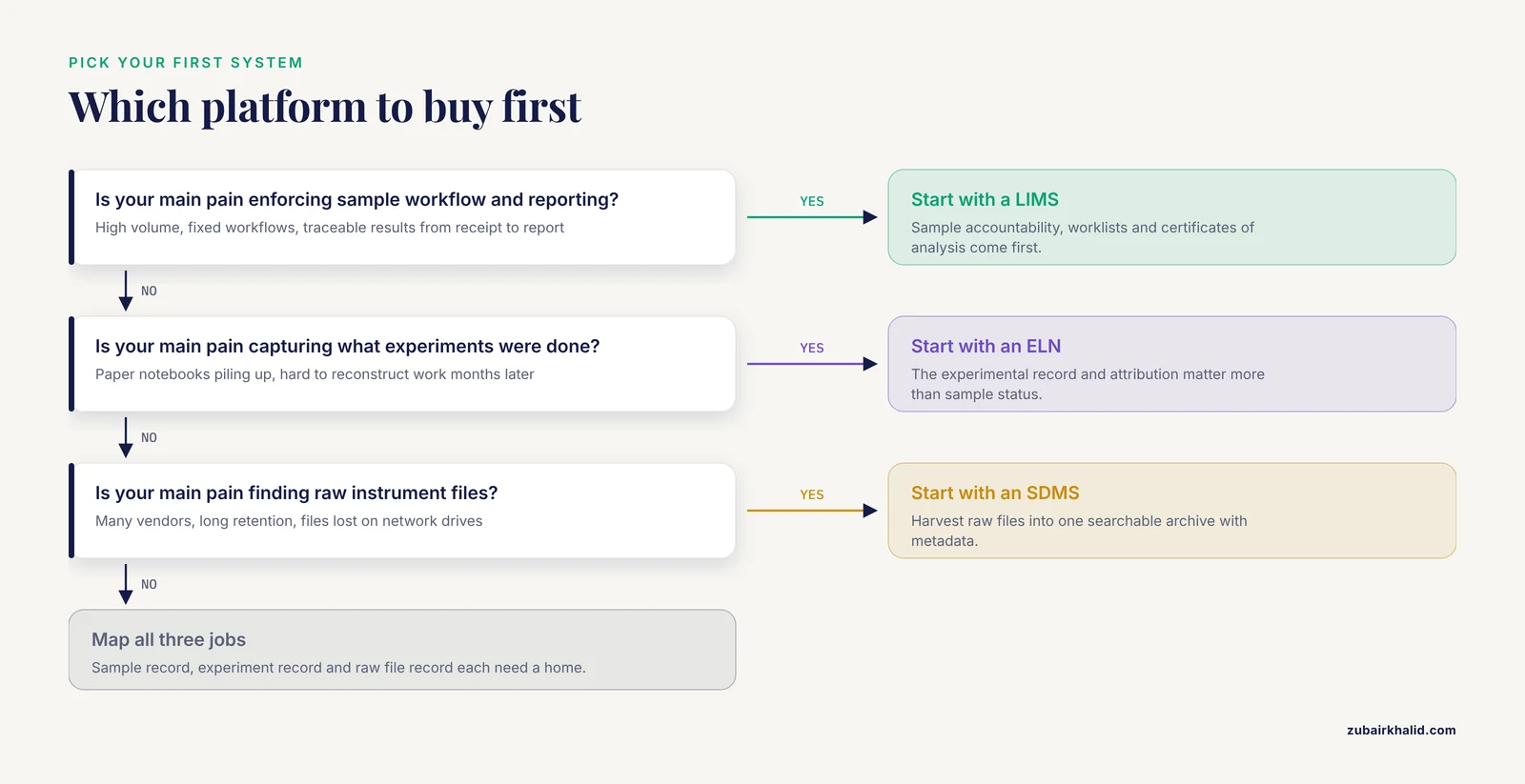
| Best first purchase for | High-volume testing labs | Research and discovery labs | Instrument-heavy labs drowning in files |
| Failure mode when absent | Lost samples, unclear status, manual reporting | Fragmented paper notebooks, weak IP records | Orphaned raw files, unreadable legacy data |
What a LIMS Is and When to Use One
A LIMS earns its keep when sample volume, regulatory exposure, or reporting requirements make manual tracking unreliable. The defining features are sample-centric. Every physical or virtual entity, whether a blood tube, an environmental swab, a compound vial, or a sequencing library, receives a persistent identifier. Every operation performed on that entity is recorded against its identifier, so the system can answer questions such as which aliquot came from which parent sample, which analyst ran which method on which instrument, and which results passed which acceptance criteria.
When to use a LIMS comes down to three signals. The first is volume. A lab processing dozens of samples a day on repeatable workflows benefits almost immediately, because manual spreadsheets become the bottleneck and the error source. The second is traceability. Regulated testing environments, including pharmaceutical quality control, clinical reference work, and environmental compliance, require demonstrable chain of custody from receipt to report. The third is reporting volume. If staff spend hours each week assembling certificates of analysis or client reports by hand, a LIMS automates that step and reduces transcription errors.
The workflow-driving character of a LIMS distinguishes it from the other two platforms. A LIMS does not simply record what happened, it instructs the bench on what should happen next. A sample enters as "received," moves to "accessioned," then "in analysis," then "review," then "reported." Users see queues and worklists generated by the system. This direction of control, from system to user, is the clearest practical answer to the lims or eln question: if your lab needs to be told what to do next by software, you are describing a LIMS.
Modern LIMS deployments increasingly merge with quality management functions. A recent design and pilot deployment of a cloud-ready platform unified LIMS and quality management system (QMS) functions in a single web-based system, mapping controls to FDA 21 CFR Part 11 and ISO/IEC 17025 under a risk-based computer software assurance approach [2]. In that deployment, the platform handled a request-and-service lifecycle across nine governance modules, and across 187 laboratory requests it recorded a 23-day mean turnaround time, 1,456 quality-control checkpoints, and 43 deviation-handling episodes [2]. The convergence message for buyers is that the boundary between "LIMS" and "quality system" is blurring in regulated laboratories.
What an ELN Is and When It Beats a LIMS
An ELN solves a different problem. Research is exploratory, and experiments rarely follow a fixed schema. A scientist changes a buffer concentration on day 3, notes an unexpected precipitate, screenshots a gel, and writes an interpretation. A traditional LIMS handles this poorly, because it expects structured fields with predefined validation. An ELN embraces the narrative. Entries are documents, enriched with structured elements such as reagent tables, embedded calculations, and instrument attachments, and signed electronically so the record can support patent filings, publications, and reproducibility audits.
Choose an ELN first when your lab's output is knowledge rather than test reports. Academic groups, early-stage discovery teams, process development groups, and computational biology collaborations all fit this profile. The strongest signals are paper notebooks piling up, difficulty reconstructing experiments months later, and anxiety about inventorship or data attribution when personnel leave.
The distinction between a LIMS and an ELN also shows up in how they treat time. A LIMS is operational and present-focused, always answering "what needs to happen to this sample today." An ELN is archival and reflective, always answering "what did we learn and can we prove it." Both records matter, and in drug discovery organizations they matter together. Machina and Wild analyzed integration of LIMS, ELN, chromatography data systems (CDS), and SDMS in pharmaceutical discovery and proposed an ELN-centric model, in which the ELN acts as the scientist's primary workspace and the other systems feed data into it [1]. That proposal reflects how scientists actually work, and it is one reason discovery organizations often lead with an ELN while manufacturing and QC organizations lead with a LIMS.
What an SDMS Is and Why Raw Data Needs Its Own System
Instrument manufacturers each ship their own software. A chromatography system writes proprietary binary files, a mass spectrometer writes vendor formats, a plate reader exports spreadsheets, and an imager writes gigabyte-scale stacks. None of these applications talk to each other, and none of them keep files organized across the whole lab. Years later, when someone asks for the original raw file behind a reported result, the answer is often a named network drive, a retired workstation, or a departed employee's folder.
An SDMS attacks this problem directly. It sits between instruments and users, harvesting data files automatically where possible, wrapping them in metadata such as instrument ID, run date, operator, method version, and sample association, and storing them in a searchable repository. Because the SDMS preserves the original file alongside any processed derivatives, it supports data integrity expectations in regulated work, where the ability to reprocess raw data is part of demonstrating that reported results rest on real measurements.
When to use an SDMS follows from three conditions. First, the lab runs multiple instrument types from multiple vendors. Second, raw files must be retained for years, whether for regulatory retention, patent support, or reproducibility. Third, anyone has ever lost time hunting for a dataset. In drug discovery, SDMS platforms are routinely listed alongside LIMS, ELN, and CDS as one of the four core informatics layers that must be integrated for organizations to make well-informed decisions about compounds and resources [1].
One clarification prevents a common mix-up. An SDMS is not a chromatography data system (CDS). The CDS controls the instrument, processes the signal, and integrates peaks. The SDMS stores whatever the CDS and every other instrument produce. Labs with heavy chromatography often run both, with the SDMS serving as the central archive that also captures non-chromatography output.
LIMS vs ELN vs SDMS: The Criteria That Decide Real Choices
Data model and structure
The deepest difference is structural. A LIMS enforces a schema: a sample record has required fields, controlled vocabularies, and validation rules. An ELN permits a narrative: a page can hold anything the scientist considers part of the record. An SDMS stores binaries: the content of the file is opaque to the system, which indexes metadata instead. Ask which shape matches your dominant data. Routine testing produces structured data and suits a LIMS. Research produces semi-structured data and suits an ELN. Instruments produce files and suit an SDMS.
Direction of control
A LIMS pushes work to people through worklists and statuses. An ELN records work that people define themselves. An SDMS pulls data from machines without human initiation. If your pain is process enforcement and turnaround accountability, the LIMS direction of control fits. If your pain is knowledge capture and retrieval, the ELN fits. If your pain is data sprawl across instruments, the SDMS fits.
Compliance and data integrity expectations
In regulated environments, each platform anchors a different compliance duty. The LIMS anchors sample accountability and results traceability, the ELN anchors attribution and the integrity of the experimental record, and the SDMS anchors raw data preservation. Recent laboratory informatics work maps these duties onto formal frameworks, pairing LIMS-QMS functionality with 21 CFR Part 11 controls and ISO/IEC 17025 expectations under a risk-based software assurance model [2]. A practical consequence is that regulated labs rarely get to choose a single system, because each system carries a distinct compliance load.
Integration as a purchasing criterion
The systems interact. A LIMS can create worklists that an ELN references, instrument output lands in the SDMS, and processed results flow back to the LIMS for reporting. Integration quality should therefore weigh as heavily as feature checklists in any research software comparison. Machina and Wild argue that effective integration of data across laboratory informatics tools lets drug discovery organizations make better-informed decisions about resource allocation during discovery and development, and they propose the ELN as the natural integration hub for the scientist-facing workflow [1]. When you evaluate any platform, ask specifically how it connects to the other two layers, whether through APIs, file harvesting, or vendor partnerships, rather than accepting a demonstration that shows each system in isolation.
Who actually uses the system day to day
User populations differ. LIMS users often include non-scientist staff, such as sample reception and reporting teams, and the interface is built for rapid structured data entry. ELN users are scientists who resist anything that slows them down, so the interface must behave like a document editor. SDMS users interact with search and retrieval more than with data entry. Budgeting for training and change management should reflect these different populations.
How the Three Systems Fit Together in Practice
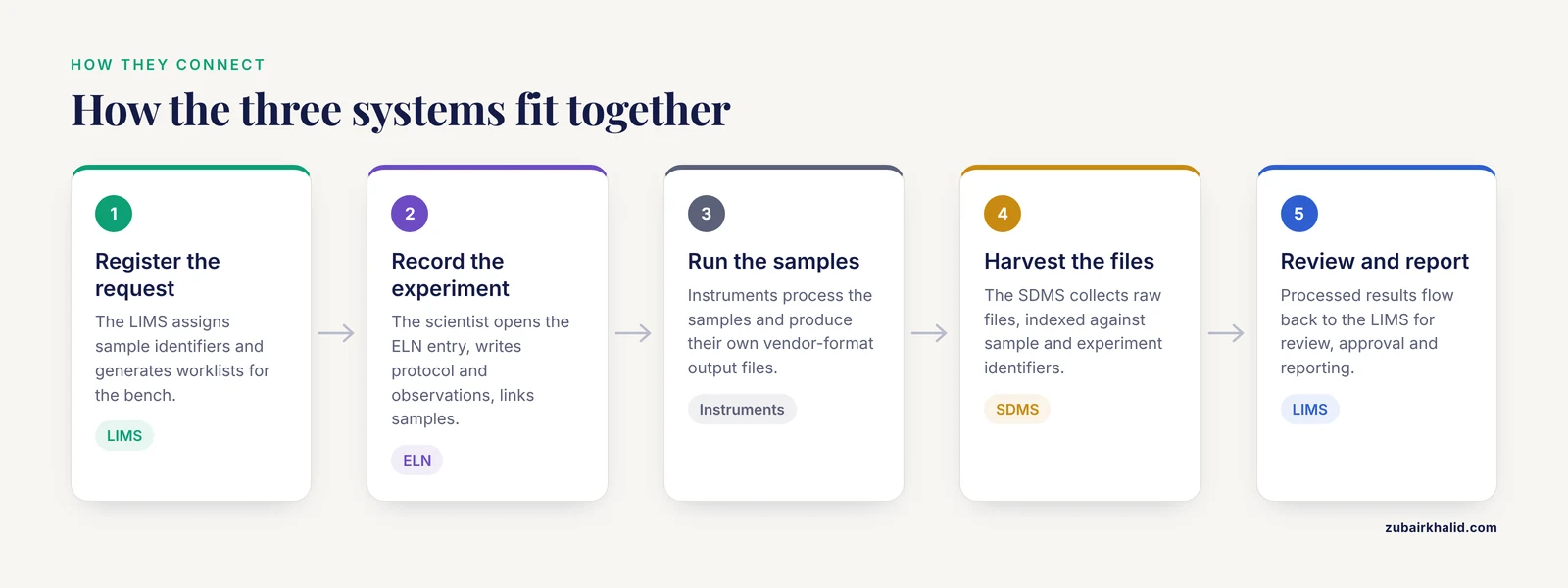
Mature laboratory informatics treats the three platforms as layers around one data backbone. In a typical integrated flow, a request is registered in the LIMS, which assigns sample identifiers and generates worklists. The scientist opens the corresponding ELN entry, records the protocol and observations, and links to the relevant samples. Instruments run the samples, and the SDMS harvests the resulting files, indexed against sample and experiment identifiers. Processed results return to the LIMS, where review, approval, and reporting occur. Quality events, deviations, and corrective actions attach to the same identifiers.
The ELN-centric model proposed for drug discovery formalizes one arrangement of this flow, positioning the ELN as the hub through which scientists interact with LIMS, CDS, and SDMS content [1]. The model's appeal is usability, because scientists live in the notebook and receive context from the other systems rather than switching among four applications. Other organizations prefer a LIMS-centric arrangement, particularly in QC and manufacturing, where the sample record is the anchor. The correct hub depends on whether the lab's center of gravity is the experiment or the sample.
Standardized vocabularies matter once data crosses system boundaries. Healthcare informatics offers a worked illustration of the principle. In a mapping study of clinical terms from routine cancer care, a multidisciplinary team mapped 3,472 source terms across seven domains to multiple standardized terminology systems, and with postcoordination and predefined mapping guidelines SNOMED CT achieved high overall mapping rates of 98.3 to 100 percent [3]. The transferable lesson for laboratory informatics is that semantic interoperability does not happen by accident. Labs that define controlled vocabularies for sample types, assay names, and instrument parameters early make later integration far easier than labs that let each system develop its own terminology.
Three Worked Scenarios
Scenario 1: A ten-person academic proteomics group
The lab runs mass spectrometers, prepares samples, and publishes papers. Output is knowledge, workflows change weekly, and the urgent need is reconstructing what was done and finding the raw files afterward. Here the lims or eln question resolves toward the ELN first. A full LIMS would impose structure the science does not yet have, and sample volumes do not justify it. Pair the ELN with disciplined network storage or a lightweight SDMS function for raw instrument files. A LIMS becomes worth revisiting if the group begins running fee-for-service projects with formal sample intake and reporting obligations.
Scenario 2: A pharmaceutical QC microbiology lab
The lab receives environmental monitoring samples, runs compendial tests, and issues results under good laboratory practice expectations. Volume is high, workflows are fixed, and every result must be traceable. When to use a LIMS is answered before the meeting starts: this is the textbook case. The LIMS is the first purchase, configured with sample accessioning, workflow statuses, specification checking, and reporting. An ELN adds value later for investigations and method development work. An SDMS matters if incubator readers or identification instruments produce files that must be retained. A unified LIMS-QMS platform is a credible option in exactly this setting, as shown by the cloud platform designed for GLP and GMP-aligned laboratory operations that combined LIMS and QMS functions with 21 CFR Part 11-aligned controls [2].
Scenario 3: A biotech with 40 instruments and no central data store
Scientists complain about finding files, and legacy data from departed staff is effectively unreadable. The dominant pain is file sprawl, not workflow enforcement and not knowledge capture. The SDMS is the first purchase. It harvests instrument output into one searchable place with metadata, which immediately protects the most irreplaceable data the company owns. Once raw data is secure, adding an ELN gives experiments a home, and a LIMS follows when the company moves candidates toward development and formal sample accountability becomes necessary.
Convergence Trends Buyers Should Know About
Three trends are reshaping the LIMS vs ELN vs SDMS decision. First, cloud delivery is becoming standard, reducing the infrastructure burden that historically made these systems expensive for smaller labs. The theranostics platform described in recent literature is explicitly cloud-ready and web-based, designed so that laboratory operations can run without local server administration [2]. Second, category boundaries are blurring. Vendors ship ELNs with sample registries, LIMS products with notebook modules, and platforms that embed quality management, as in the LIMS-QMS unification described above [2]. Third, artificial intelligence is entering laboratory workflows in operational roles, including an LLM-assisted module that generates structured standard operating procedures, identifies required consumables and instruments, performs risk assessment, and proposes executable workflows from a single service-name input [2]. Buyers should expect the question "which platform do you need" to become, over the next few years, "which integrated platform suite fits your lab," while still recognizing that the three underlying jobs, tracking samples, recording experiments, and preserving raw data, remain distinct and all must be covered somewhere.
Common Mistakes and Limitations
Buying a LIMS to fix an ELN problem. Labs with messy research records sometimes buy a LIMS hoping it will organize their science. A LIMS structures samples, not experiments, and scientists often bypass rigid schemas anyway, producing the same fragmentation with extra licensing cost.
Treating an ELN as a regulated LIMS substitute. An ELN records experiments well, but it does not inherently provide sample chain of custody, worklist-driven operations, or specification-based result release. Regulated labs that swap one for the other usually end up reconstructing both in spreadsheets, which is worse than either system alone.
Ignoring raw data until it hurts. SDMS needs feel abstract until a regulatory response, patent dispute, or reproducibility check requires a raw file that no longer exists in retrievable form. Raw data preservation deserves a decision as early as the first purchase, even if the decision is a structured network archive with naming conventions rather than a full SDMS product.
Evaluating platforms in isolation. A compelling demo of a standalone system says little about how it will exchange data with the other layers. Machina and Wild make integration effectiveness central to the value case for laboratory informatics, because integrated data is what supports informed resource decisions [1]. Buyers who skip integration questions during evaluation pay for custom interfaces later.
Underestimating vocabulary work. Integration stalls when systems use different names for the same entity. The terminology mapping experience in clinical informatics shows that achieving high semantic interoperability requires predefined mapping guidelines and expert verification, not automatic magic [3]. Laboratory informatics projects benefit from the same discipline, applied to sample types, assay names, and metadata fields.
Assuming the newest platform category replaces the older ones. Each platform class persists because it answers a different question. New unified platforms redistribute the work, but the sample record, the experiment record, and the raw file record all still need an authoritative home. Individual labs should map their own workflows to those three jobs before signing any license, because product categories vary by vendor and labels do not always match the classical definitions used here.
Frequently Asked Questions
Can one platform do the jobs of LIMS, ELN, and SDMS?
Some modern suites combine two or all three functions, and a published platform design unifies LIMS with QMS functions in a single cloud-ready system [2]. The three underlying jobs still exist, so verify that each job, sample tracking, experiment records, and raw data capture, is genuinely covered rather than merely claimed in marketing material.
Which should a small research lab buy first, a LIMS or an ELN?
For a small lab whose output is knowledge, an ELN first is usually the better choice, because it captures the experimental record scientists actually produce. A LIMS first makes sense as soon as the lab runs structured, repeatable testing workflows with formal sample intake and reporting.
Is an ELN a substitute for a LIMS in a regulated lab?
No. The two systems anchor different compliance duties, with the ELN supporting experimental attribution and the LIMS supporting sample accountability and results traceability. Regulated environments generally need LIMS functions such as worklist-driven operations and specification-based release, which ELNs do not provide by default.
Where should instrument raw files live, in the LIMS or an SDMS?
Raw files belong in a system designed for file preservation and retrieval, which is the SDMS role. A LIMS stores structured results and can link to raw files by reference, while the SDMS preserves the original binaries with the metadata needed to find and reprocess them years later.
What does ELN-centric integration mean?
It is an integration model for laboratory informatics in which the ELN serves as the scientist's primary workspace and the LIMS, CDS, and SDMS feed data into it. Machina and Wild proposed this model for drug discovery organizations, arguing that integrated data across tools supports better decisions about compounds and resources [1].
Do these platforms need to be integrated, or can they run separately?
They can run separately, and many labs start that way, but separate systems recreate the data silos the platforms were meant to remove. Effective integration lets organizations make better-informed decisions from their data [1], and shared controlled vocabularies are the practical foundation that makes integration work.
Further Reading
Sources
- Laboratory informatics tools integration strategies for drug discovery: integration of LIMS, ELN, CDS, and SDMS.
- A cloud-enabled LIMS-QMS platform with large language model-assisted standard operating procedure generation for GLP/GMP-aligned theranostics laboratory operations.
- Real-World Applicability of Multiple International Terminology Systems in Oncology: Mapping Study of Clinical Terms for Cancer Diagnosis and Treatment.