LIMS Features for Regulatory Compliance
By Dr. Zubair Khalid, DVM, MS, PhD ·

By the end of this guide, you will be able to identify the LIMS regulatory compliance features that a regulated laboratory actually needs, evaluate candidate systems against a concrete checklist, configure the core controls (audit trail, electronic signatures, role-based access, deviation handling) in a test environment, and plan a validation exercise that an inspector or auditor will accept. You will also know the mistakes that most often derail LIMS rollouts in GLP, GMP, and clinical laboratories.
Have on hand before you start:
- Your regulatory scope in writing (for example, FDA 21 CFR Part 11, GLP, GMP, ISO/IEC 17025, or CLIA)
- A map of your sample workflow from receipt to reporting
- A list of instruments and systems the LIMS must connect to
- Your organization's computer system validation policy or quality manual
- A sandbox or test instance of the LIMS you are evaluating, if the vendor provides one
Why Compliance Shapes LIMS Design
A laboratory information management system (LIMS) is software that tracks samples, reagents, instruments, workflows, results, and the people who touched each of them. In an unregulated research lab, a spreadsheet can do much of this. In a regulated setting, the record itself becomes evidence. Regulators evaluating a cell therapy product, a bioanalytical study, or a diagnostic assay want to reconstruct exactly what happened to a sample, who decided what, and when.
This requirement shows up clearly in cellular manufacturing. When researchers implemented a configurable LIMS to support pre-clinical and clinical cell production, they had to manage documentation for patients, raw materials, processes, assays, and facilities, starting early in process development and continuing through patient follow-up on clinical trials [1]. The same team used the system's quality management reporting to capture, report, and investigate process and equipment deviations that occurred during production of a master cell bank [1]. That is the core insight: in a regulated lab, the LIMS is not a convenience layer over the science. It is the system of record that regulators read.
The stakes have grown as laboratory software has consolidated. Recent industry consensus work, including the 2025 White Paper from the 19th Workshop on Recent Issues in Bioanalysis, which gathered over 1200 professionals from pharma, biotech, contract research organizations, and regulatory agencies, included dedicated in-depth workshops on "Implementation Practice for the Newest ELN/LIMS Systems," reflecting how directly compliance now depends on how these systems are configured and deployed [2].
Core LIMS Regulatory Compliance Features
The features below are the ones that map to documented regulatory expectations. For each, know what it does and how you will verify it works.
Audit trail
An audit trail is an automatic, computer-generated, time-stamped record of every create, modify, and delete action in the system, including the old value, the new value, the user, and the reason for change where required. It cannot be turned off by ordinary users and cannot be edited. This is the backbone of data integrity under principles such as ALCOA+ (attributable, legible, contemporaneous, original, accurate, plus complete, consistent, enduring, and available), which is standard textbook material for regulated data.
A compliant audit trail entry typically looks like this in structure:
{
  "record_id": "SMP-2026-04172",
  "action": "modify",
  "field": "result_value",
  "old_value": "4.82",
  "new_value": "4.28",
  "reason_for_change": "[Transcription error](/knowledge/molecular-biology/transcription-error) from instrument printout",
  "user": "j.rivera",
  "timestamp_utc": "2026-11-11T14:32:07Z",
  "signature_meaning": null
}
Expected behavior to verify in testing: attempt to edit a released result as a standard user. The system should require a reason, write the entry above, and preserve the original value in the record history. If the old value disappears from view, the audit trail is decorative, not compliant.
Electronic signatures
An electronic signature is a legally binding equivalent of a handwritten signature executed on electronic records. Under FDA 21 CFR Part 11, a signed electronic record must include the printed name of the signer, the date and time of signing, and the meaning of the signature, such as "reviewed by," "approved by," or "performed by." A practical LIMS enforces this at defined workflow steps. A typical signing manifestation looks like this:
record: BATCH-2026-118
signer_printed_name: "Jordan Rivera"
credentials: "j.rivera"
timestamp_utc: "2026-11-11T16:05:44Z"
signature_meaning: "Reviewed by"
Test it by signing a record, then re-opening it. The signature block should be immutable and linked to the exact record version that was signed. If a later edit silently leaves the signature attached to modified content, that is a finding.
Role-based access control
Role-based access control (RBAC) assigns permissions to roles rather than individuals. A bench analyst can record results but cannot approve a batch. A quality reviewer can approve but cannot originate results. Administrators can manage accounts but, ideally, cannot alter scientific data. Segregation of duties is the compliance principle here: the person who performs work should not be the sole person who verifies it.
Sample and material chain of custody
The LIMS should track every sample and critical reagent through unique identifiers, with parent-child lineage for aliquots and derivatives. In the cellular manufacturing example above, the LIMS managed blood donor eligibility, recruiting, appointments, billing, and serology, and produced annual accrual reports, all of which require traceable identity from donor to product [1]. Chain of custody answers the regulator's first question: where did this material come from and where did it go.
Deviation, investigation, and CAPA management
A deviation is any departure from an approved procedure or specification. A LIMS with compliance features lets users raise a deviation directly from a batch record, route it for investigation, record root cause, and link corrective and preventive actions (CAPA). The cell production system described earlier used exactly this pattern to capture and investigate process and equipment deviations during master cell bank production [1]. A newer integrated platform designed for GLP/GMP-aligned theranostics operations embedded deviation handling among nine governance modules and logged 43 deviation-handling episodes across a 187-request pilot deployment [3]. Without this feature, deviations live in email threads and paper forms, which auditors treat as a records-management weakness.
Version-controlled documents and SOPs
Standard operating procedures (SOPs) must be versioned, approved, effective-dated, and withdrawn on revision. A compliance-oriented LIMS either hosts controlled documents or integrates with a quality management system (QMS) that does. Some modern platforms merge the two functions. One cloud-ready system unifying LIMS and QMS functions under a risk-based Computer Software Assurance framework aligned with 21 CFR Part 11 and ISO/IEC 17025 even added a module that generates structured SOP drafts, identifies required consumables and instruments, and performs operational risk assessment from a single service-name input [3]. The table below summarizes how the core features map to compliance obligations.
| LIMS feature | What it enforces | Compliance anchor | Verification question |
|---|---|---|---|
| Audit trail | Attributable, time-stamped change history | 21 CFR Part 11, data integrity (ALCOA+) | Can any user edit or delete audit entries? |
| Electronic signatures | Signed name, date-time, and meaning on records | 21 CFR Part 11 | Does the signature bind to the exact record version? |
| Role-based access | Segregation of duties | GLP, GMP quality systems | Can an analyst approve their own result? |
| Chain of custody | Sample and material lineage | GMP traceability, ISO/IEC 17025 | Can you reconstruct a sample's history in one query? |
| Deviation and CAPA | Captured, investigated departures | GMP, GLP quality systems | Can a deviation be raised from the batch record itself? |
| Document control | Effective-dated, versioned SOPs | GLP, GMP, ISO/IEC 17025 | Can staff open a withdrawn SOP version by accident? |
| Controlled copy/export | Watermarked or hashed outputs | 21 CFR Part 11 record retention | Does an exported report identify source, version, and time? |
Standardized terminology and structured data
Compliance is not only about controls. It is also about whether your data can be interpreted later by reviewers, other laboratories, or regulatory reviewers. Standardized terminologies such as SNOMED CT, LOINC (Logical Observation Identifiers Names and Codes), and RxNorm give laboratory terms unambiguous meanings. In a real-world mapping study of 3472 clinical terms from routine cancer care across seven domains, SNOMED CT achieved high overall mapping rates of 98.3 to 100 percent when predefined mapping guidelines and postcoordination were used [4]. A LIMS that lets you bind test names, units, and result codes to such terminologies produces records that survive organizational change and external review. A LIMS that stores everything as free text does not.
Instrument integration and raw data capture
Manual transcription is the largest source of data integrity findings in laboratories. A compliance-oriented LIMS ingests results directly from instruments, preserves raw data, and links each result to the instrument, its calibration status, and the method version. When the cellular manufacturing team evaluated candidate systems, the ability to integrate with laboratory equipment was one of their explicit selection criteria, alongside cost, flexibility, regulatory compliance, and ongoing programming requirements [1]. Prefer systems that read instrument output files directly over systems that require analysts to retype values.
Evaluating LIMS for Regulatory Compliance: A Research Software Comparison
The best software for researchers in a regulated environment is not the best software for an academic lab. Evaluation criteria differ. A useful research software comparison for compliance purposes should score candidates on six axes.
- Compliance surface. Does the vendor provide documented audit trail behavior, signature manifestation details, and access control matrices? Ask for these in writing before a demo.
- Validation support. Does the vendor supply installation qualification (IQ), operational qualification (OQ), and performance qualification (PQ) documentation, or a supplier assessment package? Vendor documentation can reduce your testing burden but never eliminates it.
- Configuration versus customization. Configuration is setting the system up through supported options. Customization is code the vendor or you must maintain and revalidate. Heavily customized systems cost more to validate and to upgrade.
- Flexibility for your workflow. In the cell production pilot, the team deliberately chose a user-configurable system so laboratory staff, not programmers, could evolve the configuration as protocols changed [1]. Ask how workflow changes are made and who can make them.
- Ongoing programming burden. Some systems require continuing internal programming to stay functional. The cell manufacturing evaluation treated ongoing programming requirements as an explicit selection criterion, because hidden development cost is a common failure mode [1].
- Integration. Confirm native connectors for your chromatography data systems, plate readers, sequencers, or pathology image systems. For digital and AI pathology work, the infrastructure between samples and models, including laboratory information systems and image management systems, is now recognized as a distinct regulatory and operational layer spanning biobanks, trial workflows, and FDA pathways for in vitro diagnostics, software as a medical device, and companion diagnostics [5].
A scoring table with weighted criteria (for example, compliance surface 30 percent, validation support 20 percent, integration 20 percent, configurability 15 percent, usability 15 percent) turns vendor conversations into evidence rather than impressions.
Implementing LIMS Regulatory Compliance Features Step by Step
This walkthrough assumes a test instance of the LIMS and a representative workflow, such as a receiving-to-reporting flow for a QC assay. Adapt the specifics to your vendor's interface. The goal is to prove each control works before any production data enters the system.
Step 1. Define the compliance requirement set
Write a one-page requirements document listing the regulations that bind you and the LIMS features that satisfy each. For example, "21 CFR Part 11 requires audit trails, so the LIMS must record every field-level change with user, timestamp, old value, new value, and reason." Number each requirement. Every later test case will trace back to one of these numbers. This traceability is what auditors look for first.
Step 2. Configure roles and permissions
Create your role matrix before creating users. A minimal regulated-lab matrix:
Role              Create results   Edit results   Approve   Administer users   View audit trail
Analyst           Yes              Yes (open)     No        No                 No
Reviewer          No               No             Yes       No                 Yes
Quality unit      No               No             Yes       No                 Yes
Administrator     No               No             No        Yes                Yes (read-only)
Expected outcome: attempting to approve a record as an Analyst produces an access-denied message such as "You do not have permission to perform this action" or your vendor's equivalent. Record the exact message text in your test evidence.
Step 3. Exercise the audit trail deliberately
Modify a field in a test sample record and inspect the audit trail. In a test console or the system's history view, you should see an entry equivalent to:
{
  "action": "modify",
  "field": "specimen_storage_temp_c",
  "old_value": "-80",
  "new_value": "-70",
  "reason": "Freezer mapping update",
  "user": "test.analyst",
  "timestamp_utc": "2026-11-11T18:12:55Z"
}
Then run a completeness check if your system exposes a query interface. For a SQL-backed system:
SELECT record_id, action, field, old_value, new_value, user_name, changed_at
FROM audit_trail
WHERE record_id = 'SMP-TEST-001'
ORDER BY changed_at;
Expected output: one row per change, oldest first, with no gaps. A common error message here is a permissions failure such as "SELECT denied on table audit_trail," which is actually correct behavior for most users. Run the query as an administrator or through the vendor's audit review screen instead.
Step 4. Test electronic signature binding
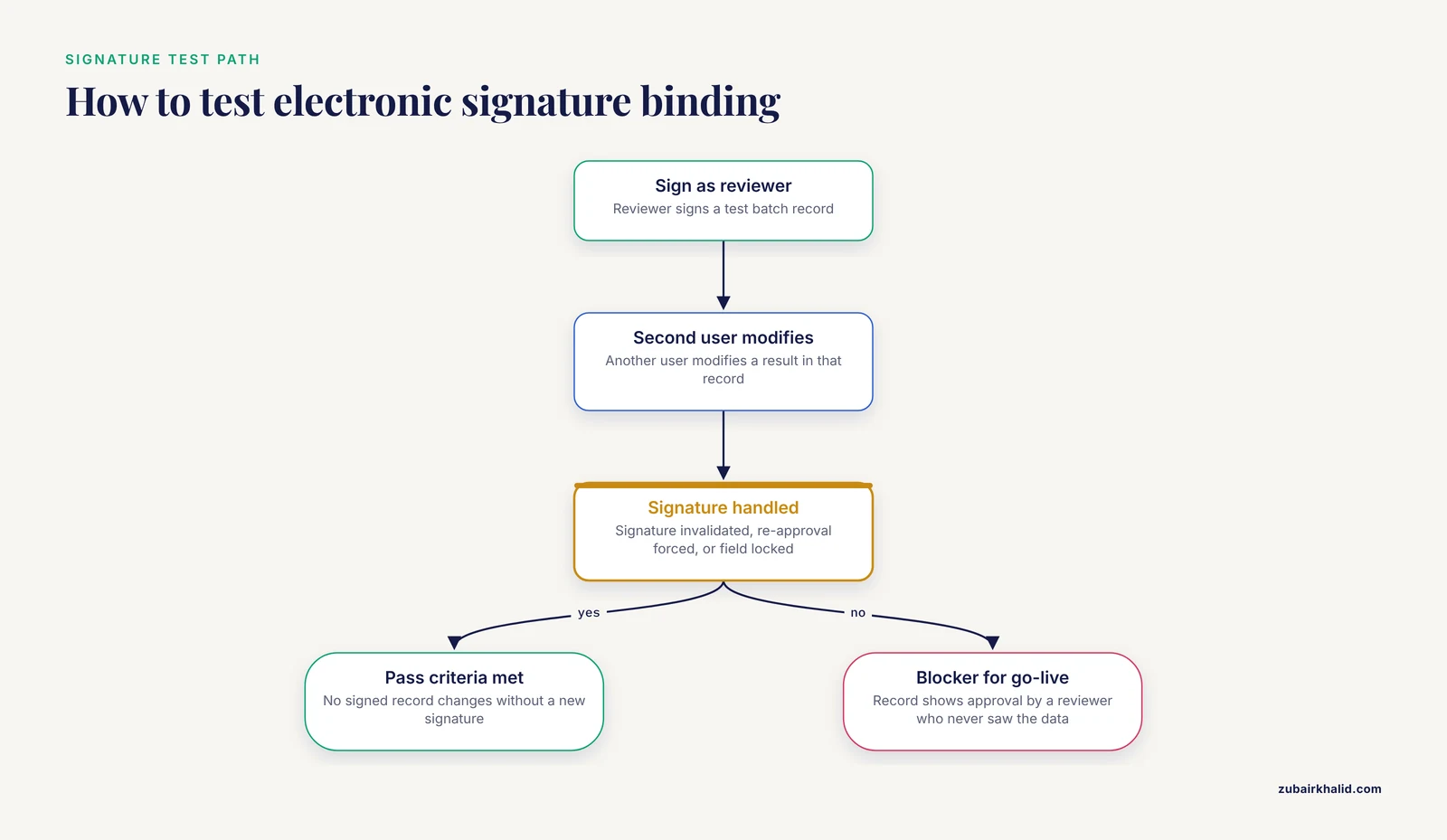
Sign a test batch record as a reviewer. Then, as another user, modify a result in that record. Verify that the system either invalidates the signature, forces re-approval, or locks the field. Pass criteria: no scenario exists in which a signed record changes without a new signature. A failure looks like this: the record shows "Approved by reviewer A" while containing data reviewer A never saw. That scenario is an automatic blocker for go-live.
Step 5. Configure deviation capture from the workflow
Enable the deviation or nonconformance module and link it to your batch record template. Trigger a simulated out-of-specification result in the test instance. Expected behavior: the LIMS offers a one-click path from the failing result to a deviation record pre-populated with the sample ID, test, result, specification, and analyst. Time this. If raising a deviation takes more than a couple of minutes or requires leaving the LIMS, analysts will not do it under production pressure, and your quality system quietly degrades.
Step 6. Bind terminology and units
Map your test catalog to standardized codes. If your domain uses LOINC for lab observations or SNOMED CT for clinical concepts, load the code sets and bind each local test name to a code. Given the mapping performance demonstrated for SNOMED CT in real clinical data [4], expect that most of your terms will map directly and a minority will need guideline-driven decisions. Document those decisions. A record that says "CRP, LOINC 1988-5, mg/L, 4.28" is defensible. A record that says "CRP 4.28" alone is not portable and invites ambiguity.
Step 7. Validate under your chosen framework
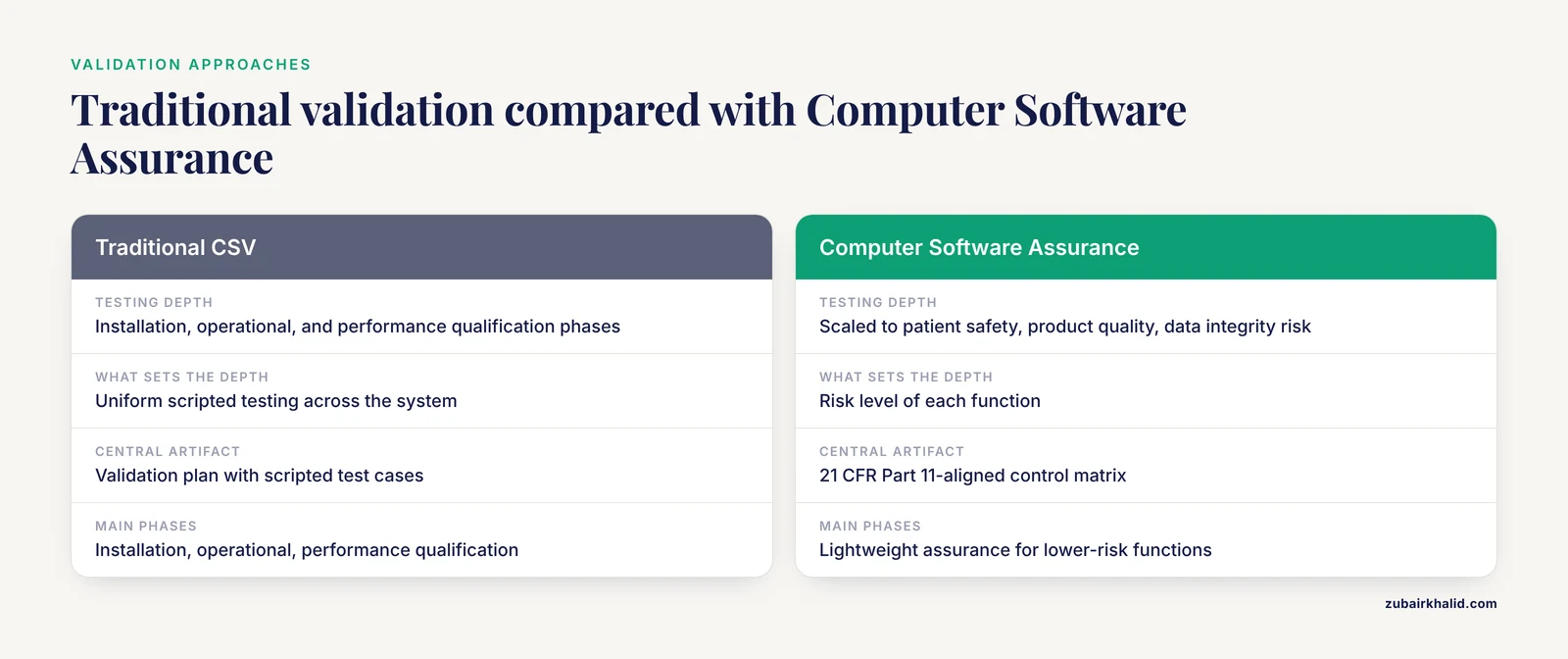
Computer system validation (CSV) is the documented process of proving that software does what it is supposed to do and does not do what it should not. The traditional model runs installation, operational, and performance qualification phases. The newer risk-based approach, Computer Software Assurance (CSA), scales testing depth to patient safety, product quality, and data integrity risk. A recent deployment for GLP/GMP-aligned theranostics operations applied CSA explicitly and produced a 21 CFR Part 11-aligned control matrix as its central validation artifact [3]. Whichever framework your quality unit mandates, produce a validation plan, execute scripted test cases against your numbered requirements, document every failure and its fix, and obtain formal approval before production use.
Step 8. Train users and control the go-live
Training must cover not just how to use the system but why the controls exist, because workarounds (shared logins, paper shadow records, backdated entries) destroy compliance faster than software gaps do. Freeze the configuration at go-live. Post-go-live changes go through change control with regression testing.
LIMS Regulatory Compliance Features Tips
- Buy the compliance features, configure the science. Choose a platform whose Part 11 controls are built in and tested by the vendor, then invest your effort in configuring workflows rather than building controls yourself.
- Write requirements before demos. Vendors demonstrate what they want to show. A numbered requirements document forces a feature-by-feature answer and exposes gaps early.
- Test the audit trail like an adversary. Try to delete records, edit history, share accounts, and backdate entries. What survives your attempts is your real compliance posture.
- Keep configuration lean. Every custom field and custom script you add must be validated and revalidated at each upgrade. The teams that sustain compliant systems over years tend to use native functionality wherever possible, a lesson consistent with the deliberate emphasis on user configurability over custom programming in the cellular manufacturing deployment [1].
- Plan for upgrade validation from day one. Ask vendors how patches are released and whether regression test packs are provided. A system that is compliant at installation but unvalidated after the third upgrade is a liability.
- Align terminology early. Binding tests to standardized codes is cheap at implementation and expensive after years of legacy records accumulate, as the terminology mapping literature makes clear [4].
- Watch the AI wave with a compliance lens. Industry consensus recommendations now explicitly address AI and machine learning integration in regulated bioanalysis [2], and early platforms are embedding large language model assistance for SOP generation and risk assessment inside Part 11-aligned frameworks [3]. Treat any AI-assisted output as draft content requiring human review under your existing document control process.
Common Mistakes and Limitations
- Treating validation as a one-time project. Systems change, vendors patch, workflows evolve. Validation is a lifecycle. The most common audit finding in this area is a system that was validated in year one and reconfigured in year three without requalification.
- Configuring the audit trail but not reviewing it. An audit trail nobody reads is an unchecked control. Schedule periodic audit trail review with a defined scope and document it.
- Ignoring the paper on the bench. If analysts record values on paper and transcribe later, your electronic records are secondhand. Design data capture so the electronic record is the original record at the point of performance.
- Over-customizing. Each customization multiplies validation and upgrade effort. The evaluation criteria used in the cellular manufacturing case explicitly weighed ongoing programming requirements for this reason [1].
- Assuming a vendor certificate transfers compliance. A vendor's Part 11 statement describes their software capabilities. Your configuration, your users, and your processes determine whether your use of the system is compliant. Shared responsibility, not transferred responsibility.
- Poor user role design. Giving everyone administrator rights "to keep things moving" defeats segregation of duties and is one of the fastest routes to a data integrity finding.
- Neglecting record retention and migration. Compliance features protect records while they live in the system. Plan for how records remain readable and attributable when you migrate platforms or reach retention limits.
- Overstating pilot metrics. When the theranostics platform reported a 23-day mean turnaround, 1456 quality-control checkpoints, and 43 deviation episodes across 187 pilot requests, the authors declined to interpret those values as efficiency or error-reduction gains because no comparable pre-deployment dataset existed [3]. Follow that standard in your own reporting. Describe pilot metrics as observations, not proven improvements.
- A general limitation. Regulations, guidance, and vendor capabilities evolve, and your organization's quality unit and applicable regulators define what is acceptable in your specific situation. Treat this guide as an implementation framework, not a substitute for your quality system.
Where the Field Is Heading
Three trends are reshaping compliant laboratory software. First, convergence of LIMS and QMS into single platforms with embedded risk-based assurance, as demonstrated in the CSA-aligned theranostics deployment [3]. Second, formal industry and regulatory attention to AI and machine learning inside regulated workflows, with successive workshop consensus documents addressing both implementation practice for new ELN/LIMS systems and agency perspectives on regulated bioanalysis and biomarker validation [2][6][7]. Third, the extension of compliance-grade information infrastructure into adjacent domains such as digital and AI pathology, where laboratory and image management systems now underpin everything from biobanking to companion diagnostic regulatory pathways [5]. Laboratories selecting systems today should favor architectures that can absorb these changes without wholesale revalidation.
Frequently Asked Questions
What is a LIMS for regulatory compliance?
It is a laboratory information management system whose configuration enforces record integrity requirements such as audit trails, electronic signatures, access control, and traceable sample lineage, so that records generated in the lab can withstand regulatory inspection.
Which regulations do LIMS compliance features address?
The most common are FDA 21 CFR Part 11 for electronic records and signatures, GLP and GMP quality requirements, ISO/IEC 17025 for testing laboratories, and CLIA for clinical laboratories, with specific feature-to-regulation mapping documented in your validation package.
Do I need to validate a commercial off-the-shelf LIMS?
Yes. Vendors can supply documentation and test evidence, but your organization remains responsible for validating the system as configured and used in your workflows.
What is the difference between a LIMS and an ELN?
A LIMS manages samples, workflows, inventory, and structured results across the laboratory, while an electronic laboratory notebook (ELN) captures experimental narrative and data at the bench. Many organizations now run them as an integrated pair.
Can a cloud-based LIMS be Part 11 compliant?
Yes. Compliance depends on the controls the system enforces and how you configure and oversee them, not on where the software physically runs, though cloud deployments add supplier assessment and data residency considerations.
How do electronic signatures work in a LIMS?
The signer authenticates with unique credentials, and the system attaches a permanent signature block to the record containing the signer's printed name, a timestamp, and the meaning of the signature such as "approved by," all under controls that prevent reuse or sharing of credentials.
How long does LIMS validation take?
It varies with system complexity, extent of configuration, and your quality framework, ranging from weeks for a lightly configured deployment to many months for a heavily integrated GMP environment, so plan it as a project phase with its own schedule and resources.
What is Computer Software Assurance and how does it change validation?
Computer Software Assurance is a risk-based approach that focuses testing effort on functions that affect patient safety, product quality, and data integrity, using lightweight assurance for lower-risk functions instead of uniform exhaustive scripted testing.
Sources
- Implementation of a configurable laboratory information management system for use in cellular process development and manufacturing.
- 2025 White Paper on Recent Issues in Bioanalysis: What is the Future of Bioanalytical LIMS? AI/ML Integration in Bioanalysis; Tear Sample Collection; Radiolabeled Mass Balance Studies; Chiral Assays; Bioanalysis of Antibody-Oligonucleotide & Bicycle Drug Conjugates (PART 1A - Recommendations on Mass Spectrometry Assays, Chromatography, Sample Preparation and Regulated Bioanalysis Sampling, Validating, Analyzing & Reporting PART 1B - Regulatory Agencies' Input on Regulated Bioanalysis/BMV).
- A cloud-enabled LIMS-QMS platform with large language model-assisted standard operating procedure generation for GLP/GMP-aligned theranostics laboratory operations.
- Real-World Applicability of Multiple International Terminology Systems in Oncology: Mapping Study of Clinical Terms for Cancer Diagnosis and Treatment.
- Operationalising digital and AI pathology in translational research and drug development: an infrastructure and regulatory perspective from biobank to companion diagnostic.
- 2025 White Paper on Recent Issues in Bioanalysis: Biomarkers Calibrators & Stability; Evaluation of NULISA; Neurofilament & Autoantibody Biomarker Assays; Removing IgM Interference; ELISpot & FluoroSpot Best Practices; Modular HD Cytometry; Single-cell Analysis Imaging Cytometry (PART 2A - Recommendations on Biomarkers Discovery, Development, Validation & Regulatory Approval, Ligand-Binding Assays (LBA) and Cell-Based Assays (CBA) PART 2B - Regulatory Agencies' Input on Biomarkers, IVD/CDx and Biomarker Assay Validation (BAV)).
- 2025 White Paper on Recent Issues in Bioanalysis: Redosing Patients with AAV Gene Therapy; CRS Immunogenicity Risk; Shedding Assays; NHP Studies Immunogenicity; CMC vs Bioanalytical Assays; Artificial Intelligence-Powered Genomic Pipelines for NGS (PART 3A - Recommendations on Gene, Cell, and Vaccine Therapies Immunogenicity & Technologies; Biotherapeutics & Biosimilars Immunogenicity Assessment & Clinical Relevance PART 3B - Regulatory Agencies' Input on Immunogenicity/Technologies of Biotherapeutics, Gene, Cell & Vaccine Therapies).