Lab Report Discussion: Limitations to Include and Mistakes to Avoid
By Dr. Zubair Khalid, DVM, MS, PhD ·

The most common failure in a lab report discussion is not a wrong result. It is a discussion that ignores its own weaknesses. Students either leave out limitations entirely, or they append a single apologetic sentence such as "human error may have occurred" and move on. Both choices cost marks and, more importantly, misrepresent the science. A discussion that cannot name what the experiment could not do is a discussion a reader cannot trust.
The first thing to check is simple. Read your conclusion, then ask what evidence a skeptic would demand before believing it. Every gap between that demand and your data is a limitation you should name. If your conclusion claims an enzyme's optimum pH is 7.2 based on three data points spaced one pH unit apart, the skeptic would ask for finer spacing and replicates. That request, translated into plain English, is your limitations paragraph.
This guide walks through where the discussion sits in a standard lab report format, the causes of weak or missing limitations from most common to rarest, concrete solutions, and the mistakes that appear over and over in graded reports.
Why the Discussion Carries the Interpretive Weight
A lab report has a fixed job. The introduction states the question. The methods describe what you did. The results show what happened. The discussion explains what it means, how it compares with published work, what the experiment could not establish, and what should come next. Interpretation is the discussion's exclusive responsibility, which is why graders weight it so heavily.
Research on how scientists actually write discussions shows that these sections do more than summarize. An analysis of 60 discussion sections from four leading management journals found that authors deploy a recognizable set of rhetorical appeals to argue for the value of their findings, and that a strongly promotional style dominates [1]. Translated to the teaching lab, this means a good discussion is an argument. Every argument needs an honest account of its weak points, because a claim presented without boundaries invites the reader to find those boundaries personally.
Published papers model the habit well. In a study of digital work platforms, the authors end their discussion by explicitly discussing limitations and future avenues for research [2]. A paper testing Conservation of Resources theory in a two-wave survey of 370 employees uses its discussion to state what the theory now explains better, then acknowledges what the design cannot rule out [3]. The pattern repeats across fields. Limitations are not an admission of failure. They are part of the argument's structure.
Where the Discussion Fits in the Lab Report Format
If you are learning how to write a lab report from scratch, anchor the discussion in the standard format used across biology, chemistry, physics, and engineering teaching labs.
- Title and abstract. The abstract compresses the whole report into a short paragraph, including one sentence on limitations in most published formats.
- Introduction. States the objective, background, and hypothesis.
- Methods. Describes materials, procedures, and analysis in enough detail for replication.
- Results. Presents data, tables, figures, and statistics without interpretation.
- Discussion. Interprets results, compares them with expectations and literature, states limitations, and proposes next steps.
- References. Lists cited sources.
Some formats merge Results and Discussion or add a separate Conclusion. Follow your instructor's or journal's specification. What never changes is that the discussion is the only section where limitations in lab report discussion belong. Placing them in the results section buries them. Placing them in the conclusion makes the conclusion defensive.
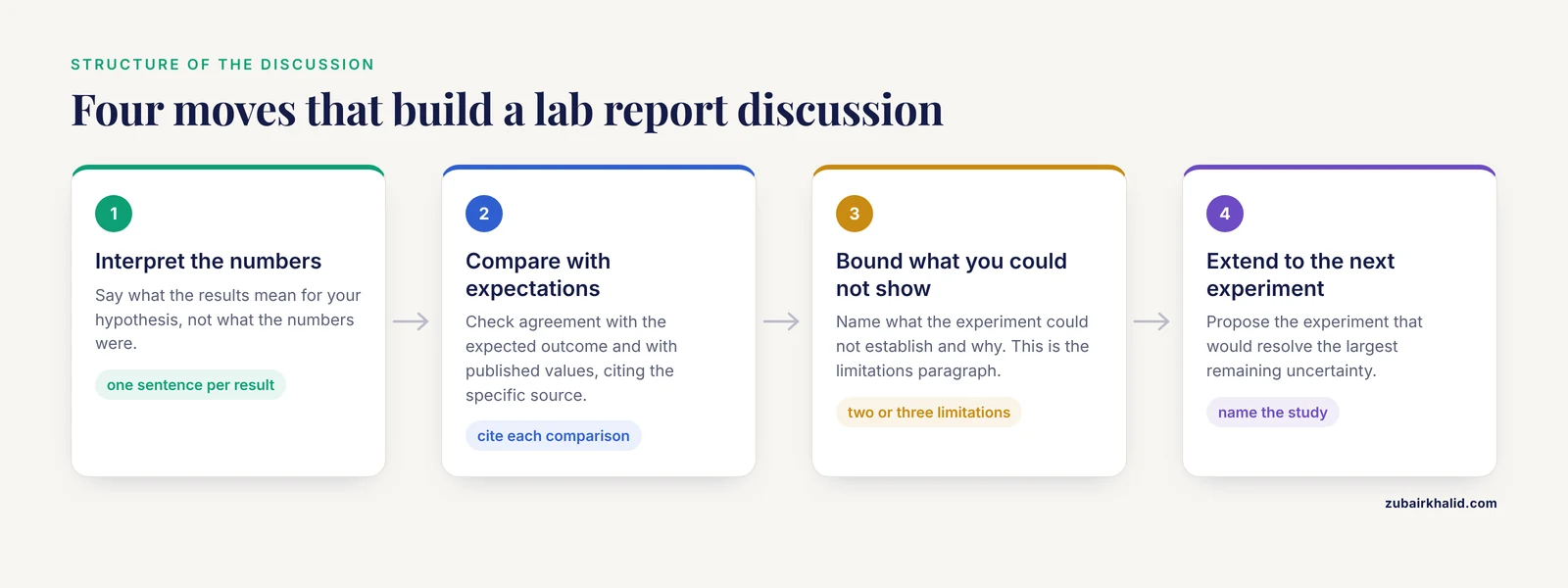
A practical discipline is to build the discussion around four moves, in order.
- Interpret. What do the numbers mean in terms of the hypothesis?
- Compare. Do the results agree with the expected outcome and with published values?
- Bound. What could the experiment not show, and why?
- Extend. What experiment would resolve the largest remaining uncertainty?
A useful worked example of the interpret move comes from an education study in which medical undergraduates created physical physiology exhibits. The authors report a median post-test score of 16 versus a pretest median of 12, with p less than 0.01, and interpret that gain as evidence the activity built higher-order skills [4]. Notice the structure. Number, comparison, significance test, plain-language meaning. Your discussion sentences should follow the same skeleton, and your limitations should target exactly the steps in that skeleton that your design weakened.
Troubleshooting Table: Symptoms, Causes, and Fixes
Use this table as a checklist during revision. Each row describes a visible symptom in a drafted discussion, the mechanism behind it, how to confirm the diagnosis, and the fix.
| Symptom in your draft | Likely cause | How to confirm | Fix |
|---|---|---|---|
| Discussion restates the results section | The interpret move was never made. You described data instead of explaining it. | Highlight every sentence that also appears (in substance) in Results. | Rewrite restated sentences to answer "why" and "so what." Each result should earn one sentence of meaning. |
| One vague limitation sentence at the end | Limitations were written last, under time pressure, without a list. | Ask whether a reader could design a better experiment from your limitation alone. | Replace the vague sentence with two or three specific limitations, each tied to a result it affects. |
| Conclusion is stronger than the data | Overclaiming. The promotional instinct described in published discussions ran ahead of the evidence. [1] | Underline every absolute verb (proves, confirms, demonstrates). Check whether the design supports that strength. | Downgrade verbs to suggests, indicates, is consistent with. Match claim strength to design strength. |
| Claims with no citations | Missing source work. Many students receive little formal training in building claims from sources. [5] | Check that every comparison with "the literature" points to a specific reference. | Add a citation for every factual claim about prior findings. Paraphrase rather than quote to avoid quotation errors. [5] |
| New data or new figures appear in the discussion | Results leaked into the interpretation section, usually numbers noticed during writing. | Scan the discussion for any number that is not already in Results. | Move the data to Results, or remove it. The discussion interprets, it does not present. |
| Limitations contradict the conclusion | The limitation undermines the very claim the conclusion asserts. | Read the conclusion, then each limitation, and test for direct conflict. | Revise the conclusion's scope so it stays inside what the limitations permit. |
| Limitations listed with no remedy | Limitations treated as a confession rather than an analysis. | Check whether each limitation is followed by a fix or a future experiment. | Pair every limitation with its most direct remedy or the next measurement that would resolve it. |
| Qualitative discussion feels shallow | Superficial analysis or missing transparency about how conclusions were reached. [6] | Ask whether the reader can trace your interpretation back to specific observations. | State your reasoning chain explicitly and acknowledge your own perspective where it shaped interpretation. [6] |
Limitations in Lab Report Discussion: Causes, From Most Common to Rarest
Understanding why limitations get mishandled helps you fix the writing rather than just patch the paragraph. The causes below run from the most frequent to the least.
Cause 1: Small sample size and no replicates
This is the single most common limitation in student lab reports. Mechanism: a small sample increases the influence of any single anomalous measurement, and without replicates you cannot distinguish a real effect from random variation. If you measured the melting point of a compound once, or ran a titration in triplicate but averaged without reporting the spread, your precision claim rests on thin data.
Include this limitation whenever your design has fewer than roughly five independent replicates per condition, or when you cannot state a measure of spread such as standard deviation. The fix you propose is usually straightforward. Repeat the measurement with more replicates and report variance.
Cause 2: Single-method or single-condition design
Mechanism: one technique measures one facet of a system. If you quantified bacterial growth by optical density alone, you cannot distinguish more cells from a change in cell size or clumping, because optical density conflates both. If you tested an enzyme at one temperature, you cannot claim anything about temperature dependence.
Include this limitation when your conclusion depends on a measurement choice. A single method is not a flaw in itself. The flaw is drawing conclusions the method cannot support. The remedy is a second, orthogonal technique, for example confirming optical density readings with a plate count.
Cause 3: Instrument precision and calibration limits
Mechanism: every instrument has a resolution and an uncertainty. A standard laboratory thermometer readable to 0.1 degree cannot resolve effects smaller than that. An uncalibrated pH meter drifts. When your expected effect is close to your instrument's noise floor, a null result may simply mean the instrument could not see the effect.
Include this limitation when the effect size you sought is small relative to your measurement uncertainty. Name the instrument, its resolution if you know it, and the direction of the bias if you can determine it. The remedy is a higher-precision instrument or a calibration step added to the protocol.
Cause 4: Uncontrolled variables and confounding
Mechanism: a confounding variable is one that varies with both your treatment and your outcome, so it can produce the pattern you observed without your hypothesized cause operating. In a teaching lab this often looks like batches run at different times of day, cultures at different passage numbers, or reagents from different lots.
Include this limitation when any variable differed across conditions and you did not hold it constant. Be specific. "Room temperature varied" is weak. "The afternoon trials ran approximately 4 degrees warmer than the morning trials, which could plausibly affect reaction rate" is a limitation a reader can act on. The remedy is holding the variable constant or randomizing its distribution across conditions.
Cause 5: Protocol deviations and human error
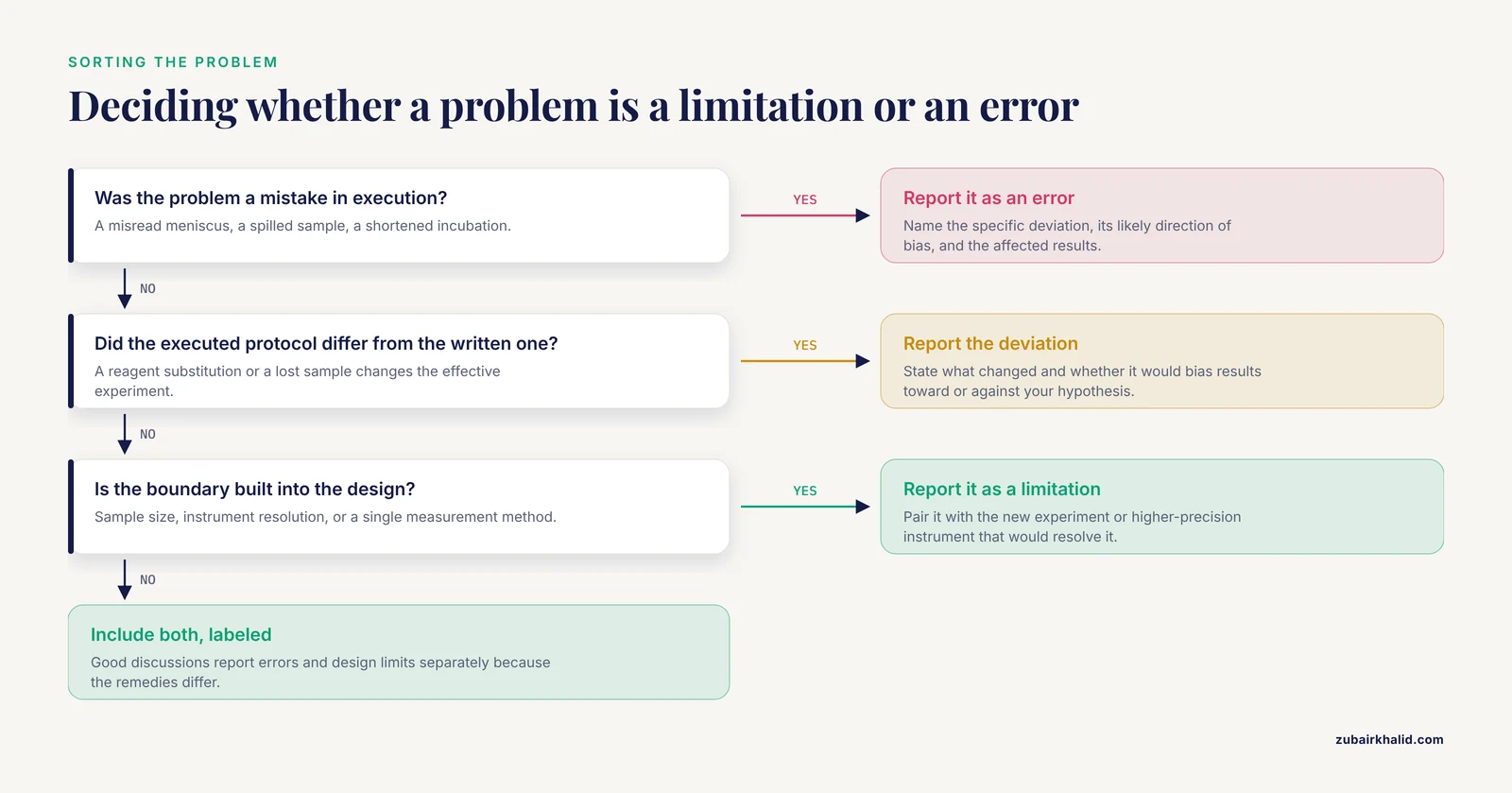
Mechanism: deviations change the effective experiment. A reagent substitution, a shortened incubation, or a lost sample means your methods section no longer describes what actually produced your data. This is the category where specificity matters most, because a reader deciding whether to trust your numbers needs to know exactly what changed.
Safety note. If a deviation involved a hazardous reagent, such as substituting a concentrated acid or an organic solvent, name the hazard class and check your institution's chemical hygiene plan or safety data sheet before repeating the procedure. Reporting the deviation in the discussion protects the next person who picks up the protocol.
Include this limitation whenever the executed protocol differs from the written one, even if you believe the difference was harmless. State the deviation, the direction of its likely effect, and whether it would bias results toward or against your hypothesis. The remedy is rerunning the affected trials under the written protocol.
Cause 6: Generalizability limits
Mechanism: results obtained in one system, one cell line, one species, or one set of conditions may not transfer to others. A reaction characterized in aqueous buffer at room temperature says little about behavior in a cell. A finding in one model organism is a hypothesis for others, not a conclusion about them.
Include this limitation when your conclusion uses broader language than your system supports. The remedy is not more data in the same system. It is an explicit statement of scope, followed by a proposal to test the effect in a second system where the question matters.
Cause 7: Weakness in the underlying assumption or model (rarest)
Mechanism: sometimes the limitation is not in execution but in the framework. If your analysis assumes a linear dose-response and the true relationship is saturating, your fitted parameters are wrong no matter how carefully you pipetted. If you assumed equilibrium was reached, but your incubation time was too short, every downstream calculation inherits the error.
This is the rarest and most serious category because it can invalidate the interpretation rather than merely narrow it. Include it when a checkable assumption was not checked. The remedy is a validation experiment, for example a time course confirming that equilibrium was actually reached, or an analysis under an alternative model to test whether conclusions survive.
How to Fix Limitations in Lab Report Discussion: Practical Solutions
The causes above produce recognizable symptoms, and each has a direct writing solution. The theme across all of them is that a limitation is only complete when it has three parts: what was limited, why it matters for a specific result, and what would resolve it.
Pair every limitation with a remedy. The weakest discussions list problems and stop. The strongest turn each problem into a next experiment. Published discussions do exactly this. The crowdwork study mentioned above closes by linking its limitations to concrete future research directions [2]. Follow that model. Instead of "the sample size was small," write "the sample size of three trials per condition limits our ability to detect small effects, and five or more replicates per condition would allow a formal test of variance."
Quantify whenever your data allow it. If you can put a number on a limitation, do it. State the coefficient of variation across replicates, the instrument resolution, or the size of the batch-to-batch difference. Numbers turn a vague apology into an assessment. When you report your own findings, mirror the clarity of published work. The physiology education study cited earlier does not say students "improved somewhat." It reports medians of 16 and 12 with a significance test, which is what makes its interpretation checkable [4].
Prioritize. Two or three substantive limitations beat eight trivial ones. Rank limitations by how much they could change your conclusion. A lost sample that reduced your treatment group is major. A thermometer readable only to 0.1 degree in an experiment where differences were 15 degrees is minor and may not need mention at all. Graders reward judgment, not volume.
Use calibrated hedging language. Scientific writing has a graded vocabulary of certainty. "Demonstrates" asserts. "Suggests" proposes. "Is consistent with" claims compatibility without causation. Match the verb to the design. Correlational data support "is associated with," never "causes." This vocabulary exists because readers use it to calibrate how much a finding should update their beliefs.
Build claims on sources used correctly. When you compare your results with published values, cite the specific source and represent it accurately. Practical guidance for student researchers emphasizes that weak citation habits, including citation bias and quotation errors, are common precisely because formal training in crafting and positioning claims is rare [5]. Check each citation by rereading the sentence in the original source. A comparison with literature you have not actually read is a limitation you have not disclosed.
For qualitative or observational labs, make your reasoning transparent. Not every lab experiment produces numbers. If your report interprets observations, microscopy images, or interview-style data, the same rigor applies in a different form. Reviews of qualitative analysis practice identify superficial analysis and lack of transparency as the chief threats to credibility, and identify reflexivity, meaning explicit awareness of how the analyst's perspective shapes interpretation, as the countermeasure [6]. Write down the chain from observation to interpretation so a reader can audit it.
Common Mistakes and Limitations
Beyond the causes, specific writing mistakes recur in graded lab reports. Each one below is fixable in a single revision pass.
- Confessing without analyzing. "Human error may have affected the results" tells a reader nothing. Which step, which error, which direction of bias, which result is most affected? Rewrite every generic error sentence into a specific one.
- Listing trivial limitations to look humble. Padding the limitations paragraph with inconsequential caveats signals that you cannot distinguish major from minor threats. Keep the two or three that genuinely bound your claims.
- Hiding the fatal limitation. If a deviation or design flaw undermines the central conclusion, saying so is not optional. A discussion that conceals a known flaw is worse than a discussion that reports a failed experiment, because it misleads the reader about the state of the evidence.
- Overclaiming causation. Observing that two variables moved together does not establish that one moved the other. Reserve causal verbs for manipulative designs where you controlled the presumed cause and held confounders constant.
- Introducing new results in the discussion. The discussion interprets data the reader has already seen. A new number appearing mid-discussion forces the reader to evaluate a claim without its supporting context. Move it to Results or cut it.
- Letting limitations contradict the conclusion. If a limitation says the instrument could not resolve small differences, the conclusion cannot report a small difference as established. Read the two sections against each other and reconcile the scope.
- Vague future work. "Further studies are needed" is filler. Name the experiment, the variable it would change, and the question it would answer. Discussions in published papers model this, extending their theoretical claims and then specifying the studies that would test them further [3].
- Ignoring the framework your field expects. A discussion gains force when it connects findings to a recognizable framework rather than leaving them floating. An HRM study illustrates the pattern. Its findings-and-discussion section ties empirical results directly to established theoretical constructs before turning to implications [7]. In a biochemistry lab, the equivalent framework is the reaction mechanism. In ecology, it is the model of population or community dynamics. Anchor your interpretation in the framework the course taught.
- Wrong citation, right-sounding claim. Grabbing a reference that seems adjacent without verifying it produces citation errors that experienced readers catch quickly. Verify every source against the specific claim it supports [5].
- Writing the discussion before digesting the results. A discussion drafted while you are still deciding what the data mean inherits that indecision. Finish your analysis, state your findings to yourself in one sentence each, and only then draft.
A Five-Step Diagnostic Sequence for Your Draft
Run this sequence on any discussion draft in under fifteen minutes.
- Extract your claims. List every factual assertion in your conclusion. Most drafts contain three to five.
- For each claim, ask what would falsify it. What measurement, control, or replicate would a skeptic require? Write it down.
- Compare your limitations list to that skeptic list. Every item on the skeptic list that is missing from your limitations paragraph is a gap. Add it, with its mechanism.
- Check that each limitation has a remedy. A limitation without a proposed fix reads as an excuse. Add the next experiment or the protocol change that would resolve it.
- Test the hedging. Read your conclusion aloud. Every absolute verb should trace to a design feature strong enough to support it. Downgrade the rest.
Prevention Practices
The cheapest limitations paragraph is the one you do not have to reconstruct after the fact.
- Keep a limitations log during the experiment. When a pipette fails, a sample is lost, a reagent lot changes, or a measurement surprises you, write it down that day with the date and the affected samples. This log becomes your limitations paragraph, written by the one person who knows the details.
- Note deviations in real time in your lab notebook. Standard notebook practice, strike through rather than erase, record what happened and why, exists precisely so that the deviation is documented while the details are fresh.
- Read the discussion sections of published papers in your field. Rhetorical analyses show that published discussions follow identifiable patterns of value claims and boundary setting, and that these patterns are consistent enough within a field to learn from [1]. Reading three or four discussions from your course's primary literature teaches the register faster than any rule list.
- Draft the limitations paragraph before the conclusion. Writing limitations first forces the conclusion to fit inside them, which prevents the contradiction error automatically.
- Do a dedicated limitations-only revision pass. On your final draft, read only the limitations paragraph and the conclusion, back to back, three times. The contradictions and overclaims that hide during a full read surface immediately when the two sections sit side by side.
- Verify citations as a separate step. Reread each cited source against the sentence that cites it, checking for quotation errors and misrepresentation [5]. Ten minutes here prevents the most embarrassing category of feedback.
Frequently Asked Questions
How long should the limitations section of a lab report discussion be?
There is no fixed length, but two or three substantive limitations, each with its mechanism and remedy, is a strong target for a teaching lab report. Depth matters more than count. One well-analyzed limitation with a proposed fix earns more credit than a list of six generic caveats.
Where do limitations go in the discussion section?
Place them after you interpret and compare your results, and before your final conclusion or future-directions statement. This order works because limitations flow naturally from the interpretation and set the boundaries within which the conclusion operates. Some formats use a dedicated Limitations subsection, which is appropriate for longer reports.
Should I admit errors in my lab report discussion?
Yes, whenever the error affected your data or interpretation. Name the specific deviation, its likely direction of bias, and the affected results. Concealing a known error misleads the reader and is treated far more harshly than the error itself. If the deviation involved a hazardous reagent, also check your institution's safety documentation before repeating the work.
What is the difference between limitations and errors?
Errors are mistakes in execution, such as a misread meniscus or a spilled sample. Limitations are boundaries built into the design, such as sample size, instrument resolution, or a single measurement method. Good discussions include both, clearly labeled, because they call for different remedies. Errors call for protocol corrections. Design limitations call for new experiments.
How do I write limitations without undermining my own conclusion?
Frame limitations as boundaries rather than refutations. State what your data support, then state the edge of that support. A conclusion hedged to match its evidence, using verbs such as "suggests" and "is consistent with," remains fully defensible alongside an honest limitations paragraph. Contradiction only arises when the conclusion claims more than the design delivered.
Can I suggest future research in the limitations section?
Yes, and you should. The cleanest structure pairs each major limitation with the future experiment that would resolve it. This is the convention in published literature, where discussions routinely close by connecting limitations to specific future research directions [2]. Avoid the empty phrase "further studies are needed." Name the study.
Do I need to cite sources when discussing limitations?
Cite sources when your limitation involves a comparison with published values, a methodological constraint documented in the literature, or a known property of your instrument or system. Claims about what previous studies found always require a citation, and the citation must accurately represent the source, since citation errors are a documented pitfall for student writers [5].
How do I know which limitations matter most?
Rank each candidate limitation by asking how much it could change your central conclusion. A limitation that could reverse your interpretation is major and belongs first. One that merely narishes the precision of a secondary claim is minor and may need only a sentence. If you are unsure, trace the limitation's effect through your analysis to the conclusion. If the chain is short and strong, the limitation matters.
Sources
- Crafting theoretical value in management research article discussion sections
- Digital Platforms of Work and the Crafting of Career Path: The Crowdworkers’ Perspective
- When digital-AI transformation sparks adaptation: job crafting and AI knowledge in job insecurity contexts
- Crafting of physical exhibits by undergraduate medical students: A mixed method study to assess the acquisition of higher-order cognitive skills and student perceptions.
- Building better citation practices in public health research: Practical considerations for student researchers, from source discovery to crafting and positioning claims.
- The Art of Analysis: Crafting Credible and Authentic Qualitative Results.
- Crafting Effective HRM Strategies for Enhancing Organizational Performance and Employee Engagement