How to Write a Letter of Inquiry for a Foundation Grant
By Dr. Zubair Khalid, DVM, MS, PhD ·

By the end of this guide you will be able to write a complete letter of inquiry (LOI) for a foundation grant, check it against what program officers actually look for, and decide when the letter is ready to send. The letter of inquiry is the short first document most private foundations ask for before they invite a full proposal. Get it right and you get a phone call or an invitation to submit. Get it wrong and the project stops there, usually with no detailed feedback.
Here is what you need on hand before you start:
- The foundation's own grant guidelines page, open in a browser tab
- A one-paragraph summary of your project that you can say out loud in under 60 seconds
- A rough total budget figure and the time span of the work
- Your organization's legal name, tax status information (for a US nonprofit, the EIN), and the name and title of the person authorized to sign
- A current two-page version of your biosketch or CV
- The email address or submission portal the foundation specifies, which is sometimes different from the general contact address on the website
You do not need special software. A plain text editor or a word processor is enough, because most LOIs are submitted as a PDF or pasted into an online form.
What a Letter of Inquiry Is and What It Is Not
A letter of inquiry is a short, structured summary of a proposed project, sent to a foundation to ask whether the funder would welcome a full proposal. Most foundations that accept unsolicited applications use this two-step process. The LOI protects the funder's time and protects yours, because a mismatch becomes clear in two pages rather than after weeks of proposal writing.
An LOI is not a compressed full proposal. It does not need a literature review, a detailed methods section, or itemized budget lines. It needs to answer five questions clearly:
- What problem are you addressing and why does it matter?
- What exactly will you do?
- Why are you the right person or team to do it?
- How much will it cost and over what period?
- Why does this project fit this foundation's mission right now?
That fifth question is the one applicants skip most often, and it is the one program officers scan for first.
Grant Proposal Planning Before You Write a Word
Good LOIs are mostly a product of planning that happens before drafting. The planning stage has three parts.
Confirm the fit
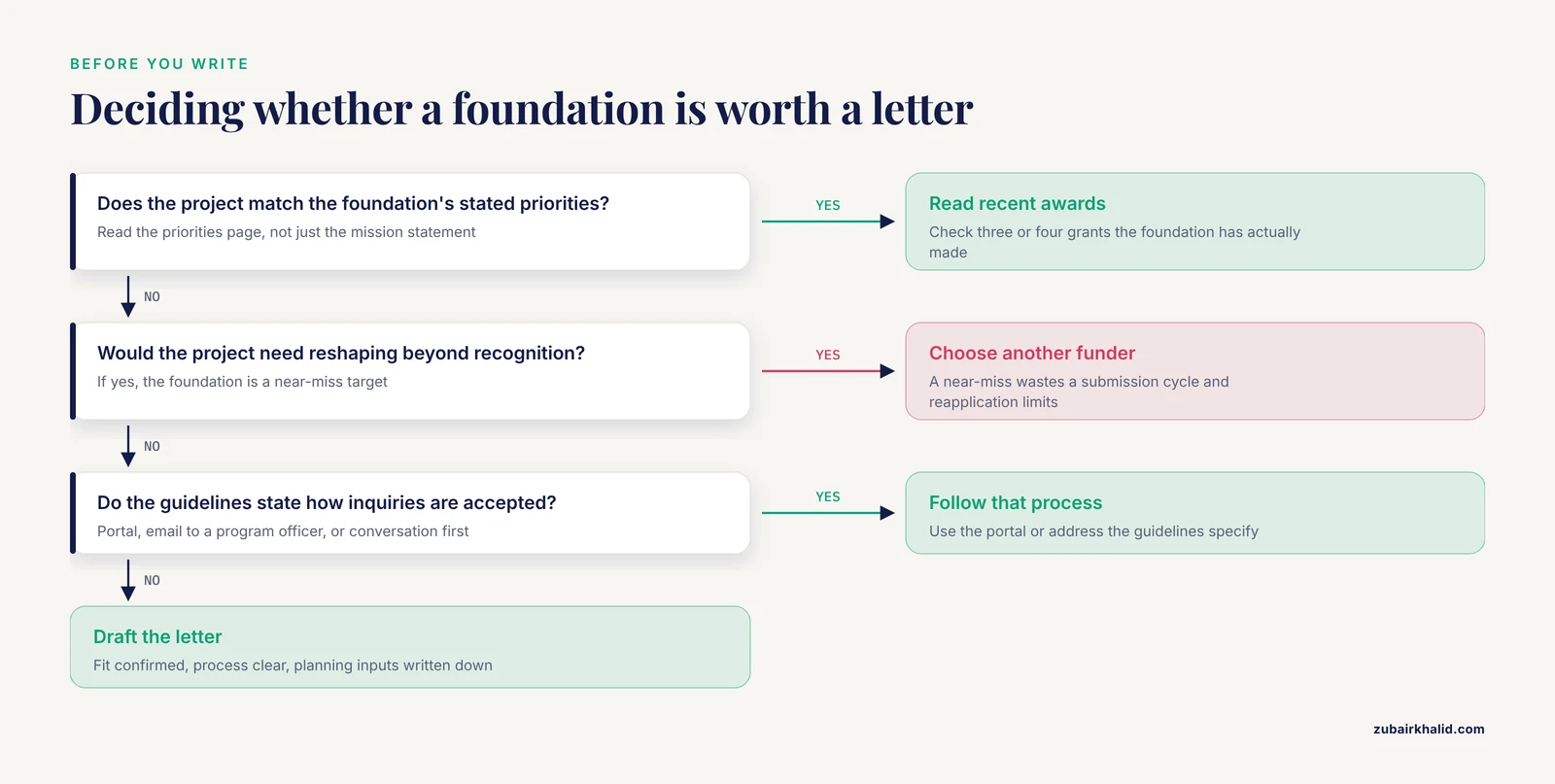
Read the foundation's stated priorities, then read three or four descriptions of grants it has actually made recently. Many foundations list recent awards on their website or in an annual report. If your project would need to be reshaped beyond recognition to fit, that foundation is not the right target. Writing an LOI to a near-miss funder wastes a submission cycle, because most foundations limit how often an organization can reapply.
Identify the correct contact and process
Foundations differ sharply in how they accept inquiries. Some use an online portal with word limits enforced by the form itself. Some accept a letter of intent by email to a program officer. Some formally discourage unsolicited contact and require an initial conversation first. Call or email the program staff if the guidelines leave any ambiguity. A two-minute question ("Do you accept LOIs from university-based investigators outside your current priority cycle?") can save you from sending a letter into a closed process.
Set your planning inputs
Before drafting, write down these five values in one place. You will use every one of them in the letter.
PLANNING INPUTS (fill in before drafting)
1. Funder name and program:        ____________________________
2. Funder's stated priority area:  ____________________________
3. Project title (working):        ____________________________
4. Total amount requested:         $ ____________
5. Project period:                 ____ months, from ______ to ______
A filled example for a life science project looks like this:
PLANNING INPUTS (example)
1. Funder name and program:        Brightwater Family Foundation,
                                   Environmental Health Program
2. Funder's stated priority area:  Community projects that reduce
                                   exposure to contaminated drinking water
3. Project title (working):        Rapid Field Screening for Lead in
                                   Private Wells in Three Rural Counties
4. Total amount requested:         $148,000
5. Project period:                 24 months, from July 2027 to June 2029
This is the stage where grant proposal planning either happens or does not. Applicants who skip it write letters that describe an interesting project with no visible connection to the funder, and those letters are declined regardless of scientific quality.
The Standard Letter of Inquiry Format for Foundation Grants
The letter of inquiry format used by most foundations follows the same skeleton. Lengths vary, and the funder's guidelines always override anything written here, but a typical LOI runs one to three pages and contains the elements below, in this order.
- Header and contact block. Your name, title, organization, address, phone, email, and the date. Address a specific person when you can, usually the program officer named in the guidelines.
- Opening paragraph. The amount requested, the project period, and a one-sentence statement of what you will do. Program officers triage hundreds of letters, so put the essentials in the first three sentences.
- Statement of need. Two or three sentences on the problem, anchored in the population or system affected. This is where your expertise shows, not where you show everything you know.
- Project description. A short paragraph on what you will actually do, including the approach in plain language and, if relevant, how you will know whether it worked.
- Organizational and investigator capacity. One paragraph on who you are and why your team or institution can carry out the work.
- Budget summary. Total request, project period, and a single sentence or short list on major cost categories.
- Fit with the funder. One explicit sentence connecting the project to the foundation's published priorities, ideally naming the program.
- Closing. A clear statement that you would welcome the opportunity to submit a full proposal, plus your contact information again.
- Signature block. Typed name, title, and the signature of the authorized official when a signature is requested.
One table that summarizes the format
| Section | Share of a 2-page LOI | What the reader checks | Most common failure |
|---|---|---|---|
| Opening | 5% | Amount, period, one-line purpose | Burying the ask in paragraph three |
| Need | 20% | Scale and urgency of the problem | Restating the literature instead of the need |
| Project description | 40% | Feasibility, clarity of approach | Vague methods, no measurable outcome |
| Capacity | 15% | Track record of the team | Listing credentials without relevance |
| Budget summary | 10% | Plausible total, clear period | Round numbers with no justification |
| Fit with funder | 10% | Explicit link to stated priorities | Generic mission language |
Step-by-Step Walkthrough: Building the Letter
The walkthrough below uses a plain text template you can copy, fill, and then format in your word processor. Work through the steps in order. Each step shows the template fragment, then the filled example, so you can see what finished output should look like.
Step 1. Open the letter with the contact block
[Your Name]
[Title], [Organization]
[Street Address], [City, State ZIP]
[Phone] | [Email]
[Date]

[Program Officer Name]
[Foundation Name]
[Foundation Address]
Filled example:
Maria Delgado, PhD
Assistant Professor, Department of Environmental Health
Ridgeline State University
410 Campus Drive, Riverton, OH 44100
(555) 555-0142 | [email protected]
November 11, 2026

Ms. Anne Whitfield, Program Officer
Brightwater Family Foundation
900 Grant Avenue, Suite 200, Columbus, OH 43215
Step 2. Write the opening paragraph
State the request, the period, and the project in three sentences or fewer. The formula is: amount, period, what, for whom, and why it fits.
Template:
Dear [Program Officer Name]:

[R Organization] requests $[amount] over [N months/years] from
[Foundation] to [one-sentence purpose]. This project will [what it
does] for [population or system]. We believe this work aligns
directly with [Foundation]'s priority on [named program or priority].
Filled example:
Dear Ms. Whitfield:

Ridgeline State University requests $148,000 over 24 months from
the Brightwater Family Foundation to pilot rapid field screening
for lead in private drinking water wells across three rural Ohio
counties. The project will test 400 household wells and deliver
results and remediation guidance directly to participating
families. We believe this work aligns directly with the
Foundation's Environmental Health Program priority on reducing
exposure to contaminated drinking water.
Check your output by covering everything after the first paragraph and asking whether a stranger could state the project's purpose, size, and duration. If not, revise before moving on.
Step 3. Write the statement of need
Two or three sentences. Name the affected population or system, describe the gap, and give one concrete grounding detail. In the sciences, resist the temptation to write a mini literature review here. The LOI reader needs to understand the problem, not evaluate your scholarship.
Private wells are not covered by municipal water testing programs
in our region, and many households have not had their water tested
in the past decade. Children and pregnant residents in the three
target counties are the groups most exposed to this gap. Our
preliminary conversations with county health departments confirm
both the concern and the demand for testing.
If your field produces a number that captures the problem, and that number appears in a published source you can name in a full proposal, use it here sparingly. If you cannot point to where the number came from, describe the problem qualitatively rather than inventing a figure.
Step 4. Write the project description
This is the longest section. Answer what you will do, how, and how you will judge success. A compact structure that works well:
- What: the core activity in one sentence
- How: two or three sentences on the approach, in language an educated non-specialist can follow
- Timeline: the major phases with months
- Success measure: what will be different or known at the end
Project description. We will purchase and validate two portable
field analyzers for lead screening, train two community health
workers to collect samples, and test 400 household wells over two
years. In months 1 to 6 we will validate the field method against
a certified analytical laboratory on 50 paired samples. In months
7 to 18 we will conduct household testing, prioritizing census
tracts with older housing stock. In months 19 to 24 we will
deliver individual results with remediation guidance and compile
a county-level map of findings for the health departments. The
project will be measured a success if 400 wells are tested, all
participating households receive actionable results, and the
county partners adopt the screening protocol for continued use.
Notice what this paragraph does. It names a number of wells, a number of validation samples, defined phases with month ranges, and a definition of success. A reader can picture the project. Compare that to a paragraph that says the project will "leverage innovative methodologies to address critical water quality challenges," which lets the reader picture nothing.
Step 5. Write the capacity paragraph
One paragraph. Connect your track record to this project's demands rather than listing your full CV.
Dr. Delgado has led two previous studies of trace metal
contamination in rural water systems and manages an analytical
laboratory on campus. The university's Office of Research will
administer the award, and the three county health departments
have provided letters expressing willingness to collaborate.
Step 6. Write the budget summary
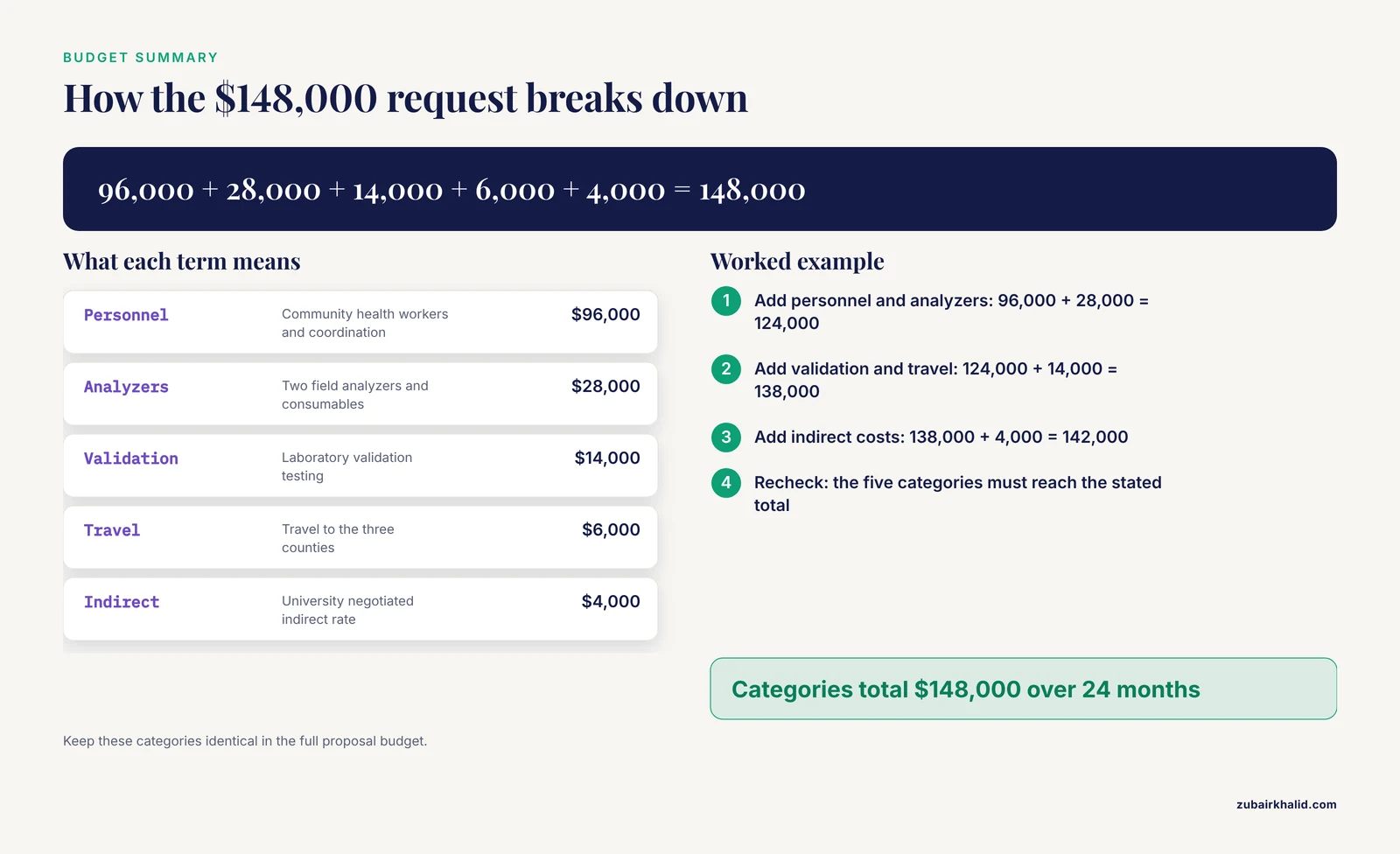
Total amount, period, and a one-sentence or short-list breakdown of major categories. Do not attach a detailed budget unless the guidelines ask for one at this stage.
The total request of $148,000 covers personnel for the community
health workers and project coordination ($96,000), the two field
analyzers and consumables ($28,000), laboratory validation
testing ($14,000), travel to the three counties ($6,000), and
indirect costs at the university's negotiated rate ($4,000).
Keep the categories consistent with what your full budget would show if invited. Program officers remember numbers, and a full proposal whose total differs sharply from the LOI total raises questions.
Step 7. Write the fit paragraph and closing
Name the program and, where you can, echo the funder's own words from its guidelines. Then close with a direct ask.
This project responds to the Environmental Health Program's
stated interest in practical, community-level interventions for
drinking water safety. We would welcome the opportunity to submit
a full proposal and to discuss the project with Foundation staff
at your convenience. Thank you for your consideration.

Sincerely,

Maria Delgado, PhD
Assistant Professor of Environmental Health
(555) 555-0142 | [email protected]
Step 8. Assemble, format, and check length
Merge the sections into a single document. Unless the guidelines say otherwise, use standard business letter formatting, a readable font at 11 or 12 points, and single spacing with a blank line between paragraphs. Convert to PDF and check that the file name is professional: something like Delgado_Ridgeline_LOI_Brightwater_2026.pdf rather than final_v3(2).pdf.
Step 9. Verify against the guidelines before sending
Run this checklist, which mirrors what program staff typically screen for on first read:
LOI PRE-SUBMISSION CHECKLIST
[ ] Length within the funder's stated limit
[ ] Amount and period stated in the first paragraph
[ ] Funder's program name used verbatim in the fit paragraph
[ ] Every acronym spelled out at first use
[ ] Budget total consistent throughout the letter
[ ] Authorized signatory named if the guidelines require one
[ ] Contact email checked for typos (this is where letters go quiet)
[ ] PDF opens correctly and prints on the expected number of pages
[ ] Submitted through the portal or address the guidelines specify,
    before the stated deadline in the funder's time zone
A Free Letter of Inquiry Template for Foundation Grants
The template below is the full assembled skeleton from the walkthrough, with bracketed fields you can fill in. Copy it into a document, replace every bracket, and delete any bracketed line the funder's guidelines do not ask for. This free letter of inquiry template for foundation grant applications works for research projects, community programs, and training grants with minor adjustments.
[Your Name]
[Title], [Organization]
[Street Address], [City, State ZIP]
[Phone] | [Email]
[Date]

[Program Officer Name]
[Foundation Name]
[Foundation Address]

Dear [Program Officer Name]:

REQUEST PARAGRAPH
[Organization] requests $[amount] over [period] from [Foundation]
to [one-sentence purpose]. This project will [core activity] for
[population or system]. This work aligns directly with
[Foundation]'s priority on [named priority].

STATEMENT OF NEED
[Two or three sentences: who is affected, what the gap is, one
concrete grounding detail.]

PROJECT DESCRIPTION
[What the project does, the approach in plain language, the major
phases with timing, and how success will be measured.]

ORGANIZATIONAL AND INVESTIGATOR CAPACITY
[One paragraph linking the team's track record to the specific
demands of this project. Note any partners and their commitment.]

BUDGET SUMMARY
Total request: $[amount] over [period].
[One sentence or short list of major cost categories.]

FIT WITH THE FUNDER
[One or two sentences naming the program and echoing the
funder's own priority language.]

We would welcome the opportunity to submit a full proposal and to
discuss this project with Foundation staff. Thank you for your
consideration.

Sincerely,

[Typed Name], [Credentials]
[Title]
[Phone] | [Email]
If your institution has an office of sponsored programs or foundation relations, ask whether it keeps a template tuned to the foundations in your region. Those offices often also review LOIs before they go out, which is free quality control.
Worked Letter of Inquiry Template Foundation Grant Example
The fragments above assemble into the following complete example letter. Use it as a calibration reference for tone and density, not as text to copy.
Maria Delgado, PhD
Assistant Professor, Department of Environmental Health
Ridgeline State University
410 Campus Drive, Riverton, OH 44100
(555) 555-0142 | [email protected]
November 11, 2026

Ms. Anne Whitfield, Program Officer
Brightwater Family Foundation
900 Grant Avenue, Suite 200, Columbus, OH 43215

Dear Ms. Whitfield:

Ridgeline State University requests $148,000 over 24 months from
the Brightwater Family Foundation to pilot rapid field screening
for lead in private drinking water wells across three rural Ohio
counties. The project will test 400 household wells and deliver
results and remediation guidance directly to participating
families. We believe this work aligns directly with the
Foundation's Environmental Health Program priority on reducing
exposure to contaminated drinking water.

Private wells are not covered by municipal water testing programs
in our region, and many households have not had their water tested
in the past decade. Children and pregnant residents in the three
target counties are the groups most exposed to this gap. Our
preliminary conversations with county health departments confirm
both the concern and the demand for testing.

We will purchase and validate two portable field analyzers for
lead screening, train two community health workers to collect
samples, and test 400 household wells over two years. In months 1
to 6 we will validate the field method against a certified
analytical laboratory on 50 paired samples. In months 7 to 18 we
will conduct household testing, prioritizing census tracts with
older housing stock. In months 19 to 24 we will deliver
individual results with remediation guidance and compile a
county-level map of findings for the health departments. The
project will be measured a success if 400 wells are tested, all
participating households receive actionable results, and the
county partners adopt the screening protocol for continued use.

Dr. Delgado has led two previous studies of trace metal
contamination in rural water systems and manages an analytical
laboratory on campus. The university's Office of Research will
administer the award, and the three county health departments
have provided letters expressing willingness to collaborate.

The total request of $148,000 covers personnel for the community
health workers and project coordination ($96,000), the two field
analyzers and consumables ($28,000), laboratory validation
testing ($14,000), travel to the three counties ($6,000), and
indirect costs at the university's negotiated rate ($4,000).

This project responds to the Environmental Health Program's
stated interest in practical, community-level interventions for
drinking water safety. We would welcome the opportunity to submit
a full proposal and to discuss the project with Foundation staff
at your convenience. Thank you for your consideration.

Sincerely,

Maria Delgado, PhD
Assistant Professor of Environmental Health
(555) 555-0142 | [email protected]
Note what the example does not contain. There is no literature review, no detailed methodology, no appendix, and no statement about how the project will transform the field. Every sentence either states a fact the reader needs or moves the request forward.
Common Errors and How to Fix Them
Unlike software, an LOI does not return error codes, but program officers and reviewers produce a recognizable set of decline messages. Each one below maps to a specific fix.
"The project does not align with our current priorities." This is the most common decline language for LOIs and it usually means the fit paragraph was missing or generic. Fix: name the program, echo the funder's own wording, and, when possible, reference the type of work the foundation has funded before.
"Insufficient detail to evaluate." The project description stayed at the level of aspiration. Fix: add the numbers. How many samples, participants, sites, or months. What happens in phase one versus phase two.
"Request exceeds program guidelines." The ask was above the funder's published range, sometimes by a lot. Fix: check the guidelines again, scale the pilot to fit, or state explicitly that this is a seed phase of a larger plan.
"Unable to confirm institutional approval." The letter went out without the signature or endorsement the funder requires, or with a request from an individual when the funder only awards to organizations. Fix: route the letter through your grants office before submission and confirm who must sign.
No response at all. Many foundations simply do not respond to LOIs they decline. Fix: note the funder's stated response time at submission, then follow up once, politely, after that window passes. Do not follow up weekly.
The form rejected the paste. Online portals often strip formatting and enforce word limits. Fix: keep a plain text master copy of your letter, paste from that, and count words in the plain text version before you start, not after the portal tells you that you are 40 words over.
How to Check That the Letter Is Ready
Three checks catch most problems.
The stranger test. Hand the letter to a colleague outside your subfield for two minutes. Then ask them to state the purpose, amount, duration, and funder fit from memory. If any of the four comes back wrong, that element needs revision.
The highlight test. Print the letter and highlight every sentence that would still be true if the funder's name were replaced with any other funder's name. A good LOI has highlights only in the need and capacity sections. If the entire fit paragraph survives the highlighter, it is generic.
The consistency check. Compare three numbers wherever they appear: the amount, the duration, and the primary deliverable count (wells tested, people enrolled, samples analyzed). They must match across the opening, the budget summary, and the closing. Mismatches between an LOI and a later full proposal are a known credibility problem.
After the LOI: Grant Proposal Planning for the Full Proposal
If the foundation invites a full proposal, your planning inputs change character. The one-paragraph project description becomes a specific aims page or a work plan. The budget summary becomes a justified, itemized budget. Keep the LOI on file during this expansion, because program officers compare the full proposal against it, and unexplained scope growth is a frequent review comment.
Two practices make this transition smooth. First, keep a single master planning document with the project's goals, methods, milestones, and budget categories, updated as conversations with the funder progress. Second, record every question a program officer asks during the LOI stage, because those questions tell you exactly what the full proposal must address.
If you are new to this process, structured training helps more than more templates. Many universities offer an internal research grant writing course through their office of research or a continuing education unit, and professional societies in your field often run short courses on foundation funding. A course will not write your LOI, but it will teach you to read a funder's guidelines the way a reviewer does, which is the underlying skill.
Common Mistakes and Limitations
- Writing to the funder you wish existed. Applicants describe a good project for a foundation that does not match. Read the funded-grants list, not just the mission statement.
- Leading with the science instead of the problem. Foundation program officers are usually not specialists in your subfield. An LOI that opens with methodological innovation rather than human or environmental impact reads as tone deaf.
- Treating the page limit as a target. If the limit is two pages, one and a half tight pages usually outperforms two full ones.
- Sending identical letters to multiple funders. Foundations within the same field talk to each other. A letter with another funder's program name left in it, an error that genuinely happens, ends discussions with both.
- Ignoring the response-time expectation. Some funders reply in weeks, others after a quarterly board cycle. Plan your timeline around the funder's cycle, not around your own deadline pressure.
- Assuming a decline is final. Some foundations decline an LOI but invite a resubmission after a revision, or suggest a different program. Read the decline message carefully before moving on.
- Budget language that cannot survive scrutiny. If you write a total in the LOI, be prepared to defend every component of it in the full proposal. Do not inflate to leave negotiating room, because the full proposal budget will be compared to the LOI.
- A general limitation. Every foundation sets its own process, and individual circumstances, such as your institution's tax status or the funder's current funding cycle, change what is appropriate. Confirm specifics against the funder's current guidelines, and consult your institution's grants office when requirements are unclear.
Frequently Asked Questions
How long should a letter of inquiry be for a foundation grant?
Most foundations ask for one to three pages, and some online forms enforce a word limit instead. Always follow the funder's stated limit, because exceeding it is one of the few errors that gets a letter set aside before anyone reads the content.
What is the difference between a letter of inquiry and a grant proposal?
An LOI is a short summary used to find out whether the foundation wants a full proposal, while the proposal is the detailed application with a full budget, methods, and supporting documents. Many foundations make awards only after both steps.
Where can I find a free letter of inquiry template for a foundation grant?
The template in this article is free to copy and adapt, and many university grants offices and foundation websites publish their own templates. The safest source is the funder itself, since some foundations provide a required LOI form rather than accepting a free-form letter.
Should a letter of inquiry be signed?
Follow the funder's instructions. Some foundations require the signature of an authorized institutional official, while others accept an email submission from the project lead with no wet signature.
How soon will a foundation respond to a letter of inquiry?
Response times range from a few weeks to several months depending on whether staff or a board makes the decision. The funder's guidelines often state an expected timeline, and if they do not, ask the program contact when you submit.
Can I send the same letter of inquiry to multiple foundations?
Adapting a core draft to several funders is normal practice, but each letter should be genuinely tailored, and you should not send the identical text with only the name changed. Some funders also ask you to disclose other pending requests for the same project.
What budget detail belongs in a letter of inquiry?
A total request, the project period, and a one-sentence breakdown of major cost categories are usually enough. Attach a full itemized budget only when the guidelines specifically request one at the inquiry stage.
Do I need to apply through an organization or can I apply as an individual?
Many foundations award only to tax-exempt organizations, while others run fellowship or individual-investigator programs. Check the eligibility section of the guidelines first, and if you are at a university, your sponsored programs office can confirm who the applying entity is.