Lab Report Template vs. Research Paper Template
By Dr. Zubair Khalid, DVM, MS, PhD ·

A lab report template documents a single experiment you already performed, for a reader who mainly wants to see what you did, what you found, and whether you understood it. A research paper template frames your findings as a contribution to the scientific record, for reviewers and journal readers who want to know what is new, why it matters, and whether the work holds up. The rule of thumb is simple: if the document closes out an assignment or an internal experiment, use a lab report template. If the document will be submitted, reviewed, published, or used to persuade a field, use a research paper template.
This guide explains what each template contains, compares them side by side on the criteria that actually decide which one you need, walks through realistic scenarios, and lists the mix-ups that cost students and early-career researchers the most time.
What a Lab Report Template Is
A lab report template is a pre-structured document that mirrors the life of one experiment. It assumes you started with a question or an assigned procedure, ran the experiment, collected raw data, and now need to present all of it in a predictable order. Most templates in undergraduate and early-graduate settings follow this sequence:
- Title and identifying information. Your name, course or lab group, date, and experiment number.
- Objective or purpose. One to three sentences stating what the experiment was designed to determine.
- Hypothesis. A testable prediction, often written as an if-then statement.
- Materials and equipment. A complete list, sometimes with quantities and concentrations.
- Methods or procedure. A numbered account of what you did, written so a peer could repeat it. In past tense, because the work is already done.
- Raw data. Tables, field notes, or instrument printouts, often transcribed from a lab notebook.
- Data analysis. Calculations, graphs, error propagation, and statistical summaries.
- Results. A plain description of what the data show, without interpretation.
- Discussion. Whether the hypothesis was supported, what sources of error mattered, and what you would change.
- Conclusion. A short restatement of what was learned.
- References. Often short, sometimes just the lab manual and a textbook.
The template exists because the reader already knows the experiment. An instructor assigning an enzyme kinetics lab does not need you to justify why enzyme kinetics matters. They need to verify that you executed the protocol correctly, recorded the data honestly, and can interpret the result. The lab report template enforces that verification.
Two features separate a lab report from nearly every other document you will write in science. First, it is account-based rather than argument-based. You are accounting for your time at the bench, not persuading anyone that a field should change direction. Second, it is self-contained. A lab report does not need to position itself against six months of prior literature, because the experiment usually sits inside a course or a defined project rather than inside an open research question.
What a Research Paper Template Is
A research paper template is a pre-structured document built around the IMRaD convention: Introduction, Methods, Results, and Discussion, usually wrapped in a title, an abstract, and a reference list. Nearly every journal in the life sciences expects this skeleton, and the templates provided by publishers, or the LaTeX and Word templates distributed by journals and preprint servers, hard-code it.
The research template does a fundamentally different job than the lab report template. It has to convince a skeptical reader that a gap in knowledge exists, that your approach can address it, that your results are trustworthy, and that the findings change something. Every section is built for that argument:
- Title and abstract. The abstract compresses the entire argument into roughly 150 to 300 words. A reader decides whether to continue based almost entirely on it.
- Introduction. Establishes the gap. A well-built introduction moves from what is known, to what is unknown, to how your work fills the unknown. For example, a study on blood-brain barrier organ-on-a-chip models opens by noting that type I collagen is the default brain-side matrix in most 3D systems even though the native brain extracellular matrix is mostly hyaluronic acid, then frames the whole study around testing whether that default choice biases the results [1]. That is the introduction doing its job: the reader knows within two paragraphs why the study had to be done.
- Methods. Written in enough detail that another lab could reproduce the work, including validation against reference standards. A diagnostic performance study, for instance, must report how specimens were classified against a composite reference standard and which regulatory approval standards the evaluation followed [2]. Multi-center studies go further and describe the harmonization process itself, such as a shared flow cytometry workflow for quantifying CAR-T cells that was validated across centers and paired with an external quality assessment scheme [3].
- Results. Presented in order of importance to the argument, with figures designed to carry the claims. Results sections also benchmark against controls or baselines so the reader can judge whether the headline numbers mean anything. In one gait-analysis study, deep learning models all produced impressive prediction accuracy, but only the Transformer model beat a simple mean-waveform baseline, which is exactly the kind of comparison a results section exists to surface [4].
- Discussion. Interprets the results against the introduction's gap, states limitations, and proposes what comes next.
- References. Deep and specific, often 30 to 80 entries, each traceable to a claim.
A research paper template also varies by paper type. A primary research article follows full IMRaD. A review article restructures the same apparatus around synthesis, as in a review of human photoaging skin models that organized 43 curated studies into clinical and ex vivo categories and mapped the biomarkers each model can assess [5]. Methods papers, case reports, and short communications all use recognizable variants of the same skeleton, which is why learning IMRaD once pays off across an entire career.
Lab Report Template vs. Research Paper Template: Side-by-Side Comparison
| Criterion | Lab Report Template | Research Paper Template |
|---|---|---|
| Primary audience | Instructor, TA, lab supervisor, internal team | Peer reviewers, journal editors, the broader field |
| Core purpose | Account for one experiment and demonstrate competence | Advance an argument and claim a contribution |
| Standard skeleton | Objective, hypothesis, materials, procedure, data, results, discussion, conclusion | Abstract, introduction, methods, results, discussion, references (IMRaD) |
| Introduction depth | One short paragraph, mostly restating the assignment's goal | Multiple paragraphs building from known to unknown to your contribution |
| Methods detail | Complete but compact, often adapted from a provided protocol | Exhaustive and reproducible, including validation, controls, and analysis pipelines |
| Raw data | Frequently included or appended | Almost never included, summarized in figures and tables, deposited in repositories |
| Data status | Experiment already completed in a course or project | Completed, but framed as part of an ongoing research program |
| Citation load | Light, often just the lab manual and one or two texts | Heavy, every claim of fact tied to a source |
| Tone | First person acceptable, plain narration | Formal, claims hedged to match evidence |
| Typical length | 3 to 10 pages | Varies by journal, commonly 4,000 to 8,000 words for a primary article |
| Who checks it | One instructor or supervisor | Two or more independent peer reviewers plus an editor |
| Reuse value | Low, usually archived after grading | High, becomes part of the citable literature |
| Template source | Course website, department handout, institutional VLE | Journal author guidelines, publisher Word or LaTeX files, preprint server templates |
The Difference Between Lab Report and Research Paper Templates, Explained
The comparison table shows the what. The deeper difference between lab report and research paper templates is the reader's question. A lab report reader asks, "Did this student do the work correctly and understand it?" A research paper reader asks, "Should the field update its thinking because of this document?" Every structural choice flows from that difference.
Consider how each template treats the introduction. A lab report introduction can be three sentences because the reader shares your context. A research paper introduction must earn its existence, because the reviewer is checking whether the study was necessary at all. The introduction of the medicinal chemistry study on benzo[b]thiophene-linked bis-oxadiazoles does this by establishing that both scaffolds carry known biological value, that combining pharmacophores is a recognized strategy, and that the specific combination was untested against colorectal and breast cancer cell lines [6]. Strip that reasoning out and the paper has no justification, no matter how good the data are.
Methods sections diverge the same way. In a lab report, you describe the procedure you were handed, noting any deviations. In a research paper, the methods section is where credibility lives, and reviewers attack it first. When twelve national reference laboratories ran a whole-genome sequencing comparison on foodborne Staphylococcus aureus, the interesting findings were about the workflow itself, including the fact that bioinformatics pipelines, not DNA extraction, drove most of the variability in typing results and enterotoxin gene detection [7]. A lab report version of that work would have simply logged the steps. The research paper version turned the workflow into the finding.
Results presentation also differs. Lab reports walk through data in the order collected, because the point is faithful accounting. Research papers order results to build the argument, saving the strongest comparison for maximum impact. And discussion sections differ most of all: a lab report discussion asks "did my hypothesis hold and what errors occurred," while a research paper discussion asks "what does this mean, what can it not tell us, and what should be tested next."
One more difference deserves attention: writing for the audience you actually have. Reader awareness is a live research topic, not just writing advice. A recent prospective study tested AI-simplified radiology reports with 98 outpatients and found that reports rewritten in plain language changed what patients understood and how safely they interpreted their own results, which is a direct reminder that the same data demand different documents for different readers [8]. A lab report and a research paper describing the same experiment differ in exactly this way.
When to Use a Lab Report
Use a lab report template in these situations:
- Course assignments. Any assigned practical, from introductory biology through advanced graduate rotations, almost always expects a lab report unless the syllabus says otherwise.
- Internal documentation. When your own team needs a record of what was run, on what samples, with what controls, a lab report format captures it without publication overhead.
- Technique training. Learning a new protocol, such as a western blot or a flow cytometry panel, and needing to demonstrate that you ran it and can interpret the outputs.
- Preliminary or pilot data summaries. Before a finding is ready for the literature, an internal lab report format is the right container for it.
- Compliance and routine testing contexts. Many quality-control and diagnostic laboratories use report formats that share the lab report's DNA: identified samples, stated methods, results, and a sign-off.
The signal that a lab report is the right choice is closure. If the document ends the life of the experiment, whether with a grade, a sign-off, or an archived record, the lab report template fits.
When to Use a Research Paper Template
Use a research paper template in these situations:
- Journal submission. This is non-negotiable. Journals supply their own templates and author guidelines, and deviations from them are a common desk-rejection trigger.
- Thesis and dissertation chapters. Most life science theses are assembled from research-paper-shaped chapters, which later convert into publications.
- Preprints. Services such as bioRxiv and medRxiv accept manuscripts built on standard IMRaD templates, and posting a preprint is now routine in many fields.
- Grant applications and progress reports. The argument structure of a research paper, gap, approach, results, significance, maps directly onto grant writing.
- Conference proceedings. Many meetings publish extended abstracts or full papers using journal-style templates.
- Any claim that others will build on. If someone else might cite your finding, it needs the reproducibility apparatus of a research paper.
The signal that a research paper is the right choice is contribution. If the document is meant to change what others know or do, the research template fits.
How to Choose: The Criteria That Decide Real Choices
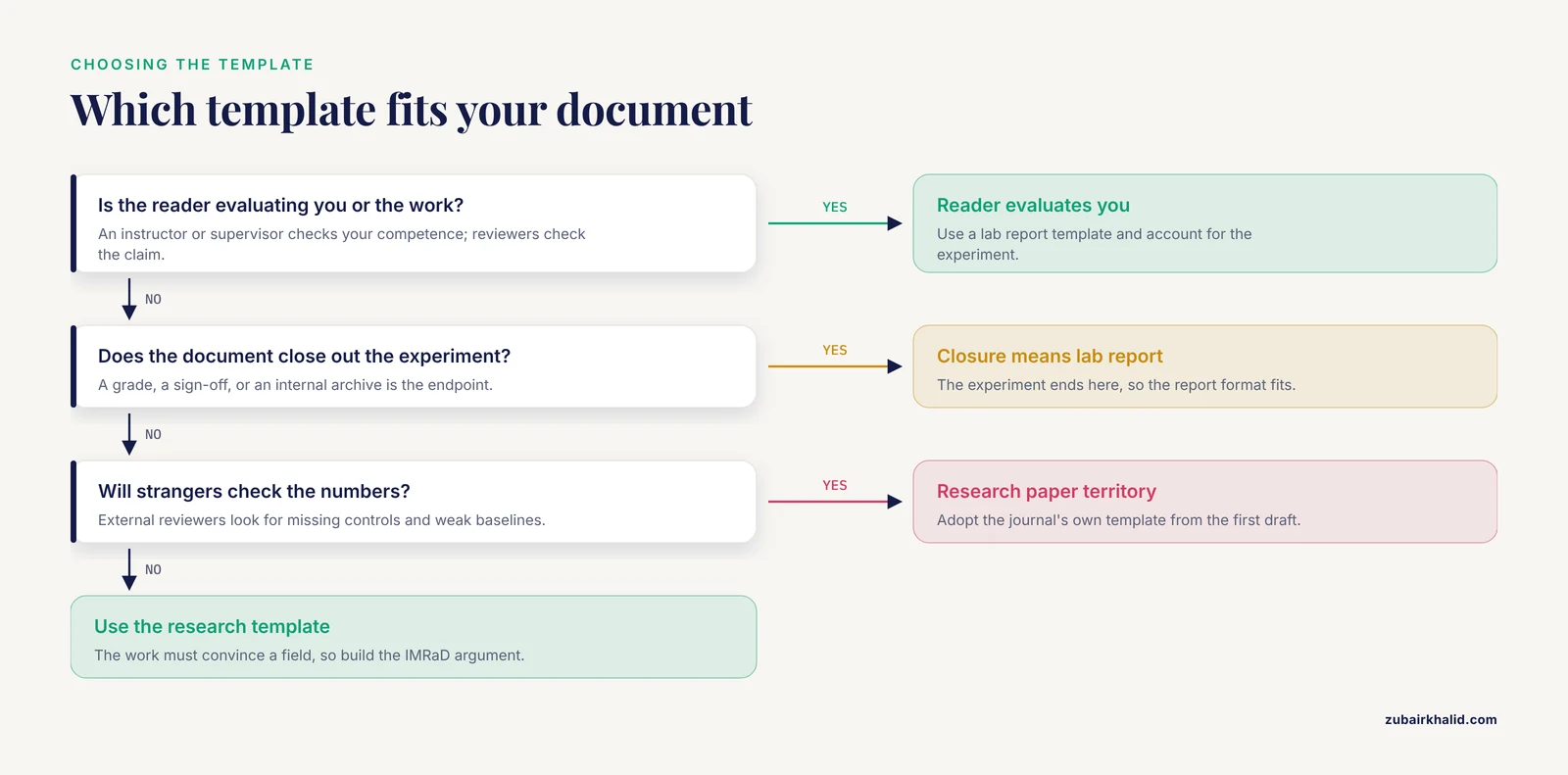
Four criteria settle almost every decision between the two templates.
Criterion 1: Who reads it, and what do they decide? If the reader is evaluating you, use a lab report. If the reader is evaluating the work, use a research paper. This distinction explains why writing for your actual reader matters so much that researchers now build systems around it, such as simplified patient-facing report generation evaluated for both understandability and clinical safety [8].
Criterion 2: Is the experiment self-contained or part of a conversation? A self-contained experiment, done once, inside a defined frame, belongs in a lab report. An experiment positioned against prior literature, contributing to an open question, belongs in a research paper.
Criterion 3: What does reproducibility require? Ask whether another person, with no access to your course or your lab, could repeat the work from your document alone. If yes is achievable at reasonable length, either template works. If full reproducibility demands validated pipelines, reference standards, and quality thresholds, as it does in modern molecular work [2] [7], you are in research paper territory.
Criterion 4: Will the numbers face outside scrutiny? Lab report data are checked by one person who watched you work. Research paper data are checked by strangers who will look for missing controls, weak baselines, and unsupported claims. The benchmarking culture of good papers, where models are tested against simple baselines rather than only against each other [4], reflects that scrutiny.
Worked Scenarios
Scenario 1: The undergraduate physiology practical. You measured reaction times under two caffeine conditions. The syllabus asks for a report due in two weeks. Use a lab report template. State the hypothesis, list materials, describe the randomized procedure, present reaction time distributions, run a simple significance test, discuss expectancy effects as a limitation, and close with a conclusion. A research paper template here would force you to fabricate a literature review and inflate a class exercise into a fake contribution, which is the most common form of this mistake.
Scenario 2: The rotation project that worked. Your six-week rotation produced a clean result with a new organoid differentiation protocol. Your supervisor asks what to prepare. Start with a lab report for the internal record, then migrate the content into a research paper template once the decision is made to publish. The methods, figures, and raw data transfer directly. The introduction and discussion get written fresh, because the argument now has to satisfy reviewers rather than one supervisor.
Scenario 3: The multi-lab collaboration. You are coordinating a comparison across four laboratories running the same assay. This is unambiguously research paper territory. The interlaboratory comparison literature shows why: the value of such work comes from quantifying variability across centers, identifying which workflow stages cause it, and recommending harmonized thresholds, all of which only matter when written up for the field [3] [7]. Your template choice should be the journal's own author template from day one, because retrofitting a lab report into IMRaD at submission time is slow and error-prone.
Scenario 4: The methods-heavy project. You built and validated a predictive model. A lab report would bury the validation under narrative. A research paper template forces the right structure: state the modeling question in the introduction, document architectures and inputs in methods, report accuracy alongside baseline comparisons in results, and interpret generalization limits in the discussion [4]. When a project's credibility depends on its analysis pipeline, choose the research paper template even if nothing is scheduled for publication yet.
Scenario 5: The lab notebook handoff. You are leaving a lab and need to hand over your work. This is where a lab notebook template PDF earns its place, which is a different document from both. A lab notebook template PDF captures the daily record: dated entries, reagent lot numbers, instrument settings, sketches, and deviations from protocol. It feeds both the lab report and the research paper but replaces neither. Think of the notebook as the source, the lab report as the internal summary, and the research paper as the public product.
Common Mistakes and Limitations
Mistake 1: Padding a lab report with fake literature review. Students told to "write it like a paper" often paste in two pages of generic background. Instructors see through this instantly, and it displaces the content that actually earns marks: correct data handling and honest error analysis.
Mistake 2: Submitting a lab report to a journal. The reverse error is more damaging. A manuscript with an assignment-style introduction, undeposited data, and a three-entry reference list will be rejected before review. If you intend to publish, adopt the journal's research template from the first draft.
Mistake 3: Confusing the lab notebook with either document. The notebook is a chronological raw record. The lab report and research paper are curated documents derived from it. A lab notebook template PDF with dated pages and structured fields protects you in all three cases, but it is not a substitute for the written report.
Mistake 4: Copying the methods from the handout verbatim. In a lab report, fine. In a research paper, methods must describe what you actually did, including deviations, reagent details, and analysis choices. Interlaboratory studies demonstrate that those analysis choices, not just bench technique, change the results, so a copied methods section is a reproducibility failure.
Mistake 5: Hiding limitations. Lab reports often treat error discussion as an admission of failure. Reviewers read it the opposite way, as evidence of competence. State the limitations plainly and once.
Mistake 6: Treating the abstract as an afterthought. A lab report may not need an abstract at all. A research paper abstract is the most-read section of the paper and should be drafted last, when the argument is stable.
A general limitation applies to all template advice: your instructor, supervisor, or target journal sets the real requirements, and their instructions override any generic template. Check the assignment sheet or the author guidelines before you start writing.
Frequently Asked Questions
Can I use a research paper template for a lab report?
You can, but you should not in most cases. The research paper template forces you to write an argument-heavy introduction and an extensive literature-grounded discussion that a lab report does not need, while burying the raw data and procedural detail your instructor wants to see. Reserve the research template for work that will face external review.
When should I use a lab report instead of a research paper?
Use a lab report whenever the document closes out an experiment for an internal reader, such as a course assignment, a rotation summary, or a team record. Use a research paper when the document must convince external reviewers that the work contributes new knowledge. If a grade, sign-off, or internal archive is the endpoint, the lab report is the right template.
What is the biggest structural difference between the two templates?
The introduction and the reference list. A lab report introduction is a short statement of purpose with minimal citations. A research paper introduction builds a case across multiple paragraphs and depends on a deep reference list, because the paper must justify why the study was needed at all.
Is a lab notebook template PDF the same as a lab report template?
No. A lab notebook template PDF structures the raw daily record of bench work, with dated entries, reagent lots, and observations. A lab report template structures the curated document written after the experiment. The notebook feeds the report, but the two serve different purposes and neither replaces the other.
Do lab reports need references?
Usually yes, but lightly. Most lab reports cite the lab manual, one or two textbooks, and any primary paper the assignment builds on. Some introductory courses waive references entirely. Research papers, by contrast, require a citation for essentially every claim of fact, so a sparse reference list is a red flag in a manuscript but normal in a lab report.
Can a lab report later become a research paper?
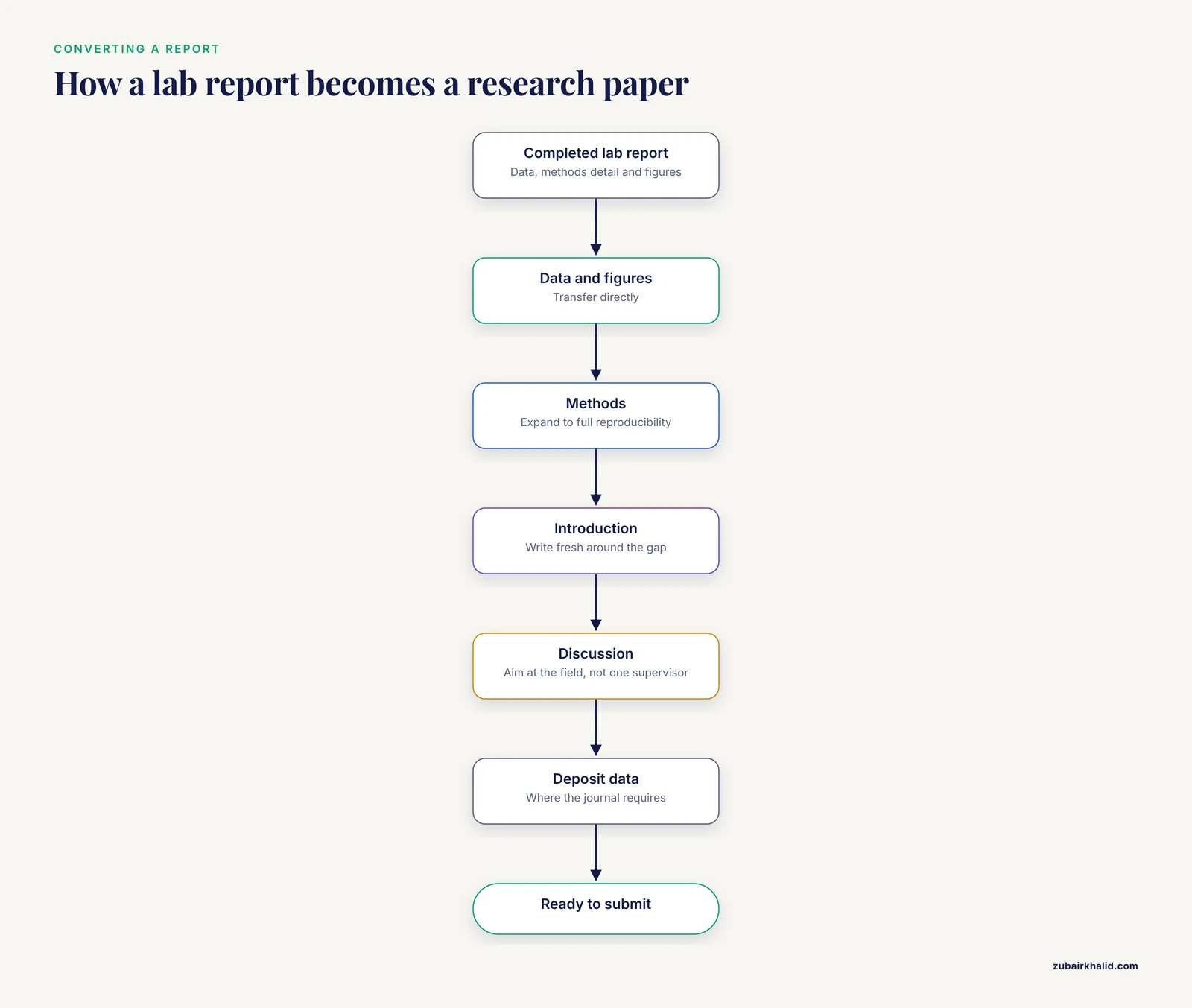
Yes, and this is a common path. The data, methods detail, and figures transfer directly. You will need to add a real introduction, expand the methods to full reproducibility standard, run proper statistical analysis if the coursework analysis was simplified, deposit the data where the journal requires, and write a discussion aimed at the field. Starting from a well-organized lab report with a complete lab notebook behind it makes that conversion far faster.
Sources
- Matrix composition modulates cancer cell phenotypes and secretions in a blood-brain barrier organ-on-a-chip model: Comparison of collagen and hyaluronic acid.
- Evaluation of the GCdiaMTB/NTM real-time PCR kit according to the Korean invitro diagnostic medical device approval standards.
- Harmonizing flow-based quantification of CD19-directed CAR-T cells: Results from a multi-center interlaboratory comparison.
- Do deep learning models learn beyond average gait? A comparison of architectures, kinematic representations, and marker sparsity for vertical ground reaction force prediction.
- Human photoaging skin models for the efficacy evaluation of anti-aging ingredients: Advances on clinical and ex vivo studies.
- Development of Benzothiophene-Bearing Bis-oxadiazole Derivatives for Potential Anticancer Targets: Evaluation of DFT, ADME-Tox, and In Silico Docking.
- Impact of wet- and dry-lab workflows on genome assembly, typing and enterotoxin gene detection in whole-genome sequencing of foodborne Staphylococcus aureus.
- AI-powered radiology report simplification in Arabic: A prospective evaluation of patient-perceived understandability and clinical safety.