Lab Report Reference List Template
By Dr. Zubair Khalid, DVM, MS, PhD ·

By the end of this guide you will be able to build a complete, correctly formatted reference list for a lab report. You will choose the right citation style, format each entry with a reusable template, order the list correctly, and run a final check that catches the errors gradators and peer reviewers notice first. You need three things on hand: your lab report draft, the citation style your course requires (commonly APA, CSE, or ACS), and a running list of every source you cited while writing. A free reference manager such as Zotero helps but is optional.
The reference list is one of the most mechanical parts of learning how to write a lab report, and that is good news. Almost every mistake in it is preventable with a template and a checklist. This guide gives you both.
What a Reference List Does in a Lab Report
A reference list is the final section of a lab report. It contains a full description of every published source you cited in the body of the report, in the exact format your citation style requires. The lab report format puts it after the conclusion, and in many grading rubrics it carries its own points.
Three rules define a correct reference list:
- Every source you cited in the text appears in the list, exactly once.
- Every entry in the list is cited somewhere in the text.
- The entries contain enough detail that a reader could find the source themselves.
Rule 3 is where lab reports earn or lose credibility. Science is cumulative. When you cite a method, a measured value, or a review article, you are telling the reader which published work supports your claim. Reference lists in published research work the same way. A systematic review of death anxiety measures identified 89 relevant studies and evaluated 21 self-report scales against formal quality criteria, and the entire synthesis rests on the transparency of its citations [1]. Your lab report is a small-scale version of the same structure.
Do not confuse the reference list with two lookalikes:
- Bibliography. A bibliography can include sources you read for background but never cited. A lab report reference list includes only cited sources.
- Footnote list. Some humanities styles put citations at the bottom of each page. Standard science styles put them in one list at the end.
Where the Reference List Fits in the Standard Lab Report Format
If you are still learning how to write a lab report, here is where citations actually appear. A typical lab report format runs in this order:
- Title and author information
- Abstract, a short summary of purpose, methods, results, and conclusion
- Introduction, where most citations live, because you are connecting your experiment to published work
- Methods, where you may cite a protocol or a standard technique
- Results, which usually cite nothing, because the numbers are yours
- Discussion, the second major citation zone, where you compare your findings to published values and interpretations
- Conclusion
- References, the list this article is about
A practical habit while drafting: drop a placeholder like (Author, Year) or the moment you write a claim that came from somewhere other than your own data. Building the in-text citations as you write makes the reference list a cleanup task instead of a reconstruction task.
Lab Report Reference List Template (Copy and Paste)
The template below covers the three entry types that account for nearly everything in a student lab report: journal article, book, and web page. It uses American Psychological Association (APA) 7th edition formatting, the most common style in biology and psychology coursework.
LAB REPORT REFERENCE LIST TEMPLATE (APA 7th, alphabetical order)

JOURNAL ARTICLE
Author, A. A., Author, B. B., & Author, C. C. (Year).
    Title of article in sentence case. Journal Name in Title Case,
    Volume(Issue), first page-last page. https://doi.org/xxxxx

BOOK
Author, A. A. (Year). Title of book in sentence case (ed. ed.).
    Publisher.

WEB PAGE
Author or Organization. (Year, Month Day). Title of page.
    Site Name. https://full-url

SECTION HEADING: center the word "References" at the top of a
new page. Apply a hanging indent of 0.5 inch to every entry.
Double-space the list. Alphabetize by first author's surname.
To make the format concrete, here is that first line of the journal article template filled in with a real published paper, the kind of source a well-built lab report would cite:
Kohn, S., de Visser, E., Wiese, E., and remaining authors as listed
    on the article. (2021). Measurement of trust in automation:
    A narrative review and reference guide. Frontiers in Psychology.
    [add volume, article number, and DOI from the article record]
The bracketed reminders are what you replace with the volume, article number, and DOI printed on the article itself. Copy volume numbers, page ranges, and DOIs directly from the publisher's record or PubMed, never from memory or from a second paper that cited it.
Choosing a Citation Style: Lab Report Reference List Template Format
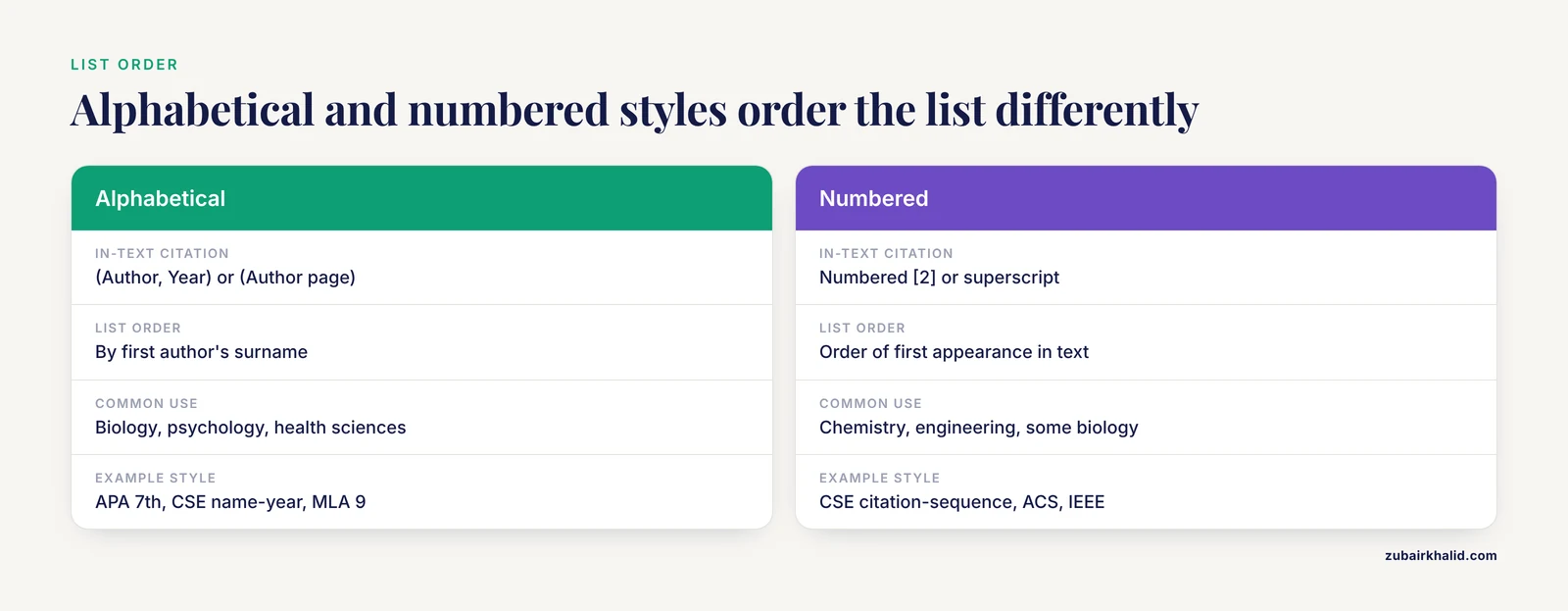
The lab report reference list template format you need depends almost entirely on your discipline and your instructor. When the syllabus does not name a style, these are the conventions.
| Style | In-text citation | List order | Common use |
|---|---|---|---|
| APA 7th | (Author, Year) | Alphabetical | Biology, psychology, health sciences |
| CSE (name-year) | (Author Year) | Alphabetical | Many undergraduate biology courses |
| CSE (citation-sequence) | Numbered [2] | Order of first appearance | Biology, some lab manuals |
| ACS | Numbered [2] or superscript | Order of first appearance | Chemistry |
| IEEE | Numbered [2] | Order of first appearance | Engineering |
| MLA 9 | (Author page) | Alphabetical | General writing courses |
Two practical differences drive everything else in the list:
- Alphabetical styles (APA, CSE name-year, MLA) list entries by the first author's surname, no matter where the citations appeared in the text.
- Numbered styles (CSE citation-sequence, ACS, IEEE) list entries in the order the citations first appear in the text, so the list order follows your writing order.
Here is the same Kohn article in numbered CSE citation-sequence format, so you can see how the style changes the entry:
[2] Kohn S, de Visser E, Wiese E, [remaining authors]. Measurement
    of trust in automation: a narrative review and reference guide.
    Front Psychol. 2021. [add volume(issue):pages and DOI]
Pick one style before you write a single entry, and use only that style. Mixed styles inside one reference list are the single most visible formatting error a grader can spot from across the room.
Step-by-Step: Building the Reference List
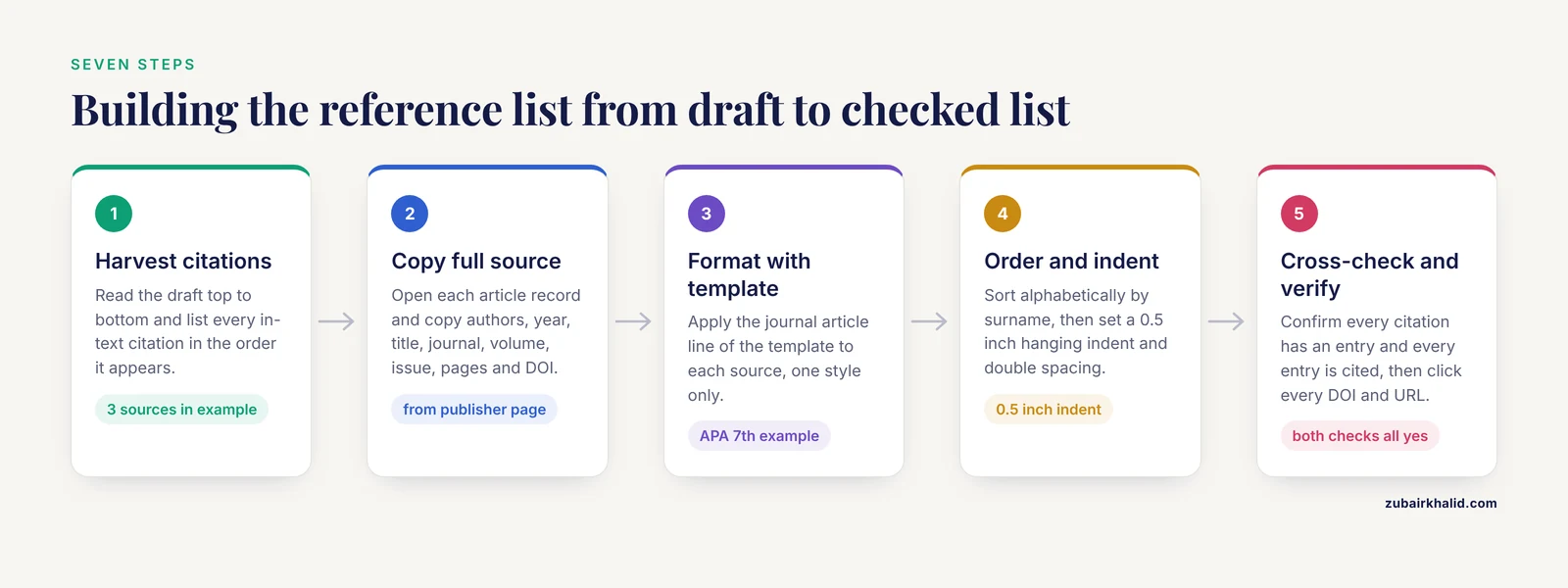
Work through these seven steps on a draft report. The worked example below turns three rough notes into a finished APA list.
Step 1. Harvest every in-text citation
Read your draft from the top and list each citation in the order it appears. Suppose your draft cites three sources:
Input: raw citation harvest
  1. (Kohn et al., 2021)          intro, trust in automation background
  2. (Hertzum, 2021)              discussion, workload benchmark values
  3. (Zuccala et al., 2019)       intro, example of systematic review methods
Step 2. Match each citation to a full source record
For each item, open the actual article record and copy the authors, year, title, journal, volume, issue, pages, and DOI. In Zotero or Mendeley, this is usually one click from the browser while you have the article open. Manual copying works too, as long as you copy from the publisher page and not from another paper's citation of it.
Step 3. Format each entry with the template
Apply the journal article line of the template to each record:
Draft entries (APA 7th)

Hertzum, M. (2021). Reference values and subscale patterns for the
    task load index (TLX): A meta-analytic review. Ergonomics.
    [volume, issue, pages, DOI]

Kohn, S., de Visser, E., Wiese, E., [remaining authors]. (2021).
    Measurement of trust in automation: A narrative review and
    reference guide. Frontiers in Psychology. [volume, DOI]

Zuccala, M., Menzies, R., Hunt, C., [remaining authors]. (2019).
    A systematic review of the psychometric properties of death
    anxiety self-report measures. Death Studies. [volume, pages, DOI]
Step 4. Order the list
APA is alphabetical, so sort by surname: Hertzum, Kohn, Zuccala. Ignore "A", "An", and "The" at the start of a title when alphabetizing works with no author. If your style is numbered, skip the sort and keep first-appearance order.
Step 5. Apply paragraph formatting
Set a hanging indent of 0.5 inch (every line after the first of each entry is indented), double spacing, and the same font as the body text. In Microsoft Word, the hanging indent lives under Paragraph, Indentation, Special, Hanging. In Google Docs, it is under Format, Align and indent, Indentation options.
Step 6. Cross-check in both directions
Run two passes:
Check 1: for every (Author, Year) or [n] in the text,
         does an entry exist in the list?        -> yes/no per item

Check 2: for every entry in the list,
         does it appear at least once in text?   -> yes/no per item
Both checks must come back all yes. A mismatch in either direction is an error in almost every grading rubric.
Step 7. Verify the identifiers
Click every DOI and URL in your finished list. A DOI that resolves to the wrong paper is worse than a missing DOI, because it tells the grader you did not check your own work. The expected output of this whole procedure is a list where the count of in-text citations equals the count of entries, every identifier resolves, and every entry follows one style.
If you used a reference manager, two classic failures have known messages and fixes:
- Word field error,
Error! Reference source not found.This appears when a citation field lost its link, usually because you deleted a source from the manager while its citation stayed in the document. Refresh the citations from the plugin, or reinsert the missing citation. - LaTeX warning,
Citation 'author2021' undefinedin the compile log. The key in your.bibfile and the key in your\cite{}command do not match, or you compiled before running BibTeX. Fix the key or rerun the full compile sequence. - Zotero document plugin error after heavy editing. Reopen the document from the Zotero plugin, or insert the problem citation fresh.
Choosing Sources Worth Citing
The quality of your reference list is mostly decided before formatting begins, at the moment you choose what goes into it. Four source types carry different weight in a lab report.
Review articles survey a topic and cite dozens of primary studies. They are efficient starting points. The trust-in-automation review cited above is a good example of the type. It organized hundreds of measurement approaches into self-report, behavioral, and physiological categories and closed with concrete recommendations for the field [3]. In a lab report introduction, one sentence backed by a review replaces a paragraph of unsupported background.
Meta-analyses pool quantitative results across studies and can supply benchmark numbers. If your experiment measured workload with the NASA Task Load Index, a meta-analysis of 556 studies provides reference values you can compare your own means against, such as an overall TLX mean of 35 for leisure tasks up to 56 for manual labor across domains [4]. Citing the reference values source directly is far stronger than quoting a number you cannot trace.
Systematic reviews follow a documented search protocol. They signal that the authors hunted down and appraised the evidence rather than summarizing what they already knew. When your discussion hinges on what the literature as a whole shows, a systematic review is the strongest single citation available to you.
Primary research articles report original experiments. Lab reports should cite them whenever a specific finding, method, or dataset matters to your argument, because a review summarizes a study while the primary article owns it.
Reference Mining: Using Other Papers' Reference Lists
The phrase "reference list" has a second working meaning in research practice, and it is a technique you should steal for every lab report. When reviewers compile evidence, they routinely search the reference lists of the articles they have already found. Scoping reviews on breastfeeding initiation used manual reference list searching alongside database searches [5]. A rapid umbrella review of dental scanning accuracy screened the reference lists of eligible reviews for additional studies [6]. A scoping review of orthopaedic waiting costs hand-searched the reference lists of included papers [7]. In a systematic review of LSD research, a manual search of reference lists contributed nine additional articles beyond the database results [8].
For a student, the tactic is simple. Find one recent, high-quality review article on your topic, open its reference list, and mine it for primary studies you can cite directly. This is faster than raw database searching and automatically connects your citations to the literature your instructor recognizes. One caution transfers directly from the review world to your coursework: a source you found in someone else's reference list should be read before it is cited, not lifted on faith.
Why Reference Lists Affect Your Grade
Peer assessment research in laboratory courses gives a concrete reason to treat the reference list seriously. A study of students' own collective criteria found that the standards students applied when giving peer feedback influenced the quality of the resulting lab reports [9]. A reference list is one of the most visible and checkable criteria a reader can apply in minutes. Formatting is binary, identifiers either resolve or do not, and every claim-to-citation match can be spot-checked. When a peer or grader forms an impression of your report, the reference list is part of that first pass.
"Reference List" Means Two Different Things in Science
A short disambiguation, because the phrase confuses searchers. In a lab report, a reference list is your citation list. In research infrastructure and regulation, a "reference list" often means a curated registry of defined items that everyone in a field agrees to use. The World Health Organization maintains a global reference list of 100 core health indicators that countries use to standardize what they measure and report [10]. Toxicology working groups built a reference list of 52 low molecular weight chemicals with reported respiratory sensitization evidence, categorized by strength of human evidence, to serve as a benchmark for evaluating new test methods [11]. Other projects build physical reference collections, such as a curated specimen collection supporting identification of regulated marine pest species in Western Australia [12].
The shared idea is standardization. Your lab report reference list standardizes how readers find your sources, and a registry reference list standardizes what a field counts as valid. Knowing the second meaning helps you read papers that use the term, and it explains why your instructor cares about consistency in yours.
Common Mistakes and Limitations
Citing sources you never opened. If you found a fact in a review, cite the review, or read the primary study and cite that. Copying a citation from another paper's reference list without reading it propagates errors and is easy to catch.
Padding the list. Ten relevant sources beat forty loosely related ones. An entry that supports nothing in your text fails the cross-check in Step 6, and a grader will find it.
Mixing styles. An APA entry next to a CSE entry is wrong in both styles. Decide once, format consistently.
Inconsistent author formatting. APA spells out given-name initials, CSE abbreviates them without periods in some variants. Whichever style you pick, apply its author rule to every entry, including the ones with ten authors.
Missing or mistyped DOIs. A DOI is the modern permanent link for most journal articles. Copy it from the article record as a full https URL. A DOI you retype by hand is the most common silent failure in student reference lists.
Alphabetizing by first name. APA, CSE name-year, and MLA all alphabetize by surname. "de Visser" sorts under D in practice, so check your style's rule for prefixes and particle surnames.
Treating the list as an afterthought. Reference errors suggest careless work in the sections a grader cannot verify as quickly. Build the list as you write, not the night before submission.
One limitation belongs here rather than scattered elsewhere. Formatting rules vary by course, journal, and instructor, and the local rubric always overrides general guidance. When your syllabus specifies something different from any template, follow the syllabus, and ask the instructor when the two genuinely conflict.
Frequently Asked Questions
What is a reference list in a lab report?
It is the final section listing full publication details for every source cited in the report. Each entry gives authors, year, title, source, and a locator such as a DOI or URL, formatted in one required citation style.
What citation style should I use for a lab report?
Use whichever style your course specifies, and ask your instructor if none is named. Biology courses commonly require APA 7th or CSE, chemistry courses commonly require ACS, and your grading rubric is the final authority.
What is the difference between a reference list and a bibliography?
A reference list contains only the sources you cited in the text, while a bibliography may also include background sources you consulted without citing. Science lab reports use reference lists, not bibliographies.
How many references should a lab report have?
There is no universal number, so follow your course guidelines. Most undergraduate reports need enough sources to support the background in the introduction and the comparisons in the discussion, which is often a handful of well-chosen papers rather than a long list.
Can I use websites in a lab report reference list?
You can when the site is an authoritative primary source, such as a database record, an official protocol, or an organization's technical documentation. Format the entry with the organization or author, date, page title, site name, and full URL, and prefer journal articles for scientific claims.
Where can I find a free lab report reference list template?
Use the copy-and-paste template in this article, which covers journal articles, books, and web pages in APA format. Free reference managers such as Zotero also generate formatted reference lists automatically once your sources are saved.
Should lab report references be alphabetical or numbered?
It depends on the citation style. APA, CSE name-year, and MLA sort alphabetically by surname, while CSE citation-sequence, ACS, and IEEE number entries in the order they first appear in the text.
How do I cite a source I found in another paper's reference list?
Find and read the original source, then cite it directly in your reference list. This practice, called reference mining or citation chasing, is standard in professional reviews, but the citation in your report must point to the source you actually used.
Sources
- A systematic review of the psychometric properties of death anxiety self-report measures
- A Rodential Reckoning: A Case Report and Systematic Review of Streptobacillary Endocarditis.
- Measurement of Trust in Automation: A Narrative Review and Reference Guide
- Reference values and subscale patterns for the task load index (TLX): a meta-analytic review
- Early initiation of breastfeeding up to six months among mothers after cesarean section or vaginal birth: A scoping review
- ACCURACY OF INTRAORAL SCANNERS VERSUS TRADITIONAL IMPRESSIONS: A RAPID UMBRELLA REVIEW.
- The Cost of Waiting on an Orthopaedic Waiting List: a scoping review
- The effects of Lysergic Acid Diethylamide (LSD) on the Positive Valence Systems: A Research Domain Criteria (RDoC)-Informed Systematic Review
- Students’ own collective criteria - influence on peer feedback and lab report quality
- The WHO global reference list of 100 core health indicators: the example of Sierra Leone
- Identifying a reference list of respiratory sensitizers for the evaluation of novel approaches to study respiratory sensitization
- Establishment of a taxonomic and molecular reference collection to support the identification of species regulated by the Western Australian Prevention List for Introduced Marine Pests