Lab Personnel Scheduling: Step-by-Step Guide
By Dr. Zubair Khalid, DVM, MS, PhD ·
By the end of this guide you will be able to build a lab personnel schedule that matches trained people to the experiments that actually need them, calculate how many staff hours your bench demand requires, protect uninterrupted work time, and fold the schedule into a broader research project plan. You will need three things on hand before you start: a current list of everyone who works in the lab with their contracted hours, a list of your recurring experimental and service tasks, and a spreadsheet program or Python 3 installed on your computer. Set aside about two hours for the first full build, then expect to spend 15 to 30 minutes per week maintaining it.
Why Lab Personnel Scheduling Is Different From Ordinary Staff Scheduling
A retail schedule mostly needs bodies present during open hours. A research lab schedule has to solve three harder problems at the same time.
First, experiments have hard timing windows that you do not control. In an in vitro fertilization laboratory, a retrospective analysis of 7,986 ICSI cycles found that neither the total number of procedures nor the workload per operator affected the mean blastulation rate per cohort, but each additional hour in the interval from ovulation trigger to oocyte denudation was associated with a measurable decline in that outcome, especially beyond the 40-hour threshold [1]. The lesson generalizes: when a biological window exists, scheduling must be built backward from the biology, not forward from staff preference.
Second, interruption is a real cost. A hybrid laboratory and field study of 120 participants under controlled conditions and 100 participants over 14 days found that constant digital notifications raised subjective workload, reduced heart rate variability, and worsened task accuracy, with larger penalties under dual-task demands, while batching notifications into scheduled release windows cut the notification rate roughly in half and lowered reported stress [2]. A bench schedule that fragments every person's day into short reactive slices is quietly destroying the accuracy of the work it organizes.
Third, a large share of lab coordination work is invisible. Interviews with pharmacy skills laboratory faculty identified substantial hidden labor in coordination, scheduling, curriculum preparation, and individualized support, and linked that hidden load to burnout and work-life strain [3]. If your schedule only counts pipetting hours, it will systematically overload the person who also does the ordering, the training, and the instrument maintenance.
What You Need Before You Start
Gather these inputs before touching a calendar:
- A staff roster with contracted hours per week and any fixed constraints (classes, clinic days, childcare pickup, visa-related restrictions).
- A task inventory of recurring work: assays, cell culture passes, animal checks, instrument maintenance, ordering, data analysis, and mentoring.
- A skill and competency record for each person, which accredited clinical laboratories are required to maintain under ISO 15189-style training and competency assessment programs [4].
- A list of equipment with booking patterns, since shared instruments are often the true bottleneck rather than people.
- The last 4 to 8 weeks of anything you already tracked, such as sign-in logs or instrument calendars, to estimate realistic task durations.
Step 1: Inventory Your Recurring Demand
List every recurring unit of work and estimate its duration, its required skill level, and whether it has a fixed time window. A worked example for a molecular biology lab:
| Task | Duration | Skill required | Time window | Frequency |
|---|---|---|---|---|
| Cell culture pass (24 flasks) | 2.5 h | Cell culture certified | Flexible, before 15:00 | 3x/week |
| qPCR run and analysis | 3 h | qPCR certified | Flexible | 2x/week |
| Flow cytometry slot | 2 h | Flow certified | Tue, Thu 10:00-14:00 | 2x/week |
| Media and buffer prep | 2 h | Any trained member | Flexible | Weekly |
| Instrument maintenance | 1.5 h | Assigned per SOP | Monthly, fixed day | 4x/month |
| Ordering and inventory | 1 h | One designated person | Flexible | Weekly |
Sum the flexible weekly bench demand: cell culture (7.5 h) plus qPCR (6 h) plus flow (4 h) plus prep (2 h) plus maintenance (1.5 h) plus ordering (1 h) equals 22 person-hours per week of scheduled work. Add a column for project-driven work from active grants or a project plan, estimated conservatively.
Step 2: Inventory Your Supply
For each person, record contracted weekly hours and the fraction of that time actually available for bench tasks. A realistic bench fraction accounts for meetings, email, training, and administrative work. For most research staff, a bench fraction of 0.6 to 0.7 is defensible. If someone works 40 contracted hours and spends 5 hours in meetings, 4 hours on email and paperwork, and 3 hours at group activities, their assignable bench time is 28 hours, a bench fraction of 0.70.
Step 3: Calculate Your Coverage Requirement
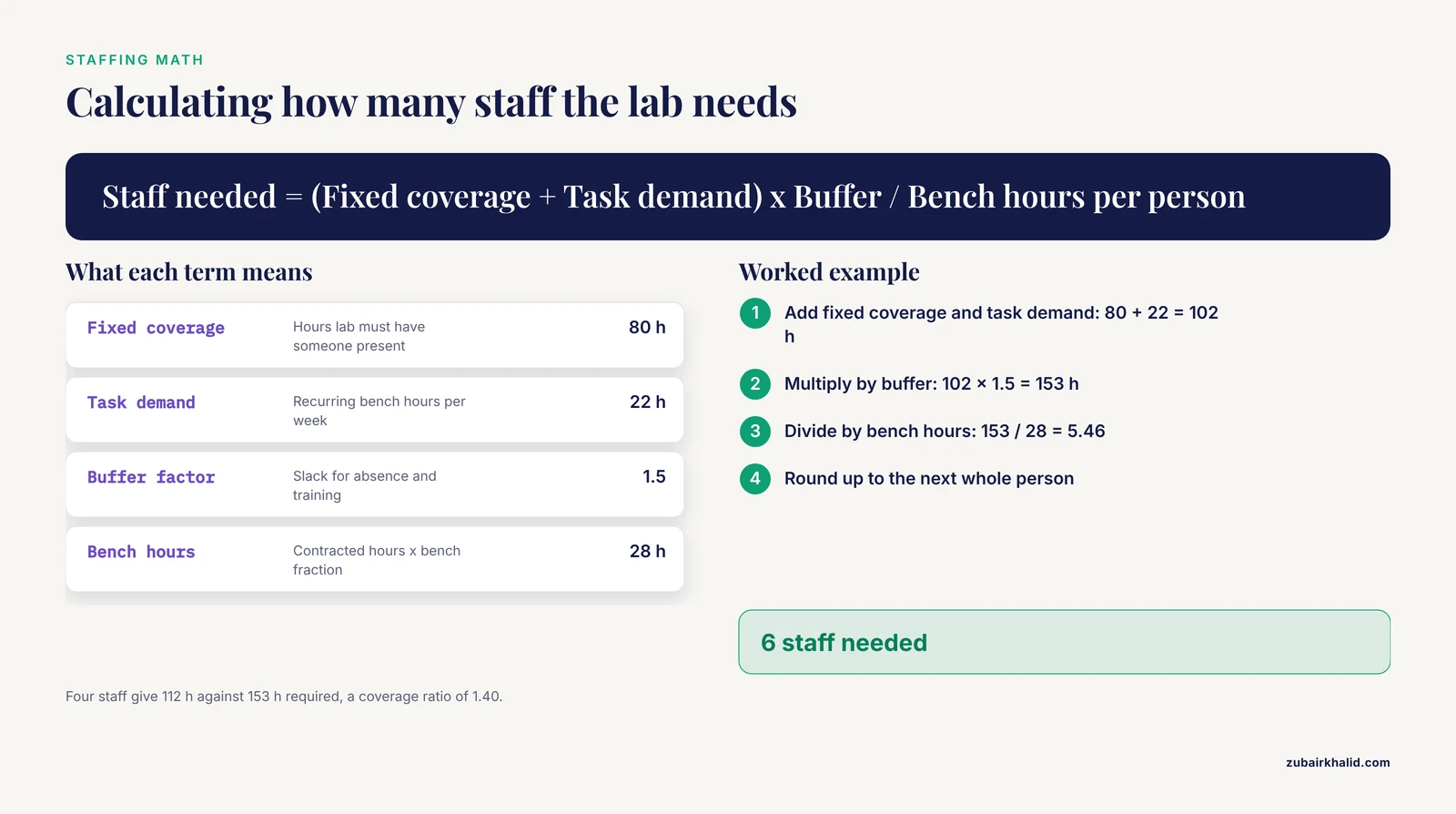
Now convert demand and supply into a staffing number. The core formula is:
Staff needed = (Weekly required task hours x Buffer factor) / Bench hours per personThe buffer factor absorbs vacations, sickness, and training. A value of 1.5 is a common starting point for small labs because one absence removes a large share of total capacity. Here is a worked calculation as a script you can adapt:
# lab_coverage_check.py
demand_hours_per_week = 22          # from Step 1
fixed_coverage_hours = 80           # hours the lab must have someone present,
                                    # e.g. 2 people x 8 h x 5 days
buffer_factor = 1.5                 # slack for vacation, sickness, training

staff = {
    "A. Rivera": 40,
    "B. Chen":   40,
    "C. Okafor": 40,
    "D. Novak":  40,
}

bench_fraction = 0.70
per_person = staff["A. Rivera"] * bench_fraction
capacity = len(staff) * per_person
required = (fixed_coverage_hours + demand_hours_per_week) * buffer_factor
staff_needed = -(-required // per_person)   # ceiling division

print(f"Bench capacity:        {capacity:.0f} h/week")
print(f"Required with buffer:  {required:.0f} h/week")
print(f"Coverage ratio:        {capacity / (fixed_coverage_hours + demand_hours_per_week):.2f}")
print(f"Staff needed:          {int(staff_needed)}")
Expected output:
Bench capacity:        112 h/week
Required with buffer:  153 h/week
Coverage ratio:        1.40
Staff needed:          6
Read the output as a diagnosis. A coverage ratio below 1.0 means the schedule fails the moment anyone is absent. A ratio between 1.0 and 1.5 means the schedule works only when everything goes right, which in a lab it rarely does. In this example, four staff provide 112 hours against a buffered requirement of 153 hours, so the lab either recruits, reallocates duties, or formally reduces its presence requirement to one person during low-activity hours.
To check that a drafted week actually meets the presence requirement cell by cell, a spreadsheet formula counts who is booked in each slot. With a sheet named Schedule where column C holds the weekday and column D holds the start hour:
=COUNTIFS(Schedule!$C$2:$C$200,"Mon",Schedule!$D$2:$D$200,9)This returns the number of people booked Monday at 09:00. Copy it across a 5 day by 10 hour grid and any cell below your minimum coverage shows a gap at a glance.
Step 4: Match Skills to Tasks With a Competency Matrix
A schedule that assigns the qPCR run to whoever is free is a schedule that assigns it to someone untrained. Quality standards for medical laboratories are explicit that personnel must have defined training, documented competency assessment, and a training schedule with defined content and frequency before they perform testing independently, an approach shown to strengthen laboratory testing capability in an implementation based on ISO 15189 [4]. Build the same discipline into any research lab with a simple matrix:
| Member | Cell culture | qPCR | Flow cytometry | Maintenance | Can train others |
|---|---|---|---|---|---|
| A. Rivera | Lead | Lead | Certified | Yes | Yes |
| B. Chen | Certified | In training | Not yet | No | No |
| C. Okafor | Certified | Certified | In training | No | No |
| D. Novak | In training | Not yet | Not yet | No | No |
Two scheduling rules follow directly. Critical tasks may only be assigned to people marked Certified or Lead, and every Lead task needs at least one certified backup, otherwise a single resignation or illness stops that line of work. Schedule the "In training" pairings deliberately, for example B. Chen shadows the Tuesday qPCR run, because training slots that exist only in intention never happen.
Step 5: Draft the Weekly Schedule and Protect Focus Time
Draft the week in three passes:
- Place fixed-window tasks first (flow slots, monthly maintenance, animal check times).
- Place paired training and supervision slots second.
- Fill remaining capacity with flexible bench work, batched into blocks of at least 2 hours.
The batching rule is not a preference. The controlled portion of the notification study cited above compared constant notifications against batches released on a 15-minute cycle, and the field arm of the study implemented two daily 50-minute focus blocks with a priority allow-list and scheduled email, finding dose-response relationships between notification rate, stress, and physiological strain, with benefits that partially reversed during a washout period [2]. Translated into a lab schedule, that means each person's day should contain at least one protected block of roughly an hour in which they are not scheduled into email, chat, or walk-up questions, and routine communications should be batched rather than allowed to interleave continuously with hands-on work.
Practical mechanics that make the protection real:
- Write the focus block into the shared calendar as a recurring event, not a personal note.
- Publish one lab communication window per day (for example 16:00 to 16:30) for non-urgent questions.
- Post a physical or shared-digital board showing who is where, so people stop interrupting each other just to locate a colleague.
Step 6: Sequence Time-Sensitive Procedures First
Once the weekly grid exists, order each day by biological and instrument constraints. Backward-plan from immovable endpoints: if a culture must be harvested 48 hours after treatment, the treatment slot is fixed and everything upstream of it inherits that constraint. The IVF workflow study demonstrates why this ordering matters more than raw workload: managerial decisions about procedural timing, not the volume of procedures per operator, were what tracked with embryo development outcomes [1]. When you cannot measure a lab's own timing tolerances, schedule conservatively around the longest expected step and record the actual durations.
Duration estimates improve with structured feedback. In the cardiac catheterization laboratory, deep learning models using video-derived procedural phases predicted procedure end times with mean absolute errors below 5 minutes for the best models, showing that procedure durations are predictable enough from structured historical data to support scheduling [5]. A lab-scale version of the same idea costs nothing: log planned versus actual duration for each recurring task in one spreadsheet column pair, and after a month replace your guesses with your own medians.
Step 7: Build the Research Project Plan Template
The weekly schedule handles recurring work. Project work needs a different artifact, a research project plan that ties people, tasks, and dates to specific aims. A compact template that fits most lab projects:
| Field | Example entry |
|---|---|
| Project / aim | Aim 2: Validate the multiplex assay |
| Task | Run 96-sample validation panel |
| Owner (single name) | C. Okafor |
| Backup | A. Rivera |
| Skill gate | qPCR Certified |
| Instrument | QuantStudio 12, Thu slot |
| Planned hours | 12 h over 2 weeks |
| Start / end dates | Nov 24 to Dec 5 |
| Dependency | Panel arrival confirmed |
| Deliverable | Validated dataset in shared folder |
Fill one row per task, keep owners to a single name, and reconcile the planned hours in this template against the residual capacity left over from Steps 3 and 5. This reconciliation step is the practical link between lab personnel scheduling and research project management: a project plan that assumes 100 percent of a person's week will collide with the schedule, the training matrix, and reality. Review the template at the same frequency as the schedule, and when a task slips more than one review cycle, either reassign it using the competency matrix or formally descope it.
Collaborative projects benefit from an explicit negotiation layer as well. A multiagent coordination model for collaborative workflows treats participating parties as autonomous agents that negotiate task allocation under their own constraints, which is a useful mental model for multi-PI collaborations where each lab controls its own people and no single schedule can be imposed top down [6].
Step 8: Document Assumptions and Decisions
Write down what the schedule assumes, because undocumented schedules cannot be audited or repaired. Guidance developed for managing metadata in a neurophysiology laboratory makes the general case: complex experiments fail reproducibility when the information about procedures, data, and processing steps is incomplete or ambiguous, and structured documentation with defined use cases produces concrete benefits for reuse [7]. For scheduling, keep one short living document recording:
- The bench fraction and buffer factor you used, and when you last validated them.
- The current competency matrix with dates of last assessment.
- Any standing exceptions (for example, who may open the lab alone before 08:00 and under what safety conditions).
- The change log: what changed in the schedule, when, and why.
This record costs minutes per week and is what lets a new lab manager reconstruct the reasoning instead of guessing.
Step 9: Automate Routine Coordination, Then Review
Two classes of automation are worth adopting, and two deserve caution.
Software that manages lab workflow as structured records, rather than as free-form email, has a long history in laboratory informatics, with systems such as LabBase designed to represent laboratory workflow so that experimental steps and their management can be tracked consistently [8]. At minimum, move bookings, shift swaps, and task handoffs into one shared system that produces a record automatically.
Automation of the scheduling decision itself is advancing quickly. A framework for clinical workflow orchestration uses multiple cooperating AI agents that exchange information through healthcare data standards to coordinate triage, laboratory, imaging, and transport operations dynamically, in contrast to manual scheduling and static boards [9]. Autonomous laboratory platforms that manage instrumentation and serve multiple users without human intervention demonstrate how far instrument-level scheduling automation can go in research settings. For a typical academic lab today, the realistic application is smaller: automated reminders for recurring maintenance, conflict detection when two people book the same instrument, and calendar-driven reminders tied to training renewal dates. Adopt those, and keep human judgment over who does what.
Finally, set a fixed review cadence. Reconcile planned against actual hours weekly, revisit the competency matrix monthly, and rebuild the demand inventory whenever a grant starts or ends.
Quick-Reference Table of Key Formulas and Options
| Item | Formula or rule | Notes |
|---|---|---|
| Bench hours per person | Contracted hours x bench fraction | Bench fraction typically 0.6 to 0.7 |
| Buffered requirement | (Fixed coverage + task demand) x buffer factor | Buffer factor 1.5 is a defensible default |
| Staff needed | Buffered requirement / bench hours per person | Round up |
| Coverage ratio | Capacity / total requirement | Below 1.0 fails on first absence, below 1.5 is fragile |
| Task assignment | Certified or Lead only for critical tasks | Enforced via competency matrix |
| Backup rule | Every Lead task has at least one certified backup | Prevents single points of failure |
| Focus protection | At least one uninterrupted block of about 60 min per person per day | Supported by notification-batching evidence [2] |
| Duration accuracy | Replace estimates with logged medians after 4 weeks | Plan-versus-actual column pair |
Lab Personnel Scheduling Tips
- Publish the schedule at least two weeks ahead where possible. Predictability is itself a workload reducer, and perceived scheduling flexibility was identified as an implementation condition people value when evaluating new work programs, alongside protected time and manageable workload [10].
- Schedule the boring blocks. Maintenance, media prep, and freezer inventory fail silently when left as spare-time tasks, so give them named owners and named slots.
- Pair every new trainee with a named certified mentor for a defined number of supervised sessions, mirroring the structured training and assessment cycle used under ISO 15189-aligned programs [4].
- Keep one person per shift designated as the safety and triage contact, and make that designation visible on the board.
- When demand spikes, add capacity in this order: defer flexible tasks, extend coverage temporarily, then reallocate from the competency matrix. Hiring is the last lever because it is the slowest.
- Batch your own administrative communication into the scheduled window rather than answering continuously, since constant reactive switching carries measurable cognitive and physiological costs [2].
Common Mistakes and Limitations
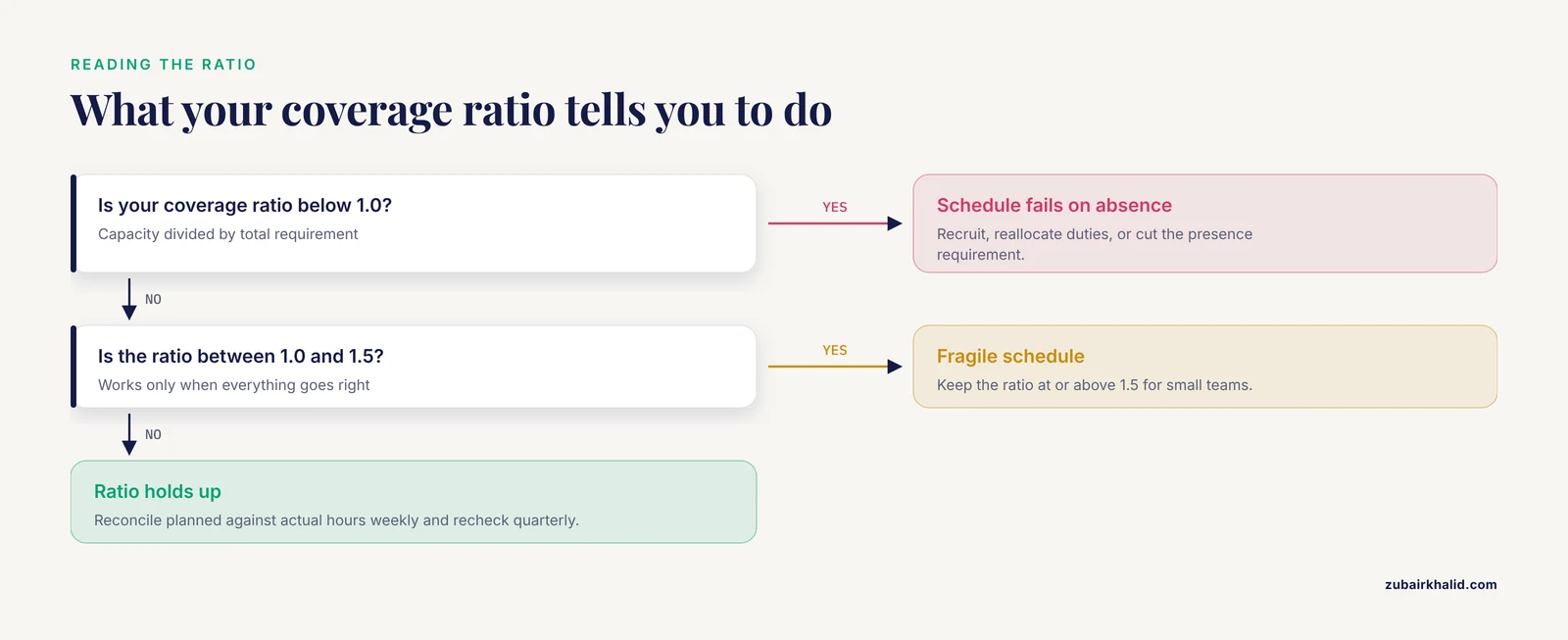
- Scheduling to 100 percent of capacity. If buffered requirement equals capacity, any absence, failed run, or delayed shipment breaks the week. Keep the coverage ratio at or above 1.5 for small teams.
- Counting only hands-on time. The hidden coordination, training, and advocacy labor documented in laboratory faculty interviews is real work that consumes the same hours as bench tasks [3]. Budget it explicitly or it will be absorbed by your most conscientious person.
- Ignoring biological timing windows. A schedule that treats a 36-to-44-hour differentiation window as negotiable has confused staff convenience with experimental validity, the exact pattern the IVF workflow analysis showed to matter for outcomes [1].
- Allowing continuous interruption. Fragmented days degrade accuracy and raise workload even when total hours are unchanged [2]. A schedule without protected blocks is a schedule that produces more errors.
- Assigning by availability instead of competency. Availability without documented competency is how labs generate repeat runs, wasted reagents, and, in regulated settings, audit findings. Use the matrix from Step 4.
- Single points of failure. One certified person for a critical assay is a resignation away from a stopped project line.
- Treating software as the fix. Automated orchestration systems depend on data standards, governance, and defined safety protocols. A shared calendar with no competency matrix and no change log automates the same chaos.
- Never validating assumptions. Bench fractions, task durations, and buffer factors decay as projects change. Re-derive them from logs at least quarterly.
One limitation applies broadly: every lab differs in staffing model, regulatory context, and equipment, so the numbers here are worked examples rather than prescriptions. Clinical and accredited laboratories must set their staffing and training rules to satisfy their own accreditation body and institutional policy, and any lab-specific safety staffing rules always override general scheduling convenience.
Frequently Asked Questions
What is lab personnel scheduling?
Lab personnel scheduling is the process of assigning trained staff to the tasks, instruments, and time windows a laboratory needs to operate, while respecting biological timing constraints, competency requirements, and each person's contracted hours.
How do I calculate how many staff my lab needs?
Multiply your total weekly required hours (fixed presence plus task demand) by a buffer factor of about 1.5, then divide by the bench hours one person actually provides, which is contracted hours times a bench fraction of roughly 0.6 to 0.7, and round up.
How far in advance should we publish the schedule?
Publish at least two weeks ahead where your science allows, because predictability reduces coordination overhead, and confirm fixed-window tasks even earlier since those anchor everything else.
What is the difference between a weekly schedule and a research project plan?
The weekly schedule allocates recurring, ongoing work across people and days, while a research project plan template ties specific project tasks to named owners, skill gates, instruments, dependencies, dates, and deliverables, and the two must be reconciled against the same capacity pool.
Should we use spreadsheets or dedicated scheduling software?
Start with a spreadsheet plus a shared calendar, which is sufficient for most labs under about ten people, and move to dedicated lab management or workflow software once conflict detection, audit trails, or multi-site coordination become a regular burden.
How does scheduling affect research quality?
Scheduling affects quality through competency matching, protected focus time, and respect for biological timing windows, all of which have documented links to task accuracy, procedural outcomes, and reproducibility in laboratory studies.
How do we handle shift swaps and absences?
Define the swap rule up front: swaps are allowed only between people with the required competency for the task, they are recorded in the same shared system as the original schedule, and the safety contact designation transfers explicitly rather than by assumption.
How often should we revisit the schedule?
Reconcile planned versus actual hours weekly, review the competency matrix monthly, and rebuild the full demand and supply inventory whenever a project starts or ends or at least quarterly.
Sources
- Optimizing IVF lab workflows through data-driven insights: associations between lab management, procedural timings, and workload with blastulation rates.
- Managing Digital Notifications and Stress: Evidence from a Hybrid Laboratory and Field Study on Cognitive Load, HRV, and Well-being
- Behind the Skills Lab: A Qualitative Study of Skills Lab Faculty Workload.
- Exploration of a Training Model for Laboratory Personnel Based on ISO 15189.
- Deep learning methods for clinical workflow phase-based prediction of procedure duration: a benchmark study.
- A multiagent approach for managing collaborative workflows in supply chains
- Handling Metadata in a Neurophysiology Laboratory
- MANAGING LABORATORY WORKFLOW WITH LABBASE
- Autonomous Agentic AI for Clinical Workflow Orchestration: Self-Managing Healthcare Operations
- Prospective Acceptability and Implementation Considerations of a Proposed Brief Online Mindfulness-Based Cognitive Therapy Intervention Among Military Personnel.