Witnessing Lab Notebooks for IP Protection
By Dr. Zubair Khalid, DVM, MS, PhD ·

By the end of this article you will be able to run a complete notebook witnessing workflow. You will know who qualifies as a witness, what that witness must actually do before signing, how often entries need to be witnessed, how to build a lab notebook template that supports patent evidence, and how paper notebooks compare with electronic lab notebooks when intellectual property is on the line.
To follow the walkthrough you need three things on hand. First, a permanently bound notebook with pre-numbered pages, or an account in an electronic lab notebook that supports electronic signatures and witness review. Second, a pen that produces permanent, non-erasable ink. Third, a colleague who qualifies as a witness, which this article defines in detail below.
Why Witnessing Lab Notebooks Matters for Patents
A laboratory notebook is a primary record of research. When a dispute arises over who invented something and when, the notebook becomes evidence. In the United States, patent rights since the America Invents Act of 2011 go to the first inventor to file a patent application, not simply the first person to think of the idea. A dated, witnessed notebook still matters because it documents when an invention was conceived, how the inventors worked through problems, and who contributed what. Those facts feed directly into inventorship determinations, prior art dates, and defense against claims that someone else invented first.
An unwitnessed notebook is a weakened document. Anyone can write anything in a notebook after the fact, so a signature from the researcher alone carries limited weight. A witness signature from a second person who read and understood the entry converts a private record into a corroboration-ready document. When large research organizations looked for ways to protect intellectual property while cutting administrative burden, they moved to electronic lab notebooks precisely because those systems automate signing, dating, and witnessing in ways that paper cannot easily match [1].
Witnessing also serves a purely scientific function that people sometimes forget. A good witness catches errors. If your witness does not understand what you wrote, that is a signal the entry needs clearer methods, clearer concentrations, and clearer conclusions. The patent benefit and the science benefit come from the same habit.
What a Witness Actually Does
A witness signature is a statement, not a rubber stamp. The person signing is attesting to specific facts. Before they sign, the witness should be able to honestly say all of the following.
- I read this entry.
- I understand what the entry describes, including the experiment, the reagents, the instruments, and the results.
- Where the entry records work I observed or data I helped generate, I can confirm it is accurate.
- I signed on the date written next to my signature, and that date reflects when I completed my review.
The classic witness notation reads something like "Read and understood by" followed by the witness signature and the date. Some organizations prefer a short attestation line. Whatever wording you use, the signature must be dated by the witness on the day the witness signs. A witness who signs today and writes a past date has just created a document problem instead of solving one.
Witnessing works best when the witness is technically competent. A patent attorney or an administrator can witness a page in a pinch, but the strongest corroboration comes from someone with enough scientific background to understand the experiment. A person who cannot follow the entry cannot meaningfully testify that they verified it.
Choosing the Right Witness
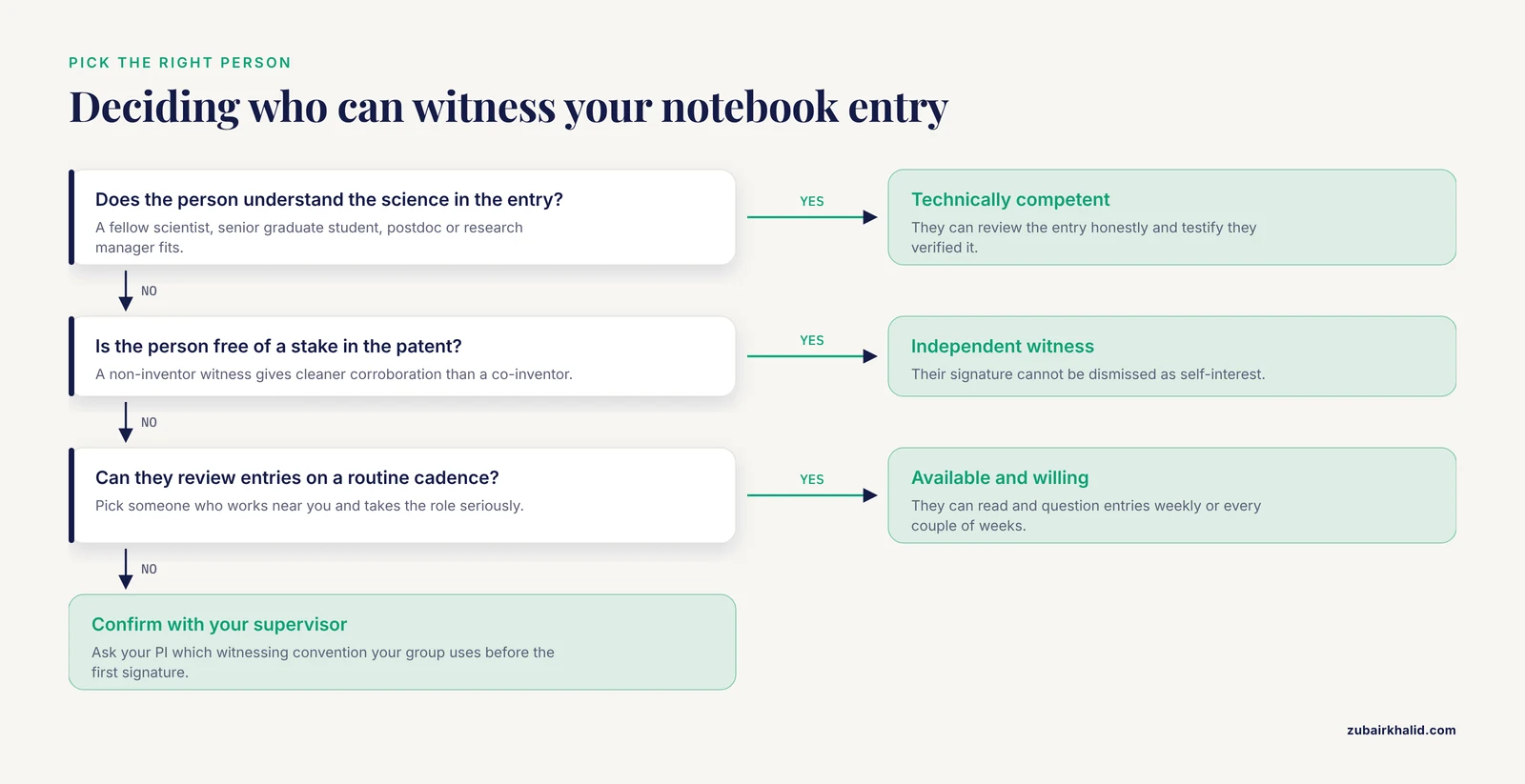
Not everyone on your floor is an eligible witness. Use these criteria.
- Technical competence. The witness should understand the science well enough to review the entry honestly. A fellow scientist, a senior graduate student, a postdoc, or a research manager all fit. Someone from a completely unrelated department fits poorly.
- Independence from the invention. The ideal witness is not a co-inventor and has no financial stake in the patent. A co-inventor can still witness entries, but a non-inventor witness provides cleaner corroboration because their signature cannot be dismissed as self-interest.
- Availability. Witnessing works on a routine cadence. Pick someone who works near you and can review entries regularly, not someone two buildings away who you will see twice a year.
- Willingness to ask questions. A witness who signs every page in ten seconds without reading adds no evidentiary value. Choose a person who takes the role seriously.
If you are a student or a new employee, ask your supervisor or principal investigator to recommend the witnessing convention used in your group. Many laboratories assign a standing witness for each researcher so signatures are consistent across the notebook.
Lab Notebook Witnessing for Patent: Step by Step
This is the core workflow. It assumes a paper, permanently bound notebook, and then a section below covers the electronic equivalent.
Step 1. Set up the notebook before you write anything
Use a permanently bound notebook, meaning the pages are sewn or glued in and cannot be removed without visible damage. Confirm the pages are pre-numbered or number them yourself in ink at the top outer corner of every page, starting at page 1 and continuing through the whole volume. Never remove pages, even if a page is a false start. Draw a single diagonal line through a blank or abandoned page, write "void" across it, and sign and date it.
Notebook setup checklist
  [ ] Cover labeled with your name, project code, and volume number
  [ ] Title page completed (name, department, project, volume 1, start date)
  [ ] Every page numbered in ink
  [ ] Blank pages at the end of the volume: draw a diagonal line, mark "void"
  [ ] Table of contents started on page 2
Expected result: every page in the volume is either numbered content or a signed, dated voided page. There is no such thing as a blank page in a finished notebook.
Step 2. Write each entry so a stranger could repeat the work
Every entry should record the date, the experiment title, the objective, the exact materials and their identifiers, the full method as performed, the raw data, the analysis, and your conclusion. Write in permanent ink. Correct mistakes with a single line through the error, then write the correction next to it with your initials and the date. Never erase, never use correction fluid, never write over an error.
Step 3. Use the template below for every entry
ENTRY: [sequential entry number]          DATE: 2026-11-11
PROJECT: [project code]                   PAGE: [page numbers covered]
TITLE: [short experiment title]

OBJECTIVE:
[One or two sentences. What question does this experiment answer?]

MATERIALS:
[Reagent or sample, catalog or lot number, concentration, source]
[Instrument name and any relevant settings]

METHOD:
[Full procedure as actually performed, including deviations from the plan]

RESULTS:
[Raw observations and measurements recorded directly, in ink]

ANALYSIS:
[Calculations, references to plots or files, interpretation]

CONCLUSION / NEXT STEPS:
[What the result means. What you will do next and why.]

RESEARCHER:  ________________  Date: __________
WITNESS:  Read and understood by ________________  Date: __________
Two formatting rules matter for patent purposes. Record data as you obtain it, directly into the notebook rather than onto scraps of paper to be copied later, because copied data invites questions about transcription errors. Cross-reference rather than duplicate, for example "see entry 14, page 41" when the same instrument run matters to two entries.
Step 4. Sign and date your own entry
At the end of the entry, sign in the researcher line and write the actual date. Sign every page the entry touches, ideally with a short line noting where the entry continues, for example "continued on page 47."
Step 5. Bring the notebook to your witness promptly
Timeliness is the single biggest quality factor in notebook evidence. An entry witnessed the same week is strong. An entry witnessed six months later, in the middle of a patent dispute, invites the argument that the witness signature was added for litigation. A practical convention in research groups is to have entries witnessed weekly, or at minimum every couple of weeks, in a short standing meeting.
Step 6. Let the witness read and question
Hand over the notebook and let the witness read the entry without rushing. A genuine review takes minutes for a routine entry and longer for a pivotal one. Expect questions. "Why did you use lot 4421 instead of the usual lot?" is exactly the kind of question that improves the record. If the witness finds something unclear, add a clarifying note in ink, initial and date it, and then continue.
Step 7. Have the witness sign and date
The witness signs in the witness line and writes the date on which they actually reviewed the entry. The finished entry should look like this.
ENTRY: 23                    DATE: 2026-11-11
PROJECT: ENZ-2026            PAGE: 46
TITLE: Phosphate buffer screen for lot 4421

OBJECTIVE:
Test whether phosphate lot 4421 supports the standard enzyme
[activity assay](/knowledge/diagnostics/molecular/enzyme-activity-assay) before scale-up runs next week.

MATERIALS:
Phosphate buffer, lot 4421, 50 mM, pH 7.4, internal stock
Enzyme substrate, lot 3387, 10 mM in water
Spectrophotometer, model on file, 405 nm, 25 C

METHOD:
Prepared 200 mL of 50 mM phosphate buffer from lot 4421, pH
adjusted to 7.4 at 25 C. Ran standard assay as in entry 21 with
three replicates per condition.

RESULTS:
Replicate absorbance readings at 405 nm recorded directly below,
triplicates at each of the four substrate concentrations.

ANALYSIS:
Linear range confirmed, consistent with entry 21 baseline.

CONCLUSION / NEXT STEPS:
Lot 4421 performs within the accepted range. Proceed with
scale-up run on 2026-11-13.

RESEARCHER:  R. Alvarez  Date: 2026-11-11
WITNESS:  Read and understood by J. Okafor  Date: 2026-11-12
Step 8. Maintain a witnessing log
Keep a single page near the front of each volume listing every witnessing session.
WITNESSING LOG, Volume 3
Entry no.   Pages      Witnessed by   Date
18-19       38-40      J. Okafor      2026-10-30
20-22       42-45      J. Okafor      2026-11-06
23          46         J. Okafor      2026-11-12
The log answers the question every patent attorney asks first: which entries in this volume are witnessed and which are not?
Step 9. Store the notebook safely
Keep completed volumes in a secure location with controlled access, because a lost notebook is a lost record. Many organizations photocopy or scan completed notebooks and store the copies separately. Do not let a notebook leave the lab without a documented handoff.
Step 10. Repeat the cadence
Witnessing only protects you if it happens continuously. Set a recurring calendar reminder for your witnessing session and treat it like a lab chore with a hard deadline, the same way you treat equipment maintenance.
A Note on Frequency
There is no statute that sets a witnessing interval. The governing principle is that the witness signature date should be close to the entry date, close enough that a skeptical reviewer believes the witness actually evaluated contemporaneous work. Weekly sessions are a common and defensible convention in active research groups. If a particular entry records a pivotal result, for example a result that will anchor a patent filing, get that entry witnessed immediately rather than waiting for the next scheduled session.
Electronic Lab Notebook Comparison
Paper notebooks remain valid and widely used, but many organizations have moved to electronic lab notebooks, often shortened to ELNs. A study of a worldwide biopharmaceutical research firm described how electronic lab notebooks helped that organization protect intellectual property while simultaneously reducing the paperwork burden of paper systems [1]. That combination, better IP protection with less administrative overhead, is the core argument for electronic systems in patent-sensitive research.
When you compare ELN platforms for witnessing, judge them against the same standard a paper notebook faces: can the system prove who wrote what, and when, and who reviewed it?
| Feature | Bound paper notebook | Electronic lab notebook |
|---|---|---|
| Timestamp | Handwritten dates, vulnerable to disputes | Automatic, system-generated timestamps |
| Witness workflow | In-person signature in ink | Configurable review-and-sign workflow, sometimes with a separate witness role |
| Tamper resistance | Depends on user discipline (no erasures, single-line corrections) | Audit trail records every edit, view, and signature event |
| Evidence of conception | Strong when discipline is perfect | Strong when the audit trail is complete and exportable |
| Cost and setup | Low, immediate | Requires licensing, validation, and training |
| Corroboration risk | Witness may not actually read pages | Witness review can be required before an entry is locked |
Features to evaluate in any ELN you are considering include an immutable audit trail, electronic signatures that meet the expectations of your legal and regulatory teams, a defined witness or reviewer role, the ability to lock an entry after signing, and clean data export so records can leave the system intact. Organizations that adopted ELNs found they could protect IP while reducing paperwork, which is exactly the trade-off that makes the change worthwhile at scale [1].
Electronic witnessing changes one behavioral thing. In a paper workflow, the witness physically holds the notebook and skims neighboring entries. In an electronic workflow, the witness sees the entry on a screen and must deliberately open it. Make sure your ELN workflow forces the witness to view the content and confirm it, rather than clicking an approval that requires no reading. The evidentiary value comes from the review, not from the click.
Common Mistakes and Limitations
These are the errors that most often damage a notebook as patent evidence, followed by the honest limits of what witnessing can do.
- Witness signatures backdated or batch-signed. A witness who signs ten pages and writes a single date, or signs pages dated months earlier, creates exactly the appearance of after-the-fact fabrication that witnessing is supposed to prevent. Every signature gets the date on which it was made.
- A witness who did not read the entry. Signing without reading is worse than not signing, because it misrepresents what happened. If your witness signs in under a minute for a complex entry, they probably did not read it.
- Loose-leaf pages, sticky notes, and removable pages. Anything that can be inserted or removed without visible damage is weak evidence. Use permanently bound volumes, or a system that controls page insertion.
- Erased or overwritten errors. Correction fluid, erasure, and overwriting destroy credibility across the entire notebook, not just the page. Use single-line cross-outs with initials and dates.
- Data copied into the notebook later. Raw readings belong in the notebook as they are collected. A "clean copy" made days later raises the question of what the original said.
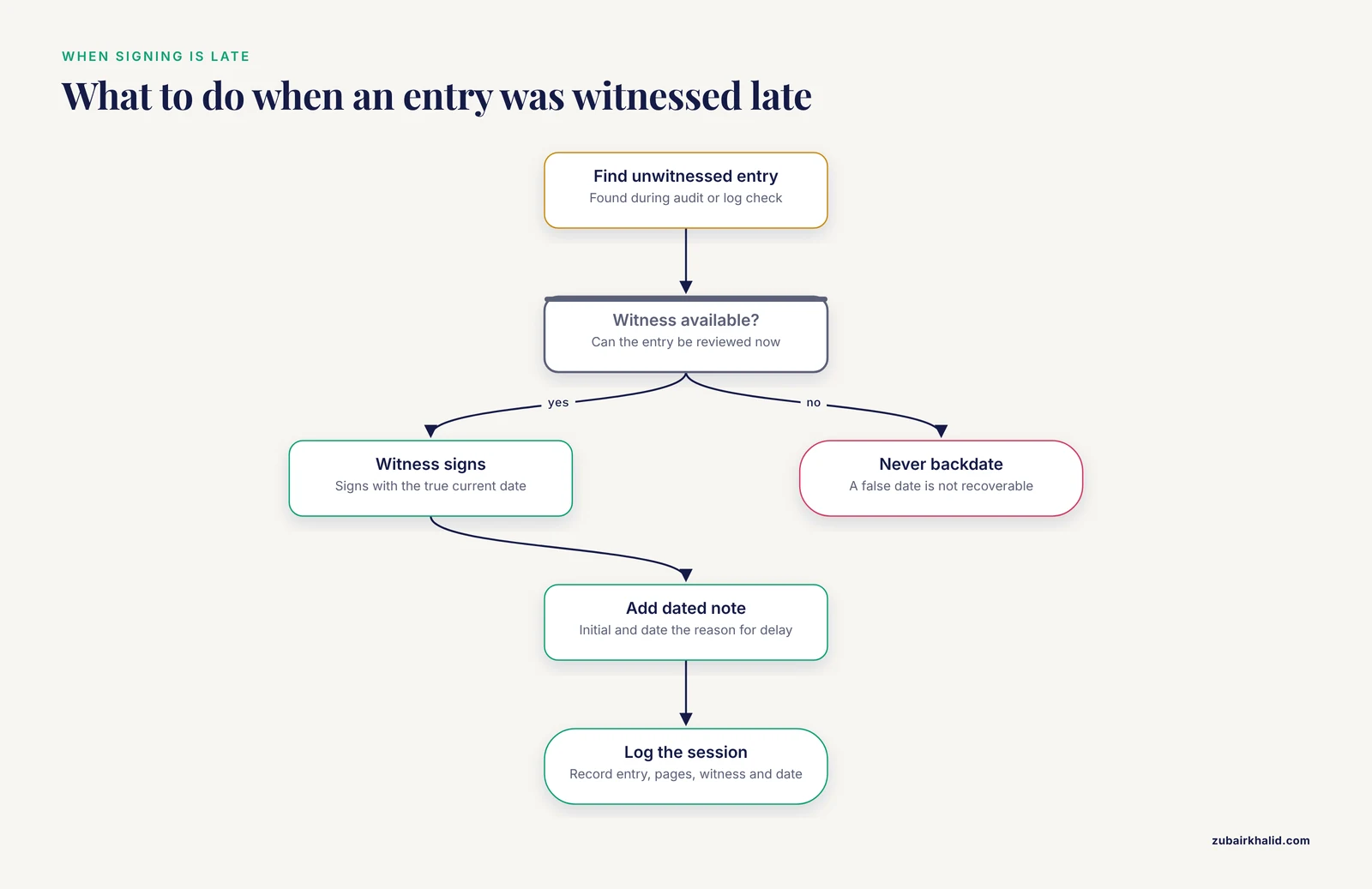
- Gaps between the entry date and the witness date with no explanation. Long delays are sometimes unavoidable, for example when a witness goes on leave. If that happens, note the reason on the witnessing line when the signature finally lands.
- Choosing a witness with no relevant background. A signature from someone who cannot understand the entry provides little corroboration. Choose a technically competent colleague.
- Treating the notebook as a legal document instead of a scientific one. The best patent notebooks are simply excellent scientific records. Write entries for the reader who will repeat your experiment in five years, and the patent value follows.
- Assuming witnessing settles inventorship. Witnessing corroborates records. It does not determine who is an inventor, which depends on the contributions each person made to the conception of the invention. Inventorship questions belong with a patent attorney or your technology transfer office.
One limitation deserves a direct statement. This article is educational guidance on research practice, not legal advice. If you believe you have a patentable invention, involve a patent attorney or your institution's technology transfer office before publishing, presenting, or disclosing the work, because public disclosure can start deadlines that affect your patent rights.
How to Check That Your Notebook Is Done Right
Run this audit on each volume before you file it away.
- Open to a random entry. Does it contain a date, objective, materials with identifiers, method, raw data, and a conclusion?
- Are all errors single-line cross-outs with initials, with no erasures anywhere in the volume?
- Is every content page signed by the researcher?
- Is every content page witnessed, with a witness signature date on or near the entry date?
- Does the witnessing log in the front of the volume match the signatures in the body?
- Are all leftover blank pages voided, signed, and dated?
If you answer no to any question, fix it now, in ink, with dated and initialed notes explaining the correction. A correction made honestly and documented contemporaneously is far better than a silent gap.
Next Steps
If your group works on paper, schedule your first recurring witnessing session this week and distribute the template above. If your organization is evaluating electronic systems, use the comparison table to build your evaluation criteria and confirm that the witness workflow requires actual review before an entry is locked. Either way, agree on the convention with your supervisor and your witness before the first signature, so everyone signs the same way for the life of the project. When a potentially patentable result appears, notify your technology transfer office promptly and get the pivotal entry witnessed the same day.
Frequently Asked Questions
Who can witness a lab notebook entry?
Any technically competent colleague who reads, understands, and can vouch for the entry, and who ideally is not a co-inventor on the resulting patent. The witness must sign and date on the day they actually review the entry.
Can a co-inventor witness my lab notebook?
Yes, a co-inventor can sign as a witness, and the signature has some value. A witness with no stake in the invention provides stronger corroboration, so use a non-inventor witness when one is available.
How often should lab notebook entries be witnessed?
There is no fixed legal interval, but the witness date should be close to the entry date. Weekly witnessing sessions are a common convention, and pivotal entries should be witnessed the same day they are written.
Does an unwitnessed notebook entry count as evidence?
An unwitnessed entry can still serve as a record of your work and may have some evidentiary value, but it is much weaker because no second person corroborates it. Witnessing is what makes a notebook strong enough to rely on in a patent dispute.
Do electronic lab notebooks hold up as patent evidence?
Yes, when the system provides an audit trail, automatic timestamps, electronic signatures, and a defined witness review workflow. Large biopharmaceutical organizations have adopted ELNs specifically to protect intellectual property while reducing paperwork, and their systems are built around those controls.
What should I do if I forgot to get pages witnessed?
Get the entries witnessed as soon as possible, have the witness sign with the true current date, and add a dated, initialed note explaining the delay. Do not backdate, because an honest late signature is recoverable and a false date is not.
Should I use correction fluid on a lab notebook mistake?
Never. Draw a single line through the error, write the correction next to it, and add your initials and the date. Corrections must remain readable because they are part of the record.
Do lab notebooks need to be notarized?
No. Notarization is not part of standard laboratory record keeping and does not substitute for a technically competent witness who read and understood the entry. A dated witness signature from a qualified colleague is the accepted practice.